PUBLISHER: Mordor Intelligence | PRODUCT CODE: 2187777

PUBLISHER: Mordor Intelligence | PRODUCT CODE: 2187777
North America Insecticide - Market Share Analysis, Industry Trends & Statistics, Growth Forecasts (2027 - 2032)
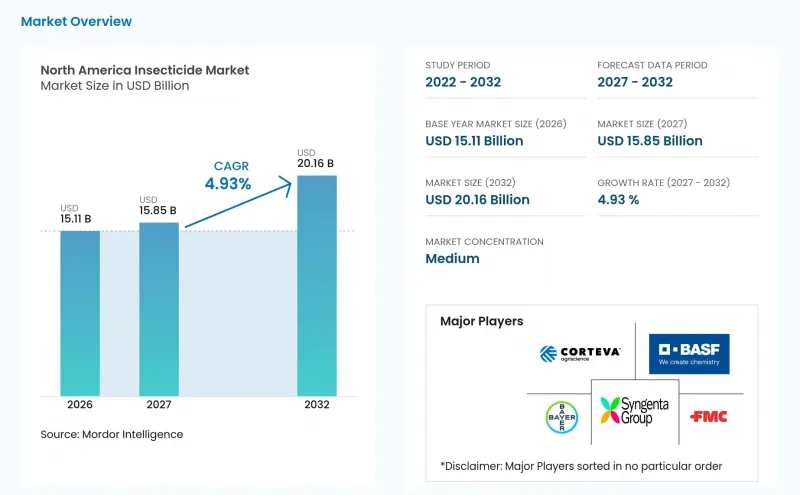
According to Mordor Intelligence, the North America insecticide market size was valued at USD 15.11 billion in 2026 and is forecast to grow from USD 15.85 billion in 2027 to USD 20.16 billion by 2032, at a CAGR of 4.93% from 2027 to 2032.
North America Insecticide Market Trends and Insights
Corn Rootworm and Soybean Aphid Resistance Driving Insecticide Rotation
Declining effectiveness of Bacillus thuringiensis (Bt) traits and increasing insecticide resistance in key corn and soybean pests are strengthening the need for diversified insect pest management programs across North America. A September 2025 study published in Proceedings of the National Academy of Sciences associated western corn rootworm resistance to Bt proteins with increased feeding injury in corn hybrids combining multiple Bt traits and RNA interference technology. According to Iowa State University Extension and Outreach in January 2026, corn rootworm management tactics were used at 100 of 170 monitored Iowa sites in 2025, with combinations of Bt hybrids and foliar or soil-applied insecticides reported at several sites. Separately, a 2026 study in the Journal of Economic Entomology detected pyrethroid-resistance-associated mutations in 99.9% of 1,955 field-collected soybean aphids from Iowa. These resistance challenges are increasing the importance of scouting, treatment-threshold assessments, and rotating insecticides with different modes of action where treatments are warranted.
Seed Treatment Adoption for Early-Season Protection
Seed treatment supports demand for insecticides in North America by enabling targeted protection against early-season insect pests in major field crops, including soybeans and corn. By applying active ingredients directly to seeds before planting, growers can protect emerging seedlings and reduce reliance on some broadcast or foliar applications when pest pressure and crop conditions permit. According to the American Soybean Association and United Soybean Board in October 2024, a survey of 491 soybean farmers across the 17 largest soybean-producing states found that 66% of surveyed farmers reported using insecticides as seed treatments, while 90% of soybean acreage represented in the survey was planted with treated seeds. This widespread adoption provides an established channel for insecticide use at planting, particularly where early-season pest risks justify treatment. However, treatment benefits vary by pest pressure and location, and regulatory requirements differ by active ingredient and jurisdiction. These factors support demand for seed-applied insecticides as part of targeted, integrated pest management programs.
Organic Production and Biological Substitution
The expansion of organic farming and demand for produce that meets specific residue standards can constrain the addressable market for conventional synthetic insecticides in selected North American crop segments. According to the United States Department of Agriculture's Economic Research Service, 7.2 million acres in the United States were certified organic in 2025, representing a substantial production base subject to organic certification requirements. Under United States Department of Agriculture organic standards, synthetic pesticides are prohibited unless specifically permitted under the National List, encouraging organic growers to rely on preventive, cultural, mechanical, and eligible biological pest-management practices. This limits the use of many conventional insecticides on certified organic acreage and supports demand for permitted alternatives. In addition, residue specifications imposed by some buyers may influence insecticide selection in high-value crops such as strawberries and lettuce. Consequently, organic production and crop-specific residue requirements may constrain conventional insecticide demand in selected segments of the North America insecticide market.
Other drivers and restraints analyzed in the detailed report include:
- Precision Application and Digital Agronomy Improving Insecticide Efficiency
- Export-Crop Residue Compliance Shaping Insecticide Selection
- Cross-Border Registration and Maximum-Residue-Limit Fragmentation
For complete list of drivers and restraints, kindly check the Table Of Contents.
Segment Analysis
Foliar application accounted for 56.4% of the North America insecticide market share in 2026, supported by established spraying infrastructure and its versatility across commodity and specialty crops. Diamides, pyrethroids, and organophosphates remain relevant to foliar pest-management programs, with product selection and application timing guided by pest scouting, resistance status, and label requirements. Chemigation and soil treatment serve specific production systems, particularly where irrigation infrastructure or soil-dwelling pests influence treatment decisions, while fumigation remains concentrated in selected specialty-crop and structural applications. Foliar spraying is forecast to retain a substantial market position because it enables growers to respond to pest pressure during the growing season and apply treatments when and where they are needed.
Seed treatment is forecast to be the fastest-growing application mode, with a forecast CAGR of 5.5% from 2027 to 2032. Applying insecticides directly to seeds provides early-season protection against selected seed- and seedling-attacking pests, reducing the need for whole-canopy treatment where pest conditions and product efficacy support this approach. Adoption is supported by the convenience of purchasing treated seed and the potential to target protection at planting; however, effectiveness depends on pest risk, crop type, and the active ingredient used. Seed treatment is therefore expanding as a complementary application mode rather than necessarily replacing foliar insecticides across North American crop systems.
Complete Report Scope:
- By Application Mode
- Chemigation
- Foliar
- Fumigation
- Seed Treatment
- Soil Treatment
- By Crop Type
- Commercial Crops
- Fruits and Vegetables
- Grains and Cereals
- Pulses and Oilseeds
- Turf and Ornamental
- By Geography
- Canada
- Mexico
- United States
- Rest of North America
List of Companies Covered in this Report:
- Albaugh, LLC (Albaugh Family Holdings, Inc.)
- AMVAC Chemical Corporation (American Vanguard Corporation)
- Atticus, LLC
- BASF Agricultural Solutions US LLC (BASF SE)
- Bayer CropScience LP (Bayer Aktiengesellschaft)
- Corteva Agriscience, LLC (Corteva, Inc.)
- FMC Corporation
- Gowan Company, LLC (Gowan Group)
- HELM AGRO US, INC. (HELM AG)
- Nufarm Americas, Inc. (Nufarm Limited)
- Syngenta Crop Protection, LLC (Syngenta Group Co., Ltd.)
- UPL NA Inc. (UPL Limited)
- Valent U.S.A. LLC
Additional Benefits:
- The market estimate (ME) sheet in Excel format
- 3 months of analyst support
TABLE OF CONTENTS
1 INTRODUCTION
- 1.1 Study Assumptions and Market Definition
- 1.2 Scope of the Study
- 1.3 Research Methodology
2 REPORT OFFERS
3 EXECUTIVE SUMMARY AND KEY FINDINGS
4 KEY INDUSTRY TRENDS
- 4.1 Consumption of Pesticide Per Hectare
- 4.2 Pricing Analysis for Active Ingredients
- 4.3 Regulatory Framework
- 4.3.1 Canada
- 4.3.2 Mexico
- 4.3.3 United States
- 4.4 Value Chain and Distribution Channel Analysis
- 4.5 Market Drivers
- 4.5.1 Corn Rootworm and Soybean Aphid Resistance Driving Insecticide Rotation
- 4.5.2 Seed Treatment Adoption for Early-Season Protection
- 4.5.3 Precision Application and Digital Agronomy Improving Insecticide Efficiency
- 4.5.4 Expansion of High-Value Specialty Crops and Greenhouse Production
- 4.5.5 State-Level Pollinator Rules Shifting Demand Toward Lower-Risk Formulations
- 4.5.6 Export-Crop Residue Compliance Shaping Insecticide Selection
- 4.6 Market Restraints
- 4.6.1 Environmental Protection Agency (EPA) and Pest Management Regulatory Agency (PMRA) Re-Registration Costs and Review Timelines
- 4.6.2 Organic Production and Biological Substitution
- 4.6.3 California and Provincial Use Restrictions Narrowing Available Product Windows
- 4.6.4 Cross-Border Registration and Maximum-Residue-Limit Fragmentation
5 MARKET SIZE AND GROWTH FORECASTS (VALUE AND VOLUME)
- 5.1 By Application Mode
- 5.1.1 Chemigation
- 5.1.2 Foliar
- 5.1.3 Fumigation
- 5.1.4 Seed Treatment
- 5.1.5 Soil Treatment
- 5.2 By Crop Type
- 5.2.1 Commercial Crops
- 5.2.2 Fruits and Vegetables
- 5.2.3 Grains and Cereals
- 5.2.4 Pulses and Oilseeds
- 5.2.5 Turf and Ornamental
- 5.3 By Geography
- 5.3.1 Canada
- 5.3.2 Mexico
- 5.3.3 United States
- 5.3.4 Rest of North America
6 COMPETITIVE LANDSCAPE
- 6.1 Key Strategic Moves
- 6.2 Market Share Analysis
- 6.3 Company Landscape
- 6.4 Company Profiles (includes Global level Overview, Market level overview, Core Business Segments, Financials, Headcount, Key Information, Market Rank, Market Share, Products and Services, and analysis of Recent Developments)
- 6.4.1 Albaugh, LLC (Albaugh Family Holdings, Inc.)
- 6.4.2 AMVAC Chemical Corporation (American Vanguard Corporation)
- 6.4.3 Atticus, LLC
- 6.4.4 BASF Agricultural Solutions US LLC (BASF SE)
- 6.4.5 Bayer CropScience LP (Bayer Aktiengesellschaft)
- 6.4.6 Corteva Agriscience, LLC (Corteva, Inc.)
- 6.4.7 FMC Corporation
- 6.4.8 Gowan Company, LLC (Gowan Group)
- 6.4.9 HELM AGRO US, INC. (HELM AG)
- 6.4.10 Nufarm Americas, Inc. (Nufarm Limited)
- 6.4.11 Syngenta Crop Protection, LLC (Syngenta Group Co., Ltd.)
- 6.4.12 UPL NA Inc. (UPL Limited)
- 6.4.13 Valent U.S.A. LLC
7 KEY STRATEGIC QUESTIONS FOR CROP PROTECTION CHEMICALS CEOS

