PUBLISHER: Mordor Intelligence | PRODUCT CODE: 2187798

PUBLISHER: Mordor Intelligence | PRODUCT CODE: 2187798
United States Live Music - Market Share Analysis, Industry Trends & Statistics, Growth Forecasts (2027 - 2032)
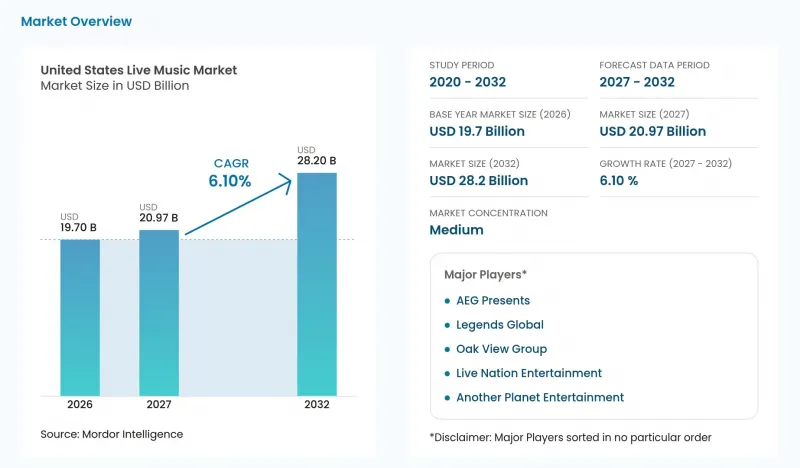
According to Mordor Intelligence, the United States live music market size was valued at USD 19.7 billion in 2026 and estimated to grow from USD 20.97 billion in 2027 to reach USD 28.2 billion by 2032, at a CAGR of 6.1% during the forecast period (2027-2032).
This report is segmented by Application (Concerts, Festivals, and more), Revenue Stream (Tickets, Sponsorship, and more), Age Group (Adults, Teenagers, and more), Venue Size (Medium, Large, and more), and Geography (South, West, and more). The market forecasts are provided in terms of value (USD), based on availability.
United States Live Music Market Trends and Insights
Pent-up post-pandemic demand surge
Pent-up demand can support live-music spending when audience interest turns into purchases for performances that promoters can deliver. Live Nation reported that average grosses at its US stadium shows grew by double digits in 2025. The company said those higher grosses helped artists offset rising production costs. Stronger receipts per show can sustain an expensive booking without requiring the promoter to add performances immediately. The commercial choice is whether demand supports a more valuable engagement or enough purchases to justify another date. Higher gross per stadium show tells promoters that audiences are paying more per event, which supports committing to costly stadium bookings.
Rise of dynamic ticket-pricing algorithms
Demand-responsive pricing can change the commercial return from a concert without requiring the venue to add seats. For a promoter considering this approach, the relevant decision is how much demand to monetize at each price level. Adjusting the offer as tickets sell can direct higher prices toward the portion of demand willing to bear them. Retaining lower-priced admissions can also preserve access for buyers whose willingness to pay falls below premium levels. A pricing rule can be bounded by a minimum admission offer and an upper premium tier, making the chosen limits part of the promoter's strategy. Revenue across the full admission mix determines the commercial return, so an isolated premium ticket price cannot describe what the pricing approach earns for the performance.
Ticket-price inflation backlash & regulatory scrutiny
Ticket sellers face a compliance constraint in the way fees are characterized to buyers, making description accuracy part of the sale. Since May 12, 2025, the Federal Trade Commission's Rule on Unfair or Deceptive Fees has required advertised live-event ticket prices to disclose totals including most mandatory charges and has prohibited fee misrepresentations. Sellers retain freedom to choose fee levels, while commercial descriptions need to match the charges actually applied. Ticketmaster, Live Nation Entertainment's ticketing subsidiary, launched upfront US prices including all fees before taxes on May 12, 2025. When fees change, sellers must update advertised totals and descriptions consistently across ticket listings. Each fee change therefore sends sellers back through every listing, which adds recurring compliance work.
Other drivers and restraints analyzed in the detailed report include:
- Corporate sponsorship appetite for experiential marketing
- Growth in hybrid/streamed add-on revenue
- Talent-booking cost escalation
For complete list of drivers and restraints, kindly check the Table Of Contents.
Segment Analysis
Concerts accounted for a 44.62% share of the United States live music market size in 2026. Zach Bryan performed for 112,408 fans at Michigan Stadium in Ann Arbor, Michigan, on September 27, 2025, in a concert promoted by AEG Presents. It was Michigan Stadium's first concert. That single show at a venue with no concert history demonstrates the audience scale a stadium concert can aggregate for its promoter.
Festivals are the fastest-growing segment, with a forecast CAGR of 8.78% during 2027-2032. Danny Wimmer Presents reported nearly 1.1 million attendees across its 2026 festivals, including 180,000 at Aftershock in Sacramento, California, over October 1-4. Aggregating performances across several days can make a festival a broader programming proposition, with the lineup's combined appeal supporting the admission offer. Corporate events provide a separate use case, as Salesforce's Dreamfest benefit concert featured Metallica and Benson Boone at Dreamforce in 2025 to support UCSF Benioff Children's Hospitals. That application links live music to a conference program, expanding the organizer's performance brief beyond an independent concert booking.
Tickets represented a 70.87% United States live music market share in 2026. Chris Brown's Live Nation-produced Breezy Bowl XX sold 107,256 tickets and grossed USD 15 million across 2 nights at MetLife Stadium in East Rutherford, New Jersey, on August 12 and 13, 2025. The engagement links a substantial admission count with measurable box-office value, showing how a concentrated paying audience can underpin a major production. Event-level ticket receipts fund such a production, so the commitment to it rests on what an artist-led engagement can generate.
Sponsorship is the fastest-growing segment, with a forecast CAGR of 9.6% during 2027-2032. Live Nation Entertainment's worldwide Sponsorship & Advertising revenue reached USD 1.33 billion in 2025, up 11% from 2024, partly reflecting greater US sponsorship activity. This stream makes revenue expansion depend on the value of sponsor programs as well as the number of paid admissions. Merchandising adds a separate event-based sales channel, with Live Nation earning revenue from artist merchandise as a promoter and venue operator. A promoter adding sponsorship and merchandise needs both brand-facing rights agreements and event-level retail execution, since the 2 streams earn revenue from different buyers.
Complete Report Scope:
- By Application
- Concerts
- Festivals
- Theater
- Corporate Events
- Weddings
- By Revenue Stream
- Tickets
- Sponsorship
- Merchandising
- By Age Group
- Children
- Teenagers
- Adults
- Seniors
- By Venue Size
- Small (less than 1,000 seats)
- Medium (1,001-10,000 seats)
- Large (greater than 10,000 seats)
- By Geography
- Northeast
- Midwest
- South
- West
List of Companies Covered in this Report:
- Live Nation Entertainment
- AEG Presents
- Legends Global
- Oak View Group
- Another Planet Entertainment
- Jam Productions
- The Bowery Presents
- C3 Presents
- Nederlander Concerts
- Feld Entertainment
- OVG360
- MSG Entertainment
- Red Mountain Entertainment
- Opry Entertainment Group
- Paradigm Talent Agency
- Wasserman Music
- United Talent Agency
- William Morris Endeavor
- Emporium Presents
- Paciolan
Additional Benefits:
- The market estimate (ME) sheet in Excel format
- 3 months of analyst support
TABLE OF CONTENTS
1 INTRODUCTION
- 1.1 Study Assumptions and Market Definition
- 1.2 Scope of the Study
2 RESEARCH METHODOLOGY
3 EXECUTIVE SUMMARY
4 MARKET LANDSCAPE
- 4.1 Market Overview
- 4.2 Market Drivers
- 4.2.1 Pent-up post-pandemic demand surge
- 4.2.2 Rise of dynamic ticket-pricing algorithms
- 4.2.3 Corporate sponsorship appetite for experiential marketing
- 4.2.4 Growth in hybrid/streamed add-on revenue
- 4.2.5 Emergence of NFT-based fan engagement models
- 4.2.6 Venue ESG retrofits unlocking new city permits
- 4.3 Market Restraints
- 4.3.1 Ticket-price inflation backlash & regulatory scrutiny
- 4.3.2 Talent-booking cost escalation
- 4.3.3 Insurance premiums tied to climate-related event risks
- 4.3.4 Local noise-ordinance tightening in secondary markets
- 4.4 Industry Value Chain Analysis
- 4.5 Regulatory Landscape
- 4.6 Technological Outlook
- 4.7 Porter's Five Forces Analysis
- 4.7.1 Threat of New Entrants
- 4.7.2 Bargaining Power of Suppliers
- 4.7.3 Bargaining Power of Buyers
- 4.7.4 Threat of Substitutes
- 4.7.5 Competitive Rivalry
5 MARKET SIZE AND GROWTH FORECASTS (VALUE)
- 5.1 By Application
- 5.1.1 Concerts
- 5.1.2 Festivals
- 5.1.3 Theater
- 5.1.4 Corporate Events
- 5.1.5 Weddings
- 5.2 By Revenue Stream
- 5.2.1 Tickets
- 5.2.2 Sponsorship
- 5.2.3 Merchandising
- 5.3 By Age Group
- 5.3.1 Children
- 5.3.2 Teenagers
- 5.3.3 Adults
- 5.3.4 Seniors
- 5.4 By Venue Size
- 5.4.1 Small (less than 1,000 seats)
- 5.4.2 Medium (1,001-10,000 seats)
- 5.4.3 Large (greater than 10,000 seats)
- 5.5 By Geography
- 5.5.1 Northeast
- 5.5.2 Midwest
- 5.5.3 South
- 5.5.4 West
6 COMPETITIVE LANDSCAPE
- 6.1 Market Concentration
- 6.2 Strategic Moves
- 6.3 Market Share Analysis
- 6.4 Company Profiles (includes Global level Overview, Market level overview, Core Segments, Financials as available, Strategic Information, Market Rank/Share for key companies, Products and Services, and Recent Developments)
- 6.4.1 Live Nation Entertainment
- 6.4.2 AEG Presents
- 6.4.3 Legends Global
- 6.4.4 Oak View Group
- 6.4.5 Another Planet Entertainment
- 6.4.6 Jam Productions
- 6.4.7 The Bowery Presents
- 6.4.8 C3 Presents
- 6.4.9 Nederlander Concerts
- 6.4.10 Feld Entertainment
- 6.4.11 OVG360
- 6.4.12 MSG Entertainment
- 6.4.13 Red Mountain Entertainment
- 6.4.14 Opry Entertainment Group
- 6.4.15 Paradigm Talent Agency
- 6.4.16 Wasserman Music
- 6.4.17 United Talent Agency
- 6.4.18 William Morris Endeavor
- 6.4.19 Emporium Presents
- 6.4.20 Paciolan
7 MARKET OPPORTUNITIES AND FUTURE OUTLOOK
- 7.1 White-Space and Unmet-Need Assessment

