PUBLISHER: Mordor Intelligence | PRODUCT CODE: 2187799

PUBLISHER: Mordor Intelligence | PRODUCT CODE: 2187799
Software As A Service - Market Share Analysis, Industry Trends & Statistics, Growth Forecasts (2027 - 2032)
According to Mordor Intelligence, the software as a service market size was valued at USD 435.4 billion in 2026 and estimated to grow from USD 511.8 billion in 2027 to reach USD 1.13 trillion by 2032, at a CAGR of 17.1% during the forecast period (2027-2032).
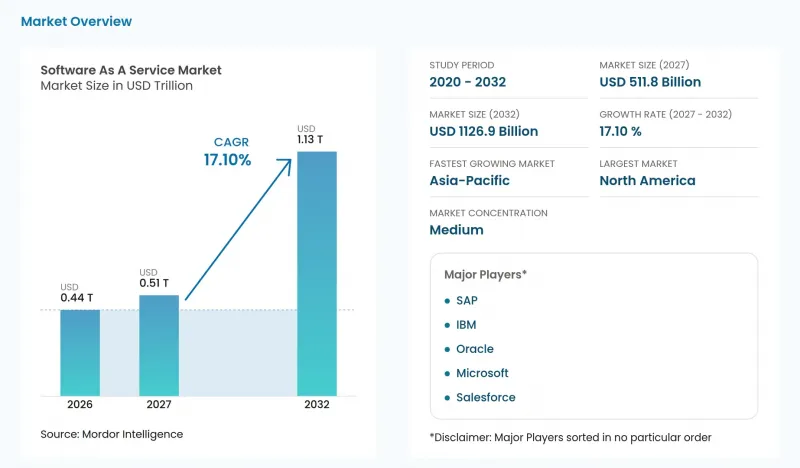
This report is segmented by Deployment (Public Cloud and more), Enterprise Size (Large Enterprises and more), Application Type (Customer Relationship Management and more), Pricing Model (Subscription-Based and more), End-User Vertical (IT and Telecom and more), and Geography (North America and more). The market forecasts are provided in terms of value (USD), based on availability.
Global Software As A Service Market Trends and Insights
Proliferation of cloud-native architectures
Shared security enforcement can make a distributed SaaS platform easier to extend without rebuilding controls for every service. Salesforce said in November 2025 that its Hyperforce perimeter processed more than 20 trillion transactions annually across 17 countries and 25 regions. The company implemented a service mesh with sidecar proxies, placing security enforcement in the platform instead of individual services. Its design authenticated, authorized and encrypted every connection by default, with mutual TLS for each service-to-service call. In CNCF's surveys, end-user organizations reporting cloud-native techniques for much or nearly all development and deployment totaled 54% in 2023, 60% in 2024 and 59% in 2025. That installed architectural base creates an opening for additional SaaS applications supported by shared platform controls rather than separately secured services.
Rapid SME digitalization post-COVID
Smaller employers' digitalization is extending into paid cloud ERP, creating an application-specific opening for business-software suppliers. From 2023 to 2025, the share of EU enterprises with 10 to 49 people employed using ERP software as a paid cloud service rose from 9.82% to 13.36%. For EU enterprises with 50 to 249 people employed, the corresponding share rose from 19.37% to 26.14% over 2023-2025. The increase in both size classes shows adoption extending across different employer scales. The higher use rate among medium-sized employers supports a different commercial proposition from the lower-penetration small-employer cohort. The lower-use small-employer cohort leaves more room for first adoption, while medium-sized firms provide a more established cloud ERP customer base.
Data-sovereignty and compliance barriers
SaaS providers serving covered EU financial entities face contractual obligations concerning service and data-processing locations. From January 17, 2025, ICT-service contracts for covered EU financial entities must identify service and data-processing locations, including storage. Those contracts must require the provider to give advance notice if it envisages changing the locations. The location provision covers the regions or countries where contracted or subcontracted functions and ICT services are provided. Coordinating delivery changes across these customer commitments can add compliance work whenever a provider reorganizes its service footprint. Subcontracting does not remove that customer-notification duty, leaving the application supplier with compliance work when the proposed location change originates upstream.
Other drivers and restraints analyzed in the detailed report include:
- Lower upfront costs vs. on-prem licensing
- Generative-AI-enabled revenue extensions
- Vendor lock-in and switching costs
For complete list of drivers and restraints, kindly check the Table Of Contents.
Segment Analysis
Public cloud accounted for an 89.17% share of the software as a service market size in 2026, making it the largest segment. In Q1 2026, Tyler Technologies said almost all its new-client SaaS contracts were deployed in public cloud. That contracting pattern places deployment choices at the new-account stage, where a supplier can align its commercial offer with a repeatable delivery approach. Concentrating new contracts around this model can allow specialized public-cloud deployment expertise to support successive customers, creating an operating basis for further application adoption.
Hybrid cloud is the fastest-growing segment, with a projected 21.3% CAGR during 2027-2032. Parallels' 2026 survey found that 33% of IT-professional respondents reported organizational workloads on premises and in one cloud, its definition of hybrid cloud. Respondents covered the United States, the United Kingdom, Germany and other countries. That mixed workload environment gives SaaS suppliers an application opportunity inside organizations that retain local resources, with deployment choices relevant to how their offers fit existing operations. Coexistence gives suppliers access to cloud-software buyers who retain on-premises workloads, without making a complete workload migration a condition of adoption.
Large enterprises represented a 57.46% software as a service market share in 2026, making them the largest segment. In August 2026, Workday said more than 65% of Fortune 500 companies used its enterprise platform for HR, finance and IT. Serving functions across these areas gives a platform provider several application entry points within one corporate customer, which can make the account more valuable than its place in a customer-count total.
Small and medium-sized enterprises (SMEs) form the fastest-growing segment, with a projected 18.8% CAGR during 2027-2032. In 2025, 52% of EU SMEs with 10 to 249 people employed bought cloud computing services, covering software, computing power and storage. These services give companies access to third-party computing resources in place of building or expanding their own IT infrastructure. In this cohort, the commercial opportunity can include adding applications to an existing paid-cloud relationship as well as serving smaller employers moving away from self-provisioned infrastructure.
Complete Report Scope:
- By Deployment
- Public Cloud
- Private Cloud
- Hybrid Cloud
- By Enterprise Size
- Small and Medium-sized Enterprises (SMEs)
- Large Enterprises
- By Application Type
- Customer Relationship Management (CRM)
- Enterprise Resource Planning (ERP)
- Human Capital Management (HCM/HRM)
- Collaboration and Productivity
- Business Intelligence and Analytics
- Security and Compliance
- Other Applications
- By Pricing Model
- Subscription-Based
- Usage-Based / Pay-As-You-Go
- Freemium and Tiered
- By End-User Vertical
- IT and Telecom
- Banking, Financial Services and Insurance (BFSI)
- Retail and E-Commerce
- Healthcare and Life Sciences
- Manufacturing
- Other Verticals
- By Geography
- North America
- United States
- Canada
- Mexico
- South America
- Brazil
- Argentina
- Colombia
- Rest of South America
- Europe
- United Kingdom
- Germany
- France
- Italy
- Spain
- Rest of Europe
- Asia-Pacific
- China
- Japan
- India
- South Korea
- Australia and New Zealand
- Rest of Asia-Pacific
- Middle East
- Israel
- Saudi Arabia
- United Arab Emirates
- Turkey
- Rest of Middle East
- Africa
- South Africa
- Egypt
- Nigeria
- Rest of Africa
- North America
Geography Analysis
North America held a 42.48% share of the software as a service market size in 2026. Public Services and Procurement Canada awarded Cornerstone on Demand a Saba Cloud SaaS contract for the Department of National Defence's Defence Learning Network. Delivery was specified for the National Capital Region over 24 months, from July 27, 2025, to July 26, 2027. The purchase shows how a defense department can buy SaaS for a specialized learning function, creating a supplier opportunity at the program level.
Asia-Pacific is the fastest-growing region, with a projected 18.4% CAGR during 2027-2032. In Australia, cloud-accounting software supplier Xero reported 20% operating-revenue growth in FY26, which ended March 31, 2026, driven by a growing customer base, greater invoice-payment activity and price changes. Constant-currency growth was 19%, while a weaker NZD against AUD had a small favorable effect on the reported result. Xero's operating mix included recurring monthly software fees and related-services revenue, so customer growth and payment activity offer separate ways to expand an accounting relationship.
In Brazil, SaaS was the most used revenue model among startups mapped by Sebrae, a private nonprofit supporting small businesses, at 39.1% in data collected through December 2025. In Europe, EU enterprises with at least 10 people employed in surveyed activities used paid cloud ERP at 30.1% and CRM at 27.9% in 2025, establishing a buyer base for application suppliers. In the Middle East, Cerillion announced an Omantel business and operations support transformation in April 2026, with delivery planned through Cerillion Cloud hosted in Oman Data Park. In Africa, South Africa's National Development Agency awarded Just Dynamics Software Solutions 36 months of maintenance, support and integration optimization for its Microsoft Dynamics 365 Business Central SaaS environment in December 2025. Oman's planned hosted deployment and South Africa's support award around an existing SaaS environment favor different local delivery capabilities.
- Microsoft
- Salesforce
- Oracle
- SAP
- IBM
- ServiceNow
- Atlassian
- Intuit
- Adobe
- Google (Alphabet)
- Workday
- Zoom Communications
- Dropbox
- HubSpot
- Shopify
- Zendesk
- Snowflake
- Alteryx
- ServiceTitan
- BambooHR
Additional Benefits:
- The market estimate (ME) sheet in Excel format
- 3 months of analyst support
TABLE OF CONTENTS
1 INTRODUCTION
- 1.1 Study Assumptions and Market Definition
- 1.2 Scope of the Study
2 RESEARCH METHODOLOGY
3 EXECUTIVE SUMMARY
4 MARKET LANDSCAPE
- 4.1 Market Overview
- 4.2 Market Drivers
- 4.2.1 Proliferation of cloud-native architectures
- 4.2.2 Rapid SME digitalization post-COVID
- 4.2.3 Lower upfront costs vs. on-prem licensing
- 4.2.4 Generative-AI-enabled revenue extensions
- 4.2.5 Edge-delivered ultra-low-latency SaaS
- 4.2.6 Carbon-accounting compliance demand
- 4.3 Market Restraints
- 4.3.1 Data-sovereignty and compliance barriers
- 4.3.2 Vendor lock-in and switching costs
- 4.3.3 FinOps scrutiny curbing SaaS sprawl
- 4.3.4 Green-cloud mandates raising costs
- 4.4 Industry Value Chain Analysis
- 4.5 Regulatory Landscape
- 4.6 Technological Outlook
- 4.7 Porter's Five Forces Analysis
- 4.7.1 Threat of New Entrants
- 4.7.2 Bargaining Power of Suppliers
- 4.7.3 Bargaining Power of Buyers
- 4.7.4 Threat of Substitutes
- 4.7.5 Competitive Rivalry
- 4.8 Investment Analysis
- 4.9 Assessment of Macroeconomic Impact
5 MARKET SIZE AND GROWTH FORECASTS (VALUE)
- 5.1 By Deployment
- 5.1.1 Public Cloud
- 5.1.2 Private Cloud
- 5.1.3 Hybrid Cloud
- 5.2 By Enterprise Size
- 5.2.1 Small and Medium-sized Enterprises (SMEs)
- 5.2.2 Large Enterprises
- 5.3 By Application Type
- 5.3.1 Customer Relationship Management (CRM)
- 5.3.2 Enterprise Resource Planning (ERP)
- 5.3.3 Human Capital Management (HCM/HRM)
- 5.3.4 Collaboration and Productivity
- 5.3.5 Business Intelligence and Analytics
- 5.3.6 Security and Compliance
- 5.3.7 Other Applications
- 5.4 By Pricing Model
- 5.4.1 Subscription-Based
- 5.4.2 Usage-Based / Pay-As-You-Go
- 5.4.3 Freemium and Tiered
- 5.5 By End-User Vertical
- 5.5.1 IT and Telecom
- 5.5.2 Banking, Financial Services and Insurance (BFSI)
- 5.5.3 Retail and E-Commerce
- 5.5.4 Healthcare and Life Sciences
- 5.5.5 Manufacturing
- 5.5.6 Other Verticals
- 5.6 By Geography
- 5.6.1 North America
- 5.6.1.1 United States
- 5.6.1.2 Canada
- 5.6.1.3 Mexico
- 5.6.2 South America
- 5.6.2.1 Brazil
- 5.6.2.2 Argentina
- 5.6.2.3 Colombia
- 5.6.2.4 Rest of South America
- 5.6.3 Europe
- 5.6.3.1 United Kingdom
- 5.6.3.2 Germany
- 5.6.3.3 France
- 5.6.3.4 Italy
- 5.6.3.5 Spain
- 5.6.3.6 Rest of Europe
- 5.6.4 Asia-Pacific
- 5.6.4.1 China
- 5.6.4.2 Japan
- 5.6.4.3 India
- 5.6.4.4 South Korea
- 5.6.4.5 Australia and New Zealand
- 5.6.4.6 Rest of Asia-Pacific
- 5.6.5 Middle East
- 5.6.5.1 Israel
- 5.6.5.2 Saudi Arabia
- 5.6.5.3 United Arab Emirates
- 5.6.5.4 Turkey
- 5.6.5.5 Rest of Middle East
- 5.6.6 Africa
- 5.6.6.1 South Africa
- 5.6.6.2 Egypt
- 5.6.6.3 Nigeria
- 5.6.6.4 Rest of Africa
- 5.6.1 North America
6 COMPETITIVE LANDSCAPE
- 6.1 Market Concentration
- 6.2 Strategic Moves
- 6.3 Market Share Analysis
- 6.4 Company Profiles (includes Global level Overview, Market level overview, Core Segments, Financials as available, Strategic Information, Market Rank/Share for key companies, Products and Services, and Recent Developments)
- 6.4.1 Microsoft
- 6.4.2 Salesforce
- 6.4.3 Oracle
- 6.4.4 SAP
- 6.4.5 IBM
- 6.4.6 ServiceNow
- 6.4.7 Atlassian
- 6.4.8 Intuit
- 6.4.9 Adobe
- 6.4.10 Google (Alphabet)
- 6.4.11 Workday
- 6.4.12 Zoom Communications
- 6.4.13 Dropbox
- 6.4.14 HubSpot
- 6.4.15 Shopify
- 6.4.16 Zendesk
- 6.4.17 Snowflake
- 6.4.18 Alteryx
- 6.4.19 ServiceTitan
- 6.4.20 BambooHR
7 MARKET OPPORTUNITIES AND FUTURE OUTLOOK
- 7.1 White-Space and Unmet-Need Assessment

