PUBLISHER: Mordor Intelligence | PRODUCT CODE: 2187803

PUBLISHER: Mordor Intelligence | PRODUCT CODE: 2187803
Corporate Events - Market Share Analysis, Industry Trends & Statistics, Growth Forecasts (2027 - 2032)
According to Mordor Intelligence, the corporate events market size is estimated at USD 369.7 billion in 2026 and is projected to be USD 418.4 billion in 2027, reaching USD 765.4 billion by 2032, growing at a CAGR of 12.84% from 2027 to 2032.
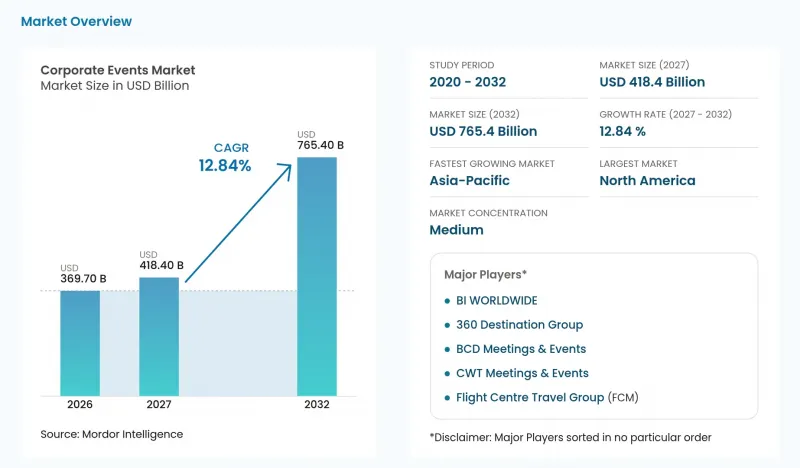
This report is segmented by Event Type (Conferences and Seminars and more), Platform (Offline Event and more), Industry (BFSI and more), Service Type (Planning and Management and more), and Geography (North America and more). The market forecasts are provided in terms of value (USD), based on availability.
Global Corporate Events Market Trends and Insights
Escalating Employer Branding Spend Among Tech and Pharma Corporations in North America
Employer-branding objectives among North American technology and pharmaceutical employers create a distinct brief for recognition events and leadership sessions. Nutanix, a North American technology company, announced its inaugural Unsung Hero Award at a June 2025 company town hall to recognize teams' contributions. Bringing recognition into a leadership program makes employee achievement part of the event's content, linking workplace identity to the gathering's purpose. For a planning provider engaged on such a program, combining recognition with leadership communication creates program-design and content work within the same assignment. An employer commissioning that content can therefore expand the brief for an existing company event without creating a separate recognition gathering.
Growing Adoption of Hybrid Event Platforms Across European MICE Sector
The European Geosciences Union's May 2026 General Assembly in Vienna and online had 22,497 registrations, with 20,027 people joining onsite and 2,470 virtually. Its virtual attendees joined from 107 countries. The organizers scheduled oral sessions for simultaneous participation in Vienna and on Zoom. For a European professional-event organizer, remote participation can extend the service brief to an international audience whose access is handled through the virtual program. At this assembly, virtual access supplemented a much larger onsite audience, making hybrid delivery an additional technical layer around the venue program.
Inflation-driven Venue and Logistics Cost Spikes in Tier-1 Cities
Higher delivery costs limit the production and hospitality that a fixed corporate event budget can support. In Skift Meetings' 2026 survey, 79% of 111 in-house corporate event professionals reported expenses rising at least 5% year over year. The survey also found flat budgets for 47% of respondents and cuts for 19%, with cited pressures including inflation, oil and gas price spikes, tariffs, and air, audiovisual, and food-and-beverage costs. BCD Meetings & Events' 2026 UK outlook forecast growing meeting demand in Manchester, Birmingham, Edinburgh, and Liverpool, driven by rising London venue costs and investment in infrastructure, technology, and large-capacity venues outside the capital. When necessary service costs rise against flat or reduced funding, an organizer faces a choice between adding money and reducing the event scope. Higher supplier bills need not buy a richer attendee experience when essential delivery absorbs funds otherwise available for additional programming.
Other drivers and restraints analyzed in the detailed report include:
- Surge in Incentive Travel Programs Linked to APAC Sales-Force Retention Campaigns
- Demand for Data-rich Event ROI Analytics from BFSI Organizers
- Increasing Cyber-security Compliance Burden for Virtual Event Platforms
For complete list of drivers and restraints, kindly check the Table Of Contents.
Segment Analysis
Conferences and seminars accounted for a 31.35% share of the corporate events market size in 2026, making them the largest segment. The Events Industry Council reported USD 383.2 billion in worldwide direct business-event spending on conventions, conferences, and congresses in 2025. That spending illustrates the scale of professional meeting activity and the commercial relevance of coordinating business audiences, content, and delivery. For a multisession commission, the provider's contribution is coordinating the program as a whole and taking responsibility for delivery across its component services.
Product launches are the fastest-growing segment, with a forecast CAGR of 14.7% from 2027 to 2032. A manufacturer introducing a new product needs the audience to see how it works, making the presentation part of the launch brief. No7 Beauty Company's 2025 annual product launch used a new production design managed by Insight Presentation Systems, with 8 screens and 20 Visionary 5 Series endpoints. In that launch, a more expansive design widened the production scope, illustrating how a single introduction can require more technical coordination. The buyer therefore needs production responsibility to cover design as well as execution, making technical capability relevant before the staging configuration is finalized.
Offline events represented a 66.32% corporate events market share in 2026, making them the largest segment. In PCMA's September 2025 survey of 80 event professionals, whose organizations were 89% North American-based, 44% said their organizations' events were fully in-person. For a fully physical program, venue operations and technical delivery are integral to the experience being commissioned, so a digital system alone cannot fulfill the service brief. Delivery capacity is consequently tied to a location and event date, limiting how far software alone can scale these assignments.
Hybrid events are the fastest-growing segment, with a forecast CAGR of 17.3% from 2027 to 2032. In the same PCMA survey, 34% of respondents offered real-time streaming of part of their in-person events. Streaming part of a physical program creates demand for selective digital coverage, allowing organizers to extend particular sessions without producing a complete virtual counterpart. Online events include single-session webinars, as in Goldcast's 2025 platform data covering 26,190 webinars hosted by 522 B2B organizations.
Complete Report Scope:
- By Event Type
- Conferences and Seminars
- Company Meetings
- Trade Fairs and Exhibitions
- Product Launches
- Incentive / Reward Programs
- Other Events
- By Platform
- Offline Event
- Hybrid Event
- Online Event
- By Industry
- BFSI
- Automotive
- Real Estate and Infrastructure
- Information Technology
- Healthcare and Life Sciences
- Others
- By Service Type
- Planning and Management
- Venue Sourcing and Logistics
- On-site Execution
- Virtual Event Technology
- Ancillary Engagement Services
- By Geography
- North America
- United States
- Canada
- Mexico
- South America
- Brazil
- Argentina
- Rest of South America
- Europe
- Germany
- United Kingdom
- France
- Italy
- Spain
- Rest of Europe
- Asia-Pacific
- China
- Japan
- South Korea
- India
- Australia
- New Zealand
- Rest of Asia-Pacific
- Middle East and Africa
- United Arab Emirates
- Saudi Arabia
- South Africa
- Rest of Middle East and Africa
- North America
Geography Analysis
North America held a 34.35% share of the corporate events market size in 2026, making it the largest geography. The Events Industry Council reported USD 487.7 billion in direct business-event spending in North America in 2025, the largest regional total worldwide. The U.S. Department of Housing and Urban Development (HUD) named EDJ Associates an awardee on a multiple-award conference-management blanket purchase agreement effective June 2025, covering all 10 continental U.S. regional locations through prospective competitive task orders. This substantial regional spending base offers suppliers scale, but access through frameworks such as HUD's depends on winning individual assignments.
Asia-Pacific is the fastest-growing geography, with a forecast CAGR of 15.9% from 2027 to 2032. Singapore recorded 156 International Congress and Convention Association (ICCA) association meetings in 2025, an 8% increase from 2024. The Business Events in Singapore (BEiS) scheme supports qualifying third-party professional services for corporate activities, subject to Singapore Tourism Board assessment and application before work, tendering, supplier payments, or contract signing. Costs qualify only when the grantee receives, is invoiced for, and pays for the services within the qualifying period, with reimbursement subject to verified costs and agreed deliverables and milestones. Recovering these qualifying costs can reduce the net expense of commissioning corporate activities in Singapore, giving organizers a specific incentive to engage professional event services.
South America's association-meeting channel is illustrated by Colombia, which recorded 158 ICCA international association meetings in 2025, up from 114 in 2024. The Polish Tourism Organisation's Poland Convention Bureau report recorded 9,832 corporate and incentive events in surveyed destinations in 2025, counting events with at least 50 participants. The Middle East and Africa region offers a destination-support example, with Dubai hosting 481 Dubai Business Events-supported business events in 2025. In Africa, Huawei Cloud hosted its Kenya Summit in Nairobi on May 16, 2025, bringing together over 500 Kenyan customers and partners around AI and digital transformation. These destinations call for access to different commissioning networks, with association organizers, corporate group-event buyers, and technology hosts offering distinct routes into professional-event work.
- CWT Meetings & Events
- BCD Meetings & Events
- Flight Centre Travel Group (FCM)
- Maritz Global Events
- RX
- BI WORLDWIDE
- ACCESS Destination Services
- 360 Destination Group
- Inspira Marketing Group
- ITA Group
- Creative Group, Inc.
- George P. Johnson Experience Marketing (GPJ)
- Freeman Company
- Jack Morton Worldwide
- MCI Group
- Emota
- Encore Global
- Informa PLC
- Hyve Group
- dmg events
Additional Benefits:
- The market estimate (ME) sheet in Excel format
- 3 months of analyst support
TABLE OF CONTENTS
1 INTRODUCTION
- 1.1 Study Assumptions and Market Definition
- 1.2 Scope of the Study
2 RESEARCH METHODOLOGY
3 EXECUTIVE SUMMARY
4 MARKET LANDSCAPE
- 4.1 Market Overview
- 4.2 Market Drivers
- 4.2.1 Escalating Employer Branding Spend Among Tech and Pharma Corporations in North America
- 4.2.2 Growing Adoption of Hybrid Event Platforms Across European MICE Sector
- 4.2.3 Surge in Incentive Travel Programs Linked to APAC Sales-Force Retention Campaigns
- 4.2.4 Demand for Data-rich Event ROI Analytics from BFSI Organizers
- 4.2.5 Rising Government-backed Exhibition Grants in GCC Nations
- 4.2.6 Expansion of Sustainable Venue Certifications Driving Eco-Friendly Event Formats
- 4.3 Market Restraints
- 4.3.1 Inflation-driven Venue and Logistics Cost Spikes in Tier-1 Cities
- 4.3.2 Increasing Cyber-security Compliance Burden for Virtual Event Platforms
- 4.3.3 Volatile Currency Fluctuations Impacting Incentive Travel Budgets in Emerging Markets
- 4.3.4 Saturation of Traditional Trade-Fair Calendars in Mature European Economies
- 4.4 Industry Value Chain Analysis
- 4.5 Regulatory Landscape
- 4.6 Technological Outlook
- 4.7 Porter's Five Forces Analysis
- 4.7.1 Threat of New Entrants
- 4.7.2 Bargaining Power of Suppliers
- 4.7.3 Bargaining Power of Buyers
- 4.7.4 Threat of Substitutes
- 4.7.5 Competitive Rivalry
5 MARKET SIZE AND GROWTH FORECASTS (VALUE)
- 5.1 By Event Type
- 5.1.1 Conferences and Seminars
- 5.1.2 Company Meetings
- 5.1.3 Trade Fairs and Exhibitions
- 5.1.4 Product Launches
- 5.1.5 Incentive / Reward Programs
- 5.1.6 Other Events
- 5.2 By Platform
- 5.2.1 Offline Event
- 5.2.2 Hybrid Event
- 5.2.3 Online Event
- 5.3 By Industry
- 5.3.1 BFSI
- 5.3.2 Automotive
- 5.3.3 Real Estate and Infrastructure
- 5.3.4 Information Technology
- 5.3.5 Healthcare and Life Sciences
- 5.3.6 Others
- 5.4 By Service Type
- 5.4.1 Planning and Management
- 5.4.2 Venue Sourcing and Logistics
- 5.4.3 On-site Execution
- 5.4.4 Virtual Event Technology
- 5.4.5 Ancillary Engagement Services
- 5.5 By Geography
- 5.5.1 North America
- 5.5.1.1 United States
- 5.5.1.2 Canada
- 5.5.1.3 Mexico
- 5.5.2 South America
- 5.5.2.1 Brazil
- 5.5.2.2 Argentina
- 5.5.2.3 Rest of South America
- 5.5.3 Europe
- 5.5.3.1 Germany
- 5.5.3.2 United Kingdom
- 5.5.3.3 France
- 5.5.3.4 Italy
- 5.5.3.5 Spain
- 5.5.3.6 Rest of Europe
- 5.5.4 Asia-Pacific
- 5.5.4.1 China
- 5.5.4.2 Japan
- 5.5.4.3 South Korea
- 5.5.4.4 India
- 5.5.4.5 Australia
- 5.5.4.6 New Zealand
- 5.5.4.7 Rest of Asia-Pacific
- 5.5.5 Middle East and Africa
- 5.5.5.1 United Arab Emirates
- 5.5.5.2 Saudi Arabia
- 5.5.5.3 South Africa
- 5.5.5.4 Rest of Middle East and Africa
- 5.5.1 North America
6 COMPETITIVE LANDSCAPE
- 6.1 Market Concentration
- 6.2 Strategic Moves
- 6.3 Market Share Analysis
- 6.4 Company Profiles (includes Global level Overview, Market level overview, Core Segments, Financials as available, Strategic Information, Market Rank/Share for key companies, Products and Services, and Recent Developments)
- 6.4.1 CWT Meetings & Events
- 6.4.2 BCD Meetings & Events
- 6.4.3 Flight Centre Travel Group (FCM)
- 6.4.4 Maritz Global Events
- 6.4.5 RX
- 6.4.6 BI WORLDWIDE
- 6.4.7 ACCESS Destination Services
- 6.4.8 360 Destination Group
- 6.4.9 Inspira Marketing Group
- 6.4.10 ITA Group
- 6.4.11 Creative Group, Inc.
- 6.4.12 George P. Johnson Experience Marketing (GPJ)
- 6.4.13 Freeman Company
- 6.4.14 Jack Morton Worldwide
- 6.4.15 MCI Group
- 6.4.16 Emota
- 6.4.17 Encore Global
- 6.4.18 Informa PLC
- 6.4.19 Hyve Group
- 6.4.20 dmg events
7 MARKET OPPORTUNITIES AND FUTURE OUTLOOK
- 7.1 White-Space and Unmet-Need Assessment

