PUBLISHER: Mordor Intelligence | PRODUCT CODE: 2187808

PUBLISHER: Mordor Intelligence | PRODUCT CODE: 2187808
Industrial Machinery - Market Share Analysis, Industry Trends & Statistics, Growth Forecasts (2027 - 2032)
According to Mordor Intelligence, the industrial machinery market size is expected to increase from USD 0.87 trillion in 2026 to USD 0.94 trillion in 2027 and reach USD 1.38 trillion by 2032, growing at a CAGR of 8.05% over 2027-2032.
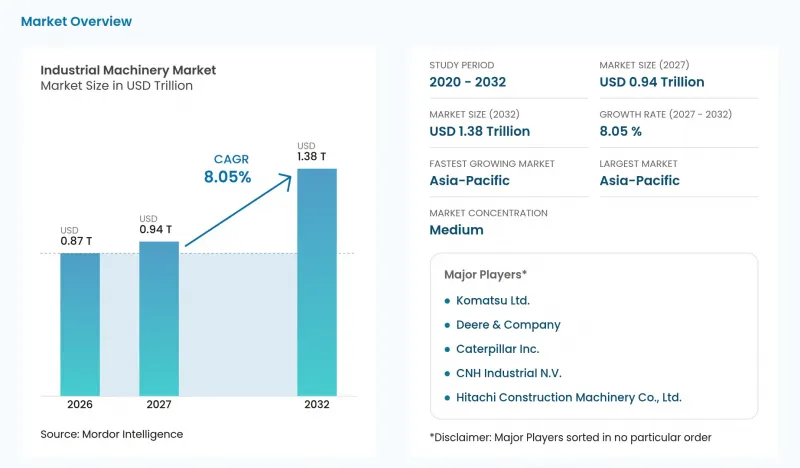
This report is segmented by Product Type (Earth-Moving Equipment and more), Application Industry (Construction and Mining and more), End-User Ownership (Original Equipment Manufacturers and more), Automation Level (Semi-Automated / CNC and more), and Geography (Asia-Pacific and more). The market forecasts are provided in terms of value (USD), based on availability.
Global Industrial Machinery Market Trends and Insights
Accelerating Adoption of Industry 4.0-Ready Retrofits in Brownfield Facilities
A plant that already operates can modernize in place, making a retrofit a potential requirement for connected automated equipment within an existing building. In May 2025, HD Hyundai Construction Equipment completed modernization of its own Ulsan plant in South Korea. The upgrade integrated real-time product tracking with welding robots, vision sensors, automated guided vehicles and AI-based inspection systems. This combination links production-line automation with material movement and quality control inside an established manufacturing operation. For a machinery supplier, that creates a potential equipment requirement spanning several connected production functions within one modernization program. A supplier can expand its role within the same factory by addressing the interfaces between production, material handling and inspection.
Construction Super-Cycle Fueled by Clean-Energy and Resilient Infrastructure Spend
Connecting renewable generation to the grid requires transmission towers, and raising them is lifting work. The Central-West Orana Renewable Energy Zone transmission build in New South Wales, Australia, began construction in June 2025 to connect renewable generation. EnergyCo reported that its first 70-meter, 500-kilovolt transmission tower was raised by crane on April 2, 2026, after pre-assembly by network operator ACEREZ. Global government spending on power generation and grid infrastructure reached USD 135 billion in 2025, more than double its 2015 level, according to the International Energy Agency. For crane suppliers, lifting transmission towers connects equipment demand to the construction phase of power-network investment.
High Capital-Expenditure and Long Payback Horizons for Advanced Automation
An advanced-automation purchase can require a broader investment decision than approving the machine's initial price. In 2026, 33% of surveyed Canadian manufacturing executives and leaders cited cost as a reason for not investing in technology. In the same survey, 40% cited difficulties integrating advanced technologies into existing systems as a challenge to technology investment. These findings put affordability and implementation within the same investment decision, although each presents a distinct hurdle. A lower equipment price alone would not resolve that systems problem. For a buyer unable to integrate a new machine, committed capital cannot deliver usable production capacity, making postponement commercially defensible.
Other drivers and restraints analyzed in the detailed report include:
- Shift Toward Outcome-Based, Predictive-Maintenance Service Contracts
- Reshoring Drives Demand for Flexible, Multi-Process CNC Platforms
- Volatile Raw-Material Pricing Compresses OEM Margins and Buyer Budgets
For complete list of drivers and restraints, kindly check the Table Of Contents.
Segment Analysis
Earth-moving equipment accounted for a 30.76% share of the industrial machinery market size in 2026. In Europe, heavy-equipment sales grew 2% in 2025, while crawler excavators, the highest-volume product in that equipment group, recorded 4% growth. Within Europe, crawler excavators grew twice as fast as the heavy-equipment total in 2025. For suppliers serving European earth-moving customers, crawler excavators therefore represented a firmer source of demand than the broader heavy-equipment growth alone suggests.
Industrial robots and automation cells are the fastest-growing segment, with a 9.15% CAGR forecast for 2027-2032. Worldwide industrial-robot installations reached 603,000 units in 2025, up 11% year over year. The global operational stock of industrial robots also reached 5.08 million units in 2025. Annual deployments at that scale can make repeatable cell designs commercially attractive because engineering investment can be spread across more equipment installations. The large operating stock adds a potential replacement and expansion channel for complete machines alongside new automation projects.
Construction and mining represented a 32.49% industrial machinery market share in 2026. Mining illustrates the largest segment's equipment scale, with Komatsu commissioning its 1,000th autonomous ultra-class haul truck worldwide in April 2026. The 290-metric-ton-payload milestone truck was deployed at Barrick's Nevada Gold Mines operation in the United States. The combination of high payload and autonomous operation makes the individual machine part of a mine's production system, giving equipment capability a direct operating role. That creates a substantial equipment requirement at the operator level, where haulage capacity and automation can be considered within the same deployment.
The pharmaceuticals industry is the fastest-growing segment, with a 10.35% CAGR forecast for 2027-2032. PMMI reported that 56% of surveyed pharmaceutical manufacturing end users definitely intended to purchase packaging or processing machinery in 2026. GEA also identified pharmaceuticals among the main customer-industry growth drivers of its global order intake in 2025. Food and beverage presents another automation application, illustrated by U.S. food-industry industrial-robot installations rising 30% to approximately 3,000 in 2025. Serving pharmaceutical projects and food-plant automation can spread a supplier's exposure across buyers with different equipment applications.
Complete Report Scope:
- By Product Type
- Earth-Moving Equipment
- Material-Handling Equipment
- Agricultural Machinery
- Industrial Robots and Automation Cells
- Other Product Types
- By Application Industry
- Construction and Mining
- Chemical
- Automotive
- Food and Beverage
- Pharmaceuticals
- Power Generation
- Other Application Industries
- By End-User Ownership
- Original Equipment Manufacturers (OEMs)
- Contract Manufacturers
- Rental and Leasing Companies
- Government and Municipalities
- By Automation Level
- Conventional Manually-Operated
- Semi-Automated / CNC
- Fully-Automated / Lights-Out Cells
- By Geography
- North America
- United States
- Canada
- Mexico
- South America
- Brazil
- Argentina
- Rest of South America
- Europe
- Germany
- France
- United Kingdom
- Italy
- Rest of Europe
- Asia-Pacific
- China
- Japan
- South Korea
- India
- Australia
- Rest of Asia-Pacific
- Middle East and Africa
- Middle East
- Saudi Arabia
- United Arab Emirates
- Turkey
- Rest of Middle East
- Africa
- South Africa
- Kenya
- Rest of Africa
- Middle East
- North America
Geography Analysis
Asia-Pacific held a 41.08% share of the industrial machinery market size in 2026 and is the fastest-growing region, with a 9.5% CAGR forecast for 2027-2032. Within this regional base, the International Federation of Robotics reported 457,315 robot shipments in Asia in 2025, up 13.3% year over year. On October 23, 2025, KUKA and Vietnamese system integrator Automech signed a contract for 60 KUKA robots to automate stamping-line operations in Vietnam. The contract gives the region a specific equipment-and-integration channel alongside its broader robot-shipment flow. For suppliers, pairing robot delivery with local integration capability can turn a regional automation opportunity into a defined industrial-production project.
U.S. agricultural tractor sales fell 16.4% year over year in September 2026, while European construction-equipment sales rose 4.6% in 2025 after declining 19% in 2024. On March 24, 2026, Liebherr-Export and official Bulgarian supplier Alki-L delivered a 300-metric-ton-class R 9350 E electric face-shovel excavator to Assarel-Medet at Bulgaria's Assarel copper mine. In March 2026, Hitachi Construction Machinery's authorized dealer West Balkans Machinery delivered a 250-metric-ton EX2600-7E electric ultra-large excavator to Rudnik uglja Pljevlja for coal extraction at northern Montenegro's Pljevlja mine. The Balkan deliveries add a dealer-mediated mining channel to Europe's construction-equipment recovery, while U.S. tractor suppliers face a monthly sales decline.
In South America, Brazil's machinery and equipment industry reported 8.4% domestic-market revenue growth in 2025. Extractive industries, agribusiness and infrastructure works supported that growth. Chile's Codelco recorded a January 2025 award covering 5 hydraulic shovels from Komatsu Chile S.A. for its Salvador Division. Within the Middle East and Africa, HD Hyundai Construction Equipment secured orders for 333 construction-equipment units from Middle Eastern countries including Saudi Arabia, the UAE and Qatar in January and February 2025. South Africa's MYSOL Holdings expanded its chrome-mining fleet with 30 Volvo articulated haulers and 10 Volvo excavators delivered in February 2025 through its collaboration with Volvo Construction Equipment and dealer Babcock.
- Caterpillar Inc.
- Komatsu Ltd.
- Deere & Company
- Hitachi Construction Machinery Co., Ltd.
- CNH Industrial N.V.
- Volvo Construction Equipment AB
- Liebherr-International AG
- Sandvik AB
- HD Construction Equipment Co., Ltd.
- J.C. Bamford Excavators Ltd. (JCB)
- Terex Corporation
- Manitowoc Company, Inc.
- Astec Industries, Inc.
- Illinois Tool Works Inc.
- Lincoln Electric Holdings, Inc.
- AGCO Corporation
- Alamo Group Inc.
- Wacker Neuson SE
- SANY Heavy Industry Co., Ltd.
- XCMG Construction Machinery Co., Ltd.
- Zoomlion Heavy Industry Science & Technology Co., Ltd.
- Kubota Corporation
- Yanmar Holdings Co., Ltd.
- Atlas Copco AB
- ABB Ltd.
Additional Benefits:
- The market estimate (ME) sheet in Excel format
- 3 months of analyst support
TABLE OF CONTENTS
1 INTRODUCTION
- 1.1 Study Assumptions and Market Definition
- 1.2 Scope of the Study
2 RESEARCH METHODOLOGY
3 EXECUTIVE SUMMARY
4 MARKET LANDSCAPE
- 4.1 Market Overview
- 4.2 Market Drivers
- 4.2.1 Accelerating Adoption of Industry 4.0-Ready Retrofits in Brownfield Facilities
- 4.2.2 Construction Super-Cycle Fueled by Clean-Energy and Resilient Infrastructure Spend
- 4.2.3 Shift Toward Outcome-Based, Predictive-Maintenance Service Contracts
- 4.2.4 Reshoring Drives Demand for Flexible, Multi-Process CNC Platforms
- 4.2.5 Rapid Uptake of Compact, Zero-Emission Machinery for Urban Retrofit Projects
- 4.2.6 Defense and Critical-Minerals CAPEX Elevates Heavy-Duty Equipment Orders
- 4.3 Market Restraints
- 4.3.1 High Capital-Expenditure and Long Payback Horizons for Advanced Automation
- 4.3.2 Volatile Raw-Material Pricing Compresses OEM Margins and Buyer Budgets
- 4.3.3 Acute Skilled-Labor Shortage for Smart-Machine Programming and Service
- 4.3.4 Cyber-Security Vulnerabilities in Connected, OT-IT Converged Equipment
- 4.4 Industry Value Chain Analysis
- 4.5 Regulatory Landscape
- 4.6 Technological Outlook
- 4.7 Porter's Five Forces Analysis
- 4.7.1 Threat of New Entrants
- 4.7.2 Bargaining Power of Suppliers
- 4.7.3 Bargaining Power of Buyers
- 4.7.4 Threat of Substitutes
- 4.7.5 Competitive Rivalry
- 4.8 Impact of Macroeconomic Factors on the Market
5 MARKET SIZE AND GROWTH FORECASTS (VALUE)
- 5.1 By Product Type
- 5.1.1 Earth-Moving Equipment
- 5.1.2 Material-Handling Equipment
- 5.1.3 Agricultural Machinery
- 5.1.4 Industrial Robots and Automation Cells
- 5.1.5 Other Product Types
- 5.2 By Application Industry
- 5.2.1 Construction and Mining
- 5.2.2 Chemical
- 5.2.3 Automotive
- 5.2.4 Food and Beverage
- 5.2.5 Pharmaceuticals
- 5.2.6 Power Generation
- 5.2.7 Other Application Industries
- 5.3 By End-User Ownership
- 5.3.1 Original Equipment Manufacturers (OEMs)
- 5.3.2 Contract Manufacturers
- 5.3.3 Rental and Leasing Companies
- 5.3.4 Government and Municipalities
- 5.4 By Automation Level
- 5.4.1 Conventional Manually-Operated
- 5.4.2 Semi-Automated / CNC
- 5.4.3 Fully-Automated / Lights-Out Cells
- 5.5 By Geography
- 5.5.1 North America
- 5.5.1.1 United States
- 5.5.1.2 Canada
- 5.5.1.3 Mexico
- 5.5.2 South America
- 5.5.2.1 Brazil
- 5.5.2.2 Argentina
- 5.5.2.3 Rest of South America
- 5.5.3 Europe
- 5.5.3.1 Germany
- 5.5.3.2 France
- 5.5.3.3 United Kingdom
- 5.5.3.4 Italy
- 5.5.3.5 Rest of Europe
- 5.5.4 Asia-Pacific
- 5.5.4.1 China
- 5.5.4.2 Japan
- 5.5.4.3 South Korea
- 5.5.4.4 India
- 5.5.4.5 Australia
- 5.5.4.6 Rest of Asia-Pacific
- 5.5.5 Middle East and Africa
- 5.5.5.1 Middle East
- 5.5.5.1.1 Saudi Arabia
- 5.5.5.1.2 United Arab Emirates
- 5.5.5.1.3 Turkey
- 5.5.5.1.4 Rest of Middle East
- 5.5.5.2 Africa
- 5.5.5.2.1 South Africa
- 5.5.5.2.2 Kenya
- 5.5.5.2.3 Rest of Africa
- 5.5.5.1 Middle East
- 5.5.1 North America
6 COMPETITIVE LANDSCAPE
- 6.1 Market Concentration
- 6.2 Strategic Moves
- 6.3 Market Share Analysis
- 6.4 Company Profiles (includes Global level Overview, Market level overview, Core Segments, Financials as available, Strategic Information, Market Rank/Share for key companies, Products and Services, and Recent Developments)
- 6.4.1 Caterpillar Inc.
- 6.4.2 Komatsu Ltd.
- 6.4.3 Deere & Company
- 6.4.4 Hitachi Construction Machinery Co., Ltd.
- 6.4.5 CNH Industrial N.V.
- 6.4.6 Volvo Construction Equipment AB
- 6.4.7 Liebherr-International AG
- 6.4.8 Sandvik AB
- 6.4.9 HD Construction Equipment Co., Ltd.
- 6.4.10 J.C. Bamford Excavators Ltd. (JCB)
- 6.4.11 Terex Corporation
- 6.4.12 Manitowoc Company, Inc.
- 6.4.13 Astec Industries, Inc.
- 6.4.14 Illinois Tool Works Inc.
- 6.4.15 Lincoln Electric Holdings, Inc.
- 6.4.16 AGCO Corporation
- 6.4.17 Alamo Group Inc.
- 6.4.18 Wacker Neuson SE
- 6.4.19 SANY Heavy Industry Co., Ltd.
- 6.4.20 XCMG Construction Machinery Co., Ltd.
- 6.4.21 Zoomlion Heavy Industry Science & Technology Co., Ltd.
- 6.4.22 Kubota Corporation
- 6.4.23 Yanmar Holdings Co., Ltd.
- 6.4.24 Atlas Copco AB
- 6.4.25 ABB Ltd.
7 MARKET OPPORTUNITIES AND FUTURE OUTLOOK
- 7.1 White-Space and Unmet-Need Assessment

