PUBLISHER: Mordor Intelligence | PRODUCT CODE: 2187813

PUBLISHER: Mordor Intelligence | PRODUCT CODE: 2187813
United States Home Service - Market Share Analysis, Industry Trends & Statistics, Growth Forecasts (2027 - 2032)
According to Mordor Intelligence, the United States home service market size was valued at USD 842 billion in 2026 and estimated to grow from USD 869.6 billion in 2027 to reach USD 1 trillion by 2032, at a CAGR of 2.93% during the forecast period (2027-2032).
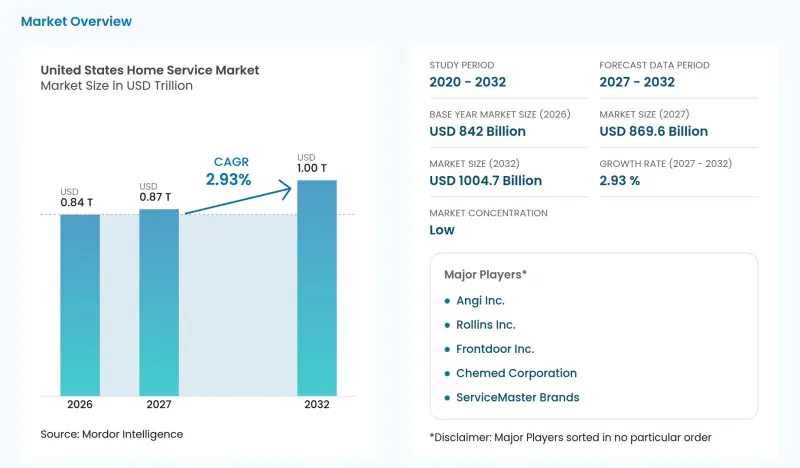
This report is segmented by Service Type (Maintenance & Repair, Improvement & Remodeling, and more), Booking Channel (Offline / Traditional, Online Marketplaces & Apps, and more), Property Type (Family Owner-Occupied and Family Rental), and Geography (South, West, and more). The market forecasts are provided in terms of value (USD), based on availability.
United States Home Service Market Trends and Insights
Aging housing stock boosting repair demand
Older homes provide a repair workload rooted in existing buildings, giving contractors a demand base beyond new construction and housing transactions. In 2024, an estimated 48.5% of occupied U.S. homes built in 1939 or earlier had a repair need, compared with 27.8% of homes built in 2000 or later. Estimated contractor costs to address reported repair needs in the older cohort totaled USD 38 billion that year. The age comparison gives contractors a reason to prioritize outreach to older properties. Because 27.8% of the newest homes also had a repair need while about half of the oldest homes did not, documented deficiencies are a stronger basis for a contractor's proposal than a home's vintage alone.
Elevated home-equity levels supporting discretionary projects
Home equity can make an elective improvement financeable without requiring the owner to sell the property. Intercontinental Exchange (ICE) reported that U.S. mortgage-holder equity reached USD 18 trillion in the second quarter of 2026, including USD 11.7 trillion in tappable equity held by 47.5 million mortgage holders. Tappable equity represents borrowing capacity under ICE's measure. Under ICE's measure, tappable equity averaged approximately USD 212,000 per borrower. Remodelers selling defined, higher-ticket scopes to mortgage holders can position financing alongside the quote, connecting the proposed project to the buyer's borrowing capacity.
Skilled-labor shortages inflating costs & lead times
Renovation capacity depends on the availability of qualified workers at the point a job moves from approval into execution. In a 2026 survey of 109 home-sector professionals, 19% identified skilled trades among the labor areas most constrained in renovation and remodeling. Scarcity in these functions can make a contractor's promised start date harder to sustain. It can also raise the labor allowance needed to secure a crew for specialized work. The Lowe's Foundation, an independent nonprofit founded by Lowe's, announced in April 2026 a USD 250 million grant commitment to help train 250,000 tradespeople by 2035 through community and technical colleges and nonprofit organizations. That training horizon leaves remodelers exposed to the cost and scheduling risk of filling the next skilled vacancy.
Other drivers and restraints analyzed in the detailed report include:
- Digital marketplaces simplifying pro discovery & booking
- Climate-resiliency incentives accelerating retrofit work
- Interest-rate & inflation sensitivity of big-ticket remodels
For complete list of drivers and restraints, kindly check the Table Of Contents.
Segment Analysis
Maintenance and repair accounted for a 37.79% share of the United States home service market size in 2026. Frontdoor's U.S. home-warranty business handled approximately 3.8 million annual service requests in 2025 through approximately 17,000 qualified independent contractor firms. Its annual plans covered repair or replacement of major home systems and appliances following breakdowns generally associated with normal wear and tear. For the largest segment, this arrangement illustrates how a coordinating business can assemble recurring access to specialized repair capacity without performing every job itself. The commercial foundation is a service relationship organized around covered breakdowns, giving contractors a route to work tied to an existing protected property.
Installation and smart-home integration is the fastest-growing segment, with a forecast CAGR of 4.05% during 2027-2032. In November 2025, Daisy announced a partnership with Indianapolis custom integrator Digital Home Design, which would operate under the Daisy brand. The announcement covered both smart-home and small-business technology installation and services. Partnering with an established integrator offers a route to extend coverage while keeping the technical work with a local specialist. A wider service network therefore needs local integration skills to turn a new residential service area into usable installation capacity.
Complete Report Scope:
- By Service Type
- Maintenance & Repair
- Plumbing
- Electrical repair
- HVAC servicing
- Appliance repair
- Cleaning Services (home cleaning, Carpet & upholstery cleaning, Window cleaning etc.)
- Improvement & Remodeling
- Installation & Smart-Home Integration
- Exterior & Landscaping
- Others (Pest Control Services, Security & Safety Services, Moving & Relocation Services etc)
- Maintenance & Repair
- By Booking Channel
- Offline / Traditional
- Online Marketplaces & Apps
- Subscription / Service Plans
- By Property Type
- Family Owner-Occupied
- Family Rental
- By Geography
- Northeast
- Midwest
- South
- West
List of Companies Covered in this Report:
- Angi Inc.
- Frontdoor Inc.
- Rollins Inc.
- Chemed Corporation
- ServiceMaster Brands
- HomeServe USA Corp.
- Porch Group Inc.
- TaskRabbit (INGKA Group)
- Thumbtack Inc.
- Amazon Home Services
- Ace Handyman Services
- ABM Industries Inc.
- FirstService Corp.
- TopBuild Corp.
- Installed Building Products
- ADT Inc.
- Orkin (Subsidiary of Rollins)
- Jani-King International
- Home Depot Services
- Lowe's Installation Services
Additional Benefits:
- The market estimate (ME) sheet in Excel format
- 3 months of analyst support
TABLE OF CONTENTS
1 INTRODUCTION
- 1.1 Study Assumptions and Market Definition
- 1.2 Scope of the Study
2 RESEARCH METHODOLOGY
3 EXECUTIVE SUMMARY
4 MARKET LANDSCAPE
- 4.1 Market Overview
- 4.2 Market Drivers
- 4.2.1 Aging housing stock boosting repair demand
- 4.2.2 Elevated home-equity levels supporting discretionary projects
- 4.2.3 Digital marketplaces simplifying pro discovery & booking
- 4.2.4 Climate-resiliency incentives accelerating retrofit work
- 4.2.5 AI-powered predictive-maintenance subscriptions creating recurring revenue pools
- 4.2.6 Growth of Rental Housing and Property Turnover
- 4.3 Market Restraints
- 4.3.1 Skilled-labor shortages inflating costs & lead times
- 4.3.2 Interest-rate & inflation sensitivity of big-ticket remodels
- 4.3.3 Patchwork municipal licensing rules delaying market expansion
- 4.3.4 High Fragmentation and Dominance of Unorganized Players
- 4.4 Industry Value Chain Analysis
- 4.5 Regulatory Landscape
- 4.6 Technological Outlook
- 4.7 Porter's Five Forces Analysis
- 4.7.1 Threat of New Entrants
- 4.7.2 Bargaining Power of Suppliers
- 4.7.3 Bargaining Power of Buyers
- 4.7.4 Threat of Substitutes
- 4.7.5 Competitive Rivalry
- 4.8 Insights into the Latest Trends and Innovations in the Market
- 4.9 Insights on Recent Developments (New Product Launches, Strategic Initiatives, Investments, Partnerships, JVs, Expansion, M&As, etc.) in the Market
5 MARKET SIZE AND GROWTH FORECASTS (VALUE)
- 5.1 By Service Type
- 5.1.1 Maintenance & Repair
- 5.1.1.1 Plumbing
- 5.1.1.2 Electrical repair
- 5.1.1.3 HVAC servicing
- 5.1.1.4 Appliance repair
- 5.1.2 Cleaning Services (home cleaning, Carpet & upholstery cleaning, Window cleaning etc.)
- 5.1.3 Improvement & Remodeling
- 5.1.4 Installation & Smart-Home Integration
- 5.1.5 Exterior & Landscaping
- 5.1.6 Others (Pest Control Services, Security & Safety Services, Moving & Relocation Services etc)
- 5.1.1 Maintenance & Repair
- 5.2 By Booking Channel
- 5.2.1 Offline / Traditional
- 5.2.2 Online Marketplaces & Apps
- 5.2.3 Subscription / Service Plans
- 5.3 By Property Type
- 5.3.1 Family Owner-Occupied
- 5.3.2 Family Rental
- 5.4 By Geography
- 5.4.1 Northeast
- 5.4.2 Midwest
- 5.4.3 South
- 5.4.4 West
6 COMPETITIVE LANDSCAPE
- 6.1 Market Concentration
- 6.2 Strategic Moves
- 6.3 Market Share Analysis
- 6.4 Company Profiles (includes Global level Overview, Market level overview, Core Segments, Financials as available, Strategic Information, Market Rank/Share for key companies, Products and Services, and Recent Developments)
- 6.4.1 Angi Inc.
- 6.4.2 Frontdoor Inc.
- 6.4.3 Rollins Inc.
- 6.4.4 Chemed Corporation
- 6.4.5 ServiceMaster Brands
- 6.4.6 HomeServe USA Corp.
- 6.4.7 Porch Group Inc.
- 6.4.8 TaskRabbit (INGKA Group)
- 6.4.9 Thumbtack Inc.
- 6.4.10 Amazon Home Services
- 6.4.11 Ace Handyman Services
- 6.4.12 ABM Industries Inc.
- 6.4.13 FirstService Corp.
- 6.4.14 TopBuild Corp.
- 6.4.15 Installed Building Products
- 6.4.16 ADT Inc.
- 6.4.17 Orkin (Subsidiary of Rollins)
- 6.4.18 Jani-King International
- 6.4.19 Home Depot Services
- 6.4.20 Lowe's Installation Services
7 MARKET OPPORTUNITIES AND FUTURE OUTLOOK
- 7.1 White-Space and Unmet-Need Assessment

