PUBLISHER: Mordor Intelligence | PRODUCT CODE: 2187818

PUBLISHER: Mordor Intelligence | PRODUCT CODE: 2187818
Agentic AI - Market Share Analysis, Industry Trends & Statistics, Growth Forecasts (2027 - 2032)
According to Mordor Intelligence, the agentic AI market size is expected to grow from USD 9.89 billion in 2026 to USD 14.06 billion in 2027 and is forecast to reach USD 82.27 billion by 2032 at 42.38% CAGR over 2027-2032.
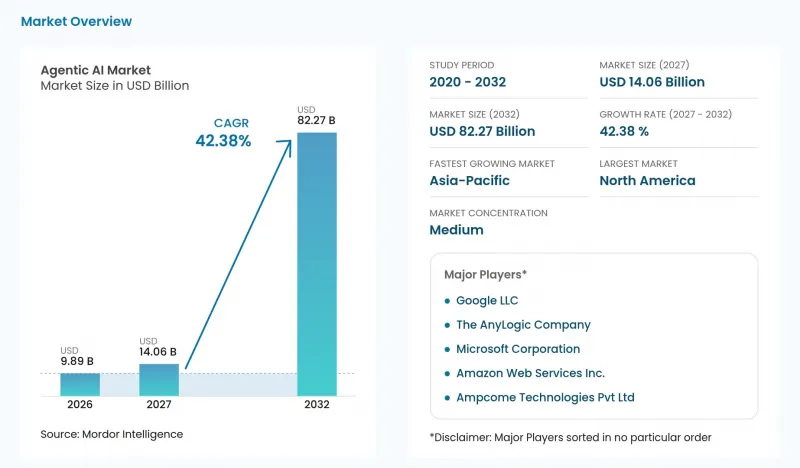
This report is segmented by Component (Solution and more), Deployment Mode (Cloud and more), Organization Size (Large Enterprises and more), End-user Industry (BFSI and more), Agent Architecture (Multi-Agent Systems and more), Application (Autonomous Process Automation and more), and Geography (North America and more). The market forecasts are provided in terms of value (USD), based on availability.
Global Agentic AI Market Trends and Insights
Surge in demand for intelligent automation
Buyers seeking intelligent automation create demand for software that can repeat a useful task across many agent instances. In IBM's January-April 2026 survey, technology executives anticipated a 38% increase in deployed AI agents by 2027. The survey covered 2,000 senior executives responsible for IT, technology, or AI decisions across 33 geographies and 19 industries. An expanded agent population would increase the opportunity to supply software that carries a defined process through successive executions. Where the same task recurs, a supplier can separate reusable application logic from the configuration needed for individual agent instances. That division can support software licensing across deployments, with implementation services concentrated on work that cannot be standardized.
Proliferation of multi-agent systems for complex problem-solving
Organizations developing multiple agents must decide how those agents contribute to one business objective and where coordination belongs within the software. KPMG's Q3 2026 US survey found that 25% of represented organizations were actively developing or implementing multi-agent systems, up from 6% in the prior quarter. The survey covered 314 US executives and business leaders at organizations with annual revenue of at least USD 1 billion, surveyed from July 24 through August 25, 2026. As several agents contribute to one objective, coordinating their work becomes part of the value of the overall solution. A buyer commissioning several agents must also resolve which component carries each task and how responsibility passes between them. Suppliers that package coordination with implementation are therefore positioned to meet that growth in development activity.
Organizational change-management and skill gaps
The ability to build an agent does not equip an organization to redesign the work around it. Harvard Business Review Analytic Services' July 2025 survey found that 48% of 623 respondents cited a lack of talent or skills as an agentic AI adoption barrier. Respondents were HBR audience members involved in data and technology decisions at organizations using or considering agentic AI. In the same survey, 31% cited difficulties adjusting work processes to accommodate agentic AI. These barriers can lengthen the path from a software decision to usable workflows, even when the agent itself functions. Longer implementation cycles can tie up supplier delivery capacity, limiting how quickly additional agent projects can become operating software.
Other drivers and restraints analyzed in the detailed report include:
- Advances in cloud-native AI infrastructure
- Integration with spatial-computing/XR ecosystems
- Ethical, bias and transparency concerns
For complete list of drivers and restraints, kindly check the Table Of Contents.
Segment Analysis
The solution segment accounted for a 61.21% share of the Agentic AI market size in 2026, making it the largest component segment. Salesforce's Agentforce annual recurring revenue exceeded USD 1.5 billion in Q2 FY2027, ended July 31, 2026, including Slackbot and Headless 360 AI offerings. Agentforce and Slack delivered 3.2 billion Agentic Work Units during the quarter, up 97% quarter over quarter. For solution providers, repeated execution can sustain an ongoing revenue relationship after the initial deployment, making service reliability and useful workflow coverage central to the software offering.
Services are the fastest-growing segment, forecast at 44% CAGR over 2027-2032. In March 2026, SEI said it would work with IBM Consulting on enterprise transformation through agentic AI and automation. The engagement called for a data-driven review of operational systems and workflows to advance process redesign and modernization. Such work can translate an organization's existing operating model into specific agent tasks and review points, creating implementation and customization opportunities around the software. Service vendors can therefore earn from the process changes needed before large-scale use, with commercial value in defining the work an agent platform must carry.
Cloud represented a 59.83% Agentic AI market share in 2026, making it the largest deployment segment. IDC's AWS-commissioned 2026 custom survey of more than 900 organizations across 15 industries and 10 countries found that 63% tested and deployed agents in public cloud infrastructure. Operating an agent as a cloud-delivered service can bring repeated interactions onto the same application, placing continuous execution at the center of the offering. A provider operating that application can handle operational changes centrally, without a separate implementation for each user interaction. That makes service operation a commercial capability in its own right, with value extending beyond the initial configuration of an agent.
Hybrid is the fastest-growing deployment segment, forecast at 44.85% CAGR over 2027-2032. In August 2026, AWS reported that Mobileye operated its production AI Support Agent on AgentCore's serverless runtime, with an on-premises ticket-management system supplying tickets and receiving AI-generated responses. Growth can come from implementing that connection as a governed workflow, with clear data access and a usable return path for completed actions. On-premises deployment plays a distinct role in regulated industries, where 63% of 413 AI practitioners and leaders surveyed by DataRobot in 2026 said their organizations required it for agentic AI. Hybrid creates an integration opportunity around retaining a local workflow while adding cloud agent execution, rather than making application replacement a prerequisite for automation.
Complete Report Scope:
- By Component
- Solution
- Services
- Consulting and Integration Services
- Training and Support Services
- Other Services
- By Deployment Mode
- On-Premises
- Cloud
- Hybrid
- By Organization Size
- Small and Medium Enterprises (SMEs)
- Large Enterprises
- By End-user Industry
- Healthcare
- BFSI
- IT and Telecom
- Manufacturing
- Government and Public Sector
- Automotive
- Retail and E-commerce
- Other End-user Industries
- By Agent Architecture
- Single-Agent Systems
- Multi-Agent Systems (MAS)
- By Application
- Autonomous Process Automation
- Predictive Analytics and Decision Support
- Intelligent Virtual Assistants
- RPA Integration
- Smart Manufacturing and IIoT
- Other Applications
- By Geography
- North America
- United States
- Canada
- Mexico
- South America
- Brazil
- Argentina
- Chile
- Rest of South America
- Europe
- Germany
- United Kingdom
- France
- Italy
- Spain
- Rest of Europe
- Asia-Pacific
- China
- Japan
- India
- South Korea
- Australia
- Singapore
- Malaysia
- Rest of Asia-Pacific
- Middle East and Africa
- Middle East
- Saudi Arabia
- United Arab Emirates
- Turkey
- Rest of Middle East
- Africa
- South Africa
- Nigeria
- Egypt
- Rest of Africa
- Middle East
- North America
Geography Analysis
North America held 39.95% of the Agentic AI market size in 2026, making it the largest regional market. KPMG's Q3 2026 US survey found 62% of represented organizations with annual revenue of at least USD 1 billion building, deploying, or developing AI agents, up from 53% in Q2. Development-stage work can support implementation services before an agent enters production, while deployment creates an operating-software relationship, giving suppliers distinct ways to engage those buyers. Because the survey combines building, deploying, and developing, suppliers that carry projects from development into production can extend their role beyond the initial software build.
Asia-Pacific is the fastest-growing geography, forecast at 45.2% CAGR over 2027-2032. Bank of Singapore, OCBC's private-banking subsidiary, rolled out an agentic source-of-wealth tool in 2025. The tool extracted, structured, and synthesized customer records and supporting documents, and prompted follow-ups for information gaps. Relationship managers' average report-preparation time fell from 10 days to 1 hour, while relationship managers and compliance teams retained judgment and final approval. The growth mechanism is the integration of agent-led preparation into a regulated customer-review workflow, where separating document work from final approval can expand useful automation without transferring the decision itself.
Google Cloud's NVIDIA-powered G4 availability in Sao Paulo, Brazil, in September 2026 sits alongside Mibanco's October 2025 WhatsApp banking pilot in Peru, whose agents could open savings accounts after secret-key, facial-biometric, and identity-document checks. A 2026 report identified fragmented data, foreign technology dependence, and uneven national readiness as constraints on scaling agents in Europe. South Africa's Capitec operated agentic AI in business-banking credit processing during FY2026, ended February 28, 2026. The United Arab Emirates' Federal Authority for Identity, Citizenship, Customs & Port Security reported in August 2026 that it had formed agentic AI working teams and assigned responsibilities. Local compute availability and identity-checked consumer channels in South America therefore present different delivery requirements from Capitec's internal credit operation and the UAE authority's federal project.
- Microsoft Corporation
- Amazon Web Services Inc.
- Google LLC
- IBM Corporation
- Oracle Corporation
- Salesforce Inc.
- SAP SE
- UiPath Inc.
- Epicor Software Corp.
- Coupa Software Inc.
- Zycus Inc.
- The AnyLogic Company
- Ampcome Technologies Pvt Ltd
- OpenAI Group PBC
- Anthropic PBC
- Adept AI Labs
- Cohere Inc.
- Rasa Technologies GmbH
- Pegasystems Inc.
- Baidu Inc.
Additional Benefits:
- The market estimate (ME) sheet in Excel format
- 3 months of analyst support
TABLE OF CONTENTS
1 INTRODUCTION
- 1.1 Study Assumptions and Market Definition
- 1.2 Scope of the Study
2 RESEARCH METHODOLOGY
3 EXECUTIVE SUMMARY
4 MARKET LANDSCAPE
- 4.1 Market Overview
- 4.2 Market Drivers
- 4.2.1 Surge in demand for intelligent automation
- 4.2.2 Proliferation of multi-agent systems for complex problem-solving
- 4.2.3 Advances in cloud-native AI infrastructure
- 4.2.4 Integration with spatial-computing/XR ecosystems
- 4.2.5 Emergence of agentic AI performance benchmarks
- 4.2.6 Open-source agent frameworks for SMEs
- 4.3 Market Restraints
- 4.3.1 Organizational change-management and skill gaps
- 4.3.2 Ethical, bias and transparency concerns
- 4.3.3 Escalating compute/resource costs for agent orchestration
- 4.3.4 Lack of interoperability / vendor lock-in
- 4.4 Industry Value Chain Analysis
- 4.5 Regulatory Landscape
- 4.6 Technological Outlook
- 4.7 Porter's Five Forces Analysis
- 4.7.1 Threat of New Entrants
- 4.7.2 Bargaining Power of Suppliers
- 4.7.3 Bargaining Power of Buyers
- 4.7.4 Threat of Substitutes
- 4.7.5 Competitive Rivalry
- 4.8 Framework of Agentic AI System
- 4.9 Impact of Macroeconomic Factors on the Market
- 4.10 INVESTMENT ANALYSIS
5 MARKET SIZE AND GROWTH FORECASTS (VALUE)
- 5.1 By Component
- 5.1.1 Solution
- 5.1.2 Services
- 5.1.2.1 Consulting and Integration Services
- 5.1.2.2 Training and Support Services
- 5.1.2.3 Other Services
- 5.2 By Deployment Mode
- 5.2.1 On-Premises
- 5.2.2 Cloud
- 5.2.3 Hybrid
- 5.3 By Organization Size
- 5.3.1 Small and Medium Enterprises (SMEs)
- 5.3.2 Large Enterprises
- 5.4 By End-user Industry
- 5.4.1 Healthcare
- 5.4.2 BFSI
- 5.4.3 IT and Telecom
- 5.4.4 Manufacturing
- 5.4.5 Government and Public Sector
- 5.4.6 Automotive
- 5.4.7 Retail and E-commerce
- 5.4.8 Other End-user Industries
- 5.5 By Agent Architecture
- 5.5.1 Single-Agent Systems
- 5.5.2 Multi-Agent Systems (MAS)
- 5.6 By Application
- 5.6.1 Autonomous Process Automation
- 5.6.2 Predictive Analytics and Decision Support
- 5.6.3 Intelligent Virtual Assistants
- 5.6.4 RPA Integration
- 5.6.5 Smart Manufacturing and IIoT
- 5.6.6 Other Applications
- 5.7 By Geography
- 5.7.1 North America
- 5.7.1.1 United States
- 5.7.1.2 Canada
- 5.7.1.3 Mexico
- 5.7.2 South America
- 5.7.2.1 Brazil
- 5.7.2.2 Argentina
- 5.7.2.3 Chile
- 5.7.2.4 Rest of South America
- 5.7.3 Europe
- 5.7.3.1 Germany
- 5.7.3.2 United Kingdom
- 5.7.3.3 France
- 5.7.3.4 Italy
- 5.7.3.5 Spain
- 5.7.3.6 Rest of Europe
- 5.7.4 Asia-Pacific
- 5.7.4.1 China
- 5.7.4.2 Japan
- 5.7.4.3 India
- 5.7.4.4 South Korea
- 5.7.4.5 Australia
- 5.7.4.6 Singapore
- 5.7.4.7 Malaysia
- 5.7.4.8 Rest of Asia-Pacific
- 5.7.5 Middle East and Africa
- 5.7.5.1 Middle East
- 5.7.5.1.1 Saudi Arabia
- 5.7.5.1.2 United Arab Emirates
- 5.7.5.1.3 Turkey
- 5.7.5.1.4 Rest of Middle East
- 5.7.5.2 Africa
- 5.7.5.2.1 South Africa
- 5.7.5.2.2 Nigeria
- 5.7.5.2.3 Egypt
- 5.7.5.2.4 Rest of Africa
- 5.7.5.1 Middle East
- 5.7.1 North America
6 COMPETITIVE LANDSCAPE
- 6.1 Market Concentration
- 6.2 Strategic Moves
- 6.3 Market Share Analysis
- 6.4 Company Profiles (includes Global level Overview, Market level overview, Core Segments, Financials as available, Strategic Information, Market Rank/Share for key companies, Products and Services, and Recent Developments)
- 6.4.1 Microsoft Corporation
- 6.4.2 Amazon Web Services Inc.
- 6.4.3 Google LLC
- 6.4.4 IBM Corporation
- 6.4.5 Oracle Corporation
- 6.4.6 Salesforce Inc.
- 6.4.7 SAP SE
- 6.4.8 UiPath Inc.
- 6.4.9 Epicor Software Corp.
- 6.4.10 Coupa Software Inc.
- 6.4.11 Zycus Inc.
- 6.4.12 The AnyLogic Company
- 6.4.13 Ampcome Technologies Pvt Ltd
- 6.4.14 OpenAI Group PBC
- 6.4.15 Anthropic PBC
- 6.4.16 Adept AI Labs
- 6.4.17 Cohere Inc.
- 6.4.18 Rasa Technologies GmbH
- 6.4.19 Pegasystems Inc.
- 6.4.20 Baidu Inc.
7 MARKET OPPORTUNITIES AND FUTURE OUTLOOK
- 7.1 White-Space and Unmet-Need Assessment

