PUBLISHER: Mordor Intelligence | PRODUCT CODE: 2194762

PUBLISHER: Mordor Intelligence | PRODUCT CODE: 2194762
Cardiovascular Drugs - Market Share Analysis, Industry Trends & Statistics, Growth Forecasts (2027 - 2032)
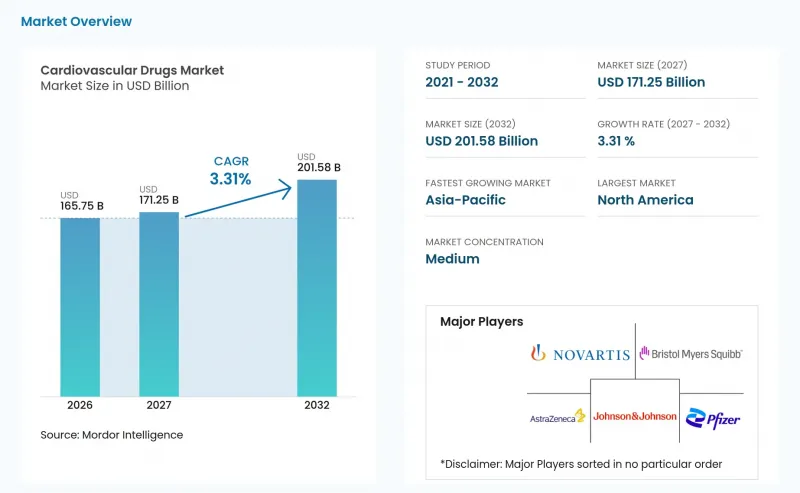
According to Mordor Intelligence, the cardiovascular drugs market size is projected to be USD 165.75 billion in 2026, USD 171.25 billion in 2027, and reach USD 201.58 billion by 2032, growing at a CAGR of 3.31% from 2027 to 2032.
Global Cardiovascular Drugs Market Trends and Insights
Rising Prevalence of CVDs in Aging Populations
The percentage of adults aged 65 and older is growing faster than any other demographic group, and cardiovascular diseases (CVDs) remain the leading cause of death worldwide. Japan reported in 2025 that 68% of cardiovascular patients aged 75 and above take at least five concurrent medicines, which complicates adherence and heightens drug-drug interaction risk. Regulators now require geriatric-specific dosing studies, adding up to 18 months to development timelines but improving post-market safety. Health plans are shifting resources toward preventive options such as PCSK9 inhibitors, provided manufacturers link payment to event-reduction metrics. This epidemiologic swell ensures sustained demand for therapies that address polypharmacy and multimorbidity.
Rapid Uptake of NOACs & SGLT-2 Inhibitors
Between 2024 and 2025 the U.S. Food and Drug Administration approved seven label expansions for SGLT-2 inhibitors that now include heart failure with preserved ejection fraction, a population that lacked disease-modifying drugs. The European Medicines Agency noted that NOAC prescriptions in atrial fibrillation surpassed warfarin for the first time in Eastern European markets in 2025, catalyzed by lower monitoring costs. Adoption remains uneven in Latin America and Sub-Saharan Africa where generic warfarin still dominates formularies. Companies are offering tiered pricing and voluntary licenses, yet market-access talks often stretch two to three years after approval. Despite disparities, faster uptake in high-income regions is boosting global revenue growth.
Patent Expiries & Generic Erosion of Blockbuster Brands
Apixaban lost exclusivity in 2024, and six months later branded sales volumes fell 42% in the United States, according to company filings. Rivaroxaban followed in 2025 with eight generic challengers in queue, and price erosion is projected to reach 70% by 2027. Companies respond by launching authorized generics and fixed-dose combinations, yet payers now scrutinize incremental innovation claims. Outcomes-based contracts that hinge on stroke-prevention metrics are replacing traditional rebates. The near-term revenue drag weighs on the cardiovascular drugs market until pipeline biologics offset generics.
Other drivers and restraints analyzed in the detailed report include:
- Expanding Reimbursement in Emerging Markets
- Regulatory Reliance on Real-World Evidence for Label Extensions
- High Cost of Biologic & Gene-Based CV Therapies
For complete list of drivers and restraints, kindly check the Table Of Contents.
Segment Analysis
In 2026, antihypertensives captured a 29.56% share of the cardiovascular drugs market size, reflecting entrenched demand across all income levels. Lipid-lowering agents are growing fastest at 4.85% CAGR as PCSK9 inhibitors and bempedoic acid address statin intolerance. The cardiovascular drugs market share of anticoagulants is contracting because generic apixaban and rivaroxaban squeeze prices, yet edoxaban is gaining traction in Asia where once-daily dosing fits local adherence patterns. Heart-failure therapies now include SGLT-2 inhibitors and ARNIs, broadening treatment beyond diuretics and ACE inhibitors.
Pulmonary arterial hypertension remains a lucrative niche with high-priced endothelin receptor antagonists and the recent launch of sotatercept. Antiarrhythmics hold a modest proportion but benefit from integration with catheter ablation services. Manufacturers pursue triple-drug fixed-dose combinations that improve adherence while extending intellectual property life. Collectively, drug-class diversification cushions the cardiovascular drugs market against single-segment volatility.
Hypertension held 31.53% of revenue in 2026, consistent with guideline-driven early treatment initiation. Dyslipidemia is expanding at 4.75% CAGR as aging populations accumulate cardiometabolic risk factors and payers approve PCSK9 inhibitors under outcomes-based contracts. Coronary artery disease remains sizeable, but adherence to long-term dual antiplatelet therapy is challenged by polypharmacy fatigue. Heart-failure indications benefit from quadruple therapeutic regimens that cut hospitalization by up to 40% relative to legacy therapy.
Arrhythmia management is migrating toward device solutions that alter the pharmaceutical mix but raise demand for peri-procedural anticoagulation. Venous thromboembolism care is lengthening as guidelines recommend indefinite treatment for unprovoked events, sustaining oral anticoagulant demand even amid price erosion. Overall, shifting comorbidity patterns diversify revenue sources across indications within the cardiovascular drugs market.
Complete Report Scope:
- By Drug Class
- Antihypertensives
- Anticoagulants
- Antiplatelet Agents
- Lipid-Lowering Drugs
- Heart-Failure Drugs
- Antiarrhythmics
- Pulmonary-Hypertension Drugs
- By Disease Indication
- Hypertension
- Coronary Artery Disease
- Heart Failure
- Arrhythmia
- Dyslipidemia
- Venous Thrombo-Embolism
- By Route of Administration
- Oral
- Injectable / IV
- Transdermal
- Others
- By Distribution Channel
- Hospital Pharmacies
- Retail Pharmacies
- Online Pharmacies
- By Geography
- North America
- United States
- Canada
- Mexico
- Europe
- Germany
- United Kingdom
- France
- Italy
- Spain
- Rest of Europe
- Asia-Pacific
- China
- India
- Japan
- Australia
- South Korea
- Rest of Asia-Pacific
- Middle East and Africa
- GCC
- South Africa
- Rest of Middle East and Africa
- South America
- Brazil
- Argentina
- Rest of South America
- North America
Geography Analysis
Asia-Pacific led the cardiovascular drugs market with a 34.35% share in 2026, and its 5.25% CAGR outpaces all other regions thanks to China's procurement reforms and India's infrastructure expansion. Local firms now secure 71% of new NRDL listings, signaling stronger domestic competitive pressure for multinationals. Japan's streamlined approval timelines further ease market entry for cutting-edge therapies, promoting steady uptake of GLP-1 agents and next-generation anticoagulants.
North America remains a pivotal innovation hub in the cardiovascular drug market, underpinned by reimbursement frameworks that quickly absorb breakthrough therapies. Nonetheless, the Inflation Reduction Act introduces price-negotiation uncertainty that may reshape launch-sequence strategies for high-value cardiovascular assets.
Europe benefits from harmonised regulatory pathways that accelerate parallel submissions, though Brexit-related logistics adjustments persist. Latin America's policy moves toward domestic production-exemplified by Brazil's preference margins-create dual imperatives of localisation and cost control. The Middle East and Africa record incremental gains aligned with cardiovascular-disease awareness campaigns, yet infrastructure gaps still limit high-cost biologic penetration.
List of Companies Covered in this Report:
- Abbott Laboratories
- Abbvie
- Amgen
- AstraZeneca
- Bayer
- Boehringer Ingelheim
- Bristol-Myers Squibb
- Daiichi Sankyo
- Eli Lilly and Company
- GlaxoSmithKline
- Johnson & Johnson
- Merck
- Novartis
- Novo Nordisk
- Otsuka Pharma
- Pfizer
- Roche
- Sanofi
- Servier
- Takeda Pharmaceuticals
Additional Benefits:
- The market estimate (ME) sheet in Excel format
- 3 months of analyst support
TABLE OF CONTENTS
1 Introduction
- 1.1 Study Assumptions & Market Definition
- 1.2 Scope of the Study
2 Research Methodology
3 Executive Summary
4 Market Landscape
- 4.1 Market Overview
- 4.2 Market Drivers
- 4.2.1 Rising prevalence of CVDs in ageing populations
- 4.2.2 Rapid uptake of NOACs & SGLT-2 inhibitors
- 4.2.3 Expanding reimbursement in emerging markets
- 4.2.4 Regulatory reliance on real-world evidence for label extensions
- 4.2.5 AI-driven in-silico repurposing accelerating CV pipeline
- 4.3 Market Restraints
- 4.3.1 Patent expiries & generic erosion of blockbuster brands
- 4.3.2 High cost of biologic & gene-based CV therapies
- 4.3.3 Single-region API sourcing creating supply-chain risk
- 4.3.4 Digital-therapeutics cannibalisation risk for chronic CV drugs
- 4.4 Supply-Chain Analysis
- 4.5 Regulatory Landscape
- 4.6 Technological Outlook
- 4.7 Porter's Five Forces
- 4.7.1 Threat of New Entrants
- 4.7.2 Bargaining Power of Suppliers
- 4.7.3 Bargaining Power of Buyers
- 4.7.4 Threat of Substitutes
- 4.7.5 Competitive Rivalry
5 Market Size & Growth Forecasts (Value, USD)
- 5.1 By Drug Class
- 5.1.1 Antihypertensives
- 5.1.2 Anticoagulants
- 5.1.3 Antiplatelet Agents
- 5.1.4 Lipid-Lowering Drugs
- 5.1.5 Heart-Failure Drugs
- 5.1.6 Antiarrhythmics
- 5.1.7 Pulmonary-Hypertension Drugs
- 5.2 By Disease Indication
- 5.2.1 Hypertension
- 5.2.2 Coronary Artery Disease
- 5.2.3 Heart Failure
- 5.2.4 Arrhythmia
- 5.2.5 Dyslipidemia
- 5.2.6 Venous Thrombo-Embolism
- 5.3 By Route of Administration
- 5.3.1 Oral
- 5.3.2 Injectable / IV
- 5.3.3 Transdermal
- 5.3.4 Others
- 5.4 By Distribution Channel
- 5.4.1 Hospital Pharmacies
- 5.4.2 Retail Pharmacies
- 5.4.3 Online Pharmacies
- 5.5 By Geography
- 5.5.1 North America
- 5.5.1.1 United States
- 5.5.1.2 Canada
- 5.5.1.3 Mexico
- 5.5.2 Europe
- 5.5.2.1 Germany
- 5.5.2.2 United Kingdom
- 5.5.2.3 France
- 5.5.2.4 Italy
- 5.5.2.5 Spain
- 5.5.2.6 Rest of Europe
- 5.5.3 Asia-Pacific
- 5.5.3.1 China
- 5.5.3.2 India
- 5.5.3.3 Japan
- 5.5.3.4 Australia
- 5.5.3.5 South Korea
- 5.5.3.6 Rest of Asia-Pacific
- 5.5.4 Middle East and Africa
- 5.5.4.1 GCC
- 5.5.4.2 South Africa
- 5.5.4.3 Rest of Middle East and Africa
- 5.5.5 South America
- 5.5.5.1 Brazil
- 5.5.5.2 Argentina
- 5.5.5.3 Rest of South America
- 5.5.1 North America
6 Competitive Landscape
- 6.1 Market Concentration
- 6.2 Market Share Analysis
- 6.3 Company Profiles (includes Global level Overview, Market level overview, Core Segments, Financials as available, Strategic Information, Market Rank/Share for key companies, Products & Services, and Recent Developments)
- 6.3.1 Abbott Laboratories
- 6.3.2 AbbVie Inc
- 6.3.3 Amgen
- 6.3.4 AstraZeneca plc
- 6.3.5 Bayer
- 6.3.6 Boehringer Ingelheim
- 6.3.7 Bristol Myers Squibb
- 6.3.8 Daiichi Sankyo
- 6.3.9 Eli Lilly
- 6.3.10 GSK plc
- 6.3.11 Johnson & Johnson
- 6.3.12 Merck & Co.
- 6.3.13 Novartis AG
- 6.3.14 Novo Nordisk
- 6.3.15 Otsuka Pharma
- 6.3.16 Pfizer Inc
- 6.3.17 F. Hoffmann-La Roche Ltd
- 6.3.18 Sanofi SA
- 6.3.19 Servier
- 6.3.20 Takeda
7 Market Opportunities & Future Outlook
- 7.1 White-space & Unmet-Need Assessment

