PUBLISHER: Mordor Intelligence | PRODUCT CODE: 2194806

PUBLISHER: Mordor Intelligence | PRODUCT CODE: 2194806
Men Skin Care Products - Market Share Analysis, Industry Trends & Statistics, Growth Forecasts (2027 - 2032)
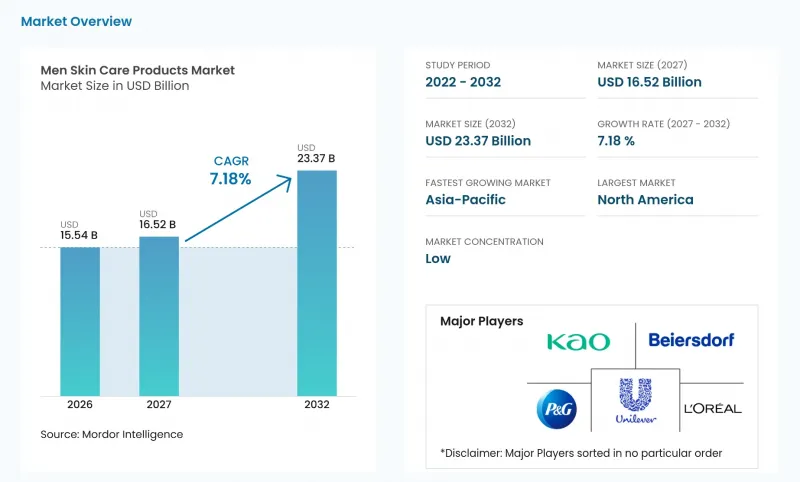
According to Mordor Intelligence, the men skin care products market is expected to grow from USD 15.54 billion in 2026 and is forecast to reach USD 23.37 billion by 2032 at 7.18% CAGR over 2027-2032.
Global Men Skin Care Products Market Trends and Insights
Rising Male Grooming and Self-Care Awareness
Male grooming is increasingly viewed as a regular form of self-care, supporting repeat purchases in the men's skin care products market as consumers shift from occasional to routine use. Men aged 25-34 show particularly strong routine adoption, making this cohort important for brands seeking to establish long-term relevance. Early routine formation can create durable loyalty when a brand establishes trust before consumers settle on a preferred regimen or purchase products only in response to seasonal needs. Self-purchasing broadens demand beyond gifts and promotional periods, allowing men to select products based on their own skin concerns. This shift favors products with clear daily use cases, including cleansing, moisturizing, and shaving-related care that can be explained without specialist language. It also increases the value of consumer education that demonstrates how a straightforward routine can address oiliness, dryness, irritation, or visible aging concerns.
Product Innovation Tailored to Male Skin
Male skin has specific characteristics, including greater thickness, more active sebaceous function, and repeated stress from shaving, which makes a generic approach less suited to everyday concerns. A 2025 clinical review notes that post-shave water loss and follicular density require formulation choices suited to male skin, including gentler cleansing systems and barrier-supporting ingredients. This clinical framing moves product design beyond cosmetic gender labeling and toward practical concerns that consumers can recognize from their own daily routines. Beiersdorf introduced NIVEA MEN Sensitive Liquid Moisturizer in September 2026 with a 5% Ceramide and Zinc PCA Soothing Complex, and reported that 98% of tested male users found it suitable for sensitive skin. Such launches support products designed around irritation, barrier care, and oil control instead of relying solely on a male-oriented label. They also make formulation evidence, clear usage instructions, and reported testing more important in the Men skin care products market.
Counterfeit and Low-Quality Products
Counterfeit products can harm consumers and weaken confidence in established brands, particularly when a buyer cannot easily verify that an online seller is authorized. A July 2025 investigation by Which? found that 67% of cosmetics it bought from major online marketplaces were likely counterfeit. The Korean Intellectual Property Office prosecuted a network in June 2025 that distributed 87,000 counterfeit products imitating SK-II, Kiehl's, and Estee Lauder, with seized goods valued at KRW 7.9 billion in genuine-product equivalent. This issue is important because social commerce and online marketplaces are key discovery channels in the Men skin care products market, particularly for younger consumers comparing products quickly. Authorized sellers, product authentication, and pharmacy partnerships can help reduce consumer risk and make it clearer where an item has originated. Legitimate brands also face ongoing compliance requirements under the United States Modernization of Cosmetics Regulation Act and the European Union Cosmetics Regulation, which raise the importance of documented product safety and traceability.
Other drivers and restraints analyzed in the detailed report include:
- Expansion of E-Commerce and Direct-to-Consumer Channels
- Rising Demand for Anti-Aging and Skin Rejuvenation Products
- Limited Skincare Routines Among Traditional Male Consumers
For complete list of drivers and restraints, kindly check the Table Of Contents.
Segment Analysis
Moisturizers and Creams held 38.5% of the Men skin care products market share in 2026, reflecting their role as an accessible entry point for men beginning a regular routine. Lightweight, non-comedogenic products suit consumers managing oily or combination skin without adding a heavy finish that can discourage repeat use. SPF-inclusive moisturizers and anti-aging variants raise the value of a basic product without asking the consumer to add another separate step. Cleansers hold the second-largest position because they meet an established hygiene need and are used often enough to create regular replenishment. Facial masks, serums and oils, and other formats grow from smaller bases as multi-step care becomes more familiar to digitally engaged consumers.
Toners are forecast to grow at an 8.3% CAGR through 2032 in the Men skin care products market, as routines move beyond basic cleansing and hydration toward more targeted care. Alcohol-free products with niacinamide, hyaluronic acid, or gentle exfoliants can address oiliness, post-shave irritation, and congestion in a format that is simple to explain. Intage reported that men's moisturizing essences and toners in Japan rose 15.7% in 2024, indicating greater acceptance of products beyond a single moisturizer. KIZEN launched a 3-in-1 Complete Facial Moisturizer in the United States in June 2025, combining toner, serum, and moisturizing cream in one application. Multi-use formats can reduce perceived routine complexity while retaining the targeted benefits that encourage consumers to move beyond a basic regimen.
Oily Skin held 40.2% of the Men skin care products market share in 2026, making it the leading skin-type need for product design and communication. Higher sebaceous activity among men supports demand for oil-control cleansers, lightweight moisturizers, and pore-focused toners. Ingredient-led product descriptions can help consumers identify suitable options for acne, excess sebum, and visible congestion. Dry Skin and Combination Skin require hydration that does not feel overly occlusive, while Normal Skin supports regular demand for preventive hydration and SPF. Skin-type guidance therefore provides a practical route for brands to improve product selection and reduce uncertainty for new users.
Sensitive Skin is forecast to expand at a 9.5% CAGR through 2032, the fastest growth rate among the skin-type segments. Repeated shaving can create micro-injuries, increase water loss, and disrupt the skin barrier, which makes irritation a recurring concern rather than a narrow niche. This supports products built with ceramides, soothing agents, and gentler surfactant systems that are easy to use in a daily routine. NIVEA MEN's 2026 Sensitive Liquid Moisturizer illustrates this direction through its Ceramide and Zinc PCA formulation and reported suitability testing. Brands with credible sensitive-skin testing can build trust among consumers who have experienced irritation from strongly fragranced or aggressive legacy products.
Complete Report Scope:
- By Product Type
- Cleansers
- Moisturizers/Creams
- Facial Masks
- Toners
- Serums and Oils
- Others
- By Skin Type
- Oily Skin
- Dry Skin
- Sensitive Skin
- Combination Skin
- Normal Skin
- By Category
- Mass
- Premium
- By Distribution Channel
- Supermarkets/Hypermarkets
- Pharmacies and Drug stores
- Health & Beauty Stores
- Online Retail Stores
- Other Distribution Channels
- By Geography
- North America
- United States
- Canada
- Mexico
- Rest of North America
- Europe
- Germany
- United Kingdom
- Italy
- France
- Spain
- Netherlands
- Poland
- Belgium
- Sweden
- Rest of Europe
- Asia-Pacific
- China
- India
- Japan
- Australia
- Indonesia
- South Korea
- Thailand
- Singapore
- Rest of Asia-Pacific
- South America
- Brazil
- Argentina
- Colombia
- Chile
- Peru
- Rest of South America
- Middle East and Africa
- South Africa
- Saudi Arabia
- United Arab Emirates
- Nigeria
- Egypt
- Morocco
- Turkey
- Rest of Middle East and Africa
- North America
Geography Analysis
North America held 37.2% of the Men skin care products market share in 2026, supported by established retail infrastructure, high spending capacity, and broad online access. Consumers can buy mass, premium, pharmacy, and direct-to-consumer products through well-developed channels. The United States is an important launch market for products that combine clinical positioning with broad distribution. Beiersdorf's 2025 NIVEA MEN Age Defense launch across Walmart, Amazon, and Target demonstrates how brands can reach buyers through mainstream retail and e-commerce. Direct-to-consumer subscriptions and specialist stores can further support discovery of higher-value products in the region.
Europe is the second-largest regional contributor to the Men skin care products market, with Germany, the United Kingdom, France, and the Nordic countries serving as important demand centers. Mature personal care habits and established pharmacy and beauty retail give consumers access to a wide range of products. Ingredient safety and transparency remain important under the European Union Cosmetics Regulation, which supports brands with well-documented safety practices and clear claims. This setting can benefit clinical-grade products and make it harder for undifferentiated imports to establish consumer trust. South America and the Middle East and Africa remain smaller in value, while Brazil and Gulf markets offer growth potential through younger consumers, modern retail expansion, and premium grooming interest.
Asia-Pacific is forecast to grow at a 9.2% CAGR through 2032, making it the primary regional growth engine for the Men skin care products market. South Korea influences routine-based skincare across Asia through the international reach of Korean beauty products and its established acceptance of multi-step care. Japan provides evidence of demand for moisturizing and anti-aging products, with its men's cosmetics market grew at a positive rate in 2025. China, India, Indonesia, Thailand, and other ASEAN markets offer broader growth potential through expanding digital commerce, wider distribution, and different consumer income levels. Portfolios that combine straightforward routines with targeted solutions can serve both new entrants and more experienced skincare users across the region.
- Procter & Gamble Co.
- L'Oreal SA
- Beiersdorf AG
- Kao Corporation
- Unilever PLC
- Shiseido Co. Ltd.
- The Estee Lauder Companies Inc.
- Kenvue Inc.
- Edgewell Personal Care Co.
- Coty Inc.
- Natura & Co Holding SA
- Johnson & Johnson Services Inc.
- Groupe Clarins
- LVMH Moet Hennessy Louis Vuitton SE
- Koninklijke Philips N.V.
- Brickell Brands LLC
- Harry's Inc.
- Bulldog Skincare
- Every Man Jack
- Dr. Squatch
Additional Benefits:
- The market estimate (ME) sheet in Excel format
- 3 months of analyst support
TABLE OF CONTENTS
1 INTRODUCTION
- 1.1 Study Assumptions and Market Definition
- 1.2 Scope of the Study
2 RESEARCH METHODOLOGY
3 EXECUTIVE SUMMARY
4 MARKET LANDSCAPE
- 4.1 Market Overview
- 4.2 Market Drivers
- 4.2.1 Rising male grooming and self-care awareness
- 4.2.2 Product innovation tailored to male skin
- 4.2.3 Expansion of e-commerce and direct-to-consumer channels
- 4.2.4 Rising demand for anti-aging and skin rejuvenation products
- 4.2.5 Preference for natural, organic, and clean-label formulations
- 4.2.6 Dermatologist-backed and clinically tested products
- 4.3 Market Restraints
- 4.3.1 Counterfeit and low-quality products
- 4.3.2 Regulatory compliance and ingredient restrictions
- 4.3.3 Limited skincare routines among traditional male consumers
- 4.3.4 Consumer skepticism about product effectiveness
- 4.4 Consumer Behaviour Analysis
- 4.5 Regulatory Landscape
- 4.6 Technological Outlook
- 4.7 Porter's Five Forces Analysis
- 4.7.1 Bargaining Power of Suppliers
- 4.7.2 Bargaining Power of Buyers
- 4.7.3 Threat of New Entrants
- 4.7.4 Threat of Substitutes
- 4.7.5 Intensity of Competitive Rivalry
5 MARKET SIZE AND GROWTH FORECASTS (VALUE)
- 5.1 By Product Type
- 5.1.1 Cleansers
- 5.1.2 Moisturizers/Creams
- 5.1.3 Facial Masks
- 5.1.4 Toners
- 5.1.5 Serums and Oils
- 5.1.6 Others
- 5.2 By Skin Type
- 5.2.1 Oily Skin
- 5.2.2 Dry Skin
- 5.2.3 Sensitive Skin
- 5.2.4 Combination Skin
- 5.2.5 Normal Skin
- 5.3 By Category
- 5.3.1 Mass
- 5.3.2 Premium
- 5.4 By Distribution Channel
- 5.4.1 Supermarkets/Hypermarkets
- 5.4.2 Pharmacies and Drug stores
- 5.4.3 Health & Beauty Stores
- 5.4.4 Online Retail Stores
- 5.4.5 Other Distribution Channels
- 5.5 By Geography
- 5.5.1 North America
- 5.5.1.1 United States
- 5.5.1.2 Canada
- 5.5.1.3 Mexico
- 5.5.1.4 Rest of North America
- 5.5.2 Europe
- 5.5.2.1 Germany
- 5.5.2.2 United Kingdom
- 5.5.2.3 Italy
- 5.5.2.4 France
- 5.5.2.5 Spain
- 5.5.2.6 Netherlands
- 5.5.2.7 Poland
- 5.5.2.8 Belgium
- 5.5.2.9 Sweden
- 5.5.2.10 Rest of Europe
- 5.5.3 Asia-Pacific
- 5.5.3.1 China
- 5.5.3.2 India
- 5.5.3.3 Japan
- 5.5.3.4 Australia
- 5.5.3.5 Indonesia
- 5.5.3.6 South Korea
- 5.5.3.7 Thailand
- 5.5.3.8 Singapore
- 5.5.3.9 Rest of Asia-Pacific
- 5.5.4 South America
- 5.5.4.1 Brazil
- 5.5.4.2 Argentina
- 5.5.4.3 Colombia
- 5.5.4.4 Chile
- 5.5.4.5 Peru
- 5.5.4.6 Rest of South America
- 5.5.5 Middle East and Africa
- 5.5.5.1 South Africa
- 5.5.5.2 Saudi Arabia
- 5.5.5.3 United Arab Emirates
- 5.5.5.4 Nigeria
- 5.5.5.5 Egypt
- 5.5.5.6 Morocco
- 5.5.5.7 Turkey
- 5.5.5.8 Rest of Middle East and Africa
- 5.5.1 North America
6 COMPETITIVE LANDSCAPE
- 6.1 Market Concentration
- 6.2 Strategic Moves
- 6.3 Market Ranking Analysis
- 6.4 Company Profiles (includes Global level Overview, Market level overview, Core Segments, Financials (if available), Strategic Information, Market Rank/Share, Products, Recent Developments)
- 6.4.1 Procter & Gamble Co.
- 6.4.2 L'Oreal SA
- 6.4.3 Beiersdorf AG
- 6.4.4 Kao Corporation
- 6.4.5 Unilever PLC
- 6.4.6 Shiseido Co. Ltd.
- 6.4.7 The Estee Lauder Companies Inc.
- 6.4.8 Kenvue Inc.
- 6.4.9 Edgewell Personal Care Co.
- 6.4.10 Coty Inc.
- 6.4.11 Natura & Co Holding SA
- 6.4.12 Johnson & Johnson Services Inc.
- 6.4.13 Groupe Clarins
- 6.4.14 LVMH Moet Hennessy Louis Vuitton SE
- 6.4.15 Koninklijke Philips N.V.
- 6.4.16 Brickell Brands LLC
- 6.4.17 Harry's Inc.
- 6.4.18 Bulldog Skincare
- 6.4.19 Every Man Jack
- 6.4.20 Dr. Squatch
7 MARKET OPPORTUNITIES AND FUTURE OUTLOOK

