PUBLISHER: Mordor Intelligence | PRODUCT CODE: 2194897

PUBLISHER: Mordor Intelligence | PRODUCT CODE: 2194897
Ketone Supplements - Market Share Analysis, Industry Trends & Statistics, Growth Forecasts (2027 - 2032)
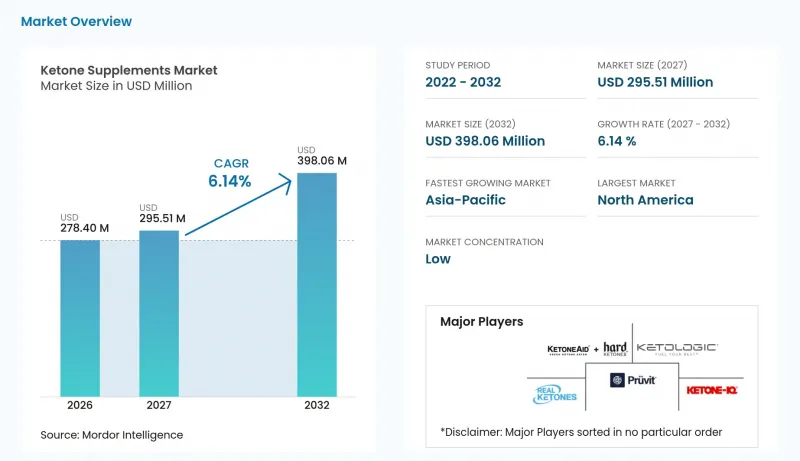
According to Mordor Intelligence, the ketone supplements size is expected to grow from USD 278.40 million in 2026 to USD 295.51 million in 2027 and is forecast to reach USD 398.06 million by 2032 at a 6.14% CAGR over 2027-2032. This report is Segmented by Product Type (Ketone Salts, Ketone Esters, MCT Oil, and Other Ketone Supplements), Form (Powder, Capsules and Tablets, Liquid, and More), Distribution Channel (Supermarkets/Hypermarkets, Health and Pharmacy Stores, Online Retail Stores, and Other Distribution Channels), and Geography (North America, Europe, and More). The Market Forecasts are Provided in Terms of Value (USD).
Global Ketone Supplements Market Trends and Insights
Rising Demand for Sports Performance and Exercise Recovery Supplements
Ketone supplements are gaining attention in sports nutrition due to their potential role in post-exercise recovery. For instance, in August 2025, according to the National Library of Medicine, a randomized crossover trial involving 13 endurance-trained men found that ketone ester supplementation increased ingested sucrose retention from 206 +- 26 g with placebo to 220 +- 26 g, while blood glucose levels were reduced by more than 1 mmol/L compared with placebo. Blood beta-hydroxybutyrate concentrations also exceeded 3.5 mmol/L .
Increasing Adoption of Ketone Supplements and Ketosis-Focused Nutrition
Growing interest in exogenous ketones is expanding their potential applications in cognitive and metabolic wellness. For instance, in March 2025, a study involving 20 adults at the University of Southern Mississippi found that ketone ester supplementation improved working-memory measures (p <= 0.035) and reduced blood glucose levels (p < 0.001) within 2 hours . These findings highlight the potential of ketone supplements to address consumer interests in mental performance and metabolic health, encouraging manufacturers to explore new product applications and expand their target audiences beyond traditional sports nutrition consumers.
High Cost Compared with Conventional Dietary Supplements
High prices remain a key restraint on the ketone supplements market, particularly for premium ketone esters, which may be less affordable than established sports nutrition products such as creatine and whey protein. These price differences can make consumers more cautious about trying ketone supplements and limit repeat purchases among budget-conscious users. Developing cost-efficient ingredients and production methods could help manufacturers improve affordability and expand their customer base. However, competitive pricing must be balanced against product quality, taste, convenience, and perceived effectiveness to sustain consumer demand.
Other drivers and restraints analyzed in the detailed report include:
- Growing Consumer Focus on Weight Management and Metabolic Health
- Increasing Interest in Cognitive Support and Sustained Mental Energy
- Gastrointestinal Side Effects and Limited Evidence of Consistent Efficacy
For complete list of drivers and restraints, kindly check the Table Of Contents.
Segment Analysis
Ketone salts accounted for 55.12% of the ketone supplements market in 2026, supported by their relative affordability and the established manufacturing base for beta-hydroxybutyrate salt products. Ketone salts are available in convenient formats, including powders, capsules, and ready-to-mix products, making them accessible to consumers seeking supplemental ketosis. Ongoing research into the safety of different ketone formulations highlights the importance of careful ingredient selection and product development to support product quality and consumer confidence.
Ketone esters are projected to expand at a CAGR of 9.51% through 2032, making them the fastest-growing product type in the ketone supplements market. Ketone esters are gaining interest among sports users and consumers focused on cognitive wellness because of their ability to rapidly increase blood beta-hydroxybutyrate levels. Product innovation is creating opportunities to improve taste, convenience, and consumer acceptance while addressing existing cost and tolerability challenges. MCT oil also serves a broader metabolic-health audience, while ketone diol-based and hybrid formulations offer manufacturers opportunities to diversify their product portfolios and strengthen market positioning.
Complete Report Scope:
- By Product Type
- Ketone Salts
- Ketone Esters
- MCT Oil
- Other Ketone Supplements
- By Form
- Powder
- Capsules and Tablets
- Liquid
- Gummies
- Other Forms
- By Distribution Channel
- Supermarkets/Hypermarkets
- Health and Pharmacy/Drug Stores
- Online Retail Stores
- Other Distribution Channels
- By Geography
- North America
- United States
- Canada
- Europe
- Germany
- United Kingdom
- Italy
- Asia-Pacific
- Japan
- Australia
- China
- South America
- Brazil
- Argentina
- Middle East and Africa
- South Africa
- Saudi Arabia
- North America
Geography Analysis
North America held 47.62% of the ketone supplements market share in 2026. North America benefits from established ketogenic diet communities, a mature sports nutrition retail network, and strong direct-to-consumer channels, supporting demand for ketone supplements across fitness and wellness applications. The United States represents the largest national market, while the United States Food and Drug Administration (FDA) influences product labeling, marketing claims, and disclaimer requirements. These regulatory guidelines encourage manufacturers to maintain transparent product information and ensure compliance with applicable dietary supplement regulations.
Asia-Pacific is forecast to grow at a CAGR of 8.52% through 2032. Japan's focus on healthy aging, cognitive wellness, and preventive healthcare supports interest in metabolic-health products, including ketone supplements. China offers opportunities in its expanding digital retail landscape, helping brands reach consumers online. In South America, growing interest in fitness and nutrition creates potential for market expansion, although affordability and import costs may limit accessibility. The Middle East and Africa region remains at an earlier stage of market development, with interest in ketogenic diets providing a potential foundation for future demand.
Europe remains an important region for the ketone supplements market, with Germany, Italy, and the United Kingdom contributing through varied consumer demand for fitness, nutrition, and wellness products. Regulatory compliance plays a key role in shaping product availability and market competition. The European Union's Novel Food requirements and health-claim regulations influence how manufacturers develop, market, and position ketone supplements. These requirements encourage companies to prioritize compliant formulations, transparent labeling, and scientifically supported product claims to build consumer trust and strengthen their market presence.
- Pruvit Ventures, Inc.
- Real Ketones, LLC
- Health Via Modern Nutrition, Inc. (HVMN)
- KetoneAid
- KetoLogic
- Hi-Tech Pharmaceuticals, Inc. (BPI Sports)
- Ancient Brands, LLC (Ancient Nutrition)
- Zhou Nutrition
- KetoSports, Inc.
- TdeltaS Global, Inc (deltaG Ketones)
- Kaizen First (Ruketo)
- Keto and Company
- TDeltaS Global Inc.
- Momentum Performance Brands LLC
- KetoSwiss AG
- Herbalife Ltd.
- Compound Solutions, Inc.
- Caldic B.V.
- Sapien Body LLC
- KETOND LLC
Additional Benefits:
- The market estimate (ME) sheet in Excel format
- 3 months of analyst support
TABLE OF CONTENTS
1 INTRODUCTION
- 1.1 Study Assumptions and Market Definition
- 1.2 Scope of the Study
2 RESEARCH METHODOLOGY
3 EXECUTIVE SUMMARY
4 MARKET LANDSCAPE
- 4.1 Market Overview
- 4.2 Market Drivers
- 4.2.1 Rising demand for sports performance and exercise recovery supplements
- 4.2.2 Increasing adoption of ketone supplements and ketosis-focused nutrition
- 4.2.3 Growing consumer focus on weight management and metabolic health
- 4.2.4 Increasing interest in cognitive support and sustained mental energy
- 4.2.5 Improving awareness and availability of ketone supplements
- 4.2.6 Advancements in Product Formulations, Flavors, and Convenient Delivery Formats
- 4.3 Market Restraints
- 4.3.1 High cost compared with conventional dietary supplements
- 4.3.2 Gastrointestinal side effects and limited evidence of consistent efficacy
- 4.3.3 Mineral intake limitations associated with ketone salt formulations
- 4.3.4 Regulatory uncertainty surrounding labeling, health claims, and long-term safety
- 4.4 Consumer Behavior Analysis
- 4.5 Regulatory Landscape
- 4.6 Technological Outlook
- 4.7 Porter's Five Forces Analysis
- 4.7.1 Bargaining Power of Suppliers
- 4.7.2 Bargaining Power of Buyers
- 4.7.3 Threat of New Entrants
- 4.7.4 Threat of Substitutes
- 4.7.5 Competitive Rivalry
5 MARKET SIZE AND GROWTH FORECASTS (VALUE)
- 5.1 By Product Type
- 5.1.1 Ketone Salts
- 5.1.2 Ketone Esters
- 5.1.3 MCT Oil
- 5.1.4 Other Ketone Supplements
- 5.2 By Form
- 5.2.1 Powder
- 5.2.2 Capsules and Tablets
- 5.2.3 Liquid
- 5.2.4 Gummies
- 5.2.5 Other Forms
- 5.3 By Distribution Channel
- 5.3.1 Supermarkets/Hypermarkets
- 5.3.2 Health and Pharmacy/Drug Stores
- 5.3.3 Online Retail Stores
- 5.3.4 Other Distribution Channels
- 5.4 By Geography
- 5.4.1 North America
- 5.4.1.1 United States
- 5.4.1.2 Canada
- 5.4.2 Europe
- 5.4.2.1 Germany
- 5.4.2.2 United Kingdom
- 5.4.2.3 Italy
- 5.4.3 Asia-Pacific
- 5.4.3.1 Japan
- 5.4.3.2 Australia
- 5.4.3.3 China
- 5.4.4 South America
- 5.4.4.1 Brazil
- 5.4.4.2 Argentina
- 5.4.5 Middle East and Africa
- 5.4.5.1 South Africa
- 5.4.5.2 Saudi Arabia
- 5.4.1 North America
6 COMPETITIVE LANDSCAPE
- 6.1 Market Concentration
- 6.2 Strategic Moves
- 6.3 Market Positioning Analysis
- 6.4 Company Profiles (includes Global Level Overview, Market Level Overview, Core Segments, Financials as available, Strategic Information, Market Rank/Share, Products and Services, Recent Developments)
- 6.4.1 Pruvit Ventures, Inc.
- 6.4.2 Real Ketones, LLC
- 6.4.3 Health Via Modern Nutrition, Inc. (HVMN)
- 6.4.4 KetoneAid
- 6.4.5 KetoLogic
- 6.4.6 Hi-Tech Pharmaceuticals, Inc. (BPI Sports)
- 6.4.7 Ancient Brands, LLC (Ancient Nutrition)
- 6.4.8 Zhou Nutrition
- 6.4.9 KetoSports, Inc.
- 6.4.10 TdeltaS Global, Inc (deltaG Ketones)
- 6.4.11 Kaizen First (Ruketo)
- 6.4.12 Keto and Company
- 6.4.13 TDeltaS Global Inc.
- 6.4.14 Momentum Performance Brands LLC
- 6.4.15 KetoSwiss AG
- 6.4.16 Herbalife Ltd.
- 6.4.17 Compound Solutions, Inc.
- 6.4.18 Caldic B.V.
- 6.4.19 Sapien Body LLC
- 6.4.20 KETOND LLC
7 MARKET OPPORTUNITIES AND FUTURE OUTLOOK

