PUBLISHER: Mordor Intelligence | PRODUCT CODE: 2194933

PUBLISHER: Mordor Intelligence | PRODUCT CODE: 2194933
Managed Backup and Recovery Services - Market Share Analysis, Industry Trends & Statistics, Growth Forecasts (2027 - 2032)
According to Mordor Intelligence, the managed backup and recovery services market size is projected to expand from USD 14.28 billion in 2026 to USD 16.84 billion in 2027, and to USD 39.31 billion by 2032, registering a CAGR of 18.47% between 2027 and 2032.
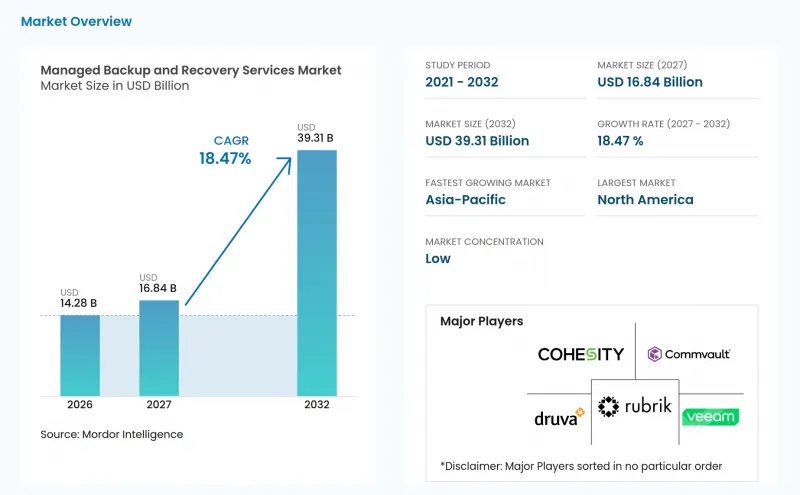
Global Managed Backup and Recovery Services Market Trends and Insights
Escalating Ransomware and Cyberattack Exposure
Ransomware has changed the buying logic in the managed backup and recovery services market because attackers increasingly target backup repositories before demanding payment. A self-hosted backup environment may not provide an independent path to recovery when the attacker can reach stored copies. This risk makes immutable storage and tested restoration central to service selection. The USD 4.4 million global average cost of a data breach reported for 2025 supports the commercial case for stronger recovery preparation. Insurers have begun to treat tested, immutable backups as an important condition for cyber liability coverage. MSP360 reported that cyberattacks were the leading client concern in its 2025 backup research, exceeding the next-highest category, disruption, by ratios ranging from 2:1 to 4:1.
Accelerating Hybrid and Multicloud Adoption
The managed backup and recovery services market benefits from increasingly mixed enterprise infrastructure. Flexera reported that 89% of enterprises had adopted multicloud strategies and that 73% were operating hybrid cloud environments in 2025. Protection now needs to cover on-premises systems, SaaS applications, cloud-native containers, and edge environments. Each environment can have different interfaces, retention rules, and recovery requirements. A single cloud-native tool does not necessarily cover all these layers with a single consistent policy. Providers that coordinate protection across the full data estate can broaden contract scope and compete on operational consistency rather than on infrastructure alone.
Data Residency and Cross-Border Transfer Complexity
Data residency creates procurement friction even though compliance obligations also stimulate demand for managed protection. A provider serving global accounts may need regionally isolated capacity in the European Economic Area, India, China, and other jurisdictions. This approach requires separate encryption-key management and replication controls. Local-storage mandates in Russia, China, and India can prevent a single-region recovery design. Organizations may also face compliance exposure where older backup jobs replicate data across borders without reflecting newer localization rules. AWS recommends recovery designs that retain workloads within the required jurisdiction and apply storage policy controls at the workload level. Operational complexity increases the cost and time required to deploy globally consistent services.
Other drivers and restraints analyzed in the detailed report include:
- Stricter Data Retention and Sovereignty Requirements
- Rising Recovery Expectations for SaaS and Cloud Workloads
- Legacy-System Integration and Migration Friction
For complete list of drivers and restraints, kindly check the Table Of Contents.
Segment Analysis
Backup as a Service held 44.29% of revenue in 2026. Its pay-per-use model, centralized management interface, and immutability features address demand for predictable and auditable protection in the managed backup and recovery services market. Cyber-insurance requirements that specify cloud-native and immutable backups further support its adoption. The service eliminates the need for organizations to maintain backup infrastructure solely through capital spending. It also brings policy management and oversight into a contract-based service model.
Managed Cyber Recovery Services is projected to expand at a 19.66% CAGR through 2032. The managed backup and recovery services market is placing greater value on verifying that recovery data is clean before restoration. Restoring a copy that contains dormant malware can reproduce the underlying incident rather than return operations to a secure state. Disaster Recovery as a Service holds the second-largest share of service-type revenue, while Managed Data Protection Services serve the middle tier by outsourcing policy management and compliance reporting. Clean-room environments are becoming increasingly important because they enable forensic validation within an isolated cloud partition before a production cutover. Rubrik and CrowdStrike integrated their platforms in September 2026 to reduce identity infrastructure recovery times from days to hours through threat telemetry and automated clean-recovery-point identification.
Public cloud accounted for 58.18% of revenue in 2026. It provides the managed backup and recovery services market with geographic redundancy and consumption-based pricing without upfront capital requirements. These characteristics support broad deployment across standard enterprise workloads. Private cloud accounts for much of the remaining non-hybrid demand in financial services, government, and defense. In these settings, operational control and residency requirements can outweigh the cost advantages associated with public cloud.
Hybrid cloud is projected to expand at a 19.98% CAGR through 2032 as organizations balance recovery needs, residency obligations, and performance requirements. The managed backup and recovery services industry is seeing hybrid adoption, as a single public cloud region cannot meet every requirement at once. The managed backup and recovery services market must therefore support recovery across distinct environments. A 2026 survey of German enterprises found that 57% used hybrid cloud as their primary model, with 54% planning to retain that approach. Full restoration of 100 terabytes from AWS S3 Standard could incur USD 9,000 in transfer charges under the published pricing tiers, which encourages some organizations to retain primary recovery copies in private cloud or colocation environments. Providers that explain egress costs and commit to multicloud portability can differentiate in enterprise evaluations.
Complete Report Scope:
- By Service Type
- Backup as a Service (BaaS)
- Disaster Recovery as a Service (DRaaS)
- Managed Data Protection Services
- Managed Cyber Recovery Services
- By Deployment Mode
- Public Cloud
- Private Cloud
- Hybrid Cloud
- By Organization Size
- Large Enterprises
- Small and Medium-Sized Enterprises
- By End-User Industry
- Banking, Financial Services, and Insurance (BFSI)
- Government and Public Administration
- Healthcare and Life Sciences
- IT and Telecommunication
- Industrial Manufacturing
- Retail and E-commerce
- Education and Research Institutions
- Other End-User Industries
- By Geography
- North America
- United States
- Canada
- Mexico
- South America
- Brazil
- Argentina
- Rest of South America
- Europe
- Germany
- United Kingdom
- France
- Italy
- Russia
- Rest of Europe
- Asia-Pacific
- China
- Japan
- India
- South Korea
- Rest of Asia-Pacific
- Middle East
- Saudi Arabia
- United Arab Emirates
- Rest of Middle East
- Africa
- South Africa
- Nigeria
- Rest of Africa
- North America
Geography Analysis
North America accounted for 36.17% of revenue in 2026. The managed backup and recovery services market in the region benefits from mature cloud infrastructure, cyber-insurance practices, and a large base of enterprises with complex multicloud estates. The Indian Health Service renewed a managed backup agreement with Iron Mountain in September 2026, citing data-loss risk from switching and the cost of reformatting historical backup chains. Such public-sector procurement can reinforce established provider relationships over multiple years.
Europe holds the second-largest regional revenue position in the managed backup and recovery services market. Germany, the United Kingdom, and France support demand for auditable architectures in regulated sectors through GDPR, the EU Data Act, and the Digital Operational Resilience Act. Hybrid cloud is important because organizations need locally compliant recovery designs, and 57% of German organizations identified it as their primary model in a 2026 survey. This pattern reflects the importance of sovereignty and resilience in European technology decisions.
Asia-Pacific is projected to expand at a 19.23% CAGR through 2032, the highest regional rate in the managed backup and recovery services market. Japan's domestic backup and recovery segment was valued at USD 385 million in July 2026, up 9.7% year over year. ITR projected a 12% CAGR through fiscal year 2030 as ransomware-related supply chain risk rises on corporate agendas. China, India, and South Korea are accelerating cloud workload migration as regional data-center capacity expands. India is both a source of demand and a delivery hub because IT services firms use managed backup internally and resell related services to global enterprises. South America, the Middle East, and Africa remain emerging demand pools, with Brazilian financial-sector rules, du Tech's UAE National Hypercloud platform, and the Development Bank of Southern Africa's 2025 five-year managed DRaaS tender showing institution-led demand.
- Veeam Software Group GmbH
- Commvault Systems, Inc.
- Rubrik, Inc.
- Cohesity, Inc.
- Druva, Inc.
- Acronis International GmbH
- Backblaze, Inc.
- Wasabi Technologies LLC
- Veritas Technologies LLC
- Arcserve LLC
- HYCU, Inc.
- Keepit A/S
- NAKIVO, Inc.
- MSP360 LLC
- Unitrends, Inc.
- Axcient, Inc.
- Infrascale, Inc.
- Barracuda Networks, Inc.
- OpenText Corporation
- NinjaOne, LLC
Additional Benefits:
- The market estimate (ME) sheet in Excel format
- 3 months of analyst support
TABLE OF CONTENTS
1 INTRODUCTION
- 1.1 Study Assumptions and Market Definition
- 1.2 Scope of the Study
2 RESEARCH METHODOLOGY
3 EXECUTIVE SUMMARY
4 MARKET LANDSCAPE
- 4.1 Market Overview
- 4.2 Market Drivers
- 4.2.1 Escalating Ransomware and Cyberattack Exposure
- 4.2.2 Accelerating Hybrid and Multicloud Adoption
- 4.2.3 Stricter Data Retention and Sovereignty Requirements
- 4.2.4 Rising Recovery Expectations for SaaS and Cloud Workloads
- 4.2.5 AI-Assisted Backup Operations and Recovery Automation
- 4.2.6 Managed Resilience Demand from IT Skills Shortages
- 4.3 Market Restraints
- 4.3.1 Data Residency and Cross-Border Transfer Complexity
- 4.3.2 Legacy-System Integration and Migration Friction
- 4.3.3 Cloud Egress Costs and Provider Lock-In Risk
- 4.3.4 Shortage of Data-Resilience Engineering Talent
- 4.4 Industry Value Chain Analysis
- 4.5 Regulatory Landscape
- 4.6 Technological Outlook
- 4.7 Porter's Five Forces Analysis
- 4.7.1 Bargaining Power of Suppliers
- 4.7.2 Bargaining Power of Buyers
- 4.7.3 Threat of New Entrants
- 4.7.4 Threat of Substitutes
- 4.7.5 Competitive Rivalry
- 4.8 Impact of Macroeconomic Factors on the Market
5 MARKET SIZE AND GROWTH FORECASTS (VALUE)
- 5.1 By Service Type
- 5.1.1 Backup as a Service (BaaS)
- 5.1.2 Disaster Recovery as a Service (DRaaS)
- 5.1.3 Managed Data Protection Services
- 5.1.4 Managed Cyber Recovery Services
- 5.2 By Deployment Mode
- 5.2.1 Public Cloud
- 5.2.2 Private Cloud
- 5.2.3 Hybrid Cloud
- 5.3 By Organization Size
- 5.3.1 Large Enterprises
- 5.3.2 Small and Medium-Sized Enterprises
- 5.4 By End-User Industry
- 5.4.1 Banking, Financial Services, and Insurance (BFSI)
- 5.4.2 Government and Public Administration
- 5.4.3 Healthcare and Life Sciences
- 5.4.4 IT and Telecommunication
- 5.4.5 Industrial Manufacturing
- 5.4.6 Retail and E-commerce
- 5.4.7 Education and Research Institutions
- 5.4.8 Other End-User Industries
- 5.5 By Geography
- 5.5.1 North America
- 5.5.1.1 United States
- 5.5.1.2 Canada
- 5.5.1.3 Mexico
- 5.5.2 South America
- 5.5.2.1 Brazil
- 5.5.2.2 Argentina
- 5.5.2.3 Rest of South America
- 5.5.3 Europe
- 5.5.3.1 Germany
- 5.5.3.2 United Kingdom
- 5.5.3.3 France
- 5.5.3.4 Italy
- 5.5.3.5 Russia
- 5.5.3.6 Rest of Europe
- 5.5.4 Asia-Pacific
- 5.5.4.1 China
- 5.5.4.2 Japan
- 5.5.4.3 India
- 5.5.4.4 South Korea
- 5.5.4.5 Rest of Asia-Pacific
- 5.5.5 Middle East
- 5.5.5.1 Saudi Arabia
- 5.5.5.2 United Arab Emirates
- 5.5.5.3 Rest of Middle East
- 5.5.6 Africa
- 5.5.6.1 South Africa
- 5.5.6.2 Nigeria
- 5.5.6.3 Rest of Africa
- 5.5.1 North America
6 COMPETITIVE LANDSCAPE
- 6.1 Market Concentration
- 6.2 Strategic Moves
- 6.3 Market Share Analysis
- 6.4 Company Profiles (includes Global Level Overview, Market Level Overview, Core Segments, Financials as available, Strategic Information, Market Rank/Share, Products and Services, Recent Developments)
- 6.4.1 Veeam Software Group GmbH
- 6.4.2 Commvault Systems, Inc.
- 6.4.3 Rubrik, Inc.
- 6.4.4 Cohesity, Inc.
- 6.4.5 Druva, Inc.
- 6.4.6 Acronis International GmbH
- 6.4.7 Backblaze, Inc.
- 6.4.8 Wasabi Technologies LLC
- 6.4.9 Veritas Technologies LLC
- 6.4.10 Arcserve LLC
- 6.4.11 HYCU, Inc.
- 6.4.12 Keepit A/S
- 6.4.13 NAKIVO, Inc.
- 6.4.14 MSP360 LLC
- 6.4.15 Unitrends, Inc.
- 6.4.16 Axcient, Inc.
- 6.4.17 Infrascale, Inc.
- 6.4.18 Barracuda Networks, Inc.
- 6.4.19 OpenText Corporation
- 6.4.20 NinjaOne, LLC
7 MARKET OPPORTUNITIES AND FUTURE OUTLOOK
- 7.1 White-space and Unmet-need Assessment

