PUBLISHER: Mordor Intelligence | PRODUCT CODE: 2194969

PUBLISHER: Mordor Intelligence | PRODUCT CODE: 2194969
Managed SASE Services - Market Share Analysis, Industry Trends & Statistics, Growth Forecasts (2027 - 2032)
According to Mordor Intelligence, the managed SASE services market size is USD 7.38 billion in 2026 and is forecast to reach USD 18.22 billion by 2032, growing at a CAGR of 16.12% from 2027 to 2032.
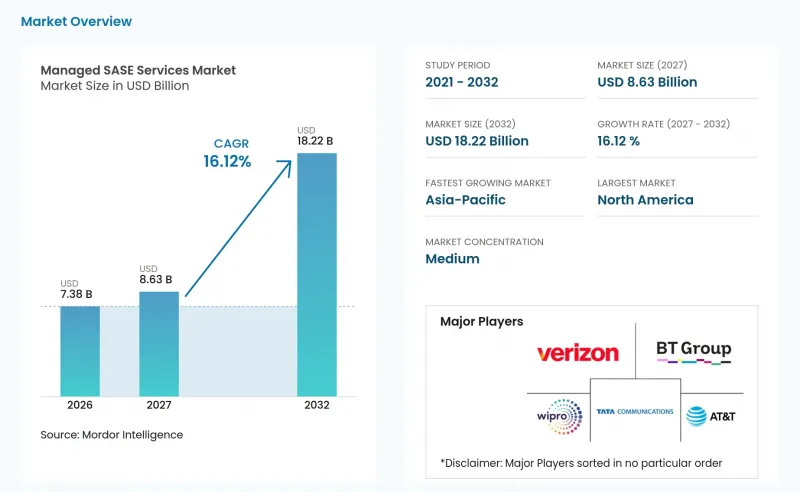
Global Managed SASE Services Market Trends and Insights
Cloud and SaaS Migration
Enterprise cloud migration is weakening the economic case for MPLS and on-premises perimeter security. Enterprise applications increasingly run in the cloud, so more traffic begins outside the corporate data center. The managed SASE services market benefits when providers inspect this traffic at distributed points of presence instead of routing it back through legacy headends. This can improve traffic handling for major software-as-a-service platforms such as Microsoft 365, Salesforce, and Workday. Providers can also use direct SaaS peering to manage latency and egress exposure. Many buyers begin with security service edge functions before adding SD-WAN, which favors modular contracts over a full platform commitment.
Hybrid Work and Distributed Access Requirements
Hybrid operations require organizations to secure remote staff, software-as-a-service applications, data centers, cloud workloads, branches, and third-party access simultaneously. Hybrid work is now a common operating model across organizations. This makes continuous policy enforcement difficult for internal teams that manage separate networks and security tools. The managed SASE services market responds to this need through monitoring, policy administration, and incident response. Larger enterprises tend to fund platform consolidation and automation, while mid-sized organizations rely more heavily on providers for daily operations.
Legacy MPLS, Firewall, and VPN Migration Complexity
Moving from MPLS circuits, hardware firewalls, and VPN concentrators to cloud-delivered SASE can disrupt both technology and internal ownership structures. Organizations often operate legacy and SASE systems together for 12 to 24 months while they address policy conflicts, customer-premises equipment compatibility, and branch cutovers. Migration difficulty is a persistent obstacle for multinational organizations with varied branch hardware. Network and security teams can also have separate governance structures, which delays decisions beyond vendor deployment timelines. The managed SASE services market depends on providers that can reduce this burden through migration engineering, zero-touch provisioning, and co-managed transition services. Providers that offer structured migration plans can build buyer confidence during procurement.
Other drivers and restraints analyzed in the detailed report include:
- Escalating Cybersecurity Threats and Zero Trust Adoption
- Enterprise Demand for Managed Security Expertise
- High Implementation and Transition Costs
For complete list of drivers and restraints, kindly check the Table Of Contents.
Segment Analysis
Platform and Subscription Services accounted for 41.37% of service type revenue in 2026. Unified contracts combine SD-WAN, security service edge functions, and network orchestration under a single agreement. This structure can support multi-year relationships and provide providers with a foundation for adding managed capabilities. Platform services also simplify commercial accountability for customers who want fewer supplier relationships. Professional Services remains important because many organizations need help integrating legacy security portfolios with cloud-delivered architectures. Consulting can help customers establish policy, deployment, and operating plans before they introduce managed services.
Managed Operations Services is projected to grow at a 16.93% CAGR from 2027 to 2032. The segment benefits from the need to enforce Zero Trust policies continuously across distributed networks. Many organizations do not want to staff network security operations around the clock or recruit specialists for every security domain. Providers can supply continuous monitoring, incident response, policy testing, and operational optimization within the same service relationship. AI-based anomaly detection and automated incident workflows add value beyond baseline network administration because they help teams prioritize issues that need attention. These capabilities matter when customers need better performance as well as better security. The managed SASE services market is therefore moving toward services that combine technology delivery with daily operating responsibility.
Fully Managed Service held 43.83% of revenue in 2026. The model appeals to security teams that want to transfer day-to-day responsibility to a provider while retaining clear service-level commitments. Full operational control gives providers a clearer view of clients' environments and can support discussions on renewal and service expansion. BT Business offers a tiered structure that ranges from self-service to fully outsourced delivery across 180 countries. The managed SASE services market uses this range of service levels to address organizations with very different internal operating capacities.
Co-Managed and Assisted Service is forecast to grow at a 16.52% CAGR from 2027 to 2032. It suits large organizations that want to retain governance while needing external support for continuous operations. These customers may already own security platforms but lack enough personnel to run them continuously. The managed SASE services market supports this model because providers can handle operational execution while internal teams set policy and oversee risk. This arrangement can ease adoption for organizations that are unwilling to fully outsource security operations.
Complete Report Scope:
- By Service Type
- Platform and Subscription Services
- Professional Services
- Managed Operations Services
- Monitoring, Incident Response and Optimization Services
- By Management Model
- Fully Managed Service
- Co-Managed and Assisted Service
- Self-Managed Service
- By Vendor Type
- Single-Vendor SASE
- Multi-Vendor SASE
- By Deployment Model
- On-Premises
- Cloud-Based
- Hybrid
- By End-User Industry
- Information Technology and Telecommunications
- BFSI
- Healthcare
- Retail and E-Commerce
- Manufacturing
- Government and Defense
- Other End-User Industries
- By Geography
- North America
- United States
- Canada
- Mexico
- South America
- Brazil
- Argentina
- Rest of South America
- Europe
- Germany
- United Kingdom
- France
- Italy
- Spain
- Russia
- Rest of Europe
- Asia-Pacific
- China
- India
- Japan
- South Korea
- Australia
- Rest of Asia-Pacific
- Middle East
- Saudi Arabia
- United Arab Emirates
- Turkey
- Rest of Middle East
- Africa
- South Africa
- Egypt
- Nigeria
- Rest of Africa
- North America
Geography Analysis
North America held 38.73% of regional revenue in 2026. The managed SASE services market benefits from mature cloud infrastructure and a carrier-managed services base in the region, including AT&T, Verizon, Comcast Business, and Lumen Technologies. CISA issued guidance in July 2026 that directs federal civilian agencies toward SASE architectures aligned with TIC 3.0. The guidance shifts demand away from commercial enterprises and toward federal agencies. Canada and Mexico are developing through multinational subsidiaries that need consistent security policies across their operations. South America is smaller, but Brazil has demand from digital financial services, while Argentina and other countries remain at earlier stages.
Europe is shaped by GDPR data residency rules, the NIS2 Directive, and the Digital Operational Resilience Act for financial services. These requirements make the location of security decisions and infrastructure a practical buying issue. The managed SASE services market in Europe values sovereign designs that place data processing, access control, management, and legal jurisdiction under EU law. Versa Networks activated a fully sovereign SASE deployment in Germany in 2026. Germany leads adoption because large enterprises face detailed security and data governance requirements. The United Kingdom, France, and Benelux are significant markets, while Italy, Spain, Russia, and the rest of Europe are developing in line with cloud modernization and regulatory enforcement.
Asia-Pacific is projected to grow at a 16.48% CAGR from 2027 to 2032. India's Digital Personal Data Protection Act, China's cybersecurity law amendments, and 5G-related connectivity upgrades are increasing the need for localized inspection capacity. The managed SASE services market in Asia-Pacific favors providers with credentialed regional infrastructure that can support specified in-country processing. Providers in the region are expanding automation-led delivery to meet this need. Saudi Arabia and the United Arab Emirates are also increasing cloud investment through national programs, while sovereign services address local data custody expectations. Africa remains early-stage, with South Africa, Egypt, and Nigeria supported by multinational companies that extend global security policies into regional operations.
- AT&T Inc.
- Verizon Communications Inc.
- BT Group plc
- Tata Communications Limited
- Wipro Limited
- Open Systems AG
- Aryaka Networks, Inc.
- Lumen Technologies, Inc.
- Vodafone Group Plc
- Telefonica, S.A.
- Deutsche Telekom AG
- NTT DOCOMO BUSINESS, Inc.
- Comcast Business
- Cato Networks Ltd.
- Palo Alto Networks, Inc.
- Fortinet, Inc.
- Zscaler, Inc.
- Netskope, Inc.
- Cisco Systems, Inc.
Additional Benefits:
- The market estimate (ME) sheet in Excel format
- 3 months of analyst support
TABLE OF CONTENTS
1 INTRODUCTION
- 1.1 Study Assumptions and Market Definition
- 1.2 Scope of the Study
2 RESEARCH METHODOLOGY
3 EXECUTIVE SUMMARY
4 MARKET LANDSCAPE
- 4.1 Market Overview
- 4.2 Impact of Macroeconomic Factors on the Market
- 4.3 Market Drivers
- 4.3.1 Cloud and SaaS Migration
- 4.3.2 Hybrid Work and Distributed Access Requirements
- 4.3.3 Escalating Cybersecurity Threats and Zero Trust Adoption
- 4.3.4 Enterprise Demand for Managed Security Expertise
- 4.3.5 Sovereign Inspection Points and Local Key Custody Requirements
- 4.3.6 eSIM-Native Zero Trust for Cellular IoT Fleets
- 4.4 Market Restraints
- 4.4.1 Legacy MPLS, Firewall and VPN Migration Complexity
- 4.4.2 High Implementation and Transition Costs
- 4.4.3 Inline Security Inspection Latency for Real-Time Applications
- 4.4.4 Hyperscale SaaS Egress Fees for Inspection Workloads
- 4.5 Industry Value Chain Analysis
- 4.6 Regulatory Landscape
- 4.7 Technological Outlook
- 4.8 Porter's Five Forces Analysis
- 4.8.1 Bargaining Power of Suppliers
- 4.8.2 Bargaining Power of Buyers
- 4.8.3 Threat of New Entrants
- 4.8.4 Threat of Substitutes
- 4.8.5 Competitive Rivalry
5 MARKET SIZE AND GROWTH FORECASTS (VALUE)
- 5.1 By Service Type
- 5.1.1 Platform and Subscription Services
- 5.1.2 Professional Services
- 5.1.3 Managed Operations Services
- 5.1.4 Monitoring, Incident Response and Optimization Services
- 5.2 By Management Model
- 5.2.1 Fully Managed Service
- 5.2.2 Co-Managed and Assisted Service
- 5.2.3 Self-Managed Service
- 5.3 By Vendor Type
- 5.3.1 Single-Vendor SASE
- 5.3.2 Multi-Vendor SASE
- 5.4 By Deployment Model
- 5.4.1 On-Premises
- 5.4.2 Cloud-Based
- 5.4.3 Hybrid
- 5.5 By End-User Industry
- 5.5.1 Information Technology and Telecommunications
- 5.5.2 BFSI
- 5.5.3 Healthcare
- 5.5.4 Retail and E-Commerce
- 5.5.5 Manufacturing
- 5.5.6 Government and Defense
- 5.5.7 Other End-User Industries
- 5.6 By Geography
- 5.6.1 North America
- 5.6.1.1 United States
- 5.6.1.2 Canada
- 5.6.1.3 Mexico
- 5.6.2 South America
- 5.6.2.1 Brazil
- 5.6.2.2 Argentina
- 5.6.2.3 Rest of South America
- 5.6.3 Europe
- 5.6.3.1 Germany
- 5.6.3.2 United Kingdom
- 5.6.3.3 France
- 5.6.3.4 Italy
- 5.6.3.5 Spain
- 5.6.3.6 Russia
- 5.6.3.7 Rest of Europe
- 5.6.4 Asia-Pacific
- 5.6.4.1 China
- 5.6.4.2 India
- 5.6.4.3 Japan
- 5.6.4.4 South Korea
- 5.6.4.5 Australia
- 5.6.4.6 Rest of Asia-Pacific
- 5.6.5 Middle East
- 5.6.5.1 Saudi Arabia
- 5.6.5.2 United Arab Emirates
- 5.6.5.3 Turkey
- 5.6.5.4 Rest of Middle East
- 5.6.6 Africa
- 5.6.6.1 South Africa
- 5.6.6.2 Egypt
- 5.6.6.3 Nigeria
- 5.6.6.4 Rest of Africa
- 5.6.1 North America
6 COMPETITIVE LANDSCAPE
- 6.1 Market Concentration
- 6.2 Strategic Moves
- 6.3 Market Share Analysis
- 6.4 Company Profiles (includes Global Level Overview, Market Level Overview, Core Segments, Financials as available, Strategic Information, Market Rank/Share, Products and Services, Recent Developments)
- 6.4.1 AT&T Inc.
- 6.4.2 Verizon Communications Inc.
- 6.4.3 BT Group plc
- 6.4.4 Tata Communications Limited
- 6.4.5 Wipro Limited
- 6.4.6 Open Systems AG
- 6.4.7 Aryaka Networks, Inc.
- 6.4.8 Lumen Technologies, Inc.
- 6.4.9 Vodafone Group Plc
- 6.4.10 Telefonica, S.A.
- 6.4.11 Deutsche Telekom AG
- 6.4.12 NTT DOCOMO BUSINESS, Inc.
- 6.4.13 Comcast Business
- 6.4.14 Cato Networks Ltd.
- 6.4.15 Palo Alto Networks, Inc.
- 6.4.16 Fortinet, Inc.
- 6.4.17 Zscaler, Inc.
- 6.4.18 Netskope, Inc.
- 6.4.19 Cisco Systems, Inc.
7 MARKET OPPORTUNITIES AND FUTURE OUTLOOK
- 7.1 White-Space and Unmet-Need Assessment

