PUBLISHER: Mordor Intelligence | PRODUCT CODE: 2194980

PUBLISHER: Mordor Intelligence | PRODUCT CODE: 2194980
Vietnam Less Than-Truckload (LTL) - Market Share Analysis, Industry Trends & Statistics, Growth Forecasts (2027 - 2032)
According to Mordor Intelligence, the Vietnam less-than truckload (LTL) market size is valued at USD 5.14 billion in 2026 and is estimated to grow from USD 5.54 billion in 2027 to reach USD 7.90 billion by 2032, at a CAGR of 7.35% during the forecast period (2027-2032).
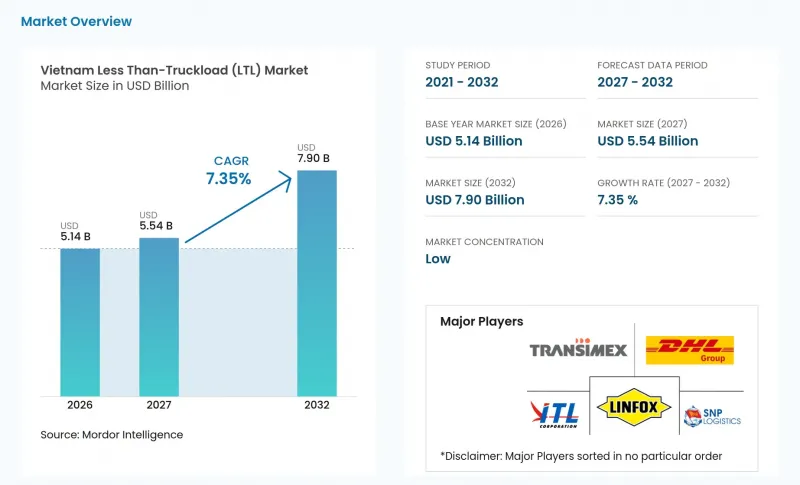
Manufacturing sourcing, e-commerce order fragmentation, and modern retail expansion are increasing the need to consolidate smaller shipments across long domestic corridors. This report is Segmented by Destination (Domestic, International), by Temperature Control (Dry, Reefer), by End-User Industry (Agriculture, Fishing, and Forestry, Construction, Manufacturing, Oil and Gas, Mining and Quarrying, Wholesale and Retail Trade, Others), and by Region (Northern Vietnam, Central Vietnam, Southern Vietnam). The Market Forecasts are Provided in Terms of Value (USD).
Vietnam Less Than-Truckload (LTL) Market Trends and Insights
E-Commerce Growth Increasing Fragmented Shipment Consolidation Demand
The Vietnam less-than truckload (LTL) market benefits as live commerce and online retail create small, frequent orders that need collection and consolidation from regional fulfillment locations. Smaller loads are less suited to dedicated truck routes because shipment timing and destination patterns vary across the day. Vietnam's 2026 e-commerce rules are raising platform compliance and tax transparency requirements, which favor logistics providers able to meet documented service standards. Larger marketplaces can also set more consistent delivery requirements for their 3PL partners. This combination supports broader formalization of LTL services on e-commerce corridors.
Industrial Zone Expansion Strengthening Regional Distribution Demand
The Vietnam less-than truckload (LTL) market gains from the movement of components, packaging, finished goods, and maintenance supplies between factories and warehouses. The VSIP joint venture received approval for 5 industrial parks across Hai Phong, Nghe An, Hue, Ha Nam, and Ho Chi Minh City in 2026. Vietnam recorded USD 38.4 billion in registered FDI in 2025, with manufacturing receiving the largest share. These facilities create multi-directional freight flows that often do not justify full truckload capacity. Industrial clusters also create a clearer basis for terminal operators to build route density and scheduled collection services.
Fragmented Owner-Operators Limiting Capacity and Service Consistency
In 2025, 84% of Vietnamese trucks reportedly belonged to owner-operators operating fleets of fewer than 10 vehicles. This structure limits the ability of the Vietnam less-than truckload (LTL) market to standardize fleet technology and dispatch practices at scale. Decree 168/2024/ND-CP increased compliance requirements under the 2025 Road Traffic Law. Smaller carriers can find it difficult to plan rest periods and meet delivery windows without formal dispatch systems. The gap creates an opening for fleet-sharing and hub-and-spoke structures that let small owners access shared capacity. It also increases the value of operators that can offer documented, predictable service to institutional shippers.
Other drivers and restraints analyzed in the detailed report include:
- Modern Retail Expansion Increasing Frequent Replenishment Shipments
- Agricultural Export Growth Increasing Consolidated Freight Demand
- Empty Return Imbalances Reducing Long-Haul Network Efficiency
For complete list of drivers and restraints, kindly check the Table Of Contents.
Segment Analysis
Domestic shipments account for 65.78% of the Vietnam less-than truckload (LTL) market share in 2026. The domestic network serves North-Central-South manufacturing links and modern retail replenishment routes across the country. Vietnam's administrative and production geography creates regular inter-provincial flows of components, consumer goods, and packaging. These cargo movements often remain below a dedicated truckload. The Vietnam LTL industry can improve truck use by combining compatible loads at regional hubs. Domestic route density also gives operators a foundation for fixed schedules, repeat collections, and delivery commitments. Greater route consistency can make smaller shipments more practical for factories and retailers.
International LTL is forecast to register at a 9.39% CAGR from 2027 to 2032. Cambodia, Laos, and southwestern China are the principal cross-border areas. The ASEAN Customs Transit System is progressively simplifying procedures across 6 ASEAN member states. Cross-border freight requires stronger customs, documentation, and service controls than domestic routes. Seino-ITL Logistics planned to develop inter-regional domestic services while using ITL's nationwide footprint. This approach links domestic collection density with outward consolidation opportunities. International growth is therefore dependent on disciplined domestic hub operations as well as border connectivity.
Complete Report Scope:
- By Destination
- Domestic
- International
- By Temperature Control
- Dry
- Reefer
- By End-User Industry
- Agriculture, Fishing, and Forestry
- Construction
- Manufacturing
- Oil and Gas, Mining and Quarrying
- Wholesale and Retail Trade
- Others
- By Region
- Northern Vietnam
- Central Vietnam
- Southern Vietnam
List of Companies Covered in this Report:
- Indo Trans Logistics Corporation (ITL)
- Linfox
- Saigon Newport Corporation
- Transimex Corporation
- DHL Group
- DSV A/S (DB Schenker)
- CJ Logistics Vietnam
- ASG Corporation
- Kuehne+Nagel International AG
- A.P. Moller - Maersk
- CEVA Logistics (CMA CGM Group)
- Viettel Post Joint Stock Corporation
- GEODIS
- NX Group
- Bee Logistics Corporation
- LOGIVAN
- U&I Logistics Corporation
- Vietnam Post Logistics
- MP Logistics
- VINATRANS
- Royal Cargo Vietnam
Additional Benefits:
- The market estimate (ME) sheet in Excel format
- 3 months of analyst support
TABLE OF CONTENTS
1 INTRODUCTION
- 1.1 Study Assumptions and Market Definition
- 1.2 Scope of the Study
2 RESEARCH METHODOLOGY
3 EXECUTIVE SUMMARY
- 3.1 Market Size, Growth, and Forecast Outlook
- 3.2 Key Demand Drivers and Operating Trends
- 3.3 Regional Freight Corridors and Demand Concentration
- 3.4 Competitive Landscape and Leading LTL Service Providers
4 MARKET LANDSCAPE
- 4.1 Market Overview and Importance of Less Than Truck Load Transportation
- 4.2 Market Drivers
- 4.2.1 E-commerce Growth Increasing Fragmented Shipment Consolidation Demand
- 4.2.2 Industrial Zone Expansion Strengthening Regional Distribution Demand
- 4.2.3 Modern Retail Expansion Increasing Frequent Replenishment Shipments
- 4.2.4 Agricultural Export Growth Increasing Consolidated Freight Demand
- 4.2.5 Digital Freight Matching Improving Backhaul Utilization Efficiency
- 4.2.6 Nationwide Network Professionalization Improving Service Coverage Reliability
- 4.3 Market Restraints
- 4.3.1 Fragmented Owner Operators Limiting Capacity and Service Consistency
- 4.3.2 Empty Return Imbalances Reducing Long-Haul Network Efficiency
- 4.3.3 Urban Congestion Disrupting Pickup and Delivery Reliability
- 4.3.4 Cold Chain Compliance Increasing Energy and Operating Costs
- 4.4 Value Chain Structure and Supply Dynamics Analysis
- 4.5 Regulatory Framework and Road Freight Compliance Landscape
- 4.6 Technology Adoption and Digitalization Trends in LTL
- 4.7 LTL Freight Rates and Pricing Structure Analysis
- 4.8 Industrial Zone and Distribution Network Expansion Analysis
- 4.9 Cross-Border Trucking and Border Gateway Flow Analysis
- 4.10 Major Freight Corridors and Route Density Analysis
- 4.11 Porter's Five Forces Analysis
- 4.11.1 Threat of New Entrants
- 4.11.2 Bargaining Power of Buyers and Consumers
- 4.11.3 Bargaining Power of Suppliers
- 4.11.4 Threat of Substitute Services
- 4.11.5 Intensity of Competitive Rivalry
- 4.12 Impact of Geo-Political Events on Supply Chain Shifts
5 MARKET SIZE AND GROWTH FORECASTS
- 5.1 By Destination
- 5.1.1 Domestic
- 5.1.2 International
- 5.2 By Temperature Control
- 5.2.1 Dry
- 5.2.2 Reefer
- 5.3 By End-User Industry
- 5.3.1 Agriculture, Fishing, and Forestry
- 5.3.2 Construction
- 5.3.3 Manufacturing
- 5.3.4 Oil and Gas, Mining and Quarrying
- 5.3.5 Wholesale and Retail Trade
- 5.3.6 Others
- 5.4 By Region
- 5.4.1 Northern Vietnam
- 5.4.2 Central Vietnam
- 5.4.3 Southern Vietnam
6 COMPETITIVE LANDSCAPE
- 6.1 Market Concentration
- 6.2 Strategic Moves
- 6.3 Market Share Analysis
- 6.4 Company Profiles (includes Global Level Overview, Market Level Overview, Core Segments, Financials as available, Strategic Information, Geographic Coverage, Products and Services, Recent Developments)
- 6.4.1 Indo Trans Logistics Corporation (ITL)
- 6.4.2 Linfox
- 6.4.3 Saigon Newport Corporation
- 6.4.4 Transimex Corporation
- 6.4.5 DHL Group
- 6.4.6 DSV A/S (DB Schenker)
- 6.4.7 CJ Logistics Vietnam
- 6.4.8 ASG Corporation
- 6.4.9 Kuehne+Nagel International AG
- 6.4.10 A.P. Moller - Maersk
- 6.4.11 CEVA Logistics (CMA CGM Group)
- 6.4.12 Viettel Post Joint Stock Corporation
- 6.4.13 GEODIS
- 6.4.14 NX Group
- 6.4.15 Bee Logistics Corporation
- 6.4.16 LOGIVAN
- 6.4.17 U&I Logistics Corporation
- 6.4.18 Vietnam Post Logistics
- 6.4.19 MP Logistics
- 6.4.20 VINATRANS
- 6.4.21 Royal Cargo Vietnam
7 MARKET OPPORTUNITIES AND FUTURE OUTLOOK
- 7.1 White-Space Opportunities and Unmet Market Needs
- 7.2 High-Potential End-User and Regional Opportunity Areas
- 7.3 Strategic Growth Priorities Across the LTL Ecosystem
- 7.4 Future Market Outlook and Emerging Demand Pockets
8 APPENDIX

