PUBLISHER: Mordor Intelligence | PRODUCT CODE: 2195035

PUBLISHER: Mordor Intelligence | PRODUCT CODE: 2195035
Managed Digital Mailroom Services - Market Share Analysis, Industry Trends & Statistics, Growth Forecasts (2027 - 2032)
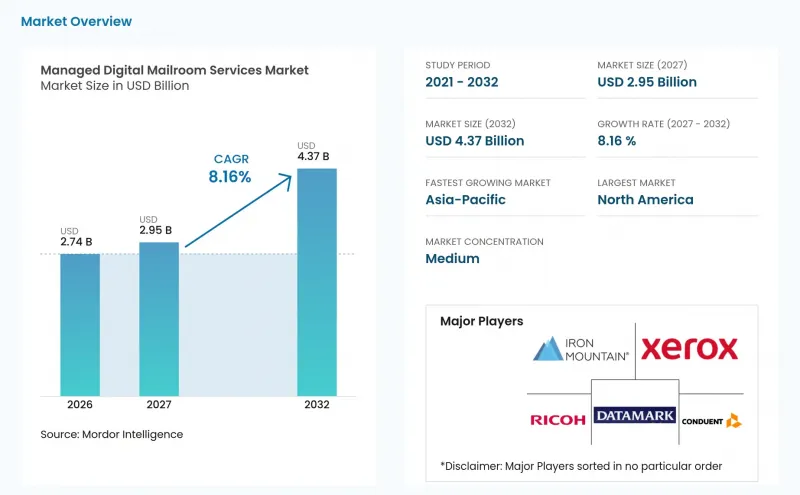
According to Mordor Intelligence, the managed digital mailroom services market size is projected to expand from USD 2.74 billion in 2026 to USD 4.37 billion by 2032, registering a CAGR of 8.16% between 2027 and 2032.
Global Managed Digital Mailroom Services Market Trends and Insights
AI-Enabled Intelligent Document Processing Reshapes Straight-Through Routing Economics
Generative AI and large language models are expanding document processing beyond optical character recognition and basic classification. These tools can handle unstructured, multilingual, and mixed-format correspondence with less reliance on predefined templates. The Managed Digital Mailroom Services Market gains from this capability because difficult correspondence can move into wider automation workflows, including legal claims and multi-jurisdiction filings that previously required greater manual review. Baloise used Liberty IDP to raise the straight-through processing rate for inbound communications from 15% to 65% by 2025 across an intake operation handling 11,000 documents each day. This result reduced the level of daily manual intervention needed for document handling. Providers are therefore moving away from labor-based pricing toward contracts tied to data quality, processing outcomes, and downstream workflow speed.
Hybrid Work Creates Structural Demand for Remote Mail Access
Hybrid work has made physical mail backlogs an ongoing operational concern for organizations with time-sensitive legal, financial, and compliance correspondence. Iron Mountain reported that 79% of U.S. employees work in a hybrid or remote capacity, which can leave distributed teams unable to access documents delivered to a central office. The Managed Digital Mailroom Services Market benefits when organizations use digital intake as a primary access channel rather than a secondary support process, particularly where documents need prompt review by staff working from different locations. This change can expand the scope of managed service agreements because scanning, routing, access controls, and user adoption must work together. DocSolid launched Airmail2 Cloud for hybrid workplaces in January 2025 and later released a mobile application for secure daily mail access. Organizations that postponed digital mailroom programs are shortening their implementation schedules to address this access gap.
Cybersecurity and Cross-Border Data Governance Risk Constrain Off-Site Aggregation
Centralized off-site processing can create an attractive target for cyber intrusion because it brings sensitive correspondence into a shared operating environment. The Managed Digital Mailroom Services Market requires providers to maintain encryption, role-based access controls, immutable audit trails, SOC 2 Type II attestation, and ISO 27001 certification where clients require them. Cross-border data rules add further complexity for operators that serve regulated customers across several jurisdictions and need to demonstrate where information is received, processed, stored, and accessed. GDPR transfer restrictions, the European Union Digital Operational Resilience Act, and U.S. state privacy rules can require geographically distributed processing instead of volume consolidation. Financial services and healthcare customers remain accountable for failures by third-party processors under their own compliance responsibilities. This makes the Managed Digital Mailroom Services Market dependent on verifiable custody procedures and clear data handling controls during provider selection.
Other drivers and restraints analyzed in the detailed report include:
- Lower Document Cycle Times and Cost-to-Serve Strengthen Enterprise ROI Cases
- Outsourcing in Regulated Document Operations Expands Service Scope
- Legacy ERP, CRM, and Content-System Integration Complexity Slows Large-Enterprise Adoption
For complete list of drivers and restraints, kindly check the Table Of Contents.
Segment Analysis
Mail scanning and image capture held 24.32% of the Managed Digital Mailroom Services Market share in 2026 because it forms the intake layer for downstream services. Scanning by itself, however, has less commercial value when clients can obtain extraction, classification, and routing under the same agreement. Data capture and extraction is projected to expand at a 9.12% CAGR through 2032. This service produces structured, system-ready information rather than image files that require manual re-entry. That difference supports organizations that need data to move into ERP, claims management, and customer relationship systems.
Document sorting and classification are becoming more useful as machine learning models are trained on industry-specific document types. Workflow automation and enterprise integration are also moving from discrete implementation projects into ongoing service arrangements. Clients need routing rules to change with their application environments and internal workflows. Digital archiving and records disposition add a compliance element to the Managed Digital Mailroom Services Market. These services are relevant for broker-dealers subject to SEC Rule 17a-4 WORM storage requirements and for organizations managing SOX seven-year retention obligations.
Complete Report Scope:
- By Service Type
- Mail Scanning and Image Capture
- Document Sorting and Classification
- Data Capture and Extraction
- Workflow Automation and Enterprise Integration
- Digital Archiving and Records Disposition
- Outbound Mail and Interoffice Redelivery
- By Service Delivery Model
- Off-Site Outsourced Managed Service
- On-Site Outsourced Managed Service
- Hybrid Co-Managed Service
- By End User
- Banking, Financial Services, and Insurance
- Healthcare
- Government and Public Sector
- Legal and Professional Services
- Retail and E-Commerce
- Transportation and Logistics
- Energy and Utilities
- Other End Users
- By Geography
- North America
- United States
- Canada
- Mexico
- South America
- Brazil
- Argentina
- Colombia
- Rest of South America
- Europe
- Germany
- United Kingdom
- France
- Italy
- Spain
- Rest of Europe
- Asia-Pacific
- China
- Japan
- India
- South Korea
- Southeast Asia
- Australia
- Rest of Asia-Pacific
- Middle East
- Turkey
- Saudi Arabia
- United Arab Emirates
- Israel
- Rest of Middle East
- Africa
- South Africa
- Nigeria
- Egypt
- Rest of Africa
- North America
Geography Analysis
North America held 38.21% of the Managed Digital Mailroom Services Market share in 2026, supported by enterprise demand in banking, financial services, insurance, healthcare, and federal contracting. The United States represents most regional revenue because buyers often seek integrated technology and managed service arrangements. HIPAA, SOX, GLBA, and state data protection laws create explicit handling and audit requirements. Iron Mountain began work on a U.S. Department of the Treasury digitization contract in June 2025 after the award in April 2025, and the Internal Revenue Service contract adds a separate reference point for large-scale federal mail digitalization. Canada and Mexico provide additional demand through regulated sectors and public-sector digitization work.
Europe is the second-largest regional contributor to the Managed Digital Mailroom Services Market, with Germany, the United Kingdom, and France as the principal revenue contributors. GDPR has made auditable document handling a regular procurement requirement, which supports specialized managed service offerings. NHS England reported a 97.8% reduction in carbon emissions per appointment letter for its digital approach compared with paper correspondence in April 2025. Ricoh UK started a 4-year print and mail services contract with the London Borough of Camden in January 2026, valued at GBP 4.8 million, which was reported as USD 5.9 million. The United Kingdom Digital Document Solutions framework, which runs through March 2027, provides a structured route for public-sector procurement.
Asia-Pacific is projected to expand at a 9.63% CAGR through 2032, making it the fastest-growing geography. India, China, Japan, South Korea, and Southeast Asia are increasing demand for cloud-delivered and multilingual document processing, supported by electronic records mandates and e-governance initiatives. Multinational enterprises also need support for jurisdiction-specific data residency requirements across the region. South America remains a smaller contributor with Brazil and Colombia leading adoption, while the Middle East and Africa are earlier-stage markets supported by demand in the United Arab Emirates, Saudi Arabia, Nigeria, Egypt, and South Africa.
- Iron Mountain Incorporated
- Xerox Corporation
- Ricoh Company, Ltd.
- Conduent Incorporated
- DATAMARK, Inc.
- OPEX Corporation
- Pitney Bowes Inc.
- Canon Inc.
- SPS Holding AG
- Quadient, Inc.
- XBP Global Holdings, Inc.
- Restore plc
- Kodak Alaris Inc.
- MetaSource, LLC
- Exela Technologies, Inc.
- Konica Minolta, Inc.
- Swiss Post Solutions AG
- Williams Lea Limited
- Epiq Systems, Inc.
- Kofax, Inc.
- ABBYY USA Software House, Inc.
- DocuWare GmbH
- Hyland Software, Inc.
- ibml, Inc.
- Canon Solutions America, Inc.
Additional Benefits:
- The market estimate (ME) sheet in Excel format
- 3 months of analyst support
TABLE OF CONTENTS
1 INTRODUCTION
- 1.1 Study Assumptions and Market Definition
- 1.2 Scope of the Study
2 RESEARCH METHODOLOGY
3 EXECUTIVE SUMMARY
4 MARKET LANDSCAPE
- 4.1 Market Overview
- 4.2 Impact of Macroeconomic Factors on the Market
- 4.3 Market Drivers
- 4.3.1 Enterprise Shift to Hybrid Work and Remote Mail Access
- 4.3.2 Demand for Lower Document Cycle Times and Cost-to-Serve
- 4.3.3 AI-Enabled Intelligent Document Processing and Straight-Through Routing
- 4.3.4 Regulatory Demand for Auditable Records and Data Privacy
- 4.3.5 Outsourcing of Document-Intensive Operations in Regulated Industries
- 4.3.6 Physical-to-Digital Sustainability and Space Optimization
- 4.4 Market Restraints
- 4.4.1 Cybersecurity and Cross-Border Data Governance Risk
- 4.4.2 Legacy ERP, CRM, and Content-System Integration Complexity
- 4.4.3 High Implementation and Change-Management Costs for Smaller Buyers
- 4.4.4 Human-in-the-Loop Requirements for Low-Quality and Unstructured Documents
- 4.5 Industry Value Chain Analysis
- 4.6 Regulatory Landscape
- 4.7 Technological Outlook
- 4.8 Porter's Five Forces Analysis
- 4.8.1 Bargaining Power of Suppliers Analysis
- 4.8.2 Bargaining Power of Buyers Analysis
- 4.8.3 Threat of New Entrants Analysis
- 4.8.4 Threat of Substitutes Analysis
- 4.8.5 Rivalry Among Existing Competitors Analysis
5 MARKET SIZE AND GROWTH FORECASTS (VALUE)
- 5.1 By Service Type
- 5.1.1 Mail Scanning and Image Capture
- 5.1.2 Document Sorting and Classification
- 5.1.3 Data Capture and Extraction
- 5.1.4 Workflow Automation and Enterprise Integration
- 5.1.5 Digital Archiving and Records Disposition
- 5.1.6 Outbound Mail and Interoffice Redelivery
- 5.2 By Service Delivery Model
- 5.2.1 Off-Site Outsourced Managed Service
- 5.2.2 On-Site Outsourced Managed Service
- 5.2.3 Hybrid Co-Managed Service
- 5.3 By End User
- 5.3.1 Banking, Financial Services, and Insurance
- 5.3.2 Healthcare
- 5.3.3 Government and Public Sector
- 5.3.4 Legal and Professional Services
- 5.3.5 Retail and E-Commerce
- 5.3.6 Transportation and Logistics
- 5.3.7 Energy and Utilities
- 5.3.8 Other End Users
- 5.4 By Geography
- 5.4.1 North America
- 5.4.1.1 United States
- 5.4.1.2 Canada
- 5.4.1.3 Mexico
- 5.4.2 South America
- 5.4.2.1 Brazil
- 5.4.2.2 Argentina
- 5.4.2.3 Colombia
- 5.4.2.4 Rest of South America
- 5.4.3 Europe
- 5.4.3.1 Germany
- 5.4.3.2 United Kingdom
- 5.4.3.3 France
- 5.4.3.4 Italy
- 5.4.3.5 Spain
- 5.4.3.6 Rest of Europe
- 5.4.4 Asia-Pacific
- 5.4.4.1 China
- 5.4.4.2 Japan
- 5.4.4.3 India
- 5.4.4.4 South Korea
- 5.4.4.5 Southeast Asia
- 5.4.4.6 Australia
- 5.4.4.7 Rest of Asia-Pacific
- 5.4.5 Middle East
- 5.4.5.1 Turkey
- 5.4.5.2 Saudi Arabia
- 5.4.5.3 United Arab Emirates
- 5.4.5.4 Israel
- 5.4.5.5 Rest of Middle East
- 5.4.6 Africa
- 5.4.6.1 South Africa
- 5.4.6.2 Nigeria
- 5.4.6.3 Egypt
- 5.4.6.4 Rest of Africa
- 5.4.1 North America
6 COMPETITIVE LANDSCAPE
- 6.1 Market Concentration
- 6.2 Strategic Moves
- 6.3 Market Share Analysis
- 6.4 Company Profiles (includes Global Level Overview, Market Level Overview, Core Segments, Financials as available, Strategic Information, Market Rank/Share, Products and Services, Recent Developments)
- 6.4.1 Iron Mountain Incorporated
- 6.4.2 Xerox Corporation
- 6.4.3 Ricoh Company, Ltd.
- 6.4.4 Conduent Incorporated
- 6.4.5 DATAMARK, Inc.
- 6.4.6 OPEX Corporation
- 6.4.7 Pitney Bowes Inc.
- 6.4.8 Canon Inc.
- 6.4.9 SPS Holding AG
- 6.4.10 Quadient, Inc.
- 6.4.11 XBP Global Holdings, Inc.
- 6.4.12 Restore plc
- 6.4.13 Kodak Alaris Inc.
- 6.4.14 MetaSource, LLC
- 6.4.15 Exela Technologies, Inc.
- 6.4.16 Konica Minolta, Inc.
- 6.4.17 Swiss Post Solutions AG
- 6.4.18 Williams Lea Limited
- 6.4.19 Epiq Systems, Inc.
- 6.4.20 Kofax, Inc.
- 6.4.21 ABBYY USA Software House, Inc.
- 6.4.22 DocuWare GmbH
- 6.4.23 Hyland Software, Inc.
- 6.4.24 ibml, Inc.
- 6.4.25 Canon Solutions America, Inc.
7 MARKET OPPORTUNITIES AND FUTURE OUTLOOK
- 7.1 White-Space and Unmet-Need Assessment

