PUBLISHER: Mordor Intelligence | PRODUCT CODE: 2195036

PUBLISHER: Mordor Intelligence | PRODUCT CODE: 2195036
Managed Document Workflow Optimization Services - Market Share Analysis, Industry Trends & Statistics, Growth Forecasts (2027 - 2032)
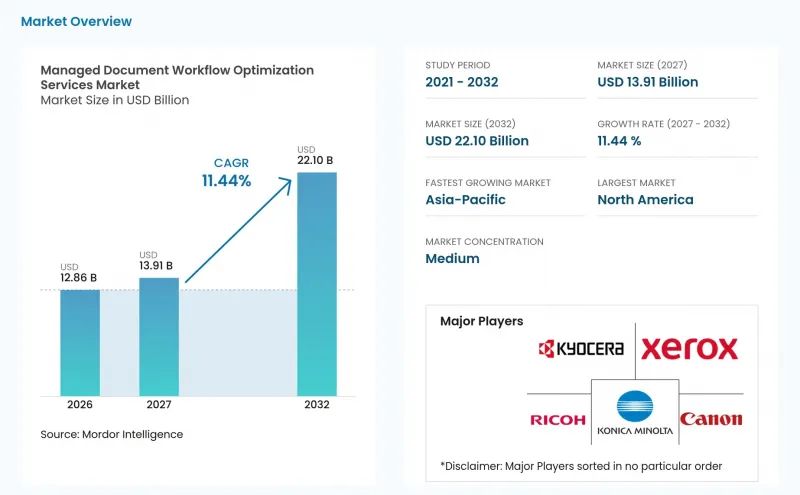
According to Mordor Intelligence, the managed document workflow optimization services market size is projected to expand from USD 12.86 billion in 2026 and USD 14.33 billion in 2027 to USD 22.10 billion by 2032, registering a CAGR of 11.44% between 2027 to 2032.
Global Managed Document Workflow Optimization Services Market Trends and Insights
Enterprise Demand for Digital Workflow Automation
Organizations are seeking to reduce delays in document-intensive work, which supports adoption across the managed document workflow optimization services market. The need extends beyond invoice handling to onboarding, human resources files, contract review, licenses, permits, and compliance documentation. These uses place document workflows closer to customer-facing and operational processes. Managed providers can therefore compete on shorter approval cycles and clearer service outcomes rather than on digitization alone. This approach is particularly relevant for financial institutions and public agencies that must process large volumes while maintaining documented control. It also creates demand for contracts that cover ongoing operation, performance review, and workflow improvement.
AI-Enabled Intelligent Document Processing
AI-enabled document processing is changing how providers extract information and manage exceptions in the managed document workflow optimization services market. ABBYY introduced Vantage 3.0 in January 2026 with direct large language model integration, real-time processing insights, and compliance and redaction capabilities. In October 2026, ABBYY introduced PHOENIX Plus, a generative AI layer for Vantage that supports zero-shot extraction across variable document types. These releases show that providers are reducing their reliance on predefined templates and labeled training data. The commercial value increasingly rests on integration, quality controls, governance, and the ability to support complex document sets. This gives managed providers an opportunity to operate and refine the technology after deployment.
Legacy-System Integration Complexity
Legacy enterprise resource planning, customer relationship management, and content systems can delay a managed document workflow optimization services market deployment. A provider may need to connect old data models, custom workflows, security controls, and informal business practices before the new service can operate fully. This work can extend implementation timelines and postpone the benefits expected from automation. It can also create internal resistance when business units have developed familiar workarounds. Modular connectors and staged migration plans can reduce disruption, but they require careful governance. Providers that support integration without forcing immediate replacement of core systems can make this constraint more manageable.
Other drivers and restraints analyzed in the detailed report include:
- Cloud Migration and Hybrid Workplace Enablement
- Regulatory Compliance and Auditability Requirements
- Data Privacy, Security and Sovereignty Concerns
For complete list of drivers and restraints, kindly check the Table Of Contents.
Segment Analysis
Managed Workflow Automation and Orchestration Services held 26.91% of the managed document workflow optimization services market share in 2026 and is projected to expand at a 12.67% CAGR through 2032. Its position shows that buyers are placing greater value on routing, approvals, exceptions, and decisions than on document storage alone. These services are integrated with operational systems, which makes them harder to replace once embedded. They are also relevant when organizations need consistent handling across multiple document types and business units. Tungsten Automation announced its Tungsten Automation Platform in September 2025, combining document automation, workflow orchestration, and knowledge discovery. The platform illustrates how providers are combining tools that were previously offered separately.
Managed Document Capture and Digitization Services and Managed Document Storage and Archiving Services remain important where paper records and retention obligations are still significant. Managed Document Security and Compliance Services serves organizations that need documented controls and audit-ready records. Managed Document Analytics and Process Optimization Services uses performance information from workflows to identify delays and recurring exceptions. Managed Document Integration and Migration Services is needed when organizations move content and workflow processes between platforms. Together, these categories show that the managed document workflow optimization services market includes both established records services and higher-value operating services. Providers that connect these activities can reduce handoffs between capture, storage, automation, and governance.
Complete Report Scope:
- By Service Type
- Managed Document Capture and Digitization Services
- Managed Document Storage and Archiving Services
- Managed Workflow Automation and Orchestration Services
- Managed Document Security and Compliance Services
- Managed Document Analytics and Process Optimization Services
- Managed Document Integration and Migration Services
- By Technology
- Optical Character Recognition and Intelligent Capture
- Natural Language Processing and Large Language Models
- Machine Learning and Deep Learning
- Robotic Process Automation Integration
- Process Mining and Workflow Analytics
- Identity, Security and Zero-Trust Technologies
- By End User
- Banking, Financial Services and Insurance
- Government and Public Sector
- Healthcare and Life Sciences
- Manufacturing and Industrial
- Retail and Consumer Goods
- Telecommunications and Information Technology
- Legal and Professional Services
- Other End Users
- By Geography
- North America
- United States
- Canada
- Mexico
- South America
- Brazil
- Argentina
- Rest of South America
- Europe
- United Kingdom
- Germany
- France
- Italy
- Spain
- Rest of Europe
- Asia-Pacific
- China
- Japan
- India
- South Korea
- Rest of Asia-Pacific
- Middle East
- United Arab Emirates
- Saudi Arabia
- Turkey
- Rest of Middle East
- Africa
- South Africa
- Nigeria
- Rest of Africa
- North America
Geography Analysis
North America held 41.99% of the managed document workflow optimization services market in 2026. The region has a large base of financial services and healthcare organizations, along with established managed-services buying practices and extensive document-processing requirements. Providers are converting hardware-oriented managed print arrangements into broader workflow contracts that include capture, compliance reporting, process analysis, and continuous service management. Xerox reported cumulative run-rate gross cost savings exceeding USD 500 million through the end of 2025 and completed the Lexmark acquisition for USD 768 million. The transaction expanded Xerox's portfolio and manufacturing footprint, supporting its move toward services-led offerings.
Europe is a major center for compliant document operations because organizations must respond to GDPR, DORA, the EU AI Act, and national rules. These frameworks increase the need for traceable workflows and controlled data handling. Hyland's 2025 European cloud and AI initiative shows that platform suppliers are addressing this demand through cloud-native content capabilities. Asia-Pacific is projected to expand at a 12.79% CAGR through 2032. Demand is supported by public-sector digitization, expanding enterprise adoption, and document needs in health, manufacturing, and financial services, which broadens the managed document workflow optimization services market.
South America is led by Brazil, where data protection requirements support demand for auditable document services. Argentina and other regional markets are earlier in cloud-based document workflow adoption, with financial services and retail among the active user groups. The Middle East is seeing government-led demand, including the UAE health-sector document standard. Africa represents a longer-term opportunity centered on financial inclusion, insurance expansion, telecommunications, and government digital identity programs. South Africa and Nigeria are likely focal points as public-sector requirements become more formal. These regional conditions give the managed document workflow optimization services market different entry points, ranging from enterprise modernization to government compliance programs.
- Xerox Holdings Corporation
- Ricoh Company, Ltd.
- Konica Minolta, Inc.
- Canon Inc.
- Kyocera Document Solutions Inc.
- Lexmark International, Inc.
- SHARP CORPORATION
- Toshiba Tec Corporation
- Seiko Epson Corporation
- FUJIFILM Business Innovation Corp.
- Pitney Bowes Inc.
- Open Text Corporation
- Hyland Software, Inc.
- Newgen Software Technologies Limited
- Laserfiche
- DocuWare GmbH
- ABBYY USA Software House Inc.
- Tungsten Automation Corporation
- PaperCut Software Pty Ltd
- Pharos Systems International, Inc.
- Vasion, Inc.
- Process Fusion, Inc.
Additional Benefits:
- The market estimate (ME) sheet in Excel format
- 3 months of analyst support
TABLE OF CONTENTS
1 INTRODUCTION
- 1.1 Study Assumptions and Market Definition
- 1.2 Scope of the Study
2 RESEARCH METHODOLOGY
3 EXECUTIVE SUMMARY
4 MARKET LANDSCAPE
- 4.1 Market Overview
- 4.2 Impact of Macroeconomic Factors on the Market
- 4.3 Market Drivers
- 4.3.1 Enterprise Demand for Digital Workflow Automation
- 4.3.2 Cloud Migration and Hybrid Workplace Enablement
- 4.3.3 Regulatory Compliance and Auditability Requirements
- 4.3.4 AI-Enabled Intelligent Document Processing
- 4.3.5 Verticalization of Document-Centric Business Processes
- 4.3.6 Under-Documented Driver: Workflow Telemetry as a Continuous Optimization Asset
- 4.4 Market Restraints
- 4.4.1 Legacy-System Integration Complexity
- 4.4.2 Data Privacy, Security and Sovereignty Concerns
- 4.4.3 Implementation, Change Management and Recurring Service Costs
- 4.4.4 Under-Documented Restraint: Confidence Loss from Low-Quality AI Extraction on Exceptional Documents
- 4.5 Industry Value Chain Analysis
- 4.6 Regulatory Landscape
- 4.7 Technological Outlook
- 4.8 Porter's Five Forces Analysis
- 4.8.1 Threat of New Entrants
- 4.8.2 Bargaining Power of Suppliers
- 4.8.3 Bargaining Power of Buyers
- 4.8.4 Threat of Substitutes
- 4.8.5 Competitive Rivalry
5 MARKET SIZE AND GROWTH FORECASTS (VALUE)
- 5.1 By Service Type
- 5.1.1 Managed Document Capture and Digitization Services
- 5.1.2 Managed Document Storage and Archiving Services
- 5.1.3 Managed Workflow Automation and Orchestration Services
- 5.1.4 Managed Document Security and Compliance Services
- 5.1.5 Managed Document Analytics and Process Optimization Services
- 5.1.6 Managed Document Integration and Migration Services
- 5.2 By Technology
- 5.2.1 Optical Character Recognition and Intelligent Capture
- 5.2.2 Natural Language Processing and Large Language Models
- 5.2.3 Machine Learning and Deep Learning
- 5.2.4 Robotic Process Automation Integration
- 5.2.5 Process Mining and Workflow Analytics
- 5.2.6 Identity, Security and Zero-Trust Technologies
- 5.3 By End User
- 5.3.1 Banking, Financial Services and Insurance
- 5.3.2 Government and Public Sector
- 5.3.3 Healthcare and Life Sciences
- 5.3.4 Manufacturing and Industrial
- 5.3.5 Retail and Consumer Goods
- 5.3.6 Telecommunications and Information Technology
- 5.3.7 Legal and Professional Services
- 5.3.8 Other End Users
- 5.4 By Geography
- 5.4.1 North America
- 5.4.1.1 United States
- 5.4.1.2 Canada
- 5.4.1.3 Mexico
- 5.4.2 South America
- 5.4.2.1 Brazil
- 5.4.2.2 Argentina
- 5.4.2.3 Rest of South America
- 5.4.3 Europe
- 5.4.3.1 United Kingdom
- 5.4.3.2 Germany
- 5.4.3.3 France
- 5.4.3.4 Italy
- 5.4.3.5 Spain
- 5.4.3.6 Rest of Europe
- 5.4.4 Asia-Pacific
- 5.4.4.1 China
- 5.4.4.2 Japan
- 5.4.4.3 India
- 5.4.4.4 South Korea
- 5.4.4.5 Rest of Asia-Pacific
- 5.4.5 Middle East
- 5.4.5.1 United Arab Emirates
- 5.4.5.2 Saudi Arabia
- 5.4.5.3 Turkey
- 5.4.5.4 Rest of Middle East
- 5.4.6 Africa
- 5.4.6.1 South Africa
- 5.4.6.2 Nigeria
- 5.4.6.3 Rest of Africa
- 5.4.1 North America
6 COMPETITIVE LANDSCAPE
- 6.1 Market Concentration
- 6.2 Strategic Moves
- 6.3 Market Share Analysis
- 6.4 Company Profiles (includes Global Level Overview, Market Level Overview, Core Segments, Financials as available, Strategic Information, Market Rank/Share, Products and Services, Recent Developments)
- 6.4.1 Xerox Holdings Corporation
- 6.4.2 Ricoh Company, Ltd.
- 6.4.3 Konica Minolta, Inc.
- 6.4.4 Canon Inc.
- 6.4.5 Kyocera Document Solutions Inc.
- 6.4.6 Lexmark International, Inc.
- 6.4.7 SHARP CORPORATION
- 6.4.8 Toshiba Tec Corporation
- 6.4.9 Seiko Epson Corporation
- 6.4.10 FUJIFILM Business Innovation Corp.
- 6.4.11 Pitney Bowes Inc.
- 6.4.12 Open Text Corporation
- 6.4.13 Hyland Software, Inc.
- 6.4.14 Newgen Software Technologies Limited
- 6.4.15 Laserfiche
- 6.4.16 DocuWare GmbH
- 6.4.17 ABBYY USA Software House Inc.
- 6.4.18 Tungsten Automation Corporation
- 6.4.19 PaperCut Software Pty Ltd
- 6.4.20 Pharos Systems International, Inc.
- 6.4.21 Vasion, Inc.
- 6.4.22 Process Fusion, Inc.
7 MARKET OPPORTUNITIES AND FUTURE OUTLOOK
- 7.1 White-Space and Unmet-Need Assessment

