PUBLISHER: Mordor Intelligence | PRODUCT CODE: 2195038

PUBLISHER: Mordor Intelligence | PRODUCT CODE: 2195038
Europe Data Center Grid Infrastructure and Interconnection - Market Share Analysis, Industry Trends & Statistics, Growth Forecasts (2027 - 2032)
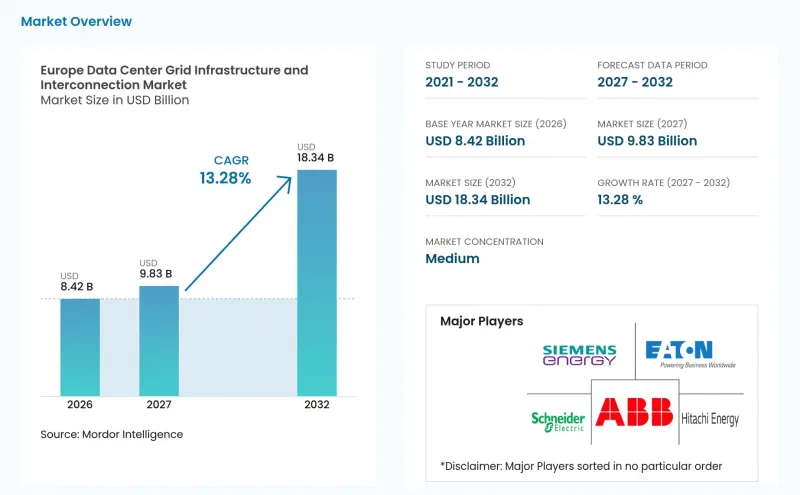
According to Mordor Intelligence, the Europe data center grid infrastructure and interconnection market size is projected to expand from USD 8.42 billion in 2026 to USD 9.83 billion in 2027, and to USD 18.34 billion by 2032, registering a CAGR of 13.28% between 2027 and 2032.
Europe Data Center Grid Infrastructure and Interconnection Market Trends and Insights
AI and Hyperscale Load Expansion Is Reshaping Grid Connection Demand at Scale
AI workloads require more than 7 times the power of conventional data center operations. Data center electricity use increased 17% in 2025, while AI-focused facilities expanded faster. Rack densities are moving from 10 kW toward 40-100 kW per rack. New campuses, therefore, need high-voltage or extra-high-voltage connections, larger transformers, stronger switchgear, and wider cables. Grid connection, control, and monitoring systems are projected to expand at a 14.29% CAGR through 2032. ENTSO-E has identified stability risks that conventional supervisory systems may not detect quickly enough.
Cloud Computing and Digitalization Sustain Baseline Grid Upgrade Demand
EU-27 installed data center capacity reached 9.9 GW of IT power supply in 2024. Cloud migration, public digital services, and legacy system replacement are creating connection requests outside major hubs. Many requests range from 5-50 MW and support upgrades to existing connections and substations. Older colocation facilities may need additional capacity as tenants add cloud and AI workloads. Schneider Electric reported accelerating data center orders in late 2025, with strength expected through 2026. This distributed demand supports work even when large greenfield projects face connection queues.
Grid Connection Queues and Transmission Capacity Shortages Compress Project Pipelines
Data center projects had requested 73 GW of grid capacity in the United Kingdom by mid-2025, compared with a peak demand of 45 GW. Not every project can therefore receive capacity on the requested timetable. Connection waits in major European hubs range from 7 to 10 years, with some delays reaching 13 years. Congestion cost the European Union EUR 4.3 billion (USD 4.80 billion) in 2024, excluding indirect project-delay costs. Capacity access is increasingly affecting hyperscaler location decisions. This favors locations with workable connection rules and available network capacity.
Other drivers and restraints analyzed in the detailed report include:
- Energy Efficiency and Renewable Integration Requirements Drive Substation Redesign
- Accelerating Grid Modernization Investment Opens New Interconnection Opportunities
- Long Lead Times for High-Voltage Transformers and Switchgear Delay Energization
For complete list of drivers and restraints, kindly check the Table Of Contents.
Segment Analysis
New grid connections held 43.12% of the Europe data center grid infrastructure and interconnection market share in 2026. The share reflects the volume of greenfield campuses entering development across Europe. Amazon committed EUR 33.7 billion (USD 39.8 billion) to a Spanish data center and AI infrastructure in March 2026. Blackstone also announced EUR 4.3 billion (USD 5.03 billion) for a further Aragon development phase in August 2025. These projects require dedicated grid connections, substations, and construction services.
Existing connection upgrades support demand as colocation and enterprise sites increase contracted capacity. Dedicated transmission infrastructure is more relevant for campuses distant from available network capacity. Transmission lines and cables are projected to expand at a 14.11% CAGR through 2032. In constrained hubs, the mix shifts toward costly upgrades and dedicated infrastructure. In emerging locations, new connections can have higher revenue per MW but require more engineering and permitting. The Europe data center grid infrastructure and interconnection industry serves both new campus construction and upgrades to established sites.
Substations and switchyards accounted for 29.84% of the Europe data center grid infrastructure and interconnection market size in 2026. Every large grid connection requires a substation or comparable switching installation. This supports the component's role across greenfield and upgrade projects. Power transformers are also critical, but their availability can affect delivery schedules. The supplied research reported a 30% supply deficit for large power transformers through 2027. Early procurement is therefore important for projects seeking firm energization dates.
Transmission lines and cables are gaining relevance as development extends beyond dense, established hubs. Nexans reported major data center cable contracts in Europe and the United States during 2026. Grid connection, control, and monitoring systems are projected to expand at a 14.29% CAGR through 2032. ENTSO-E has highlighted the need for detailed measurement of changing data center loads. Advanced metering and automated response systems support coordination between operators and transmission system operators. The Europe data center grid infrastructure industry can benefit from this activity even when physical construction slows.
Complete Report Scope:
- By Interconnection Project Type
- New Grid Connections
- Existing Connection Upgrades
- Dedicated Transmission Infrastructure
- Substation and Grid Interconnection Upgrades
- By Infrastructure Component
- Substations and Switchyards
- Power Transformers
- Transmission Lines and Cables
- Switchgear and Protection Systems
- Grid Connection, Control, and Monitoring Systems
- By Voltage Level
- Low and Medium Voltage
- High Voltage
- Extra-High Voltage
- By Data Center Size
- Small
- Medium
- Large
- Hyperscale
- By Data Center Type
- Colocation
- Cloud Service Providers (CSPs)
- Enterprise and Edge
- By Geography
- United Kingdom
- Germany
- France
- Netherlands
- Ireland
- Spain
- Italy
- Nordics
- Rest of Europe
List of Companies Covered in this Report:
- ABB Ltd.
- Schneider Electric SE
- Siemens Energy AG
- Eaton Corporation plc
- Hitachi Energy Ltd.
- GE Vernova Inc.
- Vertiv Holdings Co.
- Legrand SA
- Mitsubishi Electric Corporation
- Toshiba Energy Systems and Solutions Corporation
- SGB-SMIT Group
- Hyosung Heavy Industries Corporation
- Delta Electronics, Inc.
- Socomec Group
- Piller Power Systems
- Riello UPS S.p.A.
- AEG Power Solutions B.V.
- Bloom Energy Corporation
- Caverion Corporation
- Nexans S.A.
Additional Benefits:
- The market estimate (ME) sheet in Excel format
- 3 months of analyst support
TABLE OF CONTENTS
1 INTRODUCTION
- 1.1 Study Assumptions and Market Definition
- 1.2 Scope of the Study
2 RESEARCH METHODOLOGY
3 EXECUTIVE SUMMARY
4 MARKET LANDSCAPE
- 4.1 Market Overview
- 4.2 Impact of Macroeconomic Factors on the Market
- 4.3 Market Drivers
- 4.3.1 AI and Hyperscale Load Expansion
- 4.3.2 Cloud Computing and Digitalization Growth
- 4.3.3 Energy-Efficiency and Renewable Integration Requirements
- 4.3.4 Accelerating Grid Modernization Investment
- 4.3.5 Flexible Connection Agreements and Smart-Grid Adoption
- 4.3.6 AI-Driven Load Density Increasing Interconnection Spend per Site
- 4.4 Market Restraints
- 4.4.1 Grid Connection Queues and Transmission Capacity Shortages
- 4.4.2 Long Lead Times for High-Voltage Transformers and Switchgear
- 4.4.3 Shortage of Certified High-Voltage Engineering Talent
- 4.4.4 Dynamic Load Instability from AI Workloads and UPS Disconnection
- 4.5 Industry Value Chain Analysis
- 4.6 Regulatory Landscape
- 4.7 Technological Outlook
- 4.8 Porter's Five Forces Analysis
- 4.8.1 Bargaining Power of Suppliers
- 4.8.2 Bargaining Power of Buyers
- 4.8.3 Threat of New Entrants
- 4.8.4 Threat of Substitutes
- 4.8.5 Competitive Rivalry
5 MARKET SIZE AND GROWTH FORECASTS (VALUE)
- 5.1 By Interconnection Project Type
- 5.1.1 New Grid Connections
- 5.1.2 Existing Connection Upgrades
- 5.1.3 Dedicated Transmission Infrastructure
- 5.1.4 Substation and Grid Interconnection Upgrades
- 5.2 By Infrastructure Component
- 5.2.1 Substations and Switchyards
- 5.2.2 Power Transformers
- 5.2.3 Transmission Lines and Cables
- 5.2.4 Switchgear and Protection Systems
- 5.2.5 Grid Connection, Control, and Monitoring Systems
- 5.3 By Voltage Level
- 5.3.1 Low and Medium Voltage
- 5.3.2 High Voltage
- 5.3.3 Extra-High Voltage
- 5.4 By Data Center Size
- 5.4.1 Small
- 5.4.2 Medium
- 5.4.3 Large
- 5.4.4 Hyperscale
- 5.5 By Data Center Type
- 5.5.1 Colocation
- 5.5.2 Cloud Service Providers (CSPs)
- 5.5.3 Enterprise and Edge
- 5.6 By Geography
- 5.6.1 United Kingdom
- 5.6.2 Germany
- 5.6.3 France
- 5.6.4 Netherlands
- 5.6.5 Ireland
- 5.6.6 Spain
- 5.6.7 Italy
- 5.6.8 Nordics
- 5.6.9 Rest of Europe
6 COMPETITIVE LANDSCAPE
- 6.1 Market Concentration
- 6.2 Strategic Moves
- 6.3 Market Share Analysis
- 6.4 Company Profiles (includes Global Level Overview, Market Level Overview, Core Segments, Financials as available, Strategic Information, Market Rank/Share, Products and Services, Recent Developments)
- 6.4.1 ABB Ltd.
- 6.4.2 Schneider Electric SE
- 6.4.3 Siemens Energy AG
- 6.4.4 Eaton Corporation plc
- 6.4.5 Hitachi Energy Ltd.
- 6.4.6 GE Vernova Inc.
- 6.4.7 Vertiv Holdings Co.
- 6.4.8 Legrand SA
- 6.4.9 Mitsubishi Electric Corporation
- 6.4.10 Toshiba Energy Systems and Solutions Corporation
- 6.4.11 SGB-SMIT Group
- 6.4.12 Hyosung Heavy Industries Corporation
- 6.4.13 Delta Electronics, Inc.
- 6.4.14 Socomec Group
- 6.4.15 Piller Power Systems
- 6.4.16 Riello UPS S.p.A.
- 6.4.17 AEG Power Solutions B.V.
- 6.4.18 Bloom Energy Corporation
- 6.4.19 Caverion Corporation
- 6.4.20 Nexans S.A.
7 MARKET OPPORTUNITIES AND FUTURE OUTLOOK
- 7.1 White-Space and Unmet-Need Assessment

