PUBLISHER: Mordor Intelligence | PRODUCT CODE: 2195512

PUBLISHER: Mordor Intelligence | PRODUCT CODE: 2195512
Material Handling Equipment - Market Share Analysis, Industry Trends & Statistics, Growth Forecasts (2027 - 2032)
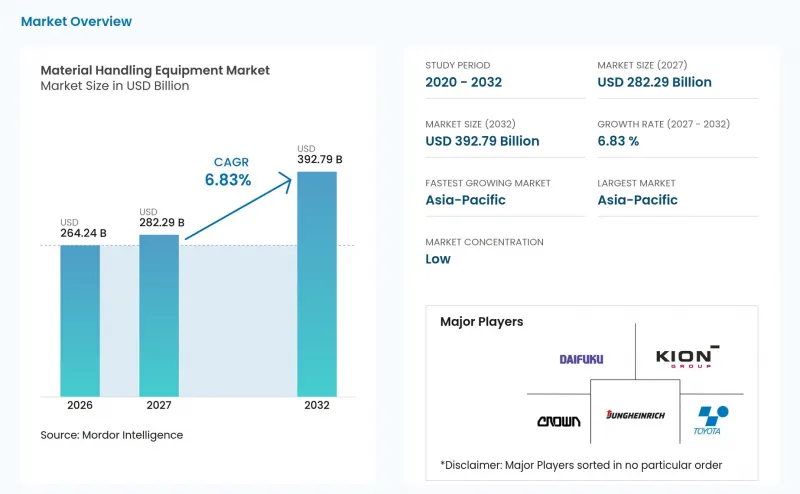
According to Mordor Intelligence, the material handling equipment market size was valued at USD 264.24 billion in 2026 and is forecast to expand from USD 282.29 billion in 2027 to reach USD 392.79 billion by 2032, growing at a CAGR of 6.83% from 2027 to 2032.
Global Material Handling Equipment Market Trends and Insights
E-Commerce Fulfillment Density and Shorter Delivery Windows
The material handling equipment market is gaining support from higher fulfillment activity and smaller order sizes. Online retail creates more frequent picking, sorting, replenishment, return handling, and packing work within a fixed warehouse footprint, so operators need to move more individual items without adding floor space. Retailers and third-party logistics providers are therefore adopting sortation lines, goods-to-person storage, conveyor-linked workstations, and improved task coordination where these tools align with their daily volume patterns. Faster delivery commitments also make system uptime more important across several shifts, since a delay in one process can affect packing, dispatch, and the availability of inventory for the next order cycle. This encourages investment in equipment that maintains an orderly flow of parcels and inventory while allowing managers to respond as order patterns or staffing needs change. The effect is especially important for engineered systems used in high-volume fulfillment settings, where process design and dependable service support can matter as much as the equipment itself.
Warehouse Labor Scarcity and Safety-Led Automation
Labor availability is influencing equipment decisions in warehouses that depend on repetitive movement, picking, loading, and replenishment tasks. Operators are seeking systems that reduce physical strain, support safer movement, and make processes more consistent across changing staffing levels without removing the flexibility needed for exceptions or unusual orders. Powered industrial truck rules in the United States also reinforce the need for clear operating practices, trained equipment use, well-organized travel routes, and equipment choices that fit workplace conditions. KION identifies skilled-worker shortages and rising labor costs as demand drivers for electric and automated handling solutions. The result is a growing preference for equipment that supports predictable processes and helps supervisors use available workers more effectively during periods of changing demand. These conditions make partial automation a practical step for operators who cannot redesign an entire facility at once but still need to improve the consistency of recurring tasks.
High Upfront Cost and Extended Payback for Integrated Systems
Integrated automation can require significant spending before an operator sees operating benefits. Storage, conveyors, software, controls, sorting equipment, site preparation, and commissioning work must often be designed together, which makes the decision more difficult than purchasing a standard piece of equipment. This creates a barrier for smaller shippers and third-party logistics providers with uncertain volumes, limited access to capital, or a need to preserve flexibility while customer demand changes. Rental and leasing can reduce the initial burden for some equipment categories, but they are less effective for highly customized systems with limited reuse outside the original facility. The material handling equipment market must therefore serve customers who favor phased projects, clear milestones, and equipment that can be expanded over time, as well as customers who can fund complete installations. Suppliers can reduce hesitation when they explain the operational changes, service needs, and practical project steps that underlie the initial equipment price.
Other drivers and restraints analyzed in the detailed report include:
- Manufacturing Reshoring and Distribution-Center Modernization
- Industrial Truck Electrification and Fleet Replacement Cycles
- Integration Complexity Across Legacy Controls and Warehouse Software
For complete list of drivers and restraints, kindly check the Table Of Contents.
Segment Analysis
Industrial trucks held 32.74% of the material handling equipment market share in 2026. Their position reflects the wide use of forklifts, pallet trucks, reach trucks, and warehouse vehicles across manufacturing, retail, logistics, construction, and many supporting distribution activities. These assets move a variety of loads between receiving areas, storage locations, production zones, packing stations, and shipping docks, so they remain essential even where a facility has automated certain processes. Storage and handling equipment includes racks, shelves, bins, and physical organization, enabling facilities to manage inventory accurately and use available space more effectively. Bulk handling systems serve process industries where a reliable, continuous flow of materials matters more than individual-item picking, including facilities that manage heavy or high-volume goods.
Engineered systems are forecast to grow at a 9.87% CAGR through 2032. Automated storage, sortation, palletizing, and connected conveyance can support sites where rising order volumes, labor limits, or delivery expectations make manual methods difficult to sustain on their own. These systems require careful planning because performance depends on the relationship between equipment, controls, building layout, inventory characteristics, and the people who supervise the operation. Industrial trucks remain important in automated facilities because they still support receiving, replenishment, exception handling, and dock work that may not be accommodated by a fixed system design. This broad set of customer needs keeps conventional equipment and engineered solutions relevant, while increasing the value of suppliers that can install, integrate, maintain, and improve both.
Manual operations accounted for 56.27% of revenue in 2026. The large installed base reflects continued use of conventional equipment across warehouses, factories, and distribution centers, particularly where work patterns, product sizes, and daily volumes can change quickly. Manual methods can suit smaller sites and variable tasks because operators can respond to unexpected conditions without the fixed design requirements of a fully automated system. Electric pallet trucks, improved storage design, digital task guidance, and clearer travel paths can enhance consistency without altering the overall operating model or disrupting facility operations. Semi-automated equipment offers an additional option for operators who want help with repetitive movement or lifting while keeping people involved in decisions that require judgment or flexibility.
Fully automated operation is forecast to grow at a 10.52% CAGR through 2032. Autonomous mobile robots, automated guided vehicles, and automated storage systems are used in defined workflows where continuity, repeatability, and process control have direct value for warehouse operators. Software coordinates routes, tasks, charging, equipment availability, and operating priorities across the facility, helping teams manage recurring work with less reliance on individual operating decisions. A measured deployment often starts in areas with repetitive tasks, clear operating rules, stable product flows, and visible performance needs before extending to other parts of the site. Suppliers must demonstrate that automated systems can operate safely alongside people and conventional equipment during the transition, while also providing training and service to/ help customers manage exceptions.
Complete Report Scope:
- By Equipment Type
- Storage and Handling (Racks, Shelving, Bins)
- Industrial Trucks (Forklifts, Pallet Trucks, AGVs/AMRs, Order Pickers)
- Bulk Material Handling (Conveyors, Stackers, Reclaimers)
- Engineered Systems (AS/RS, Sortation, Palletizers)
- By Operation
- Manual
- Semi-Automated
- Fully Automated
- By Power Source
- Electric (Lead-Acid, Li-ion)
- ICE (Diesel, LPG/CNG)
- Hydrogen Fuel Cell
- By Business Model
- New Sales
- Rental/Leasing
- Aftermarket and Services
- By End User
- E-commerce and Retail
- Food and Beverage
- Automotive
- Manufacturing
- 3PL/Logistics and Warehousing
- Pharmaceuticals
- Construction
- Others
- By Geography
- North America
- United States
- Canada
- Rest of North America
- Europe
- Germany
- United Kingdom
- France
- Italy
- Spain
- Netherlands
- Russia
- Rest of Europe
- Asia-Pacific
- China
- Japan
- India
- South Korea
- Australia
- Singapore
- Rest of Asia-Pacific
- South America
- Brazil
- Argentina
- Chile
- Colombia
- Rest of South America
- Middle East and Africa
- Saudi Arabia
- United Arab Emirates
- Turkey
- Israel
- South Africa
- Egypt
- Nigeria
- Rest of Middle East and Africa
- North America
Geography Analysis
Asia-Pacific held a 46.45% revenue share in 2026 and is forecast to grow at a 6.97% CAGR through 2032. China supports the region through manufacturing activity and demand from retail, logistics, and industrial users, while Japan and South Korea remain important for warehouse automation where labor availability and process consistency shape equipment decisions. India is adding warehouse and manufacturing capacity, creating demand for industrial trucks, storage systems, equipment service, and solutions that can be introduced in stages as sites expand. Southeast Asian markets are developing logistics and e-commerce infrastructure, which supports conventional equipment alongside selected automation as operators balance capital spending with the need to improve order handling. The material handling equipment market in Asia-Pacific gives suppliers a reason to build regional manufacturing, engineering, and service support because buyers differ widely in facility age, labor conditions, product mix, and readiness for automation.
North America is forecast to grow at a 6.31% CAGR through 2032. The region is modernizing distribution sites while adding capacity around domestic manufacturing investment, electric fleet replacement, and warehouse layouts that need to accommodate changing inventory flows and delivery expectations. The Reshoring Initiative linked 2025 manufacturing announcements to continuing domestic production and investment activity. Many customers need phased upgrades that can be installed while a site remains active, which places a premium on equipment compatibility, realistic installation plans, and suppliers that understand how daily work will continue during a project. The material handling equipment market can benefit when providers combine practical equipment choices with responsive service coverage, since an equipment delay can affect fulfillment schedules, production output, inventory access, and customer commitments.
Europe is forecast to grow at a 5.28% CAGR through 2032, supported by automotive supply chains, pharmaceutical logistics, and third-party warehousing. Germany, the Netherlands, and the United Kingdom remain important locations for advanced logistics operations, technology adoption, and customer demand for safe, energy-conscious equipment that can fit established facilities. South America is forecast to grow at a 5.04% CAGR, with Brazil central to demand and neighboring countries offering opportunities in cold-chain logistics, mining-related handling, and industrial distribution. Western Asia is forecast to grow at a 6.11% CAGR as Gulf logistics investment contrasts with earlier-stage industrial truck demand and more basic handling requirements in parts of Africa. The material handling equipment market across these regions requires products, financing options, service capacity, and deployment models that reflect major differences in infrastructure, labor conditions, customer budgets, and the ability to support advanced automation.
- Toyota Industries Corporation
- KION GROUP AG
- Daifuku Co., Ltd.
- Jungheinrich AG
- Mitsubishi Logisnext Co., Ltd.
- Crown Equipment Corporation
- Hyster-Yale Materials Handling, Inc.
- SSI SCHAFER GMBH & CO KG
- Murata Machinery, Ltd.
- KNAPP AG
- TGW Logistics Group GmbH
- BEUMER Group GmbH & Co. KG
- Hangcha Group Co., Ltd.
- Anhui Heli Co., Ltd.
- Columbus McKinnon Corporation
- Konecranes Plc
- Mecalux, S.A.
- WITRON Logistik + Informatik GmbH
Additional Benefits:
- The market estimate (ME) sheet in Excel format
- 3 months of analyst support
TABLE OF CONTENTS
1 INTRODUCTION
- 1.1 Study Assumptions and Market Definition
- 1.2 Scope of the Study
2 RESEARCH METHODOLOGY
3 EXECUTIVE SUMMARY
4 MARKET LANDSCAPE
- 4.1 Market Overview
- 4.2 Market Drivers
- 4.2.1 E-Commerce Fulfillment Density and Shorter Delivery Windows
- 4.2.2 Warehouse Labor Scarcity and Safety-Led Automation
- 4.2.3 Manufacturing Reshoring and Distribution-Center Modernization
- 4.2.4 Industrial Truck Electrification and Fleet Replacement Cycles
- 4.2.5 Brownfield Retrofit Demand from Legacy Warehouse Constraints
- 4.2.6 Interoperable Robotics and Software Lowering Automation Entry Barriers
- 4.3 Market Restraints
- 4.3.1 High Upfront Cost and Extended Payback for Integrated Systems
- 4.3.2 Integration Complexity Across Legacy Controls and Warehouse Software
- 4.3.3 Battery-Critical-Mineral Exposure and Charging-Infrastructure Bottlenecks
- 4.3.4 Project Delivery Risk from Site-Specific Engineering and Commissioning
- 4.4 Value / Supply-Chain Analysis
- 4.4.1 Raw Materials and Components
- 4.4.2 Equipment Design and Manufacturing
- 4.4.3 Systems Integration and Software
- 4.4.4 Distribution, Dealers and Rental Channels
- 4.4.5 Installation, Commissioning and Training
- 4.4.6 Spare Parts, Maintenance and Retrofits
- 4.4.7 Customer Value Capture and Total Cost of Ownership
- 4.5 Regulatory Landscape
- 4.5.1 Machine Safety and Guarding Requirements
- 4.5.2 Industrial Truck Operator Training and Workplace Safety
- 4.5.3 Autonomous Mobile Robot and Human-Robot Collaboration Safety
- 4.5.4 Battery, Charging and Hazardous-Material Requirements
- 4.5.5 Emissions, Noise and Indoor-Air-Quality Standards
- 4.5.6 Data, Cybersecurity and Critical-Infrastructure Rules
- 4.6 Technological Outlook
- 4.6.1 Lithium-Ion and Alternative Battery Architectures
- 4.6.2 Hydrogen Fuel-Cell Industrial Trucks
- 4.6.3 AGVs, AMRs and Fleet Orchestration
- 4.6.4 AS/RS, Shuttle and High-Density Storage
- 4.6.5 AI Vision, Digital Twins and Predictive Maintenance
- 4.6.6 WMS, WES, WCS and Interoperability Standards
- 4.6.7 Human-Robot Collaboration and Autonomous Forklifts
- 4.7 Porter's Five Forces Analysis
- 4.7.1 Threat of New Entrants
- 4.7.2 Bargaining Power of Buyers
- 4.7.3 Bargaining Power of Suppliers
- 4.7.4 Threat of Substitutes
- 4.7.5 Intensity of Competitive Rivalry
5 MARKET SIZE AND GROWTH FORECASTS (VALUE (USD) AND VOLUME (UNITS))
- 5.1 By Equipment Type
- 5.1.1 Storage and Handling (Racks, Shelving, Bins)
- 5.1.2 Industrial Trucks (Forklifts, Pallet Trucks, AGVs/AMRs, Order Pickers)
- 5.1.3 Bulk Material Handling (Conveyors, Stackers, Reclaimers)
- 5.1.4 Engineered Systems (AS/RS, Sortation, Palletizers)
- 5.2 By Operation
- 5.2.1 Manual
- 5.2.2 Semi-Automated
- 5.2.3 Fully Automated
- 5.3 By Power Source
- 5.3.1 Electric (Lead-Acid, Li-ion)
- 5.3.2 ICE (Diesel, LPG/CNG)
- 5.3.3 Hydrogen Fuel Cell
- 5.4 By Business Model
- 5.4.1 New Sales
- 5.4.2 Rental/Leasing
- 5.4.3 Aftermarket and Services
- 5.5 By End User
- 5.5.1 E-commerce and Retail
- 5.5.2 Food and Beverage
- 5.5.3 Automotive
- 5.5.4 Manufacturing
- 5.5.5 3PL/Logistics and Warehousing
- 5.5.6 Pharmaceuticals
- 5.5.7 Construction
- 5.5.8 Others
- 5.6 By Geography
- 5.6.1 North America
- 5.6.1.1 United States
- 5.6.1.2 Canada
- 5.6.1.3 Rest of North America
- 5.6.2 Europe
- 5.6.2.1 Germany
- 5.6.2.2 United Kingdom
- 5.6.2.3 France
- 5.6.2.4 Italy
- 5.6.2.5 Spain
- 5.6.2.6 Netherlands
- 5.6.2.7 Russia
- 5.6.2.8 Rest of Europe
- 5.6.3 Asia-Pacific
- 5.6.3.1 China
- 5.6.3.2 Japan
- 5.6.3.3 India
- 5.6.3.4 South Korea
- 5.6.3.5 Australia
- 5.6.3.6 Singapore
- 5.6.3.7 Rest of Asia-Pacific
- 5.6.4 South America
- 5.6.4.1 Brazil
- 5.6.4.2 Argentina
- 5.6.4.3 Chile
- 5.6.4.4 Colombia
- 5.6.4.5 Rest of South America
- 5.6.5 Middle East and Africa
- 5.6.5.1 Saudi Arabia
- 5.6.5.2 United Arab Emirates
- 5.6.5.3 Turkey
- 5.6.5.4 Israel
- 5.6.5.5 South Africa
- 5.6.5.6 Egypt
- 5.6.5.7 Nigeria
- 5.6.5.8 Rest of Middle East and Africa
- 5.6.1 North America
6 COMPETITIVE LANDSCAPE
- 6.1 Market Concentration
- 6.2 Strategic Moves
- 6.3 Market Share Analysis
- 6.4 Company Profiles (Includes Global Level Overview, Market Level Overview, Core Segments, Financials as available, Strategic Information, Market Rank/Share, Products and Services, Recent Developments)
- 6.4.1 Toyota Industries Corporation
- 6.4.2 KION GROUP AG
- 6.4.3 Daifuku Co., Ltd.
- 6.4.4 Jungheinrich AG
- 6.4.5 Mitsubishi Logisnext Co., Ltd.
- 6.4.6 Crown Equipment Corporation
- 6.4.7 Hyster-Yale Materials Handling, Inc.
- 6.4.8 SSI SCHAFER GMBH & CO KG
- 6.4.9 Murata Machinery, Ltd.
- 6.4.10 KNAPP AG
- 6.4.11 TGW Logistics Group GmbH
- 6.4.12 BEUMER Group GmbH & Co. KG
- 6.4.13 Hangcha Group Co., Ltd.
- 6.4.14 Anhui Heli Co., Ltd.
- 6.4.15 Columbus McKinnon Corporation
- 6.4.16 Konecranes Plc
- 6.4.17 Mecalux, S.A.
- 6.4.18 WITRON Logistik + Informatik GmbH
7 MARKET OPPORTUNITIES AND FUTURE OUTLOOK
- 7.1 White-Space and Unmet-Need Assessment

