PUBLISHER: Mordor Intelligence | PRODUCT CODE: 2196759

PUBLISHER: Mordor Intelligence | PRODUCT CODE: 2196759
Vietnam Construction Equipment - Market Share Analysis, Industry Trends & Statistics, Growth Forecasts (2027 - 2032)
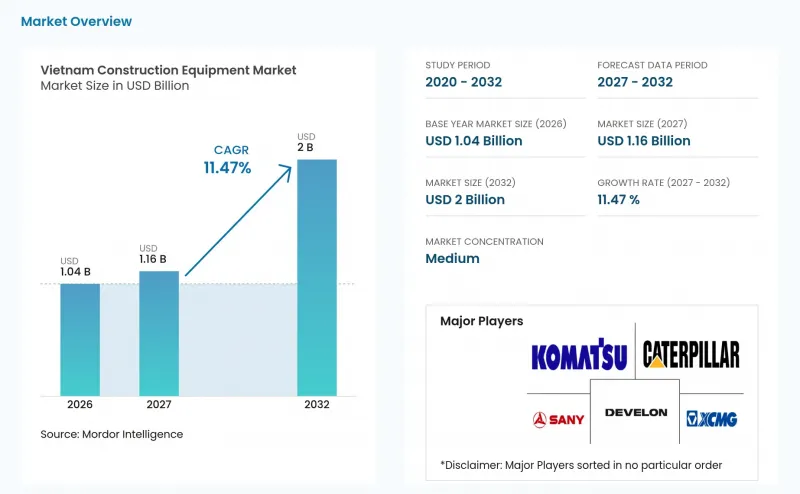
According to Mordor Intelligence, the Vietnam construction equipment market size was valued at USD 1.04 billion in 2026 and is expected to grow from USD 1.16 billion in 2027 to USD 2.00 billion by 2032, at a CAGR of 11.47% during 2027-2032.
Vietnam Construction Equipment Market Trends and Insights
Public Infrastructure and Transport Investment
Public investment remains an important source of demand for the Vietnam construction equipment market. Major road, expressway, railway, port, and urban transport works require excavators, rollers, pavers, drilling machines, cranes, and concrete equipment. The national expressway program is expanding construction activity across multiple provincial corridors, limiting contractors' ability to move idle equipment between sites. This pattern can keep rental fleets active while project owners schedule work in stages. The transport agenda also gives distributors a reason to strengthen field service capacity near active construction corridors. The quality and safety requirements under Vietnam's technical regulations favor suppliers that can demonstrate compliant equipment and dependable support.
Manufacturing FDI and Industrial-Park Expansion
Manufacturing investment is widening the construction base that supports the Vietnam construction equipment market. Industrial parks need site preparation, internal roads, drainage systems, factory foundations, warehouses, and utility connections before production starts. These requirements create demand for earthmoving, concrete, lifting, and materials-handling equipment. Established locations such as Binh Duong and Bac Ninh remain important, while Thai Nguyen, Ba Ria-Vung Tau, Tay Ninh, and Ha Nam add new activity. Kinh Bac's Phu Binh Industrial Park in Thai Nguyen illustrates the extension of high-technology construction into a northern midland location. Equipment demand can follow project announcements as developers move from land preparation to construction packages.
Imported-Equipment Cost Exposure and VND Depreciation
Vietnam depends heavily on imported construction equipment from Japan, China, South Korea, and Europe. Currency movements can raise local-currency equipment costs when suppliers price machines in foreign currencies. This pressure is difficult for contractors that have fixed-price contracts and limited flexibility to revise project budgets. It can also shift interest toward suppliers offering local financing or payment arrangements. Chinese manufacturers can benefit where their pricing and financing packages improve the initial purchase case. The Vietnam construction equipment market therefore remains sensitive to import costs even when project pipelines remain active.
Other drivers and restraints analyzed in the detailed report include:
- Urban Redevelopment and Housing Construction
- Mining, Quarrying, and Renewable-Energy Site Development
- Skilled-Operator Shortage and High Machine Utilization Risk
For complete list of drivers and restraints, kindly check the Table Of Contents.
Segment Analysis
Earthmoving equipment held 55.12% of the Vietnam construction equipment market share in 2026, and the segment is forecast to grow at an 11.43% CAGR through 2032. Its position reflects the constant need for excavation, grading, soil movement, and loading across public and private works. Excavators are used across highways, industrial parks, urban redevelopment, mining, and utility projects. Small and medium machines are relevant where access is limited or site conditions change frequently. Larger machines remain useful for road construction, mining, and major earthworks. The category benefits from its ability to serve many different job types rather than one narrow application.
Road construction equipment follows the timing of public spending and contractor mobilization. Pavers, rollers, finishers, and cold planers are most exposed to the pace of transport works. Material-handling equipment serves factories, warehouses, ports, and logistics construction, where lifting and placement tasks are important. Concrete equipment supports building foundations, urban redevelopment, and large civil projects. Material processing and crushing equipment are linked to the need for aggregates at transport and infrastructure sites. Suppliers that offer dependable parts, field support, and a broad equipment range can serve these related needs more effectively.
Conventional hydraulic/diesel equipment held 94.26% of equipment demand in 2026, while electric/hybrid equipment is forecast to grow at a 22.54% CAGR through 2032. Diesel machines remain widely used because they are familiar to operators and can work where charging access is limited. Existing service networks also make routine maintenance easier for conventional fleets. Contractors working on remote transport, quarrying, and mining sites may continue to prioritize equipment with established fuel and service arrangements. This preserves a large role for conventional machines during the forecast period. Electric and hybrid equipment starts from a smaller base but has strong potential in more controlled operations.
Early electric adoption is most practical in captive fleets at industrial, quarrying, cement, and port sites. These users can manage charging, maintenance, and machine utilization within defined operating areas. LiuGong and Xuan Thien Group handed over Vietnam's first batch of fully electric construction machinery and vehicles in March 2026 for use at Xuan Thien industrial and cement projects . The development shows that electric machines can move beyond product demonstrations when a fleet owner can provide the supporting conditions. Wider adoption still depends on charging access, after-sales support, and confidence in residual values. This leaves hybrid machines relevant for users seeking lower fuel use without full dependence on charging.
Complete Report Scope:
- By Equipment Type
- Earthmoving Equipment
- Excavator
- Backhoe Loader
- Wheeled Loader
- Bulldozer
- Motor Grader
- Road Construction Equipment
- Asphalt Paver and Finishers
- Cold Planers and Milling Machines
- Compaction Roller
- Material Handling Equipment
- Mobile Cranes
- Forklift and Telehandler
- Aerial Work Platforms
- Concrete Equipment
- Transit Mixer
- Concrete Pump
- Batching Plant
- Material Processing, Crushing, and Foundation Equipment
- Jaw and Cone Crushers
- Screening Plants
- Pile-Driving and Drilling Rigs
- Earthmoving Equipment
- By Propulsion Type
- Conventional Hydraulic/Diesel
- Electric/Hybrid
- By Power Output
- Below 100 HP
- 101 to 200 HP
- 201 to 400 HP
- Above 400 HP
- By End-User Industry
- Infrastructure
- Residential and Commercial Construction
- Mining and Quarrying
- Oil and Gas/Pipelines
- Industrial and Manufacturing
- Utilities and Power Generation
List of Companies Covered in this Report:
- Caterpillar Inc.
- Komatsu Ltd.
- Hitachi Construction Machinery Co., Ltd.
- SANY Group
- Xuzhou Construction Machinery Group Co., Ltd. (XCMG)
- Volvo Construction Equipment
- DEVELON
- JCB
- Kobelco Construction Machinery Co., Ltd.
- Liebherr Group
- Zoomlion Heavy Industry Science and Technology Co., Ltd.
- LiuGong Machinery Co., Ltd.
- Shantui Construction Machinery Co., Ltd.
- CNH Industrial N.V.
- Sumitomo Construction Machinery Co., Ltd.
- Tadano Ltd.
- Terex Corporation
- Yanmar Holdings Co., Ltd.
- Takeuchi Manufacturing Co., Ltd.
- Manitou Group
Additional Benefits:
- The market estimate (ME) sheet in Excel format
- 3 months of analyst support
TABLE OF CONTENTS
1 INTRODUCTION
- 1.1 Study Assumptions and Market Definition
- 1.2 Scope of the Study
2 RESEARCH METHODOLOGY
3 EXECUTIVE SUMMARY
4 MARKET LANDSCAPE
- 4.1 Market Overview
- 4.2 Market Drivers
- 4.2.1 Public Infrastructure and Transport Investment
- 4.2.2 Manufacturing FDI and Industrial-Park Expansion
- 4.2.3 Urban Redevelopment and Housing Construction
- 4.2.4 Mining, Quarrying, and Renewable-Energy Site Development
- 4.2.5 Contractor Preference for Compact, Multi-Application Equipment
- 4.2.6 Equipment-as-a-Service and Digital Rental Adoption
- 4.3 Market Restraints
- 4.3.1 Imported-Equipment Cost Exposure and VND Depreciation
- 4.3.2 Skilled-Operator Shortage and High Machine Utilization Risk
- 4.3.3 Fragmented Public-Project Disbursement and Delayed Procurement
- 4.3.4 Limited Charging, Service, and Residual-Value Infrastructure for Electric Equipment
- 4.4 Value/Supply-Chain Analysis
- 4.5 Regulatory Landscape
- 4.6 Technological Outlook
- 4.7 Porter's Five Forces Analysis
- 4.7.1 Threat of New Entrants
- 4.7.2 Bargaining Power of Suppliers
- 4.7.3 Bargaining Power of Buyers
- 4.7.4 Threat of Substitutes
- 4.7.5 Intensity of Competitive Rivalry
5 MARKET SIZE AND GROWTH FORECASTS, VALUE (USD) AND VOLUME (UNITS)
- 5.1 By Equipment Type
- 5.1.1 Earthmoving Equipment
- 5.1.1.1 Excavator
- 5.1.1.2 Backhoe Loader
- 5.1.1.3 Wheeled Loader
- 5.1.1.4 Bulldozer
- 5.1.1.5 Motor Grader
- 5.1.2 Road Construction Equipment
- 5.1.2.1 Asphalt Paver and Finishers
- 5.1.2.2 Cold Planers and Milling Machines
- 5.1.2.3 Compaction Roller
- 5.1.3 Material Handling Equipment
- 5.1.3.1 Mobile Cranes
- 5.1.3.2 Forklift and Telehandler
- 5.1.3.3 Aerial Work Platforms
- 5.1.4 Concrete Equipment
- 5.1.4.1 Transit Mixer
- 5.1.4.2 Concrete Pump
- 5.1.4.3 Batching Plant
- 5.1.5 Material Processing, Crushing, and Foundation Equipment
- 5.1.5.1 Jaw and Cone Crushers
- 5.1.5.2 Screening Plants
- 5.1.5.3 Pile-Driving and Drilling Rigs
- 5.1.1 Earthmoving Equipment
- 5.2 By Propulsion Type
- 5.2.1 Conventional Hydraulic/Diesel
- 5.2.2 Electric/Hybrid
- 5.3 By Power Output
- 5.3.1 Below 100 HP
- 5.3.2 101 to 200 HP
- 5.3.3 201 to 400 HP
- 5.3.4 Above 400 HP
- 5.4 By End-User Industry
- 5.4.1 Infrastructure
- 5.4.2 Residential and Commercial Construction
- 5.4.3 Mining and Quarrying
- 5.4.4 Oil and Gas/Pipelines
- 5.4.5 Industrial and Manufacturing
- 5.4.6 Utilities and Power Generation
6 COMPETITIVE LANDSCAPE
- 6.1 Market Concentration
- 6.2 Strategic Moves
- 6.3 Market Share Analysis
- 6.4 Company Profiles (Includes Global Level Overview, Market Level Overview, Core Segments, Financials as available, Strategic Information, Market Rank/Share, Products and Services, Recent Developments)
- 6.4.1 Caterpillar Inc.
- 6.4.2 Komatsu Ltd.
- 6.4.3 Hitachi Construction Machinery Co., Ltd.
- 6.4.4 SANY Group
- 6.4.5 Xuzhou Construction Machinery Group Co., Ltd. (XCMG)
- 6.4.6 Volvo Construction Equipment
- 6.4.7 DEVELON
- 6.4.8 JCB
- 6.4.9 Kobelco Construction Machinery Co., Ltd.
- 6.4.10 Liebherr Group
- 6.4.11 Zoomlion Heavy Industry Science and Technology Co., Ltd.
- 6.4.12 LiuGong Machinery Co., Ltd.
- 6.4.13 Shantui Construction Machinery Co., Ltd.
- 6.4.14 CNH Industrial N.V.
- 6.4.15 Sumitomo Construction Machinery Co., Ltd.
- 6.4.16 Tadano Ltd.
- 6.4.17 Terex Corporation
- 6.4.18 Yanmar Holdings Co., Ltd.
- 6.4.19 Takeuchi Manufacturing Co., Ltd.
- 6.4.20 Manitou Group
7 MARKET OPPORTUNITIES AND FUTURE OUTLOOK
- 7.1 White-Space and Unmet-Need Assessment
8 IMPORT AND EXPORT TRENDS

