PUBLISHER: Mordor Intelligence | PRODUCT CODE: 2196765

PUBLISHER: Mordor Intelligence | PRODUCT CODE: 2196765
Online Education - Market Share Analysis, Industry Trends & Statistics, Growth Forecasts (2027 - 2032)
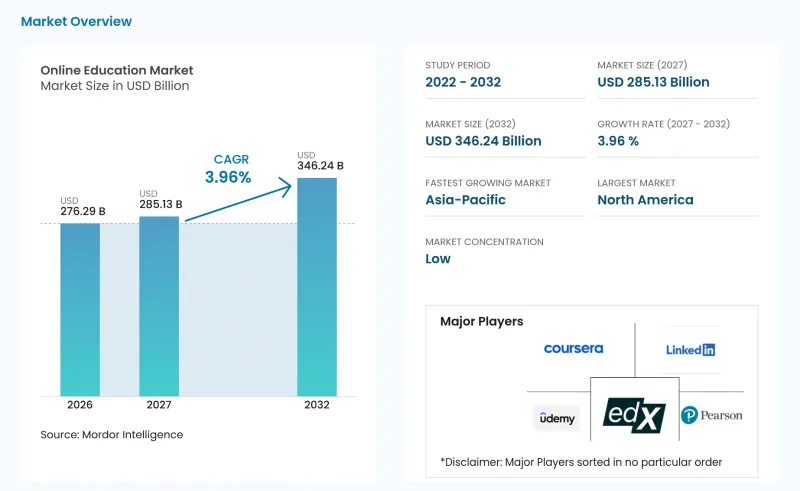
According to Mordor Intelligence, the global online education market size was valued at USD 276.29 billion in 2026 and is estimated to grow from USD 285.13 billion in 2027 to reach USD 346.24 billion by 2032, at a CAGR of 3.96% during the forecast period (2027-2032).
Global Online Education Market Trends and Insights
Smartphone and High-Speed Internet Penetration
Mobile broadband serves as a primary entry point to the global online education market in many emerging economies. The International Telecommunication Union (ITU) reported 99 mobile broadband subscriptions per 100 inhabitants worldwide in 2025, while 5G covered 55% of the global population. It also reported that 6 billion people, or 74% of the global population, were online in 2025. This infrastructure supports the global online education market by enabling short, frequent learning sessions through mobile-optimized courses, downloadable content, and low-data learning formats. Expanding digital public learning platforms are making mobile access increasingly relevant, enabling learners to access formal courses, skill development, and credit-linked programs through a single device. However, the offline population continues to constrain the global online education market, particularly in regions with limited device affordability, unreliable electricity, and inadequate broadband connectivity.
Corporate Upskilling and Reskilling for AI-Enabled Work
Corporate learning demand is shifting toward shorter programs that help employees use AI tools and build job-specific skills. LinkedIn's 2025 Workplace Learning Report found that 49% of learning and development professionals identified a skills crisis. Microsoft committed USD 4 billion over five years through its Elevate initiative to support AI cloud technology and skilling programs for schools, community colleges, and nonprofit organizations. The initiative aims to help 20 million people earn AI credentials within two years. This shift supports global online education platforms that can serve large employer cohorts, track skills progress, and integrate with talent management systems.
Low Completion Rates and Learner-Engagement Friction
Low course completion remains a challenge for consumer-oriented online learning platforms. A study published in 2015 analyzed 221 massive open online courses (MOOCs) and reported a median completion rate of 12.6%, with rates ranging from 0.7% to 52.1%. These findings highlight the difficulty of sustaining learner engagement, although the results should not be treated as a current industry-wide completion benchmark. A 2025 study of more than 5,000 user records found that greater video consumption and quiz participation were associated with higher completion rates. For online education providers, improving learner engagement and supporting measurable learning progress may help strengthen perceived course value and retention. Platforms can explore progress reminders, personalized learning paths, interactive assessments, and coaching to address disengagement and improve the learning experience.
Other drivers and restraints analyzed in the detailed report include:
- Government Digital-Education Initiatives
- Flexibility and Cost Advantages Versus Classroom Training
- Rural and Low-Income Connectivity Gaps
For complete list of drivers and restraints, kindly check the Table Of Contents.
Segment Analysis
Self-paced learning accounted for 52.60% of revenue in 2026, driven by flexible schedules and no fixed attendance or instructor availability. Coursera reported 197.3 million cumulative registered learners at the end of 2025, demonstrating the scale of self-paced catalogs. Instructor-led learning serves executive education and complex technical programs, where live feedback and accountability support higher prices. Blended programs combine online materials and in-person assessments where supervised learning is required.
Adaptive learning is the fastest-growing model, with the global online education market projected to grow at a 4.85% CAGR from 2027 to 2032. It adjusts content based on learner performance, engagement, and knowledge gaps. A 2025 meta-analysis found positive evidence for AI-driven personalized learning outcomes. Udemy's 2025 AI Fluency Packages demonstrate coaching, role-playing, and skills mapping. Mobile learning and microlearning enable frequent, short sessions. The opportunity is strongest for providers that improve outcomes without significant user friction.
Cloud deployment accounted for 72.40% of the global online education market share in 2026 and is projected to grow at a 4.96% CAGR through 2032. It requires lower upfront hardware investment, scales with enrollment, and provides continuous software updates. Cloud systems also integrate learning data with human resources, customer, and performance management systems. The 2025 APEC Education Ministerial Meeting supported AI-integrated, learner-centered models that rely on adaptive learning technologies.
On-premises systems remain relevant in government, defense, financial services, and healthcare, where data sovereignty requirements are strict. Buyers may prevent learner records from leaving an institution or national jurisdiction. Hybrid architectures retain sensitive data on-site while using cloud-based analytics or AI tools for selected functions. Data governance therefore influences deployment decisions alongside functionality and price. The global online education industry must support secure integration and flexible deployment models to compete for regulated contracts.
Complete Report Scope:
- By Learning Model
- Self-Paced Learning
- Instructor-Led Learning
- Blended Learning
- Adaptive Learning
- Others (Mobile Learning, Microlearning)
- By Deployment
- Cloud
- On-Premise
- By Offering
- Content and Courses
- Platforms and Software
- Services and Instruction
- Assessment and Credentialing
- By End User
- Academic Institutions
- Corporate and Enterprise Organizations
- Government and Public Sector
- Individual Learners
- By Geography
- North America
- United States
- Canada
- Mexico
- South America
- Brazil
- Peru
- Chile
- Argentina
- Rest of South America
- Europe
- United Kingdom
- Germany
- France
- Spain
- Italy
- BENELUX (Belgium, Netherlands, and Luxembourg)
- NORDICS (Denmark, Finland, Iceland, Norway, and Sweden)
- Rest of Europe
- Asia-Pacific
- India
- China
- Japan
- Australia
- South Korea
- South East Asia (Singapore, Malaysia, Thailand, Indonesia, Vietnam, and Philippines)
- Rest of Asia-Pacific
- Middle East and Africa
- United Arab Emirates
- Saudi Arabia
- South Africa
- Nigeria
- Rest of Middle East And Africa
- North America
Geography Analysis
North America accounted for 35.20% of the global online education market in 2026, supported by corporate learning budgets, learning management system adoption, and a mature higher education sector. Coursera reported USD 757.5 million in total global revenue in 2025, reflecting demand across its consumer and enterprise learning businesses. Microsoft's Elevate initiative supports AI skilling through schools, community colleges, and nonprofit organizations. In Canada and Mexico, online education opportunities should be assessed using country-specific evidence on enterprise learning demand, internet and mobile access, and employer investment in workforce skills.
Asia-Pacific is the fastest-growing region, while the global market is projected to grow at a 4.41% CAGR from 2027 to 2032. China's Smart Education platform reached over 160 million registered users and 61.3 billion views in 2025. India combines large learner volumes with digital public infrastructure; SWAYAM recorded over 5.15 crore enrollments across 16,530 courses, and SWAYAM Plus has 76 industry memorandums of understanding. South Korea, Japan, Australia, Indonesia, Vietnam, and the Philippines support enterprise, higher education, and mobile-first learning demand.
Europe benefits from the Digital Education Action Plan 2021-2027 and Erasmus+ initiatives. Pearson's Virtual Learning and Enterprise Learning and Skills segments grew 8% and 6%, respectively, in 2025. Coursera's Europe, Middle East, and Africa revenue reached USD 185.9 million. Brazil, the United Arab Emirates, and Saudi Arabia support demand, while Sub-Saharan Africa's 36% internet use constrains access.
- Coursera, Inc.
- Udemy, Inc.
- LinkedIn Learning, Microsoft Corporation
- Pearson plc
- 2U, Inc., including edX
- Duolingo, Inc.
- Instructure Holdings, Inc.
- Docebo S.p.A.
- Skillsoft Corp.
- Pluralsight LLC
- Udacity, Inc.
- Khan Academy, Inc.
- upGrad Education Private Limited
- Unacademy
- DataCamp, Inc.
- Go1 Pty Ltd
- Moodle Pty Ltd
- D2L Corporation
- PhysicsWallah (PW)
- Cengage Group
Additional Benefits:
- The market estimate (ME) sheet in Excel format
- 3 months of analyst support
TABLE OF CONTENTS
1 Introduction
- 1.1 Study Assumptions & Market Definition
- 1.2 Scope of the Study
2 Executive Summary
3 Market Landscape
- 3.1 Market Overview
- 3.2 Market Drivers
- 3.2.1 Smartphone and High-Speed Internet Penetration
- 3.2.2 Corporate Upskilling and Reskilling for AI-Enabled Work
- 3.2.3 Government Digital-Education Initiatives
- 3.2.4 Flexibility and Cost Advantages Versus Classroom Training
- 3.2.5 University, Employer, and Platform Micro-Credential Partnerships
- 3.2.6 AI-Powered Personalization and Automated Content Creation
- 3.3 Market Restraints
- 3.3.1 Low Completion Rates and Learner-Engagement Friction
- 3.3.2 Rural and Low-Income Connectivity Gaps
- 3.3.3 Multilingual Content and Localization Complexity
- 3.3.4 Privacy, Child-Safety, and AI-Governance Compliance Burden
- 3.4 Regulatory Landscape
- 3.5 Technological Outlook
- 3.6 Porter's Five Forces Analysis
- 3.6.1 Threat of New Entrants
- 3.6.2 Bargaining Power of Suppliers
- 3.6.3 Bargaining Power of Buyers
- 3.6.4 Threat of Substitutes
- 3.6.5 Competitive Rivalry
4 Education Infrastructure & Development Intelligence
- 4.1 Government Spending on Education
- 4.2 Private Sector Investments in Education Sector
- 4.3 Education Infrastructure Development Initives
5 Education Performance Intelligence
- 5.1 Student Teacher Ratio
- 5.2 Geography Density by Education Institute
6 Student & Learner Behavior Analysis
- 6.1 Student Enrolment
- 6.2 Tuition Fees and Education Spending
7 Market Size & Growth Forecasts (Value)
- 7.1 By Learning Model
- 7.1.1 Self-Paced Learning
- 7.1.2 Instructor-Led Learning
- 7.1.3 Blended Learning
- 7.1.4 Adaptive Learning
- 7.1.5 Others (Mobile Learning, Microlearning)
- 7.2 By Deployment
- 7.2.1 Cloud
- 7.2.2 On-Premise
- 7.3 By Offering
- 7.3.1 Content and Courses
- 7.3.2 Platforms and Software
- 7.3.3 Services and Instruction
- 7.3.4 Assessment and Credentialing
- 7.4 By End User
- 7.4.1 Academic Institutions
- 7.4.2 Corporate and Enterprise Organizations
- 7.4.3 Government and Public Sector
- 7.4.4 Individual Learners
- 7.5 By Geography
- 7.5.1 North America
- 7.5.1.1 United States
- 7.5.1.2 Canada
- 7.5.1.3 Mexico
- 7.5.2 South America
- 7.5.2.1 Brazil
- 7.5.2.2 Peru
- 7.5.2.3 Chile
- 7.5.2.4 Argentina
- 7.5.2.5 Rest of South America
- 7.5.3 Europe
- 7.5.3.1 United Kingdom
- 7.5.3.2 Germany
- 7.5.3.3 France
- 7.5.3.4 Spain
- 7.5.3.5 Italy
- 7.5.3.6 BENELUX (Belgium, Netherlands, and Luxembourg)
- 7.5.3.7 NORDICS (Denmark, Finland, Iceland, Norway, and Sweden)
- 7.5.3.8 Rest of Europe
- 7.5.4 Asia-Pacific
- 7.5.4.1 India
- 7.5.4.2 China
- 7.5.4.3 Japan
- 7.5.4.4 Australia
- 7.5.4.5 South Korea
- 7.5.4.6 South East Asia (Singapore, Malaysia, Thailand, Indonesia, Vietnam, and Philippines)
- 7.5.4.7 Rest of Asia-Pacific
- 7.5.5 Middle East and Africa
- 7.5.5.1 United Arab Emirates
- 7.5.5.2 Saudi Arabia
- 7.5.5.3 South Africa
- 7.5.5.4 Nigeria
- 7.5.5.5 Rest of Middle East And Africa
- 7.5.1 North America
8 North America Market Size and Growth Forecasts (Value) 2022-2032
- 8.1 By Learning Model
- 8.2 By Deployment
- 8.3 By Offering
- 8.4 By End User
- 8.5 By Country
9 South America Market Size and Growth Forecasts (Value) 2022-2032
- 9.1 By Learning Model
- 9.2 By Deployment
- 9.3 By Offering
- 9.4 By End User
- 9.5 By Country
10 Europe Market Size and Growth Forecasts (Value) 2022-2032
- 10.1 By Learning Model
- 10.2 By Deployment
- 10.3 By Offering
- 10.4 By End User
- 10.5 By Country
11 Asia-Pacific Market Size and Growth Forecasts (Value) 2022-2032
- 11.1 By Learning Model
- 11.2 By Deployment
- 11.3 By Offering
- 11.4 By End User
- 11.5 By Country
12 Middle East and Africa Market Size and Growth Forecasts (Value) 2022-2032
- 12.1 By Learning Model
- 12.2 By Deployment
- 12.3 By Offering
- 12.4 By End User
- 12.5 By Country
13 Competitive Landscape
- 13.1 Market Concentration
- 13.2 Strategic Moves
- 13.3 Market Share Analysis
- 13.4 Company Profiles (includes Global Level Overview, Market Level Overview, Core Segments, Financials as available, Strategic Information, Market Rank/Share, Products and Services, and Recent Developments)
- 13.4.1 Coursera, Inc.
- 13.4.2 Udemy, Inc.
- 13.4.3 LinkedIn Learning, Microsoft Corporation
- 13.4.4 Pearson plc
- 13.4.5 2U, Inc., including edX
- 13.4.6 Duolingo, Inc.
- 13.4.7 Instructure Holdings, Inc.
- 13.4.8 Docebo S.p.A.
- 13.4.9 Skillsoft Corp.
- 13.4.10 Pluralsight LLC
- 13.4.11 Udacity, Inc.
- 13.4.12 Khan Academy, Inc.
- 13.4.13 upGrad Education Private Limited
- 13.4.14 Unacademy
- 13.4.15 DataCamp, Inc.
- 13.4.16 Go1 Pty Ltd
- 13.4.17 Moodle Pty Ltd
- 13.4.18 D2L Corporation
- 13.4.19 PhysicsWallah (PW)
- 13.4.20 Cengage Group
14 Market Opportunities & Future Outlook
- 14.1 Market Opportunities
- 14.1.1 Low-Bandwidth and Offline-First Learning
- 14.1.2 Local-Language and Culturally Relevant Content
- 14.1.3 Verified Skills-to-Employment Pathways
- 14.2 Future Outlook
15 Research Methodology

