PUBLISHER: Mordor Intelligence | PRODUCT CODE: 2196866

PUBLISHER: Mordor Intelligence | PRODUCT CODE: 2196866
Rare Earth Metals Leaching Chemicals - Market Share Analysis, Industry Trends & Statistics, Growth Forecasts (2027 - 2032)
According to Mordor Intelligence, the rare earth metals leaching chemicals market size was valued at USD 0.69 billion in 2026 and is estimated to grow from USD 0.74 billion in 2027 to USD 1.07 billion by 2032, at a CAGR of 7.48% during the forecast period (2027-2032).
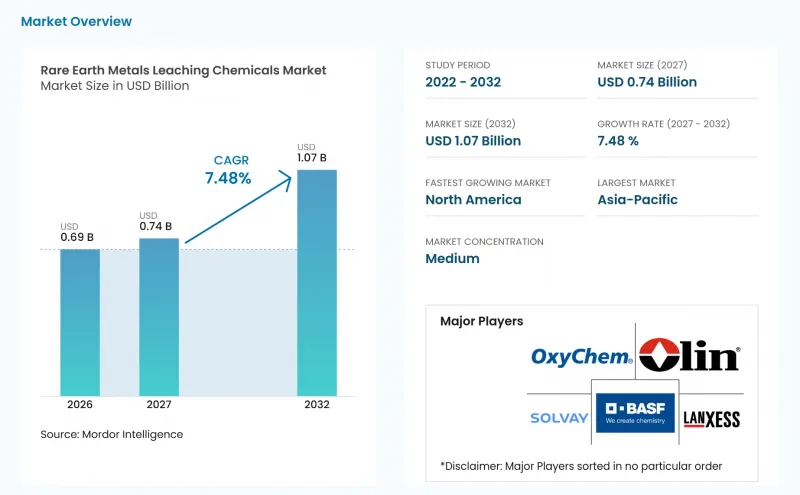
Global Rare Earth Metals Leaching Chemicals Market Trends and Insights
Electric Vehicle and Wind Turbine Magnet Demand
Demand for permanent magnets used in electric vehicles and wind turbines supports a larger rare earth extraction base. The International Energy Agency (IEA) projects demand for rare earth elements in clean energy technology at 38 kilotons by 2030, with electric vehicle motors and wind turbines as the main drivers of growth. Each additional unit of magnet-grade material requires extraction from ore or recycled feedstock prior to separation, thereby increasing the use of mineral acids, ammonium salts, and other reagents in leaching circuits. Tighter composition requirements for magnets favor more selective leaching systems that separate rare earths earlier in the process. Research published in 2025 found that organic acid ligands can produce different extraction efficiencies for individual lanthanides under near-neutral conditions, supporting the use of citric acid and related agents in specialized processing.
Critical-Mineral Supply-Chain Localization
China imposed export controls on medium- and heavy-rare-earth-related items in April 2025, prompting increased supply chain planning among manufacturers and governments. The United States Department of Energy announced up to USD 134 million in 2025 for demonstrations covering rare earth extraction and separation facilities. These projects include recovery from coal fly ash and mine tailings, which requires process-specific leaching reagents. The European Union also designated strategic projects under the Critical Raw Materials Act, creating a broader construction pipeline for rare earth processing. Even if trade restrictions change, the experience of constrained access gives buyers a reason to build supply alternatives. This supports demand for rare earth metal leaching chemicals in facilities outside China.
Mineral-Acid and Ammonium-Salt Price Volatility
Hydrochloric acid and sulfuric acid production is energy-intensive, linking reagent costs to electricity, natural gas, and other inputs. Olin Corporation identifies electricity as the largest raw material component in its chlor-alkali production. This exposure can move independently from rare earth pricing. Reagent costs in dilute-acid heap leaching can exceed 30% of operating expenditures, making cost changes significant for smaller projects. Some producers are evaluating on-site chlor-alkali generation using local salt and renewable power to reduce exposure to spot markets. This approach lowers transport dependence but requires capital investment and is most viable where ore throughput supports the cost.
Other drivers and restraints analyzed in the detailed report include:
- Expansion of Domestic Rare Earth Refining Capacity
- Growth in Hydrometallurgical Recovery from Secondary Feedstocks
- Environmental Permitting and Tailings-Liability Burden
For complete list of drivers and restraints, kindly check the Table Of Contents.
Segment Analysis
Hydrochloric acid held 42.56% of the Rare Earth Metals Leaching Chemicals market share in 2026, as it can dissolve a broad range of rare earth minerals at commercially viable reaction rates. It is used across in-situ and heap-leach circuits, particularly where chloride complexes facilitate dissolution. The market has also seen interest in on-site hydrochloric acid production at remote operations. OD6 Metals reported that a compact chlor-alkali facility at Splinter Rock could produce 62 kilotons of hydrochloric acid annually from local solar salt. Eliminating long transport routes can improve delivery cost certainty, making hydrochloric acid attractive when logistics account for a large share of the final reagent cost.
Sulfuric acid is the fastest-growing chemical type, with its market size projected to grow at an 8.42% CAGR between 2027 and 2032. Heap leaching commonly uses diluted sulfuric acid and can require less capital than agitated-tank leaching, making it well-suited to emerging clay-hosted projects in Australia and South America. Ammonium sulfate remains widely used in Chinese in-situ leaching, although ammonia-nitrogen controls present a compliance challenge. Nitric acid remains relevant for niche high-purity circuits and specialized recycling streams. Citric acid and other organic acids are gaining attention in secondary recovery as lower-impact options in selected applications.
Complete Report Scope:
- By Chemical Type
- Hydrochloric Acid
- Sulfuric Acid
- Ammonium Sulfate
- Nitric Acid
- Citric Acid
- Other Chemicals
- By Leaching Mode
- In-Situ Leaching
- Heap Leaching
- Others
- By Geography
- Asia-Pacific
- China
- India
- Japan
- South Korea
- ASEAN Countries
- Rest of Asia-Pacific
- North America
- United States
- Canada
- Mexico
- Europe
- Germany
- United Kingdom
- France
- Italy
- NORDIC Countries
- Rest of Europe
- South America
- Brazil
- Argentina
- Rest of South America
- Middle East and Africa
- Saudi Arabia
- South Africa
- Rest of Middle East and Africa
- Asia-Pacific
Geography Analysis
Asia-Pacific held 51.65% of the Rare Earth Metals Leaching Chemicals market share in 2026, reflecting the concentration of ion-adsorption deposits and refining activity in China. Research published in 2025 describes major ion-adsorption rare earth deposits in southern China and the technical role of leaching in their development. China imposed export controls on medium- and heavy-rare-earth-related items in 2025, increasing focus on supply security. This regulatory shift may encourage domestic processing efficiency while prompting overseas buyers to diversify their sources. India is building associated chemical capacity, with Gujarat Alkalies and Chemicals approving a hydrochloric acid (HCl) synthesis unit at Dahej in 2025. Japan, South Korea, and ASEAN economies contribute to demand through electronics recycling and secondary recovery, where mild-acid systems are relevant.
North America is projected to grow at an 8.66% CAGR from 2027 to 2032, the fastest rate among geographic segments in the Rare Earth Metals Leaching Chemicals market. The U.S. Department of Energy announced up to USD 134 million for integrated rare earth extraction and separation demonstrations in 2025. These projects support processing of unconventional feedstocks, including coal byproducts and mine wastes. The United States and Japan signed a framework in October 2025 covering grants, loans, guarantees, and offtake arrangements for critical-mineral and rare earth projects. This creates an opportunity for North American processors to secure supply and develop reagent strategies. Canada remains relevant in the chlor-alkali sector, although ERCO Worldwide permanently closed its Hargrave sodium chlorate operation in December 2025. Mexico can support regional logistics for downstream electric-vehicle and renewable-energy supply chains.
Europe is building demand around the Critical Raw Materials Act, which sets 2030 targets for domestic extraction, processing, and recycling. The region's Rare Earth Metals Leaching Chemicals market can benefit from recycling initiatives, as policymakers seek to retain rare earth magnet waste within Europe. Solvay's La Rochelle operations provide a regional example of investment in rare earth processing. REACH registration is a compliance requirement for suppliers introducing formulations into the European market. South America has clay mineral prospects in Brazil and Argentina, where heap leach projects could use dilute sulfuric acid at scale. Renewable power availability and project development conditions can support this approach, though outcomes depend on site-specific permitting and infrastructure. In the Middle East and Africa, industrial diversification in Saudi Arabia and established base-metal processing in South Africa create selective opportunities where phosphate and titanium streams contain recoverable rare earth values.
- Arkema
- Aurubis AG
- BASF
- ERCO Worldwide
- Grupa Azoty S.A.
- Gujarat Alkalies and Chemicals Limited
- Gujarat State Fertilizers & Chemicals Limited (GSFC)
- LANXESS
- Occidental Chemical Corporation
- Olin Corporation
- Sasol
- Solvay
- Tronox Holdings plc
- UBE Corporation
- Westlake Corporation
Additional Benefits:
- The market estimate (ME) sheet in Excel format
- 3 months of analyst support
TABLE OF CONTENTS
1 Introduction
- 1.1 Study Assumptions and Market Definition
- 1.2 Scope of the Study
2 Research Methodology
3 Executive Summary
4 Market Landscape
- 4.1 Market Overview
- 4.2 Market Drivers
- 4.2.1 Electric Vehicle and Wind Turbine Magnet Demand
- 4.2.2 Critical-Mineral Supply-Chain Localization
- 4.2.3 Expansion of Domestic Rare Earth Refining Capacity
- 4.2.4 Growth in Hydrometallurgical Recovery from Secondary Feedstocks
- 4.2.5 Ore-Mineralogy Matching for Higher Leach Selectivity
- 4.3 Market Restraints
- 4.3.1 Mineral-Acid and Ammonium-Salt Price Volatility
- 4.3.2 Environmental Permitting and Tailings-Liability Burden
- 4.3.3 Corrosion, Impurity Loading, and Reagent-Consumption Risk
- 4.4 Value Chain Analysis
- 4.5 Porter's Five Forces Analysis
- 4.5.1 Bargaining Power of Suppliers
- 4.5.2 Bargaining Power of Buyers
- 4.5.3 Threat of New Entrants
- 4.5.4 Threat of Substitutes
- 4.5.5 Competitive Rivalry
5 Market Size and Growth Forecasts (Value)
- 5.1 By Chemical Type
- 5.1.1 Hydrochloric Acid
- 5.1.2 Sulfuric Acid
- 5.1.3 Ammonium Sulfate
- 5.1.4 Nitric Acid
- 5.1.5 Citric Acid
- 5.1.6 Other Chemicals
- 5.2 By Leaching Mode
- 5.2.1 In-Situ Leaching
- 5.2.2 Heap Leaching
- 5.2.3 Others
- 5.3 By Geography
- 5.3.1 Asia-Pacific
- 5.3.1.1 China
- 5.3.1.2 India
- 5.3.1.3 Japan
- 5.3.1.4 South Korea
- 5.3.1.5 ASEAN Countries
- 5.3.1.6 Rest of Asia-Pacific
- 5.3.2 North America
- 5.3.2.1 United States
- 5.3.2.2 Canada
- 5.3.2.3 Mexico
- 5.3.3 Europe
- 5.3.3.1 Germany
- 5.3.3.2 United Kingdom
- 5.3.3.3 France
- 5.3.3.4 Italy
- 5.3.3.5 NORDIC Countries
- 5.3.3.6 Rest of Europe
- 5.3.4 South America
- 5.3.4.1 Brazil
- 5.3.4.2 Argentina
- 5.3.4.3 Rest of South America
- 5.3.5 Middle East and Africa
- 5.3.5.1 Saudi Arabia
- 5.3.5.2 South Africa
- 5.3.5.3 Rest of Middle East and Africa
- 5.3.1 Asia-Pacific
6 Competitive Landscape
- 6.1 Market Concentration
- 6.2 Strategic Moves
- 6.3 Market Share (%)/Ranking Analysis
- 6.4 Company Profiles (includes Global Overview, Market Overview, Core Segments, Financials as available, Strategic Information, Products and Services, and Recent Developments)
- 6.4.1 Arkema
- 6.4.2 Aurubis AG
- 6.4.3 BASF
- 6.4.4 ERCO Worldwide
- 6.4.5 Grupa Azoty S.A.
- 6.4.6 Gujarat Alkalies and Chemicals Limited
- 6.4.7 Gujarat State Fertilizers & Chemicals Limited (GSFC)
- 6.4.8 LANXESS
- 6.4.9 Occidental Chemical Corporation
- 6.4.10 Olin Corporation
- 6.4.11 Sasol
- 6.4.12 Solvay
- 6.4.13 Tronox Holdings plc
- 6.4.14 UBE Corporation
- 6.4.15 Westlake Corporation
7 Market Opportunities and Future Outlook
- 7.1 White-Space and Unmet-Need Assessment

