PUBLISHER: Mordor Intelligence | PRODUCT CODE: 2196914

PUBLISHER: Mordor Intelligence | PRODUCT CODE: 2196914
North America Data Center Risk Intelligence and Monitoring - Market Share Analysis, Industry Trends & Statistics, Growth Forecasts (2027 - 2032)
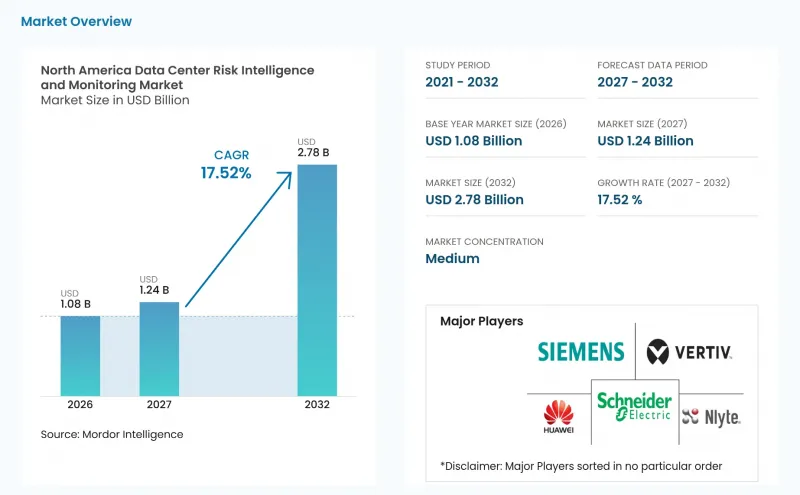
According to Mordor Intelligence, the North America data center risk intelligence and monitoring market size is expected to increase from USD 1.08 billion in 2026 to USD 1.24 billion in 2027 and reach USD 2.78 billion by 2032, growing at a CAGR of 17.52% over 2027-2032.
North America Data Center Risk Intelligence and Monitoring Market Trends and Insights
AI-Driven Rack Density and Thermal Risk
AI training and inference workloads require continuous monitoring because power and cooling conditions can change rapidly within a high-density rack. Texas Instruments reports that AI data centers can move from conventional 5 kW rack loads to more than 100 kW, which increases the importance of thermal controls and telemetry coverage. The Open Compute Project reported in October 2026 that an 18-tray air-cooled rack was expected to experience 1.89 component failures a year, compared with 1.30 failures for a liquid-cooled configuration. Direct-to-chip cooling, rear-door heat exchangers, and immersion systems add sensors for coolant distribution, pressure, and leak detection. The North America data center risk intelligence and monitoring market benefits when these signals are brought into a common operating view. Predictive tools are useful because they can identify thermal derating conditions before a fault reduces available capacity.
Hyperscale and Colocation Capacity Expansion
New capacity is expanding the number of sites that must be monitored consistently, even when power infrastructure and construction schedules differ by location. The Mexican Data Center Association projected USD 82.5 billion in construction and equipment investment from 2026 to 2031, with 1,730 MW of announced capacity compared with 279 MW of installed capacity. This buildout makes portfolio-level assessment important before operators commit to land, grid connections, and cooling systems. Capacity growth also increases the need to normalize information from separate building management systems and equipment suppliers. The North America data center risk intelligence and monitoring market is supported by platforms that can connect new campuses with existing facilities without requiring separate monitoring processes at each location. This need is strongest where hyperscale and colocation operators manage several customer commitments across a regional footprint.
High Implementation Cost and Legacy Integration Complexity
Existing facilities often use separate building management systems, controllers, and protocols that were not designed to provide structured information for analytics. Dragos notes that data center operational technology environments contain complex systems that require security and operational controls across several asset categories. Integrating legacy BACnet and Modbus environments can require middleware, engineering services, and controller upgrades. This cost is more difficult for mid-market colocation operators that do not have the purchasing power or specialized teams available to hyperscale companies. Standardized application programming interfaces and agentless discovery can reduce the burden, but they do not remove variation in old equipment. The North America data center risk intelligence and monitoring market therefore faces a slower adoption cycle among operators that need the platform most but have the least flexibility to undertake large integration projects.
Other drivers and restraints analyzed in the detailed report include:
- Rising Cost of Outages and SLA Exposure
- Energy Efficiency, Sustainability, and Compliance Reporting
- Shortage of Cross-Domain Reliability and Operational Technology Security Talent
For complete list of drivers and restraints, kindly check the Table Of Contents.
Segment Analysis
Risk Intelligence and Analytics Platforms held 29.72% of the solution-type segment in 2026. These platforms combine inputs from power equipment, cooling systems, physical security controls, and IT systems into a single operating view. Their role expands as AI workloads create more frequent anomalies that are difficult to assess through threshold alerts alone. The platforms can also maintain a consistent event history for engineering teams working across separate campuses and equipment configurations. Vertiv introduced its Next Predict managed predictive maintenance service in January 2026 to apply machine learning across power, cooling, and IT equipment. The service illustrates how infrastructure suppliers are expanding into analytics and corrective-action support.
Predictive Risk Analytics is projected to expand at an 18.92% CAGR through 2032. The category serves operators that need to separate an urgent equipment deviation from normal operational variation. Real-Time Risk Monitoring Software and Early Warning and Alerting Systems remain important, but they are increasingly incorporated into larger platforms rather than sold as isolated products. Risk Dashboard and Reporting Solutions address the need for traceable reports for internal reviews, tenant discussions, and sustainability disclosures. Risk Data Integration and Aggregation Platforms also have a clear role where multiple campuses use different building management and sensor systems.
Facility and Equipment Condition Data accounted for 28.21% of the risk data category segment in 2026. Operators use this information to track asset health across electrical and thermal systems, where an unrecognized issue can affect availability. Claroty identified vulnerabilities in UPS network cards and HVAC controllers used in data center settings in research released in June 2026. This finding shows that equipment data can reflect both maintenance needs and cyber-physical exposure. It also reinforces the value of combining operational and security data in the same assessment process.
Regulatory and Compliance Risk Data is projected to expand at an 18.63% CAGR through 2032. Energy performance, grid participation, and sustainability disclosures are adding new evidence requirements for operators across the region. Weather and Natural Hazard Data, along with Climate and Environmental Risk Data, are becoming more relevant as cooling performance and grid reliability are affected by local conditions. Power Grid and Utility Risk Data supports assessments of connection capacity, congestion, and changing utility terms. Supply Chain and Vendor Risk Data, Operational Incident and Downtime Data, and Physical Security Risk Data complete a wider view of the factors that can affect site resilience.
Internal Facility and Building Systems held 26.54% of the segment in 2026. Building management systems, data center infrastructure management tools, environmental sensors, and power management equipment remain the primary source of operating data. The challenge is not always a lack of data, but the need to standardize information from systems installed at different times and built on incompatible protocols. Claroty reported that 88% of building management system assets it assessed communicated through insecure protocols, including BACnet and Modbus. This creates a combined data quality and security issue that risk platforms need to address.
Public Safety and Regulatory Information Sources are projected to expand at a 19.59% CAGR through 2032. These sources can add utility outage notices, emergency information, and enforcement records to internal telemetry. Equipment and Sensor Networks are also increasing as high-density liquid cooling systems add more instruments across the facility. Third-Party Vendor and Supply Chain Data can help operators identify dependencies beyond the site boundary. External Hazard and Geospatial Data, Weather and Environmental Data Providers, and Power and Utility Data Sources give teams wider context when they evaluate operational conditions.
Complete Report Scope:
- By Solution Type
- Risk Intelligence and Analytics Platforms
- Real-Time Risk Monitoring Software
- Risk Dashboard and Reporting Solutions
- Predictive Risk Analytics
- Early Warning and Alerting Systems
- Risk Data Integration and Aggregation Platforms
- Risk Intelligence Advisory and Managed Services
- By Risk Data Category
- Weather and Natural Hazard Data
- Climate and Environmental Risk Data
- Power Grid and Utility Risk Data
- Facility and Equipment Condition Data
- Operational Incident and Downtime Data
- Supply Chain and Vendor Risk Data
- Physical Security Risk Data
- Regulatory and Compliance Risk Data
- By Data Source
- Internal Facility and Building Systems
- Power and Utility Data Sources
- Weather and Environmental Data Providers
- External Hazard and Geospatial Data
- Equipment and Sensor Networks
- Third-Party Vendor and Supply Chain Data
- Public Safety and Regulatory Information Sources
- By Application
- Operational Risk Monitoring
- Power and Utility Disruption Monitoring
- Climate and Natural Hazard Monitoring
- Equipment Failure and Maintenance Risk
- Security Incident Monitoring
- Supplier and Supply Chain Risk Monitoring
- Business Continuity and Incident Response Support
- Site Selection and Portfolio Risk Assessment
- By Deployment Model
- Cloud-Based Platforms
- On-Premises Platforms
- Hybrid Platforms
- By Data Center Size
- Small
- Medium
- Large
- Hyperscale
- By Data Center Type
- Colocation
- Cloud Service Providers (CSPs)
- Enterprise and Edge
- By Country
- United States
- Canada
- Mexico
List of Companies Covered in this Report:
- Schneider Electric SE
- Vertiv Group Corp.
- Siemens AG
- Nlyte Software Limited
- Huawei Technologies Co., Ltd.
- ABB Ltd.
- Eaton Corporation plc
- Johnson Controls International plc
- International Business Machines Corporation
- Cisco Systems, Inc.
- Hewlett Packard Enterprise Development LP
- Sunbird Software, Inc.
- FNT GmbH
- Device42, Inc.
- Cormant, Inc.
- Modius, Inc.
- Hyperview, Inc.
- Panduit Corp.
- Rittal GmbH & Co. KG
- Carrier Global Corporation
- Datadog, Inc.
- SolarWinds Worldwide, LLC.
- Claroty Ltd.
- DeNexus, Inc.
Additional Benefits:
- The market estimate (ME) sheet in Excel format
- 3 months of analyst support
TABLE OF CONTENTS
1 INTRODUCTION
- 1.1 Study Assumptions and Market Definition
- 1.2 Scope of the Study
2 RESEARCH METHODOLOGY
3 EXECUTIVE SUMMARY
4 MARKET LANDSCAPE
- 4.1 Market Overview
- 4.2 Impact of Macroeconomic Factors on the Market
- 4.3 Market Drivers
- 4.3.1 AI-Driven Rack Density and Thermal Risk
- 4.3.2 Hyperscale and Colocation Capacity Expansion
- 4.3.3 Rising Cost of Outages and SLA Exposure
- 4.3.4 Energy Efficiency, Sustainability, and Compliance Reporting
- 4.3.5 Cyber-Physical Exposure of BMS, Power, and Cooling Assets
- 4.3.6 Grid-Interactive Load Flexibility and Site-Level Power Intelligence
- 4.4 Market Restraints
- 4.4.1 High Implementation Cost and Legacy Integration Complexity
- 4.4.2 Shortage of Cross-Domain Reliability and OT Security Talent
- 4.4.3 Sensor Data Quality, Calibration, and Interoperability Gaps
- 4.4.4 Concern Over Monitoring Data Privacy and Expanded Attack Surface
- 4.5 Industry Value Chain Analysis
- 4.6 Regulatory Landscape
- 4.7 Technological Outlook
- 4.8 Porter's Five Forces Analysis
- 4.8.1 Bargaining Power of Suppliers
- 4.8.2 Bargaining Power of Buyers
- 4.8.3 Threat of New Entrants
- 4.8.4 Threat of Substitutes
- 4.8.5 Competitive Rivalry
5 MARKET SIZE AND GROWTH FORECASTS (VALUE)
- 5.1 By Solution Type
- 5.1.1 Risk Intelligence and Analytics Platforms
- 5.1.2 Real-Time Risk Monitoring Software
- 5.1.3 Risk Dashboard and Reporting Solutions
- 5.1.4 Predictive Risk Analytics
- 5.1.5 Early Warning and Alerting Systems
- 5.1.6 Risk Data Integration and Aggregation Platforms
- 5.1.7 Risk Intelligence Advisory and Managed Services
- 5.2 By Risk Data Category
- 5.2.1 Weather and Natural Hazard Data
- 5.2.2 Climate and Environmental Risk Data
- 5.2.3 Power Grid and Utility Risk Data
- 5.2.4 Facility and Equipment Condition Data
- 5.2.5 Operational Incident and Downtime Data
- 5.2.6 Supply Chain and Vendor Risk Data
- 5.2.7 Physical Security Risk Data
- 5.2.8 Regulatory and Compliance Risk Data
- 5.3 By Data Source
- 5.3.1 Internal Facility and Building Systems
- 5.3.2 Power and Utility Data Sources
- 5.3.3 Weather and Environmental Data Providers
- 5.3.4 External Hazard and Geospatial Data
- 5.3.5 Equipment and Sensor Networks
- 5.3.6 Third-Party Vendor and Supply Chain Data
- 5.3.7 Public Safety and Regulatory Information Sources
- 5.4 By Application
- 5.4.1 Operational Risk Monitoring
- 5.4.2 Power and Utility Disruption Monitoring
- 5.4.3 Climate and Natural Hazard Monitoring
- 5.4.4 Equipment Failure and Maintenance Risk
- 5.4.5 Security Incident Monitoring
- 5.4.6 Supplier and Supply Chain Risk Monitoring
- 5.4.7 Business Continuity and Incident Response Support
- 5.4.8 Site Selection and Portfolio Risk Assessment
- 5.5 By Deployment Model
- 5.5.1 Cloud-Based Platforms
- 5.5.2 On-Premises Platforms
- 5.5.3 Hybrid Platforms
- 5.6 By Data Center Size
- 5.6.1 Small
- 5.6.2 Medium
- 5.6.3 Large
- 5.6.4 Hyperscale
- 5.7 By Data Center Type
- 5.7.1 Colocation
- 5.7.2 Cloud Service Providers (CSPs)
- 5.7.3 Enterprise and Edge
- 5.8 By Country
- 5.8.1 United States
- 5.8.2 Canada
- 5.8.3 Mexico
6 COMPETITIVE LANDSCAPE
- 6.1 Market Concentration
- 6.2 Strategic Moves
- 6.3 Market Share Analysis
- 6.4 Company Profiles (includes Global Level Overview, Market Level Overview, Core Segments, Financials as available, Strategic Information, Market Rank/Share, Products and Services, Recent Developments)
- 6.4.1 Schneider Electric SE
- 6.4.2 Vertiv Group Corp.
- 6.4.3 Siemens AG
- 6.4.4 Nlyte Software Limited
- 6.4.5 Huawei Technologies Co., Ltd.
- 6.4.6 ABB Ltd.
- 6.4.7 Eaton Corporation plc
- 6.4.8 Johnson Controls International plc
- 6.4.9 International Business Machines Corporation
- 6.4.10 Cisco Systems, Inc.
- 6.4.11 Hewlett Packard Enterprise Development LP
- 6.4.12 Sunbird Software, Inc.
- 6.4.13 FNT GmbH
- 6.4.14 Device42, Inc.
- 6.4.15 Cormant, Inc.
- 6.4.16 Modius, Inc.
- 6.4.17 Hyperview, Inc.
- 6.4.18 Panduit Corp.
- 6.4.19 Rittal GmbH & Co. KG
- 6.4.20 Carrier Global Corporation
- 6.4.21 Datadog, Inc.
- 6.4.22 SolarWinds Worldwide, LLC.
- 6.4.23 Claroty Ltd.
- 6.4.24 DeNexus, Inc.
7 MARKET OPPORTUNITIES AND FUTURE OUTLOOK
- 7.1 White-Space and Unmet-Need Assessment
- 7.2 2027-2032 Market Outlook

