PUBLISHER: Mordor Intelligence | PRODUCT CODE: 2196953

PUBLISHER: Mordor Intelligence | PRODUCT CODE: 2196953
Special Purpose Needles - Market Share Analysis, Industry Trends & Statistics, Growth Forecasts (2027 - 2032)
According to Mordor Intelligence, the special purpose needles market size is expected to grow from USD 2.46 billion in 2026 to USD 2.66 billion in 2027 and is forecast to reach USD 3.94 billion by 2032 at 8.21% CAGR over 2027-2032.
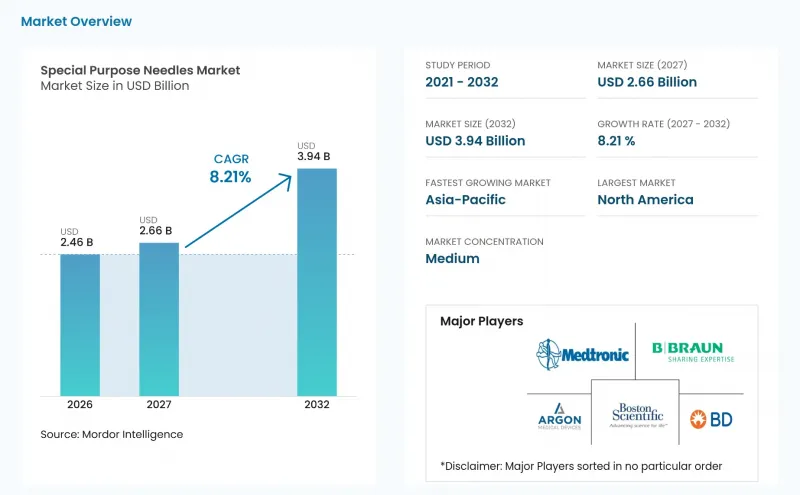
Global Special Purpose Needles Market Trends and Insights
Rising Cancer Screening and Image-Guided Biopsy Volumes
Cancer screening programs are increasing the number of procedures that require reliable tissue collection. The special purpose needles market benefits as CT and ultrasound guidance extend biopsies to targets that are difficult to access. A 2025 DeGIR registry analysis of 27,559 image-guided lung biopsies across 212 centers reported a 97.7% technical success rate and a 94.3% diagnostic yield. Outpatient diagnosis is also becoming more common as image-guided procedures are used more widely. This environment favors disposable CT-compatible core biopsy products and thin-wall aspiration needles that support specimen quality. It also supports product designs that can deliver adequate tissue for molecular testing in a single procedure.
Increasing Preference for Minimally Invasive Procedures
Fine-needle aspiration and core biopsy systems are replacing open surgical biopsy in a wider set of clinical settings. This change supports demand for sterile, single-use products that can provide access through a smaller tract. A 2025 article in the Journal of Vascular and Interventional Radiology linked the increased use of image-guided biopsies to genomic profiling, clinical trial needs, and low adverse-event rates relative to surgical alternatives. Providers also need needles that obtain adequate tissue in a single pass and reduce repeat procedures. Cook Medical and Mendaera began a 2025 collaboration to combine EchoTip technology with a handheld robotic platform for percutaneous urological procedures. The arrangement shows how manufacturers can become part of a robotic procedure workflow rather than remain suppliers of a standalone needle.
Needlestick Injuries, Infection Exposure, and Sharps-Disposal Liability
Needlestick injuries can slow adoption when facilities lack sufficient safety-validation evidence or face high disposal costs. The special purpose needles market also gains from the need for safer products, but risk concerns can limit premium purchases in resource-constrained settings. A 2025 review reported that the World Health Organization estimated a 43% average needlestick injury rate across 113 countries, with Africa reporting the highest regional incidence at 51%. Spending on basic disposal compliance can leave fewer funds for advanced specialty products. This pressure is stronger where safety budgets are directed toward basic sharps handling and disposal processes. Incomplete injury reporting can also obscure the full liability that institutions need to manage.
Other drivers and restraints analyzed in the detailed report include:
- Expansion of Chronic-Disease and Injectable Drug Management
- Growth of Safety-Engineered and Single-Use Needle Adoption
- Shortage of Skilled Operators and Uneven Access to Image Guidance
For complete list of drivers and restraints, kindly check the Table Of Contents.
Segment Analysis
Biopsy needles accounted for 17.5% of the special purpose needles market share in 2026, making them the largest product category. Their position reflects greater oncology diagnostic activity and wider use of vacuum-assisted and core needle systems. The movement from excisional surgery toward percutaneous tissue acquisition supports recurring demand for these products. Vacuum-assisted formats can retrieve larger tissue cores in a single insertion and preserve their orientation for assessment. This characteristic is important where genomic profiling requires sufficient material for testing. The special-purpose needles market also includes fine aspirating and implantation needles for specialized procedures, while suture needles remain a stable and volume-led category. Cost remains the main purchasing consideration for suture products, unlike biopsy systems where performance and compatibility carry greater weight.
IV catheter needles are forecast to grow at a 10.5% CAGR from 2027 to 2032, the highest rate in the product segmentation. Growth comes from the shift from open-hub products toward closed systems that limit blood exposure in acute care settings. BD's peripheral IV catheter portfolio has helped establish blood-control features at the hub level in North American and European facilities. Hypodermic and pen needles remain high-volume products, but demand is being differentiated by GLP-1 formulations. FITTER Forward recommendations published in 2025 reaffirmed 4 mm as the preferred pen needle length for adult patients, supporting shorter and thinner-wall formats. Core needle biopsy products are separately used in interventional oncology workflows, and implantation needles serve radiation oncology seed placement and drug-eluting implant procedures.
Sample collection accounted for 58.8% of the special purpose needles market size in 2026. Its scale is supported by oncology biopsy programs and clinical pathology work involving blood, tissue, and cytology samples. Hospitals, outpatient facilities, and reference laboratories all contribute to this demand. The commercial requirement is shifting from routine histomorphology toward tissue adequacy for genomic profiling. The 2025 Journal of Vascular and Interventional Radiology article noted that multiplexed testing raises minimum expectations for specimen cell count and DNA yield. Needles that collect sufficient material in 1 pass through optimized bevel geometry, coaxial systems, or vacuum-assisted retrieval can therefore command a performance premium. Blood collection needles remain more dependent on throughput, standardized gauge selection, and safety compliance.
Drug delivery is forecast to grow at an 11.7% CAGR through 2032, the fastest rate across applications. Pen needles for insulin and GLP-1 therapy, IV catheter systems for infusions, and implantation needles for local depots support this trajectory. The American Diabetes Association's 2025 guidance on insulin pens and connected pens links diabetes care practices to ongoing needle use. Cook Regentec introduced its ProFusion Therapeutic Infusion Needle during 2025, using a spiral sideport configuration and high ultrasound visibility for targeted intramuscular or subdermal delivery. This product illustrates how regenerative medicine and cell therapy can create more specific requirements than standard intravenous and subcutaneous delivery. The special purpose needles industry is consequently serving a broader range of drug routes and treatment settings.
Complete Report Scope:
- By Product Type
- Fine Aspirating Needles
- Biopsy Needles
- Core Needle Biopsy Needles
- Vacuum-Assisted Biopsy Needles
- Hypodermic Needles
- Pen Needles
- Suture Needles
- IV Catheter Needles
- Implantation Needles
- Other Product Types
- By Application
- Sample Collection
- Drug Delivery
- By End User
- Hospitals and Surgical Centers
- Diagnostic Imaging Centers and Pathology Laboratories
- Ambulatory Care Centers
- Specialty Clinics and Dental Clinics
- Other End Users
- By Distribution Channel
- Direct Institutional Procurement
- Medical Device Distributors
- Hospital Pharmacies
- Retail Pharmacies and Drug Stores
- E-Commerce
- Geography
- North America
- United States
- Canada
- Mexico
- Europe
- Germany
- United Kingdom
- France
- Italy
- Spain
- Rest of Europe
- Asia-Pacific
- China
- Japan
- India
- Australia
- South Korea
- Rest of Asia-Pacific
- Middle East and Africa
- GCC
- South Africa
- Rest of Middle East and Africa
- South America
- Brazil
- Argentina
- Rest of South America
- North America
Geography Analysis
North America held 43.2% of the special purpose needles market share in 2026. The United States supports this position through cancer screening, interventional radiology infrastructure, and safety rules for healthcare sharps. OSHA's Bloodborne Pathogens Standard drives replacement of conventional devices with safer formats, supporting safety-engineered needles and closed-system IV products in regulated care settings. BD's 2025 investment in Utah IV line manufacturing and its expansion of safety-engineered syringe capacity in Nebraska and Connecticut show continued manufacturer commitment to domestic supply. Canada and Mexico also contribute through cancer screening and insulin therapy, although their per-unit pricing is lower.
Asia-Pacific is forecast to grow at a 9.5% CAGR from 2027 to 2032. Aging populations, chronic disease treatment, and expanding hospital infrastructure are increasing demand across China, India, Japan, South Korea, and Southeast Asia. BD expanded manufacturing capacity for advanced injection devices in Asia during January 2026 to support regional vaccination programs and demand for safety-engineered formats. Japan and South Korea have high spending per procedure and hospital accreditation practices that support single-use, traceable specialty products, while the special purpose needles market size in Asia-Pacific is shaped by increasing hospital capability, local registration requirements, and distribution partnerships.
Europe remains a major regional base for advanced biopsy and IV catheter procurement, especially in Germany, the United Kingdom, and France. A 2025 DeGIR registry report covering 17,397 diagnostic image-guided bone biopsies across 214 centers in Germany, Austria, and Switzerland recorded a 98.9% technical success rate. The 2026 European Society of Pathology paper reaffirmed that percutaneous tissue biopsy remains central to cancer diagnosis as liquid biopsy develops. GCC countries support premium formats through private healthcare networks and high health spending, while other Middle East and African markets favor lower-cost products because of budget and image-guidance limits. Brazil and Argentina support demand for oncology biopsy products and pen needles, but reimbursement variation and import costs limit rapid uptake of advanced designs.
- Argon Medical Devices
- Beckton Dickinson
- B. Braun
- Boston Scientific
- Medtronic
- Cook Group
- Merit Medical Systems
- Hologic
- Conmed
- Olympus
- Cardinal Health
- Stryker
- PAJUNK GmbH Medizintechnologie
- BPB MEDICA - Biopsybell
- INRAD
- Ranfac
- Medax S.r.l.
- Mermaid Medical
- Somatex Medical Technologies GmbH
- DTR Medical Ltd
Additional Benefits:
- The market estimate (ME) sheet in Excel format
- 3 months of analyst support
TABLE OF CONTENTS
1 Introduction
- 1.1 Study Assumptions & Market Definition
- 1.2 Scope Of The Study
2 Research Methodology
3 Executive Summary
4 Market Landscape
- 4.1 Market Overview
- 4.2 Market Drivers
- 4.2.1 Rising Cancer Screening and Image-Guided Biopsy Volumes
- 4.2.2 Increasing Preference for Minimally Invasive Procedures
- 4.2.3 Expansion of Chronic-Disease and Injectable Drug Management
- 4.2.4 Growth of Safety-Engineered and Single-Use Needle Adoption
- 4.2.5 Rising Demand for Repeatable Molecular Sampling in Precision Oncology
- 4.2.6 Integration of Echogenic Tips, Advanced Tip Geometry and Smart Needle Features
- 4.3 Market Restraints
- 4.3.1 Needlestick Injuries, Infection Exposure and Sharps-Disposal Liability
- 4.3.2 Shortage of Skilled Operators and Uneven Access to Image Guidance
- 4.3.3 High Cost of Advanced Guidance-Compatible Needles
- 4.3.4 Sampling Inadequacy and Limited Tissue Yield for Downstream Molecular Testing
- 4.4 Supply-Chain Analysis
- 4.5 Regulatory Landscape
- 4.6 Technological Outlook
- 4.7 Porter's Five Forces Analysis
- 4.7.1 Threat Of New Entrants
- 4.7.2 Bargaining Power Of Buyers
- 4.7.3 Bargaining Power Of Suppliers
- 4.7.4 Threat Of Substitutes
- 4.7.5 Competitive Rivalry
5 Market Size & Growth Forecasts (Value, USD)
- 5.1 By Product Type
- 5.1.1 Fine Aspirating Needles
- 5.1.2 Biopsy Needles
- 5.1.3 Core Needle Biopsy Needles
- 5.1.4 Vacuum-Assisted Biopsy Needles
- 5.1.5 Hypodermic Needles
- 5.1.6 Pen Needles
- 5.1.7 Suture Needles
- 5.1.8 IV Catheter Needles
- 5.1.9 Implantation Needles
- 5.1.10 Other Product Types
- 5.2 By Application
- 5.2.1 Sample Collection
- 5.2.2 Drug Delivery
- 5.3 By End User
- 5.3.1 Hospitals and Surgical Centers
- 5.3.2 Diagnostic Imaging Centers and Pathology Laboratories
- 5.3.3 Ambulatory Care Centers
- 5.3.4 Specialty Clinics and Dental Clinics
- 5.3.5 Other End Users
- 5.4 By Distribution Channel
- 5.4.1 Direct Institutional Procurement
- 5.4.2 Medical Device Distributors
- 5.4.3 Hospital Pharmacies
- 5.4.4 Retail Pharmacies and Drug Stores
- 5.4.5 E-Commerce
- 5.5 Geography
- 5.5.1 North America
- 5.5.1.1 United States
- 5.5.1.2 Canada
- 5.5.1.3 Mexico
- 5.5.2 Europe
- 5.5.2.1 Germany
- 5.5.2.2 United Kingdom
- 5.5.2.3 France
- 5.5.2.4 Italy
- 5.5.2.5 Spain
- 5.5.2.6 Rest of Europe
- 5.5.3 Asia-Pacific
- 5.5.3.1 China
- 5.5.3.2 Japan
- 5.5.3.3 India
- 5.5.3.4 Australia
- 5.5.3.5 South Korea
- 5.5.3.6 Rest of Asia-Pacific
- 5.5.4 Middle East and Africa
- 5.5.4.1 GCC
- 5.5.4.2 South Africa
- 5.5.4.3 Rest of Middle East and Africa
- 5.5.5 South America
- 5.5.5.1 Brazil
- 5.5.5.2 Argentina
- 5.5.5.3 Rest of South America
- 5.5.1 North America
6 Competitive Landscape
- 6.1 Market Concentration
- 6.2 Market Share Analysis
- 6.3 Company Profiles {(Includes Global Level Overview, Market Level Overview, Core Segments, Financials As Available, Strategic Information, Market Rank/Share For Key Companies, Products & Services, And Recent Developments)}
- 6.3.1 Argon Medical Devices
- 6.3.2 Becton, Dickinson and Company
- 6.3.3 B. Braun Melsungen AG
- 6.3.4 Boston Scientific Corporation
- 6.3.5 Medtronic plc
- 6.3.6 Cook Medical
- 6.3.7 Merit Medical Systems, Inc.
- 6.3.8 Hologic, Inc.
- 6.3.9 CONMED Corporation
- 6.3.10 Olympus Corporation
- 6.3.11 Cardinal Health, Inc.
- 6.3.12 Stryker Corporation
- 6.3.13 PAJUNK GmbH Medizintechnologie
- 6.3.14 BPB MEDICA - Biopsybell
- 6.3.15 INRAD, Inc.
- 6.3.16 Ranfac Corp.
- 6.3.17 Medax S.r.l.
- 6.3.18 Mermaid Medical A/S
- 6.3.19 Somatex Medical Technologies GmbH
- 6.3.20 DTR Medical Ltd
7 Market Opportunities & Future Outlook
- 7.1 White-Space & Unmet-Need Assessment

