PUBLISHER: Mordor Intelligence | PRODUCT CODE: 2196977

PUBLISHER: Mordor Intelligence | PRODUCT CODE: 2196977
Soil Wetting Agents - Market Share Analysis, Industry Trends & Statistics, Growth Forecasts (2027 - 2032)
According to Mordor Intelligence, the soil wetting agents market size was valued at USD 182.00 million in 2026 and is forecast to grow from USD 193.10 million in 2027 to reach USD 259.00 million by 2032, at a CAGR of 6.05% from 2027 to 2032.
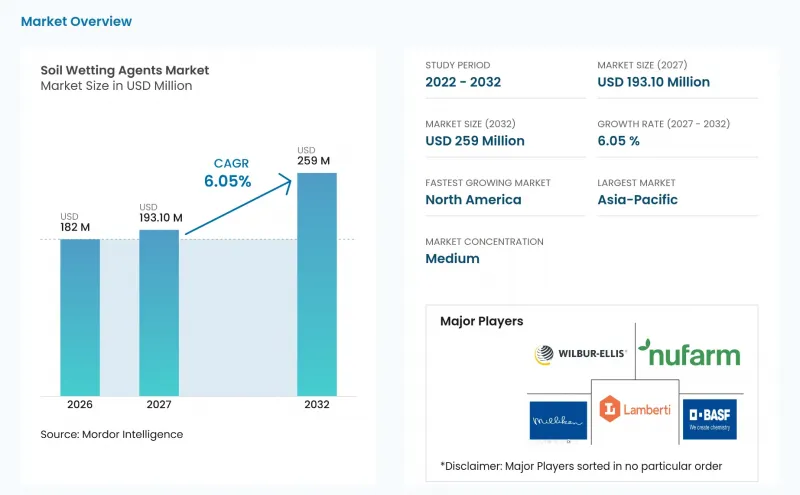
Insights and Trends of Soil Wetting Agents Market
Water Scarcity and Irrigation-Efficiency Requirements
Water scarcity is increasing the need to maximize the effectiveness of available irrigation water, particularly in regions experiencing declining freshwater availability and irregular rainfall. Soil water repellency, often associated with sandy soils, organic matter accumulation, and prolonged dry conditions, can prevent water from penetrating the soil uniformly, resulting in surface runoff, localized dry patches, and inefficient moisture retention. Soil wetting agents help overcome these limitations by reducing water repellency and improving infiltration, allowing irrigation water to spread more evenly through the soil profile. This is particularly important in water-stressed agricultural regions, where inefficient infiltration can increase irrigation requirements and affect crop establishment and productivity. Growing pressure to conserve freshwater resources is therefore encouraging the adoption of soil wetting agents across agriculture, professional turf management, and horticulture as a means of improving soil moisture distribution and making better use of limited water supplies.
Expansion of Precision Irrigation and Soil-Moisture Monitoring
Precision irrigation is creating new opportunities for the soil wetting agents market by linking irrigation decisions to measured soil conditions and improving water-use efficiency. According to the 2025 annual report of Utah's Agriculture Water Demonstration, Research, and Implementation Pilot Program (AG-DRIP), 31 farmers enrolled in 2025, bringing cumulative participation to 77 farmers since the program's launch in 2023. The program provided soil moisture sensors, flow meters, and weather stations with telemetry to support data-driven irrigation management. As sensor-based monitoring expands, growers can identify areas with uneven moisture distribution and incorporate soil wetting agents into targeted irrigation practices to improve water penetration and reduce water losses. This creates opportunities for suppliers offering formulations compatible with precision irrigation systems, supported by field-performance evidence and agronomic services. Partnerships with specialist distributors further strengthen market access in precision irrigation, as demonstrated by Aquatrols Europe Ltd's appointment of Grashobber as its exclusive distributor in Germany and Austria in October 2024.
Limited Awareness and Technical Training Among Smallholders
Limited technical knowledge constrains adoption in the soil wetting agents market among smallholders, even in areas where water stress creates a clear need for better soil moisture management. A 2025 study in Frontiers in Sustainable Food Systems found that extension contact was a strong predictor of adoption for new soil inputs among smallholder farmers in Southern Malawi. Awareness alone did not ensure consistent use, as growers also needed repeated agronomic guidance on suitable applications and treatment practices. Public advisory systems in low-income markets are often underfunded, while private distributors may prioritize higher-margin products that require less farmer education. Suppliers can reduce this barrier by using local product formats and established fertilizer distribution channels with existing grower relationships.
Other drivers and restraints analyzed in the detailed report include:
- Growth of Professional Turf and Sports-Facility Management
- Increasing Use in Drought-Prone Agriculture and Horticulture
- Premium Product Costs and Uncertain Short-Term Farm Payback
For complete list of drivers and restraints, kindly check the Table Of Contents.
Segment Analysis
Nonionic wetting agents held 51.3% of the soil wetting agents market share in 2026. Their leading position is supported by their broad compatibility with agricultural inputs and established use in turf and crop production. Because nonionic surfactants carry no electrical charge, they are generally less prone to interactions with ions present in irrigation water and tank mixtures than charged surfactants. University of Florida's Institute of Food and Agricultural Sciences (UF/IFAS) identifies nonionic surfactants as widely used agricultural adjuvants because of their compatibility with different pesticide products, while turf-management literature identifies nonionic surfactants as commonly used to improve infiltration and rewetting of water-repellent root zones. Their established application base across agriculture, horticulture, and turf therefore supports their continued market leadership.
Bio-based and organic wetting agents are forecast to grow at a CAGR of 8.1% from 2027 to 2032. Growth is supported by increasing interest in biodegradable and naturally derived surfactant chemistries, particularly in applications where environmental profile and compatibility with sustainability-oriented production systems influence product selection. Alkyl polyglucoside (APG)-based surfactants, which are also nonionic, for example, are derived from sugar and fatty-acid components and are being incorporated into turf wetting-agent formulations as naturally derived alternatives. Commercial product development is also moving toward biodegradable formulations. Bionema launched Soil-Jet BSP100 in 2024 as a biodegradable surfactant for sports and turf applications, designed to improve water infiltration and reduce soil water repellency. This shift creates opportunities for suppliers developing bio-based formulations that can combine environmental attributes with reliable wetting performance, although adoption will remain dependent on field efficacy, formulation stability, and cost competitiveness.
Complete Report Scope:
- By Product Type
- Nonionic Wetting Agents
- Anionic Wetting Agents
- Cationic Wetting Agents
- Bio-Based and Organic Wetting Agents
- Polymer-Based Wetting Agents
- By Form
- Liquid
- Powder
- Granular
- By Application
- Field Crops and Commercial Agriculture
- Horticulture and Nursery Production
- Golf Courses and Sports Turf
- Residential Lawns and Landscape Maintenance
- Other Applications
- By Geography
- North America
- United States
- Canada
- Mexico
- Rest of North America
- South America
- Brazil
- Argentina
- Rest of South America
- Europe
- Germany
- France
- United Kingdom
- Italy
- Spain
- Russia
- Rest of Europe
- Asia-Pacific
- China
- India
- Japan
- South Korea
- Australia
- Rest of Asia-Pacific
- Middle East
- Saudi Arabia
- United Arab Emirates
- Turkey
- Rest of Middle East
- Africa
- South Africa
- Egypt
- Kenya
- Nigeria
- Rest of Africa
- North America
Geography Analysis
Asia-Pacific held 24.0% of the soil wetting agents market share in 2026. Irrigated agriculture in China, India, Australia, and Southeast Asia supports regional demand. Government-led soil improvement programs and expanding micro-irrigation networks also support commercial adoption. India's public support for drip and micro-irrigation has increased the installed base of systems where wetting agent compatibility is relevant to improve their performance. Regional growers are using these products in row crops and horticulture where soil moisture management is important.
North America is forecast to grow at a CAGR of 7.4% from 2027 to 2032, making it the fastest-growing geography in the soil wetting agents market. The region has an established professional turf industry and a large commercial farming base, where precision irrigation and soil moisture management are gaining importance. Growing adoption of water-efficient irrigation technologies and increasing emphasis on optimizing water application are creating opportunities for soil wetting agents that improve infiltration, reduce runoff, and support uniform moisture distribution. Europe is moving toward bio-based formulations as regulatory attention on persistent adjuvant chemistries increases. Aquatrols Europe and Fenaco Genossenschaft registered six premium soil surfactants in Switzerland in 2026 under the country's Fertilizer Ordinance and Chemical Product Register. South America offers growth potential through expanding soybean and maize cultivation, particularly in areas experiencing variable rainfall and uneven soil moisture conditions.
The Middle East and Africa remain smaller markets but face strong water constraints. Food and Agriculture Organisation (FAO) reported in 2025 that Kuwait and Qatar were among the countries with the lowest renewable freshwater resources per person, while Saudi Arabia's Vision 2030 supports greenhouse development and controlled-environment agriculture. Turf and landscaping use is developing in the United Arab Emirates and Israel, where sandy soils can become hydrophobic, which increases the demand for soil wetting agents. African demand remains limited by smallholder awareness and premium product prices, although Kenya, South Africa, Nigeria, and Egypt have commercial demand through horticulture export supply chains.
- BASF SE
- The Aquatrols Company (Lamberti S.p.A.)
- Milliken & Company
- Syngenta AG (Sinochem Holdings Corporation Ltd)
- Croda International Plc
- Clariant AG
- Grow More, Inc.
- Seasol International Pty Ltd
- Helena Agri-Enterprises, LLC
- Geoponics Corporation
- AQUA-AID Solutions
- Harrell's LLC
- Bionema Group Limited
- Wilbur-Ellis Company, LLC (Wilbur-Ellis Holdings, Inc.)
- WinField United (Land O'Lakes, Inc.)
Additional Benefits:
- The market estimate (ME) sheet in Excel format
- 3 months of analyst support
TABLE OF CONTENTS
1 INTRODUCTION
- 1.1 Study Assumptions and Market Definition
- 1.2 Scope of the Study
2 RESEARCH METHODOLOGY
3 EXECUTIVE SUMMARY
4 MARKET LANDSCAPE
- 4.1 Market Overview
- 4.2 Market Drivers
- 4.2.1 Water Scarcity and Irrigation-Efficiency Requirements
- 4.2.2 Expansion of Precision Irrigation and Soil-Moisture Monitoring
- 4.2.3 Growth of Professional Turf and Sports-Facility Management
- 4.2.4 Increasing Use in Drought-Prone Agriculture and Horticulture
- 4.2.5 Integration with Fertilizer and Crop-Protection Programs
- 4.2.6 Demand for Bio-Based and Biodegradable Formulations
- 4.3 Market Restraints
- 4.3.1 Limited Awareness and Technical Training Among Smallholders
- 4.3.2 Premium Product Costs and Uncertain Short-Term Farm Payback
- 4.3.3 Raw-Material Price Volatility
- 4.3.4 Variable Performance Across Soil Chemistry and Water Quality
- 4.4 Regulatory Landscape
- 4.5 Technological Outlook
- 4.6 Porter's Five Forces Analysis
- 4.6.1 Threat of New Entrants
- 4.6.2 Bargaining Power of Suppliers
- 4.6.3 Bargaining Power of Buyers
- 4.6.4 Threat of Substitutes
- 4.6.5 Intensity of Competitive Rivalry
5 MARKET SIZE AND GROWTH FORECASTS (VALUE)
- 5.1 By Product Type
- 5.1.1 Nonionic Wetting Agents
- 5.1.2 Anionic Wetting Agents
- 5.1.3 Cationic Wetting Agents
- 5.1.4 Bio-Based and Organic Wetting Agents
- 5.1.5 Polymer-Based Wetting Agents
- 5.2 By Form
- 5.2.1 Liquid
- 5.2.2 Powder
- 5.2.3 Granular
- 5.3 By Application
- 5.3.1 Field Crops and Commercial Agriculture
- 5.3.2 Horticulture and Nursery Production
- 5.3.3 Golf Courses and Sports Turf
- 5.3.4 Residential Lawns and Landscape Maintenance
- 5.3.5 Other Applications
- 5.4 By Geography
- 5.4.1 North America
- 5.4.1.1 United States
- 5.4.1.2 Canada
- 5.4.1.3 Mexico
- 5.4.1.4 Rest of North America
- 5.4.2 South America
- 5.4.2.1 Brazil
- 5.4.2.2 Argentina
- 5.4.2.3 Rest of South America
- 5.4.3 Europe
- 5.4.3.1 Germany
- 5.4.3.2 France
- 5.4.3.3 United Kingdom
- 5.4.3.4 Italy
- 5.4.3.5 Spain
- 5.4.3.6 Russia
- 5.4.3.7 Rest of Europe
- 5.4.4 Asia-Pacific
- 5.4.4.1 China
- 5.4.4.2 India
- 5.4.4.3 Japan
- 5.4.4.4 South Korea
- 5.4.4.5 Australia
- 5.4.4.6 Rest of Asia-Pacific
- 5.4.5 Middle East
- 5.4.5.1 Saudi Arabia
- 5.4.5.2 United Arab Emirates
- 5.4.5.3 Turkey
- 5.4.5.4 Rest of Middle East
- 5.4.6 Africa
- 5.4.6.1 South Africa
- 5.4.6.2 Egypt
- 5.4.6.3 Kenya
- 5.4.6.4 Nigeria
- 5.4.6.5 Rest of Africa
- 5.4.1 North America
6 COMPETITIVE LANDSCAPE
- 6.1 Market Concentration
- 6.2 Strategic Moves
- 6.3 Market Share Analysis
- 6.4 Company Profiles (Includes Global Level Overview, Market Level Overview, Core Segments, Financials as Available, Strategic Information, Market Rank/Share, Products and Services, and Recent Developments)
- 6.4.1 BASF SE
- 6.4.2 The Aquatrols Company (Lamberti S.p.A.)
- 6.4.3 Milliken & Company
- 6.4.4 Syngenta AG (Sinochem Holdings Corporation Ltd)
- 6.4.5 Croda International Plc
- 6.4.6 Clariant AG
- 6.4.7 Grow More, Inc.
- 6.4.8 Seasol International Pty Ltd
- 6.4.9 Helena Agri-Enterprises, LLC
- 6.4.10 Geoponics Corporation
- 6.4.11 AQUA-AID Solutions
- 6.4.12 Harrell's LLC
- 6.4.13 Bionema Group Limited
- 6.4.14 Wilbur-Ellis Company, LLC (Wilbur-Ellis Holdings, Inc.)
- 6.4.15 WinField United (Land O'Lakes, Inc.)
7 MARKET OPPORTUNITIES AND FUTURE OUTLOOK

