PUBLISHER: Mordor Intelligence | PRODUCT CODE: 2197098

PUBLISHER: Mordor Intelligence | PRODUCT CODE: 2197098
France Plant Growth Regulators - Market Share Analysis, Industry Trends & Statistics, Growth Forecasts (2026 - 2031)
According to Mordor Intelligence, the France plant growth regulators market size is projected to grow from USD 179.5 million in 2025 to USD 194.3 million in 2026, reaching USD 289.5 million by 2031, with a CAGR of 8.3% during 2026-2031.
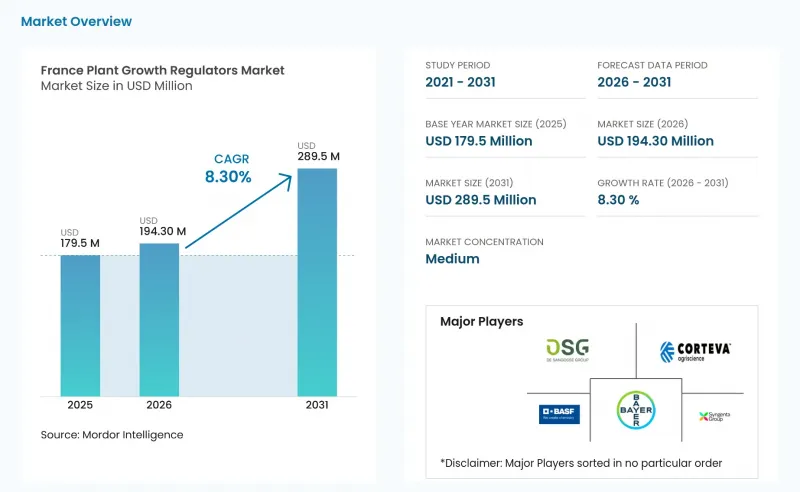
France Plant Growth Regulators Market Trends and Insights
Sustainable And Organic Acreage Supports Growth-Regulation Adoption
The French plant growth regulator market is supported by the country's extensive base of certified organic farming, which accounted for nearly 10% of the total utilized agricultural area in 2024. As more agricultural land transitions to organic and closely monitored production systems, growers face limited input options and increasingly prioritize registered products that enhance crop vigor, fruit development, and stress management within regulatory guidelines. This trend drives demand for biostimulant plant growth regulators that comply with EU organic standards and are already authorized through France's ITAB pathways. Additionally, farms are working towards HVE Level 3 certification, expanding the market for seaweed-derived and amino-acid-based products beyond fully organic farms. The market also experiences a pricing dynamic: growers operating under stricter certification standards tend to purchase narrower, more specialized product portfolios rather than broad commodity inputs. Furthermore, expanding the Soil Nutrient apparent Balance (SNuB) positive plant list from 148 pharmacopeia species to over 1,193 authorized plant species has reduced barriers to the development and commercialization of new natural formulations. This combination of certification requirements and increased eligibility for natural inputs is anticipated to sustain steady demand for higher-value solutions in the France plant growth regulators market over time.
Cereal Production And Anti-Lodging Demand
The French plant growth regulator market is strongly supported by cereal cultivation, as France annually produces significant quantities of wheat and barley, maintaining its position as the European Union's largest cereal producer. This large crop base creates steady demand for anti-lodging plant growth regulators in high-input production programs. Growers applying higher nitrogen rates require stem-strength support to reduce lodging risk and protect harvest quality. National crop production increased by 3.5% in 2025 following the weather-disrupted 2024 season, restoring spending on field-crop input programs. The France plant growth regulators market retains a stable cereal demand base even as other pesticide categories face stronger reduction pressure. Arvalis participates in the Strategic Action Plan for Anticipating the Potential European Withdrawal of Active Substances and Developing Alternative Crop Protection Techniques (PARSADA)'s intersectoral work, which provides cereal suppliers with clearer direction on the future role of anti-lodging solutions. This positions cereals as an important volume segment for companies that can balance conventional retardants with emerging lower-risk alternatives.
Approval Timelines and Dossier Costs
The France plant growth regulators market faces significant challenges due to one of Europe's most stringent authorization processes. The French Agency for Food, Environmental and Occupational Health & Safety (ANSES) typically requires 3 to 5 years to approve a complete phytopharmaceutical product dossier. Submission costs often exceed EUR 1 million (USD 1.1 million) per active substance, making the full registration process inaccessible for many smaller innovators. This delays the introduction of new products, such as cytokinins and gibberellins, despite existing grower demand. The regulatory environment benefits companies with multinational registration pipelines, as they can distribute compliance costs across multiple countries and product lines. In contrast, smaller developers frequently partner with large distributors to access regulatory support and broader commercialization networks. However, such partnerships can limit their independence and reduce future profit margins. As a result, the active-substance pipeline in the France plant growth regulators market remains more concentrated than the level of demand would indicate.
Other drivers and restraints analyzed in the detailed report include:
- Climate Stress In Fruit, Vegetable, And Orchard Production
- Precision And Protected Cultivation Adoption
- Water, Biodiversity, and Resident-Exposure Controls
For complete list of drivers and restraints, kindly check the Table Of Contents.
Segment Analysis
Cytokinins accounted for 34% of the France plant growth regulators market share in 2025, making them the largest type segment. Their widespread use across orchards, vineyards, brassicas, lettuce, turf, and protected vegetables supports this position. Depending on the label claim and product category, cytokinins can also qualify under different regulatory routes in France. This gives suppliers greater flexibility in positioning products for professional growers. The versatility of cytokinins benefits the France plant growth regulators market, as a single active class can address multiple high-value crop uses.
Gibberellins are forecast to grow at a 9.1% CAGR from 2026 to 2031, making them the fastest-growing type segment. Demand is supported by their use in seedless table grapes, where elongation treatments can command premium pricing. Organic oilseeds and pulses present an additional opportunity as certification-compatible yield tools. Auxins remained one of the argest type due to their role in rooting and fruit thinning. Ethylene releasers and other retardants continued to serve established crop uses, though their outlook is more restricted under HRI-1 risk scoring.
Complete Report Scope:
- By Type
- Cytokinins
- Auxins
- Gibberellins
- Ethylene and Ethylene-Releasing Compounds
- Other Types
- By Application
- Crop-Based
- Grains and Cereals
- Pulses and Oilseeds
- Fruits and Vegetables
- Cash Crops
- Other Crops
- Non-Crop-Based
- Turf and Ornamental Grass
- Ornamentals and Nursery Crops
- Crop-Based
- By Formulation
- Soluble Liquids
- Soluble Granules
- Suspension Concentrates
- Wettable Powders
- Other Formulations
List of Companies Covered in this Report:
- BASF SE
- Bayer AG
- Syngenta Group
- Corteva Agriscience
- De Sangosse
- Philagro France
- UPL Ltd.
- Nufarm Limited
- FMC Corporation
- Sipcam Oxon S.p.A.
- Rovensa Next
- ICL Group
- Biostadt India Limited
- Lallemand, Inc.
- Olmix Group
Additional Benefits:
- The market estimate (ME) sheet in Excel format
- 3 months of analyst support
TABLE OF CONTENTS
1 Introduction
- 1.1 Study Assumptions and Market Definition
- 1.2 Scope of the Study
2 Research Methodology
3 Executive Summary
4 Market Landscape
- 4.1 Market Overview
- 4.2 Market Drivers
- 4.2.1 Sustainable and organic acreage expansion
- 4.2.2 Cereal production and anti-lodging demand
- 4.2.3 Climate stress in fruit, vegetable, and orchard production
- 4.2.4 Precision and protected cultivation adoption
- 4.2.5 France snub pathway for natural growth-management products
- 4.2.6 PARSADA-led substitution of at-risk actives
- 4.3 Market Restraints
- 4.3.1 Approval timelines and dossier costs
- 4.3.2 Water, biodiversity, and resident-exposure controls
- 4.3.3 PPP and biostimulant regulatory boundary confusion
- 4.3.4 Grower return-on-investment pressure and organic-acreage softness
- 4.4 Regulatory Landscape
- 4.5 Technological Outlook
- 4.6 Porter's Five Forces Analysis
- 4.6.1 Bargaining Power of Suppliers
- 4.6.2 Bargaining Power of Buyers
- 4.6.3 Threat of New Entrants
- 4.6.4 Threat of Substitute Products
- 4.6.5 Intensity of Competitive Rivalry
5 Market Size And Growth Forecasts (Value, Usd)
- 5.1 By Type
- 5.1.1 Cytokinins
- 5.1.2 Auxins
- 5.1.3 Gibberellins
- 5.1.4 Ethylene and Ethylene-Releasing Compounds
- 5.1.5 Other Types
- 5.2 By Application
- 5.2.1 Crop-Based
- 5.2.1.1 Grains and Cereals
- 5.2.1.2 Pulses and Oilseeds
- 5.2.1.3 Fruits and Vegetables
- 5.2.1.4 Cash Crops
- 5.2.1.5 Other Crops
- 5.2.2 Non-Crop-Based
- 5.2.2.1 Turf and Ornamental Grass
- 5.2.2.2 Ornamentals and Nursery Crops
- 5.2.1 Crop-Based
- 5.3 By Formulation
- 5.3.1 Soluble Liquids
- 5.3.2 Soluble Granules
- 5.3.3 Suspension Concentrates
- 5.3.4 Wettable Powders
- 5.3.5 Other Formulations
6 Competitive Landscape
- 6.1 Market Concentration
- 6.2 Strategic Moves
- 6.3 Market Share Analysis
- 6.4 Company Profiles (includes Global Level Overview, Market Level Overview, Core Segments, Financials as available, Strategic Information, Market Rank/Share, Products and Services, Recent Developments)
- 6.4.1 BASF SE
- 6.4.2 Bayer AG
- 6.4.3 Syngenta Group
- 6.4.4 Corteva Agriscience
- 6.4.5 De Sangosse
- 6.4.6 Philagro France
- 6.4.7 UPL Ltd.
- 6.4.8 Nufarm Limited
- 6.4.9 FMC Corporation
- 6.4.10 Sipcam Oxon S.p.A.
- 6.4.11 Rovensa Next
- 6.4.12 ICL Group
- 6.4.13 Biostadt India Limited
- 6.4.14 Lallemand, Inc.
- 6.4.15 Olmix Group
7 Market Opportunities And Future Outlook

