PUBLISHER: Mordor Intelligence | PRODUCT CODE: 2123027

PUBLISHER: Mordor Intelligence | PRODUCT CODE: 2123027
Physical Identity And Access Management (PIAM) Software - Market Share Analysis, Industry Trends & Statistics, Growth Forecasts (2026 - 2031)
According to Mordor Intelligence, physical identity and access management (PIAM) software market size in 2026 is estimated at USD 1.12 billion, growing from 2025 value of USD 980 million with 2031 projections showing USD 2.14 billion, growing at 13.88% CAGR over 2026-2031.
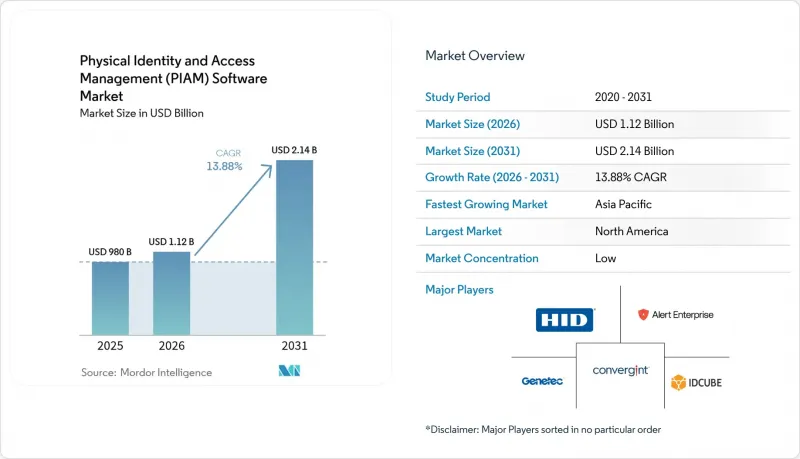
This report is Segmented by Component (Software, and Services), Deployment Mode (On-Premises, and Cloud), Organization Size (Small and Medium Enterprises, and Large Enterprises), End-User Industry (Banking Financial Services and Insurance, Government and Defense, Healthcare, and More), and Geography. The Market Forecasts are Provided in Terms of Value (USD).
Global Physical Identity And Access Management (PIAM) Software Market Trends and Insights
Compliance Mandates From Governments
Government regulations are shortening refresh cycles for identity systems. Australia's Digital ID Act 2024 requires agencies to enable citizens to use a single credential for both digital and physical services, prompting the procurement of interoperable platforms that can issue mobile badges and bridge cyber and door-access policies. In the United States, the Cybersecurity and Infrastructure Security Agency's Zero Trust Maturity Model requires continuous verification at the building entry point, moving agencies away from static swipe cards toward risk-scored decisions. ISO/IEC 27001:2022 now embeds physical controls in Annex A, nudging multinational firms to integrate building security into their enterprise governance programs. Collectively, these mandates elevate baseline functionality, such as audit-grade visitor logs and credential revocation, to "must-have" territory, driving the physical identity and access management market toward unified cyber-physical policy engines.
Rapid Growth of Smart Buildings and IoT-Enabled Facilities
Smart-city mega-projects are wiring thousands of sensors, from occupancy counters to HVAC valves, into converged operational networks. These endpoints require unique identities and least-privileged permissions, so owners should treat device onboarding similarly to human provisioning. In the Asia-Pacific region, NEOM's biometric eGates process travelers without documents and sync credentials with building-management systems for frictionless movement. China's Xiong'an planners embed PIAM hooks at the blueprint stage, enabling predictive maintenance based on real-time occupancy. Genetec reports that 77% of security leaders now collaborate with IT teams to manage this sensor sprawl, and 43% prefer hybrid cloud designs that ingest IoT telemetry while keeping door decisions at the edge. These practices place PIAM software at the heart of smart-building operating systems, expanding addressable spend beyond doors to every networked asset.
Concerns Over Security of Third-Party (Cloud) Data Storage
Defense agencies are hesitant to store biometric templates in multi-tenant clouds, citing data sovereignty rules and supply chain risks. The United States Department of Defense's Cybersecurity Maturity Model Certification requires contractors to host PIAM either on FedRAMP-authorized environments or on-premises, effectively excluding many public clouds. Europe's GDPR labels biometric data as a "special category," layering consent and encryption requirements that increase compliance costs for global rollouts. Although providers such as AWS offer customer-managed keys and regional instances, many agencies still view the cloud as an extra attack surface. This perception dampens near-term cloud share in government and classified projects, slowing the trajectory of the physical identity and access management market in those segments.
Other drivers and restraints analyzed in the detailed report include:
- Rising Adoption of Cloud-Based PIAM Platforms by SMEs
- Convergence of Cyber and Physical Identity Governance
- High Up-Front Integration Costs for Legacy Infrastructure
For complete list of drivers and restraints, kindly check the Table Of Contents.
Segment Analysis
Services contributed a smaller portion of 2025 revenue but are expanding faster than software as projects grow multi-site and multi-vendor. The physical identity and access management market size for services is widening because enterprises face decades of technical debt from proprietary protocols. Convergint Technologies notes that 62% of engagements blend cloud consoles with on-premises door controllers, requiring engineers to be versed in both REST APIs and legacy wiring. Premium consultative packages now include policy template libraries, change management workshops, and managed administration, creating recurring revenue streams. HID Global's Origo software, built on modular microservices, simplifies configuration while increasing the demand for professional tailoring to match workflows. As clients opt for outcome-based contracts that bundle licenses, upgrades, and monitoring, service providers capture a disproportionate share of incremental spending while reducing the time to value.
Cloud software still dominates the physical identity and access management market share because every deployment starts with a license. However, the mix will continue to tilt toward services through 2031 as subscription vendors embed implementation fees into multi-year commitments. Growth remains strongest where legacy estates require middleware bridges, such as hospitals running Wiegand readers or bank vaults protected by serial controllers. The shortage of certified PIAM specialists in emerging markets further boosts demand for services, positioning integrators with training academies and 24-hour remote support centers as key beneficiaries.
On-premises deployments retained 56.75% of revenue in 2025. Yet hybrid and cloud models are growing faster, propelled by mobile credential adoption and improved FedRAMP, ISO 27001, and SOC 2 attestations. The physical identity and access management market size associated with cloud is rising as SMEs choose SaaS to bypass server maintenance, and large enterprises leverage elastic compute for video analytics and behavioral risk scoring.
Edge gateways now cache decisions locally, allowing doors to continue functioning during internet loss, while logs are synced back once the links are restored. This architecture alleviates sovereignty concerns and encourages government agencies to offload non-classified workloads. Vendors respond with region-pinned data centers, customer-managed encryption keys, and role-based administration dashboards that audit every API call, chipping away at resistance. On-premises solutions will persist in air-gapped defense labs and ultra-secure data centers, but most green-field sites now default to hybrid topologies.
Complete Report Scope:
- By Component
- Software
- Services
- By Deployment Mode
- On-Premises
- Cloud
- By Organization Size
- Small and Medium Enterprises
- Large Enterprises
- By End-User Industry
- Banking Financial Services and Insurance (BFSI)
- Government and Defense
- Healthcare
- Information Technology and Telecommunications
- Energy and Utilities
- Education
- Other End-user Industries
- By Geography
- North America
- United States
- Canada
- Mexico
- South America
- Brazil
- Argentina
- Rest of South America
- Europe
- Germany
- United Kingdom
- France
- Italy
- Spain
- Rest of Europe
- Asia-Pacific
- China
- India
- Japan
- South Korea
- ASEAN
- Rest of Asia-Pacific
- Middle East and Africa
- Middle East
- Saudi Arabia
- United Arab Emirates
- Rest of Middle East
- Africa
- South Africa
- Nigeria
- Rest of Africa
- Middle East
- North America
Geography Analysis
North America generated 36.02% of 2025 revenue, buoyed by early SaaS adoption and mature integrator networks. Federal guidelines, such as NIST SP 800-217 and the Cybersecurity Maturity Model Certification, raised the baseline functionality, spurring spending in government, defense, and critical infrastructure. Canada mirrors the United States' patterns, with Crown corporations adopting zero-trust frameworks for both network and facility access.
The Asia-Pacific region is forecast to grow at a 15.98% CAGR, the fastest among regions, driven by national smart-city initiatives. Saudi Arabia's NEOM airport eGates exemplify biometric ambitions, while India's Smart Cities Mission channels municipal grants into IoT-ready access nodes embedded in traffic hubs and hospitals. China's Xiong'an New Area hardwires PIAM APIs into building-management systems, ensuring real-time energy optimization based on occupancy. Local system integrators bundle PIAM with video surveillance and elevator control, offering turnkey packages to property developers.
Europe ranks second in revenue and third in growth. eIDAS 2.0 requires member states to standardize digital wallets that link to door credentials, thereby reducing demand for federated PIAM software. Germany's automotive plants deploy contractor provisioning modules to support just-in-time manufacturing. The United Kingdom and France are accelerating cloud adoption in the public sector, leveraging local data centers operated by major hyperscalers. Strict GDPR biometric-data rules steer sensitive templates into region-pinned clusters or on-premises stores, shaping hybrid designs.
South America's market centers on Brazil and Argentina. Banks and border authorities invest in facial-recognition kiosks, while oil refineries retrofit card readers with mobile badge upgrades to reduce administrative overhead. Middle East growth relies heavily on the United Arab Emirates and Saudi Arabia, where sovereign funds fund mega-projects that incorporate mobile access from the outset. Africa shows nascent traction: South African mines adopt ruggedized readers at shafts, and Nigerian banks deploy cloud consoles to monitor distributed branches. Although smaller today, these deployments lay the groundwork for future expansion as regulations modernize.
- HID Global Corporation
- AlertEnterprise Inc.
- Genetec Inc.
- Convergint Technologies LLC
- IDCUBE Identification Systems Private Limited
- BioConnect Systems Inc.
- Gallagher Group Limited
- Cross IdentityPlus Pvt Ltd
- Brivo Systems LLC
- Johnson Controls International PLC
- Honeywell International Inc.
- Motorola Solutions Inc. (Avigilon)
- SAASPASS Inc.
- Wipro Limited
- Amazon Web Services Inc.
- IBM Corporation
Additional Benefits:
- The market estimate (ME) sheet in Excel format
- 3 months of analyst support
TABLE OF CONTENTS
1 INTRODUCTION
- 1.1 Study Assumptions and Market Definition
- 1.2 Scope of the Study
2 RESEARCH METHODOLOGY
3 EXECUTIVE SUMMARY
4 MARKET LANDSCAPE
- 4.1 Market Overview
- 4.2 Market Drivers
- 4.2.1 Compliance Mandates from Governments
- 4.2.2 Increasing Need to Manage On-Site Visitors and Contractors
- 4.2.3 Rapid Growth of Smart Buildings and IoT-Enabled Facilities
- 4.2.4 Rising Adoption of Cloud-Based PIAM Platforms by SMEs
- 4.2.5 Integration of PIAM with Physical Security Information Management (PSIM)
- 4.2.6 Convergence of Cyber and Physical Identity Governance
- 4.3 Market Restraints
- 4.3.1 Concerns Over Security of Third-Party (Cloud) Data Storage
- 4.3.2 High Up-Front Integration Costs for Legacy Infrastructure
- 4.3.3 Shortage of Skilled PIAM Implementation Specialists
- 4.3.4 Fragmented Global Regulatory Landscape
- 4.4 Industry Value Chain Analysis
- 4.5 Regulatory Landscape
- 4.6 Technological Outlook
- 4.7 Porter's Five Forces Analysis
- 4.7.1 Bargaining Power of Suppliers
- 4.7.2 Bargaining Power of Buyers
- 4.7.3 Threat of New Entrants
- 4.7.4 Threat of Substitutes
- 4.7.5 Intensity of Competitive Rivalry
- 4.8 Assessment of Macro-economic Trends on the Market
5 MARKET SIZE AND GROWTH FORECASTS (VALUE)
- 5.1 By Component
- 5.1.1 Software
- 5.1.2 Services
- 5.2 By Deployment Mode
- 5.2.1 On-Premises
- 5.2.2 Cloud
- 5.3 By Organization Size
- 5.3.1 Small and Medium Enterprises
- 5.3.2 Large Enterprises
- 5.4 By End-User Industry
- 5.4.1 Banking Financial Services and Insurance (BFSI)
- 5.4.2 Government and Defense
- 5.4.3 Healthcare
- 5.4.4 Information Technology and Telecommunications
- 5.4.5 Energy and Utilities
- 5.4.6 Education
- 5.4.7 Other End-user Industries
- 5.5 By Geography
- 5.5.1 North America
- 5.5.1.1 United States
- 5.5.1.2 Canada
- 5.5.1.3 Mexico
- 5.5.2 South America
- 5.5.2.1 Brazil
- 5.5.2.2 Argentina
- 5.5.2.3 Rest of South America
- 5.5.3 Europe
- 5.5.3.1 Germany
- 5.5.3.2 United Kingdom
- 5.5.3.3 France
- 5.5.3.4 Italy
- 5.5.3.5 Spain
- 5.5.3.6 Rest of Europe
- 5.5.4 Asia-Pacific
- 5.5.4.1 China
- 5.5.4.2 India
- 5.5.4.3 Japan
- 5.5.4.4 South Korea
- 5.5.4.5 ASEAN
- 5.5.4.6 Rest of Asia-Pacific
- 5.5.5 Middle East and Africa
- 5.5.5.1 Middle East
- 5.5.5.1.1 Saudi Arabia
- 5.5.5.1.2 United Arab Emirates
- 5.5.5.1.3 Rest of Middle East
- 5.5.5.2 Africa
- 5.5.5.2.1 South Africa
- 5.5.5.2.2 Nigeria
- 5.5.5.2.3 Rest of Africa
- 5.5.5.1 Middle East
- 5.5.1 North America
6 COMPETITIVE LANDSCAPE
- 6.1 Market Concentration
- 6.2 Strategic Moves
- 6.3 Market Share Analysis
- 6.4 Company Profiles (includes Global level Overview, Market level overview, Core Segments, Financials as available, Strategic Information, Market Rank/Share for key companies, Products and Services, and Recent Developments)
- 6.4.1 HID Global Corporation
- 6.4.2 AlertEnterprise Inc.
- 6.4.3 Genetec Inc.
- 6.4.4 Convergint Technologies LLC
- 6.4.5 IDCUBE Identification Systems Private Limited
- 6.4.6 BioConnect Systems Inc.
- 6.4.7 Gallagher Group Limited
- 6.4.8 Cross IdentityPlus Pvt Ltd
- 6.4.9 Brivo Systems LLC
- 6.4.10 Johnson Controls International PLC
- 6.4.11 Honeywell International Inc.
- 6.4.12 Motorola Solutions Inc. (Avigilon)
- 6.4.13 SAASPASS Inc.
- 6.4.14 Wipro Limited
- 6.4.15 Amazon Web Services Inc.
- 6.4.16 IBM Corporation
7 MARKET OPPORTUNITIES AND FUTURE OUTLOOK
- 7.1 White-space and Unmet-Need Assessment

