PUBLISHER: Mordor Intelligence | PRODUCT CODE: 2124350

PUBLISHER: Mordor Intelligence | PRODUCT CODE: 2124350
Hydroxyapatite - Market Share Analysis, Industry Trends & Statistics, Growth Forecasts (2026 - 2031)
According to Mordor Intelligence, the hydroxyapatite market size is projected to be USD 2.73 billion in 2025, USD 2.9 billion in 2026, and reach USD 3.96 billion by 2031, growing at a CAGR of 6.39% from 2026 to 2031.
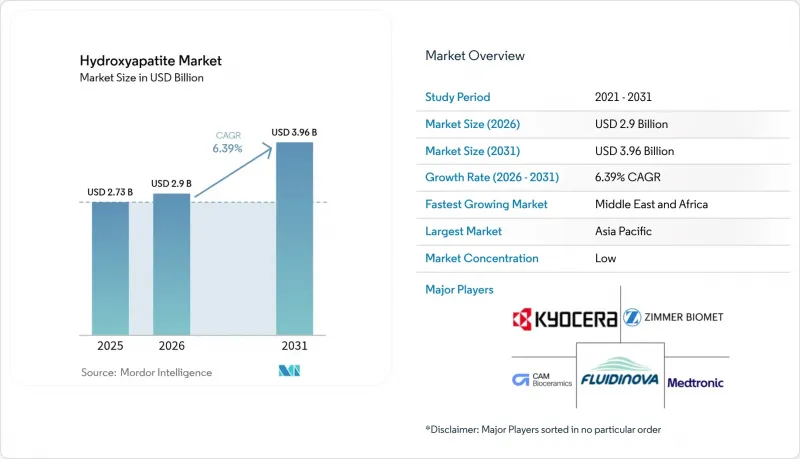
This report is Segmented by Particle Size (Nano-Sized, Micro-Sized, and Macro-Sized), Source (Synthetic and Bio-Derived), Form (Powder, Granules, and Coatings and Pastes), Application (Dental Care, Orthopedics, Plastic and Cosmetic Surgery, and Other Industrial Uses), and Geography (Asia-Pacific, North America, Europe, and More). Market Forecasts are Provided in Terms of Value (USD).
Global Hydroxyapatite Market Trends and Insights
Dental-Implant Boom in Aging Economies
By 2027, over one-fifth of residents in Japan, Germany, and Italy will be aged 65 and older, spurring a demand for tooth replacements that leans towards HA-coated fixtures instead of removable dentures. Clinical studies indicate that HA-coated posts reduce healing time compared to their uncoated titanium counterparts. This advantage helps maintain their premium pricing in markets backed by reimbursements. Dental-device companies are now aiming for comparable success with mandibular implants. In April 2025, Japan expanded its insurance coverage for HA-coated dental fixtures, projecting an addition of procedures annually starting in 2028. Proactive clinics are now integrating HA coatings with digital dentistry processes, leading to reduced chair time and increased patient turnover. These trends bolster the Hydroxyapatite market, ensuring steady demand in affluent economies.
Orthopedic Implant Volume Growth
In 2025, the global count for hip and knee arthroplasties saw significant growth, with revisions constituting a notable portion of the total. Surgeons are increasingly opting for HA-integrated cages in spinal fusions, steering clear of iliac crest autografts. This choice not only slashes operating time by nearly 40 minutes but also diminishes the risk of infections. Injectable HA-collagen putties, such as moldable scaffolds for posterolateral fusion, have gained clinical trust. The Asia-Pacific region witnessed substantial growth in orthopedic device revenue, largely driven by a rise in elective procedures in China and India. This consistent growth in surgical volumes, paired with payers' growing acceptance of premium coatings, propels the Hydroxyapatite market forward.
High Implant Procedure Cost and Regulatory Hurdles
In the U.S., single-tooth implants are expensive. Adding HA coatings further increases the component cost. This pricing structure often sidelines many Medicare beneficiaries, as routine dental care isn't federally covered. In orthopedics, revisions using HA grafts can significantly inflate hospital bills. Private insurers, however, closely monitor these costs, especially under bundled-payment models that target 90-day readmissions. Manufacturers face a hefty price tag for each 510(k) submission. This cost covers mechanical tests, biocompatibility panels, and sterility validations. Europe's MDR has extended CE-mark timelines, pushing back cash flows from product launches. These factors, combined with high surgical costs and extensive regulatory requirements, are dampening the short-term growth of the Hydroxyapatite market.
Other drivers and restraints analyzed in the detailed report include:
- Biocompatibility Advantage Over Metallic Substitutes
- 3D Printing Enabling Patient-Specific HA Implants
- Toxicology Debate on Nano-Hydroxyapatite
For complete list of drivers and restraints, kindly check the Table Of Contents.
Segment Analysis
Nano-sized powders are on track for a 7.09% CAGR through 2031, outpacing the average growth of the Hydroxyapatite market. This accelerated growth is attributed to their surface area, which enhances protein adsorption within just 48 hours. Periodontal surgeons utilize these powders in guided-tissue membranes, ensuring a bony fill instead of a fibrotic repair. Micro-sized grades, still dominant with 47.65% hydroxyapatite market share in 2025. Their packing densities enable them to achieve a compressive strength, making them ideal for hip stems and spinal cages.
Wet-precipitation plants, optimized for micro-powders, face challenges in maintaining nucleation. This limitation drives suppliers to invest in more expensive sol-gel or hydrothermal reactors. While ISO 13779-3 provides guidelines on particle-size assays, it falls short on performance thresholds, leaving buyers to establish their own specifications. Notably, nano-HA derived from Japanese scallop shells demonstrates impressive antimicrobial efficacy against Streptococcus mutans, suggesting its potential dual role in promoting bone growth and combating bacteria. Although the EU has imposed cosmetic caps, these regulations haven't yet extended to implants. However, ongoing studies on chronic inhalation could influence future regulations. As a result, there's a pronounced trend of adoption in specialized surgical channels, with expectations of a broader rollout in mainstream dental applications.
Synthetic production claimed 71.85% of 2025 volume, reflecting the stringent control over the Ca/P ratio, all under the watchful eye of ISO 13485 quality systems. The wet precipitation method, operating between 60-90 °C, adeptly transforms calcium nitrate and diammonium phosphate. The resulting commodity grades are priced at FOB China. Meanwhile, sol-gel batches, boasting higher purity, cater to craniofacial markets where radiographic clarity is paramount.
Bio-derived hydroxyapatite is growing at a 6.83% CAGR. This growth is largely attributed to mandates promoting a circular economy and the osteogenic advantages of trace strontium and magnesium, both sourced from marine feeds. When calcined between 900-1,000 °C, eggshell waste produces a porous form of HA. On the other hand, coral-based variants, while boasting interconnected channels that expedite vascular ingrowth, grapple with supply constraints due to CITES regulations. Shell Apatite, a powder derived from Japanese scallops, made its debut in local dental clinics in 2025 and is now pursuing CE certification. However, the variability in mineral trace elements poses challenges in lot release, prompting innovators to turn to blockchain-style provenance logs for solutions. In summary, as sustainability credentials gain prominence, bio-routes are transitioning from being mere novelties to becoming foundational pillars in the Hydroxyapatite market.
Complete Report Scope:
- By Particle Size
- Nano-sized
- Micro-sized
- Macro-sized (greater than 1 µm)
- By Source
- Synthetic (wet, sol-gel, hydrothermal)
- Bio-derived (egg-shell, coral, bovine, fish-scale)
- By Form
- Powder
- Granules
- Coatings and Pastes
- By Application
- Dental Care
- Orthopedics
- Plastic and Cosmetic Surgery
- Other Industrial Uses (catalysts, chromatography, water-treatment)
- By Geography
- Asia-Pacific
- China
- India
- Japan
- South Korea
- ASEAN Countries
- Rest of Asia-Pacific
- North America
- United States
- Canada
- Mexico
- Europe
- Germany
- United Kingdom
- France
- Spain
- Italy
- Russia
- Rest of Europe
- South America
- Brazil
- Argentina
- Rest of South America
- Middle-East and Africa
- Saudi Arabia
- United Arab Emirates
- South Africa
- Rest of Middle-East and Africa
- Asia-Pacific
Geography Analysis
Asia-Pacific contributed 39.25% of the 2025 share of global sales. China's wet-precipitation capacity offers commodity powders at prices significantly lower than their Western counterparts, making inroads into budget-conscious clinics in Southeast Asia. An insurance expansion in April 2025 for HA-coated dental implants in Japan is set to boost annual cases, benefiting domestic sol-gel suppliers like Matsumoto Koshou. In 2025, South Korea's regulators doubled the approvals for 3D-printed HA implants, showcasing their confidence in additive manufacturing. Meanwhile, India, despite witnessing growth in orthopedic devices in 2025, continues to prefer autografts in public hospitals, posing a challenge for HA vendors.
North America sees steady mid-single-digit growth, driven by innovations like patient-specific 3D prints, HA-collagen putties, and CaHA dermal fillers. Zimmer Biomet's FDA-approved Oxford knee has set a new standard for coating durability, pushing competitors to enhance their offerings. While CMS's exclusion of routine dental implants limits their adoption among seniors, pilot bundled-payments might pave the way for reimbursing HA-coated fixtures, provided they maintain a complication rate within 90 days. In Canada, urban private clinics lean towards premium HA products, but rural hospitals often stick to uncoated metals, highlighting a divide in the provincial healthcare system. Mexico's push for near-shoring saw two multinationals establish HA-coating facilities in Monterrey in 2025.
Europe grapples with extended approvals under MDR 2017/745, yet its emphasis on biocompatibility resonates with HA's inherent advantages. High arthroplasty rates in Germany, the UK, and France account for a significant portion of Europe's HA demand. The Middle East and Africa, buoyed by Saudi Vision 2030's healthcare investment, is witnessing 6.47% CAGR growth. This financial push is motivating orthopedic OEMs to establish hubs in Riyadh, with public-private partnerships facilitating the creation of new hospitals that are keen on premium HA implants. South America, despite grappling with currency fluctuations, sees Brazil's sizable population as a potential market, especially once reimbursement models find stability.
- Berkeley Advanced Biomaterials
- Bio-Rad Laboratories
- CAM Bioceramics
- Cerabone (Botiss)
- CGbio
- Clarion Pharmaceutical Co.
- Fluidinova
- Hoya Technosurgical Corporation (HOYA Corporation)
- KYOCERA Corporation
- Medtronic
- Merz North America Inc. (Merz Biomaterials)
- Regenity
- Reneuco Berhad (Granulab Malaysia SDN.BHD)
- SANGI Co. Ltd
- SigmaGraft Biomaterials
- Taihei Chemical Industrial Co. Ltd
- Tomita Pharmaceutical Co. Ltd
- Zimmer Biomet
Additional Benefits:
- The market estimate (ME) sheet in Excel format
- 3 months of analyst support
TABLE OF CONTENTS
1 Introduction
- 1.1 Study Assumptions and Market Definition
- 1.2 Scope of the Study
2 Research Methodology
3 Executive Summary
4 Market Landscape
- 4.1 Market Overview
- 4.2 Market Drivers
- 4.2.1 Dental-implant boom in ageing economies
- 4.2.2 Orthopedic implant volume growth
- 4.2.3 Biocompatibility advantage over metallic substitutes
- 4.2.4 Government push for safer biomaterials
- 4.2.5 3-D printing enabling patient-specific HA implants
- 4.3 Market Restraints
- 4.3.1 High implant procedure cost
- 4.3.2 Stringent FDA and CE approvals
- 4.3.3 Toxicology debate on nano-HAp in oral-care cosmetics
- 4.4 Value Chain Analysis
- 4.5 Porter's Five Forces
- 4.5.1 Bargaining Power of Suppliers
- 4.5.2 Bargaining Power of Buyers
- 4.5.3 Threat of New Entrants
- 4.5.4 Threat of Substitutes
- 4.5.5 Intensity of Rivalry
5 Market Size and Growth Forecasts (Value)
- 5.1 By Particle Size
- 5.1.1 Nano-sized
- 5.1.2 Micro-sized
- 5.1.3 Macro-sized (greater than 1 µm)
- 5.2 By Source
- 5.2.1 Synthetic (wet, sol-gel, hydrothermal)
- 5.2.2 Bio-derived (egg-shell, coral, bovine, fish-scale)
- 5.3 By Form
- 5.3.1 Powder
- 5.3.2 Granules
- 5.3.3 Coatings and Pastes
- 5.4 By Application
- 5.4.1 Dental Care
- 5.4.2 Orthopedics
- 5.4.3 Plastic and Cosmetic Surgery
- 5.4.4 Other Industrial Uses (catalysts, chromatography, water-treatment)
- 5.5 By Geography
- 5.5.1 Asia-Pacific
- 5.5.1.1 China
- 5.5.1.2 India
- 5.5.1.3 Japan
- 5.5.1.4 South Korea
- 5.5.1.5 ASEAN Countries
- 5.5.1.6 Rest of Asia-Pacific
- 5.5.2 North America
- 5.5.2.1 United States
- 5.5.2.2 Canada
- 5.5.2.3 Mexico
- 5.5.3 Europe
- 5.5.3.1 Germany
- 5.5.3.2 United Kingdom
- 5.5.3.3 France
- 5.5.3.4 Spain
- 5.5.3.5 Italy
- 5.5.3.6 Russia
- 5.5.3.7 Rest of Europe
- 5.5.4 South America
- 5.5.4.1 Brazil
- 5.5.4.2 Argentina
- 5.5.4.3 Rest of South America
- 5.5.5 Middle-East and Africa
- 5.5.5.1 Saudi Arabia
- 5.5.5.2 United Arab Emirates
- 5.5.5.3 South Africa
- 5.5.5.4 Rest of Middle-East and Africa
- 5.5.1 Asia-Pacific
6 Competitive Landscape
- 6.1 Market Concentration
- 6.2 Strategic Moves
- 6.3 Market Share(%)/Ranking Analysis
- 6.4 Company Profiles (includes Global Overview, Market Overview, Core Segments, Financials, Strategic Information, Products and Services, Recent Developments)
- 6.4.1 Berkeley Advanced Biomaterials
- 6.4.2 Bio-Rad Laboratories
- 6.4.3 CAM Bioceramics
- 6.4.4 Cerabone (Botiss)
- 6.4.5 CGbio
- 6.4.6 Clarion Pharmaceutical Co.
- 6.4.7 Fluidinova
- 6.4.8 Hoya Technosurgical Corporation (HOYA Corporation)
- 6.4.9 KYOCERA Corporation
- 6.4.10 Medtronic
- 6.4.11 Merz North America Inc. (Merz Biomaterials)
- 6.4.12 Regenity
- 6.4.13 Reneuco Berhad (Granulab Malaysia SDN.BHD)
- 6.4.14 SANGI Co. Ltd
- 6.4.15 SigmaGraft Biomaterials
- 6.4.16 Taihei Chemical Industrial Co. Ltd
- 6.4.17 Tomita Pharmaceutical Co. Ltd
- 6.4.18 Zimmer Biomet
7 Market Opportunities and Future Outlook
- 7.1 White-space and unmet-need assessment

