PUBLISHER: Mordor Intelligence | PRODUCT CODE: 2124118

PUBLISHER: Mordor Intelligence | PRODUCT CODE: 2124118
Fatty Alcohol - Market Share Analysis, Industry Trends & Statistics, Growth Forecasts (2026 - 2031)
According to Mordor Intelligence, the fatty alcohol market size was valued at 4.13 million tons in 2025 and is estimated to grow from 4.30 million tons in 2026 to reach 5.26 million tons by 2031, at a CAGR of 4.09% during the forecast period (2026-2031).
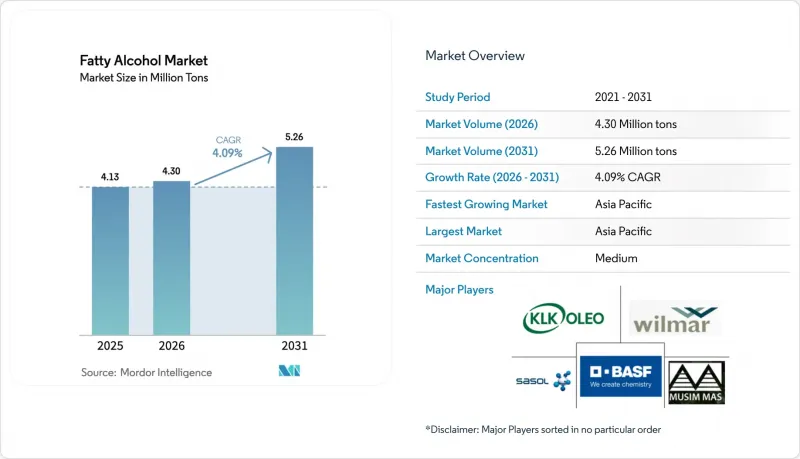
This report is Segmented by Source (Natural, Petrochemical), Application (Surfactants, Personal Care and Cosmetics, Household and Industrial Cleaning, Lubricants and Greases, Plastics Additives, Pharmaceutical Excipients, and More), and Geography (Asia-Pacific, North America, Europe, South America, and Middle East and Africa). Market Forecasts are Provided in Terms of Volume (tons).
Global Fatty Alcohol Market Trends and Insights
Surfactant Demand Boom in FMCG Sector
Nonionic surfactants built on fatty-alcohol ethoxylates represented 40% of global surfactant use in 2024, and FMCG majors are cutting anionic ratios to improve hard-water performance. Procter & Gamble's patent filings reveal sulfate-free shampoos that raise fatty-alcohol loading by up to 20% per bottle. Asia-Pacific is the epicenter; urban detergent consumption already stands above 8 kg per capita, driven by rising disposable income. Biosurfactant scale-up delays keep fatty-alcohol ethoxylates below USD 1,500 per ton, reinforcing their cost advantage. Southeast Asian producers are back-integrating into palm-kernel crushing to secure feedstock, but the strategy escalates exposure to EU deforestation rules that came into force in 2024.
Shift Toward Sulfate-Free and Milder Personal-Care Formulations
Sulfate-free personal-care products grew twice as fast as conventional lines in 2024, propelled by dermatological concerns and social-media amplification. The trend lifts demand for C16-C18 alcohols, valued for emolliency, and C12-C14 alcohols that co-surfact in mild cleansing bases. Although EU Cosmetics Regulation does not mandate sulfate-free claims, proactive reformulation has become brand risk management. Clariant's USD 810 million purchase of Lucas Meyer Cosmetics underscores premium multiples paid for specialty ingredient portfolios enabling "clean beauty" claims. Cross-category adoption extends to body washes and facial cleansers, expanding the fatty-alcohol addressable market by roughly 12-15% over the forecast horizon.
Volatile Lauric-Oil and Ethylene Feedstock Prices
Palm-kernel-oil prices surged 75% year-on-year to USD 2,063.59 per ton in March 2025 after El Nino trimmed yields in Indonesia and Malaysia, and feedstock represents up to 70% of natural-alcohol production cost. U.S. ethane stayed below USD 0.20 per gallon through 2024, sharpening cost gaps between American Ziegler plants and European naphtha crackers exposed to higher Brent prices. China's coal-to-syngas path shields Zhejiang Jiahua from both lauric oil and ethylene volatility, highlighting regional cost asymmetry. Limited hedging practices-only 30% of oleochemical firms lock in palm-kernel-oil prices-leave margins exposed to 40% intra-year swings.
Other drivers and restraints analyzed in the detailed report include:
- Regulatory Push for Biodegradable Lubricants
- Increasing Demand from Pharmaceutical Applications
- Over-Capacity in Southeast Asian Natural-Alcohol Plants
For complete list of drivers and restraints, kindly check the Table Of Contents.
Segment Analysis
Natural sources delivered 76.91% of the 2025 volume, but petrochemical routes are forecast to outpace the fatty alcohol market at a 4.39% CAGR through 2031 on the back of sub-USD 0.20-per-gallon U.S. ethane and coal-syngas economics in China. Sasol explicitly markets EUDR-exempt synthetic grades, a value proposition resonating with European detergent formulators wary of deforestation audits. Natural producers counter with RSPO and renewable-energy credentials, yet price overlooks provenance in commodity surfactant segments. Emerging bio-routes offer a third path: BASF's CO2-to-methanol pilot and Yanchang Petroleum's 150 ktpa Fischer-Tropsch demo each aim to decouple fatty-alcohol output from both palm oil and fossil ethylene, though commercialization hinges on carbon-credit economics.
Natural alcohols maintain dominance in the fatty alcohol market share for surfactant applications. To defend volume, Southeast Asian players are investing in specialty applications-emollient-grade cetyl and stearyl alcohols fetch 30% premiums over C12-C14 detergent grades. Petrochemical producers, meanwhile, chase efficiency gains; U.S. Gulf Coast sites leverage cheap shale-ethane feedstock and Gulf logistics to supply Latin America at a lower delivered cost than Malaysian exporters despite the longer voyage.
Complete Report Scope:
- By Source
- Natural
- Petrochemical
- By Application
- Surfactants
- Personal Care and Cosmetics
- Household and Industrial Cleaning
- Lubricants and Greases
- Plastics Additives
- Pharmaceutical Excipients
- Food Emulsifiers
- Other Industrial Uses
- By Geography
- Asia-Pacific
- China
- India
- Japan
- South Korea
- ASEAN Countries
- Rest of Asia-Pacific
- North America
- United States
- Canada
- Mexico
- Europe
- Germany
- United Kingdom
- France
- Italy
- Nordic Countries
- Rest of Europe
- South America
- Brazil
- Argentina
- Rest of South America
- Middle East and Africa
- Saudi Arabia
- South Africa
- Rest of Middle-East and Africa
- Asia-Pacific
Geography Analysis
Asia-Pacific owned 44.28% of the 2025 volume and is projected to post a 5.09% CAGR to 2031, making it the epicenter of the fatty alcohol market. China runs more than 5 million tpa of oleochemical capacity, with Zhejiang Jiahua's 200 ktpa coal-syngas plant achieving cost parity with Southeast Asian natural-alcohol providers. Yanchang Petroleum's Fischer-Tropsch pilot further diversifies feedstock risk, potentially insulating Chinese producers from lauric-oil and ethylene volatility. India's demand growth is consumption led; Godrej exports to 65 countries yet still imports pharma-grade alcohols, illustrating a quality-grade supply gap. Japan and South Korea remain technology exporters, with Kao's proprietary alkoxylation lines serving premium personal care. Despite massive capacity, ASEAN suppliers face price pressure as Chinese and U.S. synthetic feedstocks undercut landed costs.
North America contributed about one-fifth of global volume in 2025. Shale-driven ethane output averaging 2.8 mbpd underpins sub-USD 3 per MMBtu feedstock, cementing the cost advantage of Gulf Coast Ziegler plants. Shell's Monaca cracker expansion tightened Eastern U.S. ethane balances but also added synthetic capacity for export to Latin America. EPA lubricant mandates and sulfate-free personal-care adoption sustain growth, albeit below APAC rates.
Europe accounted for the significant consumption of fatty alcohol in 2025. While detergent consumption is saturated, specialty growth abounds; BASF's bio-methanol alcoholates unit slated for 2027 targets high-purity niches where EUDR compliance raises barriers for natural imports. Sasol's petrochemical grades find ready buyers because they circumvent deforestation rules. Nordic shipping lines lead marine lubricant conversion, aided by IFF-Kemira's EUR 130 million Finnish biopolymer investment.
South America and the Middle East-Africa are witnessing rising demand for fatty alcohols. Brazil's biodiesel boom supplies glycerine streams for hydrogenation, yet capacity lags demand, prompting imports of fatty-alcohol intermediates. Saudi Arabia leverages advantaged ethane from Aramco, with SABIC funneling surplus olefins into synthetic alcohols for Asian export. Sub-Saharan Africa remains small but is served by Sasol's regional footprint.
- Arkema
- BASF
- Croda International Plc
- Emery Oleochemicals
- Godrej Industries Limited
- IOI Oleochemical
- Kao Chemicals Europe, S.L.U.
- KLK OLEO
- LG Chem
- Moeve
- Musim Mas
- Procter and Gamble
- PT Ecogreen Oleochemicals
- Sasol
- Shell
- VVF LLC
- Wilmar International Ltd.
- Zhejiang Jiahua Energy Chemical
Additional Benefits:
- The market estimate (ME) sheet in Excel format
- 3 months of analyst support
TABLE OF CONTENTS
1 Introduction
- 1.1 Study Assumptions and Market Definition
- 1.2 Scope of the Study
2 Research Methodology
3 Executive Summary
4 Market Landscape
- 4.1 Market Overview
- 4.2 Market Drivers
- 4.2.1 Surfactant demand boom in FMCG sector
- 4.2.2 Shift toward sulfate-free and milder personal-care formulations
- 4.2.3 Regulatory push for biodegradable lubricants
- 4.2.4 Increasing demand for fatty alcohol from pharmaceutical industry
- 4.3 Market Restraints
- 4.3.1 Volatile lauric-oil and ethylene feedstock prices
- 4.3.2 Over-capacity in SE-Asia natural alcohol plants squeezing margins
- 4.3.3 Technical hurdles in catalytic hydro-downgrading of CO2-derived alkanes
- 4.4 Value Chain Analysis
- 4.5 Porter's Five Forces
- 4.5.1 Threat of New Entrants
- 4.5.2 Bargaining Power of Buyers
- 4.5.3 Bargaining Power of Suppliers
- 4.5.4 Threat of Substitutes
- 4.5.5 Intensity of Competitive Rivalry
5 Market Size and Growth Forecasts (Volume)
- 5.1 By Source
- 5.1.1 Natural
- 5.1.2 Petrochemical
- 5.2 By Application
- 5.2.1 Surfactants
- 5.2.2 Personal Care and Cosmetics
- 5.2.3 Household and Industrial Cleaning
- 5.2.4 Lubricants and Greases
- 5.2.5 Plastics Additives
- 5.2.6 Pharmaceutical Excipients
- 5.2.7 Food Emulsifiers
- 5.2.8 Other Industrial Uses
- 5.3 By Geography
- 5.3.1 Asia-Pacific
- 5.3.1.1 China
- 5.3.1.2 India
- 5.3.1.3 Japan
- 5.3.1.4 South Korea
- 5.3.1.5 ASEAN Countries
- 5.3.1.6 Rest of Asia-Pacific
- 5.3.2 North America
- 5.3.2.1 United States
- 5.3.2.2 Canada
- 5.3.2.3 Mexico
- 5.3.3 Europe
- 5.3.3.1 Germany
- 5.3.3.2 United Kingdom
- 5.3.3.3 France
- 5.3.3.4 Italy
- 5.3.3.5 Nordic Countries
- 5.3.3.6 Rest of Europe
- 5.3.4 South America
- 5.3.4.1 Brazil
- 5.3.4.2 Argentina
- 5.3.4.3 Rest of South America
- 5.3.5 Middle East and Africa
- 5.3.5.1 Saudi Arabia
- 5.3.5.2 South Africa
- 5.3.5.3 Rest of Middle-East and Africa
- 5.3.1 Asia-Pacific
6 Competitive Landscape
- 6.1 Market Concentration
- 6.2 Strategic Moves
- 6.3 Market Share(%)/Ranking Analysis
- 6.4 Company Profiles (includes Global level Overview, ... Recent Developments)
- 6.4.1 Arkema
- 6.4.2 BASF
- 6.4.3 Croda International Plc
- 6.4.4 Emery Oleochemicals
- 6.4.5 Godrej Industries Limited
- 6.4.6 IOI Oleochemical
- 6.4.7 Kao Chemicals Europe, S.L.U.
- 6.4.8 KLK OLEO
- 6.4.9 LG Chem
- 6.4.10 Moeve
- 6.4.11 Musim Mas
- 6.4.12 Procter and Gamble
- 6.4.13 PT Ecogreen Oleochemicals
- 6.4.14 Sasol
- 6.4.15 Shell
- 6.4.16 VVF LLC
- 6.4.17 Wilmar International Ltd.
- 6.4.18 Zhejiang Jiahua Energy Chemical
7 Market Opportunities and Future Outlook
- 7.1 White-space and Unmet-Need Assessment
- 7.2 C1-to-C6 bio-alcohol route commercialization (Formate and syngas fermentation)

