
PUBLISHER: Roots Analysis | PRODUCT CODE: 1883078

PUBLISHER: Roots Analysis | PRODUCT CODE: 1883078
Wires and Cables Market, Till 2035: Distribution by Voltage Categories, Installation, Product, Material, Application, Insulation Material, Conductor, End User, Business Model, and Key Geographical Regions: Industry Trends and Global Forecasts
Wires and Cables Market Overview
As per Roots Analysis, the global wires and cables market size is estimated to grow from USD 212.76 billion in the current year to USD 352.82 billion by 2035, at a CAGR of 4.705% during the forecast period, till 2035.
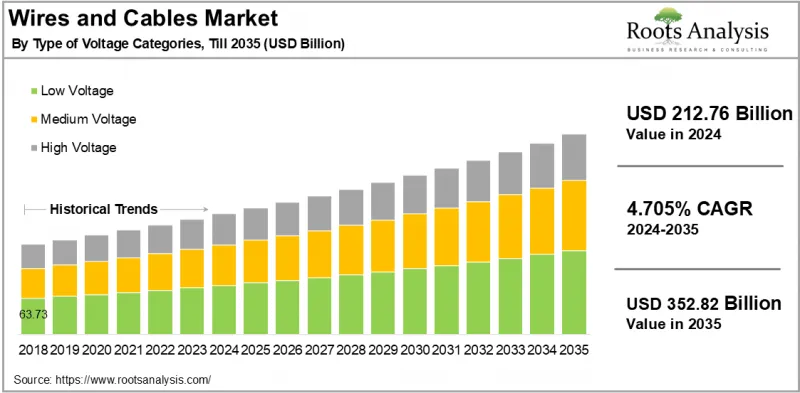
The opportunity for wires and cables market has been distributed across the following segments:
Type of Voltage Categories
- Low Voltage (up to 1000 volts)
- Medium Voltage (1000 volts to 35,000 volts)
- High Voltage (35,000 volts to 230,000 volts)
- Extra High Voltage (above 230,000 volts)
Type of Installation
- Overhead
- Submarine
- Underground
Type of Cable
- Communication Wire and Cable
- Power Cable
Type of Product
- Cable Tray and Ladders
- Cable Raceway
- Conduits and Trunking
- Glans and Connectors
- Wiring Duct
- Boxes and Covers
- Others
Type of Material
- Metallic
- Copper
- Aluminum
- Non-Metallic
- Glass
- Fiber Optics
- Others
Mode of Application
- Power Transmission
- Telecommunication
- Building Infrastructure
- Automotive Industry
- Industrial Applications
- Oil and Gas Industry
- Renewable Energy
- Others
Type of Shielding
- Shielded
- Unshielded
Type of Insulation Material
- PVC (Polyvinyl Chloride)
- XLPE (Cross-Linked Polyethylene)
- PTFE (Polytetrafluoroethylene)
- Rubber
- EPR (Ethylene Propylene Rubber)
Type of Conductor
- Single Conductor
- Multi-Conductor
End User
- Residential
- Commercial
- Industrial
- Utilities
- Others
Company Size
- Large Enterprises
- Small and Medium-sized Enterprises (SMEs)
Business Model
- B2B
- B2C
- B2B2C
Geographical Regions
- North America
- US
- Canada
- Mexico
- Other North American countries
- Europe
- Austria
- Belgium
- Denmark
- France
- Germany
- Ireland
- Italy
- Netherlands
- Norway
- Russia
- Spain
- Sweden
- Switzerland
- UK
- Other European countries
- Asia
- China
- India
- Japan
- Singapore
- South Korea
- Other Asian countries
- Latin America
- Brazil
- Chile
- Colombia
- Venezuela
- Other Latin American countries
- Middle East and North Africa
- Egypt
- Iran
- Iraq
- Israel
- Kuwait
- Saudi Arabia
- UAE
- Other MENA countries
- Rest of the World
- Australia
- New Zealand
- Other countries
Wires and Cables Market: Growth and Trends
The wires and cables industry is a vibrant and swiftly changing sector that is vital for contemporary infrastructure, enabling the transfer of electrical power and data. This industry is fundamental for improving connectivity, efficiency, and dependability across numerous sectors, including telecommunications, energy, automotive, and construction. It includes a wide variety of products, ranging from high-voltage power cables to fiber optic cables, with each one tailored to fulfill specific performance criteria and regulatory standards.
The growing need for cutting-edge technologies, such as 5G networks and renewable energy solutions, is fueling significant expansion in the wires and cables sector. These developments demand strong and effective cabling solutions to accommodate greater data transfer speeds and dependable power distribution. Additionally, the worldwide move toward smart cities and industrial automation has further intensified the demand for innovative cabling infrastructure.
The industry encounters challenges such as variable raw material costs, rigorous regulatory requirements, and the elevated expenses of advanced cabling solutions. Despite these challenges, continuous investments in research and development, along with the implementation of new materials and production methods, are anticipated to propel the market throughout the forecast period.
Wires and Cables Market: Key Segments
Market Share by Type of Voltage Categories
Based on type of voltage categories, the global wires and cables market is segmented into low voltage, medium voltage, high voltage and extra high voltage. According to our estimates, currently, the low voltage sector captures the majority of the market share. This can be attributed to its widespread use in residential, commercial, and industrial settings. These cables are essential for internal wiring, lighting, and power distribution throughout buildings and facilities. Further, the rising construction activities and urban development play a significant role in increasing the demand for low voltage cables.
Market Share by Type of Installation
Based on type of installation, the global wires and cables market is segmented into overhead, submarine, and underground. According to our estimates, currently, the underground segment captures the majority of the market share during the forecast period. This can be ascribed to the rising urbanization and the demand for dependable and secure power transmission. Underground cables are less vulnerable to weather-related issues, making them a more reliable choice for urban and suburban regions.
Market Share by Type of Cable
Based on type of cable, the global wires and cables market is segmented into communication wire and cable and power cable. According to our estimates, currently, the communication wire and cable segment captures the majority of the market share. This can be attributed to the ongoing and high demand for power cables in a range of applications, such as power transmission and distribution, construction infrastructure, industrial machinery, and the automotive sector.
Market Share by Type of Product
Based on type of product, the global wires and cables market is segmented into cable tray and ladders, cable raceway, conduits and trunking, glans and connectors, wiring duct, boxes and covers, and others product types. According to our estimates, currently, the cable tray and ladders segment captures the majority of the market share. This can be attributed to their exceptional versatility and adaptability for various industrial and commercial uses, making them a favored option for managing and organizing large quantities of cables.
Additionally, other categories such as conduits and trunking, along with glands and connectors, also contribute significantly to market shares, supporting overall market expansion.
Market Share by Type of Material
Based on type of material, the global wires and cables market is segmented into metallic, non-metallic and others. According to our estimates, currently, the copper segment captures the majority of the market share. This can be attributed to the fact that copper is renowned for its outstanding electrical conductivity, long-lasting nature, and dependability. It is commonly chosen for various applications such as power transmission, telecommunications, and building wiring.
The fiber optics segment is also witnessing notable expansion, especially in the telecommunications industry, driven by the rising need for high-speed internet, the rollout of 5G, and enhanced data transmission.
Market Share by Mode of Application
Based on mode of application, the global wires and cables market is segmented into power transmission, telecommunication, building infrastructure, automotive industry, industrial applications, oil and gas industry, renewable energy and others. According to our estimates, currently, the power transmission segment captures the majority of the market share. This can be attributed to the ongoing high global demand for electricity and the continuous growth of power infrastructure, resulting in considerable investments in power transmission and distribution systems.
Market Share by Type of Shielding
Based on type of shielding, the global wires and cables market is segmented into shielded and unshielded. According to our estimates, currently, the shielded cables segment captures the majority of the market share. Shielded cables are mainly utilized in settings where electromagnetic interference (EMI) or radio frequency interference (RFI) levels are high. In contrast, unshielded cables are typically employed in general applications where EMI/RFI is not a major issue, including residential wiring, basic electrical setups, and some industrial processes with minimal interference.
Market Share by Type of Insulation Material
Based on type of insulation material, the global wires and cables market is segmented into PVC, XLPE, PTFE, Rubber, and EPR. According to our estimates, currently, the communication wire and cable segment captures the majority of the market share. This can be attributed to its lower cost relative to other insulation options, making it a favored choice for various applications. Additionally, materials like XLPE (Cross-Linked Polyethylene) play a crucial role, particularly in settings that demand enhanced performance and thermal resilience, such as high voltage cables, contributing to the growth of the market.
Market Share by Type of Conductor
Based on type of conductor, the global wires and cables market is segmented into single conductor and multi-conductor. According to our estimates, currently, the single conductor cables segment captures the majority of the market share. This can be attributed to their simplicity and cost-efficiency, such as residential wiring, basic industrial uses, and specific power transmission applications where standalone wires are adequate.
Market Share by End User
Based on end user, the global wires and cables market is segmented into industrial sector, commercial sector, residential sector, and utilities. According to our estimates, currently, the industrial sector captures the majority of the market share. This can be attributed to the widespread application of wires and cables in machinery, equipment, and automation systems.
Market Share by Company Size
Based on company size, the global wires and cables market is segmented into large enterprises, small and medium-sized enterprises (SMEs). According to our estimates, currently, the large companies captures the majority of the market share. This can be attributed to the fact that large organizations possess the financial resources and capabilities to make substantial investments in research and development, manufacturing facilities, and marketing, allowing them to produce wires and cables at a lower cost per unit than their smaller counterparts.
Market Share by Business Model
Based on business model, the global wires and cables market is segmented into B2B, B2C and B2B2C. According to our estimates, currently, the B2B segment captures the majority of the market share. This can be attributed to the growing adoption of wires and cables technology across various industries, including aerospace, manufacturing, healthcare, finance, and others.
Additionally, the B2C model is anticipated to experience significant growth at a robust CAGR during this projection period, as wires and cables technologies become more accessible to consumers and individuals increasingly utilize them for personalized applications, smartphone connectivity, and enhanced user experiences.
Market Share by Geographical Regions
Based on geographical regions, the wires and cables market is segmented into North America, Europe, Asia, Latin America, Middle East and North Africa, and the rest of the world. According to our estimates, currently, North America captures the majority share of the market. This can be attributed to the ongoing construction projects in residential, commercial, and industrial sectors. Additionally, the rapid rollout of 5G networks necessitates significant fiber optic cable infrastructure. The robust automotive industry in the region creates a demand for a variety of cables for electric vehicles (EVs) and advanced automotive electronics, contributing to an enhancement in the overall market segment.
Example Players in Wires and Cables Market
- Cable & System Asia
- Encore Wire
- Finolex Cables
- Fujikura
- Furukawa Electric
- Habia Cable
- KEI Industries
- Leoni AG
- LS Cable & System
- NKT A/S
- Nexans
- Polycab
- Prysmian Group
- Southwire
- Sumitomo
Wires and Cables Market: Research Coverage
The report on the wires and cables market features insights on various sections, including:
- Market Sizing and Opportunity Analysis: An in-depth analysis of the wires and cables market, focusing on key market segments, including [A] type of voltage categories, [B] type of installation, [C] type of cable, [D] type of product, [E] type of material, [F] mode of application, [G] type of shielding, [H] type of insulation material, [I] type of conductor, end user, [J] type of company size, [K] type of business model, and [L] key geographical regions.
- Competitive Landscape: A comprehensive analysis of the companies engaged in the wires and cables market, based on several relevant parameters, such as [A] year of establishment, [B] company size, [C] location of headquarters and [D] ownership structure.
- Company Profiles: Elaborate profiles of prominent players engaged in the wires and cables market, providing details on [A] location of headquarters, [B] company size, [C] company mission, [D] company footprint, [E] management team, [F] contact details, [G] financial information, [H] operating business segments, [I] wires and cables portfolio, [J] moat analysis, [K] recent developments, and an informed future outlook.
- SWOT Analysis: An insightful SWOT framework, highlighting the strengths, weaknesses, opportunities and threats in the domain. Additionally, it provides Harvey ball analysis, highlighting the relative impact of each SWOT parameter.
- Value Chain Analysis: A comprehensive analysis of the value chain, providing information on the different phases and stakeholders involved in the wires and cables market
Key Questions Answered in this Report
- How many companies are currently engaged in wires and cables market?
- Which are the leading companies in this market?
- What factors are likely to influence the evolution of this market?
- What is the current and future market size?
- What is the CAGR of this market?
- How is the current and future market opportunity likely to be distributed across key market segments?
Reasons to Buy this Report
- The report provides a comprehensive market analysis, offering detailed revenue projections of the overall market and its specific sub-segments. This information is valuable to both established market leaders and emerging entrants.
- Stakeholders can leverage the report to gain a deeper understanding of the competitive dynamics within the market. By analyzing the competitive landscape, businesses can make informed decisions to optimize their market positioning and develop effective go-to-market strategies.
- The report offers stakeholders a comprehensive overview of the market, including key drivers, barriers, opportunities, and challenges. This information empowers stakeholders to stay abreast of market trends and make data-driven decisions to capitalize on growth prospects.
Additional Benefits
- Complimentary Excel Data Packs for all Analytical Modules in the Report
- 15% Free Content Customization
- Detailed Report Walkthrough Session with Research Team
- Free Updated report if the report is 6-12 months old or older
TABLE OF CONTENTS
1. PREFACE
- 1.1. Introduction
- 1.2. Market Share Insights
- 1.3. Key Market Insights
- 1.4. Report Coverage
- 1.5. Key Questions Answered
- 1.6. Chapter Outlines
2. RESEARCH METHODOLOGY
- 2.1. Chapter Overview
- 2.2. Research Assumptions
- 2.3. Database Building
- 2.3.1. Data Collection
- 2.3.2. Data Validation
- 2.3.3. Data Analysis
- 2.4. Project Methodology
- 2.4.1. Secondary Research
- 2.4.1.1. Annual Reports
- 2.4.1.2. Academic Research Papers
- 2.4.1.3. Company Websites
- 2.4.1.4. Investor Presentations
- 2.4.1.5. Regulatory Filings
- 2.4.1.6. White Papers
- 2.4.1.7. Industry Publications
- 2.4.1.8. Conferences and Seminars
- 2.4.1.9. Government Portals
- 2.4.1.10. Media and Press Releases
- 2.4.1.11. Newsletters
- 2.4.1.12. Industry Databases
- 2.4.1.13. Roots Proprietary Databases
- 2.4.1.14. Paid Databases and Sources
- 2.4.1.15. Social Media Portals
- 2.4.1.16. Other Secondary Sources
- 2.4.2. Primary Research
- 2.4.2.1. Introduction
- 2.4.2.2. Types
- 2.4.2.2.1. Qualitative
- 2.4.2.2.2. Quantitative
- 2.4.2.3. Advantages
- 2.4.2.4. Techniques
- 2.4.2.4.1. Interviews
- 2.4.2.4.2. Surveys
- 2.4.2.4.3. Focus Groups
- 2.4.2.4.4. Observational Research
- 2.4.2.4.5. Social Media Interactions
- 2.4.2.5. Stakeholders
- 2.4.2.5.1. Company Executives (CXOs)
- 2.4.2.5.2. Board of Directors
- 2.4.2.5.3. Company Presidents and Vice Presidents
- 2.4.2.5.4. Key Opinion Leaders
- 2.4.2.5.5. Research and Development Heads
- 2.4.2.5.6. Technical Experts
- 2.4.2.5.7. Subject Matter Experts
- 2.4.2.5.8. Scientists
- 2.4.2.5.9. Doctors and Other Healthcare Providers
- 2.4.2.6. Ethics and Integrity
- 2.4.2.6.1. Research Ethics
- 2.4.2.6.2. Data Integrity
- 2.4.3. Analytical Tools and Databases
- 2.4.1. Secondary Research
3. ECONOMIC AND OTHER PROJECT SPECIFIC CONSIDERATIONS
- 3.1. Forecast Methodology
- 3.1.1. Top-Down Approach
- 3.1.2. Bottom-Up Approach
- 3.1.3. Hybrid Approach
- 3.2. Market Assessment Framework
- 3.2.1. Total Addressable Market (TAM)
- 3.2.2. Serviceable Addressable Market (SAM)
- 3.2.3. Serviceable Obtainable Market (SOM)
- 3.2.4. Currently Acquired Market (CAM)
- 3.3. Forecasting Tools and Techniques
- 3.3.1. Qualitative Forecasting
- 3.3.2. Correlation
- 3.3.3. Regression
- 3.3.4. Time Series Analysis
- 3.3.5. Extrapolation
- 3.3.6. Convergence
- 3.3.7. Forecast Error Analysis
- 3.3.8. Data Visualization
- 3.3.9. Scenario Planning
- 3.3.10. Sensitivity Analysis
- 3.4. Key Considerations
- 3.4.1. Demographics
- 3.4.2. Market Access
- 3.4.3. Reimbursement Scenarios
- 3.4.4. Industry Consolidation
- 3.5. Robust Quality Control
- 3.6. Key Market Segmentations
- 3.7. Limitations
4. MACRO-ECONOMIC INDICATORS
- 4.1. Chapter Overview
- 4.2. Market Dynamics
- 4.2.1. Time Period
- 4.2.1.1. Historical Trends
- 4.2.1.2. Current and Forecasted Estimates
- 4.2.2. Currency Coverage
- 4.2.2.1. Overview of Major Currencies Affecting the Market
- 4.2.2.2. Impact of Currency Fluctuations on the Industry
- 4.2.3. Foreign Exchange Impact
- 4.2.3.1. Evaluation of Foreign Exchange Rates and Their Impact on Market
- 4.2.3.2. Strategies for Mitigating Foreign Exchange Risk
- 4.2.4. Recession
- 4.2.4.1. Historical Analysis of Past Recessions and Lessons Learnt
- 4.2.4.2. Assessment of Current Economic Conditions and Potential Impact on the Market
- 4.2.5. Inflation
- 4.2.5.1. Measurement and Analysis of Inflationary Pressures in the Economy
- 4.2.5.2. Potential Impact of Inflation on the Market Evolution
- 4.2.6. Interest Rates
- 4.2.6.1. Overview of Interest Rates and Their Impact on the Market
- 4.2.6.2. Strategies for Managing Interest Rate Risk
- 4.2.7. Commodity Flow Analysis
- 4.2.7.1. Type of Commodity
- 4.2.7.2. Origins and Destinations
- 4.2.7.3. Values and Weights
- 4.2.7.4. Modes of Transportation
- 4.2.8. Global Trade Dynamics
- 4.2.8.1. Import Scenario
- 4.2.8.2. Export Scenario
- 4.2.9. War Impact Analysis
- 4.2.9.1. Russian-Ukraine War
- 4.2.9.2. Israel-Hamas War
- 4.2.10. COVID Impact / Related Factors
- 4.2.10.1. Global Economic Impact
- 4.2.10.2. Industry-specific Impact
- 4.2.10.3. Government Response and Stimulus Measures
- 4.2.10.4. Future Outlook and Adaptation Strategies
- 4.2.11. Other Indicators
- 4.2.11.1. Fiscal Policy
- 4.2.11.2. Consumer Spending
- 4.2.11.3. Gross Domestic Product (GDP)
- 4.2.11.4. Employment
- 4.2.11.5. Taxes
- 4.2.11.6. R&D Innovation
- 4.2.11.7. Stock Market Performance
- 4.2.11.8. Supply Chain
- 4.2.11.9. Cross-Border Dynamics
- 4.2.1. Time Period
5. EXECUTIVE SUMMARY
6. INTRODUCTION
- 6.1. Chapter Overview
- 6.2. Overview of Wires and Cables
- 6.2.1. Key Characteristics of Wires and Cables
- 6.2.2. Type of Voltage Categories
- 6.2.3. Type of Installation
- 6.2.4. Type of Cable
- 6.2.5. Type of Product
- 6.2.6. Type of Material
- 6.2.7. Mode of Application
- 6.2.8. Type of Shielding
- 6.2.9. Type of Insulation Material
- 6.2.10. Type of Conductor
- 6.2.11. Type of End User
- 6.3. Future Perspective
7. COMPETITIVE LANDSCAPE
- 7.1. Chapter Overview
- 7.2. Wires and cables: Overall Market Landscape
- 7.2.1. Analysis by Year of Establishment
- 7.2.2. Analysis by Company Size
- 7.2.3. Analysis by Location of Headquarters
- 7.2.4. Analysis by Ownership Structure
8. COMPANY PROFILES
- 8.1. Chapter Overview
- 8.2. Cable & System Asia
- 8.2.1. Company Overview
- 8.2.2. Company Mission
- 8.2.3. Company Footprint
- 8.2.4. Management Team
- 8.2.5. Contact Details
- 8.2.6. Financial Performance
- 8.2.7. Operating Business Segments
- 8.2.8. Service / Product Portfolio (project specific)
- 8.2.9. MOAT Analysis
- 8.2.10. Recent Developments and Future Outlook
- 8.3. Encore Wire
- 8.4. Finolex Cables
- 8.5. Fujikura
- 8.6. Furukawa
- 8.7. Habia Cable
- 8.8. KEI Industries
- 8.9. Leoni AG
- 8.10. LS Cable & System
- 8.11. NKT A/S
- 8.12. Nexans
- 8.13. Polycab
- 8.14. Prysmian Group
9. VALUE CHAIN ANALYSIS
10. SWOT ANALYSIS
11. GLOBAL WIRES AND CABLES MARKET
- 11.1. Chapter Overview
- 11.2. Key Assumptions and Methodology
- 11.3. Trends Disruption Impacting Market
- 11.4. Global Wires and Cables Market, Historical Trends (Since 2018) and Forecasted Estimates (Till 2035)
- 11.5. Multivariate Scenario Analysis
- 11.5.1. Conservative Scenario
- 11.5.2. Optimistic Scenario
- 11.6. Key Market Segmentations
12. MARKET OPPORTUNITIES BASED ON TYPE OF VOLTAGE CATEGORIES
- 12.1. Chapter Overview
- 12.2. Key Assumptions and Methodology
- 12.3. Revenue Shift Analysis
- 12.4. Market Movement Analysis
- 12.5. Penetration-Growth (P-G) Matrix
- 12.6. Wires and Cables Market for Low Voltage: Historical Trends (Since 2018) and Forecasted Estimates (Till 2035)
- 12.7. Wires and Cables Market for Medium Voltage: Historical Trends (Since 2018) and Forecasted Estimates (Till 2035)
- 12.7.1. Wires and Cables Market for High Voltage: Historical Trends (Since 2018) and Forecasted Estimates (Till 2035)
- 12.7.2. Wires and Cables Market for Extra High Voltage: Historical Trends (Since 2018) and Forecasted Estimates (Till 2035)
- 12.8. Data Triangulation and Validation
13. MARKET OPPORTUNITIES BASED ON TYPE OF INSTALLATION
- 13.1. Chapter Overview
- 13.2. Key Assumptions and Methodology
- 13.3. Revenue Shift Analysis
- 13.4. Market Movement Analysis
- 13.5. Penetration-Growth (P-G) Matrix
- 13.6. Wires and Cables Market for Overhead: Historical Trends (Since 2018) and Forecasted Estimates (Till 2035)
- 13.7. Wires and Cables Market for Submarine: Historical Trends (Since 2018) and Forecasted Estimates (Till 2035)
- 13.8. Wires and Cables Market for Underground: Historical Trends (Since 2018) and Forecasted Estimates (Till 2035)
- 13.9. Data Triangulation and Validation
14. MARKET OPPORTUNITIES BASED ON TYPE OF CABLE
- 14.1. Chapter Overview
- 14.2. Key Assumptions and Methodology
- 14.3. Revenue Shift Analysis
- 14.4. Market Movement Analysis
- 14.5. Penetration-Growth (P-G) Matrix
- 14.6. Wires and Cables Market for Communication Wire and Cable: Historical Trends (Since 2018) and Forecasted Estimates (Till 2035)
- 14.7. Wires and Cables Market for Power Cable: Historical Trends (Since 2018) and Forecasted Estimates (Till 2035)
- 14.8. Data Triangulation and Validation
15. MARKET OPPORTUNITIES BASED ON TYPE OF PRODUCT
- 15.1. Chapter Overview
- 15.2. Key Assumptions and Methodology
- 15.3. Revenue Shift Analysis
- 15.4. Market Movement Analysis
- 15.5. Penetration-Growth (P-G) Matrix
- 15.6. Wires and Cables Market for Cable Tray and Ladders: Historical Trends (Since 2018) and Forecasted Estimates (Till 2035)
- 15.7. Wires and Cables Market for Cable Raceway: Historical Trends (Since 2018) and Forecasted Estimates (Till 2035)
- 15.8. Wires and Cables Market for Conduits and Trunking: Historical Trends (Since 2018) and Forecasted Estimates (Till 2035)
- 15.9. Wires and Cables Market for Glans and Connectors: Historical Trends (Since 2018) and Forecasted Estimates (Till 2035)
- 15.10. Wires and Cables Market for Wiring Duct: Historical Trends (Since 2018) and Forecasted Estimates (Till 2035)
- 15.11. Wires and Cables Market for Boxes and Covers: Historical Trends (Since 2018) and Forecasted Estimates (Till 2035)
- 15.12. Wires and Cables Market for Others: Historical Trends (Since 2018) and Forecasted Estimates (Till 2035)
- 15.13. Data Triangulation and Validation
16. MARKET OPPORTUNITIES BASED ON TYPE OF MATERIAL
- 16.1. Chapter Overview
- 16.2. Key Assumptions and Methodology
- 16.3. Revenue Shift Analysis
- 16.4. Market Movement Analysis
- 16.5. Penetration-Growth (P-G) Matrix
- 16.6. Wires and Cables Market for Metallic: Historical Trends (Since 2018) and Forecasted Estimates (Till 2035)
- 16.6.1. Wires and Cables Market for Copper: Historical Trends (Since 2018) and Forecasted Estimates (Till 2035)
- 16.6.2. Wires and Cables Market for Aluminum: Historical Trends (Since 2018) and Forecasted Estimates (Till 2035)
- 16.7. Wires and Cables Market for Non-Metallic: Historical Trends (Since 2018) and Forecasted Estimates (Till 2035)
- 16.7.1. Wires and Cables Market for Glass: Historical Trends (Since 2018) and Forecasted Estimates (Till 2035)
- 16.7.2. Wires and Cables Market for Fiber Optics: Historical Trends (Since 2018) and Forecasted Estimates (Till 2035)
- 16.8. Wires and Cables Market for Others: Historical Trends (Since 2018) and Forecasted Estimates (Till 2035)
- 16.9. Data Triangulation and Validation
17. MARKET OPPORTUNITIES BASED ON MODE OF APPLICATION
- 17.1. Chapter Overview
- 17.2. Key Assumptions and Methodology
- 17.3. Revenue Shift Analysis
- 17.4. Market Movement Analysis
- 17.5. Penetration-Growth (P-G) Matrix
- 17.6. Wires and Cables Market for Power Transmission: Historical Trends (Since 2018) and Forecasted Estimates (Till 2035)
- 17.7. Wires and Cables Market for Telecommunication: Historical Trends (Since 2018) and Forecasted Estimates (Till 2035)
- 17.8. Wires and Cables Market for Building Infrastructure: Historical Trends (Since 2018) and Forecasted Estimates (Till 2035)
- 17.9. Wires and Cables Market for Automotive Industry: Historical Trends (Since 2018) and Forecasted Estimates (Till 2035)
- 17.10. Wires and Cables Market for Industrial Applications: Historical Trends (Since 2018) and Forecasted Estimates (Till 2035)
- 17.11. Wires and Cables Market for Oil and Gas Industry: Historical Trends (Since 2018) and Forecasted Estimates (Till 2035)
- 17.11.1. Wires and Cables Market for Renewable Energy: Historical Trends (Since 2018) and Forecasted Estimates (Till 2035)
- 17.11.2. Wires and Cables Market for Others: Historical Trends (Since 2018) and Forecasted Estimates (Till 2035)
- 17.11. Data Triangulation and Validation
18. MARKET OPPORTUNITIES BASED ON TYPE OF SHIELDING
- 18.1. Chapter Overview
- 18.2. Key Assumptions and Methodology
- 18.3. Revenue Shift Analysis
- 18.4. Market Movement Analysis
- 18.5. Penetration-Growth (P-G) Matrix
- 18.6. Wires and Cables Market for Shielded: Historical Trends (Since 2018) and Forecasted Estimates (Till 2035)
- 18.7. Wires and Cables Market for Unshielded: Historical Trends (Since 2018) and Forecasted Estimates (Till 2035)
- 18.8. Data Triangulation and Validation
19. MARKET OPPORTUNITIES BASED ON TYPE OF INSULATION MATERIAL
- 19.1. Chapter Overview
- 19.2. Key Assumptions and Methodology
- 19.3. Revenue Shift Analysis
- 19.4. Market Movement Analysis
- 19.5. Penetration-Growth (P-G) Matrix
- 19.6. Wires and Cables Market for PVC (Polyvinyl Chloride): Historical Trends (Since 2018) and Forecasted Estimates (Till 2035)
- 19.7. Wires and Cables Market for XLPE (Cross-Linked Polyethylene): Historical Trends (Since 2018) and Forecasted Estimates (Till 2035)
- 19.8. Wires and Cables Market for PTFE (Polytetrafluoroethylene): Historical Trends (Since 2018) and Forecasted Estimates (Till 2035)
- 19.9. Wires and Cables Market for Rubber: Historical Trends (Since 2018) and Forecasted Estimates (Till 2035)
- 19.10. Wires and Cables Market for EPR (Ethylene Propylene Rubber): Historical Trends (Since 2018) and Forecasted Estimates (Till 2035)
- 19.11. Data Triangulation and Validation
20. MARKET OPPORTUNITIES BASED ON TYPE OF CONDUCTOR
- 20.1. Chapter Overview
- 20.2. Key Assumptions and Methodology
- 20.3. Revenue Shift Analysis
- 20.4. Market Movement Analysis
- 20.5. Penetration-Growth (P-G) Matrix
- 20.6. Wires and Cables Market for Single Conductor: Historical Trends (Since 2018) and Forecasted Estimates (Till 2035)
- 20.7. Wires and Cables Market for Multi-Conductor: Historical Trends (Since 2018) and Forecasted Estimates (Till 2035)
- 20.8. Data Triangulation and Validation
21. MARKET OPPORTUNITIES BASED ON END USER
- 21.1. Chapter Overview
- 21.2. Key Assumptions and Methodology
- 21.3. Revenue Shift Analysis
- 21.4. Market Movement Analysis
- 21.5. Penetration-Growth (P-G) Matrix
- 21.6. Wires and Cables Market for Residential: Historical Trends (Since 2018) and Forecasted Estimates (Till 2035)
- 21.7. Wires and Cables Market for Commercial: Historical Trends (Since 2018) and Forecasted Estimates (Till 2035)
- 21.8. Wires and Cables Market for Industrial: Historical Trends (Since 2018) and Forecasted Estimates (Till 2035)
- 21.9. Wires and Cables Market for Utilities: Historical Trends (Since 2018) and Forecasted Estimates (Till 2035)
- 21.10. Wires and Cables Market for Others: Historical Trends (Since 2018) and Forecasted Estimates (Till 2035)
- 21.11. Data Triangulation and Validation
22. MARKET OPPORTUNITIES BASED ON COMPANY SIZE
- 22.1. Chapter Overview
- 22.2. Key Assumptions and Methodology
- 22.3. Revenue Shift Analysis
- 22.4. Market Movement Analysis
- 22.5. Penetration-Growth (P-G) Matrix
- 22.6. Wires and Cables Market for Large Enterprises: Historical Trends (Since 2018) and Forecasted Estimates (Till 2035)
- 22.7. Wires and Cables Market for Small and Medium-sized Enterprises (SMEs): Historical Trends (Since 2018) and Forecasted Estimates (Till 2035)
- 22.8. Data Triangulation and Validation
23. MARKET OPPORTUNITIES BASED ON BUSINESS MODEL
- 23.1. Chapter Overview
- 23.2. Key Assumptions and Methodology
- 23.3. Revenue Shift Analysis
- 23.4. Market Movement Analysis
- 23.5. Penetration-Growth (P-G) Matrix
- 23.6. Wires and Cables Market for B2B: Historical Trends (Since 2018) and Forecasted Estimates (Till 2035)
- 23.7. Wires and Cables Market for B2C: Historical Trends (Since 2018) and Forecasted Estimates (Till 2035)
- 23.8. Wires and Cables Market for B2B2C: Historical Trends (Since 2018) and Forecasted Estimates (Till 2035)
- 23.9. Data Triangulation and Validation
24. MARKET OPPORTUNITIES FOR WIRES AND CABLES IN NORTH AMERICA
- 24.1. Chapter Overview
- 24.2. Key Assumptions and Methodology
- 24.3. Revenue Shift Analysis
- 24.4. Market Movement Analysis
- 24.5. Penetration-Growth (P-G) Matrix
- 24.6. Wires and Cables Market in North America: Historical Trends (Since 2018) and Forecasted Estimates (Till 2035)
- 24.6.1. Wires and Cables Market in the US: Historical Trends (Since 2018) and Forecasted Estimates (Till 2035)
- 24.6.2. Wires and Cables Market in Canada: Historical Trends (Since 2018) and Forecasted Estimates (Till 2035)
- 24.6.3. Wires and Cables Market in Mexico: Historical Trends (Since 2018) and Forecasted Estimates (Till 2035)
- 24.6.4. Wires and Cables Market in Other North American Countries: Historical Trends (Since 2018) and Forecasted Estimates (Till 2035)
- 24.7. Data Triangulation and Validation
25. MARKET OPPORTUNITIES FOR WIRES AND CABLES IN EUROPE
- 25.1. Chapter Overview
- 25.2. Key Assumptions and Methodology
- 25.3. Revenue Shift Analysis
- 25.4. Market Movement Analysis
- 25.5. Penetration-Growth (P-G) Matrix
- 25.6. Wires and Cables Market in Europe: Historical Trends (Since 2018) and Forecasted Estimates (Till 2035)
- 25.6.1. Wires and Cables Market in the Austria: Historical Trends (Since 2018) and Forecasted Estimates (Till 2035)
- 25.6.2. Wires and Cables Market in Belgium: Historical Trends (Since 2018) and Forecasted Estimates (Till 2035)
- 25.6.3. Wires and Cables Market in Denmark: Historical Trends (Since 2018) and Forecasted Estimates (Till 2035)
- 25.6.4. Wires and Cables Market in France: Historical Trends (Since 2018) and Forecasted Estimates (Till 2035)
- 25.6.5. Wires and Cables Market in Germany: Historical Trends (Since 2018) and Forecasted Estimates (Till 2035)
- 25.6.6. Wires and Cables Market in Ireland: Historical Trends (Since 2018) and Forecasted Estimates (Till 2035)
- 25.6.7. Wires and Cables Market in Italy: Historical Trends (Since 2018) and Forecasted Estimates (Till 2035)
- 25.6.8. Wires and Cables Market in Netherlands: Historical Trends (Since 2018) and Forecasted Estimates (Till 2035)
- 25.6.9. Wires and Cables Market in Norway: Historical Trends (Since 2018) and Forecasted Estimates (Till 2035)
- 25.6.10. Wires and Cables Market in Russia: Historical Trends (Since 2018) and Forecasted Estimates (Till 2035)
- 25.6.11. Wires and Cables Market in Spain: Historical Trends (Since 2018) and Forecasted Estimates (Till 2035)
- 25.6.12. Wires and Cables Market in Sweden: Historical Trends (Since 2018) and Forecasted Estimates (Till 2035)
- 25.6.13. Wires and Cables Market in Switzerland: Historical Trends (Since 2018) and Forecasted Estimates (Till 2035)
- 25.6.14. Wires and Cables Market in the UK: Historical Trends (Since 2018) and Forecasted Estimates (Till 2035)
- 25.6.15. Wires and Cables Market in Other European Countries: Historical Trends (Since 2018) and Forecasted Estimates (Till 2035)
- 25.7. Data Triangulation and Validation
26. MARKET OPPORTUNITIES FOR WIRES AND CABLES IN ASIA
- 26.1. Chapter Overview
- 26.2. Key Assumptions and Methodology
- 26.3. Revenue Shift Analysis
- 26.4. Market Movement Analysis
- 26.5. Penetration-Growth (P-G) Matrix
- 26.6. Wires and Cables Market in Asia: Historical Trends (Since 2018) and Forecasted Estimates (Till 2035)
- 26.6.1. Wires and Cables Market in China: Historical Trends (Since 2018) and Forecasted Estimates (Till 2035)
- 26.6.2. Wires and Cables Market in India: Historical Trends (Since 2018) and Forecasted Estimates (Till 2035)
- 26.6.3. Wires and Cables Market in Japan: Historical Trends (Since 2018) and Forecasted Estimates (Till 2035)
- 26.6.4. Wires and Cables Market in Singapore: Historical Trends (Since 2018) and Forecasted Estimates (Till 2035)
- 26.6.5. Wires and Cables Market in South Korea: Historical Trends (Since 2018) and Forecasted Estimates (Till 2035)
- 26.6.6. Wires and Cables Market in Other Asian Countries: Historical Trends (Since 2018) and Forecasted Estimates (Till 2035)
- 26.7. Data Triangulation and Validation
27. MARKET OPPORTUNITIES FOR WIRES AND CABLES IN MIDDLE EAST AND NORTH AFRICA (MENA)
- 27.1. Chapter Overview
- 27.2. Key Assumptions and Methodology
- 27.3. Revenue Shift Analysis
- 27.4. Market Movement Analysis
- 27.5. Penetration-Growth (P-G) Matrix
- 27.6. Wires and Cables Market in Middle East and North Africa (MENA): Historical Trends (Since 2018) and Forecasted Estimates (Till 2035)
- 27.6.1. Wires and Cables Market in Egypt: Historical Trends (Since 2018) and Forecasted Estimates (Till 205)
- 27.6.2. Wires and Cables Market in Iran: Historical Trends (Since 2018) and Forecasted Estimates (Till 2035)
- 27.6.3. Wires and Cables Market in Iraq: Historical Trends (Since 2018) and Forecasted Estimates (Till 2035)
- 27.6.4. Wires and Cables Market in Israel: Historical Trends (Since 2018) and Forecasted Estimates (Till 2035)
- 27.6.5. Wires and Cables Market in Kuwait: Historical Trends (Since 2018) and Forecasted Estimates (Till 2035)
- 27.6.6. Wires and Cables Market in Saudi Arabia: Historical Trends (Since 2018) and Forecasted Estimates (Till 2035)
- 27.6.7. Wires and Cables Market in United Arab Emirates (UAE): Historical Trends (Since 2018) and Forecasted Estimates (Till 2035)
- 27.6.8. Wires and Cables Market in Other MENA Countries: Historical Trends (Since 2018) and Forecasted Estimates (Till 2035)
- 27.7. Data Triangulation and Validation
28. MARKET OPPORTUNITIES FOR WIRES AND CABLES IN LATIN AMERICA
- 28.1. Chapter Overview
- 28.2. Key Assumptions and Methodology
- 28.3. Revenue Shift Analysis
- 28.4. Market Movement Analysis
- 28.5. Penetration-Growth (P-G) Matrix
- 28.6. Wires and Cables Market in Latin America: Historical Trends (Since 2018) and Forecasted Estimates (Till 2035)
- 28.6.1. Wires and Cables Market in Argentina: Historical Trends (Since 2018) and Forecasted Estimates (Till 2035)
- 28.6.2. Wires and Cables Market in Brazil: Historical Trends (Since 2018) and Forecasted Estimates (Till 2035)
- 28.6.3. Wires and Cables Market in Chile: Historical Trends (Since 2018) and Forecasted Estimates (Till 2035)
- 28.6.4. Wires and Cables Market in Colombia Historical Trends (Since 2018) and Forecasted Estimates (Till 2035)
- 28.6.5. Wires and Cables Market in Venezuela: Historical Trends (Since 2018) and Forecasted Estimates (Till 2035)
- 28.6.6. Wires and Cables Market in Other Latin American Countries: Historical Trends (Since 2018) and Forecasted Estimates (Till 2035)
- 28.7. Data Triangulation and Validation
29. MARKET OPPORTUNITIES FOR WIRES AND CABLES IN REST OF THE WORLD
- 29.1. Chapter Overview
- 29.2. Key Assumptions and Methodology
- 29.3. Revenue Shift Analysis
- 29.4. Market Movement Analysis
- 29.5. Penetration-Growth (P-G) Matrix
- 29.6. Wires and Cables Market in Rest of the World: Historical Trends (Since 2018) and Forecasted Estimates (Till 2035)
- 29.6.1. Wires and Cables Market in Australia: Historical Trends (Since 2018) and Forecasted Estimates (Till 2035)
- 29.6.2. Wires and Cables Market in New Zealand: Historical Trends (Since 2018) and Forecasted Estimates (Till 2035)
- 29.6.3. Wires and Cables Market in Other Countries
- 29.7. Data Triangulation and Validation
30. TABULATED DATA
31. LIST OF COMPANIES AND ORGANIZATIONS
32. CUSTOMIZATION OPPORTUNITIES
33. ROOTS SUBSCRIPTION SERVICES
34. AUTHOR DETAILS

