
PUBLISHER: Roots Analysis | PRODUCT CODE: 1883080

PUBLISHER: Roots Analysis | PRODUCT CODE: 1883080
Automotive V2X Market, Till 2035: Distribution by Type of Connectivity, Type of Communication, Type of Vehicle, Type of Propulsion, Type of Technology, and Geographical Regions: Industry Trends and Global Forecasts
Automotive V2X Market Overview
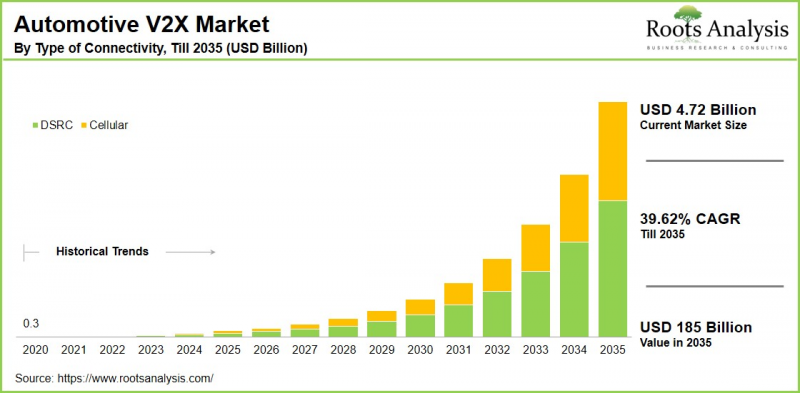
As per Roots Analysis, the global automotive V2X market size is estimated to grow from USD 4.72 billion in the current year USD 185 billion by 2035, at a CAGR of 39.62% during the forecast period, till 2035.
The opportunity for automotive V2X market has been distributed across the following segments:
Type of Connectivity
- DSRC
- Cellular
Type of Communication
- Vehicle-to-Infrastructure (V2I)
- Vehicle-to-Pedestrian (V2P)
- Vehicle-to-Vehicle (V2V)
- Others
Type of Vehicle
- Commercial Vehicle
- Passenger Cars
- Others
Type of Propulsion
- Electric Vehicle (EV)
- ICE Vehicle
Type of Technology
- Automated Driver Assistance
- Emergency Vehicle Notification
- Fleet & Asset Management
- Intelligent Traffic System
- Line of Sight
- Non-line of Sight
- Parking Management System
- Passenger Information System
- Others
Geographical Regions
- North America
- US
- Canada
- Mexico
- Other North American countries
- Europe
- Austria
- Belgium
- Denmark
- France
- Germany
- Ireland
- Italy
- Netherlands
- Norway
- Russia
- Spain
- Sweden
- Switzerland
- UK
- Other European countries
- Asia
- China
- India
- Japan
- Singapore
- South Korea
- Other Asian countries
- Latin America
- Brazil
- Chile
- Colombia
- Venezuela
- Other Latin American countries
- Middle East and North Africa
- Egypt
- Iran
- Iraq
- Israel
- Kuwait
- Saudi Arabia
- UAE
- Other MENA countries
- Rest of the World
- Australia
- New Zealand
- Other countries
Automotive V2X Market: Growth and Trends
According to the World Health Organization (WHO), around 1.19 million individuals die each year due to road accidents. To address these alarming statistics, Vehicle-to-Everything (V2X) technology in the automotive sector has become an essential element. These services utilize cameras, sensors, and wireless technologies to enable communication between the vehicle and the driver. Furthermore, they offer advanced functionalities such as line-of-sight, non-line-of-sight, and vehicle data analytics. Additionally, automated driver assistance can effectively inform the driver about their surroundings and road conditions, as well as operate the vehicle autonomously. It also includes features like fleet and asset management, enabling organizations to monitor their connected vehicles.
The global market for automotive V2X is projected to expand significantly throughout the forecast period, driven by rapid urbanization in developing countries such as China and India. The ease of implementation and well-designed technology have been crucial in shaping the future of automotive connectivity. Moreover, advancements in automotive V2X technology include the progression of cruise control, lane-change assistance, and blind spot detection, which allows vehicles to maintain speed and safely switch lanes. Additionally, these services offer V2X cybersecurity solutions that protect against hacking and data breaches. Furthermore, the exchange of real-time data and automotive IoT applications have propelled the development of V2X communication protocols.
Automotive V2X Market: Key Segments
Market Share by Type of Connectivity
Based on type of connectivity, the global automotive V2X market is segmented into DSRC and cellular. According to our estimates, currently, the dedicated short-range communications (DSRC) segment captures the majority of the market share. This can be attributed to the user-friendly applications, well-engineered technology, and established data security standards.
Conversely, the cellular segment is expected to grow at a higher CAGR during the forecast period. This is due to its effectiveness in providing connectivity over both low-range and wide-area short-range networks.
Market Share by Type of Communication
Based on type of communication, the global automotive V2X market is segmented into Vehicle-to-Infrastructure (V2I), Vehicle-to-Pedestrian (V2P), Vehicle-to-Vehicle (V2V) and others. According to our estimates, currently, the vehicle-to-vehicle (V2V) segment captures the majority of the market share. Furthermore, advancements in adaptive cruise control, lane-change assistance, driver assistance systems, and blind spot detection have contributed to the expansion of connected vehicle technologies. However, Vehicle-to-Infrastructure (V2I) segment is expected to grow at a higher CAGR during the forecast period, due to its enhanced safety, convenience, and efficiency.
Market Share by Type of Vehicle
Based on type of vehicle, the global automotive V2X market is segmented into commercial vehicle, passenger cars and others. According to our estimates, currently, the passenger cars segment captures the majority of the market share. Additionally, this segment is expected to experience a comparatively rapid growth rate during the forecast period, due to its significant demand.
Market Share by Type of Propulsion
Based on type of propulsion, the global automotive V2X market is segmented into electric vehicles (EVs) and ICE vehicles. According to our estimates, currently, the internal combustion engines (ICE) vehicles captures the majority of the market share. This is due to the fact that most consumers still prefer gasoline-powered cars, driven by ongoing demand for such vehicles. Furthermore, vehicle-to-network systems have been developed to enhance traffic management and control emissions.
On the other hand, the electric vehicle (EV) segment is projected to grow at a higher CAGR during the forecast period. This surge can be attributed to the increasing demand for EVs and their environmentally friendly transportation options.
Market Share by Type of Technology
Based on type of technology, the global automotive V2X market is segmented into automated driver assistance, emergency vehicle notification, fleet & asset management, intelligent traffic system, line of sight, non-line of sight, parking management system, passenger management system and others. According to our estimates, currently, the automated driver assistance segment captures the majority of the market share. This is due to the fact that it uses sensors, cameras, and radars to identify any obstacles or objects present on the road. Moreover, it enhances driving safety and reduces the chances of road accidents.
Market Share by Geographical Regions
Based on geographical regions, the automotive V2X market is segmented into North America, Europe, Asia, Latin America, Middle East and North Africa, and the rest of the world. According to our estimates, currently Asia captures the majority share of the market. This leadership can be attributed to the adoption of newly introduced technologies and the high number of vehicles present, especially in countries such as South Korea, India, Taiwan, and China.
However, the market in North America is expected to experience a higher compound annual growth rate (CAGR) during the forecast period. Key factors contributing to this growth include favorable automotive V2X solutions for vehicles and investments in automated driver assistance systems, such as those from Tesla.
Example Players in Automotive V2X Market
- Autotalks
- Cisco Systems
- Cohda
- Continental
- Delphi Automotive
- Denso
- Ford
- Harman International
- Huawei Technologies
- Infineon Technologies
- Kapsch TrafficCom
- LG Electronics
- NXP Semiconductors
- Qualcomm
- Robert Bosch
- Toyota
Automotive V2X Market: Research Coverage
The report on the automotive V2X market features insights on various sections, including:
- Market Sizing and Opportunity Analysis: An in-depth analysis of the automotive V2X market, focusing on key market segments, including [A] type of connectivity, [B] type of communication, [C] type of vehicle, [D] type of propulsion, [E] type of vehicle, [F] type of technology, and [G] geographical regions.
- Competitive Landscape: A comprehensive analysis of the companies engaged in the automotive V2X market, based on several relevant parameters, such as [A] year of establishment, [B] company size, [C] location of headquarters and [D] ownership structure.
- Company Profiles: Elaborate profiles of prominent players engaged in the automotive V2X market, providing details on [A] location of headquarters, [B] company size, [C] company mission, [D] company footprint, [E] management team, [F] contact details, [G] financial information, [H] operating business segments, [I] portfolio, [J] moat analysis, [K] recent developments, and an informed future outlook.
- Megatrends: An evaluation of ongoing megatrends in the automotive V2X industry.
- Patent Analysis: An insightful analysis of patents filed / granted in the automotive V2X domain, based on relevant parameters, including [A] type of patent, [B] patent publication year, [C] patent age and [D] leading players.
- Recent Developments: An overview of the recent developments made in the automotive V2X market, along with analysis based on relevant parameters, including [A] year of initiative, [B] type of initiative, [C] geographical distribution and [D] most active players.
- Porter's Five Forces Analysis: An analysis of five competitive forces prevailing in the automotive V2X market, including threats of new entrants, bargaining power of buyers, bargaining power of suppliers, threats of substitute products and rivalry among existing competitors.
- SWOT Analysis: An insightful SWOT framework, highlighting the strengths, weaknesses, opportunities and threats in the domain. Additionally, it provides Harvey ball analysis, highlighting the relative impact of each SWOT parameter.
- Value Chain Analysis: A comprehensive analysis of the value chain, providing information on the different phases and stakeholders involved in the automotive V2X market.
Key Questions Answered in this Report
- How many companies are currently engaged in automotive V2X market?
- Which are the leading companies in this market?
- What factors are likely to influence the evolution of this market?
- What is the current and future market size?
- What is the CAGR of this market?
- How is the current and future market opportunity likely to be distributed across key market segments?
Reasons to Buy this Report
- The report provides a comprehensive market analysis, offering detailed revenue projections of the overall market and its specific sub-segments. This information is valuable to both established market leaders and emerging entrants.
- Stakeholders can leverage the report to gain a deeper understanding of the competitive dynamics within the market. By analyzing the competitive landscape, businesses can make informed decisions to optimize their market positioning and develop effective go-to-market strategies.
- The report offers stakeholders a comprehensive overview of the market, including key drivers, barriers, opportunities, and challenges. This information empowers stakeholders to stay abreast of market trends and make data-driven decisions to capitalize on growth prospects.
Additional Benefits
- Complimentary Excel Data Packs for all Analytical Modules in the Report
- 15% Free Content Customization
- Detailed Report Walkthrough Session with Research Team
- Free Updated report if the report is 6-12 months old or older
TABLE OF CONTENTS
SECTION I: REPORT OVERVIEW
1. PREFACE
- 1.1. Introduction
- 1.2. Market Share Insights
- 1.3. Key Market Insights
- 1.4. Report Coverage
- 1.5. Key Questions Answered
- 1.6. Chapter Outlines
2. RESEARCH METHODOLOGY
- 2.1. Chapter Overview
- 2.2. Research Assumptions
- 2.3. Database Building
- 2.3.1. Data Collection
- 2.3.2. Data Validation
- 2.3.3. Data Analysis
- 2.4. Project Methodology
- 2.4.1. Secondary Research
- 2.4.1.1. Annual Reports
- 2.4.1.2. Academic Research Papers
- 2.4.1.3. Company Websites
- 2.4.1.4. Investor Presentations
- 2.4.1.5. Regulatory Filings
- 2.4.1.6. White Papers
- 2.4.1.7. Industry Publications
- 2.4.1.8. Conferences and Seminars
- 2.4.1.9. Government Portals
- 2.4.1.10. Media and Press Releases
- 2.4.1.11. Newsletters
- 2.4.1.12. Industry Databases
- 2.4.1.13. Roots Proprietary Databases
- 2.4.1.14. Paid Databases and Sources
- 2.4.1.15. Social Media Portals
- 2.4.1.16. Other Secondary Sources
- 2.4.2. Primary Research
- 2.4.2.1. Introduction
- 2.4.2.2. Types
- 2.4.2.2.1. Qualitative
- 2.4.2.2.2. Quantitative
- 2.4.2.3. Advantages
- 2.4.2.4. Techniques
- 2.4.2.4.1. Interviews
- 2.4.2.4.2. Surveys
- 2.4.2.4.3. Focus Groups
- 2.4.2.4.4. Observational Research
- 2.4.2.4.5. Social Media Interactions
- 2.4.2.5. Stakeholders
- 2.4.2.5.1. Company Executives (CXOs)
- 2.4.2.5.2. Board of Directors
- 2.4.2.5.3. Company Presidents and Vice Presidents
- 2.4.2.5.4. Key Opinion Leaders
- 2.4.2.5.5. Research and Development Heads
- 2.4.2.5.6. Technical Experts
- 2.4.2.5.7. Subject Matter Experts
- 2.4.2.5.8. Scientists
- 2.4.2.5.9. Doctors and Other Healthcare Providers
- 2.4.2.6. Ethics and Integrity
- 2.4.2.6.1. Research Ethics
- 2.4.2.6.2. Data Integrity
- 2.4.3. Analytical Tools and Databases
- 2.4.1. Secondary Research
3. MARKET DYNAMICS
- 3.1. Forecast Methodology
- 3.1.1. Top-Down Approach
- 3.1.2. Bottom-Up Approach
- 3.1.3. Hybrid Approach
- 3.2. Market Assessment Framework
- 3.2.1. Total Addressable Market (TAM)
- 3.2.2. Serviceable Addressable Market (SAM)
- 3.2.3. Serviceable Obtainable Market (SOM)
- 3.2.4. Currently Acquired Market (CAM)
- 3.3. Forecasting Tools and Techniques
- 3.3.1. Qualitative Forecasting
- 3.3.2. Correlation
- 3.3.3. Regression
- 3.3.4. Time Series Analysis
- 3.3.5. Extrapolation
- 3.3.6. Convergence
- 3.3.7. Forecast Error Analysis
- 3.3.8. Data Visualization
- 3.3.9. Scenario Planning
- 3.3.10. Sensitivity Analysis
- 3.4. Key Considerations
- 3.4.1. Demographics
- 3.4.2. Market Access
- 3.4.3. Reimbursement Scenarios
- 3.4.4. Industry Consolidation
- 3.5. Robust Quality Control
- 3.6. Key Market Segmentations
- 3.7. Limitations
4. MACRO-ECONOMIC INDICATORS
- 4.1. Chapter Overview
- 4.2. Market Dynamics
- 4.2.1. Time Period
- 4.2.1.1. Historical Trends
- 4.2.1.2. Current and Forecasted Estimates
- 4.2.2. Currency Coverage
- 4.2.2.1. Overview of Major Currencies Affecting the Market
- 4.2.2.2. Impact of Currency Fluctuations on the Industry
- 4.2.3. Foreign Exchange Impact
- 4.2.3.1. Evaluation of Foreign Exchange Rates and Their Impact on Market
- 4.2.3.2. Strategies for Mitigating Foreign Exchange Risk
- 4.2.4. Recession
- 4.2.4.1. Historical Analysis of Past Recessions and Lessons Learnt
- 4.2.4.2. Assessment of Current Economic Conditions and Potential Impact on the Market
- 4.2.5. Inflation
- 4.2.5.1. Measurement and Analysis of Inflationary Pressures in the Economy
- 4.2.5.2. Potential Impact of Inflation on the Market Evolution
- 4.2.6. Interest Rates
- 4.2.6.1. Overview of Interest Rates and Their Impact on the Market
- 4.2.6.2. Strategies for Managing Interest Rate Risk
- 4.2.7. Commodity Flow Analysis
- 4.2.7.1. Type of Commodity
- 4.2.7.2. Origins and Destinations
- 4.2.7.3. Values and Weights
- 4.2.7.4. Modes of Transportation
- 4.2.8. Global Trade Dynamics
- 4.2.8.1. Import Scenario
- 4.2.8.2. Export Scenario
- 4.2.9. War Impact Analysis
- 4.2.9.1. Russian-Ukraine War
- 4.2.9.2. Israel-Hamas War
- 4.2.10. COVID Impact / Related Factors
- 4.2.10.1. Global Economic Impact
- 4.2.10.2. Industry-specific Impact
- 4.2.10.3. Government Response and Stimulus Measures
- 4.2.10.4. Future Outlook and Adaptation Strategies
- 4.2.11. Other Indicators
- 4.2.11.1. Fiscal Policy
- 4.2.11.2. Consumer Spending
- 4.2.11.3. Gross Domestic Product (GDP)
- 4.2.11.4. Employment
- 4.2.11.5. Taxes
- 4.2.11.6. R&D Innovation
- 4.2.11.7. Stock Market Performance
- 4.2.11.8. Supply Chain
- 4.2.11.9. Cross-Border Dynamics
- 4.2.1. Time Period
SECTION II: QUALITATIVE INSIGHTS
5. EXECUTIVE SUMMARY
6. INTRODUCTION
- 6.1. Chapter Overview
- 6.2. Overview of Automotive V2XMarket
- 6.2.1. Type of Connectivity
- 6.2.2. Type of Communication
- 6.2.3. Type of Vehicle
- 6.2.4. Type of Propulsion
- 6.2.5. Type of Technology
- 6.3. Future Perspective
7. REGULATORY SCENARIO
SECTION III: MARKET OVERVIEW
8. COMPREHENSIVE DATABASE OF LEADING PLAYERS
9. COMPETITIVE LANDSCAPE
- 9.1. Chapter Overview
- 9.2. Automotive V2X: Overall Market Landscape
- 9.2.1. Analysis by Year of Establishment
- 9.2.2. Analysis by Company Size
- 9.2.3. Analysis by Location of Headquarters
- 9.2.4. Analysis by Ownership Structure
10. WHITE SPACE ANALYSIS
11. COMPANY COMPETITIVENESS ANALYSIS
12. STARTUP ECOSYSTEM IN THE AUTOMOTIVE V2X MARKET
- 12.1. Automotive V2X Market: Market Landscape of Startups
- 12.1.1. Analysis by Year of Establishment
- 12.1.2. Analysis by Company Size
- 12.1.3. Analysis by Company Size and Year of Establishment
- 12.1.4. Analysis by Location of Headquarters
- 12.1.5. Analysis by Company Size and Location of Headquarters
- 12.1.6. Analysis by Ownership Structure
- 12.2. Key Findings
SECTION IV: COMPANY PROFILES
13. COMPANY PROFILES
- 13.1. Chapter Overview
- 13.2. Autotalks*
- 13.2.1. Company Overview
- 13.2.2. Company Mission
- 13.2.3. Company Footprint
- 13.2.4. Management Team
- 13.2.5. Contact Details
- 13.2.6. Financial Performance
- 13.2.7. Operating Business Segments
- 13.2.8. Service / Product Portfolio (project specific)
- 13.2.9. MOAT Analysis
- 13.2.10. Recent Developments and Future Outlook
- 13.3. Cisco Systems
- 13.4. Cohda
- 13.5. Contitental
- 13.6. Delphi Automotive
- 13.7. Denso
- 13.8. Ford
- 13.9. Harman International
- 13.10. Huawei Technologies
- 13.11. Infineon Technologies
- 13.12. Kapsch TrafficCom
- 13.13. LG Electronics
- 13.14. NXP Semiconductors
- 13.15. Qualcomm
- 13.16. Robert Bosch
- 13.17. Toyota
SECTION V: MARKET TRENDS
14. MEGA TRENDS ANALYSIS
15. UNMET NEED ANALYSIS
16. PATENT ANALYSIS
17. RECENT DEVELOPMENTS
- 17.1. Chapter Overview
- 17.2. Recent Funding
- 17.3. Recent Partnerships
- 17.4. Other Recent Initiatives
SECTION VI: MARKET OPPORTUNITY ANALYSIS
18. GLOBAL AUTOMOTIVE V2X MARKET
- 18.1. Chapter Overview
- 18.2. Key Assumptions and Methodology
- 18.3. Trends Disruption Impacting Market
- 18.4. Demand Side Trends
- 18.5. Supply Side Trends
- 18.6. Global Automotive V2X Market, Historical Trends (Since 2020) and Forecasted Estimates (Till 2035)
- 18.7. Multivariate Scenario Analysis
- 18.7.1. Conservative Scenario
- 18.7.2. Optimistic Scenario
- 18.8. Investment Feasibility Index
- 18.9. Key Market Segmentations
19. MARKET OPPORTUNITIES BASED ON TYPE OF CONNECTIVITY
- 19.1. Chapter Overview
- 19.2. Key Assumptions and Methodology
- 19.3. Revenue Shift Analysis
- 19.4. Market Movement Analysis
- 19.5. Penetration-Growth (P-G) Matrix
- 19.6. Automotive V2X Market for DSRC: Historical Trends (Since 2020) and Forecasted Estimates (Till 2035)
- 19.7. Automotive V2X Market for Cellular: Historical Trends (Since 2020) and Forecasted Estimates (Till 2035)
- 19.8. Data Triangulation and Validation
- 19.8.1. Secondary Sources
- 19.8.2. Primary Sources
- 19.8.3. Statistical Modeling
20. MARKET OPPORTUNITIES BASED ON TYPE OF COMMUNICATION
- 20.1. Chapter Overview
- 20.2. Key Assumptions and Methodology
- 20.3. Revenue Shift Analysis
- 20.4. Market Movement Analysis
- 20.5. Penetration-Growth (P-G) Matrix
- 20.6. Automotive V2X Market for Vehicle-to-Infrastructure (V2I): Historical Trends (Since 2020) and Forecasted Estimates (Till 2035)
- 20.7. Automotive V2X Market for Vehicle-to-Pedestrian (V2P): Historical Trends (Since 2020) and Forecasted Estimates (Till 2035)
- 20.8. Automotive V2X Market for Vehicle-to-Vehicle (V2V): Historical Trends (Since 2020) and Forecasted Estimates (Till 2035)
- 20.9. Automotive V2X Market for Others: Historical Trends (Since 2020) and Forecasted Estimates (Till 2035)
- 20.10. Data Triangulation and Validation
- 20.10.1. Secondary Sources
- 20.10.2. Primary Sources
- 20.10.3. Statistical Modeling
21. MARKET OPPORTUNITIES BASED ON TYPE OF VEHICLE
- 21.1. Chapter Overview
- 21.2. Key Assumptions and Methodology
- 21.3. Revenue Shift Analysis
- 21.4. Market Movement Analysis
- 21.5. Penetration-Growth (P-G) Matrix
- 21.6. Automotive V2X Market for Commercial Vehicle: Historical Trends (Since 2020) and Forecasted Estimates (Till 2035)
- 21.7. Automotive V2X Market for Passenger Cars: Historical Trends (Since 2020) and Forecasted Estimates (Till 2035)
- 21.8. Automotive V2X Market for Others: Historical Trends (Since 2020) and Forecasted Estimates (Till 2035)
- 21.9. Data Triangulation and Validation
- 21.9.1. Secondary Sources
- 21.9.2. Primary Sources
- 21.9.3. Statistical Modeling
22. MARKET OPPORTUNITIES BASED ON TYPE OF PROPULSION
- 22.1. Chapter Overview
- 22.2. Key Assumptions and Methodology
- 22.3. Revenue Shift Analysis
- 22.4. Market Movement Analysis
- 22.5. Penetration-Growth (P-G) Matrix
- 22.6. Automotive V2X Market for Electric Vehicle (EV): Historical Trends (Since 2020) and Forecasted Estimates (Till 2035)
- 22.7. Automotive V2X Market for ICE Vehicle: Historical Trends (Since 2020) and Forecasted Estimates (Till 2035)
- 22.8. Data Triangulation and Validation
- 22.8.1. Secondary Sources
- 22.8.2. Primary Sources
- 22.8.3. Statistical Modeling
23. MARKET OPPORTUNITIES BASED ON TYPE OF TECHNOLOGY
- 23.1. Chapter Overview
- 23.2. Key Assumptions and Methodology
- 23.3. Revenue Shift Analysis
- 23.4. Market Movement Analysis
- 23.5. Penetration-Growth (P-G) Matrix
- 23.6. Automotive V2X Market for Automated Driver Assistance: Historical Trends (Since 2020) and Forecasted Estimates (Till 2035)
- 23.7. Automotive V2X Market for Emergency Vehicle Notification: Historical Trends (Since 2020) and Forecasted Estimates (Till 2035)
- 23.8. Automotive V2X Market for Fleet & Asset Management: Historical Trends (Since 2020) and Forecasted Estimates (Till 2035)
- 23.8. Automotive V2X Market for Intelligent Traffic System: Historical Trends (Since 2020) and Forecasted Estimates (Till 2035)
- 23.10. Automotive V2X Market for Line of Sight: Historical Trends (Since 2020) and Forecasted Estimates (Till 2035)
- 23.11. Automotive V2X Market for Non-line of Sight: Historical Trends (Since 2020) and Forecasted Estimates (Till 2035)
- 23.12. Automotive V2X Market for Parking Management System: Historical Trends (Since 2020) and Forecasted Estimates (Till 2035)
- 23.13. Automotive V2X Market for Passenger Information System: Historical Trends (Since 2020) and Forecasted Estimates (Till 2035)
- 23.14. Automotive V2X Market for Others: Historical Trends (Since 2020) and Forecasted Estimates (Till 2035)
- 23.15. Data Triangulation and Validation
- 23.15.1. Secondary Sources
- 23.15.2. Primary Sources
- 23.15.3. Statistical Modeling
24. MARKET OPPORTUNITIES FOR AUTOMOTIVE V2X IN NORTH AMERICA
- 24.1. Chapter Overview
- 24.2. Key Assumptions and Methodology
- 24.3. Revenue Shift Analysis
- 24.4. Market Movement Analysis
- 24.5. Penetration-Growth (P-G) Matrix
- 24.6. Automotive V2X Market in North America: Historical Trends (Since 2020) and Forecasted Estimates (Till 2035)
- 24.6.1. Automotive V2X Market in the US: Historical Trends (Since 2020) and Forecasted Estimates (Till 2035)
- 24.6.2. Automotive V2X Market in Canada: Historical Trends (Since 2020) and Forecasted Estimates (Till 2035)
- 24.6.3. Automotive V2X Market in Mexico: Historical Trends (Since 2020) and Forecasted Estimates (Till 2035)
- 24.6.4. Automotive V2X Market in Other North American Countries: Historical Trends (Since 2020) and Forecasted Estimates (Till 2035)
- 24.7. Data Triangulation and Validation
25. MARKET OPPORTUNITIES FOR AUTOMOTIVE V2X IN EUROPE
- 25.1. Chapter Overview
- 25.2. Key Assumptions and Methodology
- 25.3. Revenue Shift Analysis
- 25.4. Market Movement Analysis
- 25.5. Penetration-Growth (P-G) Matrix
- 25.6. Automotive V2X Market in Europe: Historical Trends (Since 2020) and Forecasted Estimates (Till 2035)
- 25.6.1. Automotive V2X Market in Austria: Historical Trends (Since 2020) and Forecasted Estimates (Till 2035)
- 25.6.2. Automotive V2X Market in Belgium: Historical Trends (Since 2020) and Forecasted Estimates (Till 2035)
- 25.6.3. Automotive V2X Market in Denmark: Historical Trends (Since 2020) and Forecasted Estimates (Till 2035)
- 25.6.4. Automotive V2X Market in France: Historical Trends (Since 2020) and Forecasted Estimates (Till 2035)
- 25.6.5. Automotive V2X Market in Germany: Historical Trends (Since 2020) and Forecasted Estimates (Till 2035)
- 25.6.6. Automotive V2X Market in Ireland: Historical Trends (Since 2020) and Forecasted Estimates (Till 2035)
- 25.6.7. Automotive V2X Market in Italy: Historical Trends (Since 2020) and Forecasted Estimates (Till 2035)
- 25.6.8. Automotive V2X Market in Netherlands: Historical Trends (Since 2020) and Forecasted Estimates (Till 2035)
- 25.6.9. Automotive V2X Market in Norway: Historical Trends (Since 2020) and Forecasted Estimates (Till 2035)
- 25.6.10. Automotive V2X Market in Russia: Historical Trends (Since 2020) and Forecasted Estimates (Till 2035)
- 25.6.11. Automotive V2X Market in Spain: Historical Trends (Since 2020) and Forecasted Estimates (Till 2035)
- 25.6.12. Automotive V2X Market in Sweden: Historical Trends (Since 2020) and Forecasted Estimates (Till 2035)
- 25.6.13. Automotive V2X Market in Switzerland: Historical Trends (Since 2020) and Forecasted Estimates (Till 2035)
- 25.6.14. Automotive V2X Market in the UK: Historical Trends (Since 2020) and Forecasted Estimates (Till 2035)
- 25.6.15. Automotive V2X Market in Other European Countries: Historical Trends (Since 2020) and Forecasted Estimates (Till 2035)
- 25.7. Data Triangulation and Validation
26. MARKET OPPORTUNITIES FOR AUTOMOTIVE V2X IN ASIA
- 26.1. Chapter Overview
- 26.2. Key Assumptions and Methodology
- 26.3. Revenue Shift Analysis
- 26.4. Market Movement Analysis
- 26.5. Penetration-Growth (P-G) Matrix
- 26.6. Automotive V2X Market in Asia: Historical Trends (Since 2020) and Forecasted Estimates (Till 2035)
- 26.6.1. Automotive V2X Market in China: Historical Trends (Since 2020) and Forecasted Estimates (Till 2035)
- 26.6.2. Automotive V2X Market in India: Historical Trends (Since 2020) and Forecasted Estimates (Till 2035)
- 26.6.3. Automotive V2X Market in Japan: Historical Trends (Since 2020) and Forecasted Estimates (Till 2035)
- 26.6.4. Automotive V2X Market in Singapore: Historical Trends (Since 2020) and Forecasted Estimates (Till 2035)
- 26.6.5. Automotive V2X Market in South Korea: Historical Trends (Since 2020) and Forecasted Estimates (Till 2035)
- 26.6.6. Automotive V2X Market in Other Asian Countries: Historical Trends (Since 2020) and Forecasted Estimates (Till 2035)
- 26.7. Data Triangulation and Validation
27. MARKET OPPORTUNITIES FOR AUTOMOTIVE V2X IN MIDDLE EAST AND NORTH AFRICA (MENA)
- 27.1. Chapter Overview
- 27.2. Key Assumptions and Methodology
- 27.3. Revenue Shift Analysis
- 27.4. Market Movement Analysis
- 27.5. Penetration-Growth (P-G) Matrix
- 27.6. Automotive V2X Market in Middle East and North Africa (MENA): Historical Trends (Since 2020) and Forecasted Estimates (Till 2035)
- 27.6.1. Automotive V2X Market in Egypt: Historical Trends (Since 2020) and Forecasted Estimates (Till 205)
- 27.6.2. Automotive V2X Market in Iran: Historical Trends (Since 2020) and Forecasted Estimates (Till 2035)
- 27.6.3. Automotive V2X Market in Iraq: Historical Trends (Since 2020) and Forecasted Estimates (Till 2035)
- 27.6.4. Automotive V2X Market in Israel: Historical Trends (Since 2020) and Forecasted Estimates (Till 2035)
- 27.6.5. Automotive V2X Market in Kuwait: Historical Trends (Since 2020) and Forecasted Estimates (Till 2035)
- 27.6.6. Automotive V2X Market in Saudi Arabia: Historical Trends (Since 2020) and Forecasted Estimates (Till 2035)
- 27.6.7. Automotive V2X Market in United Arab Emirates (UAE): Historical Trends (Since 2020) and Forecasted Estimates (Till 2035)
- 27.6.8. Automotive V2X Market in Other MENA Countries: Historical Trends (Since 2020) and Forecasted Estimates (Till 2035)
- 27.7. Data Triangulation and Validation
28. MARKET OPPORTUNITIES FOR AUTOMOTIVE V2X IN LATIN AMERICA
- 28.1. Chapter Overview
- 28.2. Key Assumptions and Methodology
- 28.3. Revenue Shift Analysis
- 28.4. Market Movement Analysis
- 28.5. Penetration-Growth (P-G) Matrix
- 28.6. Automotive V2X Market in Latin America: Historical Trends (Since 2020) and Forecasted Estimates (Till 2035)
- 28.6.1. Automotive V2X Market in Argentina: Historical Trends (Since 2020) and Forecasted Estimates (Till 2035)
- 28.6.2. Automotive V2X Market in Brazil: Historical Trends (Since 2020) and Forecasted Estimates (Till 2035)
- 28.6.3. Automotive V2X Market in Chile: Historical Trends (Since 2020) and Forecasted Estimates (Till 2035)
- 28.6.4. Automotive V2X Market in Colombia Historical Trends (Since 2020) and Forecasted Estimates (Till 2035)
- 28.6.5. Automotive V2X Market in Venezuela: Historical Trends (Since 2020) and Forecasted Estimates (Till 2035)
- 28.6.6. Automotive V2X Market in Other Latin American Countries: Historical Trends (Since 2020) and Forecasted Estimates (Till 2035)
- 28.7. Data Triangulation and Validation
29. MARKET OPPORTUNITIES FOR AUTOMOTIVE V2X IN REST OF THE WORLD
- 29.1. Chapter Overview
- 29.2. Key Assumptions and Methodology
- 29.3. Revenue Shift Analysis
- 29.4. Market Movement Analysis
- 29.5. Penetration-Growth (P-G) Matrix
- 29.6. Automotive V2X Market in Rest of the World: Historical Trends (Since 2020) and Forecasted Estimates (Till 2035)
- 29.6.1. Automotive V2X Market in Australia: Historical Trends (Since 2020) and Forecasted Estimates (Till 2035)
- 29.6.2. Automotive V2X Market in New Zealand: Historical Trends (Since 2020) and Forecasted Estimates (Till 2035)
- 29.6.3. Automotive V2X Market in Other Countries
- 29.7. Data Triangulation and Validation
30. MARKET CONCENTRATION ANALYSIS: DISTRIBUTION BY LEADING PLAYERS
- 30.1. Leading Player 1
- 30.2. Leading Player 2
- 30.3. Leading Player 3
- 30.4. Leading Player 4
- 30.5. Leading Player 5
- 30.6. Leading Player 6
- 30.7. Leading Player 7
- 30.8. Leading Player 8
31. ADJACENT MARKET ANALYSIS
SECTION VII: STRATEGIC TOOLS
32. KEY WINNING STRATEGIES
33. PORTER'S FIVE FORCES ANALYSIS
34. SWOT ANALYSIS
35. VALUE CHAIN ANALYSIS
36. ROOTS STRATEGIC RECOMMENDATIONS
- 36.1. Chapter Overview
- 36.2. Key Business-related Strategies
- 36.2.1. Research & Development
- 36.2.2. Product Manufacturing
- 36.2.3. Commercialization / Go-to-Market
- 36.2.4. Sales and Marketing
- 36.3. Key Operations-related Strategies
- 36.3.1. Risk Management
- 36.3.2. Workforce
- 36.3.3. Finance
- 36.3.4. Others
SECTION VIII: OTHER EXCLUSIVE INSIGHTS
37. INSIGHTS FROM PRIMARY RESEARCH
38. REPORT CONCLUSION
SECTION IX: APPENDIX
39. TABULATED DATA
40. LIST OF COMPANIES AND ORGANIZATIONS
41. CUSTOMIZATION OPPORTUNITIES
42. ROOTS SUBSCRIPTION SERVICES
43. AUTHOR DETAIL

