
PUBLISHER: Roots Analysis | PRODUCT CODE: 1895185

PUBLISHER: Roots Analysis | PRODUCT CODE: 1895185
AI In Drug Discovery Market, till 2040: Distribution by Drug Discovery Steps, Therapeutic Area, and Key Geographical Regions: Industry Trends and Global Forecasts
AI in Drug Discovery Market Outlook
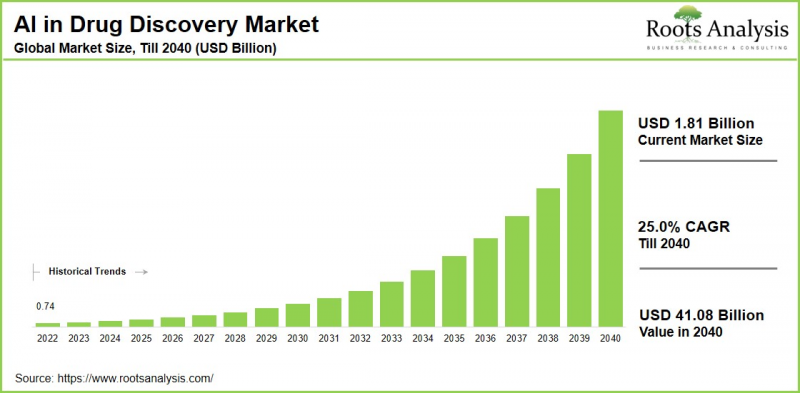
As per Roots Analysis, the global AI in drug discovery market size is estimated to grow from USD 1.81 billion in the current year to USD 41.08 billion by 2040, at a CAGR of 25% during the forecast period, till 2040. The new study provides market size, growth scenarios, industry trend and future forecast.
Artificial intelligence (AI) is revolutionizing drug discovery by speeding up the process, lowering costs, and enhancing success rates through methods, such as virtual screening, predictive modeling for efficacy and toxicity, and de novo drug design. Machine learning and deep learning techniques evaluate large datasets to pinpoint promising drug candidates, anticipate their behavior within the body, and even create completely new molecules. AI is also applied in drug repurposing and personalizing therapies by discovering new applications for existing medications or customizing treatments for individual patients based on their specific data.
The market for AI in drug discovery is expected to grow significantly due to the increasing need for advanced therapeutic medications aimed at a wide array of medical conditions. With the rising prevalence of chronic illnesses worldwide, pharmaceutical companies are enhancing their investment in research and development to fulfill the persistent demand for new medications.
Strategic Insights for Senior Leaders
Key Drivers Propelling Growth of AI in Drug Discovery Market
The primary factors propelling the AI in drug discovery market include the use of AI in drug discovery are its capability to quickly analyze large datasets, forecast molecular characteristics and toxicity, discover new drug targets, and speed up the process of repurposing existing medications. AI enhances the drug development process by employing machine learning to better predict a drug candidate's effectiveness, safety, and pharmacokinetic traits, ultimately resulting in lower expenses and shorter timelines. Other significant growth drivers, include the increasing investments and funding from private and public sectors, rising adoption of AI-driven platforms for target identification, lead optimization, toxicity prediction, and safety profiling.
Role of AI in Personalized Medicine
Artificial intelligence significantly contributes to personalized medicine by examining large datasets to facilitate tailored treatments, enhance diagnostics, and speed up the process of drug discovery. It combines information from genomics, electronic health records, and wearable technology to forecast disease risk, refine medication plans, and discover new therapeutic targets. This results in more precise diagnostics, improved patient outcomes, and more effective healthcare systems.
AI in Drug Discovery Market: Competitive Landscape of Companies in this Industry
The competitive landscape of AI in drug discovery market is characterized by intense competition, featuring a combination of large and smaller firms. Key players in this field include NVIDIA, Insilico Medicine, Exscientia, BenevolentAI, Google DeepMind, IBM, and Microsoft, which have created sophisticated AI systems for target identification, generative chemistry, and optimizing clinical trials. Major pharmaceutical organizations, such as AstraZeneca, Pfizer, Roche, Novartis, and Bayer are actively collaborating with AI firms to utilize machine learning for more rapid and economical drug development processes.
Startups such as Atomwise, Recursion Pharmaceuticals, and BenchSci bring innovation with their distinct AI-focused methodologies, while investments and partnerships are rapidly rising to meet the growing demand for precision medicine and new therapeutics. The market, which is projected for substantial growth, shows robust momentum driven by the capability of AI capability to process intricate biological data, shorten R&D timelines, and improve the success rates of drug candidates worldwide.
AI in Drug Discovery Evolution: Emerging Trends in the Industry
Emerging trends in this domain include the utilization of generative AI to create new molecules, the incorporation of multi-omics data for a comprehensive understanding of diseases, and the use of Large Language Models (LLMs) to examine scientific literature. Additional advancements include the employment of State Space Models (SSMs), which provide enhanced computational efficiency, and the integration of AI in personalized medicine, where AI develops customized treatment plans by evaluating individual patient data.
Key Market Challenges
The market for AI in drug discovery faces significant challenges, including data and technical limitations, as well as regulatory and ethical issues, and operational obstacles. The quality and availability of data are pivotal concerns, as pharmaceutical datasets frequently suffer from fragmentation, inconsistencies, incompleteness, or poor annotations. This can result in biased predictions and unreliable outcomes from AI systems.
Further, the intricate nature of biological systems makes comprehensive computational modeling difficult and is further complicated by the high computational expenses that can be burdensome for smaller organizations. Additionally, regulatory uncertainties arise from changing FDA and EMA guidelines that do not align well with the iterative characteristics of AI, ethical dilemmas such as data privacy issues under HIPAA/GDPR, and intellectual property disputes concerning the patenting of drugs developed by AI.
AI in Drug Discovery Market: Key Market Segmentation
Drug Discovery Steps
- Target identification / validation
- Hit generation / lead identification
- Lead optimization
Therapeutic Area
- Oncological disorders
- CNS disorders
- Infectious diseases
- Respiratory disorders
- Cardiovascular disorders
- Endocrine disorders
- Gastrointestinal disorders
- Musculoskeletal disorders
- Immunological disorders
- Dermatological disorders
- Others
Geographical Regions
- North America
- US
- Canada
- Mexico
- Other North American countries
- Europe
- Austria
- Belgium
- Denmark
- France
- Germany
- Ireland
- Italy
- Netherlands
- Norway
- Russia
- Spain
- Sweden
- Switzerland
- UK
- Other European countries
- Asia
- China
- India
- Japan
- Singapore
- South Korea
- Other Asian countries
- Latin America
- Brazil
- Chile
- Colombia
- Venezuela
- Other Latin American countries
- Middle East and North Africa
- Egypt
- Iran
- Iraq
- Israel
- Kuwait
- Saudi Arabia
- UAE
- Other MENA countries
- Rest of the World
- Australia
- New Zealand
- Other countries
AI in Drug Discovery Market: Key Market Share Insights
Market Share by Drug Discovery Step
Based on the drug discovery step, the global market is segmented into target identification / validation, hit generation / lead identification and lead optimization. According to our estimates, currently, lead optimization captures majority share of the market. The application of AI in the initial phases of drug discovery, particularly in lead optimization, is crucial for improving the drug's efficacy, accessibility, and safety profile. Additionally, lead optimization is vital for enhancing solubility, cellular permeability, and stability.
Market Share by Geography
According to our estimates North America currently captures a significant share of the AI in drug discovery market. This is due to the increasing utilization of AI-based tools by pharmaceutical companies for drug discovery and the rise in partnership agreements aimed at improving product offerings in North America. It is also important to note that the AI in drug discovery market in the Asia-Pacific region is expected to grow at a higher CAGR over the forecast period.
Example Players in AI in Drug Discovery Market
- Aiforia Technologies
- Atomwise
- BioSyntagma
- Chemalive
- Collaborations Pharmaceuticals
- Cyclica
- DeepMatter
- Recursion
- InveniAI
- MAbSilico
- Optibrium
- Recursion Pharmaceuticals
- Sensyne Health
- Valo Health
AI in Drug Discovery Market: Report Coverage
The report on the AI in drug discovery market features insights on various sections, including:
- Market Sizing and Opportunity Analysis: An in-depth analysis of the AI in drug discovery market, focusing on key market segments, including [A] drug discovery steps, [B] therapeutic area, and [C] key geographical regions.
- Competitive Landscape: A comprehensive analysis of the companies engaged in the AI in drug discovery market, based on several relevant parameters, such as [A] year of establishment, [B] company size, [C] location of headquarters and [D] ownership structure.
- Company Profiles: Elaborate profiles of prominent players engaged in the AI in drug discovery market, providing details on [A] location of headquarters, [B] company size, [C] company mission, [D] company footprint, [E] management team, [F] contact details, [G] financial information, [H] operating business segments, [I] portfolio, [J] recent developments, and an informed future outlook.
- Megatrends: An evaluation of ongoing megatrends in the AI in drug discovery industry.
- Patent Analysis: An insightful analysis of patents filed / granted in the AI in drug discovery domain, based on relevant parameters, including [A] type of patent, [B] patent publication year, [C] patent age and [D] leading players.
- Recent Developments: An overview of the recent developments made in the AI in drug discovery market, along with analysis based on relevant parameters, including [A] year of initiative, [B] type of initiative, [C] geographical distribution and [D] most active players.
- Porter's Five Forces Analysis: An analysis of five competitive forces prevailing in the AI in drug discovery market, including threats of new entrants, bargaining power of buyers, bargaining power of suppliers, threats of substitute products and rivalry among existing competitors.
- SWOT Analysis: An insightful SWOT framework, highlighting the strengths, weaknesses, opportunities and threats in the domain. Additionally, it provides Harvey ball analysis, highlighting the relative impact of each SWOT parameter.
- Value Chain Analysis: A comprehensive analysis of the value chain, providing information on the different phases and stakeholders involved in the AI in drug discovery market.
Key Questions Answered in this Report
- What is the current and future market size?
- Who are the leading companies in this market?
- What are the growth drivers that are likely to influence the evolution of this market?
- What are the key partnership and funding trends shaping this industry?
- Which region is likely to grow at higher CAGR till 2040?
- How is the current and future market opportunity likely to be distributed across key market segments?
Reasons to Buy this Report
- Detailed Market Analysis: The report provides a comprehensive market analysis, offering detailed revenue projections of the overall market and its specific sub-segments. This information is valuable to both established market leaders and emerging entrants.
- In-depth Analysis of Trends: Stakeholders can leverage the report to gain a deeper understanding of the competitive dynamics within the market. Each report maps ecosystem activity across partnerships, funding, and patent landscapes to reveal growth hotspots and white spaces in the industry.
- Opinion of Industry Experts: The report features extensive interviews and surveys with key opinion leaders and industry experts to validate market trends mentioned in the report.
- Decision-ready Deliverables: The report offers stakeholders with strategic frameworks (Porter's Five Forces, value chain, SWOT), and complimentary Excel / slide packs with customization support.
Additional Benefits
- Complimentary Dynamic Excel Dashboards for Analytical Modules
- Exclusive 15% Free Content Customization
- Personalized Interactive Report Walkthrough with Our Expert Research Team
- Free Report Updates for Versions Older than 6-12 Months
TABLE OF CONTENTS
1. PREFACE
- 1.1. Scope of the Report
- 1.2. Research Methodology
- 1.3. Key Questions Answered
- 1.4. Chapter Outlines
2. EXECUTIVE SUMMARY
3. INTRODUCTION
- 3.1. Chapter Overview
- 3.2. Artificial Intelligence
- 3.3. Subsets of AI
- 3.3.1. Machine Learning
- 3.3.1.1. Supervised Learning
- 3.3.1.2. Unsupervised Learning
- 3.3.1.3. Reinforced / Reinforcement Learning
- 3.3.1.4. Deep Learning
- 3.3.1.5. Natural Language Processing (NLP)
- 3.3.1. Machine Learning
- 3.4. Data Science
- 3.5. Applications of AI in Healthcare
- 3.5.1. Drug Discovery
- 3.5.2. Disease Prediction, Diagnosis and Treatment
- 3.5.3. Manufacturing and Supply Chain Operations
- 3.5.4. Marketing
- 3.5.5. Clinical Trials
- 3.6. AI in Drug Discovery
- 3.6.1. Identification of Pathway and Target
- 3.6.2. Identification of Hit or Lead
- 3.6.3. Lead Optimization
- 3.6.4. Synthesis of Drug-Like Compounds
- 3.7. Advantages of Using AI in the Drug Discovery Process
- 3.8. Challenges Associated with the Adoption of AI
- 3.9. Concluding Remarks
4. COMPETITIVE LANDSCAPE
- 4.1. Chapter Overview
- 4.2. AI-based Drug Discovery: Overall Market Landscape
- 4.2.1. Analysis by Year of Establishment
- 4.2.2. Analysis by Company Size
- 4.2.3. Analysis by Location of Headquarters
- 4.2.4. Analysis by Type of Company
- 4.2.5. Analysis by Type of Technology
- 4.2.6. Analysis by Drug Discovery Steps
- 4.2.7. Analysis by Type of Drug Molecule
- 4.2.8. Analysis by Drug Development Initiatives
- 4.2.9. Analysis by Technology Licensing Option
- 4.2.10. Analysis by Target Therapeutic Area
- 4.2.11. Key Players: Analysis by Number of Platforms / Tools Available
5. COMPANY PROFILES: AI-BASED DRUG DISCOVERY PROVIDERS IN NORTH AMERICA
- 5.1. Chapter Overview
- 5.2. Atomwise
- 5.2.1. Company Overview
- 5.2.2. AI-based Drug Discovery Technology Portfolio
- 5.2.3. Recent Developments and Future Outlook
- 5.3. BioSyntagma
- 5.3.1. Company Overview
- 5.3.2. AI-based Drug Discovery Technology Portfolio
- 5.3.3. Recent Developments and Future Outlook
- 5.4. Collaborations Pharmaceuticals
- 5.4.1. Company Overview
- 5.4.2. AI-based Drug Discovery Technology Portfolio
- 5.4.3. Recent Developments and Future Outlook
- 5.5. Cyclica
- 5.5.1. Company Overview
- 5.5.2. AI-based Drug Discovery Technology Portfolio
- 5.5.3. Recent Developments and Future Outlook
- 5.6. InveniAI
- 5.6.1. Company Overview
- 5.6.2. AI-based Drug Discovery Technology Portfolio
- 5.6.3. Recent Developments and Future Outlook
- 5.7. Recursion Pharmaceuticals
- 5.7.1. Company Overview
- 5.7.2. AI-based Drug Discovery Technology Portfolio
- 5.7.3. Recent Developments and Future Outlook
- 5.8. Valo Health
- 5.8.1. Company Overview
- 5.8.2. AI-based Drug Discovery Technology Portfolio
- 5.8.3. Recent Developments and Future Outlook
6. COMPANY PROFILES: AI-BASED DRUG DISOCVERY SERVICE PROVIDERS IN EUROPE
- 6.1. Chapter Overview
- 6.2. Aiforia Technologies
- 6.2.1. Company Overview
- 6.2.2. AI-based Drug Discovery Technology Portfolio
- 6.2.3. Recent Developments and Future Outlook
- 6.3. Chemalive
- 6.3.1. Company Overview
- 6.3.2. AI-based Drug Discovery Technology Portfolio
- 6.3.3. Recent Developments and Future Outlook
- 6.4. DeepMatter
- 6.4.1. Company Overview
- 6.4.2. AI-based Drug Discovery Technology Portfolio
- 6.4.3. Recent Developments and Future Outlook
- 6.5. Exscientia
- 6.5.1. Company Overview
- 6.5.2. AI-based Drug Discovery Technology Portfolio
- 6.5.3. Recent Developments and Future Outlook
- 6.6. MAbSilico
- 6.6.1. Company Overview
- 6.6.2. AI-based Drug Discovery Technology Portfolio
- 6.6.3. Recent Developments and Future Outlook
- 6.7. Optibrium
- 6.7.1. Company Overview
- 6.7.2. AI-based Drug Discovery Technology Portfolio
- 6.7.3. Recent Developments and Future Outlook
- 6.8. Sensyne Health
- 6.8.1. Company Overview
- 6.8.2. AI-based Drug Discovery Technology Portfolio
- 6.8.3. Recent Developments and Future Outlook
7. COMPANY PROFILES: AI-BASED DRUG DISOCVERY SERVICE PROVIDERS IN ASIA PACIFIC
- 7.1. Chapter Overview
- 7.2. 3BIGS
- 7.2.1. Company Overview
- 7.2.2. AI-based Drug Discovery Technology Portfolio
- 7.2.3. Recent Developments and Future Outlook
- 7.3. Gero
- 7.3.1. Company Overview
- 7.3.2. AI-based Drug Discovery Technology Portfolio
- 7.3.3. Recent Developments and Future Outlook
- 7.4. Insilico Medicine
- 7.4.1. Company Overview
- 7.4.2. AI-based Drug Discovery Technology Portfolio
- 7.4.3. Recent Developments and Future Outlook
- 7.5. KeenEye
- 7.5.1. Company Overview
- 7.5.2. AI-based Drug Discovery Technology Portfolio
- 7.5.3. Recent Developments and Future Outlook
8. PARTNERSHIPS AND COLLABORATIONS
- 8.1. Chapter Overview
- 8.2. Partnership Models
- 8.3. AI-based Drug Discovery: Partnerships and Collaborations
- 8.3.1. Analysis by Year of Partnership
- 8.3.2. Analysis by Type of Partnership
- 8.3.3. Analysis by Year and Type of Partnership
- 8.3.4. Analysis by Target Therapeutic Area
- 8.3.5. Analysis by Focus Area
- 8.3.6. Analysis by Year of Partnership and Focus Area
- 8.3.7. Analysis by Type of Partner Company
- 8.3.8. Analysis by Type of Partnership and Type of Partner Company
- 8.3.9. Most Active Players: Analysis by Number of Partnerships
- 8.3.10. Analysis by Region
- 8.3.11.1. Intercontinental and Intracontinental Deals
- 8.3.11.2. International and Local Deals
9. FUNDING AND INVESTMENT ANALYSIS
- 9.1. Chapter Overview
- 9.2. Types of Funding
- 9.3. AI-based Drug Discovery: Funding and Investments
- 9.3.1. Analysis of Number of Funding Instances by Year
- 9.3.2. Analysis of Amount Invested by Year
- 9.3.3. Analysis by Type of Funding
- 9.3.4. Analysis of Amount Invested and Type of Funding
- 9.3.5. Analysis of Amount Invested by Company Size
- 9.3.6. Analysis by Type of Investor
- 9.3.7. Analysis of Amount Invested by Type of Investor
- 9.3.8. Most Active Players: Analysis by Number of Funding Instances
- 9.3.9. Most Active Players: Analysis by Amount Invested
- 9.3.10. Most Active Investors: Analysis by Number of Funding Instances
- 9.3.11. Analysis of Amount Invested by Geography
- 9.3.11.1. Analysis by Region
- 9.3.11.2. Analysis by Country
10. PATENT ANALYSIS
- 10.1. Chapter Overview
- 10.2. Scope and Methodology
- 10.3. AI-based Drug Discovery: Patent Analysis
- 10.3.1 Analysis by Application Year
- 10.3.2. Analysis by Geography
- 10.3.3. Analysis by CPC Symbols
- 10.3.4. Analysis by Emerging Focus Areas
- 10.3.5. Analysis by Type of Applicant
- 10.3.6. Leading Players: Analysis by Number of Patents
- 10.4. AI-based Drug Discovery: Patent Benchmarking
- 10.4.1. Analysis by Patent Characteristics
- 10.5. AI-based Drug Discovery: Patent Valuation
- 10.6. Leading Patents: Analysis by Number of Citations
11. PORTER'S FIVE FORCES ANALYSIS
- 11.1. Chapter Overview
- 11.2. Methodology and Assumptions
- 11.3. Key Parameters
- 11.3.1. Threats of New Entrants
- 11.3.2. Bargaining Power of Drug Developers
- 11.3.3. Bargaining Power of Companies Using AI for Drug Discovery
- 11.3.4. Threats of Substitute Technologies
- 11.3.5. Rivalry Among Existing Competitors
- 11.4. Concluding Remarks
12. COMPANY VALUATION ANALYSIS
- 12.1. Chapter Overview
- 12.2. Company Valuation Analysis: Key Parameters
- 12.3. Methodology
- 12.4. Company Valuation Analysis: Roots Analysis Proprietary Scores
13. AI-BASED HEALTHCARE INITIATIVES OF TECHNOLOGY GIANTS
- 13.1. Chapter Overview
- 13.1.1. Amazon Web Services
- 13.1.2. Microsoft
- 13.1.3. Intel
- 13.1.4. Alibaba Cloud
- 13.1.5. Siemens
- 13.1.6. Google
- 13.1.7. IBM
14. COST SAVING ANALYSIS
- 14.1. Chapter Overview
- 14.2. Key Assumptions and Methodology
- 14.3. Overall Cost Saving Potential Associated with Use of AI-based Solutions in Drug Discovery
- 14.3.1. Likely Cost Savings: Analysis by Drug Discovery Steps
- 14.3.1.1. Likely Cost Savings During Target Identification / Validation
- 14.3.1.2. Likely Cost Savings During Hit Generation / Lead Identification
- 14.3.1.3. Likely Cost Savings During Lead Optimization
- 14.3.2. Likely Cost Savings: Analysis by Target Therapeutic Area
- 14.3.2.1. Likely Cost Savings for Drugs Targeting Oncological Disorders
- 14.3.2.2. Likely Cost Savings for Drugs Targeting Neurological Disorders
- 14.3.2.3. Likely Cost Savings for Drugs Targeting Infectious Diseases
- 14.3.2.4. Likely Cost Savings for Drugs Targeting Respiratory Disorders
- 14.3.2.5. Likely Cost Savings for Drugs Targeting Cardiovascular Disorders
- 14.3.2.6. Likely Cost Savings for Drugs Targeting Endocrine Disorders
- 14.3.2.7. Likely Cost Savings for Drugs Targeting Gastrointestinal Disorders
- 14.3.2.8. Likely Cost Savings for Drugs Targeting Musculoskeletal Disorders
- 14.3.2.9. Likely Cost Savings for Drugs Targeting Immunological Disorders
- 14.3.2.10. Likely Cost Savings for Drugs Targeting Dermatological Disorders
- 14.3.2.11. Likely Cost Savings for Drugs Targeting Other Disorders
- 14.3.3. Likely Cost Savings: Analysis by Geography
- 14.3.3.1. Likely Cost Savings in North America
- 14.3.3.2. Likely Cost Savings in Europe
- 14.3.3.3. Likely Cost Savings in Asia Pacific
- 14.3.3.4. Likely Cost Savings in MENA
- 14.3.3.5. Likely Cost Savings in Latin America
- 14.3.3.6. Likely Cost Savings in Rest of the World
- 14.3.1. Likely Cost Savings: Analysis by Drug Discovery Steps
15. MARKET FORECAST
- 15.1. Chapter Overview
- 15.2. Key Assumptions and Methodology
- 15.3. Global AI-based Drug Discovery Market
- 15.3.1. AI-based Drug Discovery Market: Distribution by Drug Discovery Steps
- 15.3.1.1. AI-based Drug Discovery Market for Target Identification / Validation
- 15.3.1.2. AI-based Drug Discovery Market for Hit Generation / Lead Identification
- 15.3.1.3. AI-based Drug Discovery Market for Lead Optimization
- 15.3.2. AI-based Drug Discovery Market: Distribution by Target Therapeutic Area
- 15.3.2.1. AI-based Drug Discovery Market for Oncological Disorders
- 15.3.2.2. AI-based Drug Discovery Market for Neurological Disorders
- 15.3.2.3. AI-based Drug Discovery Market for Infectious Diseases
- 15.3.2.4. AI-based Drug Discovery Market for Respiratory Disorders
- 15.3.2.5. AI-based Drug Discovery Market for Cardiovascular Disorders
- 15.3.2.6. AI-based Drug Discovery Market for Endocrine Disorders
- 15.3.2.7. AI-based Drug Discovery Market for Gastrointestinal Disorders
- 15.3.2.8. AI-based Drug Discovery Market for Musculoskeletal Disorders
- 15.3.2.9. AI-based Drug Discovery Market for Immunological Disorders
- 15.3.2.10. AI-based Drug Discovery Market for Dermatological Disorders
- 15.3.2.11. AI-based Drug Discovery Market for Other Disorders
- 15.3.3. AI-based Drug Discovery Market: Distribution by Geography
- 15.3.3.1. AI-based Drug Discovery Market in North America
- 15.3.3.1.1. AI-based Drug Discovery Market in the US
- 15.3.3.1.2. AI-based Drug Discovery Market in Canada
- 15.3.3.2. AI-based Drug Discovery Market in Europe
- 15.3.3.2.1. AI-based Drug Discovery Market in the UK
- 15.3.3.2.2. AI-based Drug Discovery Market in France
- 15.3.3.2.3. AI-based Drug Discovery Market in Germany
- 15.3.3.2.4. AI-based Drug Discovery Market in Spain
- 15.3.3.2.5. AI-based Drug Discovery Market in Italy
- 15.3.3.2.6. AI-based Drug Discovery Market in Rest of Europe
- 15.3.3.3. AI-based Drug Discovery Market in Asia Pacific
- 15.3.3.3.1. AI-based Drug Discovery Market in China
- 15.3.3.3.2. AI-based Drug Discovery Market in India
- 15.3.3.3.3. AI-based Drug Discovery Market in Japan
- 15.3.3.3.4. AI-based Drug Discovery Market in Australia
- 15.3.3.3.5. AI-based Drug Discovery Market in South Korea
- 15.3.3.4. AI-based Drug Discovery Market in MENA
- 15.3.3.4.1. AI-based Drug Discovery Market in Saudi Arabia
- 15.3.3.4.2. AI-based Drug Discovery Market in UAE
- 15.3.3.4.3. AI-based Drug Discovery Market in Iran
- 15.3.3.5. AI-based Drug Discovery Market in Latin America
- 15.3.3.5.1. AI-based Drug Discovery Market in Argentina
- 15.3.3.6. AI-based Drug Discovery Market in Rest of the World
- 15.3.3.1. AI-based Drug Discovery Market in North America
- 15.3.1. AI-based Drug Discovery Market: Distribution by Drug Discovery Steps
16. CONCLUSION
17. EXECUTIVE INSIGHTS
- 17.1. Chapter Overview
- 17.2. Aigenpulse
- 17.2.1. Company Snapshot
- 17.2.2. Interview Transcript: Steve Yemm (Chief Commercial Officer) and Satnam Surae (Chief Product Officer)
- 17.3. Cloud Pharmaceuticals
- 17.3.1. Company Snapshot
- 17.3.2. Interview Transcript: Ed Addison (Co-founder, Chairman and Chief Executive Officer)
- 17.4. DEARGEN
- 17.4.1. Company Snapshot
- 17.4.2. Interview Transcript: Bo Ram Beck (Head Researcher)
- 17.5. Intelligent Omics
- 17.5.1. Company Snapshot
- 17.5.2. Interview Transcript: Simon Haworth (Chief Executive Officer)
- 17.6. Pepticom
- 17.6.1. Company Snapshot
- 17.6.2. Interview Transcript: Immanuel Lerner (Chief Executive Officer, Co-Founder)
- 17.7. Sage-N Research
- 17.7.1. Company Snapshot
- 17.7.2. Interview Transcript: David Chiang (Chairman)
18. APPENDIX I: TABULATED DATA
19. APPENDIX II: LIST OF COMPANIES AND ORGANIZATIONS

