
PUBLISHER: Roots Analysis | PRODUCT CODE: 1993585

PUBLISHER: Roots Analysis | PRODUCT CODE: 1993585
Industrial Robotics Market, till 2035: Distribution by Type of Robot, Payload, Mobility, Application Area, End-User, Key Geographical Regions and Leading Players: Industry Trends and Global Forecasts
Industrial Robotics Market Outlook
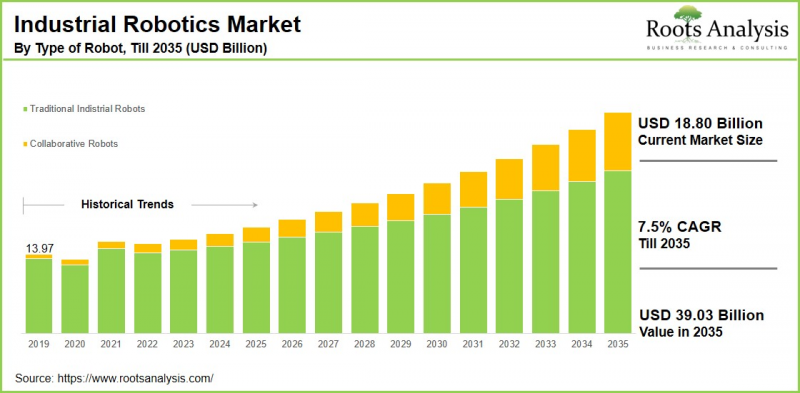
As per Roots Analysis, the global industrial robotics market size is estimated to grow from USD 18.80 billion in current year to USD 39.03 billion by 2035, at a CAGR of 7.5% during the forecast period, till 2035.
Industry 4.0 driven robotics integration is transforming manufacturing operations by enabling organizations to adopt advanced automation solutions. Over the years, the global demand for consumer electronics and automobiles has risen steadily. As a result, manufacturers are increasingly deploying assembly-line robotics to automate processes that require high precision, consistency, and repeatability.
Industrial robots are robust, high-performance machines designed to enhance efficiency by automating complex, repetitive, or hazardous manufacturing tasks. Typically equipped with one or more robotic arms, these systems can perform operations in challenging environments such as high-pressure vacuum chambers or radiation zones, thereby minimizing direct human exposure. Moreover, robotic arms can be fitted with specialized end effectors and grippers to handle delicate components or manage heavy payloads weighing several tons. Considering the above-mentioned benefits, the industrial robotics market is expected to grow significantly during the forecast period.
Strategic Insights for Senior Leaders
Key Drivers Propelling Growth of Industrial Robotics Market
The growth of the industrial robotics market is primarily driven by the increasing adoption of automation across manufacturing industries to enhance productivity, precision, and operational efficiency. Rising labor costs and persistent skill shortages are encouraging organizations to invest in robotic solutions that ensure consistent output and reduced dependency on manual intervention. Additionally, the growing demand for high-quality products in sectors such as automotive, electronics, pharmaceuticals, and food processing is accelerating the integration of advanced robotics systems.
Technological advancements in artificial intelligence, machine vision, and collaborative robots (cobots) are further expanding the applications, enabling safer and more flexible human-machine interaction. Moreover, government initiatives supporting smart manufacturing and Industry 4.0 transformation, along with the need to minimize operational risks, are also contributing to the expansion of the industrial robotics market.
Industrial Robotics Market: Competitive Landscape of Companies in this Industry
The industrial robotics market is highly fragmented, characterized by the presence of both established manufacturers and emerging entrants. The competitive landscape comprises companies of varying scales, including large multinational corporations as well as mid-sized and smaller enterprises. Notably, nearly 70% of leading industrial robot manufacturers offer collaborative robots (cobots), underscoring the growing demand for flexible and human-centric automation solutions. Further, over 90% of the players provide robotic systems to the automotive sector, reflecting the industry's continued dominance as a primary end user of industrial robotics technologies.
Industrial Robotics Evolution: Emerging Trends in the Industry
The industrial robotics market is witnessing several transformative trends driven by rapid technological advancements and evolving manufacturing requirements. A prominent trend is the growing adoption of collaborative robots (cobots), which enable safe and efficient human-robot interaction. Further, integration of artificial intelligence, machine learning, and advanced vision systems is enhancing robot autonomy, precision, and adaptability across complex tasks. Additionally, the integration of robotics with Industry 4.0 technologies, such as the Industrial Internet of Things (IIoT), cloud computing, and real-time data analytics, enables predictive maintenance, remote monitoring, and optimized production workflows. Furthermore, sustainability considerations and energy-efficient robotic solutions are gaining prominence as organizations strive to reduce operational costs and environmental impact.
Regional Analysis: Asia-Pacific Lead the Industrial Robotics Market
According to our analysis, in the current year, the industrial robotics market in Asia-Pacific captures the largest share. This is driven by rapid industrialization, strong manufacturing output, and substantial investments in automation technologies within this region. Countries such as China, Japan, South Korea, and India are at the forefront of robotics adoption, supported by robust automotive, electronics, and semiconductor manufacturing sectors. Moreover, the favorable government initiatives promoting smart factories and Industry 4.0 transformation, along with the presence of leading robot manufacturers and component suppliers are further fueling the growth of this market.
Key Challenges in Industrial Robotics Market
Key challenges hindering the adoption of industrial robotics include high initial capital investment and integration costs, particularly for small and medium-sized enterprises. The complexity associated with system integration, programming, and maintenance often necessitates specialized technical expertise, which can be limited in certain regions. Additionally, concerns related to cybersecurity, data privacy, and operational safety are becoming increasingly critical as robotics systems integrate with digital and cloud-based platforms. Moreover, ensuring seamless interoperability between legacy equipment and advanced robotic systems continues to pose operational and technical challenges for manufacturers.
Industrial Robotics Market: Key Market Segmentation
Type of Robot
- Traditional Industrial Robots
- Collaborative Robots
Payload
- Low Payloads (<20 Kgs)
- Medium Payloads (20 to 150 Kgs)
- High Payloads (>150 Kgs)
Mobility
- Stationary Robots
- Mobile Robots
Application Area
- Handling
- Welding
- Assembling
- Cleanroom
- Dispensing
- Processing
- Other Application Areas
End-User
- Electronics Industry
- Automotive Industry
- Metal and Machinery Industry
- Plastics Industry
- Food and Beverages Industry
- Other Industries
Geographical Regions
- North America
- US
- Canada
- Mexico
- Other North American countries
- Europe
- Germany
- France
- Italy
- Spain
- Turkey
- UK
- Rest of Europe
- Asia-Pacific
- China
- Japan
- South Korea
- Taiwan
- Singapore
- India
- Thailand
- Rest of Asia-Pacific
- Latin America
- Brazil
- Argentina
- Other Latin American countries
- Middle East and Africa, and Rest of the World
- North Africa
- South Africa
- Rest of Middle East and Africa
- Other Countries
Example Players in Industrial Robotics Market
- ABB
- Daihen
- FANUC
- Kawasaki Heavy Industries
- KUKA
- Mitsubishi Electric
- Nachi-Fujikoshi
- Yamaha Motor
- Comau
- Denso
- Epson America
- Omron
- Siasun
- Staubli
- Yaskawa
- Hirata
- Nordson
Industrial Robotics Market: Report Coverage
The report on the industrial robotics market features insights on various sections, including:
- Market Sizing and Opportunity Analysis: An in-depth analysis of the industrial robotics market, focusing on key market segments, including [A] type of robot, [B] payload, [C] mobility, [D] application area, [E] end-user, [F] key geographical regions and [G] leading players.
- Competitive Landscape: A comprehensive analysis of the companies engaged in the industrial robotics market, based on several relevant parameters, such as [A] year of establishment, [B] company size, [C] location of headquarters and [D] ownership structure.
- Company Profiles: Elaborate profiles of prominent players engaged in the industrial robotics market, providing details on [A] location of headquarters, [B] company size, [C] company mission, [D] company footprint, [E] management team, [F] contact details, [G] financial information, [H] operating business segments, [I] product / technology portfolio, [J] recent developments, and an informed future outlook.
- Patent Analysis: An insightful analysis of patents filed / granted in the industrial robotics domain, based on relevant parameters, including [A] type of patent, [B] patent publication year, [C] patent age and [D] leading players.
Key Questions Answered in this Report
- What is the current and future market size?
- Who are the leading companies in this market?
- What are the growth drivers that are likely to influence the evolution of this market?
- What are the key partnership and funding trends shaping this industry?
- Which region is likely to grow at higher CAGR till 2035?
- How is the current and future market opportunity likely to be distributed across key market segments?
Reasons to Buy this Report
- Detailed Market Analysis: The report provides a comprehensive market analysis, offering detailed revenue projections of the overall market and its specific sub-segments. This information is valuable to both established market leaders and emerging entrants.
- In-depth Analysis of Trends: Stakeholders can leverage the report to gain a deeper understanding of the competitive dynamics within the market. Each report maps ecosystem activity across partnerships, funding, and patent landscapes to reveal growth hotspots and white spaces in the industry.
- Opinion of Industry Experts: The report features extensive interviews and surveys with key opinion leaders and industry experts to validate market trends mentioned in the report.
- Decision-ready Deliverables: The report offers stakeholders with strategic frameworks (Porter's Five Forces, value chain, SWOT), and complimentary Excel / slide packs with customization support.
Additional Benefits
- Complimentary Dynamic Excel Dashboards for Analytical Modules
- Exclusive 15% Free Content Customization
- Personalized Interactive Report Walkthrough with Our Expert Research Team
- Free Report Updates for Versions Older than 6-12 Months
TABLE OF CONTENTS
1. PROJECT OVERVIEW
- 1.1. Context
- 1.2. Project Objectives
2. RESEARCH METHODOLOGY
- 2.1. Chapter Overview
- 2.2. Research Assumptions
- 2.3. Database Building
- 2.3.1. Data Collection
- 2.3.2. Data Validation
- 2.3.3. Data Analysis
- 2.4. Project Methodology
- 2.4.1. Secondary Research
- 2.4.1.1. Annual Reports
- 2.4.1.2. Academic Research Papers
- 2.4.1.3. Company Websites
- 2.4.1.4. Investor Presentations
- 2.4.1.5. Regulatory Filings
- 2.4.1.6. White Papers
- 2.4.1.7. Industry Publications
- 2.4.1.8. Conferences and Seminars
- 2.4.1.9. Government Portals
- 2.4.1.10. Media and Press Releases
- 2.4.1.11. Newsletters
- 2.4.1.12. Industry Databases
- 2.4.1.13. Roots Proprietary Databases
- 2.4.1.14. Paid Databases and Sources
- 2.4.1.15. Social Media Portals
- 2.4.1.16. Other Secondary Sources
- 2.4.2. Primary Research
- 2.4.2.1. Introduction
- 2.4.2.2. Types
- 2.4.2.2.1. Qualitative
- 2.4.2.2.2. Quantitative
- 2.4.2.3. Advantages
- 2.4.2.4. Techniques
- 2.4.2.4.1. Interviews
- 2.4.2.4.2. Surveys
- 2.4.2.4.3. Focus Groups
- 2.4.2.4.4. Observational Research
- 2.4.2.4.5. Social Media Interactions
- 2.4.2.5. Stakeholders
- 2.4.2.5.1. Company Executives (CXOs)
- 2.4.2.5.2. Board of Directors
- 2.4.2.5.3. Company Presidents and Vice Presidents
- 2.4.2.5.4. Key Opinion Leaders
- 2.4.2.5.5. Research and Development Heads
- 2.4.2.5.6. Technical Experts
- 2.4.2.5.7. Subject Matter Experts
- 2.4.2.5.8. Scientists
- 2.4.2.5.9. Doctors and Other Healthcare Providers
- 2.4.2.6. Ethics and Integrity
- 2.4.2.6.1. Research Ethics
- 2.4.2.6.2. Data Integrity
- 2.4.3. Analytical Tools and Databases
- 2.4.1. Secondary Research
3. ECONOMIC AND OTHER PROJECT SPECIFIC CONSIDERATIONS
- 3.1. Forecast Methodology
- 3.1.1. Top-Down Approach
- 3.1.2. Bottom-Up Approach
- 3.1.3. Hybrid Approach
- 3.2. Market Assessment Framework
- 3.2.1. Total Addressable Market (TAM)
- 3.2.2. Serviceable Addressable Market (SAM)
- 3.2.3. Serviceable Obtainable Market (SOM)
- 3.2.4. Currently Acquired Market (CAM)
- 3.3. Forecasting Tools and Techniques
- 3.3.1. Qualitative Forecasting
- 3.3.2. Correlation
- 3.3.3. Regression
- 3.3.4. Time Series Analysis
- 3.3.5. Extrapolation
- 3.3.6. Convergence
- 3.3.7. Forecast Error Analysis
- 3.3.8. Data Visualization
- 3.3.9. Scenario Planning
- 3.3.10. Sensitivity Analysis
- 3.4. Key Considerations
- 3.4.1. Demographics
- 3.4.2. Market Access
- 3.4.3. Reimbursement Scenarios
- 3.4.4. Industry Consolidation
- 3.5. Robust Quality Control
- 3.6. Key Market Segmentations
- 3.7. Limitations
4. MACRO-ECONOMIC INDICATORS
- 4.1. Chapter Overview
- 4.2. Market Dynamics
- 4.2.1. Time Period
- 4.2.1.1. Historical Trends
- 4.2.1.2. Current and Forecasted Estimates
- 4.2.2. Currency Coverage
- 4.2.2.1. Overview of Major Currencies Affecting the Market
- 4.2.2.2. Impact of Currency Fluctuations on the Industry
- 4.2.3. Foreign Exchange Impact
- 4.2.3.1. Evaluation of Foreign Exchange Rates and Their Impact on Market
- 4.2.3.2. Strategies for Mitigating Foreign Exchange Risk
- 4.2.4. Recession
- 4.2.4.1. Historical Analysis of Past Recessions and Lessons Learnt
- 4.2.4.2. Assessment of Current Economic Conditions and Potential Impact on the Market
- 4.2.5. Inflation
- 4.2.5.1. Measurement and Analysis of Inflationary Pressures in the Economy
- 4.2.5.2. Potential Impact of Inflation on the Market Evolution
- 4.2.6. Interest Rates
- 4.2.6.1. Overview of Interest Rates and Their Impact on the Market
- 4.2.6.2. Strategies for Managing Interest Rate Risk
- 4.2.7. Commodity Flow Analysis
- 4.2.7.1. Type of Commodity
- 4.2.7.2. Origins and Destinations
- 4.2.7.3. Values and Weights
- 4.2.7.4. Modes of Transportation
- 4.2.8. Global Trade Dynamics
- 4.2.8.1. Import Scenario
- 4.2.8.2. Export Scenario
- 4.2.9. War Impact Analysis
- 4.2.9.1. Russian-Ukraine War
- 4.2.9.2. Israel-Hamas War
- 4.2.10. COVID Impact / Related Factors
- 4.2.10.1. Global Economic Impact
- 4.2.10.2. Industry-specific Impact
- 4.2.10.3. Government Response and Stimulus Measures
- 4.2.10.4. Future Outlook and Adaptation Strategies
- 4.2.11. Other Indicators
- 4.2.11.1. Fiscal Policy
- 4.2.11.2. Consumer Spending
- 4.2.11.3. Gross Domestic Product (GDP)
- 4.2.11.4. Employment
- 4.2.11.5. Taxes
- 4.2.11.6. R&D Innovation
- 4.2.11.7. Stock Market Performance
- 4.2.11.8. Supply Chain
- 4.2.11.9. Cross-Border Dynamics
- 4.2.1. Time Period
5. EXECUTIVE SUMMARY
- 5.1. Insights on Leading Players
- 5.2. Insights on Startups Ecosystem
- 5.3. Insights on Global Industrial Robotics Market Opportunity
- 5.4. Insights on Global Industrial Robotics Market Opportunity by Type of Robot
- 5.5. Insights on Global Industrial Robotics Market Opportunity by Payload
- 5.6. Insights on Global Industrial Robotics Market Opportunity by Application Area
- 5.7. Insights on Global Industrial Robotics Market Opportunity by End-User
- 5.8. Insights on Global Industrial Robotics Market Opportunity by Geography
6. INDUSTRIAL ROBOTICS MARKET: ONGOING MEGATRENDS
7. INTRODUCTION
- 7.1. Overview of the Industrial Robotics Industry
- 7.2. The Anatomy of an Industrial Robot
- 7.3. Types of Industrial Robots
- 7.4. History of Industrial Robots
- 7.5. Advantages of Industrial Robots
- 7.6. Challenges Prevailing in the Industrial Robotics Market
- 7.7. Recent Developments in the Industrial Robotics Market
- 7.8. Future Perspectives
8. COMPETITIVE LANDSCAPE: LEADING PLAYERS IN THE INDUSTRIAL ROBOTICS MARKET
- 8.1. Industrial Robotics Market: Current Landscape of Leading Players
- 8.1.1. Analysis by Year of Establishment
- 8.1.2. Analysis by Company Size
- 8.1.3. Analysis by Company Size and Year of Establishment
- 8.1.4. Analysis by Location of Headquarters
- 8.1.5. Analysis by Number of Robots Offered
- 8.1.6. Analysis by Type of Robot
- 8.1.7. Analysis by Number of Axes
- 8.1.8. Analysis by Arm Outreach
- 8.1.9. Analysis by Protection Class
- 8.1.10. Analysis by Application Area
- 8.1.11. Analysis by End-User
9. INDUSTRIAL ROBOTICS MARKET: STARTUP ECOSYSTEM ANALYSIS
- 9.1. Industrial Robotics Market: Current Landscape of Startups
- 9.1.1. Analysis by Year of Establishment
- 9.1.2. Analysis by Company Size
- 9.1.3. Analysis by Company Size and Year of Establishment
- 9.1.4. Analysis by Location of Headquarters
- 9.1.5. Analysis by Type of Robot
- 9.1.6. Analysis by Application Area
10. PATENT ANLYSIS
- 10.1. Chapter Overview
- 10.2. Scope and Methodology
- 10.3. Industrial Robotics Market: Patent Analysis
- 10.3.1. Analysis by Patent Publication Year
- 10.3.2. Analysis by Patent Application Year
- 10.3.3. Analysis of Granted Patents and Patent Applications by Publication Year
- 10.3.4. Analysis by Patent Jurisdiction
- 10.3.5. Analysis by CPC Symbols
- 10.3.6. Analysis by Type of Applicant
- 10.3.7. Leading Industry Players: Analysis by Number of Patents
- 10.3.8. Leading Non-Industry Players: Analysis by Number of Patents
- 10.3.9. Leading Individual Assignees: Analysis by Number of Patents
- 10.4. Industrial Robotics Market: Patent Benchmarking Analysis
- 10.4.1. Analysis by Patent Characteristics
- 10.5. Industrial Robotics Market: Patent Valuation
- 10.6. Leading Patents by Number of Citations
11. MARKET IMPACT ANALYSIS: DRIVERS, RESTRAINTS, OPPORTUNITIES AND CHALLENGES
- 11.1. Chapter Overview
- 11.2. Market Drivers
- 11.3. Market Restraints
- 11.4. Market Opportunities
- 11.5. Market Challenges
- 11.6. Conclusion
12. GLOBAL INDUSTRIAL ROBOTICS MARKET
- 12.1. Assumptions and Methodology
- 12.2. Global Industrial Robotics Market, Historical Trends (Since 2019) and Forecasted Estimates (Till 2035)
- 12.2.1. Scenario Analysis
- 12.2.1.1. Conservative Scenario
- 12.2.1.2. Optimistic Scenario
- 12.2.1. Scenario Analysis
- 12.3. Global Industrial Robotics Market: Distribution by Geography
- 12.4. Key Market Segmentations
13. INDUSTRIAL ROBOTICS MARKET, BY TYPE OF ROBOT
- 13.1. Assumptions and Methodology
- 13.2. Industrial Robotics Market: Distribution by Type of Robot
- 13.2.1. Industrial Robotics Market for Traditional Industrial Robots (Value, YoY Growth): Historical Trends (Since 2019) and Forecasted Estimates (Till 2035)
- 13.2.2. Industrial Robotics Market for Collaborative Robots (Value, YoY Growth): Historical Trends (Since 2019) and Forecasted Estimates (Till 2035)
- 13.3. Data Triangulation and Validation
14. INDUSTRIAL ROBOTICS MARKET, BY TYPE OF TRADITIONAL INDUSTRIAL ROBOT
- 14.1. Assumptions and Methodology
- 14.2. Industrial Robotics Market: Distribution by Type of Traditional Industrial Robot
- 14.2.1. Industrial Robotics Market for Articulated Robots (Value, YoY Growth): Historical Trends (Since 2019) and Forecasted Estimates (Till 2035)
- 14.2.2. Industrial Robotics Market for Cartesian Robots (60 to 100 Kg) (Value, YoY Growth): Historical Trends (Since 2019) and Forecasted Estimates (Till 2035)
- 14.2.3. Industrial Robotics Market for SCARA Robots (Value, YoY Growth): Historical Trends (Since 2019) and Forecasted Estimates (Till 2035)
- 14.2.4. Industrial Robotics Market for Delta Robots (Value, YoY Growth): Historical Trends (Since 2019) and Forecasted Estimates (Till 2035)
- 14.2.5. Industrial Robotics Market for Other Robots (Value, YoY Growth): Historical Trends (Since 2019) and Forecasted Estimates (Till 2035)
- 14.3. Data Triangulation and Validation
15. INDUSTRIAL ROBOTICS MARKET, BY PAYLOAD
- 15.1. Assumptions and Methodology
- 15.2. Industrial Robotics Market: Distribution by Payload
- 15.2.1. Industrial Robotics Market for Low Payloads (<20 Kgs) (Value, YoY Growth): Historical Trends (Since 2019) and Forecasted Estimates (Till 2035)
- 15.2.2. Industrial Robotics Market for Medium Payloads (20 to 150 Kgs) (Value, YoY Growth): Historical Trends (Since 2019) and Forecasted Estimates (Till 2035)
- 15.2.3. Industrial Robotics Market for High Payloads (>150 Kgs) (Value, YoY Growth): Historical Trends (Since 2019) and Forecasted Estimates (Till 2035)
- 15.3. Data Triangulation and Validation
16. INDUSTRIAL ROBOTICS MARKET, BY MOBILITY
- 16.1. Assumptions and Methodology
- 16.2. Industrial Robotics Market: Distribution by Mobility
- 16.2.1. Industrial Robotics Market for Stationary Robots (Value, YoY Growth): Historical Trends (Since 2019) and Forecasted Estimates (Till 2035)
- 16.2.2. Industrial Robotics Market for Mobile Robots (Value, YoY Growth): Historical Trends (Since 2019) and Forecasted Estimates (Till 2035)
- 16.2.2.1. Mobile Robots Market for Manufacturing (Value, YoY Growth): Historical Trends (Since 2019) and Forecasted Estimates (Till 2035)
- 16.2.2.2. Mobile Robots Market for Logistics (Value, YoY Growth): Historical Trends (Since 2019) and Forecasted Estimates (Till 2035)
- 16.3. Data Triangulation and Validation
17. INDUSTRIAL ROBOTICS MARKET, BY APPLICATION AREA
- 17.1. Assumptions and Methodology
- 17.2. Industrial Robotics Market: Distribution by Application Area
- 17.2.1. Industrial Robotics Market for Handling (Value, YoY Growth): Historical Trends (Since 2019) and Forecasted Estimates (Till 2035)
- 17.2.2. Industrial Robotics Market for Welding (Value, YoY Growth): Historical Trends (Since 2019) and Forecasted Estimates (Till 2035)
- 17.2.3. Industrial Robotics Market for Assembling (Value, YoY Growth): Historical Trends (Since 2019) and Forecasted Estimates (Till 2035)
- 17.2.4. Industrial Robotics Market for Cleanroom (Value, YoY Growth): Historical Trends (Since 2019) and Forecasted Estimates (Till 2035)
- 17.2.5. Industrial Robotics Market for Dispensing (Value, YoY Growth): Historical Trends (Since 2019) and Forecasted Estimates (Till 2035)
- 17.2.6. Industrial Robotics Market for Processing (Value, YoY Growth): Historical Trends (Since 2019) and Forecasted Estimates (Till 2035)
- 17.2.7. Industrial Robotics Market for Other Application Areas (Value, YoY Growth): Historical Trends (Since 2019) and Forecasted Estimates (Till 2035)
- 17.3. Data Triangulation and Validation
18. INDUSTRIAL ROBOTICS MARKET, BY END USER
- 18.1. Assumptions and Methodology
- 18.2. Industrial Robotics Market: Distribution by End-User
- 18.2.1. Industrial Robotics Market for Electronics Industry (Value, YoY Growth): Historical Trends (Since 2019) and Forecasted Estimates (Till 2035)
- 18.2.2. Industrial Robotics Market for Automotive Industry (Value, YoY Growth): Historical Trends (Since 2019) and Forecasted Estimates (Till 2035)
- 18.2.3. Industrial Robotics Market for Metal and Machinery Industry (Value, YoY Growth): Historical Trends (Since 2019) and Forecasted Estimates (Till 2035)
- 18.2.4. Industrial Robotics Market for Plastics Industry (Value, YoY Growth): Historical Trends (Since 2019) and Forecasted Estimates (Till 2035)
- 18.2.5. Industrial Robotics Market for Food and Beverages Industry (Value, YoY Growth): Historical Trends (Since 2019) and Forecasted Estimates (Till 2035)
- 18.2.6. Industrial Robotics Market for Other Industries (Value, YoY Growth): Historical Trends (Since 2019) and Forecasted Estimates (Till 2035)
- 18.3. Data Triangulation and Validation
19. INDUSTRIAL ROBOTICS MARKET, BY GEOGRAPHY
- 19.1. Assumptions and Methodology
- 19.2. Industrial Robotics Market: Distribution by Geography
- 19.2.1. Industrial Robotics Market in North America (Value, YoY Growth): Historical Trends (Since 2019) and Forecasted Estimates (Till 2035)
- 19.2.1.1. Industrial Robotics Market in the US (Value, YoY Growth): Historical Trends (Since 2019) and Forecasted Estimates (Till 2035)
- 19.2.1.2. Industrial Robotics Market in Canada (Value, YoY Growth): Historical Trends (Since 2019) and Forecasted Estimates (Till 2035)
- 19.2.1.3. Industrial Robotics Market in Mexico (Value, YoY Growth): Historical Trends (Since 2019) and Forecasted Estimates (Till 2035)
- 19.2.1.4. Industrial Robotics Market in Rest of North America (Value, YoY Growth): Historical Trends (Since 2019) and Forecasted Estimates (Till 2035)
- 19.2.2. Industrial Robotics Market in Europe (Value, YoY Growth): Historical Trends (Since 2019) and Forecasted Estimates (Till 2035)
- 19.2.2.1. Industrial Robotics Market in Germany (Value, YoY Growth): Historical Trends (Since 2019) and Forecasted Estimates (Till 2035)
- 19.2.2.2. Industrial Robotics Market in France (Value, YoY Growth): Historical Trends (Since 2019) and Forecasted Estimates (Till 2035)
- 19.2.2.3. Industrial Robotics Market in Italy (Value, YoY Growth): Historical Trends (Since 2019) and Forecasted Estimates (Till 2035)
- 19.2.2.4. Industrial Robotics Market in Spain (Value, YoY Growth): Historical Trends (Since 2019) and Forecasted Estimates (Till 2035)
- 19.2.2.5. Industrial Robotics Market in Turkey (Value, YoY Growth): Historical Trends (Since 2019) and Forecasted Estimates (Till 2035)
- 19.2.2.6. Industrial Robotics Market in the UK (Value, YoY Growth): Historical Trends (Since 2019) and Forecasted Estimates (Till 2035)
- 19.2.2.7. Industrial Robotics Market in Rest of Europe (Value, YoY Growth): Historical Trends (Since 2019) and Forecasted Estimates (Till 2035)
- 19.2.3. Industrial Robotics Market in Asia-Pacific (Value, YoY Growth): Historical Trends (Since 2019) and Forecasted Estimates (Till 2035)
- 19.2.3.1. Industrial Robotics Market in China (Value, YoY Growth): Historical Trends (Since 2019) and Forecasted Estimates (Till 2035)
- 19.2.3.2. Industrial Robotics Market in Japan (Value, YoY Growth): Historical Trends (Since 2019) and Forecasted Estimates (Till 2035)
- 19.2.3.3. Industrial Robotics Market in South Korea (Value, YoY Growth): Historical Trends (Since 2019) and Forecasted Estimates (Till 2035)
- 19.2.3.4. Industrial Robotics Market in Taiwan (Value, YoY Growth): Historical Trends (Since 2019) and Forecasted Estimates (Till 2035)
- 19.2.3.5. Industrial Robotics Market in Singapore (Value, YoY Growth): Historical Trends (Since 2019) and Forecasted Estimates (Till 2035)
- 19.2.3.6. Industrial Robotics Market in India (Value, YoY Growth): Historical Trends (Since 2019) and Forecasted Estimates (Till 2035)
- 19.2.3.7. Industrial Robotics Market in Thailand (Value, YoY Growth): Historical Trends (Since 2019) and Forecasted Estimates (Till 2035)
- 19.2.3.8. Industrial Robotics Market in Rest of Asia-Pacific (Value, YoY Growth): Historical Trends (Since 2019) and Forecasted Estimates (Till 2035)
- 19.2.4. Industrial Robotics Market in Latin America (Value, YoY Growth): Historical Trends (Since 2019) and Forecasted Estimates (Till 2035)
- 19.2.4.1. Industrial Robotics Market in Brazil (Value, YoY Growth): Historical Trends (Since 2019) and Forecasted Estimates (Till 2035)
- 19.2.4.2. Industrial Robotics Market in Rest of Latin America (Value, YoY Growth): Historical Trends (Since 2019) and Forecasted Estimates (Till 2035)
- 19.2.5. Industrial Robotics Market in Middle East and Africa and Rest of the World (Value, YoY Growth): Historical Trends (Since 2019) and Forecasted Estimates (Till 2035)
- 19.2.5.1. Industrial Robotics Market in North Africa (Value, YoY Growth): Historical Trends (Since 2019) and Forecasted Estimates (Till 2035)
- 19.2.5.2. Industrial Robotics Market in South Africa (Value, YoY Growth): Historical Trends (Since 2019) and Forecasted Estimates (Till 2035)
- 19.2.5.3. Industrial Robotics Market in Rest of Middle East and Africa (Value, YoY Growth): Historical Trends (Since 2019) and Forecasted Estimates (Till 2035)
- 19.2.5.4. Industrial Robotics Market in Rest of the World (Value, YoY Growth): Historical Trends (Since 2019) and Forecasted Estimates (Till 2035)
- 19.2.1. Industrial Robotics Market in North America (Value, YoY Growth): Historical Trends (Since 2019) and Forecasted Estimates (Till 2035)
- 19.3. Data Triangulation and Validation
20. INDUSTRIAL ROBOTICS MARKET, BY LEADING PLAYERS
21. COMPANY PROFILES
- 21.1. Chapter Overview
- 21.2. Leading Players in the Industrial Robotics Market
- 21.2.1. ABB
- 21.2.1.1. Company Overview
- 21.2.1.2. Product Portfolio
- 21.2.1.3. Financial Details
- 21.2.1.4. Recent Developments and Future Outlook
- 21.2.2. Daihen
- 21.2.2.1. Company Overview
- 21.2.2.2. Product Portfolio
- 21.2.2.3. Financial Details
- 21.2.2.4. Recent Developments and Future Outlook
- 21.2.3. FANUC
- 21.2.3.1. Company Overview
- 21.2.3.2. Product Portfolio
- 21.2.3.3. Financial Details
- 21.2.3.4. Recent Developments and Future Outlook
- 21.2.4. Kawasaki Heavy Industries
- 21.2.4.1. Company Overview
- 21.2.4.2. Product Portfolio
- 21.2.4.3. Financial Details
- 21.2.4.4. Recent Developments and Future Outlook
- 21.2.5. KUKA
- 21.2.5.1. Company Overview
- 21.2.5.2. Product Portfolio
- 21.2.5.3. Financial Details
- 21.2.5.4. Recent Developments and Future Outlook
- 21.2.6. Mitsubishi Electric
- 21.2.6.1. Company Overview
- 21.2.6.2. Product Portfolio
- 21.2.6.3. Financial Details
- 21.2.6.4. Recent Developments and Future Outlook
- 21.2.7. Nachi-Fujikoshi
- 21.2.7.1. Company Overview
- 21.2.7.2. Product Portfolio
- 21.2.7.3. Financial Details
- 21.2.7.4. Recent Developments and Future Outlook
- 21.2.8. Yamaha Motor
- 21.2.8.1. Company Overview
- 21.2.8.2. Product Portfolio
- 21.2.8.3. Financial Details
- 21.2.8.4. Recent Developments and Future Outlook
- 21.2.1. ABB
- 21.3. Other Leading Players in the Industrial Robotics Market
- 21.3.1. Comau
- 21.3.1.1. Company Overview
- 21.3.1.2. Product Portfolio
- 21.3.2. Denso
- 21.3.2.1. Company Overview
- 21.3.2.2. Product Portfolio
- 21.3.3. Epson America
- 21.3.3.1. Company Overview
- 21.3.3.2. Product Portfolio
- 21.3.4. Hirata
- 21.3.4.1. Company Overview
- 21.3.4.2. Product Portfolio
- 21.3.5. Nordson
- 21.3.5.1. Company Overview
- 21.3.5.2. Product Portfolio
- 21.3.6. Omron
- 21.3.6.1. Company Overview
- 21.3.6.2. Product Portfolio
- 21.3.7. Siasun
- 21.3.7.1. Company Overview
- 21.3.7.2. Product Portfolio
- 21.3.8. Staubli
- 21.3.8.1. Company Overview
- 21.3.8.2. Product Portfolio
- 21.3.9. Yaskawa
- 21.3.9.1. Company Overview
- 21.3.9.2. Product Portfolio
- 21.3.1. Comau
22. GLOBAL POLICY ANALYSIS
- 22.1. Chapter Overview
- 22.1.1. Strategic Initiatives Taken in the US for Industrial Robotics
- 22.1.2. Strategic Initiatives Taken in Germany for Industrial Robotics
- 22.1.3. Strategic Initiatives Taken in South Korea for Industrial Robotics
- 22.1.4. Strategic Initiatives Taken in China for Industrial Robotics
- 22.1.5. Strategic Initiatives Taken in Japan for Industrial Robotics
23. PORTER'S FIVE FORCES ANALYSIS
- 23.1. Chapter Overview
- 23.2. Research Methodology
- 23.3. Key Parameters
- 23.3.1. Threats of New Entrants
- 23.3.2. Bargaining Power of Buyers
- 23.3.3. Bargaining Power of Product Providers
- 23.3.4. Threats of Substitute Products
- 23.3.5. Rivalry among Existing Competitors
- 23.4. Harvey Ball Analysis
- 23.5. Concluding Remarks
24. INSIGHTS FROM PRIMARY RESEARCH
25. APPENDIX 1: TABULATED DATA
26. APPENDIX 2: LIST OF COMPANIES AND ORGANIZATIONS

