
PUBLISHER: Roots Analysis | PRODUCT CODE: 1993596

PUBLISHER: Roots Analysis | PRODUCT CODE: 1993596
Middle East and North Africa (MENA) AI in Healthcare Market: Distribution by Type of Platform, Type of Component, Type of Application, Type of Technology, End User and Leading Players: Industry Trends and Forecasts, Till 2035
Middle East And Africa (MENA) AI In Healthcare Market: Overview
As per Roots Analysis, the Middle East and North Africa (MENA) AI in healthcare market is estimated to grow from USD 0.6 billion in the current year to USD 15.0 billion by 2035 at a CAGR of 43.0% during the forecast period, till 2035.
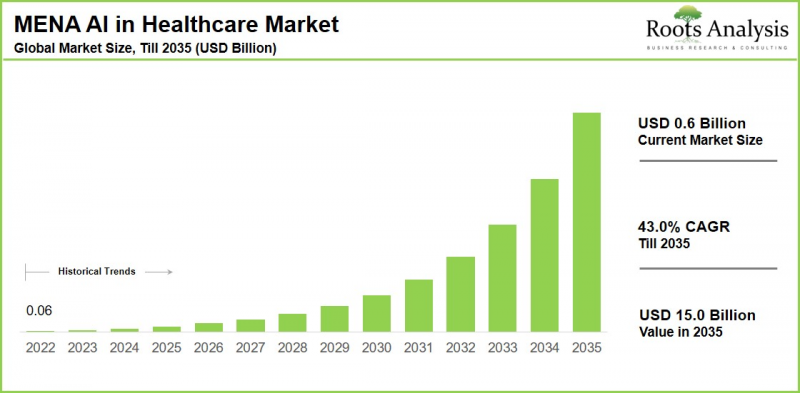
Middle East And Africa (MENA) AI in Healthcare Market: Growth and Trends
Artificial Intelligence is swiftly transforming healthcare by enhancing the detection, treatment, and management of diseases across various care environments. It allows healthcare providers to operate more effectively while delivering safer, more individualized care to patients. AI technologies can review extensive amounts of medical information, including images, laboratory results, and electronic health records, to uncover subtle patterns that may indicate early-stage diseases. In fields like radiology, pathology, cardiology, and oncology, algorithms assist healthcare professionals by improving diagnostic precision and minimizing the risk of human mistakes. In addition to diagnosis, AI aids in creating customized treatment strategies, forecasting disease development, and refining medication selection, supporting the ongoing shift towards precision medicine.
AI enhances operational efficiency by automating clinical documentation, utilizing virtual assistants, and incorporating decision-support tools into hospital information systems. These technologies alleviate administrative tasks, enabling healthcare workers to dedicate more time to patient care and intricate decision-making. Additionally, AI-driven wearables for remote patient monitoring facilitate ongoing observation of vital signs and the early identification of complications, transforming healthcare from a reactive approach to a preventive one. Given these considerations, the AI in Healthcare Market in the Middle East and Africa (MENA) is projected to experience substantial growth during the forecast period.
The AI in healthcare market in the MENA region is experiencing considerable growth, driven by large investments, government initiatives, and pioneering partnerships. Key progress includes a rise in funding for AI infrastructure, like data centers, along with a shift towards personalized medicine that employs AI for precise diagnostics and treatment options.
Growth Drivers: Strategic Enablers of Market Expansion
The growth of artificial intelligence (AI) in healthcare is being driven by several key factors including the rising prevalence of chronic diseases, such as diabetes and cardiovascular conditions along with a globally aging population. This generates substantial demand for advanced diagnostic and management solutions. Further, government strategies like the UAE's National AI Strategy 2031 and Saudi Arabia's Vision 2030 allocate billions to AI infrastructure, including data centers and smart hospitals, enabling real-time data platforms for seamless health information exchange across providers. Expanding medical databases fuel AI algorithm training for precise diagnostics, with personalized medicine gaining traction through multi-omics technologies, tailoring treatments to genetic and lifestyle factors amid rising non-communicable diseases. Surging investments from tech giants and regional funds support telehealth expansions, such as Seha Virtual Hospital and Aster DM's myAster app rollout in Saudi Arabia, optimizing resource use and remote care for underserved areas.
Market Challenges: Critical Barriers Impeding Progress
The Middle East and North Africa (MENA) AI in healthcare market encounters several challenges that impede widespread adoption despite its growth potential. Key hurdles include inadequate data quality and fragmented health records, which undermine AI model training and interoperability, as standardized electronic health records remain scarce, resulting in incomplete datasets that compromise diagnostic precision. Infrastructure gaps, such as poor internet connectivity, outdated IT systems, and insufficient computational resources, particularly in rural areas further stall deployment. A significant lack of healthcare professionals with AI skills creates resistance because of low digital literacy and worries about interpretability, requiring substantial upskilling to establish trust. Regulatory and ethical issue pose risks around data privacy, security, bias, and equitable access, while high integration costs, cultural hesitancy and workforce shortages demand collaborative policy interventions.
Solutions is the Fastest Growing Market Segment
Based on the platform type, the global market is divided into solutions and services. Our forecast for the AI in healthcare market indicates that solutions currently hold the largest market share and are expected to stay dominant throughout the projected timeframe. This is due to the widespread adoption of various AI-powered solutions within the healthcare sector and the increasing strategic efforts by industry players to introduce new products. For example, Microsoft in recent years have introduced a range of artificial intelligence enhancements in Microsoft Cloud for healthcare, including the latest healthcare AI models in Azure AI Studio within Microsoft Fabric and additional developer tools in Copilot Studio. These newly launched tools assist in improving patient care and aiding clinicians in their decision-making processes. In the long term, the services sector is expected to experience a higher compound annual growth rate (CAGR) throughout the forecast period. This growth is attributed to the rising utilization of telehealth services for remote support and ongoing patient monitoring.
Healthcare Providers are Likely to Propel Market Growth
According to the end users, the global market for artificial intelligence (AI) in healthcare is divided into segments including healthcare providers (such as hospitals and outpatient facilities), healthcare payers, healthcare companies (which encompass pharmaceuticals, biotechnology, and medical devices), patients, and other users. Our market research indicates that healthcare providers currently hold the largest share of the market at 45%, primarily due to the increased implementation of robotic surgeries, AI-driven tools for remote patient monitoring, and machine learning for data analysis. AI-driven technologies assist in diagnosing illnesses with greater precision, decrease the time taken for interpretation, and ensure timely treatment delivery. Due to its importance, healthcare providers are increasingly implementing artificial intelligence to enhance patient outcomes, which is anticipated to be a major factor for the largest market share.
However, the healthcare sector is projected to experience significant growth at a considerable CAGR throughout the forecast period. AI technology is commonly utilized in areas such as genome analysis, clinical trials, and the drug development process. Furthermore, it aids in identifying targeted medications based on information to create personalized therapies. Additionally, predictive analytics models and AI-driven analytical tools are employed to carry out clinical trials, streamlining the drug discovery process.
Middle East and Africa (MENA) AI in Healthcare Market: Key Segments
Type of Platform
- Solutions
- Services
Type of Component
- Hardware
- Software Solution
- Services
- Others
Type of Application
- Robot-Assisted Surgery
- Virtual Assistants
- Administrative Workflow Assistants
- Connected Medical Devices
- Medical Imaging & Diagnostics
- Clinical Trials
- Fraud Detection
- Cybersecurity
- Dosage Error Reduction
- Precision Medicine
- Drug Discovery & Development
- Lifestyle Management & Remote Patient Monitoring Wearables
- Other Applications
Type of Technology
- Machine Learning
- Natural Language Processing
- Context-aware Computing
- Computer Vision
End User
- Healthcare Providers
- Healthcare Payers
- Healthcare Companies
- Patients
- Other End Users
Example Players in the Middle East and Africa (MENA) AI in Healthcare Market
- GE Healthcare
- IBM
- Intel Corporation
- IQVIA
- Medtronic
- Microsoft
- NVIDIA Corporation
- Oracle
- Siemens Healthineers
Key Questions Answered in this Report
- How many AI in healthcare providers in Middle East and Africa are currently engaged in this market?
- Which are the leading companies in this market?
- Which country dominates the Middle East and Africa (MENA) AI in Healthcare Market in Middle East and Africa?
- What are the key trends observed in the Middle East and Africa (MENA) AI in Healthcare Market in Middle East and Africa?
- What factors are likely to influence the evolution of this market?
- What are the primary challenges faced by AI in healthcare providers in Middle East and Africa?
- What is the current and future Middle East and Africa Middle East and Africa Wearable Injectors Market size?
- What is the CAGR of MENA AI in healthcare market?
- How is the current and future market opportunity likely to be distributed across key market segments?
Reasons to Buy this Report
- The report provides a comprehensive market analysis, offering detailed revenue projections of the overall market and its specific sub-segments. This information is valuable to both established market leaders and emerging entrants.
- The report offers stakeholders a comprehensive overview of the market, including key drivers, barriers, opportunities, and challenges. This information empowers stakeholders to stay abreast of market trends and make data-driven decisions to capitalize on growth prospects.
- The report can aid businesses in identifying future opportunities in any sector. It also helps in understanding if those opportunities are worth pursuing.
- The report helps in identifying customer demand by understanding the needs, preferences, and behavior of the target audience in order to tailor products or services effectively.
- The report equips new entrants with requisite information regarding a particular market to help them build successful business strategies.
- The report allows for more effective communication with the audience and in building strong business relations.
Complementary Benefits
- Complimentary Excel Data Packs for all Analytical Modules in the Report
- 15% Free Content Customization
- Detailed Report Walkthrough Session with Research Team
- Free Updated report if the report is 6-12 months old or older
TABLE OF CONTENTS
1. PREFACE
- 1.1. Introduction
- 1.2. Market Share Insights
- 1.3. Key Market Insights
- 1.4. Report Coverage
- 1.5. Key Questions Answered
- 1.6. Chapter Outlines
2. RESEARCH METHODOLOGY
- 2.1. Chapter Overview
- 2.2. Research Assumptions
- 2.3. Database Building
- 2.3.1. Data Collection
- 2.3.2. Data Validation
- 2.3.3. Data Analysis
- 2.4. Project Methodology
- 2.4.1. Secondary Research
- 2.4.1.1. Annual Reports
- 2.4.1.2. Academic Research Papers
- 2.4.1.3. Company Websites
- 2.4.1.4. Investor Presentations
- 2.4.1.5. Regulatory Filings
- 2.4.1.6. White Papers
- 2.4.1.7. Industry Publications
- 2.4.1.8. Conferences and Seminars
- 2.4.1.9. Government Portals
- 2.4.1.10. Media and Press Releases
- 2.4.1.11. Newsletters
- 2.4.1.12. Industry Databases
- 2.4.1.13. Roots Proprietary Databases
- 2.4.1.14. Paid Databases and Sources
- 2.4.1.15. Social Media Portals
- 2.4.1.16. Other Secondary Sources
- 2.4.2. Primary Research
- 2.4.2.1. Introduction
- 2.4.2.2. Types
- 2.4.2.2.1. Qualitative
- 2.4.2.2.2. Quantitative
- 2.4.2.3. Advantages
- 2.4.2.4. Techniques
- 2.4.2.4.1. Interviews
- 2.4.2.4.2. Surveys
- 2.4.2.4.3. Focus Groups
- 2.4.2.4.4. Observational Research
- 2.4.2.4.5. Social Media Interactions
- 2.4.2.5. Stakeholders
- 2.4.2.5.1. Company Executives (CXOs)
- 2.4.2.5.2. Board of Directors
- 2.4.2.5.3. Company Presidents and Vice Presidents
- 2.4.2.5.4. Key Opinion Leaders
- 2.4.2.5.5. Research and Development Heads
- 2.4.2.5.6. Technical Experts
- 2.4.2.5.7. Subject Matter Experts
- 2.4.2.5.8. Scientists
- 2.4.2.5.9. Doctors and Other Healthcare Providers
- 2.4.2.6. Ethics and Integrity
- 2.4.2.6.1. Research Ethics
- 2.4.2.6.2. Data Integrity
- 2.4.3. Analytical Tools and Databases
- 2.4.1. Secondary Research
3. MARKET DYNAMICS
- 3.1. Forecast Methodology
- 3.1.1. Top-Down Approach
- 3.1.2. Bottom-Up Approach
- 3.1.3. Hybrid Approach
- 3.2. Market Assessment Framework
- 3.2.1. Total Addressable Market (TAM)
- 3.2.2. Serviceable Addressable Market (SAM)
- 3.2.3. Serviceable Obtainable Market (SOM)
- 3.2.4. Currently Acquired Market (CAM)
- 3.3. Forecasting Tools and Techniques
- 3.3.1. Qualitative Forecasting
- 3.3.2. Correlation
- 3.3.3. Regression
- 3.3.4. Time Series Analysis
- 3.3.5. Extrapolation
- 3.3.6. Convergence
- 3.3.7. Forecast Error Analysis
- 3.3.8. Data Visualization
- 3.3.9. Scenario Planning
- 3.3.10. Sensitivity Analysis
- 3.4. Key Considerations
- 3.4.1. Demographics
- 3.4.2. Market Access
- 3.4.3. Reimbursement Scenarios
- 3.4.4. Industry Consolidation
- 3.5. Robust Quality Control
- 3.6. Key Market Segmentations
- 3.7. Limitations
4. MACRO-ECONOMIC INDICATORS
- 4.1. Chapter Overview
- 4.2. Market Dynamics
- 4.2.1. Time Period
- 4.2.1.1. Historical Trends
- 4.2.1.2. Current and Forecasted Estimates
- 4.2.2. Currency Coverage
- 4.2.2.1. Overview of Major Currencies Affecting the Market
- 4.2.2.2. Impact of Currency Fluctuations on the Industry
- 4.2.3. Foreign Exchange Impact
- 4.2.3.1. Evaluation of Foreign Exchange Rates and Their Impact on Market
- 4.2.3.2. Strategies for Mitigating Foreign Exchange Risk
- 4.2.4. Recession
- 4.2.4.1. Historical Analysis of Past Recessions and Lessons Learnt
- 4.2.4.2. Assessment of Current Economic Conditions and Potential Impact on the Market
- 4.2.5. Inflation
- 4.2.5.1. Measurement and Analysis of Inflationary Pressures in the Economy
- 4.2.5.2. Potential Impact of Inflation on the Market Evolution
- 4.2.6. Interest Rates
- 4.2.6.1. Overview of Interest Rates and Their Impact on the Market
- 4.2.6.2. Strategies for Managing Interest Rate Risk
- 4.2.7. Commodity Flow Analysis
- 4.2.7.1. Type of Commodity
- 4.2.7.2. Origins and Destinations
- 4.2.7.3. Values and Weights
- 4.2.7.4. Modes of Transportation
- 4.2.8. Global Trade Dynamics
- 4.2.8.1. Import Scenario
- 4.2.8.2. Export Scenario
- 4.2.9. War Impact Analysis
- 4.2.9.1. Russian-Ukraine War
- 4.2.9.2. Israel-Hamas War
- 4.2.10. COVID Impact / Related Factors
- 4.2.10.1. Global Economic Impact
- 4.2.10.2. Industry-specific Impact
- 4.2.10.3. Government Response and Stimulus Measures
- 4.2.10.4. Future Outlook and Adaptation Strategies
- 4.2.11. Other Indicators
- 4.2.11.1. Fiscal Policy
- 4.2.11.2. Consumer Spending
- 4.2.11.3. Gross Domestic Product (GDP)
- 4.2.11.4. Employment
- 4.2.11.5. Taxes
- 4.2.11.6. R&D Innovation
- 4.2.11.7. Stock Market Performance
- 4.2.11.8. Supply Chain
- 4.2.11.9. Cross-Border Dynamics
- 4.2.1. Time Period
5. EXECUTIVE SUMMARY
6. INTRODUCTION
- 6.1. Chapter Overview
- 6.2. Overview of Middle East and Africa (MENA) AI in Healthcare Market
- 6.2.1. Historical Evolution
- 6.2.2. Key Applications
- 6.2.3. Impact on Healthcare
- 6.3. Future Perspective
7. REGULATORY SCENARIO
8. COMPREHENSIVE DATABASE OF LEADING PLAYERS
9. COMPETITIVE LANDSCAPE
- 9.1. Chapter Overview
- 9.2. AI in Healthcare Market: Overall Market Landscape
- 9.2.1. Analysis by Year of Establishment
- 9.2.2. Analysis by Company Size
- 9.2.3. Analysis by Location of Headquarters
- 9.2.4. Analysis by Ownership Structure
10. WHITE SPACE ANALYSIS
11. COMPANY COMPETITIVENESS ANALYSIS
12. STARTUP ECOSYSTEM IN THE AI IN HEALTHCARE MARKET
- 12.1. AI in healthcare Market: Market Landscape of Startups
- 12.1.1. Analysis by Year of Establishment
- 12.1.2. Analysis by Company Size
- 12.1.3. Analysis by Company Size and Year of Establishment
- 12.1.4. Analysis by Location of Headquarters
- 12.1.5. Analysis by Company Size and Location of Headquarters
- 12.1.6. Analysis by Ownership Structure
- 12.2. Key Findings
13. COMPANY PROFILES
- 13.1. Chapter Overview
- 13.2. Microsoft*
- 13.2.1. Company Overview
- 13.2.2. Company Mission
- 13.2.3. Company Footprint
- 13.2.4. Management Team
- 13.2.5. Contact Details
- 13.2.6. Financial Performance
- 13.2.7. Operating Business Segments
- 13.2.8. Technology / Platform Portfolio
- 13.2.9. MOAT Analysis
- 13.2.10. Recent Developments and Future Outlook
- 13.3. Google
- 13.4. NVIDIA Corporation
- 13.5. Intel
- 13.6. GE Healthcare
- 13.7. Medtronic
- 13.8. Oracle
- 13.9. IQVIA
- 13.10. Siemens Healthineers
14. MEGA TRENDS ANALYSIS
15. PATENT ANALYSIS
16. RECENT DEVELOPMENTS
- 16.1. Chapter Overview
- 16.2. Recent Funding
- 16.3. Recent Partnerships
- 16.4. Other Recent Initiatives
17. MIDDLE EAST AND NORTH AFRICA (MENA) AI IN HEALTHCARE MARKET
- 17.1. Chapter Overview
- 17.2. Key Assumptions and Methodology
- 17.3. Trends Disruption Impacting Market
- 17.4. Demand Side Trends
- 17.5. Supply Side Trends
- 17.6. Middle East and Africa (MENA) AI in Healthcare Market, Historical Trends (Since 2022) and Forecasted Estimates (Till 2035)
- 17.7. Multivariate Scenario Analysis
- 17.7.1. Conservative Scenario
- 17.7.2. Optimistic Scenario
- 17.8. Investment Feasibility Index
- 17.9. Key Market Segmentations
18. MARKET OPPORTUNITIES BASED ON TYPE OF PLATFORM
- 18.1. Chapter Overview
- 18.2. Key Assumptions and Methodology
- 18.3. Revenue Shift Analysis
- 18.4. Market Movement Analysis
- 18.5. Penetration-Growth (P-G) Matrix
- 18.6. Middle East and Africa (MENA) AI in Healthcare Market for Solutions: Historical Trends (Since 2022) and Forecasted Estimates (Till 2035)
- 18.7. Middle East and Africa (MENA) AI in Healthcare Market for Services: Historical Trends (Since 2022) and Forecasted Estimates (Till 2035)
- 18.8. Data Triangulation and Validation
- 18.8.1. Secondary Sources
- 18.8.2. Primary Sources
- 18.8.3. Statistical Modeling
19. MARKET OPPORTUNITIES BASED ON TYPE OF COMPONENT
- 19.1. Chapter Overview
- 19.2. Key Assumptions and Methodology
- 19.3. Revenue Shift Analysis
- 19.4. Market Movement Analysis
- 19.5. Penetration-Growth (P-G) Matrix
- 19.6. Middle East and Africa (MENA) AI in Healthcare Market for Hardware: Historical Trends (Since 2022) and Forecasted Estimates (Till 2035)
- 19.7. Middle East and Africa (MENA) AI in Healthcare Market for Software Solutions: Historical Trends (Since 2022) and Forecasted Estimates (Till 2035)
- 19.8. Middle East and Africa (MENA) AI in Healthcare Market for Services: Historical Trends (Since 2022) and Forecasted Estimates (Till 2035)
- 19.9. Middle East and Africa (MENA) AI in Healthcare Market for Others: Historical Trends (Since 2022) and Forecasted Estimates (Till 2035)
- 19.10. Data Triangulation and Validation
- 19.10.1. Secondary Sources
- 19.10.2. Primary Sources
- 19.10.3. Statistical Modeling
20. MARKET OPPORTUNITIES BASED ON TYPE OF APPLICATION
- 20.1. Chapter Overview
- 20.2. Key Assumptions and Methodology
- 20.3. Revenue Shift Analysis
- 20.4. Market Movement Analysis
- 20.5. Penetration-Growth (P-G) Matrix
- 20.6. Middle East and Africa (MENA) AI in Healthcare Market for Robot-Assisted Surgery: Historical Trends (Since 2022) and Forecasted Estimates (Till 2035)
- 20.7. Middle East and Africa (MENA) AI in Healthcare Market for Virtual Assistants: Historical Trends (Since 2022) and Forecasted Estimates (Till 2035)
- 20.9. Middle East and Africa (MENA) AI in Healthcare Market for Administrative Workflow Assistants: Historical Trends (Since 2022) and Forecasted Estimates (Till 2035)
- 20.10. Middle East and Africa (MENA) AI in Healthcare Market for Connected Medical Devices: Historical Trends (Since 2022) and Forecasted Estimates (Till 2035)
- 20.11. Middle East and Africa (MENA) AI in Healthcare Market for Medical Imaging & Diagnostics: Historical Trends (Since 2022) and Forecasted Estimates (Till 2035)
- 20.12. Middle East and Africa (MENA) AI in Healthcare Market for Clinical Trials: Historical Trends (Since 2022) and Forecasted Estimates (Till 2035)
- 20.13. Middle East and Africa (MENA) AI in Healthcare Market for Fraud Detection: Historical Trends (Since 2022) and Forecasted Estimates (Till 2035)
- 20.14. Middle East and Africa (MENA) AI in Healthcare Market for Cybersecurity: Historical Trends (Since 2022) and Forecasted Estimates (Till 2035)
- 20.15. Middle East and Africa (MENA) AI in Healthcare Market for Dosage Error Reduction: Historical Trends (Since 2022) and Forecasted Estimates (Till 2035)
- 20.16. Middle East and Africa (MENA) AI in Healthcare Market for Precision Medicine: Historical Trends (Since 2022) and Forecasted Estimates (Till 2035)
- 20.17. Middle East and Africa (MENA) AI in Healthcare Market for Drug Discovery & Development: Historical Trends (Since 2022) and Forecasted Estimates (Till 2035)
- 20.18. Middle East and Africa (MENA) AI in Healthcare Market for Lifestyle Management & Remote Patient Monitoring Wearables: Historical Trends (Since 2022) and Forecasted Estimates (Till 2035)
- 20.19. Middle East and Africa (MENA) AI in Healthcare Market for Other Applications: Historical Trends (Since 2022) and Forecasted Estimates (Till 2035)
- 20.20. Data Triangulation and Validation
- 20.20.1. Secondary Sources
- 20.20.2. Primary Sources
- 20.20.3. Statistical Modeling
21. MARKET OPPORTUNITIES BASED ON TYPE OF TECHNOLOGY
- 21.1. Chapter Overview
- 21.2. Key Assumptions and Methodology
- 21.3. Revenue Shift Analysis
- 21.4. Market Movement Analysis
- 21.5. Penetration-Growth (P-G) Matrix
- 21.6. Middle East and Africa (MENA) AI in Healthcare Market for Machine Learning: Historical Trends (Since 2022) and Forecasted Estimates (Till 2035)
- 21.7. Middle East and Africa (MENA) AI in Healthcare Market for Natural Language Processing: Historical Trends (Since 2022) and Forecasted Estimates (Till 2035)
- 21.8. Middle East and Africa (MENA) AI in Healthcare Market for Context-aware Computing: Historical Trends (Since 2022) and Forecasted Estimates (Till 2035)
- 21.9. Middle East and Africa (MENA) AI in Healthcare Market for Computer Vision: Historical Trends (Since 2022) and Forecasted Estimates (Till 2035)
- 21.10. Data Triangulation and Validation
- 21.10.1. Secondary Sources
- 21.10.2. Primary Sources
- 21.10.3. Statistical Modeling
22. MARKET OPPORTUNITIES BASED ON END USER
- 22.1. Chapter Overview
- 22.2. Key Assumptions and Methodology
- 22.3. Revenue Shift Analysis
- 22.4. Market Movement Analysis
- 22.5. Penetration-Growth (P-G) Matrix
- 22.6. Middle East and Africa (MENA) AI in Healthcare Market for Healthcare Providers: Historical Trends (Since 2022) and Forecasted Estimates (Till 2035)
- 22.7. Middle East and Africa (MENA) AI in Healthcare Market for Healthcare Payers: Historical Trends (Since 2022) and Forecasted Estimates (Till 2035)
- 22.8. Middle East and Africa (MENA) AI in Healthcare Market for Healthcare Companies: Historical Trends (Since 2022) and Forecasted Estimates (Till 2035)
- 22.9. Middle East and Africa (MENA) AI in Healthcare Market for Patients: Historical Trends (Since 2022) and Forecasted Estimates (Till 2035)
- 22.10. Middle East and Africa (MENA) AI in Healthcare Market for Other End Users: Historical Trends (Since 2022) and Forecasted Estimates (Till 2035)
- 22.11. Data Triangulation and Validation
- 22.11.1. Secondary Sources
- 22.11.2. Primary Sources
- 22.11.3. Statistical Modeling
23. MARKET CONCENTRATION ANALYSIS: DISTRIBUTION BY LEADING PLAYERS
24. ADJACENT MARKET ANALYSIS
25. KEY WINNING STRATEGIES
26. PORTER'S FIVE FORCES ANALYSIS
27. SWOT ANALYSIS
28. ROOTS STRATEGIC RECOMMENDATIONS
- 28.1. Chapter Overview
- 28.2. Key Business-related Strategies
- 28.2.1. Research & Development
- 28.2.2. Product Manufacturing
- 28.2.3. Commercialization / Go-to-Market
- 28.2.4. Sales and Marketing
- 28.3. Key Operations-related Strategies
- 28.3.1. Risk Management
- 28.3.2. Workforce
- 28.3.3. Finance
- 28.3.4. Others
29. INSIGHTS FROM PRIMARY RESEARCH
30. REPORT CONCLUSION
31. TABULATED DATA
32. LIST OF COMPANIES AND ORGANIZATIONS
33. ROOTS SUBSCRIPTION SERVICES
34. AUTHOR DETAILS

