
PUBLISHER: Roots Analysis | PRODUCT CODE: 2005202

PUBLISHER: Roots Analysis | PRODUCT CODE: 2005202
Ecotel Tourism Market, Till 2035: Industry Trends and Global Forecasts
Ecotel Tourism Market Overview
As per Roots Analysis, the global ecotel tourism market size is estimated to grow from USD 0.61 billion in the current year USD 10.83 billion by 2035, at a CAGR of 33.33% during the forecast period, till 2035.
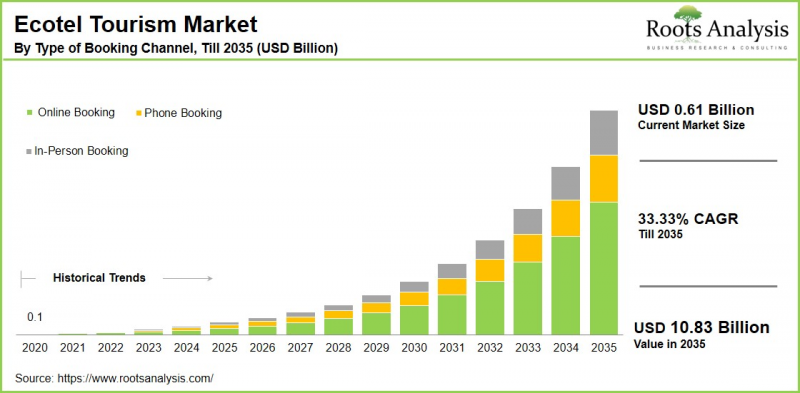
The opportunity for ecotel tourism market has been distributed across the following segments:
Type of Accommodation
- Eco-Hotels
- Eco-Lodges
- Green Resorts
- Others
Type of Traveler
- Adventure Travelers
- Business Travelers
- Family Travelers
- Leisure Travelers
- Others
Type of Tour
- Domestic
- International
Type of Booking Channel
- In-Person Booking
- Online Booking
- Phone Booking
Type of Consumer Orientation
- Corporate Group
- Eco-Conscious Family
- Millennials & Gen Z
Geographical Regions
- North America
- US
- Canada
- Mexico
- Other North American countries
- Europe
- Austria
- Belgium
- Denmark
- France
- Germany
- Ireland
- Italy
- Netherlands
- Norway
- Russia
- Spain
- Sweden
- Switzerland
- UK
- Other European countries
- Asia
- China
- India
- Japan
- Singapore
- South Korea
- Other Asian countries
- Latin America
- Brazil
- Chile
- Colombia
- Venezuela
- Other Latin American countries
- Middle East and North Africa
- Egypt
- Iran
- Iraq
- Israel
- Kuwait
- Saudi Arabia
- UAE
- Other MENA countries
- Rest of the World
- Australia
- New Zealand
- Other countries
Ecotel Tourism Market: Growth and Trends
As sustainability continues to become standard practice across various industries, the tourism and hospitality sector is embracing this trend, leading to unprecedented growth in the ecotel tourism market. The word "Ecotel" blends "eco," relating to ecology, with "hotel." Ecotel tourism is a specialized area within the tourism sector that prioritizes eco-friendly accommodations and sustainable travel experiences.
The hospitality industry emphasizes environmental preservation, social responsibility, and economic sustainability. The aim of an ecotel is to reduce its environmental footprint while offering guests a comfortable and enjoyable stay through eco-conscious hotels, lodges, resorts, and other types of accommodations. Additionally, service providers utilize renewable energy, implement water conservation methods, and adopt waste reduction and management practices to support the industry's objectives.
Consequently, the ecotel tourism sector is rapidly gaining popularity, driven by a rise in demand for sustainable travel experiences. A significant transformation in traveler preferences is reshaping the tourism landscape, making responsible travel choices essential. Increased environmental awareness campaigns and a growing number of eco-friendly hotels catering to this expanding demographic broaden the scope of the sustainable tourism market.
Moreover, emerging market trends reveal that travelers are actively looking for green resorts and eco-lodges that prioritize sustainability while maintaining comfort and luxury. The growth of this market is expected to continue, fueled by the surge in global tourism, the rising popularity of glamping (glamorous camping), and advancements in renewable energy solutions, which enhance market prospects.
Ecotel Tourism Market: Key Segments
Market Share by Type of Accommodation
Based on type of accommodation, the global ecotel tourism market is segmented into various types. According to our estimates, currently, the eco-lodges capture the majority of the market share. This can be attributed to the factors such as immersive experiences in nature, a focus on sustainability, and attraction to eco-minded tourists. Eco-lodges are often situated in beautiful natural environments like mountains and rainforests, providing guests with a direct connection to nature, which broadens the market's potential.
Market Share by Type of Traveler
Based on type of traveler, the global ecotel tourism market is segmented into adventure travelers, business travelers, family travelers, leisure travelers, and others. According to our estimates, currently, the leisure traveler segment captures the majority of the market share. This can be attributed to the increasing preference for eco-resorts and lodges situated in picturesque and natural environments for relaxation, rejuvenation, and distinctive experiences.
Market Share by Type of Tour
Based on type of tour, the global ecotel tourism market is segmented into domestic and international. According to our estimates, currently, the e-commerce segment captures the majority of the market share. This can be attributed to its cost-effectiveness and convenience, as domestic travel tends to be less expensive than international options. The shorter distances and familiar settings make domestic trips more accessible and attractive, thereby propelling the industry forward.
However, the international segment is projected to experience a comparatively higher compound annual growth rate (CAGR) during the forecast period, due to increasing global awareness.
Market Share by Type of Booking Channel
Based on type of booking channel, the global ecotel tourism market is segmented into online booking, in-person booking, and phone booking. According to our estimates, currently, the online booking segment captures the majority of the market share. This can be linked to the increasing number of online travel agencies that provide an extensive selection of eco lodges, allowing travelers to easily compare different options.
On the other hand, the phone booking segment is projected to experience a comparatively higher compound annual growth rate (CAGR) during the forecast period. This growth can be attributed to the rising popularity of apps, which are favored for their convenience and intuitive interface.
Market Share by Type of Consumer Orientation
Based on type of consumer orientation, the global ecotel tourism market is segmented into corporate groups, eco-conscious families, and millennials & Gen Z. According to our estimates, currently, the millennials & Gen Z segment captures the majority of the market share. This group of consumers demonstrates a strong awareness of environmental issues such as climate change, plastic pollution, and the loss of biodiversity.
As a result, they are willing to invest in eco-friendly lodging, luxurious eco-hotels, and sustainable resorts. Furthermore, they desire genuine, nature-based experiences and place importance on destinations that support community-based tourism and the preservation of cultural heritage.
Market Share by Geographical Regions
Based on geographical regions, the ecotel tourism market is segmented into North America, Europe, Asia, Latin America, Middle East and North Africa, and the rest of the world. According to our estimates, currently Europe captures the majority share of the market. Moreover, the ecotel tourism market is witnessing remarkable growth in Asia, driven by its varied ecosystems. Asia comprises some of the planet's most diverse ecological regions, such as rainforests, coral reefs, mountains, and wildlife reserves found in nations like Malaysia, Thailand, and India, which provide breathtaking natural attractions well-suited for the green tourism sector.
Example Players in Ecotel Tourism Market
- Accor Group
- Bambu Indah
- El Nido Resorts
- Garonga Safari Camp
- Jetwing Surf
- Kachi Lodge
- Karinji Eco Retreat
- Marriott International
- Mashpi Lodge
- Pacuare Lodge
- Radisson Hotel Group
- Rewa Lodge
- Scandic Hotels
- Soneva Kiri
- Three Camel Lodge
Ecotel Tourism Market: Research Coverage
The report on the ecotel tourism market features insights on various sections, including:
- Market Sizing and Opportunity Analysis: An in-depth analysis of the ecotel tourism market, focusing on key market segments, including [A] type of accommodation, [B] type of traveler, [C] type of tour, [D] type of booking channel, [E] type of consumer orientation, and [F] geographical regions.
- Competitive Landscape: A comprehensive analysis of the companies engaged in the ecotel tourism market, based on several relevant parameters, such as [A] year of establishment, [B] company size, [C] location of headquarters and [D] ownership structure.
- Company Profiles: Elaborate profiles of prominent players engaged in the ecotel tourism market, providing details on [A] location of headquarters, [B] company size, [C] company mission, [D] company footprint, [E] management team, [F] contact details, [G] financial information, [H] operating business segments, [I] portfolio, [J] moat analysis, [K] recent developments, and an informed future outlook.
- Megatrends: An evaluation of ongoing megatrends in the ecotel tourism industry.
- Patent Analysis: An insightful analysis of patents filed / granted in the ecotel tourism domain, based on relevant parameters, including [A] type of patent, [B] patent publication year, [C] patent age and [D] leading players.
- Recent Developments: An overview of the recent developments made in the ecotel tourism market, along with analysis based on relevant parameters, including [A] year of initiative, [B] type of initiative, [C] geographical distribution and [D] most active players.
- Porter's Five Forces Analysis: An analysis of five competitive forces prevailing in the ecotel tourism market, including threats of new entrants, bargaining power of buyers, bargaining power of suppliers, threats of substitute products and rivalry among existing competitors.
- SWOT Analysis: An insightful SWOT framework, highlighting the strengths, weaknesses, opportunities and threats in the domain. Additionally, it provides Harvey ball analysis, highlighting the relative impact of each SWOT parameter.
- Value Chain Analysis: A comprehensive analysis of the value chain, providing information on the different phases and stakeholders involved in the ecotel tourism market.
Key Questions Answered in this Report
- How many companies are currently engaged in ecotel tourism market?
- Which are the leading companies in this market?
- What factors are likely to influence the evolution of this market?
- What is the current and future market size?
- What is the CAGR of this market?
- How is the current and future market opportunity likely to be distributed across key market segments?
Reasons to Buy this Report
- The report provides a comprehensive market analysis, offering detailed revenue projections of the overall market and its specific sub-segments. This information is valuable to both established market leaders and emerging entrants.
- Stakeholders can leverage the report to gain a deeper understanding of the competitive dynamics within the market. By analyzing the competitive landscape, businesses can make informed decisions to optimize their market positioning and develop effective go-to-market strategies.
- The report offers stakeholders a comprehensive overview of the market, including key drivers, barriers, opportunities, and challenges. This information empowers stakeholders to stay abreast of market trends and make data-driven decisions to capitalize on growth prospects.
Additional Benefits
- Complimentary Excel Data Packs for all Analytical Modules in the Report
- 15% Free Content Customization
- Detailed Report Walkthrough Session with Research Team
- Free Updated report if the report is 6-12 months old or older
TABLE OF CONTENTS
SECTION I: REPORT OVERVIEW
1. PREFACE
- 1.1. Introduction
- 1.2. Market Share Insights
- 1.3. Key Market Insights
- 1.4. Report Coverage
- 1.5. Key Questions Answered
- 1.6. Chapter Outlines
2. RESEARCH METHODOLOGY
- 2.1. Chapter Overview
- 2.2. Research Assumptions
- 2.3. Database Building
- 2.3.1. Data Collection
- 2.3.2. Data Validation
- 2.3.3. Data Analysis
- 2.4. Project Methodology
- 2.4.1. Secondary Research
- 2.4.1.1. Annual Reports
- 2.4.1.2. Academic Research Papers
- 2.4.1.3. Company Websites
- 2.4.1.4. Investor Presentations
- 2.4.1.5. Regulatory Filings
- 2.4.1.6. White Papers
- 2.4.1.7. Industry Publications
- 2.4.1.8. Conferences and Seminars
- 2.4.1.9. Government Portals
- 2.4.1.10. Media and Press Releases
- 2.4.1.11. Newsletters
- 2.4.1.12. Industry Databases
- 2.4.1.13. Roots Proprietary Databases
- 2.4.1.14. Paid Databases and Sources
- 2.4.1.15. Social Media Portals
- 2.4.1.16. Other Secondary Sources
- 2.4.2. Primary Research
- 2.4.2.1. Introduction
- 2.4.2.2. Types
- 2.4.2.2.1. Qualitative
- 2.4.2.2.2. Quantitative
- 2.4.2.3. Advantages
- 2.4.2.4. Techniques
- 2.4.2.4.1. Interviews
- 2.4.2.4.2. Surveys
- 2.4.2.4.3. Focus Groups
- 2.4.2.4.4. Observational Research
- 2.4.2.4.5. Social Media Interactions
- 2.4.2.5. Stakeholders
- 2.4.2.5.1. Company Executives (CXOs)
- 2.4.2.5.2. Board of Directors
- 2.4.2.5.3. Company Presidents and Vice Presidents
- 2.4.2.5.4. Key Opinion Leaders
- 2.4.2.5.5. Research and Development Heads
- 2.4.2.5.6. Technical Experts
- 2.4.2.5.7. Subject Matter Experts
- 2.4.2.5.8. Scientists
- 2.4.2.5.9. Doctors and Other Healthcare Providers
- 2.4.2.6. Ethics and Integrity
- 2.4.2.6.1. Research Ethics
- 2.4.2.6.2. Data Integrity
- 2.4.3. Analytical Tools and Databases
- 2.4.1. Secondary Research
3. MARKET DYNAMICS
- 3.1. Forecast Methodology
- 3.1.1. Top-Down Approach
- 3.1.2. Bottom-Up Approach
- 3.1.3. Hybrid Approach
- 3.2. Market Assessment Framework
- 3.2.1. Total Addressable Market (TAM)
- 3.2.2. Serviceable Addressable Market (SAM)
- 3.2.3. Serviceable Obtainable Market (SOM)
- 3.2.4. Currently Acquired Market (CAM)
- 3.3. Forecasting Tools and Techniques
- 3.3.1. Qualitative Forecasting
- 3.3.2. Correlation
- 3.3.3. Regression
- 3.3.4. Time Series Analysis
- 3.3.5. Extrapolation
- 3.3.6. Convergence
- 3.3.7. Forecast Error Analysis
- 3.3.8. Data Visualization
- 3.3.9. Scenario Planning
- 3.3.10. Sensitivity Analysis
- 3.4. Key Considerations
- 3.4.1. Demographics
- 3.4.2. Market Access
- 3.4.3. Reimbursement Scenarios
- 3.4.4. Industry Consolidation
- 3.5. Robust Quality Control
- 3.6. Key Market Segmentations
- 3.7. Limitations
4. MACRO-ECONOMIC INDICATORS
- 4.1. Chapter Overview
- 4.2. Market Dynamics
- 4.2.1. Time Period
- 4.2.1.1. Historical Trends
- 4.2.1.2. Current and Forecasted Estimates
- 4.2.2. Currency Coverage
- 4.2.2.1. Overview of Major Currencies Affecting the Market
- 4.2.2.2. Impact of Currency Fluctuations on the Industry
- 4.2.3. Foreign Exchange Impact
- 4.2.3.1. Evaluation of Foreign Exchange Rates and Their Impact on Market
- 4.2.3.2. Strategies for Mitigating Foreign Exchange Risk
- 4.2.4. Recession
- 4.2.4.1. Historical Analysis of Past Recessions and Lessons Learnt
- 4.2.4.2. Assessment of Current Economic Conditions and Potential Impact on the Market
- 4.2.5. Inflation
- 4.2.5.1. Measurement and Analysis of Inflationary Pressures in the Economy
- 4.2.5.2. Potential Impact of Inflation on the Market Evolution
- 4.2.6. Interest Rates
- 4.2.6.1. Overview of Interest Rates and Their Impact on the Market
- 4.2.6.2. Strategies for Managing Interest Rate Risk
- 4.2.7. Commodity Flow Analysis
- 4.2.7.1. Type of Commodity
- 4.2.7.2. Origins and Destinations
- 4.2.7.3. Values and Weights
- 4.2.7.4. Modes of Transportation
- 4.2.8. Global Trade Dynamics
- 4.2.8.1. Import Scenario
- 4.2.8.2. Export Scenario
- 4.2.9. War Impact Analysis
- 4.2.9.1. Russian-Ukraine War
- 4.2.9.2. Israel-Hamas War
- 4.2.10. COVID Impact / Related Factors
- 4.2.10.1. Global Economic Impact
- 4.2.10.2. Industry-specific Impact
- 4.2.10.3. Government Response and Stimulus Measures
- 4.2.10.4. Future Outlook and Adaptation Strategies
- 4.2.11. Other Indicators
- 4.2.11.1. Fiscal Policy
- 4.2.11.2. Consumer Spending
- 4.2.11.3. Gross Domestic Product (GDP)
- 4.2.11.4. Employment
- 4.2.11.5. Taxes
- 4.2.11.6. R&D Innovation
- 4.2.11.7. Stock Market Performance
- 4.2.11.8. Supply Chain
- 4.2.11.9. Cross-Border Dynamics
- 4.2.1. Time Period
SECTION II: QUALITATIVE INSIGHTS
5. EXECUTIVE SUMMARY
6. INTRODUCTION
- 6.1. Chapter Overview
- 6.2. Overview of Ecotel Tourism Market
- 6.2.1. Type of Accommodation
- 6.2.2. Type of Traveler
- 6.2.3. Type of Tour
- 6.2.4. Type of Booking Channel
- 6.2.5. Type of Consumer Orientation
- 6.3. Future Perspective
7. REGULATORY SCENARIO
SECTION III: MARKET OVERVIEW
8. COMPREHENSIVE DATABASE OF LEADING PLAYERS
9. COMPETITIVE LANDSCAPE
- 9.1. Chapter Overview
- 9.2. Ecotel Tourism: Overall Market Landscape
- 9.2.1. Analysis by Year of Establishment
- 9.2.2. Analysis by Company Size
- 9.2.3. Analysis by Location of Headquarters
- 9.2.4. Analysis by Ownership Structure
10. WHITE SPACE ANALYSIS
11. COMPANY COMPETITIVENESS ANALYSIS
12. STARTUP ECOSYSTEM IN THE ECOTEL TOURISM MARKET
- 12.1. Ecotel Tourism: Market Landscape of Startups
- 12.1.1. Analysis by Year of Establishment
- 12.1.2. Analysis by Company Size
- 12.1.3. Analysis by Company Size and Year of Establishment
- 12.1.4. Analysis by Location of Headquarters
- 12.1.5. Analysis by Company Size and Location of Headquarters
- 12.1.6. Analysis by Ownership Structure
- 12.2. Key Findings
SECTION IV: COMPANY PROFILES
13. COMPANY PROFILES
- 13.1. Chapter Overview
- 13.2. Accor Group *
- 13.2.1. Acuity Brands Overview
- 13.2.2. Company Mission
- 13.2.3. Company Footprint
- 13.2.4. Management Team
- 13.2.5. Contact Details
- 13.2.6. Financial Performance
- 13.2.7. Operating Business Segments
- 13.2.8. Service / Product Portfolio (project specific)
- 13.2.9. MOAT Analysis
- 13.2.10. Recent Developments and Future Outlook
- 13.3. Bambu Indah
- 13.4. El Nido Resorts
- 13.5. Garonga Safari Camp
- 13.6. Jetwing Surf
- 13.7. Kachi Lodge
- 13.8. Karinji Eco Retreat
- 13.9. Marriott International
- 13.10. Mashpi Lodge
- 13.11. Pacuare Lodge
- 13.12. Radisson Hotel Group
- 13.13. Rewa Lodge
- 13.14. Scandic Hotels
- 13.15. Soneva Kiri
- 13.16. Three Camel Lodge
SECTION V: MARKET TRENDS
14. MEGA TRENDS ANALYSIS
15. UNMET NEED ANALYSIS
16. PATENT ANALYSIS
17. RECENT DEVELOPMENTS
- 17.1. Chapter Overview
- 17.2. Recent Funding
- 17.3. Recent Partnerships
- 17.4. Other Recent Initiatives
SECTION VI: MARKET OPPORTUNITY ANALYSIS
18. GLOBAL ECOTEL TOURISM MARKET
- 18.1. Chapter Overview
- 18.2. Key Assumptions and Methodology
- 18.3. Trends Disruption Impacting Market
- 18.4. Demand Side Trends
- 18.5. Supply Side Trends
- 18.6. Global Ecotel Tourism Market, Historical Trends (Since 2020) and Forecasted Estimates (Till 2035)
- 18.7. Multivariate Scenario Analysis
- 18.7.1. Conservative Scenario
- 18.7.2. Optimistic Scenario
- 18.8. Investment Feasibility Index
- 18.9. Key Market Segmentations
19. MARKET OPPORTUNITIES BASED ON TYPE OF ACCOMMODATION
- 19.1. Chapter Overview
- 19.2. Key Assumptions and Methodology
- 19.3. Revenue Shift Analysis
- 19.4. Market Movement Analysis
- 19.5. Penetration-Growth (P-G) Matrix
- 19.6. Ecotel Tourism Market for Eco-Hotels: Historical Trends (Since 2020) and Forecasted Estimates (Till 2035)
- 19.7. Ecotel Tourism Market for Eco-Lodges: Historical Trends (Since 202) and Forecasted Estimates (Till 2035)
- 19.8. Ecotel Tourism Market for Green Resorts: Historical Trends (Since 202) and Forecasted Estimates (Till 2035)
- 19.9. Ecotel Tourism Market for Others: Historical Trends (Since 202) and Forecasted Estimates (Till 2035)
- 19.10. Data Triangulation and Validation
- 19.10.1. Secondary Sources
- 19.10.2. Primary Sources
- 19.10.3. Statistical Modeling
20. MARKET OPPORTUNITIES BASED ON TYPE OF TRAVELER
- 20.1. Chapter Overview
- 20.2. Key Assumptions and Methodology
- 20.3. Revenue Shift Analysis
- 20.4. Market Movement Analysis
- 20.5. Penetration-Growth (P-G) Matrix
- 20.6. Ecotel Tourism Market for Adventure Travelers: Historical Trends (Since 2020) and Forecasted Estimates (Till 2035)
- 20.7. Ecotel Tourism Market for Business Travelers: Historical Trends (Since 2020) and Forecasted Estimates (Till 2035)
- 20.8. Ecotel Tourism Market for Family Travelers: Historical Trends (Since 2020) and Forecasted Estimates (Till 2035)
- 20.9. Ecotel Tourism Market for Leisure Travelers: Historical Trends (Since 2020) and Forecasted Estimates (Till 2035)
- 20.10. Ecotel Tourism Market for Others: Historical Trends (Since 2020) and Forecasted Estimates (Till 2035)
- 20.11. Data Triangulation and Validation
- 20.11.1. Secondary Sources
- 20.11.2. Primary Sources
- 20.11.3. Statistical Modeling
21. MARKET OPPORTUNITIES BASED ON TYPE OF TOUR
- 21.1. Chapter Overview
- 21.2. Key Assumptions and Methodology
- 21.3. Revenue Shift Analysis
- 21.4. Market Movement Analysis
- 21.5. Penetration-Growth (P-G) Matrix
- 21.6. Ecotel Tourism Market for Domestic: Historical Trends (Since 2020) and Forecasted Estimates (Till 2035)
- 21.7. Ecotel Tourism Market for International: Historical Trends (Since 2020) and Forecasted Estimates (Till 2035)
- 21.8. Data Triangulation and Validation
- 21.8.1. Secondary Sources
- 21.8.2. Primary Sources
- 21.8.3. Statistical Modeling
22. MARKET OPPORTUNITIES BASED ON TYPE OF BOOKING CHANNEL
- 22.1. Chapter Overview
- 22.2. Key Assumptions and Methodology
- 22.3. Revenue Shift Analysis
- 22.4. Market Movement Analysis
- 22.5. Penetration-Growth (P-G) Matrix
- 22.6. Ecotel Tourism Market for In-Person Booking: Historical Trends (Since 2020) and Forecasted Estimates (Till 2035)
- 22.7. Ecotel Tourism Market for Online Booking: Historical Trends (Since 2020) and Forecasted Estimates (Till 2035)
- 22.8. Ecotel Tourism Market for Phone Booking: Historical Trends (Since 2020) and Forecasted Estimates (Till 2035)
- 22.9. Data Triangulation and Validation
- 22.9.1. Secondary Sources
- 22.9.2. Primary Sources
- 22.9.3. Statistical Modeling
23. MARKET OPPORTUNITIES BASED ON TYPE OF CONSUMER ORIENTATION
- 23.1. Chapter Overview
- 23.2. Key Assumptions and Methodology
- 23.3. Revenue Shift Analysis
- 23.4. Market Movement Analysis
- 23.5. Penetration-Growth (P-G) Matrix
- 23.6. Ecotel Tourism Market for Corporate Groups: Historical Trends (Since 2020) and Forecasted Estimates (Till 2035)
- 23.7. Ecotel Tourism Market for Eco-Conscious Families: Historical Trends (Since 2020) and Forecasted Estimates (Till 2035)
- 23.8. Ecotel Tourism Market for Millennials & Gen Z: Historical Trends (Since 2020) and Forecasted Estimates (Till 2035)
- 23.9. Data Triangulation and Validation
- 23.9.1. Secondary Sources
- 23.9.2. Primary Sources
- 23.9.3. Statistical Modeling
24. MARKET OPPORTUNITIES FOR ECOTEL TOURISM IN NORTH AMERICA
- 24.1. Chapter Overview
- 24.2. Key Assumptions and Methodology
- 24.3. Revenue Shift Analysis
- 24.4. Market Movement Analysis
- 24.5. Penetration-Growth (P-G) Matrix
- 24.6. Ecotel Tourism Market in North America: Historical Trends (Since 2020) and Forecasted Estimates (Till 2035)
- 24.6.1. Ecotel Tourism Market in the US: Historical Trends (Since 2020) and Forecasted Estimates (Till 2035)
- 24.6.2. Ecotel Tourism Market in Canada: Historical Trends (Since 2020) and Forecasted Estimates (Till 2035)
- 24.6.3. Ecotel Tourism Market in Mexica: Historical Trends (Since 2020) and Forecasted Estimates (Till 2035)
- 24.6.4. Ecotel Tourism Market in Other North American Countries: Historical Trends (Since 2020) and Forecasted Estimates (Till 2035)
- 24.7. Data Triangulation and Validation
25. MARKET OPPORTUNITIES FOR ECOTEL TOURISM IN EUROPE
- 25.1. Chapter Overview
- 25.2. Key Assumptions and Methodology
- 25.3. Revenue Shift Analysis
- 25.4. Market Movement Analysis
- 25.5. Penetration-Growth (P-G) Matrix
- 25.6. Ecotel Tourism Market in Europe: Historical Trends (Since 2020) and Forecasted Estimates (Till 2035)
- 25.6.1. Ecotel Tourism Market in Austria: Historical Trends (Since 2020) and Forecasted Estimates (Till 2035)
- 25.6.2. Ecotel Tourism Market in Belgium: Historical Trends (Since 2020) and Forecasted Estimates (Till 2035)
- 25.6.3. Ecotel Tourism Market in Denmark: Historical Trends (Since 2020) and Forecasted Estimates (Till 2035)
- 25.6.4. Ecotel Tourism Market in France: Historical Trends (Since 2020) and Forecasted Estimates (Till 2035)
- 25.6.5. Ecotel Tourism Market in Germany: Historical Trends (Since 2020) and Forecasted Estimates (Till 2035)
- 25.6.6. Ecotel Tourism Market in Ireland: Historical Trends (Since 2020) and Forecasted Estimates (Till 2035)
- 25.6.7. Ecotel Tourism Market in Italy: Historical Trends (Since 2020) and Forecasted Estimates (Till 2035)
- 25.6.8. Ecotel Tourism Market in Netherlands: Historical Trends (Since 2020) and Forecasted Estimates (Till 2035)
- 25.6.9. Ecotel Tourism Market in Norway: Historical Trends (Since 2020) and Forecasted Estimates (Till 2035)
- 25.6.10. Ecotel Tourism Market in Russia: Historical Trends (Since 2020) and Forecasted Estimates (Till 2035)
- 25.6.11. Ecotel Tourism Market in Spain: Historical Trends (Since 2020) and Forecasted Estimates (Till 2035)
- 25.6.12. Ecotel Tourism Market in Sweden: Historical Trends (Since 2020) and Forecasted Estimates (Till 2035)
- 25.6.13. Ecotel Tourism Market in Switzerland: Historical Trends (Since 2020) and Forecasted Estimates (Till 2035)
- 25.6.14. Ecotel Tourism Market in the UK: Historical Trends (Since 2020) and Forecasted Estimates (Till 2035)
- 25.6.15. Ecotel Tourism Market in Other European Countries: Historical Trends (Since 2020) and Forecasted Estimates (Till 2035)
- 25.7. Data Triangulation and Validation
26. MARKET OPPORTUNITIES FOR ECOTEL TOURISM IN ASIA
- 26.1. Chapter Overview
- 26.2. Key Assumptions and Methodology
- 26.3. Revenue Shift Analysis
- 26.4. Market Movement Analysis
- 26.5. Penetration-Growth (P-G) Matrix
- 26.6. Ecotel Tourism Market in Asia: Historical Trends (Since 2020) and Forecasted Estimates (Till 2035)
- 26.6.1. Ecotel Tourism Market in China: Historical Trends (Since 2020) and Forecasted Estimates (Till 2035)
- 26.6.2. Ecotel Tourism Market in India: Historical Trends (Since 2020) and Forecasted Estimates (Till 2035)
- 26.6.3. Ecotel Tourism Market in Japan: Historical Trends (Since 2020) and Forecasted Estimates (Till 2035)
- 26.6.4. Ecotel Tourism Market in Singapore: Historical Trends (Since 2020) and Forecasted Estimates (Till 2035)
- 26.6.5. Ecotel Tourism Market in South Korea: Historical Trends (Since 2020) and Forecasted Estimates (Till 2035)
- 26.6.6. Ecotel Tourism Market in Other Asian Countries: Historical Trends (Since 2020) and Forecasted Estimates (Till 2035)
- 26.7. Data Triangulation and Validation
27. MARKET OPPORTUNITIES FOR ECOTEL TOURISM IN MIDDLE EAST AND NORTH AFRICA (MENA)
- 27.1. Chapter Overview
- 27.2. Key Assumptions and Methodology
- 27.3. Revenue Shift Analysis
- 27.4. Market Movement Analysis
- 27.5. Penetration-Growth (P-G) Matrix
- 27.6. Ecotel Tourism Market in Middle East and North Africa (MENA): Historical Trends (Since 2020) and Forecasted Estimates (Till 2035)
- 27.6.1. Ecotel Tourism Market in Egypt: Historical Trends (Since 2020) and Forecasted Estimates (Till 205)
- 27.6.2. Ecotel Tourism Market in Iran: Historical Trends (Since 2020) and Forecasted Estimates (Till 2035)
- 27.6.3. Ecotel Tourism Market in Iraq: Historical Trends (Since 2020) and Forecasted Estimates (Till 2035)
- 27.6.4. Ecotel Tourism Market in Israel: Historical Trends (Since 2020) and Forecasted Estimates (Till 2035)
- 27.6.5. Ecotel Tourism Market in Kuwait: Historical Trends (Since 2020) and Forecasted Estimates (Till 2035)
- 27.6.6. Ecotel Tourism Market in Saudi Arabia: Historical Trends (Since 2020) and Forecasted Estimates (Till 2035)
- 27.6.7. Ecotel Tourism Market in United Arab Emirates (UAE): Historical Trends (Since 2020) and Forecasted Estimates (Till 2035)
- 27.6.8. Ecotel Tourism Market in Other MENA Countries: Historical Trends (Since 2020) and Forecasted Estimates (Till 2035)
- 27.7. Data Triangulation and Validation
28. ADJACENT MARKET ANALYSIS
SECTION VII: STRATEGIC TOOLS
29. KEY WINNING STRATEGIES
30. PORTER'S FIVE FORCES ANALYSIS
31. SWOT ANALYSIS
32. VALUE CHAIN ANALYSIS
33. ROOTS STRATEGIC RECOMMENDATIONS
SECTION VIII: OTHER EXCLUSIVE INSIGHTS
34. INSIGHTS FROM PRIMARY RESEARCH
35. REPORT CONCLUSION
SECTION IX: APPENDIX
36. TABULATED DATA
37. LIST OF COMPANIES AND ORGANIZATIONS
38. CUSTOMIZATION OPPORTUNITIES
39. ROOTS SUBSCRIPTION SERVICES
40. AUTHOR DETAILS

