PUBLISHER: Roots Analysis | PRODUCT CODE: 2052135

PUBLISHER: Roots Analysis | PRODUCT CODE: 2052135
Autonomous Navigation Market, Till 2035: Distribution by Type of Solution, Type of Platform, Type of Application, and Geographical Regions: Industry Trends and Global Forecasts
Autonomous Navigation Market Outlook
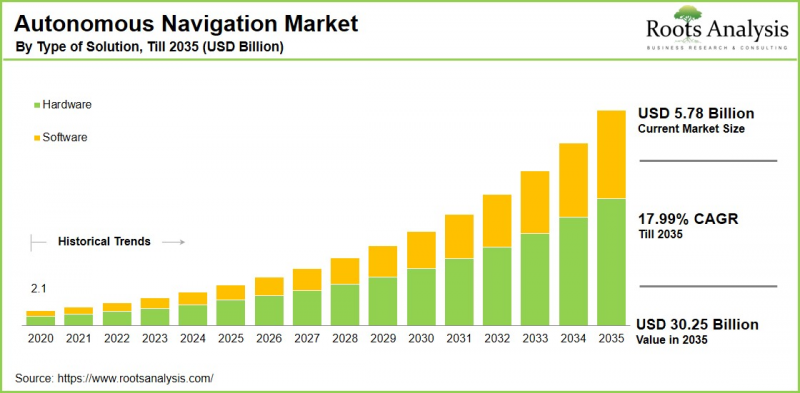
As per Roots Analysis, the global autonomous navigation market size is estimated to grow from USD 5.78 billion in the current year to USD 30.25 billion by 2035, at a CAGR of 17.99% during the forecast period, till 2035.
Rapid advancements in technology are significantly transforming autonomous navigation systems through the integration of artificial intelligence (AI). Autonomous navigation refers to the capability of a system or vehicle to operate and make decisions independently, leveraging sensors, algorithms, and onboard processing to perceive its environment and determine optimal paths. These systems have become increasingly vital across a wide range of applications, including self-driving vehicles, and robotics in logistics and manufacturing.
Typically, autonomous navigation systems integrate technologies such as LiDAR, cameras, radar, GPS, and AI-driven algorithms to enable real-time learning and decision-making. Continuous innovation has strengthened system capabilities, driving a surge in demand for such solutions. Additionally, the advent of 5G technology is playing a transformative role by enabling faster data transmission, reduced latency, and improved connectivity, thereby supporting real-time responsiveness in autonomous systems. In response, companies are actively developing advanced smart mobility solutions aimed at revolutionizing urban transportation and optimizing traffic management. Overall, considering the above-mentioned factors, the autonomous navigation market is expected to grow significantly throughout the forecast period.
Strategic Insights for Senior Leaders
Key Drivers Propelling Growth of Autonomous Navigation Market
The growing advantages of autonomous vehicle technology have significantly accelerated the demand for autonomous navigation solutions. By minimizing accidents associated with human error, autonomous systems enhance overall safety through the use of advanced features such as sensors, cameras, and AI-driven decision-making capabilities. These solutions enable vehicles to detect and respond to obstacles and hazardous conditions more rapidly and accurately than human operators, while also improving operational efficiency, and environmental sustainability.
Furthermore, the expanding adoption of autonomous navigation across diverse sectors, including automotive, drones, maritime transportation, defense, and logistics, is strengthening its market potential by enabling more efficient and precise industry-specific operations. Moreover, ongoing advancements in navigation technologies, particularly the integration of artificial intelligence, and machine learning, are expected to further drive market evolution over the coming decade.
Evolving Competitive Landscape of Autonomous Navigation Industry
The competitive landscape of the autonomous navigation market is evolving rapidly, characterized by the presence of established global leaders, regional players, and emerging startups. Major companies such as Lockheed Martin, Raytheon Technologies, and Honeywell are driving market development through their strong expertise in aerospace, defense, and advanced navigation systems. Concurrently, innovative firms and startups like ANELLO Photonics are contributing to niche technological advancements by offering specialized solutions. Collectively, these players are focused on expanding their market share and global presence through strategic collaborations with technology providers, research institutions, and government bodies. This helps in accelerating innovation in the integration of artificial intelligence, machine learning, and IoT within navigation systems.
Technology Innovations Shaping the Autonomous Navigation Landscape
The autonomous navigation market is witnessing the emergence of several transformative trends driven by rapid technological advancements and increasing cross-industry adoption. One of the most prominent trends is the integration of artificial intelligence and machine learning algorithms, enabling systems to achieve higher levels of perception, adaptability, and real-time decision-making. Additionally, the growing deployment of advanced sensor fusion technologies, combining LiDAR, radar, cameras, and GPS, is enhancing navigation accuracy and reliability across complex environments.
The expansion of 5G connectivity is further supporting low-latency communication and data exchange, facilitating seamless operation of autonomous systems. Moreover, there is a rising focus on edge computing to process data locally, reducing dependency on centralized systems and improving responsiveness. The market is also experiencing increased adoption across diverse sectors, including automotive, aerospace, maritime, logistics, and defense, alongside the development of smart mobility and urban infrastructure solutions. Collectively, these trends are shaping a more intelligent, connected, and efficient autonomous navigation ecosystem, driving sustained market growth and innovation.
North America Holding the Largest Share in the Autonomous Navigation Market
According to our analysis, in the current year, North America captures the highest share of the global autonomous navigation market. This is driven by a combination of technological, institutional, and commercial factors. The region's early adoption of advanced navigation technologies, including LiDAR and GPS-integrated systems, has been a key contributor to its dominance. Notably, strong investments and initiatives by organizations such as the U.S. Department of Defense and NASA in autonomous systems for defense and space exploration have significantly bolstered market demand.
Supportive government policies and programs further facilitate the development and deployment of autonomous vehicles and navigation solutions. In addition, the growing demand for self-driving technologies across commercial sectors, particularly in logistics and transportation, is accelerating market expansion. The strong presence of leading industry players, coupled with continuous innovation in integrating artificial intelligence into navigation systems, is expected to sustain North America's market leadership throughout the forecast period.
Key Challenges in the Autonomous Navigation Market
Autonomous navigation systems typically depend on GPS and external communication networks to achieve accurate positioning and route planning. However, these systems are susceptible to signal degradation, interference, or complete loss in GPS-denied environments, creating a need for more robust internal navigation capabilities. Furthermore, insufficient infrastructure for the testing, deployment, and maintenance of autonomous systems remains a significant barrier, particularly in developing regions. In addition, autonomous navigation solutions are exposed to cybersecurity risks, including hacking, jamming, and spoofing, which can compromise system safety and reliability. Addressing these vulnerabilities requires the implementation of advanced security frameworks, which adds to system complexity and development costs, potentially constraining overall market growth.
Autonomous Navigation Market: Key Market Segmentation
By Type of Solution
- Hardware
- Sensing System
- Cemera
- GNSS
- INS
- Lidar
- Processing Unit
- Radar
- Ultra Sonic Systems
- Software
By Type of Platform
- Airborne
- Land
- Marine
- Space
- Weapons
By Type of Application
- Commercial
- Military & Government
By Geographical Regions
- North America
- US
- Canada
- Mexico
- Other North American countries
- Europe
- Austria
- Belgium
- Denmark
- France
- Germany
- Ireland
- Italy
- Netherlands
- Norway
- Russia
- Spain
- Sweden
- Switzerland
- UK
- Other European countries
- Asia
- China
- India
- Japan
- Singapore
- South Korea
- Other Asian countries
- Latin America
- Brazil
- Chile
- Colombia
- Venezuela
- Other Latin American countries
- Middle East and North Africa
- Egypt
- Iran
- Iraq
- Israel
- Kuwait
- Saudi Arabia
- UAE
- Other MENA countries
Example Players in Autonomous Navigation Market
- ABB
- Aptiv
- BAE Systems
- Elbit System
- General Dynamic
- Here Technologies
- Honeywell
- L3Harris Technologies
- Lockheed Martin
- Moog
- Northrop Grumman
- Nuro
- Raytheon Technologies
- Safran
- Thales
Autonomous Navigation Market: Report Coverage
The report on the autonomous navigation market features insights on various sections, including:
- Market Sizing and Opportunity Analysis: An in-depth analysis of the autonomous navigation market, focusing on key market segments, including [A] type of solution, [B] type of platform, [C] type of application, and [D] geographical regions.
- Competitive Landscape: A comprehensive analysis of the companies engaged in the autonomous navigation market, based on several relevant parameters, such as [A] year of establishment, [B] company size, [C] location of headquarters and [D] ownership structure.
- Company Profiles: Elaborate profiles of prominent players engaged in the autonomous navigation market, providing details on [A] location of headquarters, [B] company size, [C] company mission, [D] company footprint, [E] management team, [F] contact details, [G] financial information, [H] operating business segments, [I] product / technology portfolio, [J] recent developments, and an informed future outlook.
- Megatrends: An evaluation of ongoing megatrends in the autonomous navigation industry.
- Patent Analysis: An insightful analysis of patents filed / granted in the autonomous navigation domain, based on relevant parameters, including [A] type of patent, [B] patent publication year, [C] patent age and [D] leading players.
- Recent Developments: An overview of the recent developments made in the autonomous navigation market, along with analysis based on relevant parameters, including [A] year of initiative, [B] type of initiative, [C] geographical distribution and [D] most active players.
- Porter's Five Forces Analysis: An analysis of five competitive forces prevailing in the autonomous navigation market, including threats of new entrants, bargaining power of buyers, bargaining power of suppliers, threats of substitute products and rivalry among existing competitors.
- SWOT Analysis: An insightful SWOT framework, highlighting the strengths, weaknesses, opportunities and threats in the domain. Additionally, it provides Harvey ball analysis, highlighting the relative impact of each SWOT parameter.
Key Questions Answered in this Report
- What is the current and future market size?
- Who are the leading companies in this market?
- What are the growth drivers that are likely to influence the evolution of this market?
- What are the key partnership and funding trends shaping this industry?
- Which region is likely to grow at higher CAGR till 2035?
- How is the current and future market opportunity likely to be distributed across key market segments?
Reasons to Buy this Report
- Detailed Market Analysis: The report provides a comprehensive market analysis, offering detailed revenue projections of the overall market and its specific sub-segments. This information is valuable to both established market leaders and emerging entrants.
- In-depth Analysis of Trends: Stakeholders can leverage the report to gain a deeper understanding of the competitive dynamics within the market. Each report maps ecosystem activity across partnerships, funding, and patent landscapes to reveal growth hotspots and white spaces in the industry.
- Opinion of Industry Experts: The report features extensive interviews and surveys with key opinion leaders and industry experts to validate market trends mentioned in the report.
- Decision-ready Deliverables: The report offers stakeholders with strategic frameworks (Porter's Five Forces, value chain, SWOT), and complimentary Excel / slide packs with customization support.
Additional Benefits
- Complimentary Dynamic Excel Dashboards for Analytical Modules
- Exclusive 15% Free Content Customization
- Personalized Interactive Report Walkthrough with Our Expert Research Team
- Free Report Updates for Versions Older than 6-12 Months
TABLE OF CONTENTS
SECTION I: REPORT OVERVIEW
1. PREFACE
- 1.1. Introduction
- 1.2. Market Share Insights
- 1.3. Key Market Insights
- 1.4. Report Coverage
- 1.5. Key Questions Answered
- 1.6. Chapter Outlines
2. RESEARCH METHODOLOGY
- 2.1. Chapter Overview
- 2.2. Research Assumptions
- 2.3. Database Building
- 2.3.1. Data Collection
- 2.3.2. Data Validation
- 2.3.3. Data Analysis
- 2.4. Project Methodology
- 2.4.1. Secondary Research
- 2.4.1.1. Annual Reports
- 2.4.1.2. Academic Research Papers
- 2.4.1.3. Company Websites
- 2.4.1.4. Investor Presentations
- 2.4.1.5. Regulatory Filings
- 2.4.1.6. White Papers
- 2.4.1.7. Industry Publications
- 2.4.1.8. Conferences and Seminars
- 2.4.1.9. Government Portals
- 2.4.1.10. Media and Press Releases
- 2.4.1.11. Newsletters
- 2.4.1.12. Industry Databases
- 2.4.1.13. Roots Proprietary Databases
- 2.4.1.14. Paid Databases and Sources
- 2.4.1.15. Social Media Portals
- 2.4.1.16. Other Secondary Sources
- 2.4.2. Primary Research
- 2.4.2.1. Introduction
- 2.4.2.2. Types
- 2.4.2.2.1. Qualitative
- 2.4.2.2.2. Quantitative
- 2.4.2.3. Advantages
- 2.4.2.4. Techniques
- 2.4.2.4.1. Interviews
- 2.4.2.4.2. Surveys
- 2.4.2.4.3. Focus Groups
- 2.4.2.4.4. Observational Research
- 2.4.2.4.5. Social Media Interactions
- 2.4.2.5. Stakeholders
- 2.4.2.5.1. Company Executives (CXOs)
- 2.4.2.5.2. Board of Directors
- 2.4.2.5.3. Company Presidents and Vice Presidents
- 2.4.2.5.4. Key Opinion Leaders
- 2.4.2.5.5. Research and Development Heads
- 2.4.2.5.6. Technical Experts
- 2.4.2.5.7. Subject Matter Experts
- 2.4.2.5.8. Scientists
- 2.4.2.5.9. Doctors and Other Healthcare Providers
- 2.4.2.6. Ethics and Integrity
- 2.4.2.6.1. Research Ethics
- 2.4.2.6.2. Data Integrity
- 2.4.3. Analytical Tools and Databases
- 2.4.1. Secondary Research
3. MARKET DYNAMICS
- 3.1. Forecast Methodology
- 3.1.1. Top-Down Approach
- 3.1.2. Bottom-Up Approach
- 3.1.3. Hybrid Approach
- 3.2. Market Assessment Framework
- 3.2.1. Total Addressable Market (TAM)
- 3.2.2. Serviceable Addressable Market (SAM)
- 3.2.3. Serviceable Obtainable Market (SOM)
- 3.2.4. Currently Acquired Market (CAM)
- 3.3. Forecasting Tools and Techniques
- 3.3.1. Qualitative Forecasting
- 3.3.2. Correlation
- 3.3.3. Regression
- 3.3.4. Time Series Analysis
- 3.3.5. Extrapolation
- 3.3.6. Convergence
- 3.3.7. Forecast Error Analysis
- 3.3.8. Data Visualization
- 3.3.9. Scenario Planning
- 3.3.10. Sensitivity Analysis
- 3.4. Key Considerations
- 3.4.1. Demographics
- 3.4.2. Market Access
- 3.4.3. Reimbursement Scenarios
- 3.4.4. Industry Consolidation
- 3.5. Robust Quality Control
- 3.6. Key Market Segmentations
- 3.7. Limitations
4. MACRO-ECONOMIC INDICATORS
- 4.1. Chapter Overview
- 4.2. Market Dynamics
- 4.2.1. Time Period
- 4.2.1.1. Historical Trends
- 4.2.1.2. Current and Forecasted Estimates
- 4.2.2. Currency Coverage
- 4.2.2.1. Overview of Major Currencies Affecting the Market
- 4.2.2.2. Impact of Currency Fluctuations on the Industry
- 4.2.3. Foreign Exchange Impact
- 4.2.3.1. Evaluation of Foreign Exchange Rates and Their Impact on Market
- 4.2.3.2. Strategies for Mitigating Foreign Exchange Risk
- 4.2.4. Recession
- 4.2.4.1. Historical Analysis of Past Recessions and Lessons Learnt
- 4.2.4.2. Assessment of Current Economic Conditions and Potential Impact on the Market
- 4.2.5. Inflation
- 4.2.5.1. Measurement and Analysis of Inflationary Pressures in the Economy
- 4.2.5.2. Potential Impact of Inflation on the Market Evolution
- 4.2.6. Interest Rates
- 4.2.6.1. Overview of Interest Rates and Their Impact on the Market
- 4.2.6.2. Strategies for Managing Interest Rate Risk
- 4.2.7. Commodity Flow Analysis
- 4.2.7.1. Type of Commodity
- 4.2.7.2. Origins and Destinations
- 4.2.7.3. Values and Weights
- 4.2.7.4. Modes of Transportation
- 4.2.8. Global Trade Dynamics
- 4.2.8.1. Import Scenario
- 4.2.8.2. Export Scenario
- 4.2.9. War Impact Analysis
- 4.2.9.1. Russian-Ukraine War
- 4.2.9.2. Israel-Hamas War
- 4.2.10. COVID Impact / Related Factors
- 4.2.10.1. Global Economic Impact
- 4.2.10.2. Industry-specific Impact
- 4.2.10.3. Government Response and Stimulus Measures
- 4.2.10.4. Future Outlook and Adaptation Strategies
- 4.2.11. Other Indicators
- 4.2.11.1. Fiscal Policy
- 4.2.11.2. Consumer Spending
- 4.2.11.3. Gross Domestic Product (GDP)
- 4.2.11.4. Employment
- 4.2.11.5. Taxes
- 4.2.11.6. R&D Innovation
- 4.2.11.7. Stock Market Performance
- 4.2.11.8. Supply Chain
- 4.2.11.9. Cross-Border Dynamics
- 4.2.1. Time Period
SECTION II: QUALITATIVE INSIGHTS
5. EXECUTIVE SUMMARY
6. INTRODUCTION
- 6.1. Chapter Overview
- 6.2. Overview of Autonomous Navigation Market
- 6.2.1. Type of Solution
- 6.2.2. Type of Platform
- 6.2.3. Type of Application
- 6.3. Future Perspective
7. REGULATORY SCENARIO
SECTION III: MARKET OVERVIEW
8. COMPREHENSIVE DATABASE OF LEADING PLAYERS
9. COMPETITIVE LANDSCAPE
- 9.1. Chapter Overview
- 9.2. Autonomous Navigation: Overall Market Landscape
- 9.2.1. Analysis by Year of Establishment
- 9.2.2. Analysis by Company Size
- 9.2.3. Analysis by Location of Headquarters
- 9.2.4. Analysis by Ownership Structure
10. WHITE SPACE ANALYSIS
11. COMPANY COMPETITIVENESS ANALYSIS
12. STARTUP ECOSYSTEM IN THE AUTONOMOUS NAVIGATION MARKET
- 12.1. Autonomous Navigation: Market Landscape of Startups
- 12.1.1. Analysis by Year of Establishment
- 12.1.2. Analysis by Company Size
- 12.1.3. Analysis by Company Size and Year of Establishment
- 12.1.4. Analysis by Location of Headquarters
- 12.1.5. Analysis by Company Size and Location of Headquarters
- 12.1.6. Analysis by Ownership Structure
- 12.2. Key Findings
SECTION IV: COMPANY PROFILES
13. COMPANY PROFILES
- 13.1. Chapter Overview
- 13.2. ABB*
- 13.2.1. Company Overview
- 13.2.2. Company Mission
- 13.2.3. Company Footprint
- 13.2.4. Management Team
- 13.2.5. Contact Details
- 13.2.6. Financial Performance
- 13.2.7. Operating Business Segments
- 13.2.8. Service / Product Portfolio (project specific)
- 13.2.9. MOAT Analysis
- 13.2.10. Recent Developments and Future Outlook
- 13.3. Aptiv
- 13.4. BAE Systems
- 13.5. Elbit Systems
- 13.6. General Dynamics
- 13.7. Here Technologies
- 13.8. Honeywell
- 13.9. L3Harris Technologies
- 13.10. Lockheed Martin
- 13.11. Moog
- 13.12. Northrop Grumman
- 13.13. Nuro
- 13.14. Raytheon Technologies
- 13.15. Safran
- 13.16. Thales
SECTION V: MARKET TRENDS
14. MEGA TRENDS ANALYSIS
15. UNMET NEED ANALYSIS
16. PATENT ANALYSIS
17. RECENT DEVELOPMENTS
- 17.1. Chapter Overview
- 17.2. Recent Funding
- 17.3. Recent Partnerships
- 17.4. Other Recent Initiatives
SECTION VI: MARKET OPPORTUNITY ANALYSIS
18. GLOBAL AUTONOMOUS NAVIGATION MARKET
- 18.1. Chapter Overview
- 18.2. Key Assumptions and Methodology
- 18.3. Trends Disruption Impacting Market
- 18.4. Demand Side Trends
- 18.5. Supply Side Trends
- 18.6. Global Autonomous Navigation Market, Historical Trends (Since 2020) and Forecasted Estimates (Till 2035)
- 18.7. Multivariate Scenario Analysis
- 18.7.1. Conservative Scenario
- 18.7.2. Optimistic Scenario
- 18.8. Investment Feasibility Index
- 18.9. Key Market Segmentations
19. MARKET OPPORTUNITIES BASED ON TYPE OF SOLUTION
- 19.1. Chapter Overview
- 19.2. Key Assumptions and Methodology
- 19.3. Revenue Shift Analysis
- 19.4. Market Movement Analysis
- 19.5. Penetration-Growth (P-G) Matrix
- 19.6. Autonomous Navigation Market for Hardware: Historical Trends (Since 2020) and Forecasted Estimates (Till 2035)
- 19.7. Autonomous Navigation Market for Software: Historical Trends (Since 2020) and Forecasted Estimates (Till 2035)
- 19.8. Data Triangulation and Validation
- 19.8.1. Secondary Sources
- 19.8.2. Primary Sources
- 19.8.3. Statistical Modeling
20. MARKET OPPORTUNITIES BASED ON TYPE OF PLATFORM
- 20.1. Chapter Overview
- 20.2. Key Assumptions and Methodology
- 20.3. Revenue Shift Analysis
- 20.4. Market Movement Analysis
- 20.5. Penetration-Growth (P-G) Matrix
- 20.6. Autonomous Navigation Market for Airborne: Historical Trends (Since 2020) and Forecasted Estimates (Till 2035)
- 20.7. Autonomous Navigation Market for Land: Historical Trends (Since 2020) and Forecasted Estimates (Till 2035)
- 20.8. Autonomous Navigation Market for Marine: Historical Trends (Since 2020) and Forecasted Estimates (Till 2035)
- 20.9. Autonomous Navigation Market for Space: Historical Trends (Since 2020) and Forecasted Estimates (Till 2035)
- 20.10. Autonomous Navigation Market for Weapons: Historical Trends (Since 2020) and Forecasted Estimates (Till 2035)
- 20.11. Data Triangulation and Validation
- 20.11.1. Secondary Sources
- 20.11.2. Primary Sources
- 20.11.3. Statistical Modeling
21. MARKET OPPORTUNITIES BASED ON TYPE OF APPLICATION
- 21.1. Chapter Overview
- 21.2. Key Assumptions and Methodology
- 21.3. Revenue Shift Analysis
- 21.4. Market Movement Analysis
- 21.5. Penetration-Growth (P-G) Matrix
- 21.6. Autonomous Navigation Market for Commercial: Historical Trends (Since 2020) and Forecasted Estimates (Till 2035)
- 21.7. Autonomous Navigation Market for Military & Government: Historical Trends (Since 2020) and Forecasted Estimates (Till 2035)
- 21.8. Data Triangulation and Validation
- 21.8.1. Secondary Sources
- 21.8.2. Primary Sources
- 21.8.3. Statistical Modeling
22. MARKET OPPORTUNITIES FOR AUTONOMOUS NAVIGATION IN NORTH AMERICA
- 22.1. Chapter Overview
- 22.2. Key Assumptions and Methodology
- 22.3. Revenue Shift Analysis
- 22.4. Market Movement Analysis
- 22.5. Penetration-Growth (P-G) Matrix
- 22.6. Autonomous Navigation Market in North America: Historical Trends (Since 2020) and Forecasted Estimates (Till 2035)
- 22.6.1. Autonomous Navigation Market in the US: Historical Trends (Since 2020) and Forecasted Estimates (Till 2035)
- 22.6.2. Autonomous Navigation Market in Canada: Historical Trends (Since 2020) and Forecasted Estimates (Till 2035)
- 22.6.3. Autonomous Navigation Market in Mexico: Historical Trends (Since 2020) and Forecasted Estimates (Till 2035)
- 22.6.4. Autonomous Navigation Market in Other North American Countries: Historical Trends (Since 2020) and Forecasted Estimates (Till 2035)
- 22.7. Data Triangulation and Validation
23. MARKET OPPORTUNITIES FOR AUTONOMOUS NAVIGATION IN EUROPE
- 23.1. Chapter Overview
- 23.2. Key Assumptions and Methodology
- 23.3. Revenue Shift Analysis
- 23.4. Market Movement Analysis
- 23.5. Penetration-Growth (P-G) Matrix
- 23.6. Autonomous Navigation Market in Europe: Historical Trends (Since 2020) and Forecasted Estimates (Till 2035)
- 23.6.1. Autonomous Navigation Market in Austria: Historical Trends (Since 2020) and Forecasted Estimates (Till 2035)
- 23.6.2. Autonomous Navigation Market in Belgium: Historical Trends (Since 2020) and Forecasted Estimates (Till 2035)
- 23.6.3. Autonomous Navigation Market in Denmark: Historical Trends (Since 2020) and Forecasted Estimates (Till 2035)
- 23.6.4. Autonomous Navigation Market in France: Historical Trends (Since 2020) and Forecasted Estimates (Till 2035)
- 23.6.5. Autonomous Navigation Market in Germany: Historical Trends (Since 2020) and Forecasted Estimates (Till 2035)
- 23.6.6. Autonomous Navigation Market in Ireland: Historical Trends (Since 2020) and Forecasted Estimates (Till 2035)
- 23.6.7. Autonomous Navigation Market in Italy: Historical Trends (Since 2020) and Forecasted Estimates (Till 2035)
- 23.6.8. Autonomous Navigation Market in Netherlands: Historical Trends (Since 2020) and Forecasted Estimates (Till 2035)
- 23.6.9. Autonomous Navigation Market in Norway: Historical Trends (Since 2020) and Forecasted Estimates (Till 2035)
- 23.6.10. Autonomous Navigation Market in Russia: Historical Trends (Since 2020) and Forecasted Estimates (Till 2035)
- 23.6.11. Autonomous Navigation Market in Spain: Historical Trends (Since 2020) and Forecasted Estimates (Till 2035)
- 23.6.12. Autonomous Navigation Market in Sweden: Historical Trends (Since 2020) and Forecasted Estimates (Till 2035)
- 23.6.13. Autonomous Navigation Market in Switzerland: Historical Trends (Since 2020) and Forecasted Estimates (Till 2035)
- 23.6.14. Autonomous Navigation Market in the UK: Historical Trends (Since 2020) and Forecasted Estimates (Till 2035)
- 23.6.15. Autonomous Navigation Market in Other European Countries: Historical Trends (Since 2020) and Forecasted Estimates (Till 2035)
- 23.7. Data Triangulation and Validation
24. MARKET OPPORTUNITIES FOR MAUTONOMOUS NAVIGATION IN ASIA
- 24.1. Chapter Overview
- 24.2. Key Assumptions and Methodology
- 24.3. Revenue Shift Analysis
- 24.4. Market Movement Analysis
- 24.5. Penetration-Growth (P-G) Matrix
- 24.6. Autonomous Navigation Market in Asia: Historical Trends (Since 2020) and Forecasted Estimates (Till 2035)
- 24.6.1. Autonomous Navigation Market in China: Historical Trends (Since 2020) and Forecasted Estimates (Till 2035)
- 24.6.2. Autonomous Navigation Market in India: Historical Trends (Since 2020) and Forecasted Estimates (Till 2035)
- 24.6.3. Autonomous Navigation Market in Japan: Historical Trends (Since 2020) and Forecasted Estimates (Till 2035)
- 24.6.4. Autonomous Navigation Market in Singapore: Historical Trends (Since 2020) and Forecasted Estimates (Till 2035)
- 24.6.5. Autonomous Navigation Market in South Korea: Historical Trends (Since 2020) and Forecasted Estimates (Till 2035)
- 24.6.6. Autonomous Navigation Market in Other Asian Countries: Historical Trends (Since 2020) and Forecasted Estimates (Till 2035)
- 24.7. Data Triangulation and Validation
25. MARKET OPPORTUNITIES FORAUTONOMOUS NAVIGATION IN MIDDLE EAST AND NORTH AFRICA (MENA)
- 25.1. Chapter Overview
- 25.2. Key Assumptions and Methodology
- 25.3. Revenue Shift Analysis
- 25.4. Market Movement Analysis
- 25.5. Penetration-Growth (P-G) Matrix
- 25.6. Autonomous Navigation Market in Middle East and North Africa (MENA): Historical Trends (Since 2020) and Forecasted Estimates (Till 2035)
- 25.6.1. Autonomous Navigation Market in Egypt: Historical Trends (Since 2020) and Forecasted Estimates (Till 205)
- 25.6.2. Autonomous Navigation Market in Iran: Historical Trends (Since 2020) and Forecasted Estimates (Till 2035)
- 25.6.3. Autonomous Navigation Market in Iraq: Historical Trends (Since 2020) and Forecasted Estimates (Till 2035)
- 25.6.4. Autonomous Navigation Market in Israel: Historical Trends (Since 2020) and Forecasted Estimates (Till 2035)
- 25.6.5. Autonomous Navigation Market in Kuwait: Historical Trends (Since 2020) and Forecasted Estimates (Till 2035)
- 25.6.6. Autonomous Navigation Market in Saudi Arabia: Historical Trends (Since 2020) and Forecasted Estimates (Till 2035)
- 25.6.7. Neuromorphic Computing Marke in United Arab Emirates (UAE): Historical Trends (Since 2020) and Forecasted Estimates (Till 2035)
- 25.6.8. Autonomous Navigation Market in Other MENA Countries: Historical Trends (Since 2020) and Forecasted Estimates (Till 2035)
- 25.7. Data Triangulation and Validation
26. MARKET OPPORTUNITIES FOR AUTONOMOUS NAVIGATION IN LATIN AMERICA
- 26.1. Chapter Overview
- 26.2. Key Assumptions and Methodology
- 26.3. Revenue Shift Analysis
- 26.4. Market Movement Analysis
- 26.5. Penetration-Growth (P-G) Matrix
- 26.6. Autonomous Navigation Market in Latin America: Historical Trends (Since 2020) and Forecasted Estimates (Till 2035)
- 26.6.1. Autonomous Navigation Market in Argentina: Historical Trends (Since 2020) and Forecasted Estimates (Till 2035)
- 26.6.2. Autonomous Navigation Market in Brazil: Historical Trends (Since 2020) and Forecasted Estimates (Till 2035)
- 26.6.3. Autonomous Navigation Market in Chile: Historical Trends (Since 2020) and Forecasted Estimates (Till 2035)
- 26.6.4. Autonomous Navigation Market in Colombia Historical Trends (Since 2020) and Forecasted Estimates (Till 2035)
- 26.6.5. Autonomous Navigation Market in Venezuela: Historical Trends (Since 2020) and Forecasted Estimates (Till 2035)
- 26.6.6. Autonomous Navigation Market in Other Latin American Countries: Historical Trends (Since 2020) and Forecasted Estimates (Till 2035)
- 26.7. Data Triangulation and Validation
27. ADJACENT MARKET ANALYSIS
SECTION VII: STRATEGIC TOOLS
28. KEY WINNING STRATEGIES
29. PORTER'S FIVE FORCES ANALYSIS
30. SWOT ANALYSIS
31. VALUE CHAIN ANALYSIS
32. ROOTS STRATEGIC RECOMMENDATIONS
SECTION VIII: OTHER EXCLUSIVE INSIGHTS
33. INSIGHTS FROM PRIMARY RESEARCH
34. REPORT CONCLUSION
SECTION IX: APPENDIX
35. TABULATED DATA
36. LIST OF COMPANIES AND ORGANIZATIONS
37. CUSTOMIZATION OPPORTUNITIES
38. ROOTS SUBSCRIPTION SERVICES
39. AUTHOR DETAILS

