PUBLISHER: Roots Analysis | PRODUCT CODE: 2106265

PUBLISHER: Roots Analysis | PRODUCT CODE: 2106265
Medication Adherence Market by Type of Solution, Type of Product, Route of Administration, Therapeutic Area, End-user, and Key Geographical Regions- Trends and Forecast Till 2035
MEDICATION ADHERENCE MARKET: OVERVIEW
As per Roots Analysis, the global medication adherence market is estimated to grow from USD 6.08 billion in the current year to USD 15.35 billion by 2035, at a CAGR of 10.92% during the forecast period, till 2035.
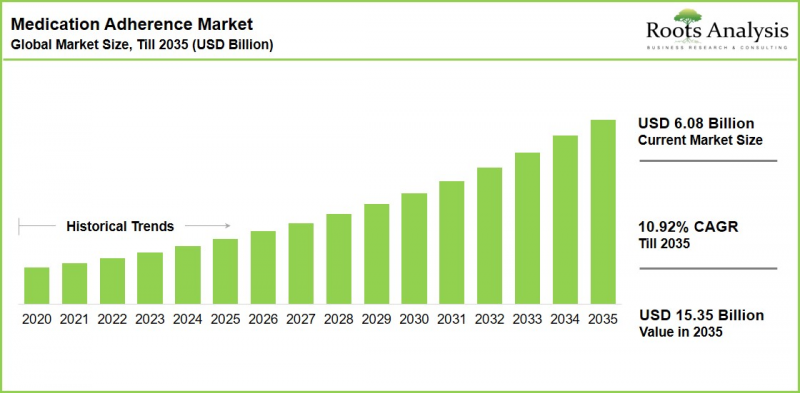
Medication Adherence Market: Growth and Trends
Medication adherence refers to the degree to which a patient's actual dosing behavior matches the regimen prescribed by a physician. This variable remains a primary barrier to achieving predictable patient outcomes in chronic disease management. A growing suite of hardware and software solutions, ranging from sensor-equipped smart devices to AI-enabled reminder and monitoring platforms, has been developed to address this concern. These solutions enable patients to manage complex regimens outside clinical settings and reduce the need for frequent in-person follow-up. Given the growing prevalence of chronic disorders, including diabetes, cardiovascular disease, respiratory conditions, and cancer, healthcare systems continue to face sustained pressure amid an aging population.
According to the World Health Organization (WHO), average adherence to long-term therapies for chronic conditions in developed countries is only around 50%. This adherence gap is estimated to result in over USD 100 billion in avoidable healthcare costs annually in the US alone, driven by preventable hospitalizations, emergency department visits, and disease progression. Chronic disease management requires frequent engagement with the healthcare system, which not only drives up treatment costs but also erodes patient adherence to treatment over time.
To address this burden, pharmaceutical companies, device manufacturers, and digital health innovators are increasingly investing in patient-centric adherence solutions that improve treatment continuity and clinical outcomes at home. These tools combine dose-tracking hardware, such as smart pill bottles, blister packs, and connected inhalers, with software layers that turn raw dosing events into timely alerts for patients, caregivers, and care teams. Companies such as BrightInsight continue to expand their AI-enabled adherence and persistence platforms, reflecting growing industry confidence in connected, data-driven patient support solutions.
Digital health tools have gained wide acceptance for supporting self-administered therapy in home-care settings. This shift toward self-management has pushed device developers and software vendors to add advanced features to their offerings, including AI-based risk scoring, companion mobile apps, remote monitoring dashboards, dosing reminders, and audible or visual delivery confirmation. Continuous innovation in adherence technology, along with growing acceptance among both patients and payers, is expected to support steady market growth over the forecast period.
Growth Drivers: Strategic Enablers of Market Expansion
The medication adherence market is experiencing robust growth, driven by the increasing prevalence of chronic diseases, including diabetes, cardiovascular disorders, respiratory conditions, and cancer, alongside a growing geriatric population. Rising demand for consistent, long-term therapy management is accelerating the adoption of adherence solutions that improve treatment continuity and reduce avoidable healthcare utilization. Additionally, the maturity of digital health infrastructure, including smartphone penetration, wearable connectivity, and AI-enabled analytics, is driving the adoption of adherence platforms that were commercially impractical only a few years ago, strengthening the long-term growth prospects of the market.
Market Challenges: Critical Barriers Impeding Progress
Despite its strong growth prospects, the medication adherence market faces several challenges that may limit broader adoption. Upfront and per-patient costs for connected hardware and AI-enabled platforms remain a significant barrier, particularly in regions with limited reimbursement support and high healthcare expenses. Additionally, evolving data privacy regulation and lengthy health-system procurement and security review cycles increase time-to-revenue for vendors. Persistent behavioral barriers, such as forgetfulness, complex treatment regimens, and low health literacy, continue to limit the effectiveness of technology-driven adherence solutions, particularly among elderly populations and in resource-constrained settings. Addressing these cost, regulatory, and behavioral challenges will be critical to accelerating market adoption and realizing the full commercial potential of medication adherence technologies.
Medication Adherence Market: Key Insights
The report delves into the current state of the medication adherence market and identifies potential growth opportunities within the industry. Some key findings include:
- Device and software vendors in the medication adherence market largely reach hospitals, health plans, and pharmaceutical sponsors of patient-support programs through direct commercial teams. This model currently limits the visibility that third-party distributors have into adherence solution commercialization, despite their established reach into retail and home care channels.
- Rather than traditional wholesalers, pharmacy chains are increasingly bundling medication synchronization and compliance packaging with digital reminder tools. CVS Health's medication synchronization program illustrates this shift, aligning refill timing across a patient's regimen and layering in adherence outreach as a retained-customer service.
- Omnicell's pharmacy-facing packaging and analytics systems reflect the type of dedicated capability, automated blister packaging paired with dispensing data capture, that distributors and independent pharmacies increasingly need to participate in adherence-linked contracts.
- Direct-to-patient delivery models, integrated with telehealth and e-prescribing, are shifting the distributor role from pure product movement toward end-to-end onboarding, device training, and adherence coaching.
- Regulatory accreditations from organizations such as URAC and the Accreditation Commission for Health Care (ACHC) are required for distributors and specialty pharmacies seeking inclusion in limited-distribution and adherence-linked payer networks.
- Rising demand for self-administered injectable therapies is prompting contract development and manufacturing organizations to bundle device assembly, packaging, and adherence-support services, blurring the boundary between manufacturing and distribution partners.
- Regulatory reform of pharmacy benefit managers, including rebate pass-through and pricing transparency mandates taking effect in the US, is encouraging manufacturers of adherence-linked therapies to diversify distribution beyond PBM-affiliated pharmacies.
- Consolidation among large specialty distributors and 3PLs is raising barriers to entry for smaller regional players, even as the shift toward decentralized, home-based care creates openings for niche distributors with condition-specific or regional expertise.
Medication Adherence Market
The market sizing and opportunity analysis has been segmented across the following parameters:
By Type of Solution
- Hardware Centric
- Software Centric
By Type of Product
- Smart Inhalers
- Smart Injectors
- Smart Wearable Injectors
- Smart Pills
- Smart Medication Dispensers
- Smart Pill Bottles / Caps and Boxes
- Smart Blister Packs
- Others
By Route of Administration
- Oral
- Injectable
- Inhalable
- Others
By Therapeutic Area
- Cardiovascular Disorders
- Metabolic Disorders
- Neurological and Central Nervous System Related Disorders
- Respiratory Disorders
- Others
By End-User
- Hospitals
- Home Care Settings
- Others
By Geographical Regions
- North America
- US
- Canada
- Mexico
- Europe
- France
- Germany
- UK
- Italy
- Spain
- Rest of Europe
- Asia-Pacific
- China
- India
- Japan
- Rest of Asia-Pacific
- Middle East and North Africa
- Egypt
- Israel
- Saudi Arabia
- Latin America
- Argentina
- Brazil
Medication Adherence Market: Key Segment
Software-Centric Solutions Dominate the Medication Adherence Market
Based on our market assessment, software-centric solutions currently constitute the largest share (65%) of the overall medication adherence market, accounting for a majority of the overall market share. The segment is expected to retain its dominant position throughout the forecast period, primarily due to its scalability, lower marginal deployment cost, and ease of integration with existing electronic health record and telehealth infrastructure compared to dedicated hardware. Widespread adoption across chronic disease populations, coupled with growing payer interest in outcomes-linked digital tools, continues to reinforce this segment's market leadership.
In contrast, the hardware-centric segment is anticipated to register a higher CAGR during the forecast period, driven by rising demand for objective, sensor-verified dosing data that self-reported software alone cannot provide. Compact, patient-friendly device design continues to enhance adoption in home-care settings, particularly for chronic conditions such as diabetes, respiratory disease, and cardiovascular disorders.
North America Maintains Market Leadership
According to our market projections, North America is expected to maintain its leadership in the medication adherence market through 2035, accounting for the largest share of the global market. The region's dominance is due to the well-established digital health infrastructure, a high prevalence of chronic disease, favorable reimbursement frameworks tied to value-based care, and early adoption of AI-enabled monitoring technologies. Further, robust healthcare expenditure, a supportive regulatory environment, and the concentration of leading solution providers continue to reinforce the region's competitive position.
Asia-Pacific Emerges as the Fastest-Growing Regional Market
According to our market projections, the Asia-Pacific medication adherence market is expected to register the highest CAGR during the forecast period, positioning the region as the fastest-growing market globally. This unprecedented growth is driven by rapid healthcare digitization, expanding middle-class populations, rising disposable incomes, and the increasing prevalence of chronic diseases across major economies such as China and India. Government initiatives aimed at strengthening healthcare infrastructure, expanding insurance coverage, and improving access to digital health technologies are further accelerating market expansion across the region.
Cardiovascular Disorders Account for the Largest Share of the Market
Based on our analysis, the cardiovascular disorders segment currently accounts for the largest share of the medication adherence market by therapeutic area and is expected to maintain its leadership throughout the forecast period. This dominance is primarily driven by the large population of patients with hypertension and heart failure, coupled with the significant clinical consequences of missed doses, including an increased risk of acute cardiovascular events. Medication adherence solutions are particularly well suited to this therapeutic area, as they enable early identification of non-adherent patients before a preventable event occurs.
Example Players in Medication Adherence Market
- Bigfoot Biomedical
- BIOCORP
- Eitan Medical
- E3D Elcam Drug Delivery Device
- EoFlow
- Gerresheimer
- Insulet
- Medtronic
- Medtrum
- Nemera
- Phillips-Medisize
- Roche
- Sonceboz
- SOOIL Development
- Tandem Diabetes Care
- West Pharmaceutical Services
- Ypsomed
Expert Interview and Industry Insights
The opinions and insights presented in this study were influenced by discussions conducted with multiple stakeholders. The research report features detailed transcripts of interviews held with the following industry stakeholders:
- Senior Director, Global Strategic Marketing, Medical, Large Company, US
- Co-Founder and Chief Executive Officer, Small Company, US
- Chief Executive Officer, Small Company, US
- Chief Executive Officer and President, Mid-sized Company, US
- Chief Executive Officer, Small Company, Italy
- Vice President and Chief Scientist, Large Company, Israel
- Director of Global Communications, and Former Vice President of Strategic Partnerships and Business Development, Mid-sized Company, US
- Former Chief Executive Officer, Small Company, US
- Former Director of Front-end Innovation and Head of Connected Health, Large Company, US
- Former Vice President, Marketing and Alliance Management, Mid-sized Company, US
- Advisor of Strategy and Business Development, Small Company, US
In addition, the market report includes transcripts of the following other third-party discussions:
- Associate, Very Large Company, United States
- Director, Associate Professor, Very Large Company, United States
- Chief Pharmacy Officer, Policy Analyst, Very Large Company, United States
- Chief Executive Officer, Mid-sized Company, United States
- Chief Executive Officer, Mid-sized Company, United States
- Chief Experience Officer, Mid-sized Company, United States
- Chief Medical Officer, Mid-sized Company, United States
- Co-Founder and Board Member, Small Company, United States
- Chief Executive Officer, Mid-sized Company, United States
- Chief Executive Officer, Small Company, United States
- Chief Executive Officer, Large Company, United States
- Chief Optimus, Small Company, United States
- Chief Technical Officer and Chief Scientific Officer, Mid-sized Company, United States
- Co-Founder and Chief Executive Officer, Mid-sized Company, United States
MEDICATION ADHERENCE MARKET: RESEARCH COVERAGE
- Market Sizing and Opportunity Analysis: The report features an in-depth analysis of the medication adherence market, focusing on key market segments, including type of solution, type of product, route of administration, therapeutic area, end-user, and geographical regions.
- Hardware-Centric Solutions Landscape: A detailed assessment of the overall hardware-centric medication adherence landscape, featuring information on several relevant parameters, such as type of product, connectivity features, and regulatory status. Additionally, it features detailed analysis of device manufacturers, based on parameters such as year of establishment, company size (based on employee count), and location of headquarters.
- Software-Centric Solutions Landscape: A detailed assessment of the overall software-centric medication adherence landscape, featuring information on parameters such as platform type, integration capability, therapeutic focus, and status of development. Additionally, it features detailed analysis of software developers, based on parameters such as year of establishment, company size, and location of headquarters.
- Company Profiles: In-depth profiles of prominent players engaged in offering medication adherence solutions, featuring information on their year of establishment, location of headquarters, company size (in terms of number of employees), management team, portfolio, and key initiatives.
- Clinical Trial Analysis: A comprehensive assessment of the clinical trial landscape for medication adherence solutions, covering trial activity by registration year, status, patient population, study design, sponsor type, and geography. The chapter also highlights leading organizations based on registered trials, providing insights into research trends, development priorities, and the evolving clinical evidence base.
- Partnerships and Collaborations Analysis: A comprehensive assessment of partnership activity in the medication adherence market, evaluating collaborations by year, partnership type, device class, integrated device type, and geography. The chapter also identifies the most active organizations and analyzes regional deal trends to highlight key collaboration strategies shaping the market.
- Funding and Investment Analysis: A comprehensive assessment of funding and investment activity in the medication adherence market, analyzing trends by year, funding type, investment value, and geography.
- Value Chain / Cost Price Analysis: A comprehensive assessment of the medication adherence value chain, examining cost distribution across key stages, including concept development, product development, clinical trials, regulatory approvals, manufacturing and assembly, application development, and commercialization, to identify major cost drivers and value creation opportunities.
- Regulatory Landscape: A comprehensive overview of the regulatory framework governing medication adherence solutions and combination products across major global markets. The chapter examines country-specific approval pathways, the roles of key regulatory authorities, and evolving requirements for ensuring the safety, effectiveness, performance, and cybersecurity of connected medication adherence devices.
- Case Studies: A comparative assessment of the use of connected drug delivery devices to improve medication adherence in diabetes and asthma. The chapter examines disease burden, key epidemiological trends, the economic impact of non-adherence, and the evolution of smart drug delivery technologies for each indication.
- SWOT Analysis: A strategic assessment of the medication adherence market, evaluating its key strengths, weaknesses, opportunities, and threats. The chapter also compares the relative impact of each SWOT factor to provide insights into the market's competitive landscape and future growth potential.
- Blue Ocean Strategy Analysis: A strategic evaluation of growth opportunities in the connected drug delivery devices market using the Blue Ocean Strategy framework. The chapter applies tools such as the Strategy Canvas and Pioneer-Migrator-Settler (PMS) Map to identify avenues for market differentiation and sustainable competitive advantage.
KEY QUESTIONS ANSWERED IN THIS REPORT
- Which are the leading companies in the medication adherence market?
- Which region dominates the medication adherence market?
- What are the key trends observed in the medication adherence market?
- What factors are likely to influence the evolution of this market?
- What are the primary challenges faced by medication adherence solution providers?
- What is the current and future market size?
- What is the CAGR of this market?
- How is the current and future market opportunity likely to be distributed across key market segments?
REASONS TO BUY THIS REPORT
- The report provides a comprehensive market analysis, offering detailed revenue projections of the overall market and its specific sub-segments. This information is valuable to both established market leaders and emerging entrants.
- The report offers stakeholders a comprehensive overview of the market, including key drivers, barriers, opportunities, and challenges. This information empowers stakeholders to stay abreast of market trends and make data-driven decisions to capitalize on growth prospects.
- The report can aid businesses in identifying future opportunities in any sector. It also helps in understanding if those opportunities are worth pursuing.
- The report helps in identifying customer demand by understanding the needs, preferences, and behavior of the target audience in order to tailor products or services effectively.
- The report equips new entrants with requisite information regarding a particular market to help them build successful business strategies.
- The report allows for more effective communication with the audience and in building strong business relations.
ADDITIONAL BENEFITS
- Complementary Excel Data Packs for all Analytical Modules in the Report
- 15% Free Content Customization
- Detailed Report Walkthrough Session with Research Team
- Free Updated Report if the Report is 6-12 Months Old or Older
TABLE OF CONTENTS
1. PREFACE
- 1.1. Introduction
- 1.2. Market Share Insights
- 1.3. Key Market Insights
- 1.4. Report Coverage
- 1.5. Key Questions Answered
- 1.6. Chapter Outlines
2. RESEARCH METHODOLOGY
- 2.1. Chapter Overview
- 2.2. Research Assumptions
- 2.2.1. Market Landscape and Market Trends
- 2.2.2. Market Forecast and Opportunity Analysis
- 2.2.3. Comparative Analysis
- 2.3. Database Building
- 2.3.1. Data Collection
- 2.3.2. Data Validation
- 2.3.3. Data Analysis
- 2.4. Project Methodology
- 2.4.1. Secondary Research
- 2.4.1.1. Annual Reports
- 2.4.1.2. Academic Research Papers
- 2.4.1.3. Company Websites
- 2.4.1.4. Investor Presentations
- 2.4.1.5. Regulatory Filings
- 2.4.1.6. White Papers
- 2.4.1.7. Industry Publications
- 2.4.1.8. Conferences and Seminars
- 2.4.1.9. Government Portals
- 2.4.1.10. Media and Press Releases
- 2.4.1.11. Newsletters
- 2.4.1.12. Industry Databases
- 2.4.1.13. Roots Proprietary Databases
- 2.4.1.14. Paid Databases and Sources
- 2.4.1.15. Social Media Portals
- 2.4.1.16. Other Secondary Sources
- 2.4.2. Primary Research
- 2.4.2.1. Types of Primary Research
- 2.4.2.1.1. Qualitative Research
- 2.4.2.1.2. Quantitative Research
- 2.4.2.1.3. Hybrid Approach
- 2.4.2.2. Advantages of Primary Research
- 2.4.2.3. Techniques for Primary Research
- 2.4.2.3.1. Interviews
- 2.4.2.3.2. Surveys
- 2.4.2.3.3. Focus Groups
- 2.4.2.3.4. Observational Research
- 2.4.2.3.5. Social Media Interactions
- 2.4.2.4. Key Opinion Leaders Considered in Primary Research
- 2.4.2.4.1. Company Executives (CXOs)
- 2.4.2.4.2. Board of Directors
- 2.4.2.4.3. Company Presidents and Vice Presidents
- 2.4.2.4.4. Research and Development Heads
- 2.4.2.4.5. Technical Experts
- 2.4.2.4.6. Subject Matter Experts
- 2.4.2.4.7. Scientists
- 2.4.2.4.8. Doctors and Other Healthcare Providers
- 2.4.2.5. Ethics and Integrity
- 2.4.2.5.1. Research Ethics
- 2.4.2.5.2. Data Integrity
- 2.4.2.1. Types of Primary Research
- 2.4.3. Analytical Tools and Databases
- 2.4.1. Secondary Research
- 2.5. Robust Quality Control
3. MARKET DYNAMICS
- 3.1. Chapter Overview
- 3.2. Forecast Methodology
- 3.2.1. Top-down Approach
- 3.2.2. Bottom-up Approach
- 3.2.3. Hybrid Approach
- 3.3. Market Assessment Framework
- 3.3.1. Total Addressable Market (TAM)
- 3.3.2. Serviceable Addressable Market (SAM)
- 3.3.3. Serviceable Obtainable Market (SOM)
- 3.3.4. Currently Acquired Market (CAM)
- 3.4. Forecasting Tools and Techniques
- 3.4.1. Qualitative Forecasting
- 3.4.2. Correlation
- 3.4.3. Regression
- 3.4.4. Extrapolation
- 3.4.5. Convergence
- 3.4.6. Sensitivity Analysis
- 3.4.7. Scenario Planning
- 3.4.8. Data Visualization
- 3.4.9. Time Series Analysis
- 3.4.10. Forecast Error Analysis
- 3.5. Key Considerations
- 3.5.1. Demographics
- 3.5.2. Government Regulations
- 3.5.3. Reimbursement Scenarios
- 3.5.4. Market Access
- 3.5.5. Supply Chain
- 3.5.6. Industry Consolidation
- 3.5.7. Pandemic / Unforeseen Disruptions Impact
- 3.6. Limitations
4. MACRO-ECONOMIC INDICATORS
- 4.1. Chapter Overview
- 4.2. Market Dynamics
- 4.2.1. Time Period
- 4.2.1.1. Historical Trends
- 4.2.1.2. Current and Forecasted Estimates
- 4.2.2. Currency Coverage
- 4.2.2.1. Major Currencies Affecting the Market
- 4.2.2.2. Factors Affecting Currency Fluctuations on the Industry
- 4.2.2.3. Impact of Currency Fluctuations on the Industry
- 4.2.3. Foreign Currency Exchange Rate
- 4.2.3.1. Impact of Foreign Exchange Rate Volatility on the Market
- 4.2.3.2. Strategies for Mitigating Foreign Exchange Risk
- 4.2.4. Recession
- 4.2.4.1. Assessment of Current Economic Conditions and Potential Impact on the Market
- 4.2.4.2. Historical Analysis of Past Recessions and Lessons Learnt
- 4.2.5. Inflation
- 4.2.5.1. Measurement and Analysis of Inflationary Pressures in the Economy
- 4.2.5.2. Potential Impact of Inflation on the Market Evolution
- 4.2.6. Interest Rates
- 4.2.6.1. Interest Rates and Their Impact on the Market
- 4.2.6.2. Strategies for Managing Interest Rate Risk
- 4.2.7. Commodity Flow Analysis
- 4.2.7.1. Type of Commodity
- 4.2.7.2. Origins and Destinations
- 4.2.7.3. Values and Weights
- 4.2.7.4. Modes of Transportation
- 4.2.8. Global Trade Dynamics
- 4.2.8.1. Import Scenario
- 4.2.8.2. Export Scenario
- 4.2.8.3. Trade Policies
- 4.2.8.4. Strategies for Mitigating the Risks Associated with Trade Barriers
- 4.2.8.5. Impact of Trade Barriers on the Market
- 4.2.9. War Impact Analysis
- 4.2.9.1. Russian-Ukraine War
- 4.2.9.2. Israel-Hamas War
- 4.2.10. COVID Impact / Related Factors
- 4.2.10.1. Global Economic Impact
- 4.2.10.2. Industry-specific Impact
- 4.2.10.3. Government Response and Stimulus Measures
- 4.2.10.4. Future Outlook and Adaptation Strategies
- 4.2.11. Other Indicators
- 4.2.11.1. Fiscal Policy
- 4.2.11.2. Consumer Spending
- 4.2.11.3. Gross Domestic Product
- 4.2.11.4. Employment
- 4.2.11.5. Taxes
- 4.2.11.6. Stock Market Performance
- 4.2.11.7. Cross Border Dynamics
- 4.2.1. Time Period
- 4.3. Conclusion
5. EXECUTIVE SUMMARY
6. INTRODUCTION
- 6.1. Chapter Overview
- 6.2. Medication Adherence
- 6.2.1. Digital Tools for Improving Medication Adherence
- 6.3. Overview of Medication Adherence
- 6.4. Key Design Features and Development Process
- 6.5. Classification of Medication Adherence
- 6.5.1. Type of Device
- 6.5.1.1. Smart Inhalers
- 6.5.1.2. Smart Handheld Injectors
- 6.5.1.3. Smart Pills
- 6.5.1.4. Smart Implantable Devices
- 6.5.2. Type of Technology
- 6.5.1. Type of Device
- 6.6. Regulatory Guidelines for Medication Adherence
- 6.7. Advantages and Limitations of Medication Adherence
- 6.8. Impact of COVID-19 on Medication Adherence Domain
- 6.9. Future Perspective
7. MARKET LANDSCAPE: MEDICATION ADHERENCE
- 7.1. Chapter Overview
- 7.2. Medication Adherence: Overall Market Landscape
- 7.2.1. Analysis by Stage of Development
- 7.2.2. Analysis by Launch Year
- 7.2.3. Analysis by Type of Integrated Device
- 7.2.4. Analysis by Route of Administration
- 7.2.5. Analysis by Target Indication
- 7.2.6. Analysis by Therapeutic Area
- 7.2.7. Analysis by Key Features
- 7.2.8. Analysis by Mode of Connectivity
- 7.2.9. Analysis by Availability of Companion Mobile Application
- 7.2.10. Analysis by Availability of Data Storage / Cloud Platform
- 7.3. Medication Adherence Manufacturers: Overall Market Landscape
- 7.3.1. Analysis by Year of Establishment
- 7.3.2. Analysis by Company Size
- 7.3.3. Analysis by Location of Headquarters
- 7.3.4. Analysis by Year of Establishment and Location of Headquarters
- 7.3.5. Analysis by Company Size and Location of Headquarters
- 7.3.6. Most Active Players: Analysis by Number of Medication Adherence Manufactured
8. MARKET LANDSCAPE: ADD-ON SENSORS
- 8.1. Chapter Overview
- 8.2. Add-on Sensors: Overall Market Landscape
- 8.2.1. Analysis by Stage of Development
- 8.2.2. Analysis by Launch Year
- 8.2.3. Analysis by Compatible Device
- 8.2.4. Analysis by Route of Administration
- 8.2.5. Analysis by Target Indication
- 8.2.6. Analysis by Therapeutic Area
- 8.2.7. Analysis by Key Features
- 8.2.8. Analysis by Mode of Connectivity
- 8.2.9. Analysis by Availability of Companion Mobile Application
- 8.2.10. Analysis by Availability of Data Storage / Cloud Platform
- 8.3. Add-on Sensor Manufacturers: Overall Market Landscape
- 8.3.1. Analysis by Year of Establishment
- 8.3.2. Analysis by Company Size
- 8.3.3. Analysis by Location of Headquarters
- 8.3.4. Analysis by Year of Establishment and Location of Headquarters
- 8.3.5. Analysis by Company Size and Location of Headquarters
- 8.3.6. Most Active Players: Analysis by Number of Add-on Sensors Manufactured
9. PRODUCT COMPETITIVENESS ANALYSIS
- 9.1. Chapter Overview
- 9.2. Assumptions and Key Parameters
- 9.3. Methodology
- 9.4. Medication Adherence: Product Competitiveness Analysis
- 9.4.1. Smart Drug Delivery Devices
- 9.4.1.1. Smart Handheld Injectors (Peer Group 1a)
- 9.4.1.2. Smart Wearable Injectors (Peer Group 1b)
- 9.4.1.3. Other Integrated Devices (Peer Group 1c)
- 9.4.2. Add-on Sensors (Peer Group 2)
- 9.4.1. Smart Drug Delivery Devices
10. COMPANY PROFILES: MEDICATION ADHERENCE DEVICE MANUFACTURERS BASED IN NORTH AMERICA
- 10.1. Chapter Overview
- 10.2. Leading Medication Adherence Device Manufacturers
- 10.2.1. Medtronic
- 10.2.1.1. Company Overview
- 10.2.1.2. Financial Information
- 10.2.1.3. Medication Adherence Portfolio
- 10.2.1.4. Recent Developments and Future Outlook
- 10.2.2. Insulet
- 10.2.3. Tandem Diabetes Care
- 10.2.4. Bigfoot Biomedical
- 10.2.5. Phillips-Medisize
- 10.2.6. West Pharmaceutical Services
- 10.2.1. Medtronic
11. COMPANY PROFILES: MEDICATION ADHERENCE DEVICE MANUFACTURERS BASED IN EUROPE
- 11.1. Chapter Overview
- 11.2. Leading Medication Adherence Device Manufacturers
- 11.2.1. BIOCORP
- 11.2.1.1. Company Overview
- 11.2.1.2. Financial Information
- 11.2.1.3. Medication Adherence Portfolio
- 11.2.1.4. Recent Developments and Future Outlook
- 11.2.2. Gerresheimer
- 11.2.3. Roche
- 11.2.4. Ypsomed
- 11.2.5. Nemera
- 11.2.6. Sonceboz
- 11.2.1. BIOCORP
12. COMPANY PROFILES: MEDICATION ADHERENCE DEVICE MANUFACTURERS BASED IN ASIA-PACIFIC AND REST OF THE WORLD
- 12.1. Chapter Overview
- 12.2. Leading Medication Adherence Device Manufacturers
- 12.2.1. Medtrum
- 12.2.1.1. Company Overview
- 12.2.1.2. Medication Adherence Portfolio
- 12.2.1.3. Recent Developments and Future Outlook
- 12.2.2. SOOIL Development
- 12.2.3. EOFlow
- 12.2.4. Eitan Medical
- 12.2.5. E3D Elcam Drug Delivery Device
- 12.2.1. Medtrum
13. CLINICAL TRIAL ANALYSIS
- 13.1. Chapter Overview
- 13.2. Scope and Methodology
- 13.3. Medication Adherence: Clinical Trial Analysis
- 13.3.1. Analysis by Trial Registration Year
- 13.3.2. Analysis of Enrolled Patient Population by Trial Registration Year
- 13.3.3. Analysis by Trial Status
- 13.3.4. Analysis by Trial Registration Year and Trial Status
- 13.3.5. Analysis of Number of Enrolled Patients Population by Trial Status
- 13.3.6. Analysis by Target Patient Population
- 13.3.7. Analysis by Type of Sponsor / Collaborator
- 13.3.8. Analysis by Study Design
- 13.3.8.1. Analysis by Type of Allocation
- 13.3.8.2. Analysis by Type of Intervention Model
- 13.3.8.3. Analysis by Type of Masking
- 13.3.8.4. Analysis by Trial Purpose
- 13.3.9. Leading Players: Analysis by Number of Registered Trials
- 13.3.10. Leading Medication Adherence: Analysis by Number of Registered Trials
- 13.3.11. Analysis by Geography
- 13.3.11.1. Analysis of Clinical Trials by Geography
- 13.3.11.2. Analysis of Number of Registered Trials by Trial Status and Geography
- 13.3.11.3. Analysis of Number of Enrolled Patient Population by Geography
14. PARTNERSHIPS AND COLLABORATIONS
- 14.1. Chapter Overview
- 14.2. Partnership Models
- 14.3. Medication Adherence: Partnerships and Collaborations
- 14.3.1. Analysis by Year of Partnership
- 14.3.2. Analysis by Type of Partnership
- 14.3.3. Analysis by Year and Type of Partnership
- 14.3.4. Analysis by Class of Device
- 14.3.5. Analysis by Type of Integrated Device
- 14.3.6. Most Active Players: Analysis by Number of Partnerships
- 14.3.7. Analysis by Geography
- 14.3.7.1. Intracontinental and Intercontinental Deals
- 14.3.7.2. Local and International Deals
15. FUNDING AND INVESTMENT ANALYSIS
- 15.1. Chapter Overview
- 15.2. Funding Models
- 15.3. Medication Adherence: Funding and Investments
- 15.3.1. Analysis by Year of Funding
- 15.3.2. Analysis by Type of Funding
- 15.3.3. Analysis by Year and Type of Funding
- 15.3.4. Analysis of Amount Invested by Year of Funding
- 15.3.5. Analysis of Amount Invested by Type of Funding
- 15.3.6. Analysis by Geography
- 15.3.7. Most Active Players: Analysis by Number of Funding Instances
- 15.3.8. Most Active Players: Analysis by Amount Raised
16. VALUE CHAIN / COST PRICE ANALYSIS
- 16.1. Chapter Overview
- 16.2. Medication Adherence: Value Chain
- 16.3. Cost Distribution across the Value Chain
- 16.3.1. Concept Development and Proof of Concept
- 16.3.2. Research and Product Development
- 16.3.3. Conduct of Clinical Trials
- 16.3.4. Regulatory Approvals
- 16.3.5. Manufacturing and Product Assembly
- 16.3.6. Application Development
- 16.3.7. Marketing and Sales
17. REGULATORY LANDSCAPE FOR MEDICATION ADHERENCE
- 17.1. Chapter Overview
- 17.2. Regulatory Approval of Combination Products in North America
- 17.2.1. Regulatory Approval of Combination Products in the US
- 17.2.1.1. Overview
- 17.2.1.2. Historical Background
- 17.2.1.3. Role of Regulatory Bodies in Product Approval
- 17.2.2. Regulatory Approval of Combination Products in Canada
- 17.2.2.1. Overview
- 17.2.2.2. Role of Regulatory Bodies in Product Approval
- 17.2.3. Regulatory Approval of Combination Products in Mexico
- 17.2.3.1. Overview
- 17.2.3.2. Role of Regulatory Bodies in Product Approval
- 17.2.1. Regulatory Approval of Combination Products in the US
- 17.3. Regulatory Approval of Combination Products in Europe
- 17.3.1. Regulatory Approval of Combination Products in EU5 Countries
- 17.3.1.1. Overview
- 17.3.1.2. Role of Regulatory Bodies in Product Approval
- 17.3.1. Regulatory Approval of Combination Products in EU5 Countries
- 17.4. Regulatory Approval of Combination Products in Asia-Pacific
- 17.4.1. Regulatory Approval of Combination Products in Japan
- 17.4.1.1. Overview
- 17.4.1.2. Role of Regulatory Bodies in Product Approval
- 17.4.2. Regulatory Approval of Combination Products in China
- 17.4.2.1. Overview
- 17.4.2.2. Role of Regulatory Bodies in Product Approval
- 17.4.3. Regulatory Approval of Combination Products in India
- 17.4.3.1. Overview
- 17.4.3.2. Role of Regulatory Bodies in Product Approval
- 17.4.4. Regulatory Approval of Combination Products in South Korea
- 17.4.4.1. Overview
- 17.4.4.2. Role of Regulatory Bodies in Product Approval
- 17.4.5. Regulatory Approval of Combination Products in Australia
- 17.4.5.1. Overview
- 17.4.5.2. Role of Regulatory Bodies in Product Approval
- 17.4.1. Regulatory Approval of Combination Products in Japan
- 17.5. Regulatory Approval of Combination Products in Middle East and North Africa
- 17.5.1. Regulatory Approval of Combination Products in Saudi Arabia
- 17.5.1.1. Overview
- 17.5.1.2. Role of Regulatory Bodies in Product Approval
- 17.5.2. Regulatory Approval of Combination Products in United Arab Emirates
- 17.5.2.1. Overview
- 17.5.2.2. Role of Regulatory Bodies in Product Approval
- 17.5.1. Regulatory Approval of Combination Products in Saudi Arabia
- 17.6. Regulatory Approval of Combination Products in Latin America
- 17.6.1. Regulatory Approval of Combination Products in Brazil
- 17.6.1.1. Overview
- 17.6.1.2. Role of Regulatory Bodies in Product Approval
- 17.6.2. Regulatory Approval of Combination Products in Argentina
- 17.6.2.1. Overview
- 17.6.2.2. Role of Regulatory Bodies in Product Approval
- 17.6.1. Regulatory Approval of Combination Products in Brazil
- 17.7. Connected Devices: Other Measures for Testing Safety, Effectiveness and Performance
- 17.8. Ensuring Security of Data Captured
- 17.9. Concluding Remarks
18. CASE STUDIES: APPLICATION OF CONNECTED DRUG DELIVERY DEVICES TO IMPROVE MEDICATION ADHERENCE
- 18.1. Chapter Overview
- 18.2. Case Study I: Diabetes
- 18.2.1. Disease Overview
- 18.2.2. Key Statistics
- 18.2.3. Economic Burden due to Non-Adherence
- 18.2.4. Evolution of Connected / Smart Drug Delivery Devices for Improving Adherence
- 18.3. Case Study II: Asthma
- 18.3.1. Disease Overview
- 18.3.2. Key Statistics
- 18.3.3. Economic Burden due to Non-Adherence
- 18.3.4. Evolution of Connected / Smart Drug Delivery Devices for Improving Adherence
19. SWOT ANALYSIS
- 19.1. Chapter Overview
- 19.2. Strengths
- 19.3. Weaknesses
- 19.4. Opportunities
- 19.5. Threats
- 19.6. Comparison of SWOT Factors
20. BLUE OCEAN STRATEGY
- 20.1. Overview of Blue Ocean Strategy
- 20.1.1. Red Oceans
- 20.1.2. Blue Oceans
- 20.1.3. Comparison of Red Ocean Strategy and Blue Ocean Strategy
- 20.1.4. Connected Drug Delivery Devices: Blue Ocean Strategy and Shift Tools
- 20.1.4.1. Strategy Canvas
- 20.1.4.2. Pioneer-Migrator-Settler (PMS) Map
21. GLOBAL MEDICATION ADHERENCE MARKET
- 21.1. Chapter Overview
- 21.2. Assumptions and Methodology
- 21.3. Global Medication Adherence Market: Historical Trends (since 2020) and Forecasted Estimates (till 2035)
- 21.3.1. Scenario Analysis
- 21.3.1.1. Conservative Scenario
- 21.3.1.2. Optimistic Scenario
- 21.3.1. Scenario Analysis
- 21.4. Key Market Segmentations
22. MEDICATION ADHERENCE MARKET, BY TYPE OF SOLUTION
- 22.1. Chapter Overview
- 22.2. Assumptions and Methodology
- 22.3. Medication Adherence Market: Distribution by Type of Solution
- 22.3.1. Medication Adherence Market for Hardware Centric: Historical Trends (since 2020) and Forecasted Estimates (till 2035)
- 22.3.2. Medication Adherence Market for Software Centric: Historical Trends (since 2020) and Forecasted Estimates (till 2035)
- 22.4. Data Triangulation and Validation
23. MEDICATION ADHERENCE MARKET, BY TYPE OF PRODUCT
- 23.1. Chapter Overview
- 23.2. Assumptions and Methodology
- 23.3. Medication Adherence Market: Distribution by Type of Product
- 23.3.1. Medication Adherence Market for Smart Inhalers: Historical Trends (since 2020) and Forecasted Estimates (till 2035)
- 23.3.2. Medication Adherence Market for Smart Injectors: Historical Trends (since 2020) and Forecasted Estimates (till 2035)
- 23.3.3. Medication Adherence Market for Smart Wearable Injectors: Historical Trends (since 2020) and Forecasted Estimates (till 2035)
- 23.3.4. Medication Adherence Market for Smart Pills: Historical Trends (since 2020) and Forecasted Estimates (till 2035)
- 23.3.5. Medication Adherence Market for Smart Medication Dispensers: Historical Trends (since 2020) and Forecasted Estimates (till 2035)
- 23.3.6. Medication Adherence Market for Smart Pills Bottles / Caps and Boxes: Historical Trends (since 2020) and Forecasted Estimates (till 2035)
- 23.3.7. Medication Adherence Market for Smart Blisters Packs: Historical Trends (since 2020) and Forecasted Estimates (till 2035)
- 23.3.8. Medication Adherence Market for Others: Historical Trends (since 2020) and Forecasted Estimates (till 2035)
- 23.4. Data Triangulation and Validation
24. MEDICATION ADHERENCE MARKET, BY ROUTE OF ADMINISTRATION
- 24.1. Chapter Overview
- 24.2. Assumptions and Methodology
- 24.3. Medication Adherence Market: Distribution by Route of Administration
- 24.3.1. Medication Adherence Market for Oral: Historical Trends (since 2020) and Forecasted Estimates (till 2035)
- 24.3.2. Medication Adherence Market for Injectables: Historical Trends (since 2020) and Forecasted Estimates (till 2035)
- 24.3.3. Medication Adherence Market for Inhalable: Historical Trends (since 2020) and Forecasted Estimates (till 2035)
- 24.3.4. Medication Adherence Market for Others: Historical Trends (since 2020) and Forecasted Estimates (till 2035)
- 24.4. Data Triangulation and Validation
25. MEDICATION ADHERENCE MARKET, BY THERAPEUTIC AREA
- 25.1. Chapter Overview
- 25.2. Assumptions and Methodology
- 25.3. Medication Adherence Market: Distribution by Therapeutic Area
- 25.3.1. Medication Adherence Market for Metabolic Disorders: Historical Trends (since 2020) and Forecasted Estimates (till 2035)
- 25.3.2. Medication Adherence Market for Cardiovascular Disorders: Historical Trends (since 2020) and Forecasted Estimates (till 2035)
- 25.3.3. Medication Adherence Market for Neurological and Central Nervous System Related Disorders: Historical Trends (since 2020) and Forecasted Estimates (till 2035)
- 25.3.4. Medication Adherence Market for Respiratory Disorders: Historical Trends (since 2020) and Forecasted Estimates (till 2035)
- 25.3.5. Medication Adherence Market for Others: Historical Trends (since 2020) and Forecasted Estimates (till 2035)
- 25.4. Data Triangulation and Validation
26. MEDICATION ADHERENCE MARKET, BY END-USER
- 26.1. Chapter Overview
- 26.2. Assumptions and Methodology
- 26.3. Medication Adherence Market: Distribution by End-user
- 26.3.1. Medication Adherence Market for Hospitals: Historical Trends (since 2020) and Forecasted Estimates (till 2035)
- 26.3.2. Medication Adherence Market for Home Care Settings: Historical Trends (since 2020) and Forecasted Estimates (till 2035)
- 26.3.3. Medication Adherence Market for Others: Historical Trends (since 2020) and Forecasted Estimates (till 2035)
- 26.4. Data Triangulation and Validation
27. MEDICATION ADHERENCE MARKET, BY GEOGRAPHICAL REGIONS
- 27.1. Chapter Overview
- 27.2. Assumptions and Methodology
- 27.3. Medication Adherence Market: Distribution by Geographical Regions
- 27.3.1. Medication Adherence Market in North America: Historical Trends (since 2020) and Forecasted Estimates (till 2035)
- 27.3.1.1. Medication Adherence Market in the US: Historical Trends (since 2020) and Forecasted Estimates (till 2035)
- 27.3.1.2. Medication Adherence Market in Canada: Historical Trends (since 2020) and Forecasted Estimates (till 2035)
- 27.3.2. Medication Adherence Market in Europe: Historical Trends (since 2020) and Forecasted Estimates (till 2035)
- 27.3.2.1. Medication Adherence Market in the UK: Historical Trends (since 2020) and Forecasted Estimates (till 2035)
- 27.3.2.2. Medication Adherence Market in Germany: Historical Trends (since 2020) and Forecasted Estimates (till 2035)
- 27.3.2.3. Medication Adherence Market in France: Historical Trends (since 2020) and Forecasted Estimates (till 2035)
- 27.3.2.4. Medication Adherence Market in Italy: Historical Trends (since 2020) and Forecasted Estimates (till 2035)
- 27.3.2.5. Medication Adherence Market in Spain: Historical Trends (since 2020) and Forecasted Estimates (till 2035)
- 27.3.2.6. Medication Adherence Market in Rest of Europe: Historical Trends (since 2020) and Forecasted Estimates (till 2035)
- 27.3.3. Medication Adherence Market in Asia-Pacific: Historical Trends (since 2020) and Forecasted Estimates (till 2035)
- 27.3.3.1. Medication Adherence Market in China: Historical Trends (since 2020) and Forecasted Estimates (till 2035)
- 27.3.3.2. Medication Adherence Market in India: Historical Trends (since 2020) and Forecasted Estimates (till 2035)
- 27.3.3.3. Medication Adherence Market in Japan: Historical Trends (since 2020) and Forecasted Estimates (till 2035)
- 27.3.3.4. Medication Adherence Market in Rest of Asia-Pacific: Historical Trends (since 2020) and Forecasted Estimates (till 2035)
- 27.3.1. Medication Adherence Market in North America: Historical Trends (since 2020) and Forecasted Estimates (till 2035)
- 27.4. Data Triangulation and
28. CONCLUDING REMARKS
29. EXECUTIVE INSIGHTS
- 29.1. Chapter Overview
- 29.2. Company A
- 29.2.1. Company Snapshot
- 29.2.2. Interview Transcript: Senior Director, Global Strategic Marketing, Medical
- 29.3. Company B
- 29.3.1. Company Snapshot
- 29.3.2. Interview Transcript: Co-founder and Chief Executive Officer
- 29.4. Company C
- 29.4.1. Company Snapshot
- 29.4.2. Interview Transcript: Founder and Chief Executive Officer
- 29.5. Company D
- 29.5.1. Company Snapshot
- 29.5.2. Interview Transcript: Chief Executive Officer and President
- 29.6. Company E
- 29.6.1. Company Snapshot
- 29.6.2. Interview Transcript: Chief Executive Officer
- 29.7. Company F
- 29.7.1. Company Snapshot
- 29.7.2. Interview Transcript: Vice President and Chief Scientist
- 29.8. Company G
- 29.8.1. Company Snapshot
- 29.8.2. Interview Transcript: Director (Global Communications) and Former Vice President (Strategic Partnerships and Business Development)
- 29.9. Company H
- 29.9.1. Company Snapshot
- 29.9.2. Interview Transcript: Former Chief Executive Officer
- 29.10. Company I
- 29.10.1. Company Snapshot
- 29.10.2. Interview Transcript: Former Director (Front-end Innovation and Head of Connected Health)
- 29.11. Company J
- 29.11.1. Company Snapshot
- 29.11.2. Interview Transcript: Former Vice President (Marketing and Alliance Management)
- 29.12. Company K
- 29.12.1. Company Snapshot
- 29.12.2. Interview Transcript: Advisor (Strategy and Business Development)
- 29.13. Company L
- 29.13.1. Company Snapshot
- 29.13.2. Interview Transcript: Associate
- 29.14. Company M
- 29.14.1. Company Snapshot
- 29.14.2. Interview Transcript: Director, Associate Professor
- 29.15. Company N
- 29.15.1. Company Snapshot
- 29.15.2. Interview Transcript: Chief Pharmacy Officer, Policy Analyst
- 29.16. Company O
- 29.16.1. Company Snapshot
- 29.16.2. Interview Transcript: Chief Executive Officer
- 29.17. Company P
- 29.17.1. Company Snapshot
- 29.17.2. Interview Transcript: Chief Executive Officer
- 29.18. Company Q
- 29.18.1. Company Snapshot
- 29.18.2. Interview Transcript: Chief Experience Officer
- 29.19. Company R
- 29.19.1. Company Snapshot
- 29.19.2. Interview Transcript: Chief Medical Officer
- 29.20. Company S
- 29.20.1. Company Snapshot
- 29.20.2. Interview Transcript: Co-Founder and Board Member
- 29.21. Company T
- 29.21.1. Company Snapshot
- 29.21.2. Interview Transcript: Chief Executive Officer
- 29.22. Company U
- 29.22.1. Company Snapshot
- 29.22.2. Interview Transcript: Chief Executive Officer
- 29.23. Company V
- 29.23.1. Company Snapshot
- 29.23.2. Interview Transcript: Chief Executive Officer
- 29.24. Company W
- 29.24.1. Company Snapshot
- 29.24.2. Interview Transcript: Chief Optimus
- 29.25. Company X
- 29.25.1. Company Snapshot
- 29.25.2. Interview Transcript: Chief Technical Officer and Chief Scientific Officer
- 29.26. Company Y
- 29.26.1. Company Snapshot
- 29.26.2. Interview Transcript: Co-Founder and Chief Executive Officer
30. APPENDIX 1: TABULATED DATA
31. APPENDIX 2: LIST OF COMPANIES AND ORGANIZATIONS
List of Tables
List of Figures

