PUBLISHER: Roots Analysis | PRODUCT CODE: 2106272

PUBLISHER: Roots Analysis | PRODUCT CODE: 2106272
mRNA Therapeutics Market by Target Indication (Non-Small Cell Lung Cancer, Melanoma, Muscle-Invasive Urothelial Carcinoma, Propionic Acidemia, and Cystic Fibrosis) and Geographical Regions - Trends and Forecast, Till 2035
mRNA THERAPEUTICS MARKET: OVERVIEW
As per Roots Analysis, the global mRNA therapeutics market (growth opportunities beyond COVID applications) is estimated to grow from USD 201 million in the current year to USD 9,988 million by 2035, reflecting a compound annual growth rate (CAGR) of approximately 63% during the forecast period.
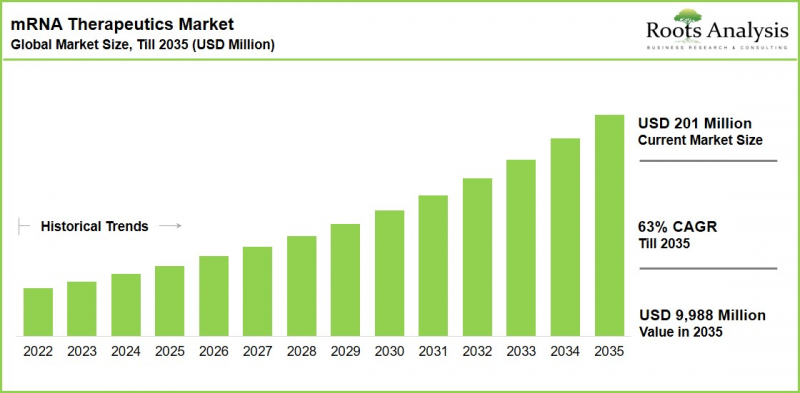
mRNA Therapeutics Market: Growth and Trends
Messenger RNA (mRNA) therapeutics represent one of the most consequential technology platforms to have entered mainstream biopharmaceutical development in the past decade. Rather than relying on externally manufactured proteins, monoclonal antibodies, or small molecules, mRNA-based interventions deliver synthetic genetic instructions directly into a patient's own cells, prompting transient, on-demand production of a therapeutic protein of interest. This modular platform enables the same manufacturing process and LNP delivery system to target multiple diseases by changing the encoded reducing development timelines.
Notably, following the clinical and commercial success of prophylactic therapeutics, the mRNA therapeutics field is advancing across oncology, rare diseases, cardiovascular disorders, and regenerative medicine. Within oncology, mRNA constructs are being engineered to encode tumor-associated antigens, immune-stimulatory cytokines, and patient-specific , with the objective of provoking a durable, targeted anti-tumor immune response. It is an approach that is increasingly viewed as complementary to checkpoint inhibition. For rare genetic disorders, protein replacement therapies aim to restore missing or faulty proteins through repeated treatment. This approach can slow disease progression while avoiding the permanent genetic changes associated with DNA-based gene therapy.
Industry is also shifting toward vertical integration, as market players seek to internalize both RNA construct optimization and lipid nanoparticle delivery in order to shorten iteration cycles and strengthen freedom-to-operate. This consolidation trend, combined with sustained capital inflows and an expanding base of strategic partnerships between platform originators and large pharmaceutical companies, is positioning mRNA therapeutics as a steadily growing market within the broader biopharmaceutical industry.
Growth Drivers: Factors Fueling Expansion
Growth of the market is underpinned by the rising global burden of oncological, rare genetic, and autoimmune conditions, which is intensifying demand for precisely targeted, biologically differentiated treatment options. The shift toward precision medicine is accelerating the development of mRNA-based therapies. Advances in genomics, biomarker research, and molecular diagnostics are enabling more targeted treatments with improved efficacy and safety.
Further, the growing funding and investment activities from governments, venture investors, and strategic pharmaceutical partnerships. Public funding agencies are backing platform-agnostic RNA manufacturing infrastructure, while private investment is flowing into next-generation delivery science, including non-LNP delivery vehicles and tissue-selective targeting chemistries.
Strategic collaborations between emerging biotechnology innovators and established pharmaceutical companies are further de-risking clinical development, pooling technical expertise, and extending commercial reach into new geographies which collectively reinforce the market's growth trajectory the forecast period.
Market Challenges: Critical Barriers Hindering Progress
Despite considerable scientific and commercial momentum, the mRNA therapeutics market continues to witness several barriers. Some of the significant challenges include achieving efficiency, tissue-selective, and repeat-dose-tolerant delivery beyond the liver and intramuscular compartments. This challenge continues to constrain the addressable set of indications for many programs. Further, the requirement of cold-chain logistics for storage and transportation of these therapeutics along with advanced manufacturing technologies may increase per-dose costs compared with those of small-molecule or many biologic alternatives, which can complicate reimbursement discussions in cost-sensitive markets.
Regulatory pathways for chronic and repeat-dosing mRNA therapeutics are still being established in most jurisdictions, creating approval-timeline uncertainty. Additionally, intense competition and intellectual property (IP) activity across lipid nanoparticle (LNP) and RNA construct technologies are increasing freedom-to-operate challenges, particularly for smaller developers. Furthermore, heightened public scrutiny of mRNA-based medicines in some markets following the COVID-19 pandemic underscores the need for transparent and proactive communication by industry stakeholders.
mRNA Therapeutics Market: Key Insights
The report delves into the current state of the mRNA therapeutics market and identifies potential growth opportunities within the industry. Some key findings include:
- Driven by the platform's inherent flexibility and the pressing need for differentiated treatment options, an expanding base of biotechnology innovators and large pharmaceutical companies is prioritizing mRNA-based drug development across oncology and rare disease indications.
- Several mRNA therapeutics are currently under active investigation across multiple stages of development; notably, approximately 70% of pipeline activity is concentrated among two developers, namely Moderna and BioNTech.
- Deal flow between platform owners and indication specialists continues to accelerate. In January 2026, Moderna partnered with Recordati to advance mRNA-3927, its investigational candidate for propionic acidemia, toward development and eventual commercialization.
- Capital inflows into mRNA-focused developers have risen steadily, giving companies more room to expand pipelines and candidates toward later-stage trials. Reprogram Biosciences illustrates this trend at the early stage, having raised USD 6 million in seed funding in May 2026 to advance an mRNA-based in situ cell reprogramming approach designed to convert tumors into antigen-presenting sites.
- More than 10% of the global mRNA therapeutics pipeline has reached Phase III, a relatively high late-stage share for an emerging modality and a signal of growing clinical maturity. Moderna and BioNTech together account for approximately 70% of active development activity, underscoring how concentrated pipeline leadership remains at this stage of the market.
- Patent filings tied to mRNA constructs, delivery systems and manufacturing processes have risen sharply over the past five years. This reflects both the pace of innovation and a defensive push by developers to protect platform technology that can be redeployed across many disease areas.
- Large pharmaceutical companies are increasingly partnering with or acquiring smaller mRNA-focused developers rather than building platforms internally. Pfizer has been the most active participant in this pattern, followed by Sanofi, which expanded its RNA capabilities through the acquisition of Translate Bio. Bayer has also entered this space through targeted collaborations.
mRNA Therapeutics Market
The market sizing and opportunity analysis has been segmented across the following parameters:
By Target Indication
- Non-Small Cell Lung Cancer
- Melanoma
- Muscle-Invasive Urothelial Carcinoma
- Propionic Acidemia
- Cystic Fibrosis
By Geographical Regions
- North America
- US
- Canada
- Europe
- Germany
- UK
- France
- Italy
- Spain
- Rest of Europe
- Asia-Pacific
- China
- Japan
- South Korea
- Australia
mRNA Therapeutics Market: Key Segments
Non-Small Cell Lung Cancer Leads the Target Indication Landscape
Based on Roots Analysis market assessment and detailed clinical pipeline analysis, non-small cell lung cancer (NSCLC) is projected to hold the highest share among target indications by 2035. This dominance is driven by the global prevalence of NSCLC, the substantial unmet need among patients diagnosed at advanced stages, and the pronounced tumor heterogeneity. These unmet needs make the indication particularly well suited to immunotherapy-driven and personalized neoantigen-based mRNA vaccine approaches. Further, rising adoption of next-generation sequencing and AI-enabled biomarker discovery is further strengthening the precision-targeting rationale for mRNA-based interventions in this indication.
North America Maintains Market Leadership
North America is expected to lead the regional market for mRNA therapeutics through 2035. This growth is supported by a well-established technology ecosystem featuring pioneering developers with clinically validated platforms. GMP-compliant manufacturing infrastructure built during the large-scale rollout of mRNA-based therapeutics are now being redeployed to support an expanding pipeline across oncology and rare disease applications in this region.
Asia-Pacific Emerges as the Fastest-Growing Regional Market
While North America continues to lead , Asia-Pacific is projected to register the highest CAGR during the forecast period. This accelerated growth is being driven by rising biotechnology investment across China, India, South Korea, and Japan, where government-backed initiatives are actively supporting mRNA research, domestic manufacturing capacity, and technology-transfer partnerships. These initiatives are collectively expanding the region's biopharmaceutical infrastructure, which further supports the mRNA therapeutics market growth in Asia-Pacific.
Example Players in mRNA Therapeutics Market
- Arcturus Therapeutics
- BioNTech
- CureVac
- Moderna
- Providence Therapeutics
- RNAimmune (subsidiary of Sirnaomics)
- Recode Therapeutics
- Suzhou Abogen Biosciences
- Turn Biotechnologies
- Walvax
Expert Interview and Industry Insights
The opinions and insights presented in this study were influenced by discussions conducted with multiple stakeholders across the mRNA therapeutics. The research features detailed transcripts of interviews held with the following industry stakeholders:
- Business Development Manager, Mid-sized Organization, Australia
- Senior Director Business Development, Large Organization, Belgium
- Team Leader, Large Organization, South Korea
In addition, the market report includes transcripts of the following other third-party discussions:
- Director of Advanced Drug Delivery, Mid-sized Organization, UK
- Deputy Director, Mid-sized Organization, US
- Co-founder and Chief Executive Officer, Mid-sized Organization, Germany
- Co-founder, Large Organization, Germany
- Chief Executive Officer, Large Organization, US
- Chief Executive Officer, Mid-sized Organization, US
- Chief Executive Officer, Large Organization, US
- Chief Executive Officer, Large Organization, Italy
- President, Mid-sized Organization, Switzerland
- Medical Professional, Large Organization, Germany
mRNA THERAPEUTICS MARKET: RESEARCH COVERAGE
- Market Sizing and Opportunity Analysis: An in-depth analysis of the mRNA therapeutics market, focusing on key segments, including target indication, geographical regions, and sales forecast of therapeutics.
- mRNA Therapeutics Landscape: A detailed assessment of the current development landscape, featuring information on stage of development, target indication, route of administration, delivery technology, and type of sponsor. Additionally, developer-level analysis based on year of establishment, company size, and location of headquarters.
- Company Profiles: In-depth profiles of prominent players engaged in mRNA therapeutics development, featuring their year of establishment, location of headquarters, company size, management team, portfolio, and key initiatives.
- Clinical Trial Analysis: An analysis of completed and ongoing clinical trials, based on trial registration year, enrolled patient population, trial phase, trial status, type of sponsor / collaborator, study design, and geography.
- Patent Analysis: An analysis of patents filed / granted related to mRNA constructs and delivery technologies since 2022, based on patent type, application and publication year, jurisdiction, CPC symbols, and type of applicant.
- Partnerships and Collaborations: An analysis of partnerships established in the past few years, based on the type of partnership, year of agreement, and geography of partnering companies.
- Funding and Investment Analysis: An analysis of investments made in this domain, including seed financing, venture capital rounds, and grants, highlighting the growing investor interest in mRNA-based platforms.
- Recent Developments: A detailed analysis of recent developments in this industry, including partnerships, funding activity, and other strategic initiatives undertaken by key stakeholders.
- Porter's Five Forces Analysis: A qualitative analysis of five competitive forces in this domain, namely, threat of new entrants, bargaining power of buyers, bargaining power of suppliers, threat of substitutes, and competitive rivalry.
- Market Impact Analysis: The report analyzes the various drivers, restraints, opportunities, and challenges affecting the growth of the mRNA therapeutics market.
Key Questions Answered in this Report
- Which are the leading companies in the mRNA therapeutics market?
- Which region dominates the mRNA therapeutics market?
- What are the key trends observed in the mRNA therapeutics market?
- What factors are likely to influence the evolution of this market?
- What are the primary challenges faced by mRNA therapeutics developers?
- What is the current and future market size?
- What is the CAGR of this market?
- How is the current and future market opportunity likely to be distributed across key market segments?
Reasons to Buy this Report
This study has been designed to serve as an investor and business-development-ready resource, differentiated from generic market sizing decks in the following:
- Forward-LookingNon-COVID Opportunity Sizing: Market estimates isolate the durable, non-pandemic-dependent opportunity for mRNA therapeutics, giving investors a clean view of the platform's long-term commercial potential across oncology and rare disease.
- Triangulated, Bottom-Up and Top-Down Forecasting: Revenue projections combine top-down category sizing with bottom-up, pipeline-level clinical and commercial assumptions, validated through primary interviews with active industry stakeholders.
- Multivariate Scenario Modelling: Conservative and optimistic scenario forecasts are provided alongside the base case, allowing investors and corporate strategy teams to stress-test assumptions under varying clinical and regulatory outcomes.
- Granular Segment-Level Transparency: Five-year and ten-year forecasts are available at the level of individual target indications and countries, supporting precise capital allocation and licensing / partnering decisions.
- Decision-Ready Company Intelligence: Profiles combine portfolio, pipeline, financial, and initiative-level data on both large pharmaceutical companies and emerging platform innovators, streamlining due diligence and competitive benchmarking.
- Deal and Funding Signal Tracking: Dedicated partnership, licensing, and funding analyses surface real-time strategic signals, critical inputs for M&A screening, co-investment, and licensing-out strategies.
Additional Benefits
- Complementary Excel Data Packs for all Analytical Modules in the Report
- 15% Free Content Customization
- Detailed Report Walkthrough Session with Research Team
- Free Updated report if the report is 6-12 months old or older
TABLE OF CONTENTS
1. PREFACE
- 1.1. Introduction
- 1.2. Market Share Insights
- 1.3. Key Market Insights
- 1.4. Report Coverage
- 1.5. Key Questions Answered
- 1.6. Chapter Outlines
2. RESEARCH METHODOLOGY
- 2.1. Chapter Overview
- 2.2. Research Assumptions
- 2.2.1. Market Landscape and Market Trends
- 2.2.2. Market Forecast and Opportunity Analysis
- 2.2.3. Comparative Analysis
- 2.3. Database Building
- 2.3.1. Data Collection
- 2.3.2. Data Validation
- 2.3.3. Data Analysis
- 2.4. Project Methodology
- 2.4.1. Secondary Research
- 2.4.1.1. Annual Reports
- 2.4.1.2. Academic Research Papers
- 2.4.1.3. Company Websites
- 2.4.1.4. Investor Presentations
- 2.4.1.5. Regulatory Filings
- 2.4.1.6. White Papers
- 2.4.1.7. Industry Publications
- 2.4.1.8. Conferences and Seminars
- 2.4.1.9. Government Portals
- 2.4.1.10. Media and Press Releases
- 2.4.1.11. Newsletters
- 2.4.1.12. Industry Databases
- 2.4.1.13. Roots Proprietary Databases
- 2.4.1.14. Paid Databases and Sources
- 2.4.1.15. Social Media Portals
- 2.4.1.16. Other Secondary Sources
- 2.4.2. Primary Research
- 2.4.2.1. Types of Primary Research
- 2.4.2.1.1. Qualitative Research
- 2.4.2.1.2. Quantitative Research
- 2.4.2.1.3. Hybrid Approach
- 2.4.2.2. Advantages of Primary Research
- 2.4.2.3. Techniques for Primary Research
- 2.4.2.3.1. Interviews
- 2.4.2.3.2. Surveys
- 2.4.2.3.3. Focus Groups
- 2.4.2.3.4. Observational Research
- 2.4.2.3.5. Social Media Interactions
- 2.4.2.4. Key Opinion Leaders Considered in Primary Research
- 2.4.2.4.1. Company Executives (CXOs)
- 2.4.2.4.2. Board of Directors
- 2.4.2.4.3. Company Presidents and Vice Presidents
- 2.4.2.4.4. Research and Development Heads
- 2.4.2.4.5. Technical Experts
- 2.4.2.4.6. Subject Matter Experts
- 2.4.2.4.7. Scientists
- 2.4.2.4.8. Doctors and Other Healthcare Providers
- 2.4.2.5. Ethics and Integrity
- 2.4.2.5.1. Research Ethics
- 2.4.2.5.2. Data Integrity
- 2.4.2.1. Types of Primary Research
- 2.4.3. Analytical Tools and Databases
- 2.4.1. Secondary Research
- 2.5. Robust Quality Control
3. MARKET DYNAMICS
- 3.1. Chapter Overview
- 3.2. Forecast Methodology
- 3.2.1. Top-down Approach
- 3.2.2. Bottom-up Approach
- 3.2.3. Hybrid Approach
- 3.3. Market Assessment Framework
- 3.3.1. Total Addressable Market (TAM)
- 3.3.2. Serviceable Addressable Market (SAM)
- 3.3.3. Serviceable Obtainable Market (SOM)
- 3.3.4. Currently Acquired Market (CAM)
- 3.4. Forecasting Tools and Techniques
- 3.4.1. Qualitative Forecasting
- 3.4.2. Correlation
- 3.4.3. Regression
- 3.4.4. Extrapolation
- 3.4.5. Convergence
- 3.4.6. Sensitivity Analysis
- 3.4.7. Scenario Planning
- 3.4.8. Data Visualization
- 3.4.9. Time Series Analysis
- 3.4.10. Forecast Error Analysis
- 3.5. Key Considerations
- 3.5.1. Demographics
- 3.5.2. Government Regulations
- 3.5.3. Reimbursement Scenarios
- 3.5.4. Market Access
- 3.5.5. Supply Chain
- 3.5.6. Industry Consolidation
- 3.5.7. Pandemic / Unforeseen Disruptions Impact
- 3.6. Limitations
4. MACRO-ECONOMIC INDICATORS
- 4.1. Chapter Overview
- 4.2. Market Dynamics
- 4.2.1. Time Period
- 4.2.1.1. Historical Trends
- 4.2.1.2. Current and Forecasted Estimates
- 4.2.2. Currency Coverage
- 4.2.2.1. Major Currencies Affecting the Market
- 4.2.2.2. Factors Affecting Currency Fluctuations in the Industry
- 4.2.2.3. Impact of Currency Fluctuations on the Industry
- 4.2.3. Foreign Currency Exchange Rate
- 4.2.3.1. Impact of Foreign Exchange Rate Volatility on the Market
- 4.2.3.2. Strategies for Mitigating Foreign Exchange Risk
- 4.2.4. Recession
- 4.2.4.1. Assessment of Current Economic Conditions and Potential Impact on the Market
- 4.2.4.2. Historical Analysis of Past Recessions and Lessons Learnt
- 4.2.5. Inflation
- 4.2.5.1. Measurement and Analysis of Inflationary Pressures in the Economy
- 4.2.5.2. Potential Impact of Inflation on the Market Evolution
- 4.2.6. Interest Rates
- 4.2.6.1. Interest Rates and Their Impact on the Market
- 4.2.6.2. Strategies for Managing Interest Rate Risk
- 4.2.7. Commodity Flow Analysis
- 4.2.7.1. Type of Commodity
- 4.2.7.2. Origins and Destinations
- 4.2.7.3. Values and Weights
- 4.2.7.4. Modes of Transportation
- 4.2.8. Global Trade Dynamics
- 4.2.8.1. Import Scenario
- 4.2.8.2. Export Scenario
- 4.2.8.3. Trade Policies
- 4.2.8.4. Strategies for Mitigating the Risks Associated with Trade Barriers
- 4.2.8.5. Impact of Trade Barriers on the Market
- 4.2.9. War Impact Analysis
- 4.2.9.1. Russia-Ukraine War
- 4.2.9.2. Israel-Hamas War
- 4.2.10. COVID Impact / Related Factors
- 4.2.10.1. Global Economic Impact
- 4.2.10.2. Industry-specific Impact
- 4.2.10.3. Government Response and Stimulus Measures
- 4.2.10.4. Future Outlook and Adaptation Strategies
- 4.2.11. Other Indicators
- 4.2.11.1. Fiscal Policy
- 4.2.11.2. Consumer Spending
- 4.2.11.3. Gross Domestic Product
- 4.2.11.4. Employment
- 4.2.11.5. Taxes
- 4.2.11.6. Stock Market Performance
- 4.2.11.7. Cross Border Dynamics
- 4.2.1. Time Period
- 4.3. Conclusion
5. EXECUTIVE SUMMARY
6. INTRODUCTION
- 6.1. Chapter Overview
- 6.2. mRNA Therapeutics
- 6.2.1. Advantages of mRNA Therapeutics
- 6.2.2. Key Applications of mRNA Therapeutics
- 6.3. mRNA Therapeutics
- 6.3.1. Advantages of mRNA Therapeutics
- 6.3.2. Key Applications of mRNA Therapeutics
- 6.4. mRNA Delivery Routes
- 6.5. mRNA Delivery Strategies
- 6.6. Key Challenges Associated with mRNA Therapeutics
- 6.7. Future Perspectives
7. MARKET LANDSCAPE
- 7.1. Chapter Overview
- 7.2. mRNA Therapeutics: Overall Market Landscape
- 7.2.1. Analysis by Status of Development
- 7.2.2. Analysis by Type of Drug Candidate
- 7.2.3. Analysis by Type of Program
- 7.2.4. Analysis by Type of Delivery System
- 7.2.5. Analysis by Type of Molecule Encoded
- 7.2.6. Analysis by Route of Administration
- 7.2.7. Analysis by Therapeutic Area
- 7.3. mRNA Therapeutics: Developer Landscape
- 7.3.1. Analysis by Year of Establishment
- 7.3.2. Analysis by Company Size
- 7.3.3. Analysis by Location of Headquarters
- 7.3.4. Most Active Developers: Analysis by Number of Drugs Developed
8. PRODUCT COMPETITIVENESS ANALYSIS
- 8.1. Chapter Overview
- 8.2. Assumptions and Key Parameters
- 8.3. Methodology
- 8.4. mRNA Therapeutics: Product Competitiveness Analysis
- 8.4.1. mRNA Therapeutics Developed by Players based in North America
- 8.4.2. mRNA Therapeutics Developed by Players based in Europe
- 8.4.3. mRNA Therapeutics Developed by Players based in Asia-Pacific and Rest of the World
9. COMPANY PROFILES: mRNA THERAPEUTICS DEVELOPERS BASED IN NORTH AMERICA
- 9.1. Chapter Overview
- 9.2. Leading Developers in mRNA Therapeutics Market based in North America
- 9.2.1. Arcturus Therapeutics
- 9.2.1.1. Company Overview
- 9.2.1.2. Financial Information
- 9.2.1.3. mRNA Therapeutics Portfolio
- 9.2.1.4. Recent Developments and Future Outlook
- 9.2.2. Immorna
- 9.2.2.1. Company Overview
- 9.2.2.2. mRNA Therapeutics Portfolio
- 9.2.2.3. Recent Developments and Future Outlook
- 9.2.3. Moderna
- 9.2.3.1. Company Overview
- 9.2.3.2. Financial Information
- 9.2.3.3. mRNA Therapeutics Portfolio
- 9.2.3.4. Recent Developments and Future Outlook
- 9.2.4. Providence Therapeutics
- 9.2.4.1. Company Overview
- 9.2.4.2. Financial Information
- 9.2.4.3. mRNA Therapeutics Portfolio
- 9.2.4.4. Recent Developments and Future Outlook
- 9.2.5. Innovac Therapeutics
- 9.2.5.1. Company Overview
- 9.2.5.2. mRNA Therapeutics Portfolio
- 9.2.5.3. Recent Developments and Future Outlook
- 9.2.6. Kernal Biologics
- 9.2.6.1. Company Overview
- 9.2.6.2. Financial Information
- 9.2.6.3. mRNA Therapeutics Portfolio
- 9.2.6.4. Recent Developments and Future Outlook
- 9.2.7. Recode Therapeutics
- 9.2.7.1. Company Overview
- 9.2.7.2. Financial Information
- 9.2.7.3. mRNA Therapeutics Portfolio
- 9.2.7.4. Recent Developments and Future Outlook
- 9.2.8. Rejuvenation Technologies
- 9.2.8.1. Company Overview
- 9.2.8.2. Financial Information
- 9.2.8.3. mRNA Therapeutics Portfolio
- 9.2.8.4. Recent Developments and Future Outlook
- 9.2.9. RNAimmune
- 9.2.9.1. Company Overview
- 9.2.9.2. Financial Information
- 9.2.9.3. mRNA Therapeutics Portfolio
- 9.2.9.4. Recent Developments and Future Outlook
- 9.2.10. Turn Biotechnologies
- 9.2.10.1. Company Overview
- 9.2.10.2. Financial Information
- 9.2.10.3. mRNA Therapeutics Portfolio
- 9.2.10.4. Recent Developments and Future Outlook
- 9.2.11. Strand Therapeutics
- 9.2.11.1. Company Overview
- 9.2.11.2. Financial Information
- 9.2.11.3. mRNA Therapeutics Portfolio
- 9.2.11.4. Recent Developments and Future Outlook
- 9.2.1. Arcturus Therapeutics
10. COMPANY PROFILES: mRNA THERAPEUTICS DEVELOPERS BASED IN EUROPE
- 10.1. Chapter Overview
- 10.2. Leading Developers in mRNA Therapeutics Market based in North America
- 10.2.1. BioNTech
- 10.2.1.1. Company Overview
- 10.2.1.2. Financial Information
- 10.2.1.3. mRNA Therapeutics Portfolio
- 10.2.1.4. Recent Developments and Future Outlook
- 10.2.2. CureVac
- 10.2.2.1. Company Overview
- 10.2.2.2. Financial Information
- 10.2.2.3. mRNA Therapeutics Portfolio
- 10.2.2.4. Recent Developments and Future Outlook
- 10.2.3. Ethris
- 10.2.3.1. Company Overview
- 10.2.3.2. mRNA Therapeutics Portfolio
- 10.2.3.3. Recent Developments and Future Outlook
- 10.2.1. BioNTech
11. COMPANY PROFILES: mRNA THERAPEUTICS DEVELOPERS BASED IN ASIA-PACIFIC
- 11.1. Chapter Overview
- 11.2. Leading Developers in mRNA Therapeutics Market based in North America
- 11.2.1. Suzhou Abogen Biosciences
- 11.2.1.1. Company Overview
- 11.2.1.2. mRNA Therapeutics Portfolio
- 11.2.1.3. Recent Developments and Future Outlook
- 11.2.2. Gennova Biopharmaceuticals
- 11.2.2.1. Company Overview
- 11.2.2.2. Financial Information
- 11.2.2.3. mRNA Therapeutics Portfolio
- 11.2.2.4. Recent Developments and Future Outlook
- 11.2.3. RNACure
- 11.2.3.1. Company Overview
- 11.2.3.2. mRNA Therapeutics Portfolio
- 11.2.3.3. Recent Developments and Future Outlook
- 11.2.4. Walvax
- 11.2.4.1. Company Overview
- 11.2.4.2. Financial Information
- 11.2.4.3. mRNA Therapeutics Portfolio
- 11.2.4.4. Recent Developments and Future Outlook
- 11.2.1. Suzhou Abogen Biosciences
12. BIG PHARMA INITIATIVES
- 12.1. Chapter Overview
- 12.2. Scope and Methodology
- 12.3. mRNA Therapeutics Market: Big Player Initiatives
- 12.3.1. Analysis by Year of Initiative
- 12.3.2. Analysis by Type of Initiative
- 12.3.3. Analysis by Year and Type of Initiative
- 12.3.4. Analysis by Type of Partnership
- 12.3.5. Analysis by Type of Expansion
- 12.3.6. Analysis by Year of Initiative and Company
- 12.3.7. Big Pharma Players: Analysis by Number of Initiatives
- 12.4. Benchmarking Analysis: Big Pharma Players
- 12.4.1. Spider Web Analysis: Bayer
- 12.4.2. Spider Web Analysis: Pfizer
- 12.4.3. Spider Web Analysis: Sanofi
- 12.5. Concluding Remarks
13. START-UP HEALTH INDEXING
- 13.1. Chapter Overview
- 13.2. Start-ups focused on mRNA Therapeutics
- 13.3. Benchmarking of Start-ups
- 13.4. Startup-Health Indexing
- 13.4.1. Analysis by Location of Headquarters
- 13.4.2. Analysis by Company Strength
- 13.4.3. Analysis by Pipeline Maturity
- 13.4.4. Analysis by Pipeline Strength
- 13.4.5. Analysis by Financial Support
- 13.4.6. Analysis by Investor Strength
- 13.4.7. Analysis by Partnership Activity
- 13.4.8. Start-ups Health Indexing: Roots Analysis Perspective
14. CLINICAL TRIAL ANALYSIS
- 14.1. Chapter Overview
- 14.2. Scope and Methodology
- 14.3. mRNA Therapeutics: Clinical Trial Analysis
- 14.3.1. Analysis by Trial Registration Year
- 14.3.2. Analysis of Number of Patients Enrolled by Trial Registration Year
- 14.3.3. Analysis by Trial Phase
- 14.3.4. Analysis of Number of Patients Enrolled by Trial Phase
- 14.3.5. Analysis by Trial Status
- 14.3.6. Analysis by Trial Registration Year and Trial Status
- 14.3.7. Analysis by Patient Gender
- 14.3.8. Analysis by Study Design
- 14.3.8.1. Analysis by Type of Allocation
- 14.3.8.2. Analysis by Type of Intervention Model
- 14.3.8.3. Analysis by Type of Masking
- 14.3.8.4. Analysis by Trial Purpose
- 14.3.9. Analysis by Type of Sponsor / Collaborator
- 14.3.10. Analysis by Geography
- 14.3.10.1. Analysis of Clinical Trials by Geography
- 14.3.10.2. Analysis of Clinical Trials by Geography and Trial Status
- 14.3.10.3. Analysis of Patients Enrolled by Geography and Trial Status
15. PARTNERSHIPS AND COLLABORATIONS
- 15.1. Chapter Overview
- 15.2. Partnership Models
- 15.3. mRNA Therapeutics Market: Partnerships and Collaborations
- 15.3.1. Analysis by Year of Partnership
- 15.3.2. Analysis by Type of Partnership
- 15.3.3. Analysis by Year and Type of Partnership
- 15.3.4. Analysis by Therapeutic Area
- 15.3.5. Most Active Players: Analysis by Number of Partnerships
- 15.3.6. Analysis by Geography
- 15.3.6.1. Intercontinental and Intracontinental Agreements
- 15.3.6.2. Local and International Agreements
16. FUNDING AND INVESTMENTS
- 16.1. Chapter Overview
- 16.2. Funding Models
- 16.3. mRNA Therapeutics Market: Funding and Investment Analysis
- 16.3.1. Analysis by Year of Funding
- 16.3.1.1. Cumulative Year-wise Trend of Funding Instances
- 16.3.1.2. Cumulative Year-wise Trend of Amount Invested
- 16.3.2. Analysis by Type of Funding
- 16.3.2.1. Analysis of Funding Instances
- 16.3.2.2. Analysis of Amount Invested
- 16.3.3. Analysis by Year and Type of Funding
- 16.3.4. Analysis by Amount Raised by Year and Type of Funding
- 16.3.5. Analysis by Therapeutic Area
- 16.3.6. Most Active Players: Analysis by Number of Funding Instances
- 16.3.7. Most Active Players: Analysis by Amount Raised
- 16.3.8. Analysis by Geography
- 16.3.9. Most Active Players: Analysis by Number of Funding Instances
- 16.3.10. Most Active Players: Analysis by Amount Invested
- 16.3.1. Analysis by Year of Funding
- 16.4. Summary of Funding and Investments
17. PATENT ANALYSIS
- 17.1. Chapter Overview
- 17.2. Scope and Methodology
- 17.3. mRNA Therapeutics: Patent Analysis
- 17.3.1. Analysis by Type of Patent
- 17.3.2. Analysis by Patent Publication Year
- 17.3.3. Analysis by Type of Patent and Publication Year
- 17.3.4. Analysis by Patent Application Year
- 17.3.5. Analysis by Patent Jurisdiction
- 17.3.6. Analysis by CPC Symbols
- 17.3.7. Analysis by Type of Applicant
- 17.3.8. Leading Industry Players: Analysis by Number of Patents
- 17.3.9. Leading Non-Industry Players: Analysis by Number of Patents
- 17.3.10. Leading Inventors: Analysis by Number of Patents
- 17.4. Patent Benchmarking Analysis
- 17.4.1. Analysis of Patent Characteristics
- 17.5. Patent Valuation
- 17.6. Leading Patents by Number of Citations
18. FDA APPROVAL STRATEGIES
- 18.1. Chapter Overview
- 18.2. Methodology
- 18.3. Key Parameters
- 18.4. General Reasons for Failure of Trials Focused on mRNA Therapeutics
- 18.5. Benchmarking Analysis: Distribution of Key Strategies by mRNA Therapeutics
19. OUTSOURCING: GO / NO-GO FRAMEWORK
- 19.1. Chapter Overview
- 19.2. Outsourcing: Go / No-Go Framework
- 19.3. mRNA Therapeutics Outsourcing: Go / No-Go Framework
- 19.3.1. Key Parameters and Assumptions
- 19.3.2. Methodology
- 19.3.3. Results and Interpretations
- 19.3.3.1. Outsourcing: Go / No-Go Framework for Small Companies
- 19.3.3.2. Outsourcing: Go / No-Go Framework for Mid-Sized Companies
- 19.3.3.3. Outsourcing: Go / No-Go Framework for Large Companies
20. MARKET IMPACT ANALYSIS
- 20.1. Chapter Overview
- 20.2. Market Drivers
- 20.3. Market Restraints
- 20.4. Market Opportunities
- 20.5. Market Challenges
- 20.6. Conclusion
21. GLOBAL mRNA THERAPEUTICS MARKET
- 21.1. Chapter Overview
- 21.2. Assumptions and Methodology
- 21.3. Global mRNA Therapeutics Market, Forecasted Estimates (Till 2035)
- 21.3.1. Scenario Analysis
- 21.3.1.1. Conservative Scenario
- 21.3.1.2. Optimistic Scenario
- 21.3.1. Scenario Analysis
- 21.4. Key Market Segmentations
22. mRNA THERAPEUTICS MARKET, BY TARGET INDICATION
- 22.1. Chapter Overview
- 22.2. Key Assumptions and Methodology
- 22.3. mRNA Therapeutics Market: Distribution by Target Indication
- 22.3.1. mRNA Therapeutics Market for Non-Small Cell Lung Cancer, Forecasted Estimates (Till 2035)
- 22.3.2. mRNA Therapeutics Market for Melanoma, Forecasted Estimates (Till 2035)
- 22.3.3. mRNA Therapeutics Market for Muscle-Invasive Urothelial Carcinoma, Forecasted Estimates (Till 2035)
- 22.3.4. mRNA Therapeutics Market for Propionic Acidemia, Forecasted Estimates (Till 2035)
- 22.3.5. mRNA Therapeutics Market for Cystic Fibrosis, Forecasted Estimates (Till 2035)
- 22.4. Data Triangulation and Validation
23. mRNA THERAPEUTICS MARKET, BY GEOGRAPHICAL REGIONS
- 23.1. Chapter Overview
- 23.2. Key Assumptions and Methodology
- 23.3. mRNA Therapeutics Market: Distribution by Geographical Regions
- 23.3.1. mRNA Therapeutics Market in North America, Forecasted Estimates (Till 2035)
- 23.3.1.1. mRNA Therapeutics Market in the US, Forecasted Estimates (Till 2035)
- 23.3.1.2. mRNA Therapeutics Market in Canada, Forecasted Estimates (Till 2035)
- 23.3.2. mRNA Therapeutics Market in Europe, Forecasted Estimates (Till 2035)
- 23.3.2.1. mRNA Therapeutics Market in Germany, Forecasted Estimates (Till 2035)
- 23.3.2.2. mRNA Therapeutics Market in France, Forecasted Estimates (Till 2035)
- 23.3.2.3. mRNA Therapeutics Market in Italy, Forecasted Estimates (Till 2035)
- 23.3.2.4. mRNA Therapeutics Market in UK, Forecasted Estimates (Till 2035)
- 23.3.2.5. mRNA Therapeutics Market in Spain, Forecasted Estimates (Till 2035)
- 23.3.2.6. mRNA Therapeutics Market in Rest of Europe, Forecasted Estimates (Till 2035)
- 23.3.3. mRNA Therapeutics Market in Asia-Pacific, Forecasted Estimates (Till 2035)
- 23.3.3.1. mRNA Therapeutics Market in China, Forecasted Estimates (Till 2035)
- 23.3.3.2. mRNA Therapeutics Market in Japan, Forecasted Estimates (Till 2035)
- 23.3.3.3. mRNA Therapeutics Market in Australia, Forecasted Estimates (Till 2035)
- 23.3.3.4. mRNA Therapeutics Market in South Korea, Forecasted Estimates (Till 2035)
- 23.3.1. mRNA Therapeutics Market in North America, Forecasted Estimates (Till 2035)
- 23.4. mRNA Therapeutics Market, By Geographical Regions: Market Dynamics Assessment
- 23.4.1. Penetration Growth (P-G) Matrix
- 23.4.2. Market Movement Analysis
- 23.5. Data Triangulation and Validation
24. MARKET OPPORTUNITY ANALYSIS: NORTH AMERICA
- 24.1. mRNA Therapeutics Market in North America: Distribution by Target Disease Indication
- 24.1.1. mRNA Therapeutics Market in North America for Non-Small Cell Lung Cancer, Forecasted Estimates (Till 2035)
- 24.1.2. mRNA Therapeutics Market in North America for Melanoma, Forecasted Estimates (Till 2035)
- 24.1.3. mRNA Therapeutics Market in North America for Muscle-Invasive Urothelial Carcinoma, Forecasted Estimates (Till 2035)
- 24.1.4. mRNA Therapeutics Market in North America for Propionic Acidemia, Forecasted Estimates (Till 2035)
- 24.1.5. mRNA Therapeutics Market in North America for Cystic Fibrosis, Forecasted Estimates (Till 2035)
25. MARKET OPPORTUNITY ANALYSIS: EUROPE
- 25.1. mRNA Therapeutics Market in Europe: Distribution by Target Disease Indication
- 25.1.1. mRNA Therapeutics Market in Europe for Non-Small Cell Lung Cancer, Forecasted Estimates (Till 2035)
- 25.1.2. mRNA Therapeutics Market in Europe for Melanoma, Forecasted Estimates (Till 2035)
- 25.1.3. mRNA Therapeutics Market in Europe for Muscle-Invasive Urothelial Carcinoma, Forecasted Estimates (Till 2035)
- 25.1.4. mRNA Therapeutics Market in Europe for Propionic Acidemia, Forecasted Estimates (Till 2035)
- 25.1.5. mRNA Therapeutics Market in Europe for Cystic Fibrosis, Forecasted Estimates (Till 2035)
26. MARKET OPPORTUNITY ANALYSIS: ASIA-PACIFIC
- 26.1. mRNA Therapeutics Market in Asia-Pacific: Distribution by Target Disease Indication
- 26.1.1. mRNA Therapeutics Market in Asia-Pacific for Non-Small Cell Lung Cancer, Forecasted Estimates (Till 2035)
- 26.1.2. mRNA Therapeutics Market in Asia-Pacific for Melanoma, Forecasted Estimates (Till 2035)
- 26.1.3. mRNA Therapeutics Market in Asia-Pacific for Muscle-Invasive Urothelial Carcinoma, Forecasted Estimates (Till 2035)
- 26.1.4. mRNA Therapeutics Market in Asia-Pacific for Propionic Acidemia, Forecasted Estimates (Till 2035)
- 26.1.5. mRNA Therapeutics Market in Asia-Pacific for Cystic Fibrosis, Forecasted Estimates (Till 2035)
27. CONCLUDING REMARKS
28. EXECUTIVE INSIGHTS
- 28.1. Chapter Overview
- 28.2. Company A
- 28.2.1. Company Snapshot
- 28.2.2. Interview Transcript: Business Development Manager
- 28.3. Company B
- 28.3.1. Company Snapshot
- 28.3.2. Interview Transcript: Senior Director, Business Development
- 28.4. Company C
- 28.4.1. Company Snapshot
- 28.4.2. Interview Transcript: Team Leader
- 28.5. Company D
- 28.5.1. Company Snapshot
- 28.5.2. Interview Transcript: Director of Advanced Drug Delivery
- 28.6. Company E
- 28.6.1. Company Snapshot
- 28.6.2. Interview Transcript: Deputy Director
- 28.7. Company F
- 28.7.1. Company Snapshot
- 28.7.2. Interview Transcript: Co-founder and Chief Executive Officer
- 28.8. Company G
- 28.8.1. Company Snapshot
- 28.8.2. Interview Transcript: Co-founder
- 28.9. Company H
- 28.9.1. Company Snapshot
- 28.9.2. Interview Transcript: Chief Executive Officer
- 28.10. Company I
- 28.10.1. Company Snapshot
- 28.10.2. Interview Transcript: Chief Executive Officer
- 28.11. Company J
- 28.11.1. Company Snapshot
- 28.11.2. Interview Transcript: Chief Executive Officer
- 28.12. Company K
- 28.12.1. Company Snapshot
- 28.12.2. Interview Transcript: Chief Executive Officer
- 28.13. Company L
- 28.13.1. Company Snapshot
- 28.13.2. Interview Transcript: President
- 28.14. Company M
- 28.14.1. Company Snapshot
- 28.14.2. Interview Transcript: Medical Professional
29. APPENDIX 1: TABULATED DATA
30. APPENDIX 2: LIST OF COMPANIES AND ORGANIZATIONS
List of Tables
List of Figures

