PUBLISHER: Roots Analysis | PRODUCT CODE: 2107339

PUBLISHER: Roots Analysis | PRODUCT CODE: 2107339
Fc Fusion Protein Market by Type of Fusion Molecule, Therapeutic Area, Route of Administration, End User, and Geographical Regions - Trends and Forecast Till 2035
FC FUSION PROTEIN MARKET: OVERVIEW
As per Roots Analysis, the global Fc fusion protein market is estimated to grow from USD 45.0 billion in the current year to USD 103.7 billion by 2035, registering a CAGR of 9.7% across the forecast period.
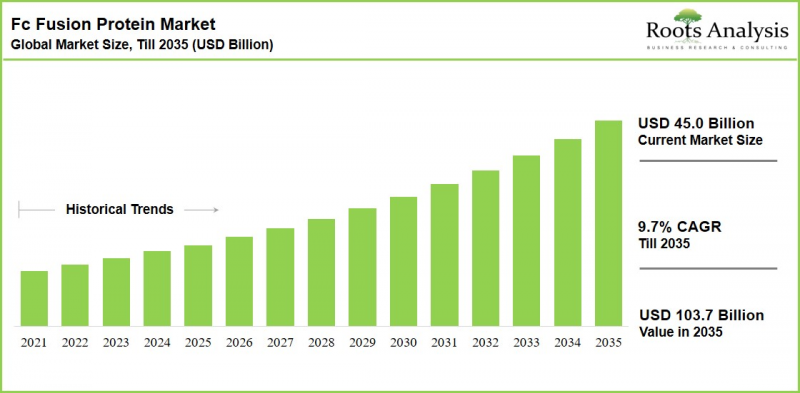
Fc Fusion Protein Market: Growth and Trends
Fc fusion proteins are engineered biologics created by genetically linking the Fc (fragment crystallizable) region of an antibody to a therapeutically relevant protein, peptide, or receptor domain. This design leverages the neonatal Fc receptor (FcRn) recycling pathway to extend plasma half-life, improve molecular stability, enable more favorable immune engagement, compared with the native biomolecule alone.
Growing global cases of chronic and autoimmune conditions, together with a persistent clinical need for therapies that combine efficacy with reduced dosing frequency, continue to push developers toward the Fc fusion format. Conventional biologics and small-molecule APIs are often limited by short circulating half-lives and frequent administration schedules; Fc fusion technology addresses this gap directly, translating into better adherence and improved quality of life for patients managing long-term disease.
The pipeline is also evolving structurally. Beyond first-generation single-target molecules such as etanercept, developers are advancing multi-specific constructs capable of engaging more than one biological pathway within a single molecule. The early-phase evaluation of HCB301, a tri-specific SIRPa-PD-1-TGF-B Fc fusion protein, is a useful illustration: initial clinical data pointed to a workable safety profile, predictable pharmacokinetics, and early antitumor signal, suggesting that multifunctional Fc fusion architecture may become an important next-generation immuno-oncology approach.
At the same time, the molecular complexity of Fc fusion proteins, larger, more heterogeneous constructs than a typical monoclonal antibody, places real demands on manufacturing and cold-chain handling. This is where the opportunity for distribution partners, specialty logistics providers, and channel intermediaries becomes most relevant: as more Fc fusion candidates progress through late-stage trials and reach approval, sponsors will increasingly need partners capable of temperature-controlled transport, GMP-aligned handling, and reliable last-mile delivery into hospital and specialty-clinic settings.
Growth Drivers: Factors Fueling Market Expansion
Two forces are principally responsible for the market's steady expansion. First, the rising global burden of chronic and autoimmune diseases, cancer, diabetes, rheumatoid arthritis, and related conditions, has widened the addressable patient population for immune-modulating biologics, and Fc fusion proteins are well positioned given their demonstrated ability to neutralize disease-causing ligands and regulate immune signalling. Second, the format's core pharmacokinetic advantage, extended plasma half-life through FcRn-mediated recycling, directly reduces dosing frequency, which in turn improves patient compliance and treatment outcomes in indications that require sustained, long-term management. Together, these drivers reinforce a durable, non-cyclical demand base for the underlying therapeutic class, and by extension for the logistics and distribution infrastructure that supports it.
Market Challenges: Critical Barriers Hindering Progress
Growth is nonetheless tempered by manufacturing complexity. The intricate molecular architecture of Fc fusion proteins tends to produce lower manufacturing yields and higher process-optimization requirements than simpler biologics, pushing up production costs and lengthening development timelines. Compounding this, aggregation and inconsistent glycosylation remain persistent quality concerns, since both can affect product stability, efficacy, and immunogenicity, adding to the analytical and regulatory burden placed on manufacturers. For distribution and logistics partners, this technical complexity reinforces the importance of validated cold-chain capability and demonstrable GMP-aligned handling protocols as a baseline requirement for entry into this space, rather than a differentiator.
Fc Fusion Protein Market: Key Insights
The report delves into the current state of the Fc Fusion Protein market and identifies potential growth opportunities for distribution partners, channel intermediaries, and service integrators. Some key findings include:
- Next-Gen Immuno-Oncology Pipelines: Biopharma is advancing novel Fc constructs into early Phase 1/2 clinical trials, such as SIRPa-Fc (e.g., Henlius's HLX701) and FLT3L-Fc (e.g., Roche's RO7497987) to enhance immune response and dendritic cell priming.
- Targeted Fc Domain Engineering: Researchers are modifying the CH2/CH3 amino acid sequences to optimize FcRn recycling (extending plasma half-life) while silencing or tuning effector functions (ADCC/CDC) to minimize off-target toxicity.
- Early CDMO Manufacturing Alliances: Startups are forming early-stage biomanufacturing partnerships with specialized CDMOs (e.g., ProBioGen and Zag Bio for ZAG 101) to overcome cell-line expression bottlenecks and establish scalable GMP production.
- Multispecific & Bispecific Platforms: Focus is shifting beyond traditional receptor-extracellular domain (ECD) fusions toward multi-domain, bispecific Fc constructs capable of engaging multiple targets simultaneously in autoimmune and oncology settings.
- Robust Intellectual Property Activity: Academic institutions and biopharma developers have generated a massive IP surge, securing proprietary Fc modifications, linker technologies, and combination therapies.
Recent Deal Activity Signalling Investor Momentum
- In March: Shanghai Henlius Biotech dosed the first patient in a Phase 1b/2 trial evaluating HLX701, a next-generation SIRPa-Fc fusion protein, in combination with cetuximab and chemotherapy for advanced RAS/BRAF wild-type metastatic colorectal cancer in China.
- In January: ProBioGen entered a collaboration with Zag Bio to provide cell line development, process development, and GMP manufacturing support for ZAG 101, an Fc fusion candidate targeting Type 1 diabetes.
- In January: Henlius received NMPA clearance to begin a Phase 1b/2 study of HLX701, a SIRPa-Fc fusion protein licensed from FBD Biologics, in partnership with HanchorBio, for advanced solid tumors.
- In January: HanchorBio formed a strategic partnership with WuXi Biologics to accelerate development and GMP manufacturing of its bi- and multi-functional Fc fusion protein pipeline across oncology and autoimmune disease.
Collectively, these transactions demonstrate sustained industry confidence in the Fc fusion format, particularly through investments in next-generation multi-specific constructs and strategic manufacturing collaborations with CDMOs.
Fc Fusion Protein Market Segments
The market sizing and opportunity analysis has been segmented across the following parameters:
By Type of Fusion Molecule
- Receptor ECD
- Antibodies
- Cytokines
- Growth Factor
- Others
By Therapeutic Area
- Autoimmune & Inflammatory Disorders
- Ophthalmological Disorders
- Oncological Disorders
- Hematological Disorders
- Other Disorders
By Route of Administration
- Intravenous Route
- Subcutaneous Route
- Intravitreal Route
By End User
- Hospitals
- Specialty Clinics
- Other End Users
By Geographical Regions
- North America
- US
- Canada
- Europe
- Germany
- UK
- France
- Italy
- Spain
- Rest of Europe
- Asia-Pacific
- China
- Japan
- South Korea
- Australia
Fc Fusion Protein Market: Key Segmentation Insights
Receptor Extracellular Domain (ECD) Leads the Market
Based on Roots Analysis market assessment, receptor extracellular domain (ECD) based Fc fusion proteins currently secure the largest share of overall market revenue. These molecules are built by fusing the extracellular domain of a naturally occurring receptor to an immunoglobulin Fc region, creating a construct that intercepts disease-causing ligands before they can engage cell-surface receptors. This combination of targeted pathway inhibition and Fc-driven half-life extension has underpinned strong clinical adoption. The cytokine-based fusion segment, meanwhile, is expected to post a comparatively higher CAGR, as Fc engineering increasingly addresses the short half-life and dose-limiting toxicity that have historically constrained native cytokine therapeutics.
Autoimmune and Inflammatory Disorders Dominate the Market
According to our market analysis, autoimmune and inflammatory disorders account for the largest share of the market. This highest share reflects the high global burden of chronic immune-mediated disease and the long clinical track record of receptor-Fc fusion drugs such as etanercept and abatacept across rheumatoid arthritis, psoriatic arthritis, and related conditions. Looking ahead, the ophthalmological disorders segment is projected to grow at a notably faster pace, supported by the rising prevalence of age-related retinal disease and the expanding role of Fc fusion proteins in extending intraocular drug activity.
Intravenous Route Dominates the Market
Based on the Roots Analysis market report, the intravenous route accounts for the highest share of the market, consistent with the systemic, hospital-administered nature of many chronic and severe indications this drug class addresses. The intravitreal route, used to deliver therapeutics directly into the eye for retinal disease, is expected to grow at a comparatively faster rate as ophthalmic applications expand.
North America Dominates the Market and Asia-Pacific Register Higher CAGR
North America is projected to hold the largest share of global market revenue; a position built on its historical role as the first region to commercialize an Fc fusion protein and its concentration of leading developers and manufacturing infrastructure. Asia-Pacific, however, is expected to register the fastest CAGR over the forecast period, aided by expanding biologics manufacturing capacity in China and India and increasingly supportive government policy, factors that are also expected to widen the opportunity for regional distribution and supply chain partners.
Hospitals Hold the Highest Market Share
Hospitals capture the largest share of end-user revenue, given the specialist supervision, infusion capability, and diagnostic monitoring that Fc fusion biologic therapy typically requires, along with hospitals' role as first adopters of newly approved biologics. Specialty clinics are expected to grow at a faster pace as outpatient care models for rheumatology, ophthalmology, and immunology continue to expand.
Example Players in Fc Fusion Protein Market
- Amgen
- Bristol Myers Squibb
- Eli Lilly
- Merck
- Novartis
- Pfizer
- Regeneron Pharmaceuticals
- Roche
- Sanofi
Expert Interview and Industry Insights
The research report features detailed transcripts of interviews held with the following industry participants:
- Chief Executive Officer, Small Company, Taiwan
- Chief Executive Officer, Senior Vice President, Mid-sized Company, Seoul
- Co-founder, President and Chief Executive Officer, Mid-sized Company, US
- Founder and Principal Consultant, Small Company, US; Professor in Biomedical Innovation, Very Large Institute, Norway
- Founder, Small Company, Taiwan
- Head of US Medical Affairs and Evidence Generation, Mid-sized Company, US
- UBC Chair in Multiple Sclerosis and Autoimmune Neurology Research, Very Large Institute, Canada
- Senior Research Scientist, Very Large Institute, China
- Professor of Medicine, Clinical Translational Science, Very Large Institute, US
- Professor of Pediatrics and Communicable Diseases, Very Large Institute, US
FC FUSION PROTEIN MARKET: RESEARCH COVERAGE
- Market Sizing and Opportunity Analysis: An in-depth analysis of the market focusing on key segments, including target indication, type of fusion molecule, route of administration, and key geographical regions.
- Marketed and Pipeline Landscape: A detailed assessment of approved and clinical / preclinical Fc fusion protein based therapeutics candidates, including phase of development, fusion-molecule type, target indication, route of administration, and developer information.
- Company Profiles: In-depth profiles of prominent players engaged in Fc fusion protein development, covering company overview, product portfolio, recent developments, and future outlook.
- Clinical Trial Analysis: An in-depth analysis of completed, ongoing and planned clinical studies, based on trial phase, study design, type of intervention, leading sponsors, and regional distribution of trials.
- Grant Analysis: A review of research grants awarded to institutes engaged in Fc fusion protein related projects, covering year of award, amount awarded, administering institute, and purpose of funding.
- Publication Analysis: A review of peer-reviewed scientific literature related to Fc fusion proteins, covering year of publication, emerging focus areas, leading authors, and key journals.
- Patent Analysis: A detailed analysis of patents filed / granted related to Fc fusion proteins, including patent jurisdiction, patent age, emerging focus areas, and leading players, along with a benchmarking and valuation analysis.
- Partnerships and Collaborations: An analysis of partnerships inked by stakeholders in the Fc fusion protein dominas, based on year, type of partnership, and most active players.
- Market Forecast and Opportunity Analysis: Historical trends and forecasted estimates across all key segments and geographies, developed using a top-down and bottom-up triangulated methodology.
Key Questions Answered in this Report
- Which are the leading companies in the Fc fusion protein market?
- How big is the current Fc fusion protein market, and what is its projected size by 2035?
- What is the CAGR of this market through the forecast period?
- Which type of fusion molecule and therapeutic area currently hold the largest market share?
- Which region dominates the market today, and which region is growing the fastest?
- What are the key growth drivers and challenges shaping this market?
- How is the current and future market opportunity distributed across key segments?
- What opportunities exist for distributors, specialty logistics providers, and channel partners entering this space?
- Which recent partnerships, licensing deals, and clinical developments signal investor momentum in this market?
Reasons to Buy this Report
This report is built to give distributors, channel partners, and investors a clear, decision-ready view of a market segment that is expanding steadily but remains under-covered from a channel and logistics perspective. Its core differentiators include:
- Top-Down and Bottom-Up Triangulated Forecasting: Market estimates are derived using a hybrid methodology that validates top-down category-level assessments against bottom-up, company- and product-level data, reducing forecast bias and improving confidence for planning purposes.
- Five-Parameter Actionable Segmentation: Segmentation across type of fusion molecule, therapeutic area, route of administration, end user, and geography enables precise opportunity sizing for any go-to-market, procurement, or investment thesis.
- Primary Research-Backed Insights: Findings are validated through direct discussions with CEOs, senior researchers, and clinical / academic experts across small, mid-sized, and large organizations, ensuring the analysis reflects real operating conditions rather than desk research alone.
- Forward-Looking Pipeline: Coverage of next-generation, multi-specific Fc fusion candidates provides an early read on which indications and geographies are likely to generate future distribution and logistics demand.
- 150+ Pages Analyst-Curated Report: A concise, decision-focused report structure that surfaces the data points and strategic themes that matter most, without the noise of unnecessary detail.
Additional Benefits
- Complementary PPT Insights Pack
- Complementary Excel Data Packs for all Analytical Modules in the Report
- 15% Free Content Customization
- Detailed Report Walkthrough Session with Research Team
- Free Updated report if the report is 6-12 months old or older
TABLE OF CONTENTS
1. BACKGROUND
- 1.1. Context
- 1.2. Project Objectives
2. RESEARCH METHODOLOGY
- 2.1. Chapter Overview
- 2.2. Research Assumptions
- 2.2.1. Market Landscape and Market Trends
- 2.2.2. Market Forecast and Opportunity Analysis
- 2.2.3. Comparative Analysis
- 2.3. Database Building
- 2.3.1. Data Collection
- 2.3.2. Data Validation
- 2.3.3. Data Analysis
- 2.4. Project Methodology
- 2.4.1. Secondary Research
- 2.4.1.1. Annual Reports
- 2.4.1.2. Academic Research Papers
- 2.4.1.3. Company Websites
- 2.4.1.4. Investor Presentations
- 2.4.1.5. Regulatory Filings
- 2.4.1.6. White Papers
- 2.4.1.7. Industry Publications
- 2.4.1.8. Conferences and Seminars
- 2.4.1.9. Government Portals
- 2.4.1.10. Media and Press Releases
- 2.4.1.11. Newsletters
- 2.4.1.12. Industry Databases
- 2.4.1.13. Roots Proprietary Databases
- 2.4.1.14. Paid Databases and Sources
- 2.4.1.15. Social Media Portals
- 2.4.1.16. Other Secondary Sources
- 2.4.2. Primary Research
- 2.4.2.1. Types of Primary Research
- 2.4.2.1.1. Qualitative Research
- 2.4.2.1.2. Quantitative Research
- 2.4.2.1.3. Hybrid Approach
- 2.4.2.2. Advantages of Primary Research
- 2.4.2.3. Techniques for Primary Research
- 2.4.2.3.1. Interviews
- 2.4.2.3.2. Surveys
- 2.4.2.3.3. Focus Groups
- 2.4.2.3.4. Observational Research
- 2.4.2.3.5. Social Media Interactions
- 2.4.2.4. Key Opinion Leaders Considered in Primary Research
- 2.4.2.4.1. Company Executives (CXOs)
- 2.4.2.4.2. Board of Directors
- 2.4.2.4.3. Company Presidents and Vice Presidents
- 2.4.2.4.4. Research and Development Heads
- 2.4.2.4.5. Technical Experts
- 2.4.2.4.6. Subject Matter Experts
- 2.4.2.4.7. Scientists
- 2.4.2.4.8. Doctors and Other Healthcare Providers
- 2.4.2.5. Ethics and Integrity
- 2.4.2.5.1. Research Ethics
- 2.4.2.5.2. Data Integrity
- 2.4.2.1. Types of Primary Research
- 2.4.3. Analytical Tools and Databases
- 2.4.1. Secondary Research
- 2.5. Robust Quality Control
3. ECONOMIC AND OTHER PROJECT-SPECIFIC CONSIDERATIONS
- 3.1. Chapter Overview
- 3.2. Forecast Methodology
- 3.2.1. Top-down Approach
- 3.2.2. Bottom-up Approach
- 3.2.3. Hybrid Approach
- 3.3. Market Assessment Framework
- 3.3.1. Total Addressable Market (TAM)
- 3.3.2. Serviceable Addressable Market (SAM)
- 3.3.3. Serviceable Obtainable Market (SOM)
- 3.3.4. Currently Acquired Market (CAM)
- 3.4. Forecasting Tools and Techniques
- 3.4.1. Qualitative Forecasting
- 3.4.2. Correlation
- 3.4.3. Regression
- 3.4.4. Extrapolation
- 3.4.5. Convergence
- 3.4.6. Sensitivity Analysis
- 3.4.7. Scenario Planning
- 3.4.8. Data Visualization
- 3.4.9. Time Series Analysis
- 3.4.10. Forecast Error Analysis
- 3.5. Key Considerations
- 3.5.1. Demographics
- 3.5.2. Government Regulations
- 3.5.3. Reimbursement Scenarios
- 3.5.4. Market Access
- 3.5.5. Supply Chain
- 3.5.6. Industry Consolidation
- 3.5.7. Pandemic / Unforeseen Disruptions Impact
- 3.6. Limitations
4. MACRO-ECONOMIC INDICATORS
- 4.1. Chapter Overview
- 4.2. Market Dynamics
- 4.2.1. Time Period
- 4.2.1.1. Historical Trends
- 4.2.1.2. Current and Forecasted Estimates
- 4.2.2. Currency Coverage
- 4.2.2.1. Major Currencies Affecting the Market
- 4.2.2.2. Factors Affecting Currency Fluctuations
- 4.2.2.3. Impact of Currency Fluctuations on the Industry
- 4.2.3. Foreign Currency Exchange Rate
- 4.2.3.1. Impact of Foreign Exchange Rate Volatility on the Market
- 4.2.3.2. Strategies for Mitigating Foreign Exchange Risk
- 4.2.4. Recession
- 4.2.4.1. Assessment of Current Economic Conditions and Potential Impact on the Market
- 4.2.4.2. Historical Analysis of Past Recessions and Lessons Learnt
- 4.2.5. Inflation
- 4.2.5.1. Measurement and Analysis of Inflationary Pressures in the Economy
- 4.2.5.2. Potential Impact of Inflation on the Market Evolution
- 4.2.6. Interest Rates
- 4.2.6.1. Interest Rates and Their Impact on the Market
- 4.2.6.2. Strategies for Managing Interest Rate Risk
- 4.2.7. Commodity Flow Analysis
- 4.2.7.1. Type of Commodity
- 4.2.7.2. Origins and Destinations
- 4.2.7.3. Values and Weights
- 4.2.7.4. Modes of Transportation
- 4.2.8. Global Trade Dynamics
- 4.2.8.1. Import Scenario
- 4.2.8.2. Export Scenario
- 4.2.8.3. Trade Policies
- 4.2.8.4. Strategies for Mitigating the Risks Associated with Trade Barriers
- 4.2.8.5. Impact of Trade Barriers on the Market
- 4.2.9. War Impact Analysis
- 4.2.9.1. Russian-Ukraine War
- 4.2.9.2. Israel-Hamas War
- 4.2.10. COVID Impact / Related Factors
- 4.2.10.1. Global Economic Impact
- 4.2.10.2. Industry-specific Impact
- 4.2.10.3. Government Response and Stimulus Measures
- 4.2.10.4. Future Outlook and Adaptation Strategies
- 4.2.11. Other Indicators
- 4.2.11.1. Fiscal Policy
- 4.2.11.2. Consumer Spending
- 4.2.11.3. Gross Domestic Product (GDP)
- 4.2.11.4. Employment
- 4.2.11.5. Taxes
- 4.2.11.6. Stock Market Performance
- 4.2.11.7. Cross-Border Dynamics
- 4.2.1. Time Period
- 4.3. Conclusion
5. EXECUTIVE SUMMARY
6. INTRODUCTION
- 6.1. Overview of Fc Fusion Proteins
- 6.2. Components of Fc Fusion Proteins
- 6.3. Mechanism of Action
- 6.4. Types of Fc Fusion Proteins
- 6.5. Applications of Fc Fusion Proteins
- 6.6. Advantages of Fc Fusion Proteins over Other Biological Moieties
- 6.7. Future Perspectives
7. PIPELINE REVIEW: MARKETED AND CLINICAL DRUGS
- 7.1. Analysis Methodology and Key Parameters
- 7.2. Fc Fusion Proteins: Drug Pipeline
- 7.3. Fc Fusion Proteins: Pipeline Analysis
- 7.3.1. Analysis by Phase of Development
- 7.3.2. Analysis by Type of Fusion Molecule
- 7.3.3. Analysis by Target Gene
- 7.3.4. Analysis by Therapeutic Areas
- 7.3.5. Analysis by Target Disease Indications
- 7.3.6. Analysis by Type of Therapy
- 7.3.7. Analysis by Route of Administration
- 7.3.8. Analysis by Dosing Frequency
- 7.4. Fc Fusion Proteins: List of Drug Developers
- 7.4.1. Analysis by Year of Establishment
- 7.4.2. Analysis by Company Size
- 7.4.3. Analysis by Location of Headquarters
- 7.4.4. Leading Developers
- 7.4.5. Grid Analysis: Distribution by Phase of Development, Company Size and Location of Headquarters
8. COMPANY PROFILES
- 8.1. Chapter Overview
- 8.2. Amgen
- 8.2.1. Company Overview
- 8.2.2. Financial Information
- 8.2.3. Product Portfolio
- 8.2.4. Recent Developments and Future Outlook
- 8.3. Bristol-Myers Squibb
- 8.4. Pfizer
- 8.5. Regeneron Pharmaceuticals
- 8.6. Roche
- 8.7. Sanofi
9. CLINICAL TRIAL ANALYSIS
- 9.1. Analysis Methodology and Key Parameters
- 9.2. Fc Fusion Proteins: List of Clinical Trials
- 9.2.1. Analysis by Trial Registration Year
- 9.2.2. Analysis by Trial Phase
- 9.2.3. Analysis by Study Design
- 9.2.4. Analysis by Type of Masking
- 9.2.5. Analysis by Type of Intervention Model
- 9.2.6. World Cloud: Emerging Focus Areas
- 9.2.7. Analysis by Trial Registration Year and Geography
- 9.2.8. Analysis by Type of Sponsor
- 9.2.9. Leading Industry Players: Analysis by Number of Trials Registered
- 9.2.10. Leading Non-Industry Players: Analysis by Number of Trials Registered
- 9.2.11. Popular Indications: Analysis by Number of Registered Trials
- 9.2.12. Popular Interventions: Analysis by Number of Registered Trials
- 9.2.13. Geographical Analysis by Number of Registered Trials
- 9.2.14. Geographical Analysis by Number of Patients Enrolled
10. ACADEMIC GRANT ANALYSIS
- 10.1. Analysis Methodology and Key Parameters
- 10.2. Fc Fusion Proteins: Analysis of Academic Grants
- 10.2.1. Analysis by Year of Grant Award
- 10.2.2. Analysis by Amount Awarded
- 10.2.3. Analysis by Administering Institute Center
- 10.2.4. Analysis by Support Period
- 10.2.5. Analysis by Type of Grant Application
- 10.2.6. Analysis by Purpose of Grant Award
- 10.2.7. Analysis by Activity Code
- 10.2.8. Word Cloud Analysis: Emerging Focus Areas
- 10.2.9. Popular NIH Departments: Analysis by Number of Grants
- 10.2.10. Prominent Program Officers: Analysis by Number of Grants
- 10.2.11. Popular Recipient Organizations: Analysis by Number of Grants
11. PUBLICATION ANALYSIS
- 11.1. Analysis Methodology and Key Parameters
- 11.2. Fc Fusion Proteins: Recent Publications
- 11.3. Analysis by Year of Publication
- 11.4. Word Cloud Analysis: Emerging Focus Areas
- 11.5. Analysis by Target Therapeutic Area
- 11.6. Leading Authors: Analysis by Number of Publications
- 11.7. Key Journals: Analysis by Number of Publications
12. PATENT ANALYSIS
- 12.1. Analysis Methodology and Key Parameters
- 12.2. Fc Fusion Proteins: Patent Analysis
- 12.2.1. Analysis by Publication Year
- 12.2.2. Analysis by Type of Patent
- 12.2.3. Analysis by Geographical Location
- 12.2.4. Analysis by Patent Age
- 12.2.5. Analysis by CPC Symbols
- 12.2.6. Word Cloud Analysis: Emerging Focus Areas
- 12.2.7. Leading Patent Assignees: Analysis by Number of Patents
- 12.2.8. Leading Industry Players: Analysis by Number of Patents
- 12.2.9. Leading Non-Industry Players: Analysis by Number of Patents
- 12.2.10. Fc Fusion Proteins: Patent Benchmarking Analysis
- 12.2.11. Fc Fusion Proteins: Patent Valuation Analysis
13. PARTNERSHIPS AND COLLABORATIONS
- 13.1. Analysis Methodology and Key Parameters
- 13.2. Partnership Models
- 13.3. Fc Fusion Proteins: List of Partnerships and Collaborations
- 13.3.1. Analysis by Year of Partnership
- 13.3.2. Analysis by Type of Partnership
- 13.3.3. Analysis by Type of Partnership and Type of Fusion molecule
- 13.3.4. Analysis by Year of Partnership and Type of Partner
- 13.3.5. Analysis by Type of Partnership and Type of Partner
- 13.3.6. Most Active Players: Analysis by Number of Partnerships
- 13.3.7. Regional Analysis
- 13.3.7.1. Intercontinental and Intracontinental Agreements
14. MARKET IMPACT ANALYSIS: DRIVERS, RESTRAINTS, OPPORTUNITIES AND CHALLENGES
- 14.1. Chapter Overview
- 14.2. Market Drivers
- 14.3. Market Restraints
- 14.4. Market Opportunities
- 14.5. Market Challenges
15. GLOBAL FC FUSION PROTEIN MARKET
- 15.1. Chapter Overview
- 15.2. Assumptions and Methodology
- 15.3. Global Fc Fusion Protein Market, Historical Trends (Since 2021) and Forecasted Estimates (Till 2035)
- 15.3.1. Scenario Analysis
- 15.3.1.1. Conservative Scenario
- 15.3.1.2. Optimistic Scenario
- 15.3.1. Scenario Analysis
16. FC FUSION PROTEIN MARKET, BY TYPE OF FUSION MOLECULE
- 16.1. Chapter Overview
- 16.2. Key Assumptions and Methodology
- 16.3. Fc Fusion Protein Market: Distribution by Type of Fusion Molecule
- 16.3.1. Fc Fusion Protein Market for Receptor ECD, Historical Trends (Since 2021) and Forecasted Estimates (Till 2035)
- 16.3.2. Fc Fusion Protein Market for Antibodies, Historical Trends (Since 2021) and Forecasted Estimates (Till 2035)
- 16.3.3. Fc Fusion Protein Market for Cytokines, Historical Trends (Since 2021) and Forecasted Estimates (Till 2035)
- 16.3.4. Fc Fusion Protein Market for Growth Factor, Historical Trends (Since 2021) and Forecasted Estimates (Till 2035)
- 16.3.5. Fc Fusion Protein Market for Others, Historical Trends (Since 2021) and Forecasted Estimates (Till 2035)
- 16.4. Data Triangulation and Validation
17. FC FUSION PROTEIN MARKET, BY THERAPEUTIC AREA
- 17.1. Chapter Overview
- 17.2. Key Assumptions and Methodology
- 17.3. Fc Fusion Protein Market: Distribution by Therapeutic Area
- 17.3.1. Fc Fusion Protein Market for Autoimmune & Inflammatory Disorders, Historical Trends (Since 2021) and Forecasted Estimates (Till 2035)
- 17.3.2. Fc Fusion Protein Market for Ophthalmological Disorders, Historical Trends (Since 2021) and Forecasted Estimates (Till 2035)
- 17.3.3. Fc Fusion Protein Market for Oncological Disorders, Historical Trends (Since 2021) and Forecasted Estimates (Till 2035)
- 17.3.4. Fc Fusion Protein Market for Hematological Disorders, Historical Trends (Since 2021) and Forecasted Estimates (Till 2035)
- 17.3.5. Fc Fusion Protein Market for Other Disorders, Historical Trends (Since 2021) and Forecasted Estimates (Till 2035)
- 17.4. Data Triangulation and Validation
18. FC FUSION PROTEIN MARKET, BY ROUTE OF ADMINISTRATION
- 18.1. Chapter Overview
- 18.2. Key Assumptions and Methodology
- 18.3. Fc Fusion Protein Market: Distribution by Route of Administration
- 18.3.1. Fc Fusion Protein Market for Intravenous Route, Historical Trends (Since 2021) and Forecasted Estimates (Till 2035)
- 18.3.2. Fc Fusion Protein Market for Subcutaneous Route, Historical Trends (Since 2021) and Forecasted Estimates (Till 2035)
- 18.3.3. Fc Fusion Protein Market for Intravitreal Route, Historical Trends (Since 2021) and Forecasted Estimates (Till 2035)
- 18.4. Data Triangulation and Validation
19. FC FUSION PROTEIN MARKET, BY END USER
- 19.1. Chapter Overview
- 19.2. Key Assumptions and Methodology
- 19.3. Fc Fusion Protein Market: Distribution by End User
- 19.3.1. Fc Fusion Protein Market for Hospitals, Historical Trends (Since 2021) and Forecasted Estimates (Till 2035)
- 19.3.2. Fc Fusion Protein Market for Specialty Clinics, Historical Trends (Since 2021) and Forecasted Estimates (Till 2035)
- 19.3.3. Fc Fusion Protein Market for Other End Users, Historical Trends (Since 2021) and Forecasted Estimates (Till 2035)
- 19.4. Data Triangulation and Validation
20. FC FUSION PROTEIN MARKET, BY GEOGRAPHICAL REGIONS
- 20.1. Chapter Overview
- 20.2. Key Assumptions and Methodology
- 20.3. Fc Fusion Protein Market: Distribution by Geographical Regions
- 20.3.1. Fc Fusion Protein Market in North America, Historical Trends (Since 2021) and Forecasted Estimates (Till 2035)
- 20.3.2. Fc Fusion Protein Market in Europe, Historical Trends (Since 2021) and Forecasted Estimates (Till 2035)
- 20.3.3. Fc Fusion Protein Market in Asia-Pacific, Historical Trends (Since 2021) and Forecasted Estimates (Till 2035)
- 20.3.4. Fc Fusion Protein Market in Middle East and North Africa, Historical Trends (Since 2021) and Forecasted Estimates (Till 2035)
- 20.3.5. Fc Fusion Protein Market in Latin America, Historical Trends (Since 2021) and Forecasted Estimates (Till 2035)
- 20.4. Data Triangulation and Validation
21. EXECUTIVE INSIGHTS
22. APPENDIX 1: TABULATED DATA

