PUBLISHER: Roots Analysis | PRODUCT CODE: 2112607

PUBLISHER: Roots Analysis | PRODUCT CODE: 2112607
Vaccines Market Distribution by Type of Vaccine API, Targeted Patient Population, Type of Vaccines, Route of Administration, and Key Geographical Region - Trends and Forecasts Till 2035
VACCINES MARKET: OVERVIEW
As per Roots Analysis, the global vaccines market is estimated to grow from USD 48 billion in the current year to USD 94 billion by 2030, reflecting a compound annual growth rate (CAGR) of approximately 11.9% during the forecast period.
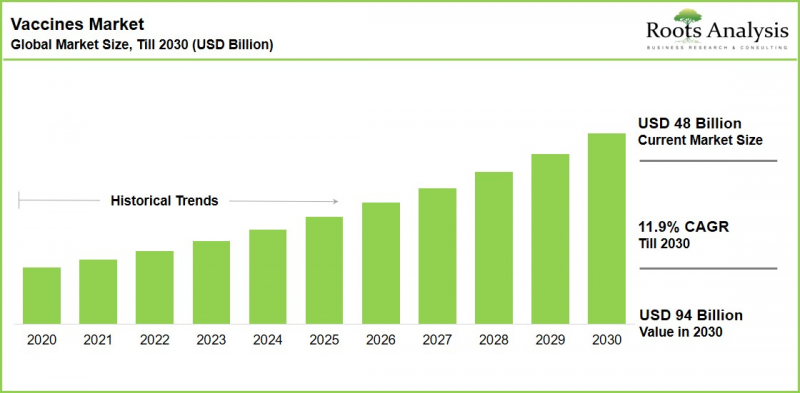
Vaccines Market: Growth and Trends
Vaccines remain one of the most cost-effective public health interventions available, using weakened, inactivated or engineered pathogen components to train the immune system to recognize and respond to disease-causing organisms before natural exposure occurs. The category spans well-established platforms such as live-attenuated, inactivated, subunit, conjugate and toxoid formulations, alongside a fast-growing pipeline of recombinant, mRNA and DNA-based candidates.
Global disease surveillance continues to reinforce the case for expanded immunization coverage. Health authorities have flagged a rising number of newly identified and re-emerging pathogens in recent years, while agencies tracking vector-borne and enteric illness continue to report a substantial annual caseload and mortality burden from conditions such as dengue and rotavirus infection. In response, governments, multilateral health bodies, and industry players have scaled up immunization programs, manufacturing partnerships, and regional production capacity, for instance, expanded polio vaccine manufacturing collaborations in Africa and multi-billion-dollar continental initiatives aimed at localizing vaccine production.
Growth Drivers: Factors Fueling Market Expansion
Demand is being propelled by the sustained global burden of infectious disease, heightened public health emphasis on childhood immunization schedules, and growing recognition of the role vaccines play in reducing downstream healthcare costs. National immunization programs targeting diseases such as diphtheria, pertussis, tetanus, and measles continue to expand coverage, particularly across low- and middle-income geographies supported by multilateral funding bodies. Parallel advances in adjuvant technology, thermostable formulations and needle-free delivery are broadening the addressable patient base, while next-generation mRNA and recombinant platforms are shortening development timelines and improving the ability of manufacturers to respond rapidly to emerging pathogens.
Market Challenges: Critical Barriers Hindering Progress
Despite favourable demand fundamentals, the industry continues to contend with structural constraints. Manufacturing vaccines derived from live biological systems requires specialized infrastructure, tightly controlled cold-chain logistics and highly skilled personnel, all of which elevate production costs and limit the speed at which capacity can be scaled.
Cold-chain maintenance remains a particular constraint in distributing vaccines to remote and resource-limited regions. In parallel, vaccine hesitancy driven by misinformation, affordability concerns and inconsistent access continue to cap uptake in certain markets, underscoring the need for coordinated public health messaging alongside continued product innovation.
Market Opportunities: Momentum Behind Next Generation Platforms
Continued investment in recombinant and mRNA-based vaccine technology is opening new growth avenues, offering faster development cycles, improved safety profiles, and the flexibility to target previously difficult pathogens. Public and private funding bodies have committed sizeable capital toward next-generation candidates delivered via novel routes such as intranasal and oral formats, aiming to improve compliance and reduce dependence on cold-chain infrastructure. Leading manufacturers are simultaneously deepening licensing and co-development partnerships to expand adjuvant platforms and accelerate pipeline diversification, positioning the industry for sustained innovation-led growth through the forecast period.
Vaccines Market: Key Insights
The report delves into the current state of the Vaccines market and identifies potential growth opportunities within the industry. Some key findings include:
- Vaccine developers are increasingly shifting R&D investments from COVID-19 vaccines toward high-growth infectious disease targets, including RSV, influenza, pneumococcal disease, dengue, malaria, HPV and Lyme disease.
- mRNA has evolved into a versatile vaccine platform, driving the development of multivalent, combination and rapid-response vaccines for emerging infectious diseases.
- Strategic partnerships are increasingly focused on co-development, technology licensing, manufacturing scale-up and regional commercialization to accelerate product development and market access.
- Public-private collaborations involving governments, global health organizations and vaccine manufacturers continue to strengthen pandemic preparedness, vaccine accessibility, and immunization programmes worldwide.
- The competitive landscape is becoming increasingly diversified, with biotechnology companies, academic institutions and regional manufacturers entering a market traditionally dominated by multinational pharmaceutical companies.
- The preventive vaccine pipeline remains one of the most active segments within biopharmaceutical R&D, with more than 1,400 completed, ongoing and planned clinical studies spanning diverse pathogens, vaccine platforms and patient populations. Increasing multinational trial participation is improving recruitment efficiency and supporting global regulatory submissions.
- Growing investments in thermostable formulations and needle-free delivery technologies are addressing cold-chain limitations and improving vaccine accessibility in low-resource settings.
- Regulatory agencies are increasingly adopting accelerated review pathways and collaborative approval mechanisms for vaccines addressing unmet medical needs and emerging infectious disease threats.
- Recent industry developments are centred on expanding RSV vaccine portfolios, advancing next-generation influenza vaccines, commercializing malaria, and dengue vaccines, and developing universal coronavirus vaccine candidates.
- Emerging vaccine developers are leveraging innovative delivery approaches, including intranasal, oral, and microneedle-based vaccines, to improve patient acceptance and immunization outcomes.
Vaccines Market
The market sizing and opportunity analysis has been segmented across the following parameters:
By Type of Vaccine API
- Conjugate Vaccines
- Inactivated and Subunit Vaccines
- Live Attenuated Vaccines
- Recombinant Vaccines
- Toxoid Vaccines
- Others
By Distribution by Targeted Patient Population
- Pediatric
- Adult
By Distribution by Vaccine Type
- Pneumococcal Conjugate Vaccine
- Human Papillomavirus Vaccine
- Rotavirus Vaccine
- Influenza Vaccine
- MMR Vaccine
- Tetanus and Diphtheria Booster Vaccine
- Varicella Vaccine
- DTaP-Hib-IPV Vaccine
- DTaP-HepB-Hib-IPV Vaccine
- Other
By Route of Administration
- Intramuscular
- Subcutaneous
- Oral
- Intravenous
- Others
By Geographical Regions
- North America
- Europe
- Asia-Pacific
- Rest of the World
Vaccines Market: Key Segments
Live Attenuated Lead the Market and Continue to Register Higher CAGR
Live-attenuated vaccines remain the leading technology category within the global market, a position underpinned by their long clinical track record, established regulatory pathways and broad deployment across pediatric immunization schedules. Continued innovation in attenuation and stabilization techniques is expected to sustain their relevance even as newer platforms gain traction.
North America Maintains Market Leadership
According to our market projections, North America is projected to remain the largest regional contributor to global vaccines revenue through the forecast period, supported by well-funded public health infrastructure, favorable reimbursement environments and rapid uptake of newly approved vaccines, including recently updated respiratory and variant-adapted formulations.
Asia-Pacific Poised for the Fastest Regional Growth
The Asia-Pacific vaccines market is expected to register the highest regional CAGR over the forecast horizon, driven by expanding immunization infrastructure, large unvaccinated patient pools, and coordinated national programs, such as multi-year partnerships with global vaccine alliances aimed at extending coverage of HPV and typhoid conjugate vaccines into routine childhood immunization schedules.
Example Players in Vaccines Market
- Bio Farma
- Emergent BioSolutions
- GC Pharma
- GlaxoSmithKline
- Janssen
- Merck
- Novavax
- Moderna
- Pfizer
- Sanofi Pasteur
- Valneva
VACCINES MARKET: RESEARCH COVERAGE
- Market Sizing and Opportunity Analysis: An in-depth, top-down and bottom-up assessment of the global vaccines market, segmented by [A] type of vaccine API, [B] targeted patient population, [C] type of vaccine, [D] route of administration, [E] geographical regions, and [F] sales forecast of therapies.
- Vaccines Market Landscape: A comprehensive review of marketed and clinical-stage vaccine candidates, profiled by type of developer, phase of development, route of administration, vaccine API, dosage form, dosage regimen, target disease indication and target patient population.
- Company Competitiveness Analysis: A benchmarking exercise assessing vaccine developers across North America, Europe, and Asia-Pacific on the basis of supplier strength (company size and domain experience) and pipeline strength (number of clinical-stage candidates, phase reached, route diversity and indication breadth).
- Company Profiles: Detailed profiles of leading vaccine manufacturers, capturing year of establishment, headquarters, company size, financial performance (where available), product portfolio, recent developments, and forward-looking outlook.
- Clinical Trial Analysis: An analysis of over a thousand completed, ongoing and planned vaccine trials, segmented by registration year, enrolled patient population, trial phase, recruitment status, study design, sponsor type, leading industry players, and geography.
- Disease-Specific Development Initiatives: A focused review of ongoing vaccine development for high-burden and emerging conditions, including COVID-19, Ebola virus disease, HIV/AIDS, malaria, and Zika virus infection, covering disease burden, current treatment landscape, R&D pipeline, and associated funding activity.
- Funding and Investment Analysis: A tracking exercise covering seed, venture, debt and grant financing, IPOs, and follow-on offerings across vaccine developers, segmented by funding type, vaccine API, focus area, investor type, and geography.
- Vaccine Contract Manufacturing (Case Study): A dedicated assessment of the vaccine CMO landscape, covering outsourced service scope, scale of operation, expression systems used, and manufacturer distribution by geography and vaccine type.
- Recent Developments and Market Impact Analysis: A structured review of recent partnerships, approvals, funding rounds, and policy actions shaping the competitive and regulatory environment, alongside an assessment of the key drivers, restraints, opportunities, and challenges influencing overall market evolution.
Key Questions Answered in this Report
- What is the current and projected size of the global vaccines market through 2030?
- What is the CAGR of the overall market and of its individual segments?
- Which vaccine API types, patient populations and routes of administration are expected to lead, and which will grow fastest?
- Which geographical region currently dominates the market, and which is poised for the fastest growth?
- Who are the leading companies in the vaccines market, and how do they compare on pipeline and commercial strength?
- What clinical trial and patent activity trends are shaping near-term competitive positioning?
- How is funding and investment activity distributed across vaccine developers, geographies, and technology types?
- What are the principal risks and structural barriers facing industry stakeholders?
Reasons to Buy this Report
- Top-Down and Bottom-Up Triangulation: Market estimates are cross-validated using a top-down macro-epidemiological model alongside a bottom-up, company-level revenue build-up, minimizing forecast bias, and improving confidence for investment and licensing decisions.
- Three-Scenario Forecasting: In addition to the base-case model, the report provides conservative and optimistic scenarios across every market segment, allowing stakeholders to stress-test assumptions under varying regulatory, funding and adoption conditions.
- Primary Research Depth: Insights are triangulated against structured interviews with clinicians, R&D leadership, and C-suite executives across vaccine developers, ensuring the findings reflect practitioner and industry sentiment, not desk research alone.
- Investor-Ready Financial Granularity: Segment-level revenue tables (by API, patient population, route of administration and geography), a company competitiveness matrix, and funding / investment tracking are structured for direct use in investment memos, board decks, and due-diligence workflows.
Additional Benefits
- Complementary PPT Data Packs
- Complementary Excel Data Packs for all Analytical Modules in the Report
- 15% Free Content Customization
- Detailed Report Walkthrough Session with Research Team
- Free Updated report if the report is 6-12 months old or older
TABLE OF CONTENTS
1. PREFACE
- 1.1. Scope of the Report
- 1.2. Research Methodology
- 1.3. Chapter Outlines
2. EXECUTIVE SUMMARY
3. INTRODUCTION
- 3.1. Chapter Overview
- 3.2. Preventive Vaccines
- 3.2.1. Classification of Vaccines
- 3.2.1.1. Live, Attenuated Vaccines
- 3.2.1.2. Inactivated Vaccines
- 3.2.1.3. Subunit Vaccines
- 3.2.1.4. Toxoid Vaccines
- 3.2.1.5. DNA Vaccines
- 3.2.2. Key Components of a Vaccine Formulation
- 3.2.3. Production of Vaccines using Different Expression Systems
- 3.2.3.1. Embryonated Chicken Eggs and Primary Chicken Embryonic Fibroblasts (CEFs)
- 3.2.3.2. Mammalian Expression Systems
- 3.2.3.3. Avian Expression Systems
- 3.2.3.4. Plant Expression Systems
- 3.2.3.5. Bacterial Expression Systems
- 3.2.3.6. Yeast Expression Systems
- 3.2.3.7. Insect Expression System
- 3.2.4. Routes of Vaccine Administration
- 3.2.4.1. Intramuscular Route
- 3.2.4.2. Subcutaneous Route
- 3.2.4.3. Oral Route
- 3.2.4.4. Intranasal Route
- 3.2.4.5. Intradermal Route
- 3.2.4.6. Inhalation
- 3.2.5. Clinical Development and Approval of Vaccines
- 3.2.6. Future Perspectives
- 3.2.1. Classification of Vaccines
4. MARKET LANDSCAPE
- 4.1. Chapter Overview
- 4.2. Preventive Vaccines: Overall Market Landscape
- 4.2.1. Marketed Vaccines Landscape
- 4.2.2. Clinical-Stage Vaccines Landscape
- 4.2.2.1. Analysis by Type of Developer
- 4.2.2.2. Analysis by Phase of Development
- 4.2.2.3. Analysis by Route of Administration
- 4.2.2.4. Analysis by Type of Vaccine API
- 4.2.2.5. Analysis by Dosage Form
- 4.2.2.6. Analysis by Dosage
- 4.2.2.7. Analysis by Target Disease Indication
- 4.2.2.8. Analysis by Target Patient Population
- 4.2.2.9. Key Industry Players: Analysis by Number of Vaccines in Clinical Development
- 4.2.2.10. Key Non-Industry Players: Analysis by Number of Vaccines in Clinical Development
5. COMPANY COMPETITIVENESS ANALYSIS
- 5.1. Chapter Overview
- 5.2. Methodology
- 5.3. Assumptions and Key Parameters
- 5.4. Competitiveness Analysis: Preventive Vaccine Developers
- 5.4.1. Preventive Vaccine Developers based in North America
- 5.4.2. Preventive Vaccine Developers based in Europe
- 5.4.3. Preventive Vaccine Developers based in Asia Pacific
6. COMPANY PROFILES
- 6.1. Chapter Overview
- 6.2. Bio Farma
- 6.2.1. Company Overview
- 6.2.2. Preventive Vaccines Portfolio
- 6.2.3. Recent Developments and Future Outlook
- 6.3. Emergent BioSolutions
- 6.3.1. Company Overview
- 6.3.2. Preventive Vaccines Portfolio
- 6.3.3. Recent Developments and Future Outlook
- 6.4. GC Pharma
- 6.4.1. Company Overview
- 6.4.2. Preventive Vaccines Portfolio
- 6.4.3. Recent Developments and Future Outlook
- 6.5. GlaxoSmithKline
- 6.5.1. Company Overview
- 6.5.2. Preventive Vaccines Portfolio
- 6.5.3. Recent Developments and Future Outlook
- 6.6. Janssen
- 6.6.1. Company Overview
- 6.6.2. Preventive Vaccines Portfolio
- 6.6.3. Recent Developments and Future Outlook
- 6.7. Merck
- 6.7.1. Company Overview
- 6.7.2. Preventive Vaccines Portfolio
- 6.7.3. Recent Developments and Future Outlook
- 6.8. Novavax
- 6.8.1. Company Overview
- 6.8.2. Preventive Vaccines Portfolio
- 6.8.3. Recent Developments and Future Outlook
- 6.9. Pfizer
- 6.9.1. Company Overview
- 6.9.2. Preventive Vaccines Portfolio
- 6.9.3. Recent Developments and Future Outlook
- 6.10. Sanofi Pasteur
- 6.10.1. Company Overview
- 6.10.2. Preventive Vaccines Portfolio
- 6.10.3. Recent Developments and Future Outlook
- 6.11. Valneva
- 6.11.1. Company Overview
- 6.11.2. Preventive Vaccines Portfolio
- 6.11.3. Recent Developments and Future Outlook
7. CLINICAL TRIAL ANALYSIS
- 7.1. Chapter Overview
- 7.2. Scope and Methodology
- 7.3. Preventive Vaccines: Clinical Trial Analysis
- 7.3.1. Analysis by Trial Registration Year
- 7.3.2. Analysis by Enrolled Patient Population and Trial Registration Year
- 7.3.3. Analysis by Trial Phase
- 7.3.4. Analysis by Trial Recruitment Status
- 7.3.5. Analysis by Study Design
- 7.3.6. Analysis by Trial Focus Area
- 7.3.7. Analysis by Type of Preventive Vaccine (based on Pathogen)
- 7.3.8. Analysis by Target Disease Indication
- 7.3.9. Analysis by Type of Sponsor / Collaborator
- 7.3.10. Leading Industry Players: Analysis by Number of Registered Trials
- 7.3.11. Geographical Analysis by Number of Registered Trials
- 7.3.12. Geographical Analysis by Enrolled Patient Population
- 7.3.13. Geographical Analysis by Trial Recruitment Status
8. ONGOING VACCINE DEVELOPMENT INITIATIVES FOR COMPLEX CONDITIONS
- 8.1. Chapter Overview
- 8.2. Coronavirus Disease (COVID-19)
- 8.2.1. Disease Overview
- 8.2.2. Global Burden of COVID-19
- 8.2.3. Current Treatment Landscape
- 8.2.4. Preventive Vaccines for COVID-19
- 8.2.4.1. Historical Background of COVID-19 Vaccine Research
- 8.2.4.2. COVID-19 and Affiliated Research Landscape
- 8.2.5. Funding Instances
- 8.2.6. Recent Developments
- 8.3. Ebola Virus Disease (EVD)
- 8.3.1. Disease Overview
- 8.3.2. Global Burden of EVD
- 8.3.3. Current Treatment Landscape
- 8.3.4. Preventive Vaccines for EVD
- 8.3.4.1. Historical Background of Ebola Virus Vaccine Research
- 8.3.4.2. Anti-Ebola Virus Vaccines and Affiliated Research Landscape
- 8.3.5. Funding Instances
- 8.3.6. Recent Developments
- 8.4. HIV/AIDS
- 8.4.1. Disease Overview
- 8.4.2. Global Burden of HIV/AIDS
- 8.4.3. Current Treatment Landscape
- 8.4.4. Preventive Vaccines for HIV/AIDS
- 8.4.4.1. Historical Background of HIV/AIDS Vaccine Research
- 8.4.4.2. Anti-HIV Vaccines and Affiliated Research Landscape
- 8.4.5. Funding Instances
- 8.4.6. Recent Developments
- 8.5. Malaria
- 8.5.1. Disease Overview
- 8.5.2. Global Burden of Malaria
- 8.5.3. Current Treatment Landscape
- 8.5.4. Preventive Vaccines for Malaria
- 8.5.4.1. Historical Background of Malaria Vaccine Research
- 8.5.4.2. Anti-Malaria Vaccines and Affiliated Research Landscape
- 8.5.5. Funding Instances
- 8.5.6. Recent Developments
- 8.6. Zika Virus Infection
- 8.6.1. Disease Overview
- 8.6.2. Global Burden of Zika Virus Infection
- 8.6.3. Current Treatment Landscape
- 8.6.4. Preventive Vaccines for Zika Virus Infection
- 8.6.4.1. Historical Background of Zika Virus Vaccine Research
- 8.6.4.2. Anti-Zika Virus Vaccines and Affiliated Research Landscape
- 8.6.5. Funding Instances
- 8.6.6. Recent Developments
9. FUNDING AND INVESTMENT ANALYSIS
- 9.1. Chapter Overview
- 9.2. Types of Funding
- 9.3. Preventive Vaccines: Funding and Investment Analysis
- 9.3.1. Analysis by Number of Funding Instances
- 9.3.2. Analysis by Amount Invested
- 9.3.3. Analysis by Type of Funding
- 9.3.4. Analysis by Amount Invested across Different Types of Vaccine API
- 9.3.5. Analysis by Focus Area
- 9.3.6. Analysis by Amount Invested by Different Type of Investors
- 9.3.7. Most Active Players: Analysis by Number of Funding Instances
- 9.3.8. Most Active Investors: Analysis by Number of Funding Instances
- 9.3.9. Analysis by Geography
- 9.3.9.1. Continent-wise Analysis
- 9.3.9.2. Country-wise Analysis
10. MARKET SIZING AND OPPORTUNITY ANALYSIS
- 10.1. Chapter Overview
- 10.2. Forecast Methodology and Key Assumptions
- 10.3. Overall Preventive Vaccines Market, till 2030
- 10.3.1. Preventive Vaccines Market, till 2030: Distribution by Route of Administration
- 10.3.2. Preventive Vaccines Market, till 2030: Distribution by Type of Vaccine
- 10.3.3. Preventive Vaccines Market, till 2030: Distribution by Type of Vaccine API
- 10.3.4. Preventive Vaccines Market, till 2030: Distribution by Target Patient Population
- 10.3.5. Preventive Vaccines Market, till 2030: Distribution by Key Geographical Regions
- 10.3.5.1. Preventive Vaccines Market in North America, till 2030
- 10.3.5.1.1. Preventive Vaccines Market in the US, till 2030
- 10.3.5.1.2. Preventive Vaccines Market in Mexico, till 2030
- 10.3.5.1.3. Preventive Vaccines Market in Canada, till 2030
- 10.3.5.2. Preventive Vaccines Market in Europe, till 2030
- 10.3.5.2.1. Preventive Vaccines Market in Spain, till 2030
- 10.3.5.2.2. Preventive Vaccines Market in the UK, till 2030
- 10.3.5.2.3. Preventive Vaccines Market in Italy, till 2030
- 10.3.5.2.4. Preventive Vaccines Market in France, till 2030
- 10.3.5.2.5. Preventive Vaccines Market in Germany, till 2030
- 10.3.5.2.6. Preventive Vaccines Market in Rest of Europe, till 2030
- 10.3.5.3. Preventive Vaccines Market in Asia Pacific, till 2030
- 10.3.5.3.1. Preventive Vaccines Market in India, till 2030
- 10.3.5.3.2. Preventive Vaccines Market in China, till 2030
- 10.3.5.3.3. Preventive Vaccines Market in Australia, till 2030
- 10.3.5.3.4. Preventive Vaccines Market in Rest of Asia Pacific, till 2030
- 10.3.5.4. Preventive Vaccines Market in Rest of the World, till 2030
- 10.3.5.1. Preventive Vaccines Market in North America, till 2030
11. CASE-IN-POINT: CONTRACT MANUFACTURING OF VACCINES
- 11.1. Chapter Overview
- 11.2. Vaccine Contract Manufacturing
- 11.2.1. Addressing an Unmet Need
- 11.2.2. Commonly Outsourced Operations
- 11.2.3. Selecting a CMO Partner
- 11.2.4. Advantages of Outsourcing Manufacturing Services
- 11.2.5. Associated Risks and Challenges
- 11.3. Vaccine Contract Manufacturing: Overall Market Landscape
- 11.3.1. Analysis by Year of Establishment
- 11.3.2. Analysis by Company Size
- 11.3.3. Analysis by Scale of Operation
- 11.3.4. Analysis by Location of Headquarters
- 11.3.5. Analysis by Location of Manufacturing Facilities
- 11.3.6. Analysis by Type of Service(s) Offered
- 11.3.7. Analysis by Expression System Used
- 11.3.8. Analysis by Type of Vaccine Manufactured
- 11.3.9. Analysis by Type of Vaccine Manufactured and Location of Headquarters
12. CONCLUDING REMARKS
13. EXECUTIVE INSIGHTS
- 13.1. Chapter Overview
- 13.2. Alopexx
- 13.2.1. Company Snapshot
- 13.2.2. Interview Transcript: Daniel R. Vlock, Chief Executive Officer
14. APPENDIX 1: TABULATED DATA
List of Tables
- Table 3.1 Classification of Vaccines
- Table 3.2 Live, Attenuated Vaccines: Commonly Reported Adverse Events
- Table 3.3 Inactivated Vaccines: Commonly Reported Adverse Events
- Table 3.4 Subunit Vaccines: Commonly Reported Adverse Events
- Table 3.5 Toxoid Vaccines: Commonly Reported Adverse Events
- Table 3.6 Vaccine Excipients and their Functions
- Table 3.7 Routes of Administration and Type of Delivery Devices for Vaccine Administration
- Table 3.8 Common Pediatric Vaccines and their Routes of Administration
- Table 4.1 List of Marketed Preventive Vaccines
- Table 4.2 List of Clinical-Stage Preventive Vaccines
- Table 6.1 Preventive Vaccine Developers: List of Companies Profiled
- Table 6.2 Bio Farma: Company Overview
- Table 6.3 Bio Farma: Preventive Vaccine Pipeline
- Table 6.4 Bio Farma: Recent Developments and Future Outlook
- Table 6.5 Emergent BioSolutions: Company Overview
- Table 6.6 Emergent BioSolutions: Preventive Vaccine Pipeline
- Table 6.7 Emergent BioSolutions: Recent Developments and Future Outlook
- Table 6.8 GC Pharma: Company Overview
- Table 6.9 GC Pharma: Preventive Vaccine Pipeline
- Table 6.10 GC Pharma: Recent Developments and Future Outlook
- Table 6.11 GlaxoSmithKline: Company Overview
- Table 6.12 GlaxoSmithKline: Preventive Vaccine Pipeline
- Table 6.13 GlaxoSmithKline: Recent Developments and Future Outlook
- Table 6.14 Janssen: Company Overview
- Table 6.15 Janssen: Preventive Vaccine Pipeline
- Table 6.16 Janssen: Recent Developments and Future Outlook
- Table 6.17 Merck: Company Overview
- Table 6.18 Merck: Preventive Vaccine Pipeline
- Table 6.19 Merck: Recent Developments and Future Outlook
- Table 6.20 Novavax: Company Overview
- Table 6.21 Novavax: Preventive Vaccine Pipeline
- Table 6.22 Novavax: Recent Developments and Future Outlook
- Table 6.23 Pfizer: Company Overview
- Table 6.24 Pfizer: Preventive Vaccine Pipeline
- Table 6.25 Pfizer: Recent Developments and Future Outlook
- Table 6.26 Sanofi Pasteur: Company Overview
- Table 6.27 Sanofi Pasteur: Preventive Vaccine Pipeline
- Table 6.28 Sanofi Pasteur: Recent Developments and Future Outlook
- Table 6.29 Valneva: Company Overview
- Table 6.30 Valneva: Preventive Vaccine Pipeline
- Table 6.31 Valneva: Recent Developments and Future Outlook
- Table 8.1 Preventive Vaccines under Investigation for COVID-19
- Table 8.2 COVID-19 Vaccines: Funding Instances
- Table 8.3 Ebola Virus Disease: List of Marketed Therapeutics
- Table 8.4 Preventive Vaccines under Investigation for Ebola Virus Disease
- Table 8.5 Anti-Ebola Virus Vaccines: Funding Instances
- Table 8.6 HIV/AIDS: List of Marketed Therapeutics
- Table 8.7 Preventive Vaccines under Investigation for HIV/AIDS
- Table 8.8 Anti-HIV Vaccines: Funding Instances
- Table 8.9 Malaria: List of Marketed Therapeutics
- Table 8.10 Preventive Vaccines under Investigation for Malaria
- Table 8.11 Anti-Malaria Vaccines: Funding Instances
- Table 8.12 Preventive Vaccines under Investigation for Zika Virus Infection
- Table 8.13 Anti-Zika Virus Vaccines: Funding Instances
- Table 9.1 Preventive Vaccines: List of Funding and Investments, till Q1 2020
- Table 11.1 Vaccine Contract Manufacturers: List of Service Providers
- Table 11.2 Vaccine CMOs: Information on Type of Services Offered
- Table 11.3 Vaccine CMOs: Information on Scale of Operation
- Table 11.4 Vaccine CMOs: Information on Expression System Used
- Table 11.5 Vaccine CMOs: Information on Type of Vaccines Manufactured
- Table 11.6 List of Ad hoc Vaccine Manufacturers
- Table 12.1 Preventive Vaccines Market: Summary of the Report
- Table 14.1 Clinical-Stage Preventive Vaccines: Distribution by Type of Developer
- Table 14.2 Clinical-Stage Preventive Vaccines: Distribution by Phase of Development
- Table 14.3 Clinical-Stage Preventive Vaccines: Distribution by Route of Administration
- Table 14.4 Clinical-Stage Preventive Vaccines: Distribution by Type of Vaccine API
- Table 14.5 Clinical-Stage Preventive Vaccines: Distribution by Type of Vaccine API and Phase of Development
- Table 14.6 Clinical-Stage Preventive Vaccines: Distribution by Dosage Form
- Table 14.7 Clinical-Stage Preventive Vaccines: Distribution by Dosage
- Table 14.8 Clinical-Stage Preventive Vaccines: Distribution by Target Disease Indication
- Table 14.9 Clinical-Stage Preventive Vaccines: Distribution by Target Patient Population
- Table 14.10 Key Industry Players: Distribution by Number of Vaccines in Clinical Development
- Table 14.11 Key Non-Industry Players: Distribution by Number of Vaccines in Clinical Development
- Table 14.12 Clinical Trial Analysis: Cumulative Distribution by Trial Registration Year, Pre-2010-2020
- Table 14.13 Clinical Trial Analysis: Distribution by Number of Patients Enrolled by Trial Registration Year, Pre-2010-2020
- Table 14.14 Clinical Trial Analysis: Distribution by Trial Phase
- Table 14.15 Clinical Trial Analysis: Distribution by Trial Recruitment Status
- Table 14.16 Clinical Trial Analysis: Cumulative Year-wise Trend by Trial Recruitment Status
- Table 14.17 Clinical Trial Analysis: Distribution by Study Design
- Table 14.18 Clinical Trial Analysis: Distribution by Trial Focus Area
- Table 14.19 Clinical Trial Analysis: Distribution by Type of Preventive Vaccine (based on Pathogen)
- Table 14.20 Clinical Trial Analysis: Cumulative Year-wise Trend by Type of Preventive Vaccines
- Table 14.21 Clinical Trial Analysis: Distribution by Target Disease Indication
- Table 14.22 Clinical Trial Analysis: Distribution by Patient Enrollment and Target Disease Indication
- Table 14.23 Clinical Trial Analysis: Distribution by Type of Sponsor / Collaborator
- Table 14.24 Leading Industry Players: Distribution by Number of Registered Trials
- Table 14.25 Funding and Investment Analysis: Cumulative Number of Instances by Year, 2015-Q1 2020
- Table 14.26 Funding and Investment Analysis: Cumulative Amount Invested, 2015-Q1 2020 (USD Million)
- Table 14.27 Funding and Investment Analysis: Distribution by Type of Funding, 2015-Q1 2020
- Table 14.28 Funding and Investment Analysis: Distribution of Amount Invested by Type of Funding, 2015-Q1 2020 (USD Million)
- Table 14.29 Funding and Investment Analysis: Distribution of Amount Invested by Type of Vaccine API
- Table 14.30 Funding and Investment Analysis: Distribution of Amount Invested by Focus Area
- Table 14.31 Funding and Investment Analysis: Distribution of Amount Invested by Different Type of Investors
- Table 14.32 Most Active Players: Distribution by Number of Funding Instances
- Table 14.33 Most Active Investors: Distribution by Number of Funding Instances
- Table 14.34 Funding and Investment Analysis: Regional Distribution by Number of Funding Instances and Amount Raised (USD Million)
- Table 14.35 Funding and Investment Analysis: Country-wise Distribution by Total Amount Invested (USD Million)
- Table 14.36 Overall Preventive Vaccines Market, Conservative, Base and Optimistic Scenarios, 2020-2030 (USD Billion)
- Table 14.37 Preventive Vaccines Market, 2020-2030: Distribution by Route of Administration (USD Billion)
- Table 14.38 Preventive Vaccines Market, 2020-2030: Distribution by Type of Vaccine (USD Billion)
- Table 14.39 Preventive Vaccines Market, 2020-2030: Distribution by Type of Vaccine API (USD Billion)
- Table 14.40 Preventive Vaccines Market, 2020-2030: Distribution by Target Patient Population (USD Billion)
- Table 14.41 Preventive Vaccines Market, 2020-2030: Distribution by Key Geographical Regions (USD Billion)
- Table 14.42 Preventive Vaccines Market in North America, Conservative, Base and Optimistic Scenarios, 2020-2030 (USD Billion)
- Table 14.43 Preventive Vaccines Market in the US, Conservative, Base and Optimistic Scenarios, 2020-2030 (USD Billion)
- Table 14.44 Preventive Vaccines Market in Mexico, Conservative, Base and Optimistic Scenarios, 2020-2030 (USD Billion)
- Table 14.45 Preventive Vaccines Market in Canada, Conservative, Base and Optimistic Scenarios, 2020-2030 (USD Billion)
- Table 14.46 Preventive Vaccines Market in Europe, Conservative, Base and Optimistic Scenarios, 2020-2030 (USD Billion)
- Table 14.47 Preventive Vaccines Market in Spain, Conservative, Base and Optimistic Scenarios, 2020-2030 (USD Billion)
- Table 14.48 Preventive Vaccines Market in the UK, Conservative, Base and Optimistic Scenarios, 2020-2030 (USD Billion)
- Table 14.49 Preventive Vaccines Market in Italy, Conservative, Base and Optimistic Scenarios, 2020-2030 (USD Billion)
- Table 14.50 Preventive Vaccines Market in France, Conservative, Base and Optimistic Scenarios, 2020-2030 (USD Billion)
- Table 14.51 Preventive Vaccines Market in Germany, Conservative, Base and Optimistic Scenarios, 2020-2030 (USD Billion)
- Table 14.52 Preventive Vaccines Market in Rest of Europe, Conservative, Base and Optimistic Scenarios, 2020-2030 (USD Billion)
- Table 14.53 Preventive Vaccines Market in Asia Pacific, Conservative, Base and Optimistic Scenarios, 2020-2030 (USD Billion)
- Table 14.54 Preventive Vaccines Market in India, Conservative, Base and Optimistic Scenarios, 2020-2030 (USD Billion)
- Table 14.55 Preventive Vaccines Market in China, Conservative, Base and Optimistic Scenarios, 2020-2030 (USD Billion)
- Table 14.56 Preventive Vaccines Market in Australia, Conservative, Base and Optimistic Scenarios, 2020-2030 (USD Billion)
- Table 14.57 Preventive Vaccines Market in Rest of Asia Pacific, Conservative, Base and Optimistic Scenarios, 2020-2030 (USD Billion)
- Table 14.58 Preventive Vaccines Market in Rest of the World, Conservative, Base and Optimistic Scenarios, 2020-2030 (USD Billion)
- Table 14.59 Vaccine CMOs: Distribution by Year of Establishment
- Table 14.60 Vaccine CMOs: Distribution by Company Size
- Table 14.61 Vaccine CMOs: Distribution by Scale of Operation
- Table 14.62 Vaccine CMOs: Distribution by Location of Headquarters (Region and Country-wise)
- Table 14.63 Vaccine CMOs: Distribution by Location of Manufacturing Facility (Region-wise)
- Table 14.64 Vaccine CMOs: Distribution by Type of Services Offered
- Table 14.65 Vaccine CMOs: Distribution by Expression System Used
- Table 14.66 Vaccine CMOs: Distribution by Type of Vaccines Manufactured
- Table 14.67 Vaccine CMOs: Region-wise Distribution by Type of Vaccine Manufactured
List of Figures
- Figure 3.1 Difference Between Vaccines and Small Molecules
- Figure 3.2 Classification of Vaccines
- Figure 3.3 Routes for Vaccine Administration
- Figure 4.1 Clinical-Stage Preventive Vaccines: Distribution by Type of Developer
- Figure 4.2 Clinical-Stage Preventive Vaccines: Distribution by Phase of Development
- Figure 4.3 Clinical-Stage Preventive Vaccines: Distribution by Route of Administration
- Figure 4.4 Clinical-Stage Preventive Vaccines: Distribution by Type of Vaccine API
- Figure 4.5 Clinical-Stage Preventive Vaccines: Distribution by Type of Vaccine API and Phase of Development
- Figure 4.6 Clinical-Stage Preventive Vaccines: Distribution by Dosage Form
- Figure 4.7 Clinical-Stage Preventive Vaccines: Distribution by Dosage
- Figure 4.8 Clinical-Stage Preventive Vaccines: Distribution by Target Disease Indication
- Figure 4.9 Clinical-Stage Preventive Vaccines: Distribution by Target Patient Population
- Figure 4.10 Key Industry Players: Distribution by Number of Vaccines in Clinical Development
- Figure 4.11 Key Non-Industry Players: Distribution by Number of Vaccines in Clinical Development
- Figure 5.1 Company Competitiveness Analysis: Preventive Vaccine Developers based in North America
- Figure 5.2 Company Competitiveness Analysis: Preventive Vaccine Developers based in Europe
- Figure 5.3 Company Competitiveness Analysis: Preventive Vaccine Developers based in Asia Pacific
- Figure 7.1 Clinical Trial Analysis: Scope and Methodology
- Figure 7.2 Clinical Trial Analysis: Cumulative Distribution by Trial Registration Year, Pre-2010-2020
- Figure 7.3 Clinical Trial Analysis: Distribution by Number of Patients Enrolled by Trial Registration Year, Pre-2010-2020
- Figure 7.4 Clinical Trial Analysis: Distribution by Trial Phase
- Figure 7.5 Clinical Trial Analysis: Distribution by Trial Recruitment Status
- Figure 7.6 Clinical Trial Analysis: Cumulative Year-wise Trend by Trial Recruitment Status
- Figure 7.7 Clinical Trial Analysis: Distribution by Study Design
- Figure 7.8 Clinical Trial Analysis: Distribution by Trial Focus Area
- Figure 7.9 Clinical Trial Analysis: Distribution by Type of Preventive Vaccine (based on Pathogen)
- Figure 7.10 Clinical Trial Analysis: Cumulative Year-wise Trend by Type of Preventive Vaccines
- Figure 7.11 Clinical Trial Analysis: Distribution by Target Disease Indication
- Figure 7.12 Clinical Trial Analysis: Distribution by Patient Enrollment and Target Disease Indication
- Figure 7.13 Clinical Trial Analysis: Distribution by Type of Sponsor / Collaborator
- Figure 7.14 Leading Industry Players: Distribution by Number of Registered Trials
- Figure 7.15 Clinical Trial Analysis: Geographical Distribution by Number of Registered Trials
- Figure 7.16 Clinical Trial Analysis: Geographical Distribution by Enrolled Patient Population
- Figure 7.17 Clinical Trial Analysis: Geographical Distribution by Trial Registration Year and Recruitment Status
- Figure 8.1 Historical Timeline of COVID-19 Vaccine Development
- Figure 8.2 Historical Timeline of Anti-Ebola Virus Vaccine Development
- Figure 8.3 Historical Timeline of Anti-HIV Vaccine Development
- Figure 8.4 Historical Timeline of Anti-Malaria Vaccine Development
- Figure 8.5 Historical Timeline of Anti-Zika Virus Vaccine Development
- Figure 9.1 Funding and Investment Analysis: Cumulative Number of Instances by Year, 2015-Q1 2020
- Figure 9.2 Funding and Investment Analysis: Cumulative Amount Invested, 2015-Q1 2020 (USD Million)
- Figure 9.3 Funding and Investment Analysis: Distribution by Type of Funding, 2015-Q1 2020
- Figure 9.4 Funding and Investment Analysis: Distribution of Amount Invested by Type of Funding, 2015-Q1 2020 (USD Million)
- Figure 9.5 Funding and Investment Analysis: Distribution of Amount Invested by Type of Vaccine API
- Figure 9.6 Funding and Investment Analysis: Distribution of Amount Invested and Focus Area
- Figure 9.7 Funding and Investment Analysis: Distribution of Amount Invested by Different Type of Investors
- Figure 9.8 Most Active Players: Distribution by Number of Funding Instances
- Figure 9.9 Most Active Investors: Distribution by Number of Funding Instances
- Figure 9.10 Funding and Investment Analysis: Regional Distribution by Number of Funding Instances and Amount Raised (USD Million)
- Figure 9.11 Funding and Investment Analysis: Country-wise Distribution by Total Amount Invested (USD Million)
- Figure 10.1 Overall Preventive Vaccines Market, 2020-2030 (USD Billion)
- Figure 10.2 Preventive Vaccines Market, 2020-2030: Distribution by Route of Administration (USD Billion)
- Figure 10.3 Preventive Vaccines Market, 2020-2030: Distribution by Type of Vaccine (USD Billion)
- Figure 10.4 Preventive Vaccines Market, 2020-2030: Distribution by Type of Vaccine API (USD Billion)
- Figure 10.5 Preventive Vaccines Market, 2020-2030: Distribution by Target Patient Population (USD Billion)
- Figure 10.6 Preventive Vaccines Market, 2020-2030: Distribution by Key Geographical Regions (USD Billion)
- Figure 10.7 Preventive Vaccines Market in North America, 2020-2030 (USD Billion)
- Figure 10.8 Preventive Vaccines Market in the US, 2020-2030 (USD Billion)
- Figure 10.9 Preventive Vaccines Market in Mexico, 2020-2030 (USD Billion)
- Figure 10.10 Preventive Vaccines Market in Canada, 2020-2030 (USD Billion)
- Figure 10.11 Preventive Vaccines Market in Europe, 2020-2030 (USD Billion)
- Figure 10.12 Preventive Vaccines Market in Spain, 2020-2030 (USD Billion)
- Figure 10.13 Preventive Vaccines Market in the UK, 2020-2030 (USD Billion)
- Figure 10.14 Preventive Vaccines Market in Italy, 2020-2030 (USD Billion)
- Figure 10.15 Preventive Vaccines Market in France, 2020-2030 (USD Billion)
- Figure 10.16 Preventive Vaccines Market in Germany, 2020-2030 (USD Billion)
- Figure 10.17 Preventive Vaccines Market in Rest of Europe, 2020-2030 (USD Billion)
- Figure 10.18 Preventive Vaccines Market in Asia Pacific, 2020-2030 (USD Billion)
- Figure 10.19 Preventive Vaccines Market in India, 2020-2030 (USD Billion)
- Figure 10.20 Preventive Vaccines Market in China, 2020-2030 (USD Billion)
- Figure 10.21 Preventive Vaccines Market in Australia, 2020-2030 (USD Billion)
- Figure 10.22 Preventive Vaccines Market in Rest of Asia Pacific, 2020-2030 (USD Billion)
- Figure 10.23 Preventive Vaccines Market in Rest of the World, 2020-2030 (USD Billion)
- Figure 11.1 Type of Third-Party Service Providers in the Pharmaceutical Industry
- Figure 11.2 Commonly Outsourced Vaccine Development Operations
- Figure 11.3 Key Factors to Consider while Selecting a CMO Partner
- Figure 11.4 Risks and Challenges Associated with Contract Manufacturing
- Figure 11.5 Vaccine CMOs: Distribution by Year of Establishment
- Figure 11.6 Vaccine CMOs: Distribution by Company Size
- Figure 11.7 Vaccine CMOs: Distribution by Scale of Operation
- Figure 11.8 Vaccine CMOs: Distribution by Location of Headquarters (Region and Country-wise)
- Figure 11.9 Vaccine CMOs: Distribution by Location of Manufacturing Facility (Region-wise)
- Figure 11.10 Vaccine CMOs: Distribution by Type of Services Offered
- Figure 11.11 Vaccine CMOs: Distribution by Expression System Used
- Figure 11.12 Vaccine CMOs: Distribution by Type of Vaccine Manufactured
- Figure 11.13 Vaccine CMOs: Distribution by Type of Vaccine Manufactured and Location of Headquarters

