PUBLISHER: Roots Analysis | PRODUCT CODE: 2112609

PUBLISHER: Roots Analysis | PRODUCT CODE: 2112609
Microbiome Therapeutics Market by Type of Product, Route of Administration, Target Indication, Therapeutic Area, End User and Geographical Regions - Trends and Forecast Till 2035
MICROBIOME THERAPEUTICS MARKET: OVERVIEW
As per Roots Analysis, the global microbiome therapeutics market is estimated to grow from USD 0.6 billion in the current year to USD 4.6 billion by 2035, registering a CAGR of 25.4% across the forecast period.
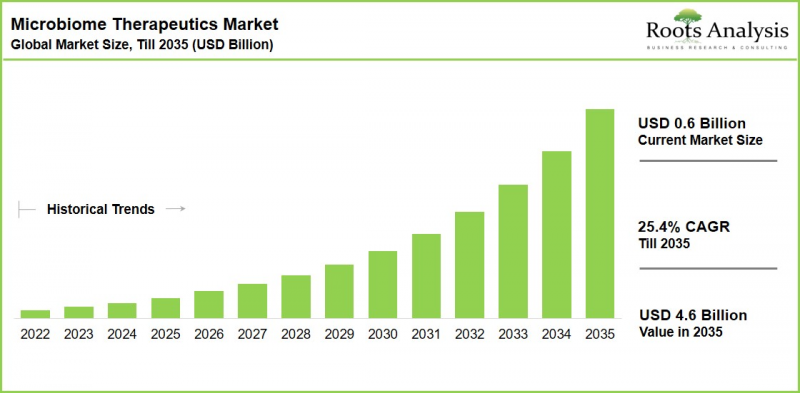
Microbiome Therapeutics Market: Growth and Trends
Microbiome therapeutics represent one of the most closely watched frontiers in modern medicine. These therapeutic drugs are built on the premise that the trillions of microorganisms residing in and on the human body can be deliberately modulated to treat and prevent disease. The field has moved well beyond conventional probiotics and donor-dependent fecal microbiota transplantation (FMT) to include defined bacterial consortia, live biotherapeutic products (LBPs), and genetically engineered microbial therapies. Advances in single-cell genomics, transcriptomics, and machine learning are enabling researchers to map host-microbe interactions with a precision that was not possible a decade ago.
Clinical validation is most advanced in recurrent Clostridioides difficile infection (rCDI). FMT-based therapies have demonstrated cure rates of 70-91%, while standard antibiotic regimens are associated with recurrence rates of 25-30%. This clinical differentiation highlights the FDA approvals of Rebyota and VOWST, the first two microbiome-based therapeutics to reach the US market. This approval also set a regulatory precedent that subsequent developers are now following into new indications, including inflammatory bowel disease, oncology, metabolic disease, and neurological disorders.
The competitive landscape is also shifting towards technological innovations. Developers are moving away from single-donor FMT toward standardized consortia products such as VE303, which offer greater manufacturing consistency and reduced donor-related variability. Emerging platforms that combine therapeutic and diagnostic function, sensing local inflammatory signals and responding with targeted molecule production, point to a next generation of precision microbiome engineering supported by synthetic biology, AI-enabled profiling, and CRISPR-based strain design.
Growth Drivers: Factors Fueling Market Expansion
One of the primary drivers of the microbiome therapeutics market is the rapid maturation of microbiome science. In addition, progress in sequencing technologies, metagenomics, and synthetic biology has enabled a broader pipeline of targeted live biotherapeutic products and engineered consortia addressing recurrent C. difficile infection, inflammatory bowel disease, and metabolic disorders. These advancements in sequencing technologies and metagenomics are translating into stronger investor confidence across the sector.
Further, capital formation and strategic collaboration are reinforcing this growth momentum. Partnerships between pharmaceutical companies and academic institutions, alongside sustained venture capital inflows, are funding both clinical development and commercialization infrastructure. Pendulum Therapeutics expanded its research collaboration with Mayo Clinic in 2026 to explore microbiome-based interventions in women's health and dermatology. This collaboration illustrates how established players are widening the addressable indication set through partnership rather than solely through internal R&D.
Market Challenges: Critical Barriers Hindering Progress
Despite strong momentum, the market faces meaningful operational and regulatory challenges. Manufacturing microbiome therapeutics requires donor screening, strain isolation, and rigorous contamination control, all of which raise production costs. These requirements, combined with specialized cold-chain logistics and scale-up hurdles, constrain near-term profitability and slow the pace of broader commercial adoption.
Regulatory pathways for live biotherapeutic products also remain in flux. Developers must demonstrate consistent safety, efficacy, and manufacturing quality within a framework that is still evolving across jurisdictions, and the absence of a fully standardized approval pathway can extend development timelines and add commercialization risk, particularly for smaller, single-asset companies.
Microbiome Therapeutics Market: Key Insights
The report delves into the current state of the microbiome therapeutics market and identifies potential growth opportunities within the industry. Some key findings include:
- Rapidly Expanding Clinical Pipeline: The approvals of Rebyota and VOWST have established a clear regulatory precedent. Drug developers are now advancing candidates across inflammatory bowel disease, oncology, metabolic disorders, and neurological conditions, widening the addressable market well beyond C. difficile infection.
- Shift Toward Defined, Scalable Products: The industry is transitioning from donor-dependent FMT toward standardized microbiome drugs and defined bacterial consortia, which offer stronger intellectual property protection and more predictable manufacturing economics, a combination that is attracting pharmaceutical and venture investors.
- Sustained Capital Inflows: Recent financings, including Kanvas Biosciences' USD 48 million Series A for microbiome-based immuno-oncology and EnteroBiotix's GBP 19 million raise for its Phase 2b IBS-C program, reflect continued investor confidence in both early- and late-stage assets.
- Oncology Emerging as a High-Potential Frontier: The launch of the BIOFRONT trial, the first pivotal Phase 3 study of a microbiome-based oral therapy in oncology, signals that the field's addressable footprint is extending well beyond gastrointestinal disease.
- Key Focus Areas for Future: Manufacturing scalability and the pace of regulatory harmonization for live biotherapeutic products remain the principal variables that will determine how quickly the pipeline converts into approved, reimbursed therapies, making them an important metric for investors to monitor.
Microbiome Therapeutics Market Segments
The market sizing and opportunity analysis has been segmented across the following parameters:
By Type of Product
- Fecal Microbiota Transplantation
- Microbiome Drugs
By Route of Administration
- Oral
- Rectal
- Topical
- Others
By Target Indication
- Clostridioides difficile Infection
- Crohn's Disease
- Diabetes
- Inflammatory Bowel Disease
- Other Target Indications
By Therapeutic Area
- Autoimmune Disorders
- Gastrointestinal Disorders
- Metabolic Disorders
- Neurological Disorders
- Oncological Disorders
- Other Therapeutic Areas
By End User
- Homecare Settings
- Hospitals and Clinics
- Research and Academic Institutes
- Other End Users
By Geographical Regions
- North America
- Europe
- Asia-Pacific
- Middle East and North Africa
- Latin America
Microbiome Therapeutics Market: Key Segment Insights
Fecal Microbiota Transplantation Leads the Market
Based on Roots Analysis market assessment, the fecal microbiota transplantation segment currently accounts for the largest share of the microbiome therapeutics market. This highest share is due to the clinical efficacy and its early commercialization advantage in recurrent Clostridioides difficile infection. The segment's highest share is further supported by regulatory approvals of standardized FMT-based products that have accelerated physician adoption and payer acceptance.
On the other hand, the microbiome drugs segment is projected to register the highest CAGR during the forecast period. This growth is driven by the industry's shift toward defined, scalable, and precision-engineered microbial therapeutics. These therapies offer standardized formulations, controlled manufacturing, and stronger intellectual property protection than conventional FMT, making them increasingly attractive to pharmaceutical investors and strategic partners.
Oral Route of Administration Dominates the Market
According to the Roots Analysis market projections, the oral route of administration accounts for the highest market share. Notably, this segment is expected to grow at a relatively higher CAGR during the forecast period. Oral formulations, including capsules containing defined microbiome consortia, offer clear advantages in patient compliance, outpatient administration, manufacturing standardization, and commercial distribution relative to rectal or topical alternatives.
North America Dominates the Market
North America is expected to retain the highest global market share by 2035. The region's highest share is underpinned by an advanced regulatory framework, evidenced by the USFDA's first-in-world approvals of Rebyota and VOWST, a deep clinical research ecosystem, and the presence of leading developers such as Seres Therapeutics, Finch Therapeutics, and Vedanta Biosciences. High disease burden reinforces this position: the US alone reports approximately 500,000 annual C. difficile infections and an estimated 35,000 antimicrobial resistance attributable deaths each year.
Asia-Pacific Emerges as the Fastest-Growing Regional Market
Asia-Pacific is projected to grow at the highest CAGR through 2035, driven by rising awareness of gut health, growing incidence of inflammatory bowel disease and metabolic disorders, and strong government support for biotechnology innovation, including China's leadership in genomic sequencing research and India's Genome India Project.
Example Players in Microbiome Therapeutics Market
- Ferring Pharmaceuticals
- Infant Bacterial Therapeutics
- MaaT Pharma
- Mikrobiomik
- Seres Therapeutics
- Vedanta Biosciences
Expert Interview and Industry Insights
The opinions and insights presented in this study were influenced by discussions conducted with multiple stakeholders. The research report features detailed transcripts of interviews held with the following industry stakeholders:
- Former Senior Manager, Corporate Development, Mid-sized Company, UK
- Co-founder and Chairman, Small Company, US
- Chief Executive Officer, Small Company, US
- Senior Scientist, Large Company, US
- President, Small Company, Taiwan
- Vice President, Business Development, Small Company, US
- Chief Business Officer, Mid-sized Company, Israel
- Chief Scientific Officer, Small Company, Switzerland
- Professor, Large Company, Ireland
MICROBIOME THERAPEUTICS MARKET: RESEARCH COVERAGE
- Market Sizing and Opportunity Analysis: An in-depth analysis of the microbiome therapeutics market, sized and forecast across type of product, route of administration, target indication, therapeutic area, end user, and geographical regions.
- Microbiome Therapeutics Market Landscape: A detailed assessment of the current developer and product landscape, featuring analysis by stage of development, type of molecule, type of biologic, target indication, therapeutic area, route of administration, and company headquarters.
- Company Profiles: In-depth profiles of prominent players engaged in the development and commercialization of microbiome therapeutics, featuring company overview, financial information, product portfolio, and recent developments.
- Clinical Trial Analysis: An analysis of registered clinical trials for microbiome therapeutics, based on parameters such as trial phase, trial status, study design, sponsor type, enrolled patient population, and geography.
- Attractiveness Competitiveness (AC) Matrix: A detailed attractiveness competitiveness (AC) matrix analysis of the small scale bioreactors market, evaluating business units based on market attractiveness and competitive strength, and categorizing them into strong, average, and weak segments to identify strategic growth opportunities and competitive positioning.
- Start-up Health Indexing: A detailed benchmarking analysis of start-ups engaged in the small scale bioreactors market, evaluating companies based on portfolio strength, pipeline maturity, indication diversity, funding activity, partnership landscape, and the proprietary Roots Analysis Start-up Health Index to identify the most promising and competitive emerging players.
- Case Studies: Key Therapeutic Areas, Contract Services and Big Data: Focused case studies covering microbiome therapeutics across metabolic, gastrointestinal, oncological, dermatological, and infectious disease indications, along with the contract manufacturing and big-data ecosystems supporting the field.
- Partnerships and Collaborations: A detailed analysis of partnership and collaboration activity in the microbiome therapeutics market, examining partnership trends by year, deal type, target indication, therapeutic area, partner type, geographic distribution, and the most active organizations to highlight collaboration strategies and industry evolution.
- Funding and Investment Analysis: A detailed analysis of funding and investment activity in the microbiome therapeutics market, evaluating financing trends by year, funding type, investment amount, funding purpose, target indication, therapeutic area, geography, and the most active companies and investors to provide insights into capital flow and investment priorities across the industry.
- Case Study: Contract Services for Microbiome Therapeutics and Live Biotherapeutics: A detailed case study of contract services for microbiome therapeutics and live biotherapeutics, covering manufacturing processes, key challenges, the growing role of contract manufacturing, and an in-depth assessment of contract service providers based on company characteristics, manufacturing capabilities, and product expertise, along with key considerations for selecting an appropriate CMO/CRO partner.
- Case Study: Big Data And Microbiome Therapeutics: A detailed case study on the role of big data in microbiome therapeutics, examining the growing adoption of data-driven technologies, including IoT, key application areas, Google Trends-based interest analysis, microbiome data management challenges, personalized medicine applications, and the capabilities of leading big data service providers supporting microbiome research.
Key Questions Answered in this Report
- Which are the leading companies in the microbiome therapeutics market?
- Which region dominates the microbiome therapeutics market?
- What are the key trends observed in the microbiome therapeutics market?
- What factors are likely to influence the evolution of this market?
- What are the primary challenges faced by microbiome therapeutics developers?
- What is the current and future market size?
- What is the CAGR of this market?
- How is the current and future market opportunity likely to be distributed across key market segments?
Reasons to Buy this Report
- The report provides a comprehensive market analysis, offering detailed revenue projections of the overall market and its specific sub-segments. This information is valuable to both established market leaders and emerging entrants.
- The report offers stakeholders a comprehensive overview of the market, including key drivers, barriers, opportunities, and challenges. This information empowers stakeholders to stay abreast of market trends and make data-driven decisions to capitalize on growth prospects.
- The report can aid businesses in identifying future opportunities in any sector. It also helps in understanding if those opportunities are worth pursuing.
- The report helps in identifying customer demand by understanding the needs, preferences, and behavior of the target audience in order to tailor products or services effectively.
- The report equips new entrants with requisite information regarding a particular market to help them build successful business strategies.
- The report allows for more effective communication with the audience and in building strong business relations.
Additional Benefits
- Complementary PPT Insights Pack
- Complementary Excel Data Packs for all Analytical Modules in the Report
- 15% Free Content Customization
- Detailed Report Walkthrough Session with Research Team
- Free Updated report if the report is 6-12 months old or older
TABLE OF CONTENTS
1. PREFACE
- 1.1. Introduction
- 1.2. Market Share Insights
- 1.3. Key Market Insights
- 1.4. Report Coverage
- 1.5. Key Questions Answered
- 1.6. Chapter Outlines
2. RESEARCH METHODOLOGY
- 2.1. Chapter Overview
- 2.2. Research Assumptions
- 2.2.1. Market Landscape and Market Trends
- 2.2.2. Market Forecast and Opportunity Analysis
- 2.2.3. Comparative Analysis
- 2.3. Database Building
- 2.3.1. Data Collection
- 2.3.2. Data Validation
- 2.3.3. Data Analysis
- 2.4. Project Methodology
- 2.4.1. Secondary Research
- 2.4.1.1. Annual Reports
- 2.4.1.2. Academic Research Papers
- 2.4.1.3. Company Websites
- 2.4.1.4. Investor Presentations
- 2.4.1.5. Regulatory Filings
- 2.4.1.6. White Papers
- 2.4.1.7. Industry Publications
- 2.4.1.8. Conferences and Seminars
- 2.4.1.9. Government Portals
- 2.4.1.10. Media and Press Releases
- 2.4.1.11. Newsletters
- 2.4.1.12. Industry Databases
- 2.4.1.13. Roots Proprietary Databases
- 2.4.1.14. Paid Databases and Sources
- 2.4.1.15. Social Media Portals
- 2.4.1.16. Other Secondary Sources
- 2.4.2. Primary Research
- 2.4.2.1. Types of Primary Research
- 2.4.2.1.1. Qualitative Research
- 2.4.2.1.2. Quantitative Research
- 2.4.2.1.3. Hybrid Approach
- 2.4.2.2. Advantages of Primary Research
- 2.4.2.3. Techniques for Primary Research
- 2.4.2.3.1. Interviews
- 2.4.2.3.2. Surveys
- 2.4.2.3.3. Focus Groups
- 2.4.2.3.4. Observational Research
- 2.4.2.3.5. Social Media Interactions
- 2.4.2.4. Key Opinion Leaders Considered in Primary Research
- 2.4.2.4.1. Company Executives (CXOs)
- 2.4.2.4.2. Board of Directors
- 2.4.2.4.3. Company Presidents and Vice Presidents
- 2.4.2.4.4. Research and Development Heads
- 2.4.2.4.5. Technical Experts
- 2.4.2.4.6. Subject Matter Experts
- 2.4.2.4.7. Scientists
- 2.4.2.4.8. Doctors and Other Healthcare Providers
- 2.4.2.5. Ethics and Integrity
- 2.4.2.5.1. Research Ethics
- 2.4.2.5.2. Data Integrity
- 2.4.2.1. Types of Primary Research
- 2.4.3. Analytical Tools and Databases
- 2.4.1. Secondary Research
- 2.5. Robust Quality Control
3. MARKET DYNAMICS
- 3.1. Chapter Overview
- 3.2. Forecast Methodology
- 3.2.1. Top-down Approach
- 3.2.2. Bottom-up Approach
- 3.2.3. Hybrid Approach
- 3.3. Market Assessment Framework
- 3.3.1. Total Addressable Market (TAM)
- 3.3.2. Serviceable Addressable Market (SAM)
- 3.3.3. Serviceable Obtainable Market (SOM)
- 3.3.4. Currently Acquired Market (CAM)
- 3.4. Forecasting Tools and Techniques
- 3.4.1. Qualitative Forecasting
- 3.4.2. Correlation
- 3.4.3. Regression
- 3.4.4. Extrapolation
- 3.4.5. Convergence
- 3.4.6. Sensitivity Analysis
- 3.4.7. Scenario Planning
- 3.4.8. Data Visualization
- 3.4.9. Time Series Analysis
- 3.4.10. Forecast Error Analysis
- 3.5. Key Considerations
- 3.5.1. Demographics
- 3.5.2. Government Regulations
- 3.5.3. Reimbursement Scenarios
- 3.5.4. Market Access
- 3.5.5. Supply Chain
- 3.5.6. Industry Consolidation
- 3.5.7. Pandemic / Unforeseen Disruptions Impact
- 3.6. Limitations
4. MACRO-ECONOMIC INDICATORS
- 4.1. Chapter Overview
- 4.2. Market Dynamics
- 4.2.1. Time Period
- 4.2.1.1. Historical Trends
- 4.2.1.2. Current and Forecasted Estimates
- 4.2.2. Currency Coverage
- 4.2.2.1. Major Currencies Affecting the Market
- 4.2.2.2. Factors Affecting Currency Fluctuations
- 4.2.2.3. Impact of Currency Fluctuations on the Industry
- 4.2.3. Foreign Currency Exchange Rate
- 4.2.3.1. Impact of Foreign Exchange Rate Volatility on the Market
- 4.2.3.2. Strategies for Mitigating Foreign Exchange Risk
- 4.2.4. Recession
- 4.2.4.1. Assessment of Current Economic Conditions and Potential Impact on the Market
- 4.2.4.2. Historical Analysis of Past Recessions and Lessons Learnt
- 4.2.5. Inflation
- 4.2.5.1. Measurement and Analysis of Inflationary Pressures in the Economy
- 4.2.5.2. Potential Impact of Inflation on the Market Evolution
- 4.2.6. Interest Rates
- 4.2.6.1. Interest Rates and Their Impact on the Market
- 4.2.6.2. Strategies for Managing Interest Rate Risk
- 4.2.7. Commodity Flow Analysis
- 4.2.7.1. Type of Commodity
- 4.2.7.2. Origins and Destinations
- 4.2.7.3. Values and Weights
- 4.2.7.4. Modes of Transportation
- 4.2.8. Global Trade Dynamics
- 4.2.8.1. Import Scenario
- 4.2.8.2. Export Scenario
- 4.2.8.3. Trade Policies
- 4.2.8.4. Strategies for Mitigating the Risks Associated with Trade Barriers
- 4.2.8.5. Impact of Trade Barriers on the Market
- 4.2.9. War Impact Analysis
- 4.2.9.1. Russian-Ukraine War
- 4.2.9.2. Israel-Hamas War
- 4.2.10. COVID Impact / Related Factors
- 4.2.10.1. Global Economic Impact
- 4.2.10.2. Industry-specific Impact
- 4.2.10.3. Government Response and Stimulus Measures
- 4.2.10.4. Future Outlook and Adaptation Strategies
- 4.2.11. Other Indicators
- 4.2.11.1. Fiscal Policy
- 4.2.11.2. Consumer Spending
- 4.2.11.3. Gross Domestic Product
- 4.2.11.4. Employment
- 4.2.11.5. Taxes
- 4.2.11.6. Stock Market Performance
- 4.2.11.7. Cross Border Dynamics
- 4.2.1. Time Period
- 4.3. Conclusion
5. EXECUTIVE SUMMARY
- 5.1. Executive Summary: Market Landscape
- 5.2. Executive Summary: Market Trends
- 5.3. Executive Summary: Market Forecast and Opportunity Analysis
6. INTRODUCTION
- 6.1. Chapter Overview
- 6.2. Concept of Microbiota and Microbiome
- 6.2.1. Discovery of Human Microbiome
- 6.2.2. Functions of Human Microbiome
- 6.3. Overview of Gut Flora
- 6.3.1. Role of Gut Flora in Human Health
- 6.3.2. Factors Affecting Gut Flora
- 6.3.2.1. Antibiotic Consumption
- 6.3.2.2. Age and Pregnancy
- 6.3.2.2.1. Mode of Childbirth
- 6.3.2.2.2. Type of Feeding
- 6.3.2.2.3. Antibiotic Consumption by Mother
- 6.3.2.3. Stress-related Factors
- 6.3.2.4. Dietary Factors
- 6.3.2.5. Impact of Lifestyle
- 6.4. Microbiome and Associated Diseases
- 6.4.1. Cancer
- 6.4.2. Inflammatory Bowel Disease (IBD)
- 6.4.3. Obesity
- 6.4.4. Parkinson's Disease
- 6.4.5. Type 2 Diabetes
- 6.4.6. Other Disease Indications
- 6.5. Impact of Microbiota on Drug Pharmacokinetics
- 6.6. Impact of Microbiota on Therapeutic Outcomes
- 6.7. Microbiome Therapeutics
- 6.7.1. Probiotics
- 6.7.1.1. Beneficial Bacterial Strains
- 6.7.1.1.1. Lactobacilli
- 6.7.1.1.2. Bifidobacteria
- 6.7.1.1.3. Others
- 6.7.1.2. Key Therapeutic Areas
- 6.7.1.2.1. Antibiotic-Associated Diarrhea (AAD)
- 6.7.1.2.2. Bacterial Vaginosis
- 6.7.1.2.3. High Blood Pressure
- 6.7.1.2.4. Hypercholesterolemia
- 6.7.1.2.5. Infectious Childhood Diarrhea (ICD)
- 6.7.1.2.6. Inflammatory Bowel Disease (IBD)
- 6.7.1.2.7. Lactose Intolerance
- 6.7.1.2.8. Vitamin Production
- 6.7.1.2.9. Weight Management
- 6.7.1.3. Side Effects of Probiotics
- 6.7.1.1. Beneficial Bacterial Strains
- 6.7.2. Prebiotics
- 6.7.2.1. Sources of Prebiotics
- 6.7.2.2. Types of Prebiotics
- 6.7.2.2.1. Fructo-Oligosaccharides (FOS)
- 6.7.2.2.2. Galacto-Oligosaccharides (GOS)
- 6.7.2.2.3. Inulin
- 6.7.2.3. Key Therapeutic Areas
- 6.7.2.3.1. Antibiotic Associated Diarrhea (AAD)
- 6.7.2.3.2. Constipation
- 6.7.2.3.3. Gastrointestinal Diseases
- 6.7.2.3.4. Dysbiosis
- 6.7.2.4. Side Effects of Prebiotics
- 6.7.1. Probiotics
- 6.8. The Human Microbiome Project (HMP)
- 6.8.1. Project Approach
- 6.8.2. Project Initiatives
- 6.8.3. Project Achievements
- 6.9. Regulatory Guidelines for Live Biotherapeutic Products (LBPs)
- 6.10. Key Challenges Associated with the Development of Microbiome Therapeutics
- 6.11. Future Perspectives
7. MICROBIOME THERAPEUTICS: MARKET LANDSCAPE
- 7.1. Chapter Overview
- 7.2. Microbiome Therapeutics: Overall Market Landscape
- 7.2.1. Analysis by Stage of Development
- 7.2.2. Analysis by Type of Molecule
- 7.2.3. Analysis by Stage of Development and Type of Molecule
- 7.2.4. Analysis by Type of Biologic
- 7.2.5. Analysis by Target Indication
- 7.2.6. Analysis by Therapeutic Area
- 7.2.7. Analysis by Route of Administration
- 7.2.8. Analysis by Type of Formulation
- 7.2.9. Analysis by Dosage Frequency
- 7.2.10. Analysis by Type of Therapy
- 7.3. Microbiome Therapeutics: Developer Landscape
- 7.3.1. Analysis by Year of Establishment
- 7.3.2. Analysis by Company Size
- 7.3.3. Analysis by Location of Headquarters (Region)
- 7.3.4. Analysis by Location of Headquarters (Country)
- 7.3.5. Most Active Players: Analysis by Number of Microbiome Therapeutics
8. MICROBIOME THERAPEUTICS: COMPANY PROFILES
- 8.1. Chapter Overview
- 8.2. Ferring Pharmaceuticals
- 8.2.1. Company Overview
- 8.2.2. Financial Information
- 8.2.3. Microbiome-Based Product Portfolio
- 8.2.4. Recent Developments and Future Outlook
- 8.3. Infant Bacterial Therapeutics
- 8.4. MaaT Pharma
- 8.5. Mikrobiomik
- 8.6. Seres Therapeutics
- 8.7. Vedanta Biosciences
9. CLINICAL TRIAL ANALYSIS
- 9.1. Chapter Overview
- 9.2. Scope and Methodology
- 9.3. Microbiome Therapeutics: Clinical Trial Analysis
- 9.3.1. Analysis by Trial Registration Year
- 9.3.2. Analysis of Enrolled Patient Population by Trial Registration Year
- 9.3.3. Analysis by Trial Status
- 9.3.4. Analysis of Enrolled Patient Population by Trial Status
- 9.3.5. Analysis by Trial Registration Year and Trial Status
- 9.3.6. Analysis by Trial Phase
- 9.3.7. Analysis of Enrolled Patient Population by Trial Phase
- 9.3.8. Analysis by Type of Sponsor / Collaborator
- 9.3.9. Analysis by Study Design
- 9.3.10. Analysis by Gender
- 9.3.11. Leading Industry Players: Analysis by Number of Registered Trials
- 9.3.12. Leading Non-industry Players: Analysis by Number of Registered Trials
- 9.3.13. Analysis by Trial Status, Trial Phase and Geography
- 9.3.14. Analysis by Geography
- 9.3.15. Analysis by Trial Status and Geography
- 9.3.16. Analysis of Enrolled Patient Population by Trial Status and Geography
10. ATTRACTIVENESS COMPETITIVENESS (AC) MATRIX
- 10.1. Chapter Overview
- 10.2. AC Matrix: An Overview
- 10.2.1. Strong Business Units
- 10.2.2. Average Business Units
- 10.2.3. Weak Business Units
- 10.3. AC Matrix: Analytical Methodology
- 10.4. AC Matrix: Plotting the Information
- 10.5. AC Matrix: Analyzing the Data
- 10.5.1. Strong Business Units
- 10.5.2. Average Business Units
- 10.5.3. Weak Business Units
- 10.6. Concluding Remarks
11. START-UP HEALTH INDEXING
- 11.1. Chapter Overview
- 11.2. Scope and Methodology
- 11.3. Benchmarking of Start-ups
- 11.3.1. Analysis by Portfolio Strength
- 11.3.2. Analysis by Pipeline Maturity
- 11.3.3. Analysis by Indication Diversity
- 11.3.4. Analysis by Funding Amount
- 11.3.5. Analysis by Partnership Activity
- 11.3.6. Start-up Health Indexing: Roots Analysis Perspective
- 11.3.7. Start-up Health Indexing: Leading Companies
12. CASE STUDY: KEY THERAPEUTIC AREAS
- 12.1. Chapter Overview
- 12.2. Metabolic Disorders
- 12.2.1. Diabetes
- 12.2.1.1. Disease Description
- 12.2.1.2. Associated Health Risks / Complications
- 12.2.1.3. Epidemiology
- 12.2.1.4. Disease Diagnosis
- 12.2.1.5. Current Treatment Options
- 12.2.1.5.1. Insulin Therapies
- 12.2.1.5.2. Non-Insulin Therapies
- 12.2.1.6. Side Effects of Current Treatment Options
- 12.2.1.7. Microbiome Therapeutics for Diabetes
- 12.2.2. Lactose Intolerance
- 12.2.2.1. Disease Description
- 12.2.2.2. Epidemiology
- 12.2.2.3. Current Treatment Options
- 12.2.2.4. Microbiome Therapeutics for Lactose Intolerance
- 12.2.3. Nonalcoholic Steatohepatitis (NASH)
- 12.2.3.1. Disease Description
- 12.2.3.2. Epidemiology
- 12.2.3.3. Current Treatment Options
- 12.2.3.4. Microbiome Therapeutics for NASH
- 12.2.4. Primary Hyperoxaluria
- 12.2.4.1. Disease Description
- 12.2.4.2. Epidemiology
- 12.2.4.3. Current Treatment Options
- 12.2.4.4. Microbiome Therapeutics for Primary Hyperoxaluria
- 12.2.5. Obesity
- 12.2.5.1. Disease Description
- 12.2.5.2. Epidemiology
- 12.2.5.3. Current Treatment Options
- 12.2.5.4. Side Effects of Current Treatment Options
- 12.2.5.5. Microbiome Therapeutics for Obesity
- 12.2.1. Diabetes
- 12.3. Digestive and Gastrointestinal Disorders
- 12.3.1. Crohn's Disease
- 12.3.1.1. Disease Description
- 12.3.1.2. Epidemiology
- 12.3.1.3. Current Treatment Options
- 12.3.1.4. Side Effects of Current Treatment Options
- 12.3.1.5. Microbiome Therapeutics for Crohn's Disease
- 12.3.2. Irritable Bowel Syndrome (IBS)
- 12.3.2.1. Disease Description
- 12.3.2.2. Epidemiology
- 12.3.2.3. Current Treatment Options
- 12.3.2.4. Microbiome Therapeutics for IBS
- 12.3.3. Ulcerative Colitis
- 12.3.3.1. Disease Description
- 12.3.3.2. Epidemiology
- 12.3.3.3. Current Treatment Options
- 12.3.3.4. Side Effects of Current Treatment Options
- 12.3.3.5. Microbiome Therapeutics for Ulcerative Colitis
- 12.3.1. Crohn's Disease
- 12.4. Oncological Indications
- 12.4.1. Colorectal Cancer
- 12.4.1.1. Disease Description
- 12.4.1.2. Epidemiology
- 12.4.1.3. Current Treatment Options
- 12.4.1.4. Side Effects of Current Treatments
- 12.4.1.5. Microbiome Therapeutics for Colorectal Cancer
- 12.4.2. Lung Cancer
- 12.4.2.1. Disease Description
- 12.4.2.2. Epidemiology
- 12.4.2.3. Current Treatment Options
- 12.4.2.4. Side Effects of Current Treatment Options
- 12.4.2.5. Microbiome Therapeutics for Lung Cancer
- 12.4.1. Colorectal Cancer
- 12.5. Dermatological Disorders
- 12.5.1. Acne Vulgaris
- 12.5.1.1. Disease Description
- 12.5.1.2. Epidemiology
- 12.5.1.3. Current Treatment Options
- 12.5.1.4. Side Effects of Current Treatment Options
- 12.5.1.5. Microbiome Therapeutics for Acne Vulgaris
- 12.5.1. Acne Vulgaris
- 12.6. Infectious Diseases
- 12.6.1. Clostridium Difficile Infections (CDIs)
- 12.6.1.1. Disease Description
- 12.6.1.2. Epidemiology
- 12.6.1.3. Disease Diagnosis
- 12.6.1.4. Current Treatment Options
- 12.6.1.5. Side Effects of Current Treatment Options
- 12.6.1.6. Microbiome Therapeutics for CDI
- 12.6.2. Bacterial Vaginosis
- 12.6.2.1. Disease Description
- 12.6.2.2. Epidemiology
- 12.6.2.3. Current Treatment Options
- 12.6.2.4. Side Effects of Current Treatment Options
- 12.6.2.5. Microbiome Therapeutics for Bacterial Vaginosis
- 12.6.1. Clostridium Difficile Infections (CDIs)
13. PARTNERSHIPS AND COLLABORATIONS
- 13.1. Chapter Overview
- 13.2. Partnership Models
- 13.3. Microbiome Therapeutics: List of Partnerships and Collaborations
- 13.4. Analysis by Year of Partnership
- 13.5. Analysis by Type of Partnership
- 13.6. Analysis by Year and Type of Partnership
- 13.7. Analysis by Target Indication
- 13.8. Analysis by Therapeutic Area
- 13.9. Analysis by Type of Partnership and Therapeutic Area
- 13.10. Analysis by Type of Partner
- 13.11. Most Active Players: Analysis by Number of Partnerships
- 13.12. Analysis by Geography
- 13.12.1. Local and International Deals
- 13.12.2. Intracontinental and Intercontinental Deals
14. FUNDING AND INVESTMENTS
- 14.1. Chapter Overview
- 14.2. Funding Models
- 14.3. Microbiome Therapeutics: List of Funding and Investments
- 14.3.1. Analysis of Funding Instances by Year of Funding
- 14.3.2. Analysis of Amount Invested by Year of Funding
- 14.3.3. Analysis by Type of Funding
- 14.3.4. Analysis by Year and Type of Funding
- 14.3.5. Analysis by Amount Invested and Type of Funding
- 14.3.6. Analysis by Purpose of Funding
- 14.3.7. Analysis by Target Indication
- 14.3.8. Analysis by Therapeutic Area
- 14.3.9. Analysis by Geography
- 14.3.10. Most Active Players: Analysis by Number of Instances
- 14.3.11. Most Active Players: Analysis by Amount Invested
- 14.3.12. Leading Investors: Analysis by Number of Instances
- 14.3.13. Funding and Investment Summary
15. CASE STUDY: CONTRACT SERVICES FOR MICROBIOME THERAPEUTICS AND LIVE BIOTHERAPEUTICS
- 15.1. Chapter Overview
- 15.2. Manufacturing Microbiome Therapeutics
- 15.2.1. Key Steps Involved
- 15.2.2. Associated Challenges
- 15.2.3. Growing Demand for Contract Manufacturing Services
- 15.2.4. Contract Manufacturing Organizations (CMOs)
- 15.2.4.1. Introduction to Contract Manufacturing
- 15.2.5. Microbiome Therapeutics: List of Contract Manufacturing Providers
- 15.2.5.1. Analysis by Year of Establishment
- 15.2.5.2. Analysis by Company Size
- 15.2.5.3. Analysis by Location of Headquarters
- 15.2.5.4. Analysis by Scale of Operation
- 15.2.5.5. Analysis by Type of Product Manufactured
- 15.2.5.6. Analysis by Type of Formulation
- 15.2.5.7. Analysis by Scale of Operation and Type of Formulation
- 15.3. Key Considerations for Selecting a CMO / CRO Partner
16. CASE STUDY: BIG DATA AND MICROBIOME THERAPEUTICS
- 16.1. Chapter Overview
- 16.2. Introduction to Big Data
- 16.3. Internet of Things (IoT)
- 16.4. Growing Interest in Big Data: Google Trends Analysis
- 16.5. Key Application Areas
- 16.6. Big Data in Microbiome Research
- 16.6.1. Microbiome Data and Personalized Medicine
- 16.6.2. Microbiome-related Data Management Challenges
- 16.6.3. National Microbiome Data Center
- 16.7. Big Data Services for Microbiome Research: Profiles of Key Players
17. MICROBIOME THERAPEUTICS MARKET
- 17.1. Chapter Overview
- 17.2. Assumptions and Methodology
- 17.3. Global Microbiome Therapeutics Market: Historical Trends (since 2022) and Forecasted Estimates (till 2035)
- 17.3.1. Roots Analysis Perspective on Market Growth
- 17.3.2. Scenario Analysis
- 17.3.2.1. Conservative Scenario
- 17.3.2.2. Optimistic Scenario
- 17.4. Key Market Segmentations
18. MICROBIOME THERAPEUTICS MARKET, BY TYPE OF PRODUCT
- 18.1. Chapter Overview
- 18.2. Assumptions and Methodology
- 18.3. Microbiome Therapeutics Market: Distribution by Type of Product
- 18.3.1. Microbiome Therapeutics Market for Fecal Microbiota Transplantation: Historical Trends (since 2022) and Forecasted Estimates (till 2035)
- 18.3.2. Microbiome Therapeutics Market for Microbiome Drugs: Historical Trends (since 2022) and Forecasted Estimates (till 2035)
- 18.4. Data Triangulation and Validation
19. MICROBIOME THERAPEUTICS MARKET, BY ROUTE OF ADMINISTRATION
- 19.1. Chapter Overview
- 19.2. Key Assumptions and Methodology
- 19.3. Microbiome Therapeutics Market: Distribution by Route of Administration
- 19.3.1. Microbiome Therapeutics Market for Oral Route: Historical Trends (since 2022) and Forecasted Estimates (till 2035)
- 19.3.2. Microbiome Therapeutics Market for Rectal Route: Historical Trends (since 2022) and Forecasted Estimates (till 2035)
- 19.3.3. Microbiome Therapeutics Market for Topical Route: Historical Trends (since 2022) and Forecasted Estimates (till 2035)
- 19.3.4. Microbiome Therapeutics Market for Others: Historical Trends (since 2022) and Forecasted Estimates (till 2035)
- 19.4. Data Triangulation and Validation
20. MICROBIOME THERAPEUTICS MARKET, BY TARGET INDICATION
- 20.1. Chapter Overview
- 20.2. Key Assumptions and Methodology
- 20.3. Microbiome Therapeutics Market: Distribution by Target Indication
- 20.3.1. Microbiome Therapeutics Market for Clostridioides difficile Infection: Historical Trends (since 2022) and Forecasted Estimates (till 2035)
- 20.3.2. Microbiome Therapeutics Market for Crohn's Disease: Historical Trends (since 2022) and Forecasted Estimates (till 2035)
- 20.3.3. Microbiome Therapeutics Market for Diabetes: Historical Trends (since 2022) and Forecasted Estimates (till 2035)
- 20.3.4. Microbiome Therapeutics Market for Inflammatory Bowel Disease: Historical Trends (since 2022) and Forecasted Estimates (till 2035)
- 20.3.5. Microbiome Therapeutics Market for Other Target Indications: Historical Trends (since 2022) and Forecasted Estimates (till 2035)
- 20.4. Data Triangulation and Validation
21. MICROBIOME THERAPEUTICS MARKET, BY THERAPEUTIC AREA
- 21.1. Chapter Overview
- 21.2. Key Assumptions and Methodology
- 21.3. Microbiome Therapeutics Market: Distribution by Therapeutic Area
- 21.3.1. Microbiome Therapeutics Market for Autoimmune Disorders: Historical Trends (since 2022) and Forecasted Estimates (till 2035)
- 21.3.2. Microbiome Therapeutics Market for Gastrointestinal Disorders: Historical Trends (since 2022) and Forecasted Estimates (till 2035)
- 21.3.3. Microbiome Therapeutics Market for Metabolic Disorders: Historical Trends (since 2022) and Forecasted Estimates (till 2035)
- 21.3.4. Microbiome Therapeutics Market for Neurological Disorders: Historical Trends (since 2022) and Forecasted Estimates (till 2035)
- 21.3.5. Microbiome Therapeutics Market for Oncological Disorders: Historical Trends (since 2022) and Forecasted Estimates (till 2035)
- 21.3.6. Microbiome Therapeutics Market for Other Therapeutic Areas: Historical Trends (since 2022) and Forecasted Estimates (till 2035)
- 21.4. Data Triangulation and Validation
22. MICROBIOME THERAPEUTICS MARKET, BY GEOGRAPHICAL REGIONS
- 22.1. Chapter Overview
- 22.2. Key Assumptions and Methodology
- 22.3. Microbiome Therapeutics Market: Distribution by Geographical Regions
- 22.3.1. Microbiome Therapeutics Market in North America: Historical Trends (since 2022) and Forecasted Estimates (till 2035)
- 22.3.2. Microbiome Therapeutics Market in Europe: Historical Trends (since 2022) and Forecasted Estimates (till 2035)
- 22.3.3. Microbiome Therapeutics Market in Asia-Pacific: Historical Trends (since 2022) and Forecasted Estimates (till 2035)
- 22.3.4. Microbiome Therapeutics Market in Middle East and North Africa: Historical Trends (since 2022) and Forecasted Estimates (till 2035)
- 22.3.5. Microbiome Therapeutics Market in Latin America: Historical Trends (since 2022) and Forecasted Estimates (till 2035)
- 22.4. Data Triangulation and Validation
- 22.5. Market Dynamics Assessment
- 22.5.1. Penetration Growth (P-G) Matrix
- 22.5.2. Market Movement Analysis
- 22.6. Data Triangulation and Validation
23. CONCLUDING INSIGHTS
24. EXECUTIVE INSIGHTS
25. APPENDIX I: TABULATED DATA
26. APPENDIX II: LIST OF COMPANIES AND ORGANIZATIONS

