PUBLISHER: Roots Analysis | PRODUCT CODE: 2125138

PUBLISHER: Roots Analysis | PRODUCT CODE: 2125138
Germany Precision Oncology Diagnostics Market - Trends and Forecast Till 2035
GERMANY PRECISION ONCOLOGY DIAGNOSTICS MARKET: OVERVIEW
As per Roots Analysis, the Germany precision oncology diagnostics market is estimated to grow from USD 1.28 billion in the current year to USD 5.18 billion by 2035, at a CAGR of 15.0% during the forecast period, till 2035.
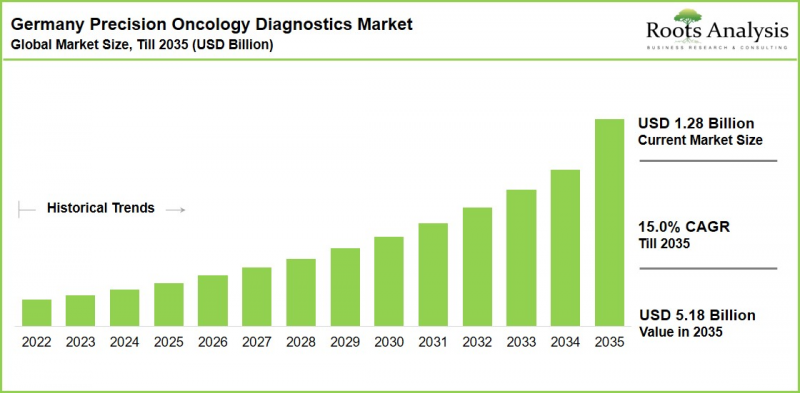
Germany Precision Oncology Diagnostics Market: Growth and Trends
Precision oncology diagnostics encompass a range of molecular and genomic testing approaches, including companion diagnostics, next-generation sequencing (NGS)-based multi-gene panels, liquid biopsy assays, and immunohistochemistry (IHC) / fluorescence in situ hybridization (FISH)-based tests, that are used to characterize the molecular profile of a patient's tumor and guide selection of targeted and biomarker-driven therapies. Germany represents the largest national market for precision oncology diagnostics in Europe. This position is supported by its statutory health insurance system, which covers over 90% of the population, an extensive network of University Comprehensive Cancer Centers, and one of the EU's largest oncology patient pools.
According to the Robert Koch Institute and the German Cancer Society (Deutsche Krebsgesellschaft), Germany records more than 500,000 new cancer diagnoses annually, with lung, breast, colorectal and prostate cancer accounting for the largest share of the disease burden. A substantial and growing proportion of these patients are eligible for biomarker-guided treatment decisions, particularly following the increasing approval of targeted therapies and immune checkpoint inhibitors that require companion diagnostic confirmation prior to prescription. This regulatory linkage between diagnostic testing and treatment eligibility has firmly embedded precision diagnostics into routine German oncology care pathways.
The market has evolved from single-biomarker, PCR- and IHC-based assays towards comprehensive genomic profiling using NGS panels capable of interrogating hundreds of genes simultaneously, alongside the emergence of liquid biopsy-based testing for patients with inadequate tissue or a need for longitudinal treatment monitoring. Germany's Comprehensive Cancer Centers, coordinated through the German Cancer Consortium (DKTK), along with government-backed genomic medicine initiatives such as genomDE, have played an instrumental role in accelerating clinical adoption of these advanced diagnostic modalities and in building the molecular tumor board infrastructure required to interpret complex genomic results.
Growth Drivers: Strategic Enablers of Market Expansion
The market growth is being driven by the country's rising cancer incidence and aging population, favorable and relatively well-defined reimbursement pathways (including EBM codes and NUB status for innovative hospital-based diagnostics). Further, the presence of a strong domestic diagnostics and biotechnology ecosystem comprising both specialized precision diagnostics developers and large multinational players with German operations.
Government-funded genomic medicine programs sustained public and private research funding, and a dense clinical trial ecosystem anchored around academic oncology centers further support continued adoption of advanced molecular testing. In addition, the increasing integration of artificial intelligence enabled digital pathology tools is helping laboratories manage rising test volumes while improving diagnostic turnaround time and consistency.
Market Challenges: Critical Barriers Impeding Progress
Despite this favorable growth outlook, the market faces certain challenges that may impede the market growth. Some of the potential challenges include the administrative and financial burden of complying with the EU In Vitro Diagnostic Regulation (IVDR), particularly for smaller diagnostic developers. In addition, fragmented reimbursement negotiations across individual statutory health insurance funds and a shortage of trained molecular pathologists and bioinformaticians required to support high-throughput genomic testing may hinder market growth.
Stringent German and EU data protection requirements (GDPR) add further complexity to the sharing and pooling of genomic data across institutions. On the other hand, sustained price pressure from statutory payers continues to influence the commercial strategies of diagnostic test developers and distributors operating in the country.
Germany Precision Oncology Diagnostics Market: Key Insights
The report delves into the current state of the Germany precision oncology diagnostics market and identifies potential growth opportunities within the industry. Some key findings from the report include:
- Germany represents the largest national precision oncology diagnostics opportunity within the European Union, underpinned by a cancer patient pool exceeding 500,000 new diagnoses annually and near-universal reimbursed access to biomarker testing for approved indications.
- Close to 60% of the precision oncology diagnostics providers active in the country are Germany-headquartered specialist laboratories and diagnostics developers, while the remainder are multinational players with dedicated German commercial, laboratory or R&D operations.
- Majority of the precision oncology diagnostic tests offered in Germany are companion diagnostics, reflecting the tight regulatory linkage between diagnostic approval and the label of the corresponding targeted therapy in the country.
- NGS-based multi-gene panels represent the fastest-growing test type, driven by expanding adoption of comprehensive genomic profiling across Comprehensive Cancer Centers and university hospitals coordinated through the German Cancer Consortium (DKTK).
- Lung cancer and breast cancer together account for the largest share of precision diagnostic test volumes in Germany, supported by well-established, guideline-driven biomarker testing algorithms (including EGFR, ALK, ROS1, HER2 and BRCA1/2).
- Liquid biopsy adoption continues to rise as a complementary or alternative approach to tissue biopsy, particularly for treatment response monitoring and in patients with insufficient tissue for conventional testing.
- Hospitals and university-affiliated Comprehensive Cancer Centers remain the leading end users of precision oncology diagnostics in Germany, although independent reference and specialty molecular pathology laboratories are capturing a rising share of test volumes amid ongoing centralization of molecular testing.
- Since 2022, industry stakeholders in this domain have entered into a steadily rising number of partnerships, the majority of which have been signed with pharmaceutical companies for co-development of companion diagnostics alongside novel targeted therapies.
- Venture and strategic funding into Germany-based precision oncology diagnostics innovators have grown steadily over the past three years, further catalyzed by government-backed genomic medicine initiatives such as genomDE.
- Given the breadth of reimbursed indications, the depth of academic-industry collaboration and continued technological innovation, the Germany precision oncology diagnostics market is well-positioned for sustained double-digit growth through 2035.
Germany Precision Oncology Diagnostics Market Segments
Roots Analysis segments the global Germany precision oncology diagnostics opportunity across the following parameters:
By Test Type
- Companion Diagnostics
- NGS-based Panels
- Liquid Biopsy Tests
- IHC / FISH-based Tests
- PCR-based Tests
By Type of Technology
- Next-Generation Sequencing
- Polymerase Chain Reaction
- Immunohistochemistry / FISH
- Liquid Biopsy Platforms
- Digital Pathology and AI-enabled Tools
By Cancer Indication
- Lung Cancer
- Breast Cancer
- Colorectal Cancer
- Prostate Cancer
- Hematologic Malignancies
- Others
By Sample Type
- Tissue Biopsy
- Liquid Biopsy (Blood-based)
By End User
- Hospitals and Comprehensive Cancer Centers
- Independent Diagnostic / Reference Laboratories
- Academic and Research Institutes
Germany Precision Oncology Diagnostics Market: Key Segments
Companion Diagnostics Continue to Lead the Germany Precision Oncology Diagnostics Market
Based on our market assessment, companion diagnostics currently capture the highest share of the Germany precision oncology diagnostics market. Notably, this segment is also expected to maintain dominance during the forecast period. This can be attributed to the regulatory requirement linking several targeted therapies and immune checkpoint inhibitors to a validated companion diagnostic prior to reimbursed prescription, alongside strong physician familiarity and established laboratory workflows for these assays.
On the other hand, NGS-based multi-gene panels are anticipated to register the highest growth rate among all test types through 2035. This lucrative growth is due to the fact that German Comprehensive Cancer Centers and community hospitals transition from sequential single-gene testing toward comprehensive genomic profiling that enables more efficient use of limited tissue and faster identification of actionable alterations.
Hospitals and Comprehensive Cancer Centers Account for the Largest End-User Share
Hospitals currently account for the majority of precision oncology diagnostic testing in Germany. This includes university-affiliated Comprehensive Cancer Centers designated under the German Cancer Aid (Deutsche Krebshilfe) program. The leading position is supported by access to molecular tumor boards, multidisciplinary oncology expertise, and integrated pathology infrastructure, enabling complex diagnostic testing and interpretation.
Example Players in the Germany Precision Oncology Diagnostics Market
- BioNTech (Diagnostics)
- CeGaT
- Centogene
- indivumed
- Molecular Health
- MVZ Wagnerstibbe
- NEO New Oncology
- QIAGEN
- Roche Diagnostics Deutschland
- Siemens Healthineers
- STRATIFYER Molecular Pathology
- Sysmex Inostics
How Different Stakeholders Benefit from this Germany Precision Oncology Diagnostics Market Report?
The insights presented in this report are structured to support the strategic and operational decision-making needs of stakeholders across the Germany precision oncology diagnostics value chain. In addition to market size and competitive intelligence, the report provides segment-level analysis, including high-share segments, emerging low-share opportunities and the fastest-growing segments, enabling stakeholders to identify where demand is concentrated and where future growth is likely to emerge.
Diagnostic Test Developers and Distributors: Prioritizing High-Value and High-Growth Testing Opportunities
Diagnostic test developers and in-country distributors can use the report's market segmentation, competitive landscape and reimbursement analysis to assess the relative attractiveness of individual cancer indications, testing technologies, sample types and end-user channels. Insights on high-share segments can support portfolio prioritization, while low-share and high-CAGR segments can help identify emerging white-space opportunities and guide expansion into underserved areas of the German market.
Pharmaceutical and Biotechnology Companies: Aligning Companion Diagnostics with Therapy Development
Pharmaceutical and biotechnology companies developing targeted and biomarker-driven therapies can leverage the report's analysis of companion diagnostics, biomarker testing, partnerships and market segments to identify suitable diagnostic development and distribution partners in Germany. Segment-level growth analysis can also help companies assess testing demand across relevant cancer indications and align therapy launch strategies with local diagnostic infrastructure, reimbursement conditions and adoption trends.
Investors and Private Equity / Venture Capital Firms: Identifying High-Growth and Underpenetrated Market Segments
Investors can use the report's quantified market sizing, segment-level share and CAGR analysis, funding landscape and competitive assessment to evaluate the commercial attractiveness of precision oncology diagnostics opportunities. High-share segments can provide visibility into established revenue pools, while low-share but faster-growing segments may indicate opportunities for market entry, portfolio diversification or investment in emerging technologies and testing applications.
Hospitals, Comprehensive Cancer Centers and Laboratories: Planning Testing Capacity Around Demand Growth
Hospitals, Comprehensive Cancer Centers and independent laboratories can use the report's end-user, technology and application-level analysis to understand where precision oncology testing demand is concentrated and which segments are expanding most rapidly. These insights can support capital planning, laboratory workflow design, technology procurement and build-versus-outsource decisions for molecular diagnostics capacity.
Policy Makers and Payers: Assessing Access, Reimbursement and Emerging Diagnostic Demand
Payers and policy stakeholders can reference the report's reimbursement, regulatory and segment-level analysis to evaluate current access pathways and understand how market growth is distributed across diagnostic technologies, cancer indications and end-user settings. Insights into high-share and high-growth segments can help identify areas where reimbursement frameworks, testing access or policy clarification may be required to support broader and more equitable adoption of precision oncology diagnostics in Germany.
GERMANY PRECISION ONCOLOGY DIAGNOSTICS MARKET: RESEARCH COVERAGE
- Market Sizing and Opportunity Analysis: The report features an in-depth analysis of the Germany precision oncology diagnostics market, focusing on key market segments, including [A] test type, [B] technology, [C] cancer indication, [D] sample type, [E] end user and [F] regional hubs.
- Germany Healthcare, Regulatory and Reimbursement Landscape: A detailed review of Germany's oncology epidemiology, statutory health insurance framework, EU IVDR regulatory requirements and reimbursement pathways (including EBM and NUB) applicable to precision oncology diagnostics.
- Precision Oncology Diagnostics Providers Landscape: A detailed assessment of the overall Germany precision oncology diagnostics provider landscape, featuring information on parameters such as test type, technology platform, cancer indication, sample type, end user, distribution channel, year of establishment, company size and location of headquarters.
- Company Profiles: In-depth profiles of prominent players engaged in the Germany precision oncology diagnostics domain, featuring information on their year of establishment, location of headquarters, company size, business segments, test / product portfolio and key initiatives.
- Regulatory and Reimbursement Framework: An analysis of the EU IVDR's impact on the Germany market, applicable reimbursement pathways and key implications for stakeholders operating in or entering the country.
- Partnerships and Collaborations: An analysis of recent partnerships inked by stakeholders in this domain, based on parameters such as year of partnership, type of partnership, type of partner and most active players.
- Funding and Investment Analysis: An analysis of recent funding and investment activity in the domain, based on parameters such as year of funding, type of funding and most active investors / players.
- Porter's Five Forces Analysis: A qualitative analysis of five competitive forces in this domain, namely, threat of new entrants, bargaining power of buyers, bargaining power of suppliers, threat of substitute solutions, and rivalry among existing competitors.
- Market Impact Analysis: The report analyzes various factors, such as drivers, restraints, opportunities and challenges affecting growth of the Germany precision oncology diagnostics market.
- Stakeholder and Investor Insights: A dedicated analysis of how diagnostics developers, pharmaceutical companies, investors, healthcare providers and policy makers can each benefit from the intelligence presented in this report.
KEY QUESTIONS ANSWERED IN THIS REPORT
- Which are the leading companies in the Germany precision oncology diagnostics market?
- What is the current and future size of the Germany precision oncology diagnostics market?
- What is the CAGR of this market through 2035?
- Which test type, technology and cancer indication segments are likely to dominate the market?
- What are the key trends and growth drivers observed in the Germany precision oncology diagnostics market?
- What are the primary regulatory and reimbursement barriers faced by stakeholders in this domain?
- How is the current and future market opportunity likely to be distributed across key market segments?
Reasons to Buy this Report
- The report provides a comprehensive market analysis, offering detailed revenue projections of the overall Germany precision oncology diagnostics market and its specific sub-segments, valuable to both established market leaders and emerging entrants.
- The report offers stakeholders a comprehensive overview of the market, including key drivers, barriers, opportunities and challenges, empowering data-driven decision-making.
- The report can aid businesses in identifying future opportunities in the Germany market, and in understanding whether those opportunities are worth pursuing.
- The report helps in identifying customer demand by understanding the needs, preferences and behavior of target end users in order to tailor products or services effectively.
- The report equips new entrants with the requisite information regarding the Germany market to help them build successful market entry strategies.
- The report allows for more effective communication with investors, partners and other stakeholders, and supports the building of strong business relationships.
Additional Benefits
- Complementary PPT Insights Pack
- Complementary Excel Data Packs for all Analytical Modules in the Report
- 15% Free Content Customization
- Detailed Report Walkthrough Session with Research Team
- Free Updated report if the report is 6-12 months old or older
TABLE OF CONTENTS
1. PREFACE
- 1.1. Introduction
- 1.2. Market Share Insights
- 1.3. Key Market Insights
- 1.4. Report Coverage
- 1.5. Key Questions Answered
- 1.6. Chapter Outlines
2. RESEARCH METHODOLOGY
- 2.1. Chapter Overview
- 2.2. Research Assumptions
- 2.2.1. Market Landscape and Market Trends
- 2.2.2. Market Forecast and Opportunity Analysis
- 2.2.3. Comparative Analysis
- 2.3. Database Building
- 2.3.1. Data Collection
- 2.3.2. Data Validation
- 2.3.3. Data Analysis
- 2.4. Project Methodology
- 2.4.1. Secondary Research
- 2.4.1.1. Annual Reports
- 2.4.1.2. Academic Research Papers
- 2.4.1.3. Company Websites
- 2.4.1.4. Investor Presentations
- 2.4.1.5. Regulatory Filings
- 2.4.1.6. White Papers
- 2.4.1.7. Industry Publications
- 2.4.1.8. Conferences and Seminars
- 2.4.1.9. Government Portals
- 2.4.1.10. Media and Press Releases
- 2.4.1.11. Newsletters
- 2.4.1.12. Industry Databases
- 2.4.1.13. Roots Proprietary Databases
- 2.4.1.14. Paid Databases and Sources
- 2.4.1.15. Social Media Portals
- 2.4.1.16. Other Secondary Sources
- 2.4.2. Primary Research
- 2.4.2.1. Types of Primary Research
- 2.4.2.1.1. Qualitative Research
- 2.4.2.1.2. Quantitative Research
- 2.4.2.1.3. Hybrid Approach
- 2.4.2.2. Advantages of Primary Research
- 2.4.2.3. Techniques for Primary Research
- 2.4.2.3.1. Interviews
- 2.4.2.3.2. Surveys
- 2.4.2.3.3. Focus Groups
- 2.4.2.3.4. Observational Research
- 2.4.2.3.5. Social Media Interactions
- 2.4.2.4. Key Opinion Leaders Considered in Primary Research
- 2.4.2.4.1. Company Executives (CXOs)
- 2.4.2.4.2. Board of Directors
- 2.4.2.4.3. Company Presidents and Vice Presidents
- 2.4.2.4.4. Research and Development Heads
- 2.4.2.4.5. Technical Experts
- 2.4.2.4.6. Subject Matter Experts
- 2.4.2.4.7. Scientists
- 2.4.2.4.8. Doctors and Other Healthcare Providers
- 2.4.2.5. Ethics and Integrity
- 2.4.2.5.1. Research Ethics
- 2.4.2.5.2. Data Integrity
- 2.4.2.1. Types of Primary Research
- 2.4.3. Analytical Tools and Databases
- 2.4.1. Secondary Research
- 2.5. Robust Quality Control
3. MARKET DYNAMICS
- 3.1. Chapter Overview
- 3.2. Forecast Methodology
- 3.2.1. Top-down Approach
- 3.2.2. Bottom-up Approach
- 3.2.3. Hybrid Approach
- 3.3. Market Assessment Framework
- 3.3.1. Total Addressable Market (TAM)
- 3.3.2. Serviceable Addressable Market (SAM)
- 3.3.3. Serviceable Obtainable Market (SOM)
- 3.3.4. Currently Acquired Market (CAM)
- 3.4. Forecasting Tools and Techniques
- 3.4.1. Qualitative Forecasting
- 3.4.2. Correlation
- 3.4.3. Regression
- 3.4.4. Extrapolation
- 3.4.5. Convergence
- 3.4.6. Sensitivity Analysis
- 3.4.7. Scenario Planning
- 3.4.8. Data Visualization
- 3.4.9. Time Series Analysis
- 3.4.10. Forecast Error Analysis
- 3.5. Key Considerations
- 3.5.1. Demographics
- 3.5.2. Government Regulations
- 3.5.3. Reimbursement Scenarios
- 3.5.4. Market Access
- 3.5.5. Supply Chain
- 3.5.6. Industry Consolidation
- 3.5.7. Pandemic / Unforeseen Disruptions Impact
- 3.6. Limitations
4. MACRO-ECONOMIC INDICATORS
- 4.1. Chapter Overview
- 4.2. Market Dynamics
- 4.2.1. Time Period
- 4.2.1.1. Historical Trends
- 4.2.1.2. Current and Forecasted Estimates
- 4.2.2. Currency Coverage
- 4.2.2.1. Major Currencies Affecting the Market
- 4.2.2.2. Factors Affecting Currency Fluctuations on the Industry
- 4.2.2.3. Impact of Currency Fluctuations on the Industry
- 4.2.3. Foreign Currency Exchange Rate
- 4.2.3.1. Impact of Foreign Exchange Rate Volatility on the Market
- 4.2.3.2. Strategies for Mitigating Foreign Exchange Risk
- 4.2.4. Recession
- 4.2.4.1. Assessment of Current Economic Conditions and Potential Impact on the Market
- 4.2.4.2. Historical Analysis of Past Recessions and Lessons Learnt
- 4.2.5. Inflation
- 4.2.5.1. Measurement and Analysis of Inflationary Pressures in the Economy
- 4.2.5.2. Potential Impact of Inflation on the Market Evolution
- 4.2.6. Interest Rates
- 4.2.6.1. Interest Rates and Their Impact on the Market
- 4.2.6.2. Strategies for Managing Interest Rate Risk
- 4.2.7. Commodity Flow Analysis
- 4.2.7.1. Type of Commodity
- 4.2.7.2. Origins and Destinations
- 4.2.7.3. Values and Weights
- 4.2.7.4. Modes of Transportation
- 4.2.8. Global Trade Dynamics
- 4.2.8.1. Import Scenario
- 4.2.8.2. Export Scenario
- 4.2.8.3. Trade Policies
- 4.2.8.4. Strategies for Mitigating the Risks Associated with Trade Barriers
- 4.2.8.5. Impact of Trade Barriers on the Market
- 4.2.9. War Impact Analysis
- 4.2.9.1. Russian-Ukraine War
- 4.2.9.2. Israel-Hamas War
- 4.2.10. COVID Impact / Related Factors
- 4.2.10.1. Global Economic Impact
- 4.2.10.2. Industry-specific Impact
- 4.2.10.3. Government Response and Stimulus Measures
- 4.2.10.4. Future Outlook and Adaptation Strategies
- 4.2.11. Other Indicators
- 4.2.11.1. Fiscal Policy
- 4.2.11.2. Consumer Spending
- 4.2.11.3. Gross Domestic Product
- 4.2.11.4. Employment
- 4.2.11.5. Taxes
- 4.2.11.6. Stock Market Performance
- 4.2.11.7. Cross Border Dynamics
- 4.2.1. Time Period
- 4.3. Conclusion
5. EXECUTIVE SUMMARY
6. INTRODUCTION
- 6.1. Overview of Precision Oncology Diagnostics
- 6.2. Types of Precision Oncology Diagnostic Tests
- 6.3. Technology Landscape
- 6.4. Clinical Workflow and Sample Types
- 6.5. Role of Precision Diagnostics in Treatment Selection
- 6.6. Future Perspectives
7. MARKET LANDSCAPE: GERMANY PRECISION ONCOLOGY DIAGNOSTICS PROVIDERS
- 7.1. Methodology and Key Parameters
- 7.2. Market Landscape
- 7.2.1. Analysis by Test Type
- 7.2.2. Analysis by Technology Platform
- 7.2.3. Analysis by Cancer Indication
- 7.2.4. Analysis by Sample Type
- 7.2.5. Analysis by End User
- 7.2.6. Analysis by Distribution Channel
- 7.2.7. Analysis by Year of Establishment
- 7.2.8. Analysis by Company Size
- 7.2.9. Analysis by Location of Headquarters
8. COMPANY PROFILES
- 8.1. Overview of Germany-headquartered Precision Oncology Diagnostics Providers
- 8.1.1. CeGaT
- 8.1.1.1. Company Overview
- 8.1.1.2. Business Segments
- 8.1.1.3. Precision Oncology Diagnostics Portfolio
- 8.1.1.4. Key Initiatives
- 8.1.2. Centogene
- 8.1.3. indivumed
- 8.1.4. Molecular Health
- 8.1.5. STRATIFYER Molecular Pathology
- 8.1.1. CeGaT
- 8.2. Overview of Multinational Players with Germany Operations
- 8.2.1. QIAGEN
- 8.2.2. Roche Diagnostics Deutschland
- 8.2.3. Siemens Healthineers
- 8.2.4. Sysmex Inostics
- 8.2.5. NEO New Oncology
9. REGULATORY AND REIMBURSEMENT FRAMEWORK
- 9.1. Chapter Overview
- 9.2. EU IVDR Impact on the Germany Market
- 9.3. Reimbursement Pathways (EBM, NUB, Hospital DRG)
- 9.4. Health Technology Assessment Considerations
- 9.5. Key Implications for Stakeholders
10. PARTNERSHIPS AND COLLABORATIONS
- 10.1. Chapter Overview
- 10.2. Germany Precision Oncology Diagnostics: Recent Partnerships
- 10.2.1. Analysis by Year of Partnership
- 10.2.2. Analysis by Type of Partnership
- 10.2.3. Analysis by Type of Partner
- 10.2.4. Most Active Players
11. FUNDING AND INVESTMENT ANALYSIS
- 11.1. Chapter Overview
- 11.2. Germany Precision Oncology Diagnostics: Recent Funding and Investments
- 11.2.1. Analysis by Year
- 11.2.2. Analysis by Type of Funding
- 11.2.3. Most Active Investors / Players
12. PORTER'S FIVE FORCES ANALYSIS
- 12.1. Chapter Overview
- 12.2. Threat of New Entrants
- 12.3. Bargaining Power of Buyers
- 12.4. Bargaining Power of Suppliers
- 12.5. Threat of Substitute Solutions
- 12.6. Rivalry Among Existing Competitors
- 12.7. Conclusion
13. MARKET IMPACT ANALYSIS: DRIVERS, RESTRAINTS, OPPORTUNITIES AND CHALLENGES
- 13.1. Chapter Overview
- 13.2. Market Drivers
- 13.3. Market Restraints
- 13.4. Market Opportunities
- 13.5. Market Challenges
14. GERMANY PRECISION ONCOLOGY DIAGNOSTICS MARKET, SIZE AND FORECAST (TILL 2035)
- 14.1. Key Assumptions and Methodology
- 14.2. Historical Trends (since 2022) and Forecasted Estimates (till 2035)
- 14.2.1. Multivariate Scenario Analysis
- 14.2.1.1. Conservative Scenario
- 14.2.1.2. Base Case Scenario
- 14.2.1.3. Optimistic Scenario
- 14.2.1. Multivariate Scenario Analysis
- 14.3. Key Market Segmentations
15. GERMANY PRECISION ONCOLOGY DIAGNOSTICS MARKET, BY TEST TYPE
- 15.1. Key Assumptions and Methodology
- 15.2. Market: Distribution by Test Type
- 15.2.1. Companion Diagnostics: Forecasted Estimates (Till 2035)
- 15.2.2. NGS-based Panels: Forecasted Estimates (Till 2035)
- 15.2.3. Liquid Biopsy Tests: Forecasted Estimates (Till 2035)
- 15.2.4. IHC / FISH-based Tests: Forecasted Estimates (Till 2035)
- 15.2.5. PCR-based Tests: Forecasted Estimates (Till 2035)
- 15.3. Data Triangulation and Validation
16. GERMANY PRECISION ONCOLOGY DIAGNOSTICS MARKET, BY TYPE OF TECHNOLOGY
- 16.1. Key Assumptions and Methodology
- 16.2. Market: Distribution by Technology
- 16.2.1. Next-Generation Sequencing: Forecasted Estimates (Till 2035)
- 16.2.2. Polymerase Chain Reaction: Forecasted Estimates (Till 2035)
- 16.2.3. Immunohistochemistry / FISH: Forecasted Estimates (Till 2035)
- 16.2.4. Liquid Biopsy Platforms: Forecasted Estimates (Till 2035)
- 16.2.5. Digital Pathology and AI-enabled Tools: Forecasted Estimates (Till 2035)
- 16.3. Data Triangulation and Validation
17. GERMANY PRECISION ONCOLOGY DIAGNOSTICS MARKET, BY TYPE OF DISEASE INDICATION
- 17.1. Key Assumptions and Methodology
- 17.2. Market: Distribution by Disease Indication
- 17.2.1. Lung Cancer: Forecasted Estimates (Till 2035)
- 17.2.2. Breast Cancer: Forecasted Estimates (Till 2035)
- 17.2.3. Colorectal Cancer: Forecasted Estimates (Till 2035)
- 17.2.4. Prostate Cancer: Forecasted Estimates (Till 2035)
- 17.2.5. Hematologic Malignancies: Forecasted Estimates (Till 2035)
- 17.2.6. Others: Forecasted Estimates (Till 2035)
- 17.3. Data Triangulation and Validation
18. GERMANY PRECISION ONCOLOGY DIAGNOSTICS MARKET, BY SAMPLE TYPE
- 18.1. Key Assumptions and Methodology
- 18.2. Market: Distribution by Sample Type
- 18.2.1. Tissue Biopsy: Forecasted Estimates (Till 2035)
- 18.2.2. Liquid Biopsy (Blood-based) : Forecasted Estimates (Till 2035)
- 18.3. Data Triangulation and Validation
19. GERMANY PRECISION ONCOLOGY DIAGNOSTICS MARKET, BY END USER
- 19.1. Key Assumptions and Methodology
- 19.2. Market: Distribution by End User
- 19.2.1. Hospitals and Comprehensive Cancer Centers: Forecasted Estimates (Till 2035)
- 19.2.2. Independent Diagnostic / Reference Laboratories: Forecasted Estimates (Till 2035)
- 19.2.3. Academic and Research Institutes: Forecasted Estimates (Till 2035)
- 19.3. Data Triangulation and Validation
20. GERMANY PRECISION ONCOLOGY DIAGNOSTICS MARKET, BY KEY REGIONAL HUBS
- 20.1. Key Assumptions and Methodology
- 20.2. Market: Distribution by Distribution Channel
- 20.3. Analysis by Key German States / Oncology Hubs
- 20.3.1. Bavaria: Forecasted Estimates (Till 2035)
- 20.3.2. North Rhine-Westphalia: Forecasted Estimates (Till 2035)
- 20.3.3. Baden-Wurttemberg: Forecasted Estimates (Till 2035)
- 20.3.4. Berlin: Forecasted Estimates (Till 2035)
- 20.3.5. Rest of Germany: Forecasted Estimates (Till 2035)
- 20.4. Data Triangulation and Validation
21. STAKEHOLDER AND INVESTOR INSIGHTS
- 21.1. Strategic Benefits for Diagnostic Companies and Distributors
- 21.2. Strategic Benefits for Pharmaceutical and Biotechnology Companies
- 21.3. Strategic Benefits for Investors and Private Equity / Venture Capital Firms
- 21.4. Strategic Benefits for Healthcare Providers and Payers
22. CONCLUSION
23. APPENDIX
- 23.1. Transcripts
- 23.2. Glossary of Abbreviations

