PUBLISHER: Roots Analysis | PRODUCT CODE: 2125143

PUBLISHER: Roots Analysis | PRODUCT CODE: 2125143
North America Pharma Cloud Services Market - Trends and Forecast Till 2035
NORTH AMERICA PHARMA CLOUD SERVICES MARKET: OVERVIEW
As per Roots Analysis, the North America pharma cloud services market is estimated to grow from USD 6.8 billion in the current year to USD 21.2 billion by 2035, at a CAGR of 13.5% during the forecast period, till 2035.
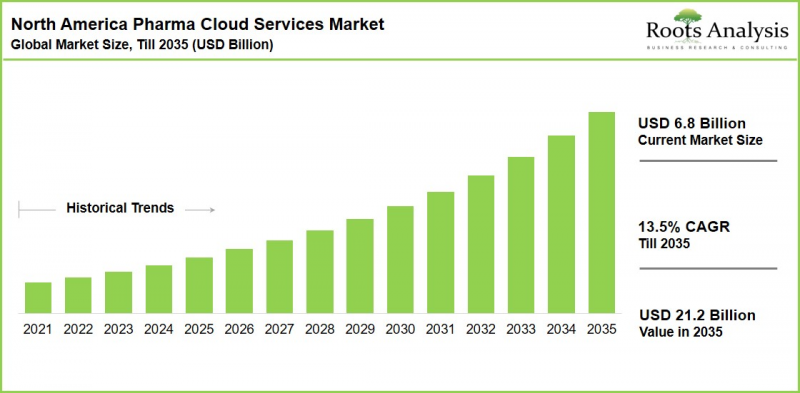
North America Pharma Cloud Services Market: Growth and Trends
Pharmaceutical companies across North America are steadily modernizing their IT infrastructure to manage the growing volume and complexity of data generated across research, clinical development, manufacturing, and commercial operations. Cloud computing has emerged as a foundational layer within this transformation, offering secure storage, scalable computing capacity, and real-time collaboration across geographically distributed teams.
Although healthcare and life sciences organizations were historically cautious about migrating sensitive data to cloud environments, this caution was primarily due to concerns around privacy, security, and regulatory compliance, the emergence of validated, GxP-compliant cloud infrastructure has meaningfully improved industry confidence. North America, supported by a mature healthcare IT ecosystem, well-defined regulatory frameworks, and the concentrated presence of leading pharmaceutical and biotechnology companies, has become a particularly favourable environment for cloud adoption.
As pharmaceutical companies continuously generate large volumes of genomic, clinical, imaging, real-world, and manufacturing data, legacy on-premises IT systems are proving inadequate to support modern research and development needs. Cloud-based platforms address this gap by offering elastic computing power, flexible storage, and advanced analytics capabilities that traditional infrastructure cannot easily match.
In early-stage research, cloud platforms enable scientists to process large and heterogeneous datasets more efficiently, supporting faster target identification, lead optimization, and candidate selection. As artificial intelligence and machine learning become embedded within discovery workflows, cloud computing is increasingly regarded as a core enabler of data-driven drug discovery.
The relevance of cloud infrastructure grows further as candidates progress into clinical development, a stage that involves multiple stakeholders, large patient datasets, complex trial designs, and stringent documentation requirements. Cloud-based solutions are streamlining these processes by supporting clinical trial management, decentralized and hybrid trial models, predictive analytics, pharmacovigilance, regulatory submissions, and real-time collaboration between sponsors, contract research organizations, investigators, and regulatory bodies. Given the high volume of clinical trial activity and well-defined regulatory expectations in North America, pharmaceutical companies in the region are increasingly turning to cloud platforms to improve trial efficiency and compliance readiness.
Beyond research and clinical development, cloud technologies are becoming increasingly important within pharmaceutical manufacturing and supply chain management, where the industry continues to face pressure to improve transparency, product quality, and operational resilience across complex global supply networks. Cloud-based systems are enabling greater visibility into manufacturing operations, quality control, inventory movement, serialization, and supplier coordination, capabilities that are particularly valuable as companies work to modernize legacy infrastructure and build more agile manufacturing ecosystems.
Growth Drivers: Factors Fueling Market Expansion
The North America pharma cloud services market is being propelled by the rising adoption of virtual and decentralized clinical trials, which depend on secure, scalable cloud infrastructure to support remote patient participation and real-time data capture. The integration of artificial intelligence into cloud-based pharma platforms is further accelerating drug discovery, optimizing clinical trial management, and improving operational efficiency across development and manufacturing functions.
Growing regulatory requirements for data management and compliance are prompting pharmaceutical companies to migrate to validated, secure cloud environments capable of supporting GxP and other quality standards. Demand for scalable, cost-effective software-as-a-service application that improves clinical data management, pharmacovigilance, manufacturing operations, and commercial engagement is providing additional momentum. Notably, leading pharmaceutical companies, including Pfizer, Novartis, and AstraZeneca, have expanded their use of hyperscale platforms such as AWS and Microsoft Azure. This expansion is done to support enterprise-wide digital transformation, signaling that cloud adoption is shifting from basic IT modernization toward a core strategic priority.
Market Challenges: Critical Barriers Hindering Progress
Despite strong growth momentum, the North America pharma cloud services market continues to face several structural challenges. Migrating legacy, on-premise systems that house decades of regulated data remain a complex and resource-intensive undertaking for many established pharmaceutical companies. This process requires careful validation and change management to avoid disruption to ongoing development and manufacturing programs.
Data privacy, cybersecurity, and cross-border data governance remain persistent concerns as pharmaceutical companies increasingly rely on multi-cloud and hybrid deployment models that span several vendors and jurisdictions. Ensuring interoperability between cloud platforms, in-house systems, and third-party partner networks also continues to pose integration challenges. Further, rapid advances in AI and cloud-native technologies require pharmaceutical companies to continuously reassess vendor capabilities, contracts, and total cost of ownership, increasing procurement complexity.
North America Pharma Cloud Services Market: Key Insights
The report delves into the current state of the North America pharma cloud services market and identifies potential growth opportunities within the industry, particularly from a distributor and channel-partner perspective. Some key findings include:
- Adoption of AI-enabled cloud platforms is accelerating across drug discovery, clinical development, regulatory documentation, manufacturing, and commercial operations, as pharmaceutical companies seek to manage growing volumes of genomic, clinical, imaging, and real-world data.
- Cloud-native automation of complex drug development workflows, spanning clinical, regulatory, patient safety, and quality functions, is gaining traction as companies seek faster access to structured and unstructured data and stronger cross-functional decision support.
- Partnership activity among stakeholders in this domain remains high, with platform utilization agreements emerging as the most common deal type, reflecting pharma companies' need for scalable, secure, and compliant infrastructure across the drug lifecycle.
- Increasing adoption of hybrid and multi-cloud strategies, supported by growing availability of GxP-certified cloud environments, is reinforcing confidence in large-scale cloud migration across the industry.
- Cloud-enabled cost savings are expected to be most pronounced in drug discovery and development, where scalable computing and AI-driven analytics can meaningfully reduce experimentation cycles and time-to-market.
- Given the pace of AI integration, growing regulatory-grade cloud infrastructure, and the ongoing modernization of R&D, clinical, and manufacturing workflows, the North America pharma cloud services market is well positioned for sustained growth through 2035.
North America Pharma Cloud Services Market Segments
Roots Analysis segments the North America pharma cloud services opportunity across the following parameters:
By Area of Application
- Drug Discovery
- Drug Development
- Drug Manufacturing
By Type of Cloud Service
- Software as a Service (SaaS)
- Infrastructure as a Service (IaaS)
- Platform as a Service (PaaS)
- Others
By Type of Cloud
- Hybrid Cloud
- Public Cloud
- Private Cloud
By End User
- Pharmaceutical and Life Sciences Companies
- Contract Research Organizations (CROs)
- Others
North America Pharma Cloud Services Market: Key Segment Insights
Drug Discovery Leads and is the Fastest-Growing Application Area
Drug discovery currently accounts for the largest share of the North America pharma cloud services market and is projected to grow at the highest CAGR through 2035. This leadership reflects the growing reliance of research organizations on scalable compute infrastructure and AI-enabled analytics to accelerate target identification, molecular simulation, and lead optimization.
Merck's multi-year collaboration with Google Cloud, valued at up to USD 1 billion, highlights the growing adoption of enterprise-scale cloud infrastructure in the pharmaceutical industry. The partnership aims to deploy an agentic AI platform across R&D, manufacturing, and commercial operations, reflecting the industry's shift from experimental AI pilots to large-scale cloud-enabled innovation.
Software as a Service Remains the Preferred Delivery Model
SaaS continues to dominate the North America pharma cloud services market. This dominance can be attributed to the fact that pharmaceutical companies favor subscription-based applications that reduce capital expenditure while offering rapid deployment and continuous updates. Regulated, purpose-built SaaS platforms such as Veeva Vault Clinical, which is widely used to manage clinical trial data capture, site management, and study workflows, underscores this segment's highest share.
Hybrid Cloud Continues to Anchor Enterprise Deployments
Hybrid cloud architecture holds the largest share of the market. This highest share reflects pharmaceutical companies' need to balance the security and control associated with private infrastructure against the scalability and cost efficiency of public cloud. AstraZeneca collaborated with AWS to develop an AI-powered assistant using Amazon Bedrock Agents.
The platform has scaled to more than 1,000 users across clinical, regulatory, patient safety, and quality functions, reflecting the growing adoption of hybrid, enterprise-grade cloud deployments.
Pharmaceutical and Life Sciences Companies Drive End-User Demand
Pharmaceutical and life sciences companies represent the largest end-user segment and are expected to grow at a relatively higher CAGR during the forecast period. This highest growth is largely because organizations are migrating away from legacy, on-premises systems in favor of cloud platforms that support faster innovation and enterprise-wide data integration. Veeva Systems' expanded partnership with BioMarin Pharmaceutical. This collaboration aimed at broadening the use of cloud-based development and commercial platforms to speed up rare disease drug development.
Example Players in North America Pharma Cloud Services Market
- Amazon Web Services
- Cisco Systems
- Cognizant
- DXC Technology
Expert Interview and Industry Insights
The opinions and insights presented in this study were shaped by discussions with multiple stakeholders across the value chain. The research report features detailed transcripts of interviews held with the following industry participants:
- Vice President Growth, Small Company, US
- Regional Manager North and South America, Small Company, Switzerland
In addition, the market report includes transcripts from the following third-party discussions:
- Chief Regulatory Officer, Very Large Company, France
- Group Vice President, Research Services, Health & Life Sciences, Very Large Company, US
- Senior Vice President, Life Sciences, Very Large Company, US
- Vice President of R&D Business Consulting, Very Large Company, US
- Global Director, Healthcare & Life Sciences, Very Large Company, US
- Chief Information and Data Officer, Mid-sized Company, US
- Head of AI Consulting, Mid-sized Company, UK
- Managing Director, Mid-sized Company, India
- Head of GTM, Strategic Partnerships & Alliances, Mid-sized Company, Germany
- Technical Lead, Large Company, US
NORTH AMERICA PHARMA CLOUD SERVICES MARKET: RESEARCH COVERAGE
- Market Sizing and Opportunity Analysis: The report features an in-depth analysis of the North America pharma cloud services market, focusing on key market segments, including [A] area of application, [B] type of cloud service, [C] type of cloud, and [D] end user, along with historical trends (since 2021) and forecasted estimates (till 2035).
- Market Landscape Analysis: A comprehensive assessment of the overall North America pharma cloud services provider landscape, based on parameters such as year of establishment, company size, location of headquarters, type of company, cloud service business model, quality certifications, type of cloud, type of cloud service, area of application, and additional capabilities and services offered.
- Company Competitiveness Analysis: A benchmarking exercise evaluating pharma cloud service providers across defined peer groups, based on relevant qualitative and quantitative parameters.
- Company Profiles: In-depth profiles of prominent players engaged in offering pharma cloud services, featuring information on company overview, financial information, service portfolio, and recent developments and future outlook.
- Partnerships and Collaborations: An analysis of partnerships established by stakeholders in this domain since 2021, based on year of partnership, type of partnership, focus area, most active players, and geography (local, international, intracontinental, and intercontinental agreements).
- Cost Saving Analysis: An insightful analysis estimating the likely cost savings enabled by cloud-based solutions across drug discovery, drug development, and drug manufacturing, till 2035, across key global regions.
- Anticipated Technology Upgrades and Affiliated Opportunities: An analysis of key enabling technologies, including artificial intelligence, deep learning, machine learning, and quantum computing, and their likely cost-saving impact when integrated with cloud computing, along with an innovation versus associated risk assessment.
- Market Impact Analysis: The report analyzes various factors, such as drivers, restraints, opportunities, and challenges, affecting the growth of the North America pharma cloud services market.
- Executive Insights: A summary of the report's key findings, presented from the perspective of stakeholders across the pharma cloud services value chain.
Key Questions Answered in this Report
- Which are the leading companies in the North America pharma cloud services market?
- Which area of application and end-user segment dominate the North America pharma cloud services market?
- What are the key trends observed in the North America pharma cloud services market?
- What factors are likely to influence the evolution of this market?
- What are the primary challenges faced by pharma cloud service providers and adopters?
- What is the current and future size of the North America pharma cloud services market?
- What is the CAGR of this market through 2035?
- How is the current and future market opportunity likely to be distributed across key market segments?
- What cost savings can pharmaceutical companies expect from cloud adoption across discovery, development, and manufacturing?
Reasons to Buy this Report
This report has been specifically developed to support distributors, channel partners, and business development teams evaluating entry into the North America Pharma Cloud Services market.
- The report provides comprehensive market analysis, offering detailed revenue projections for the overall North America pharma cloud services market and its specific sub-segments, valuable to both established market leaders and emerging entrants.
- The report offers stakeholders a comprehensive overview of the market, including key drivers, barriers, opportunities, and challenges, empowering them to stay abreast of market trends and make data-driven decisions to capitalize on growth prospects.
- The report can aid businesses in identifying future opportunities in this domain, while also helping assess whether those opportunities are worth pursuing.
- The report helps in identifying customer demand by understanding the needs, preferences, and behavior of pharmaceutical and life sciences target audiences.
- The report equips new entrants with requisite information regarding this market to help them build successful business strategies.
- The report allows for more effective communication with stakeholders and supports the development of stronger business relationships across the pharma cloud services value chain.
Additional Benefits
- Complementary PPT Insights Pack
- Complementary Excel Data Packs for all Analytical Modules in the Report
- 15% Free Content Customization
- Detailed Report Walkthrough Session with Research Team
- Free Updated report if the report is 6-12 months old or older
TABLE OF CONTENTS
1. PREFACE
- 1.1. Introduction
- 1.2. Market Share Insights
- 1.3. Key Market Insights
- 1.4. Report Coverage
- 1.5. Key Questions Answered
- 1.6. Chapter Outlines
2. RESEARCH METHODOLOGY
- 2.1. Chapter Overview
- 2.2. Research Assumptions
- 2.2.1. Market Landscape and Market Trends
- 2.2.2. Market Forecast and Opportunity Analysis
- 2.2.3. Comparative Analysis
- 2.3. Database Building
- 2.3.1. Data Collection
- 2.3.2. Data Validation
- 2.3.3. Data Analysis
- 2.4. Project Methodology
- 2.4.1. Secondary Research
- 2.4.1.1. Annual Reports
- 2.4.1.2. Academic Research Papers
- 2.4.1.3. Company Websites
- 2.4.1.4. Investor Presentations
- 2.4.1.5. Regulatory Filings
- 2.4.1.6. White Papers
- 2.4.1.7. Industry Publications
- 2.4.1.8. Conferences and Seminars
- 2.4.1.9. Government Portals
- 2.4.1.10. Media and Press Releases
- 2.4.1.11. Newsletters
- 2.4.1.12. Industry Databases
- 2.4.1.13. Roots Proprietary Databases
- 2.4.1.14. Paid Databases and Sources
- 2.4.1.15. Social Media Portals
- 2.4.1.16. Other Secondary Sources
- 2.4.2. Primary Research
- 2.4.2.1. Types of Primary Research
- 2.4.2.1.1. Qualitative Research
- 2.4.2.1.2. Quantitative Research
- 2.4.2.1.3. Hybrid Approach
- 2.4.2.2. Advantages of Primary Research
- 2.4.2.3. Techniques for Primary Research
- 2.4.2.3.1. Interviews
- 2.4.2.3.2. Surveys
- 2.4.2.3.3. Focus Groups
- 2.4.2.3.4. Observational Research
- 2.4.2.3.5. Social Media Interactions
- 2.4.2.4. Key Opinion Leaders Considered in Primary Research
- 2.4.2.4.1. Company Executives (CXOs)
- 2.4.2.4.2. Board of Directors
- 2.4.2.4.3. Company Presidents and Vice Presidents
- 2.4.2.4.4. Research and Development Heads
- 2.4.2.4.5. Technical Experts
- 2.4.2.4.6. Subject Matter Experts
- 2.4.2.4.7. Scientists
- 2.4.2.4.8. Doctors and Other Healthcare Providers
- 2.4.2.5. Ethics and Integrity
- 2.4.2.5.1. Research Ethics
- 2.4.2.5.2. Data Integrity
- 2.4.2.1. Types of Primary Research
- 2.4.3. Analytical Tools and Databases
- 2.4.1. Secondary Research
- 2.5. Robust Quality Control
3. MARKET DYNAMICS
- 3.1. Chapter Overview
- 3.2. Forecast Methodology
- 3.2.1. Top-down Approach
- 3.2.2. Bottom-up Approach
- 3.2.3. Hybrid Approach
- 3.3. Market Assessment Framework
- 3.3.1. Total Addressable Market (TAM)
- 3.3.2. Serviceable Addressable Market (SAM)
- 3.3.3. Serviceable Obtainable Market (SOM)
- 3.3.4. Currently Acquired Market (CAM)
- 3.4. Forecasting Tools and Techniques
- 3.4.1. Qualitative Forecasting
- 3.4.2. Correlation
- 3.4.3. Regression
- 3.4.4. Extrapolation
- 3.4.5. Convergence
- 3.4.6. Sensitivity Analysis
- 3.4.7. Scenario Planning
- 3.4.8. Data Visualization
- 3.4.9. Time Series Analysis
- 3.4.10. Forecast Error Analysis
- 3.5. Key Considerations
- 3.5.1. Demographics
- 3.5.2. Government Regulations
- 3.5.3. Reimbursement Scenarios
- 3.5.4. Market Access
- 3.5.5. Supply Chain
- 3.5.6. Industry Consolidation
- 3.5.7. Pandemic / Unforeseen Disruptions Impact
- 3.6. Limitations
4. MACRO-ECONOMIC INDICATORS
- 4.1. Chapter Overview
- 4.2. Market Dynamics
- 4.2.1. Time Period
- 4.2.1.1. Historical Trends
- 4.2.1.2. Current and Forecasted Estimates
- 4.2.2. Currency Coverage
- 4.2.2.1. Major Currencies Affecting the Market
- 4.2.2.2. Factors Affecting Currency Fluctuations on the Industry
- 4.2.2.3. Impact of Currency Fluctuations on the Industry
- 4.2.3. Foreign Currency Exchange Rate
- 4.2.3.1. Impact of Foreign Exchange Rate Volatility on the Market
- 4.2.3.2. Strategies for Mitigating Foreign Exchange Risk
- 4.2.4. Recession
- 4.2.4.1. Assessment of Current Economic Conditions and Potential Impact on the Market
- 4.2.4.2. Historical Analysis of Past Recessions and Lessons Learnt
- 4.2.5. Inflation
- 4.2.5.1. Measurement and Analysis of Inflationary Pressures in the Economy
- 4.2.5.2. Potential Impact of Inflation on the Market Evolution
- 4.2.6. Interest Rates
- 4.2.6.1. Interest Rates and Their Impact on the Market
- 4.2.6.2. Strategies for Managing Interest Rate Risk
- 4.2.7. Commodity Flow Analysis
- 4.2.7.1. Type of Commodity
- 4.2.7.2. Origins and Destinations
- 4.2.7.3. Values and Weights
- 4.2.7.4. Modes of Transportation
- 4.2.8. Global Trade Dynamics
- 4.2.8.1. Import Scenario
- 4.2.8.2. Export Scenario
- 4.2.8.3. Trade Policies
- 4.2.8.4. Strategies for Mitigating the Risks Associated with Trade Barriers
- 4.2.8.5. Impact of Trade Barriers on the Market
- 4.2.9. War Impact Analysis
- 4.2.9.1. Russian-Ukraine War
- 4.2.9.2. Israel-Hamas War
- 4.2.10. COVID Impact / Related Factors
- 4.2.10.1. Global Economic Impact
- 4.2.10.2. Industry-specific Impact
- 4.2.10.3. Government Response and Stimulus Measures
- 4.2.10.4. Future Outlook and Adaptation Strategies
- 4.2.11. Other Indicators
- 4.2.11.1. Fiscal Policy
- 4.2.11.2. Consumer Spending
- 4.2.11.3. Gross Domestic Product
- 4.2.11.4. Employment
- 4.2.11.5. Taxes
- 4.2.11.6. Stock Market Performance
- 4.2.11.7. Cross Border Dynamics
- 4.2.1. Time Period
- 4.3. Conclusion
5. EXECUTIVE SUMMARY
6. INTRODUCTION
- 6.1. Chapter Overview
- 6.2. Overview of Cloud Computing
- 6.2.1. Types of Clouds and Cloud Services
- 6.2.2. Cloud Computing in Drug Discovery, Development and Manufacturing
- 6.2.3. Benefits and Limitations of Cloud Computing
- 6.3. Concluding Remarks
7. MARKET LANDSCAPE
- 7.1. Chapter Overview
- 7.2. North American Cloud Service Providers: Overall Market Landscape
- 7.2.1. Analysis by Year of Establishment
- 7.2.2. Analysis by Company Size
- 7.2.3. Analysis by Location of Headquarters (Region)
- 7.2.4. Analysis by Location of Headquarters (Country)
- 7.2.5. Analysis by Type of Company
- 7.2.6. Analysis by Cloud Service Business Model
- 7.2.7. Analysis by Quality Certifications
- 7.2.8. Analysis by Type of Cloud
- 7.2.9. Analysis by Type of Cloud Services
- 7.2.10. Analysis by Area of Application
- 7.2.11. Analysis by Additional Capabilities
- 7.2.12. Analysis by Additional Services Offered
8. COMPANY COMPETITIVENESS ANALYSIS
- 8.1. Chapter Overview
- 8.2. Assumptions and Key Parameters
- 8.3. Methodology
- 8.4. Overview of Peer Groups
- 8.5. Company Competitiveness Analysis
9. COMPANY PROFILES: PHARMA CLOUD SERVICE PROVIDERS
- 9.1. Chapter Overview
- 9.2. Microsoft
- 9.2.1. Company Overview
- 9.2.2. Financial Information
- 9.2.3. Service Portfolio
- 9.2.4. Recent Developments and Future Outlook
- 9.3. Google
- 9.4. Amazon Web Services
- 9.5. IBM
- 9.6. Nutanix
- 9.7. Hewlett Packard Enterprise
10. PARTNERSHIPS AND COLLABORATIONS
- 10.1. Chapter Overview
- 10.2. Partnership Models
- 10.3. North America Cloud Service Providers: Partnerships and Collaborations
- 10.3.1. Analysis by Year of Partnership
- 10.3.2. Analysis by Type of Partnership
- 10.3.3. Analysis by Year and Type of Partnership
- 10.3.4. Analysis by Focus Area
- 10.3.5. Most Active Players: Analysis by Number of Partnerships
- 10.3.6. Analysis by Geography
- 10.3.6.1. Local and International Agreements
- 10.3.6.2. Intracontinental and Intercontinental Agreements
11. COST SAVING ANALYSIS
- 11.1. Chapter Overview
- 11.2. Key Assumptions and Methodology
- 11.2.1. Overall Cost Saving Potential of Cloud-based Solutions for Drug Discovery, Development and Manufacturing, till 2035
- 11.3. Likely Cost Savings in Drug Discovery, till 2035
- 11.3.1. Likely Cost Savings in Drug Discovery in North America, till 2035
- 11.3.2. Likely Cost Savings in Drug Discovery in Europe, till 2035
- 11.3.3. Likely Cost Savings in Drug Discovery in Asia-Pacific, till 2035
- 11.3.4. Likely Cost Savings in Drug Discovery in Middle East and North Africa, till 2035
- 11.3.5. Likely Cost Savings in Drug Discovery in Latin America, till 2035
- 11.3.6. Likely Cost Savings in Drug Discovery in Rest of the World, till 2035
- 11.4. Likely Cost Savings in Drug Development, till 2035
- 11.4.1. Likely Cost Savings in Drug Development in North America, till 2035
- 11.4.2. Likely Cost Savings in Drug Development in Europe, till 2035
- 11.4.3. Likely Cost Savings in Drug Development in Asia-Pacific, till 2035
- 11.4.4. Likely Cost Savings in Drug Development in Middle East and North Africa, till 2035
- 11.4.5. Likely Cost Savings in Drug Development in Latin America, till 2035
- 11.4.6. Likely Cost Savings in Drug Development in Rest of the World, till 2035
- 11.5. Likely Cost Savings in Drug Manufacturing, till 2035
- 11.5.1. Likely Cost Savings in Drug Manufacturing in North America, till 2035
- 11.5.2. Likely Cost Savings in Drug Manufacturing in Europe, till 2035
- 11.5.3. Likely Cost Savings in Drug Manufacturing in Asia-Pacific, till 2035
- 11.5.4. Likely Cost Savings in Drug Manufacturing in Middle East and North Africa, till 2035
- 11.5.5. Likely Cost Savings in Drug Manufacturing in Latin America, till 2035
- 11.5.6. Likely Cost Savings in Drug Manufacturing in Rest of the World, till 2035
- 11.6. Concluding Remarks: Cost Saving Scenarios
12. ANTICIPATED TECHNOLOGY UPGRADES AFFILIATED OPPORTUNITIES
- 12.1. Chapter Overview
- 12.2. Key Assumptions and Methodology
- 12.3. Key Tools and Technologies
- 12.3.1. Artificial Intelligence
- 12.3.1.1. Artificial Intelligence in Pharmaceutical Product Development and Manufacturing
- 12.3.1.2. Likely Cost-Savings by Integrating Artificial Intelligence with Cloud Computing
- 12.3.2. Deep Learning
- 12.3.2.1. Deep Learning in Pharmaceutical Product Development and Manufacturing
- 12.3.2.2. Likely Cost-Savings by Integrating Deep Learning with Cloud Computing
- 12.3.3. Machine Learning
- 12.3.3.1. Machine Learning in Pharmaceutical Product Development and Manufacturing
- 12.3.3.2. Likely Cost-Savings by Integrating Machine Learning with Cloud Computing
- 12.3.4. Quantum Computing
- 12.3.4.1. Quantum Computing in Pharmaceutical Product Development and Manufacturing
- 12.3.4.2. Likely Cost-Savings by Integrating Quantum Computing with Cloud Computing
- 12.3.1. Artificial Intelligence
- 12.4. Extent of Innovation versus Associated Risk Analysis
- 12.4.1. Results and Discussion
13. MARKET IMPACT ANALYSIS
- 13.1. Chapter Overview
- 13.2. Market Drivers
- 13.3. Market Restraints
- 13.4. Market Opportunities
- 13.5. Market Challenges
- 13.6. Conclusion
14. NORTH AMERICA PHARMA CLOUD SERVICES MARKET
- 14.1. Chapter Overview
- 14.2. Key Assumptions and Methodology
- 14.3. North America Pharma Cloud Services Market, Historical Trends (since 2021) and Forecasted Estimates (till 2035)
- 14.3.1. Roots Analysis Perspective on Market Growth
- 14.3.2. Scenario Analysis
- 14.3.2.1. Conservative Scenario
- 14.3.2.2. Optimistic Scenario
- 14.4. Key Market Segmentations
15. NORTH AMERICA PHARMA CLOUD SERVICES MARKET, BY AREA OF APPLICATION
- 15.1. Chapter Overview
- 15.2. Key Assumptions and Methodology
- 15.3. North America Pharma Cloud Services Market: Distribution by Area of Application
- 15.3.1. North America Pharma Cloud Services Market for Drug Discovery, Historical Trends (since 2021) and Forecasted Estimates (till 2035)
- 15.3.2. North America Pharma Cloud Services Market for Drug Development, Historical Trends (since 2021) and Forecasted Estimates (till 2035)
- 15.3.3. North America Pharma Cloud Services Market for Drug Manufacturing, Historical Trends (since 2021) and Forecasted Estimates (till 2035)
- 15.4. Data Triangulation and Validation
16. NORTH AMERICA PHARMA CLOUD SERVICES MARKET, BY TYPE OF CLOUD SERVICE
- 16.1. Chapter Overview
- 16.2. Key Assumptions and Methodology
- 16.3. North America Pharma Cloud Services Market: Distribution by Type of Cloud Service
- 16.3.1. North America Pharma Cloud Services Market for Software as a Service (SaaS), Historical Trends (since 2021) and Forecasted Estimates (till 2035)
- 16.3.2. North America Pharma Cloud Services Market for Infrastructure as a Service (IaaS), Historical Trends (since 2021) and Forecasted Estimates (till 2035)
- 16.3.3. North America Pharma Cloud Services Market for Platform as a Service (PaaS), Historical Trends (since 2021) and Forecasted Estimates (till 2035)
- 16.3.4. North America Pharma Cloud Services Market for Others, Historical Trends (since 2021) and Forecasted Estimate, (till 2035)
- 16.4. Data Triangulation and Validation
17. NORTH AMERICA PHARMA CLOUD SERVICES MARKET, BY TYPE OF CLOUD
- 17.1. Chapter Overview
- 17.2. Key Assumptions and Methodology
- 17.3. North America Pharma Cloud Services Market: Distribution by Type of Cloud
- 17.3.1. North America Pharma Cloud Services Market for Hybrid Cloud, Historical Trends (since 2021) and Forecasted Estimates (till 2035)
- 17.3.2. North America Pharma Cloud Services Market for Public Cloud, Historical Trends (since 2021) and Forecasted Estimates (till 2035)
- 17.3.3. North America Pharma Cloud Services Market for Private Cloud, Historical Trends (since 2021) and Forecasted Estimates (till 2035)
- 17.4. Data Triangulation and Validation
18. NORTH AMERICA PHARMA CLOUD SERVICES MARKET, BY END USER
- 18.1. Chapter Overview
- 18.2. Key Assumptions and Methodology
- 18.3. North America Pharma Cloud Services Market: Distribution by End User
- 18.3.1. North America Pharma Cloud Services Market for Pharmaceutical and Life Sciences Companies, Historical Trends (since 2021) and Forecasted Estimates (till 2035)
- 18.3.2. North America Pharma Cloud Services Market for CROs, Historical Trends (since 2021) and Forecasted Estimates (till 2035)
- 18.3.3. North America Pharma Cloud Services Market for Others, Historical Trends (since 2021) and Forecasted Estimates (till 2035)
- 18.4. Data Triangulation and Validation
19. CONCLUDING REMARKS
21. APPENDIX I: TABULATED DATA

