PUBLISHER: Roots Analysis | PRODUCT CODE: 2132674

PUBLISHER: Roots Analysis | PRODUCT CODE: 2132674
Europe Alpha-Emitting Radioligand Therapy Market - Trends and Forecast Till 2035
EUROPE ALPHA-EMITTING RADIOLIGAND THERAPY MARKET: OVERVIEW
The Europe alpha-emitting radioligand therapy market is estimated to grow from an estimated USD 0.05 billion in the current year to nearly USD 0.40 billion by 2035, reflecting a CAGR of close to 26% during the forecast period, till 2035. Growth is being driven by the accelerating clinical validation of targeted alpha therapy (TAT) in prostate cancer and neuroendocrine tumors, expanding actinium-225 and lead-212 production capacity across the region, and rising strategic investment by both large pharmaceutical companies and specialized radiopharmaceutical developers headquartered in Europe.
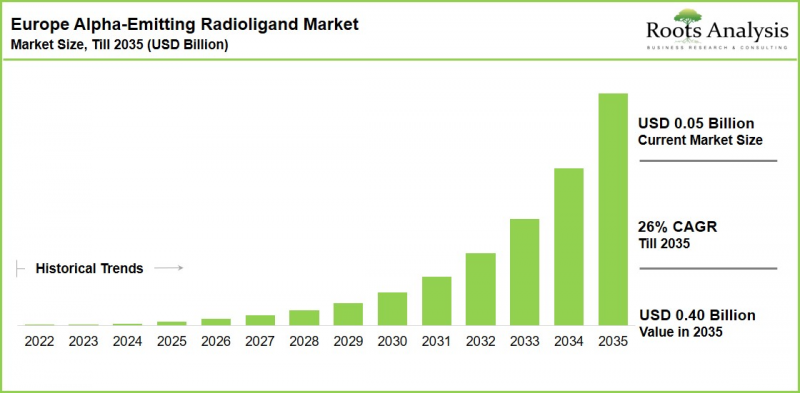
Europe Alpha-Emitting Radioligand Therapy Market: Growth and Trends
Alpha-emitting radioligand therapy also referred to as targeted alpha therapy or TAT uses high linear energy transfer (LET) alpha particles, delivered via radionuclides such as actinium-225, radium-223, lead-212, astatine-211, thorium-227 and bismuth-213, conjugated to tumor-targeting ligands. Since alpha particles travel only a few cell diameters (approximately 50-100 micrometers) before depositing their energy, they cause dense, largely irreparable double-strand DNA breaks within targeted cancer cells while sparing much of the surrounding healthy tissue.
This precision profile distinguishes alpha-emitting radioligand therapy from conventional beta-emitting agents such as lutetium-177 and is a central reason the modality is increasingly viewed as the next frontier of precision radiopharmaceutical oncology across Europe. In addition, Europe occupies a distinctive position in the global targeted alpha therapy landscape. Europe has well-established radionuclide production and research infrastructure, supported by EU initiatives such as PRISMAP and SECURE. These programs aim to strengthen the sustainable, GMP-grade supply of alpha-emitting isotopes for clinical and commercial use.
Radium-223 dichloride remains the foundation of Europe's clinical experience with alpha-emitting radiopharmaceuticals. Meanwhile, a growing pipeline of actinium-225 and lead-212 labeled therapies is advancing in trials for prostate cancer, neuroendocrine tumors, and other solid cancers.
Growth Drivers: Strategic Enablers of Market Expansion
Growth in the Europe alpha-emitting radioligand therapy market is being propelled by the rising prevalence of prostate cancer and neuroendocrine tumors across the region. Further, mounting clinical evidence shows that alpha-particle-based agents can produce meaningful responses in patients who have progressed on lutetium-177 based beta emitting radioligand therapy. The approval and commercialization of PSMA and somatostatin receptor-targeted beta therapies have strengthened Europe's diagnostic, referral, and reimbursement infrastructure. This includes PET-based patient selection using gallium-68 and copper-64 tracers, enabling faster adoption of alpha-emitting therapies.
Substantial capital deployment is further accelerating market expansion. European developers, including ITM Isotope Technologies Munich SE, Orano Med, Curium, and clinical-stage biotechnology companies, are securing funding to expand actinium-225 and lead-212 production. Global players such as Novartis, Bayer, Eli Lilly, and Bristol Myers Squibb are also investing in European manufacturing, clinical trials, and isotope-sourcing partnerships.
Continued regulatory engagement by the European Medicines Agency on radiopharmaceutical development pathways, combined with expanding nuclear medicine and cyclotron infrastructure across Germany, France, the UK, Italy and Spain, is expected to further support adoption over the forecast period.
Market Challenges: Critical Barriers Impeding Progress
Despite favorable momentum, the Europe alpha-emitting radioligand therapy market faces several challenges that impede the market growth. Chief among these is the limited and inconsistent global supply of medical-grade actinium-225 and other alpha-emitting isotopes, which are produced through a small number of reactor- and accelerator-based routes; capacity constraints have already been cited by developers as a factor in trial pausing or delay.
Complex, short half-life-driven cold-chain logistics, specialized radiopharmacy handling requirements, and the need for dedicated hot-cell manufacturing infrastructure add further cost and operational complexity relative to conventional oncology therapeutics.
Additionally, variability in reimbursement and health-technology-assessment frameworks across individual European countries and relatively nascent stage of clinical development for most alpha-emitting candidates (with the exception of radium-223) may also hinder the adoption of alpha-radioligand therapy. Further, the need for specialized radiation safety, dosimetry and multidisciplinary treatment infrastructure at the hospital level is a major challenge. Addressing isotope supply security, harmonizing regulatory and reimbursement pathways, and scaling manufacturing capacity will be critical for stakeholders seeking to capture the full opportunity presented by this market.
Europe Alpha-Emitting Radioligand Therapy Market: Key Insights
The report delves into the current state of the Europe alpha-emitting radioligand therapy market and identifies the key growth opportunities within the industry. Some of the key findings from the report include:
- Driven by encouraging early clinical data and the limitations of currently approved beta-emitting radioligand therapies, industry stakeholders and academic research groups across Europe are prioritizing the development of next-generation alpha-emitting candidates targeting PSMA, somatostatin receptors and other tumor-associated antigens.
- Several alpha-emitting therapies are currently approved or under investigation across various stages of development for oncology indications; a considerable proportion of active developers are headquartered in Germany, France, Switzerland and the UK, reflecting the region's deep radiochemistry and nuclear medicine research base.
- Actinium-225-labelled candidates account for the largest share of the European targeted alpha therapy pipeline, followed by lead-212- and radium-223-based agents; astatine-211 and thorium-227 platforms represent a smaller but scientifically differentiated segment.
- Prostate cancer remains the leading indication targeted by developers in this space, supported by the established PSMA-targeting infrastructure built around beta-emitting radioligand therapy; neuroendocrine tumors represent the second-largest indication segment.
- A growing proportion of ongoing and planned clinical trials involving alpha-emitting radioligand therapies are being conducted at multi-country European sites, reflecting the region's coordinated academic and industry trial networks.
- Isotope supply security has emerged as a defining strategic theme; European Union-backed initiatives such as PRISMAP and the SECURE project are actively working to expand sustainable production of actinium-225, lead-212 and other alpha-emitting radionuclides for clinical and commercial use.
- Partnerships between isotope producers, radiopharmaceutical developers and contract development and manufacturing organizations (CDMOs) have increased notably in recent years, as companies work to secure long-term access to alpha-emitting radionuclides ahead of anticipated demand growth.
- Funding activity in the space has been robust, with venture capital, strategic pharmaceutical investment and licensing deals directed toward European alpha-emitting radioligand therapy developers; acquisitions of alpha-emitter-focused platforms by large pharmaceutical companies have set valuation benchmarks for the sector globally.
- Germany is expected to remain the largest individual country market within Europe through 2035, supported by its concentration of isotope production capacity, nuclear medicine infrastructure and radiopharmaceutical developers.
- Given the rising disease burden, differentiated efficacy profile and continued innovation in isotope production and ligand design, the Europe alpha-emitting radioligand therapy market is well positioned for sustained, above-average growth relative to the broader oncology radiopharmaceuticals space through the forecast period.
Europe Alpha-Emitting Radioligand Therapy Market: Key Segments Insights
The market sizing and opportunity analysis presented in this report has been segmented across the following parameters:
By Radionuclide Type
- Actinium-225
- Radium-223
- Lead-212
- Astatine-211
- Thorium-227
- Bismuth-213
- Others
By Product Type
- Marketed / Approved Products
- Pipeline / Investigational Products
By Cancer Indication
- Prostate Cancer
- Neuroendocrine Tumors
- Bone Metastases
- Ovarian Cancer
- Hematological Malignancies
- Others
By Route of Administration
- Intravenous
- Others
By End User
- Hospitals and Nuclear Medicine Departments
- Cancer / Oncology Centers
- Specialty Radiopharmacies
By Country
- Germany
- UK
- France
- Italy
- Spain
- Switzerland
- Netherlands
- Rest of Europe
Europe Alpha-Emitting Radioligand Therapy Market: Key Segments Insight
Actinium-225 Continues to Lead the Radionuclide Segment
Based on our market assessment, actinium-225-based candidates currently represent the largest and fastest-growing radionuclide segment within the Europe alpha-emitting radioligand therapy market. This high share reflects the isotope's favorable decay characteristics, growing manufacturing investment and the breadth of the PSMA and somatostatin receptor-targeted pipeline built around it.
Radium-223 remains the only alpha emitter with long-standing regulatory approval in Europe and continues to generate steady clinical use in bone-metastatic castration-resistant prostate cancer, while lead-212-based candidates are emerging as a differentiated, generator-based alternative supported by several European and multinational developers.
Germany Maintains Regional Market Leadership
According to our proprietary market report, Germany is expected to retain its position as the largest country-level market for alpha-emitting radioligand therapy in Europe through 2035. This dominance is supported by the concentration of radiochemistry research institutions, cyclotron and reactor-linked isotope production capacity, and a dense cluster of radiopharmaceutical developers, including ITM Isotope Technologies Munich SE and academic medical centers with established nuclear medicine programs. France, the UK, Italy and Spain are expected to contribute meaningfully to regional growth, aided by expanding clinical trial activity and nuclear medicine infrastructure investment.
Prostate Cancer Remains the Leading Indication
According to the market forecast, prostate cancer accounts for the highest share and is expected to remain the leading indication for alpha-emitting radioligand therapy across Europe throughout the forecast period. This dominance is driven by the high prevalence of metastatic castration-resistant prostate cancer, the established PSMA-PET diagnostic and referral pathway, and the growing body of clinical evidence supporting actinium-225 PSMA agents in patients who have progressed on lutetium-177 based therapy.
On the other hand, Neuroendocrine tumors represent the fastest growing segment, representing higher CAGR during the forecast period. This lucrative growth is supported by an expanding pipeline of alpha-emitting somatostatin receptor-targeted candidates.
Hospitals and Nuclear Medicine Departments Account for the Largest End-User Share
Based on our analysis, Hospitals and hospital-affiliated nuclear medicine departments currently account for the majority of the market share. This dominance reflects the specialized radiation safety infrastructure, dosimetry expertise and multidisciplinary oncology care required to deliver these therapies. Continued expansion of dedicated theranostics centers and specialty radiopharmacy capacity is expected to support broader patient access over the forecast period.
Example Players in the Europe Alpha-Emitting Radioligand Therapy Market
- Ariceum Therapeutics
- Bayer
- Curium
- Convergent Therapeutics
- Clarity Pharmaceuticals
- Eli Lilly and Company
- Full-Life Technologies
- Fusion Pharmaceuticals (AstraZeneca)
- ITM Isotope Technologies Munich SE
- Novartis
- Orano Med
- Perspective Therapeutics
- RayzeBio (Bristol Myers Squibb)
- Telix Pharmaceuticals
EUROPE ALPHA-EMITTING RADIOLIGAND THERAPY MARKET: RESEARCH COVERAGE
- Market Sizing and Opportunity Analysis: An in-depth analysis of the Europe alpha-emitting radioligand therapy market, focusing on key market segments, including radionuclide type, product type, cancer indication, route of administration, end user and country.
- Alpha-Emitting Radioligand Therapies Landscape: A detailed assessment of the overall competitive landscape, featuring information on stage of development, radionuclide type, targeting moiety, indication and route of administration, along with analysis of developers by year of establishment, company size and location of headquarters.
- Company Profiles: In-depth profiles of prominent players engaged in the Europe alpha-emitting radioligand therapy industry, featuring information on year of establishment, location of headquarters, company size, management team, portfolio and key initiatives.
- Clinical Trial Analysis: An analysis of completed and ongoing clinical trials, based on trial registration year, enrolled patient population, trial phase, trial status, type of sponsor / collaborator and geography.
- Isotope Supply Chain Analysis: An assessment of actinium-225, lead-212 and other alpha-emitting radionuclide production capacity, sourcing models and European supply-security initiatives.
- Patent Analysis: An analysis of patents filed / granted related to alpha-emitting radioligand therapies, based on parameters such as patent application year, publication year, jurisdiction and type of applicant.
- Regulatory and Market Access Analysis: An analysis of the regulatory and market access landscape for alpha-emitting radioligand therapies in Europe, covering European Medicines Agency regulatory pathways, radiopharmaceutical-specific requirements, clinical development and regulatory considerations, radiation safety and handling requirements, health technology assessment and reimbursement mechanisms, and country-level market access considerations across Germany, the UK, France, Italy, Spain, Switzerland and the Netherlands.
- Market Impact Analysis: An analysis of the drivers, restraints, opportunities and challenges affecting market growth.
KEY QUESTIONS ANSWERED IN THIS REPORT
- What is the current and future size of the Europe alpha-emitting radioligand therapy market?
- What is the projected CAGR of the Europe alpha-emitting radioligand therapy market through 2035?
- Which radionuclide type (actinium-225, radium-223, lead-212 or others) leads the market today, and which is expected to grow fastest?
- Which country is expected to dominate the Europe alpha-emitting radioligand therapy market, and which will grow fastest?
- Which companies are the leading developers of alpha-emitting radioligand therapies in Europe?
- What are the key trends and growth drivers shaping this market?
- What are the primary challenges, including isotope supply constraints, faced by developers in this space?
- How is the current and future market opportunity distributed across key indications and end users?
REASONS TO BUY THIS REPORT
- Provides a comprehensive market analysis, offering detailed revenue projections of the overall Europe alpha-emitting radioligand therapy market and its sub-segments, valuable to both established market leaders and emerging entrants.
- Offers stakeholders a comprehensive overview of the market, including key drivers, barriers, opportunities and challenges, empowering data-driven decision-making.
- Help businesses identify future opportunities and assess whether those opportunities are worth pursuing.
- Supports identification of customer demand by clarifying the needs, preferences and behavior of the target audience.
- Equips new entrants with the requisite market intelligence to build successful go-to-market and isotope-sourcing strategies.
- Enables more effective communication with stakeholders and supports the building of strong business relationships across the value chain.
ADDITIONAL BENEFITS
- Complementary Excel Data Packs for all Analytical Modules in the Report
- 15% Free Content Customization
- Detailed Report Walkthrough Session with Research Team
- Free Updated Report if the Report is 6-12 Months Old or Older
TABLE OF CONTENTS
1. PREFACE
- 1.1. Introduction
- 1.2. Market Share Insights
- 1.3. Key Market Insights
- 1.4. Report Coverage
- 1.5. Key Questions Answered
- 1.6. Chapter Outlines
2. RESEARCH METHODOLOGY
- 2.1. Chapter Overview
- 2.2. Research Assumptions
- 2.2.1. Market Landscape and Market Trends
- 2.2.2. Market Forecast and Opportunity Analysis
- 2.2.3. Comparative Analysis
- 2.3. Database Building
- 2.3.1. Data Collection
- 2.3.2. Data Validation
- 2.3.3. Data Analysis
- 2.4. Project Methodology
- 2.4.1. Secondary Research
- 2.4.1.1. Annual Reports
- 2.4.1.2. Academic Research Papers
- 2.4.1.3. Company Websites
- 2.4.1.4. Investor Presentations
- 2.4.1.5. Regulatory Filings
- 2.4.1.6. White Papers
- 2.4.1.7. Industry Publications
- 2.4.1.8. Conferences and Seminars
- 2.4.1.9. Government Portals
- 2.4.1.10. Media and Press Releases
- 2.4.1.11. Newsletters
- 2.4.1.12. Industry Databases
- 2.4.1.13. Roots Proprietary Databases
- 2.4.1.14. Paid Databases and Sources
- 2.4.1.15. Social Media Portals
- 2.4.1.16. Other Secondary Sources
- 2.4.2. Primary Research
- 2.4.2.1. Types of Primary Research
- 2.4.2.1.1. Qualitative Research
- 2.4.2.1.2. Quantitative Research
- 2.4.2.1.3. Hybrid Approach
- 2.4.2.2. Advantages of Primary Research
- 2.4.2.3. Techniques for Primary Research
- 2.4.2.3.1. Interviews
- 2.4.2.3.2. Surveys
- 2.4.2.3.3. Focus Groups
- 2.4.2.3.4. Observational Research
- 2.4.2.3.5. Social Media Interactions
- 2.4.2.4. Key Opinion Leaders Considered in Primary Research
- 2.4.2.4.1. Company Executives (CXOs)
- 2.4.2.4.2. Research and Development Heads
- 2.4.2.4.3. Technical Experts
- 2.4.2.4.4. Subject Matter Experts
- 2.4.2.4.5. Scientists
- 2.4.2.4.6. Nuclear Medicine Specialists
- 2.4.2.4.7. Medical Oncologists and Other Healthcare Providers
- 2.4.2.5. Ethics and Integrity
- 2.4.2.5.1. Research Ethics
- 2.4.2.5.2. Data Integrity
- 2.4.2.1. Types of Primary Research
- 2.4.3. Analytical Tools and Databases
- 2.4.1. Secondary Research
- 2.5. Robust Quality Control
3. MARKET DYNAMICS
- 3.1. Chapter Overview
- 3.2. Forecast Methodology
- 3.2.1. Top-down Approach
- 3.2.2. Bottom-up Approach
- 3.2.3. Hybrid Approach
- 3.3. Market Assessment Framework
- 3.3.1. Total Addressable Market (TAM)
- 3.3.2. Serviceable Addressable Market (SAM)
- 3.3.3. Serviceable Obtainable Market (SOM)
- 3.3.4. Currently Acquired Market (CAM)
- 3.4. Forecasting Tools and Techniques
- 3.4.1. Qualitative Forecasting
- 3.4.2. Correlation
- 3.4.3. Regression
- 3.4.4. Extrapolation
- 3.4.5. Convergence
- 3.4.6. Sensitivity Analysis
- 3.4.7. Scenario Planning
- 3.4.8. Data Visualization
- 3.4.9. Time Series Analysis
- 3.4.10. Forecast Error Analysis
- 3.5. Key Considerations
- 3.5.1. Disease Prevalence and Incidence
- 3.5.2. Regulatory Environment
- 3.5.3. Reimbursement Scenarios
- 3.5.4. Market Access
- 3.5.5. Radioisotope Supply Chain
- 3.5.6. Manufacturing Infrastructure
- 3.5.7. Clinical Trial Activity
- 3.5.8. Industry Consolidation
- 3.5.9. Geopolitical and Supply Chain Disruptions
- 3.6. Limitations
4. MACRO-ECONOMIC INDICATORS
- 4.1. Chapter Overview
- 4.2. Market Dynamics
- 4.2.1. Time Period
- 4.2.1.1. Historical Trends
- 4.2.1.2. Current and Forecasted Estimates
- 4.2.2. Currency Coverage
- 4.2.2.1. Major Currencies Affecting the Market
- 4.2.2.2. Factors Affecting Currency Fluctuations
- 4.2.2.3. Impact of Currency Fluctuations on the Industry
- 4.2.3. Foreign Currency Exchange Rate
- 4.2.3.1. Impact of Foreign Exchange Rate Volatility
- 4.2.3.2. Strategies for Mitigating Foreign Exchange Risk
- 4.2.4. Recession
- 4.2.4.1. Assessment of Current Economic Conditions
- 4.2.4.2. Historical Analysis of Past Recessions
- 4.2.5. Inflation
- 4.2.5.1. Measurement and Analysis of Inflationary Pressures
- 4.2.5.2. Potential Impact on Market Evolution
- 4.2.6. Interest Rates
- 4.2.6.1. Interest Rates and Their Impact
- 4.2.6.2. Strategies for Managing Interest Rate Risk
- 4.2.7. Global Trade Dynamics
- 4.2.7.1. Import Scenario
- 4.2.7.2. Export Scenario
- 4.2.7.3. Trade Policies
- 4.2.7.4. Strategies for Mitigating Trade Barriers
- 4.2.7.5. Impact of Trade Barriers
- 4.2.8. War Impact Analysis
- 4.2.8.1. Russia-Ukraine War
- 4.2.8.2. Other Geopolitical Factors
- 4.2.9. COVID-19 Impact / Related Factors
- 4.2.9.1. Global Economic Impact
- 4.2.9.2. Industry-specific Impact
- 4.2.9.3. Government Response and Stimulus Measures
- 4.2.9.4. Future Outlook and Adaptation Strategies
- 4.2.10. Other Indicators
- 4.2.10.1. Fiscal Policy
- 4.2.10.2. Consumer Spending
- 4.2.10.3. Gross Domestic Product
- 4.2.10.4. Employment
- 4.2.10.5. Taxes
- 4.2.10.6. Stock Market Performance
- 4.2.10.7. Cross-border Dynamics
- 4.2.1. Time Period
- 4.3. Conclusion
5. EXECUTIVE SUMMARY
6. INTRODUCTION
- 6.1. Chapter Overview
- 6.2. Alpha-Emitting Radioligand Therapy
- 6.2.1. Overview of Targeted Alpha Therapy
- 6.2.2. Mechanism of Action
- 6.2.3. Advantages of Alpha-Emitting Radioligand Therapy
- 6.2.4. Key Applications in Oncology
- 6.3. Alpha-Emitting Radionuclides
- 6.3.1. Actinium-225
- 6.3.2. Radium-223
- 6.3.3. Lead-212
- 6.3.4. Astatine-211
- 6.3.5. Thorium-227
- 6.3.6. Bismuth-213
- 6.4. Targeting Moieties and Molecular Targets
- 6.4.1. PSMA
- 6.4.2. Somatostatin Receptors
- 6.4.3. Other Tumor-associated Targets
- 6.5. Routes of Administration
- 6.6. Patient Selection and Diagnostic Imaging
- 6.7. Dosimetry and Radiation Safety Considerations
- 6.8. Key Challenges Associated with Alpha-Emitting Radioligand Therapy
- 6.9. Future Perspectives
7. MARKET LANDSCAPE
- 7.1. Chapter Overview
- 7.2. Europe Alpha-Emitting Radioligand Therapy: Overall Market Landscape
- 7.2.1. Analysis by Status of Development
- 7.2.2. Analysis by Radionuclide Type
- 7.2.3. Analysis by Product Type
- 7.2.4. Analysis by Cancer Indication
- 7.2.5. Analysis by Route of Administration
- 7.2.6. Analysis by End User
- 7.2.7. Analysis by Country
- 7.3. Alpha-Emitting Radioligand Therapy: Developer Landscape
- 7.3.1. Analysis by Year of Establishment
- 7.3.2. Analysis by Company Size
- 7.3.3. Analysis by Location of Headquarters
- 7.3.4. Most Active Developers: Analysis by Number of Candidates Developed
8. COMPANY COMPETITIVENESS ANALYSIS
- 8.1. Chapter Overview
- 8.2. Assumptions and Key Parameters
- 8.3. Methodology
- 8.4. Overview of Peer Groups Based in Europe
9. COMPANY PROFILES: ALPHA-EMITTING RADIOLIGAND THERAPY DEVELOPERS BASED IN EUROPE
- 9.1. Chapter Overview
- 9.2. Leading European Developers
- 9.2.1. Ariceum Therapeutics
- 9.2.1.1. Company Overview
- 9.2.1.2. Financial Information
- 9.2.1.3. Alpha-Emitting Radioligand Therapy Portfolio
- 9.2.1.4. Recent Developments and Future Outlook
- 9.2.1. Ariceum Therapeutics
- 9.3. Bayer
- 9.4. Curicum
- 9.5. Convergent Therapeutics
- 9.6. Clarity Pharmaceuticals
- 9.7. Eli Lilly and Company
- 9.8. Full-Life Technologies
- 9.9. Fusion Pharmaceuticals (AstraZeneca)
- 9.10. ITM Isotope Technologies Munich SE
- 9.11. Novartis
- 9.12. Orano Med
- 9.13. Perspective Therapeutics
- 9.14. RayzeBio (Bristol Myers Squibb)
- 9.15. Telix Pharmaceuticals
10. PARTNERSHIPS AND COLLABORATIONS
- 10.1. Chapter Overview
- 10.2. Partnership Models
- 10.3. Europe Alpha-Emitting Radioligand Therapy: Partnerships and Collaborations
- 10.3.1. Analysis by Year of Partnership
- 10.3.2. Analysis by Type of Partnership
- 10.3.3. Analysis by Year and Type of Partnership
- 10.3.4. Analysis by Type of Partner
- 10.3.5. Analysis by Type of Partnership and Type of Partner
- 10.3.6. Most Active Players: Analysis by Number of Partnerships
- 10.4. Analysis by Region
- 10.4.1. Local and International Agreements
- 10.4.2. Intracontinental and Intercontinental Agreements
11. FUNDING AND INVESTMENT ANALYSIS
- 11.1. Chapter Overview
- 11.2. Funding Models
- 11.3. Europe Alpha-Emitting Radioligand Therapy: Funding and Investment Analysis
- 11.3.1. Analysis by Year of Funding
- 11.3.1.1. Cumulative Year-wise Trend of Funding Instances
- 11.3.1.2. Cumulative Year-wise Trend of Amount Invested
- 11.3.2. Analysis by Type of Funding
- 11.3.2.1. Analysis of Funding Instances
- 11.3.2.2. Analysis of Amount Invested
- 11.3.3. Analysis by Year and Type of Funding
- 11.3.4. Analysis of Amount Invested by Year and Type of Funding
- 11.3.5. Analysis by Region
- 11.3.6. Most Active Players
- 11.3.6.1. Analysis by Number of Funding Instances
- 11.3.6.2. Analysis by Amount Raised
- 11.3.6.3. Leading Investors: Analysis by Number of Funding Instances
- 11.3.1. Analysis by Year of Funding
12. MEGA TRENDS
- 12.1. Chapter Overview
- 12.2. Europe Alpha-Emitting Radioligand Therapy: Key Megatrends
13. MARKET IMPACT ANALYSIS
- 13.1. Chapter Overview
- 13.2. Market Drivers
- 13.3. Market Restraints
- 13.4. Market Opportunities
- 13.5. Market Challenges
- 13.6. Conclusion
14. EUROPE ALPHA-EMITTING RADIOLIGAND THERAPY MARKET
- 14.1. Chapter Overview
- 14.2. Key Assumptions and Methodology
- 14.3. Europe Alpha-Emitting Radioligand Therapy Market, Forecasted Estimates (Till 2035)
- 14.3.1. Scenario Analysis
- 14.3.1.1. Conservative Scenario
- 14.3.1.2. Optimistic Scenario
- 14.3.1. Scenario Analysis
- 14.4. Key Market Segmentations
- 14.4.1. By Radionuclide Type
- 14.4.2. By Product Type
- 14.4.3. By Cancer Indication
- 14.4.4. By Route of Administration
- 14.4.5. By End User
- 14.4.6. By Country
15. EUROPE ALPHA-EMITTING RADIOLIGAND THERAPY MARKET, BY RADIONUCLIDE TYPE
- 15.1. Chapter Overview
- 15.2. Key Assumptions and Methodology
- 15.3. Europe Alpha-Emitting Radioligand Therapy Market: Distribution by Radionuclide Type
- 15.3.1. Actinium-225, Forecasted Estimates (Till 2035)
- 15.3.2. Radium-223, Forecasted Estimates (Till 2035)
- 15.3.3. Lead-212, Forecasted Estimates (Till 2035)
- 15.3.4. Astatine-211, Forecasted Estimates (Till 2035)
- 15.3.5. Thorium-227, Forecasted Estimates (Till 2035)
- 15.3.6. Bismuth-213, Forecasted Estimates (Till 2035)
- 15.3.7. Others, Forecasted Estimates (Till 2035)
- 15.4. Data Triangulation and Validation
16. EUROPE ALPHA-EMITTING RADIOLIGAND THERAPY MARKET, BY PRODUCT TYPE
- 16.1. Chapter Overview
- 16.2. Key Assumptions and Methodology
- 16.3. Europe Alpha-Emitting Radioligand Therapy Market: Distribution by Product Type
- 16.3.1. Marketed / Approved Products, Forecasted Estimates (Till 2035)
- 16.3.2. Pipeline / Investigational Products, Forecasted Estimates (Till 2035)
- 16.4. Data Triangulation and Validation
17. EUROPE ALPHA-EMITTING RADIOLIGAND THERAPY MARKET, BY CANCER INDICATION
- 17.1. Chapter Overview
- 17.2. Key Assumptions and Methodology
- 17.3. Europe Alpha-Emitting Radioligand Therapy Market: Distribution by Cancer Indication
- 17.3.1. Prostate Cancer, Forecasted Estimates (Till 2035)
- 17.3.2. Neuroendocrine Tumors, Forecasted Estimates (Till 2035)
- 17.3.3. Bone Metastases, Forecasted Estimates (Till 2035)
- 17.3.4. Ovarian Cancer, Forecasted Estimates (Till 2035)
- 17.3.5. Hematological Malignancies, Forecasted Estimates (Till 2035)
- 17.3.6. Others, Forecasted Estimates (Till 2035)
- 17.4. Data Triangulation and Validation
18. EUROPE ALPHA-EMITTING RADIOLIGAND THERAPY MARKET, BY ROUTE OF ADMINISTRATION
- 18.1. Chapter Overview
- 18.2. Key Assumptions and Methodology
- 18.3. Europe Alpha-Emitting Radioligand Therapy Market: Distribution by Route of Administration
- 18.3.1. Intravenous, Forecasted Estimates (Till 2035)
- 18.3.2. Others, Forecasted Estimates (Till 2035)
- 18.4. Data Triangulation and Validation
19. EUROPE ALPHA-EMITTING RADIOLIGAND THERAPY MARKET, BY END USER
- 19.1. Chapter Overview
- 19.2. Key Assumptions and Methodology
- 19.3. Europe Alpha-Emitting Radioligand Therapy Market: Distribution by End User
- 19.3.1. Hospitals and Nuclear Medicine Departments, Forecasted Estimates (Till 2035)
- 19.3.2. Cancer / Oncology Centers, Forecasted Estimates (Till 2035)
- 19.3.3. Specialty Radiopharmacies, Forecasted Estimates (Till 2035)
- 19.4. Data Triangulation and Validation
20. EUROPE ALPHA-EMITTING RADIOLIGAND THERAPY MARKET, BY COUNTRY
- 20.1. Chapter Overview
- 20.2. Key Assumptions and Methodology
- 20.3. Europe Alpha-Emitting Radioligand Therapy Market: Distribution by Country
- 20.3.1. Alpha-Emitting Radioligand Therapy Market in Germany, Forecasted Estimates (Till 2035)
- 20.3.2. Alpha-Emitting Radioligand Therapy Market in the UK, Forecasted Estimates (Till 2035)
- 20.3.3. Alpha-Emitting Radioligand Therapy Market in France, Forecasted Estimates (Till 2035)
- 20.3.4. Alpha-Emitting Radioligand Therapy Market in Italy, Forecasted Estimates (Till 2035)
- 20.3.5. Alpha-Emitting Radioligand Therapy Market in Spain, Forecasted Estimates (Till 2035)
- 20.3.6. Alpha-Emitting Radioligand Therapy Market in Switzerland, Forecasted Estimates (Till 2035)
- 20.3.7. Alpha-Emitting Radioligand Therapy Market in the Netherlands, Forecasted Estimates (Till 2035)
- 20.3.8. Alpha-Emitting Radioligand Therapy Market in Rest of Europe, Forecasted Estimates (Till 2035)
- 20.4. Data Triangulation and Validation
21. Concluding Remarks
22. Executive Insights
23. Appendix I: Tabulated Data
24. Appendix II: List of Companies and Organizations

