PUBLISHER: Roots Analysis | PRODUCT CODE: 2132677

PUBLISHER: Roots Analysis | PRODUCT CODE: 2132677
India AI-Enabled Clinical Trials Market by Component, Application, Therapeutic Area, Deployment Mode, End User, Trial Phase, and Regions - Trends and Forecast Till 2035
INDIA AI-ENABLED CLINICAL TRIALS MARKET: OVERVIEW
As per Roots Analysis, the India AI-enabled clinical trials market is estimated to grow from USD 140 million in the current year to USD 803 million by 2035, reflecting a compound annual growth rate (CAGR) of approximately 21.4% during the forecast period.
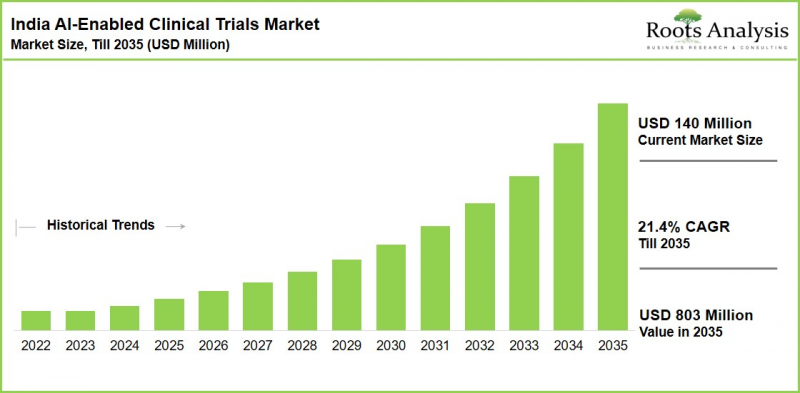
India AI-Enabled Clinical Trials Market: Growth and Trends
Artificial intelligence has moved from a peripheral pilot activity to a core operational capability within India's clinical research ecosystem. AI-assisted trial design, automated eligibility screening, and predictive enrollment modeling are helping sponsors compress trial timelines, reduce protocol amendments, and lower per-patient monitoring costs. Machine learning algorithms are increasingly embedded in electronic data capture (EDC) systems, adverse event triage workflows, and remote patient monitoring platforms, allowing researchers to detect data anomalies and safety signals well before they would surface through conventional manual review.
India's clinical trials market itself continues to expand steadily, supported by the country's large and genetically diverse treatment-naive patient pool, a growing base of accredited investigator sites, and clinical research costs that remain substantially lower than those in North America or Western Europe.
Adoption is concentrated among large multinational sponsors and leading domestic CROs in the near term, but mid-sized biotech and generic drug developers are following closely as cloud-based, subscription-priced AI platforms lower the barrier to entry. Oncology, cardiovascular disease, infectious disease, and metabolic disorder programs are the earliest and most intensive adopters of AI-enabled patient identification and trial-matching tools, reflecting both the complexity of these indications and the depth of real-world data now available for model training in India.
Global biopharmaceutical companies are expanding their research operations in India. They are increasing the number of clinical trial sites and conducting more Phase II and Phase III trials in the country. This is creating greater demand for AI-enabled clinical trial software and services.
Regulatory modernization has further reinforced the adoption of AI-enabled clinical trials. Recently, CDSCO's SUGAM portal has digitized much of the trial application and approval workflow, while the agency continues to refine guidance for remote monitoring, electronic informed consent, and decentralized data collection. As these frameworks mature, market players are more willing to deploy AI-enabled decentralized clinical trial (DCT) components, including wearable-based data capture, telemedicine-linked follow-up, and AI-based document and safety-report automation, alongside traditional site-based models.
Growth Drivers: Strategic Enablers of Market Expansion
The India AI-enabled clinical trials market is being propelled by a combination of structural and technological factors. India is a preferred destination for global clinical research due to its large patient population, skilled investigator base, and lower operating costs. The resulting increase in clinical trial activity is driving demand for AI-enabled tools that can efficiently manage trials at scale.
Rising R&D investment by global pharmaceutical and biotechnology companies, several of which have established or expanded India-based global capability centers (GCCs) for early and late-stage clinical development, is a significant driver. These centers are increasingly standardizing on AI-enabled platforms for protocol feasibility, site selection, and patient recruitment to meet enrollment targets faster and reduce trial-cycle costs.
Further, the shift toward decentralized and hybrid trial models is also driving the adoption of AI-enabled clinical trials models. AI-powered remote monitoring, wearable-device data integration, and natural language processing based document automation are reducing the operational burden of running geographically dispersed studies, a particularly valuable capability in a country with wide variation in site infrastructure and patient access. The growing openness of regulatory bodies to digital and remote trial components is accelerating uptake of these tools.
Additionally, the growing digitization of India's healthcare system is improving the availability of electronic health records (EHRs), real-world data (RWD), and structured clinical datasets. This expanding database is supporting the development and training of AI models for patient identification, risk stratification, and enrollment forecasting, thereby increasing the value of AI-enabled clinical trial technologies.
Market Challenges: Critical Barriers Impeding Progress
The India AI-enabled clinical trials market faces several structural challenges that may impede the market growth. Data privacy and cross-border data transfer requirements create additional regulatory and technical challenges for AI platforms hosted outside India. These requirements can make it more difficult for sponsors to deploy centralized, cloud-based analytics tools across multi-country clinical trials.
Clinical data in India is often fragmented across hospital information systems, laboratory networks, and paper-based records, which complicates the aggregation of clean, structured datasets required to train and validate AI models. Variability in site-level digital maturity, especially outside metro-centered research hubs, further limits uniform adoption of AI-enabled monitoring and recruitment tools.
Approval timelines for new drugs and clinical trial protocols in India can extend considerably due to multiple regulatory and review requirements, while guidance on the use of AI-based decision-support tools in clinical trials continues to evolve. This creates uncertainty for vendors and sponsors evaluating long-term investment in AI-enabled trial infrastructure. Additionally, a shortage of professionals with combined expertise in clinical research and data science constrains the pace at which AI tools can be effectively implemented, validated, and scaled across sponsor and CRO organizations.
India AI-Enabled Clinical Trials Market: Key Insights
The report examines the current state of the India AI-enabled clinical trials market and identifies the principal growth opportunities within the industry. Selected findings include:
- Driven by rising trial volumes and sponsor demand for faster enrollment, the India AI-enabled clinical trials market is projected to expand at a robust double-digit CAGR through 2035.
- Software-based AI platforms, spanning patient recruitment, protocol design, and predictive risk-based monitoring, currently account for the largest share of deployments, while AI-enabled services (data annotation, model validation, consulting) represent the fastest-growing category.
- Cloud-based deployment continues to dominate new implementations, reflecting sponsors' preference for scalable, subscription-based access over on-premise infrastructure.
- Oncology remains the leading therapeutic area for AI-enabled trial technologies, supported by high trial complexity and the availability of structured real-world oncology datasets, followed closely by cardiovascular and infectious disease programs.
- Pharmaceutical and biotechnology companies represent the largest end-user segment by revenue, while CROs are emerging as the fastest-growing adopter group as they build AI capabilities into their service offerings to win outsourced trial mandates.
- A growing share of Indian and multinational CROs, technology vendors, and hospital networks are entering strategic partnerships and technology-licensing agreements to accelerate the rollout of AI-enabled trial platforms across metro and non-metro research sites.
- Regulatory modernization, including digitized submission through the SUGAM portal and evolving CDSCO guidance on decentralized and remote trial elements, is expected to be a key enabler of continued market expansion over the forecast period.
India AI-Enabled Clinical Trials Market: Key Segments
The market sizing and opportunity analysis has been segmented across the following parameters:
By Component
- Software / Platforms
- Services
By Application
- Patient Recruitment and Retention
- Trial Design and Protocol Optimization
- Predictive Analytics and Risk-Based Monitoring
- Real-World Data and Evidence Generation
- Regulatory and Compliance Management
By Therapeutic Area
- Oncology
- Cardiovascular Disorders
- Neurological Disorders
- Infectious Diseases
- Metabolic and Endocrine Disorders
- Others
By Deployment Mode
- Cloud-Based
- On-Premises
By End User
- Pharmaceutical and Biotechnology Companies
- Contract Research Organizations (CROs)
- Academic and Research Institutes
- Hospitals and Diagnostic Centers
By Trial Phase
- Phase I
- Phase II
- Phase III
By Region (within India)
- North India
- West India
- South India
- East India
India AI-Enabled Clinical Trials Market: Key Segment Insights
Software Platforms Lead, Services Emerge as the Fastest Growing Segment
Software platforms for patient recruitment, protocol feasibility, and risk-based monitoring currently represent the largest share of the India AI-enabled clinical trials market. This highest share reflects market players' preference for scalable and reusable technology assets across multiple trial programs. AI-enabled services, including model validation, data annotation, and implementation consulting, are expected to record the fastest growth over the forecast period. This lucrative growth is due to the fact that market players and CROs seek specialized expertise to operationalize AI tools within existing trial workflows.
Oncology Holds the Highest Share
Oncology trials account for the largest share of AI-enabled clinical trial share. This dominance is driven by high protocol complexity, biomarker-driven patient stratification requirements, and the relatively rich availability of structured real-world oncology data for model training. Cardiovascular and infectious disease programs follow closely, supported by India's substantial disease burden in both categories and government-backed screening and research initiatives.
South and West India Lead the Regional Market
Metro research hubs in South India (Bengaluru, Hyderabad, Chennai) and West India (Mumbai, Pune, Ahmedabad) currently account for the majority of AI-enabled clinical trial deployments. This dominance reflects the concentration of accredited investigator sites, hospital networks, and technology talent in these regions. North India is expected to be among the fastest growing regional markets as market players expand site networks around Delhi-NCR and other emerging research clusters.
Pharmaceutical and Biotechnology Companies Retain the Largest End-User Share
Pharmaceutical and biotechnology companies hold the highest share of the market. This highest share reflects their direct sponsorship of the majority of ongoing trials. CROs are the fastest-growing end-user category as they increasingly embed AI-enabled recruitment, monitoring, and analytics capabilities into their service portfolios to differentiate themselves when competing for outsourced trial mandates from global sponsors.
Example Players in the India AI-Enabled Clinical Trials Market
- Accutest Research Laboratories
- IQVIA
- ICON
- Lambda Therapeutic Research
- Reliance Life Sciences
- Syngene International
- Saama Technologies
- Tata Consultancy Services (TCS)
- Veeva Systems
- WuXi AppTec
INDIA AI-ENABLED CLINICAL TRIALS MARKET: RESEARCH COVERAGE
- Market Sizing and Opportunity Analysis: An in-depth analysis of the market across key segments, including component, application, therapeutic area, deployment mode, end user, trial phase, region, and sales forecast.
- Technology and Solution Landscape: A detailed assessment of AI-enabled clinical trial software and service offerings, covering functional capability, deployment model, integration with existing clinical data systems, and stage of commercial maturity.
- Competitive Landscape and Company Profiles: Detailed profiles of prominent players engaged in offering AI-enabled clinical trial solutions in India, including information on year of establishment, headquarters, portfolio, and key initiatives.
- Regulatory Landscape Analysis: An overview of the CDSCO / NDCTR 2019 framework, CTRI registration requirements, and evolving guidance relevant to AI-enabled and decentralized trial components.
- Recent Developments: Analysis of partnerships, collaborations, funding rounds, and technology-licensing deals relevant to India's AI-enabled clinical trials ecosystem.
- Market Impact Analysis: An assessment of the key drivers, restraints, opportunities, and challenges shaping market growth.
- Porter's Five Forces Analysis: A qualitative assessment of competitive intensity across the value chain.
KEY QUESTIONS ANSWERED IN THIS REPORT
- What is the current and projected size of the India AI-enabled clinical trials market through 2035?
- What is the compound annual growth rate (CAGR) of this market?
- Which components, applications, and therapeutic areas are expected to lead market growth?
- Which end users and regions within India are driving current and future demand?
- Who are the leading solution providers and CROs active in this market?
- What regulatory factors are shaping adoption of AI-enabled and decentralized trial technologies in India?
- What are the primary challenges facing AI-enabled clinical trial technology adoption in India?
- How is the market opportunity likely to be distributed across key market segments through 2035?
Reasons to Buy This Report
This report provides a comprehensive market analysis, offering detailed revenue projections for the overall India AI-enabled clinical trials market and its component segments, enabling established market participants and emerging entrants to quantify market potential and identify attractive areas for investment and expansion.
- It offers stakeholders a clear overview of key market drivers, barriers, opportunities, and challenges, supporting data-driven decision-making and helping organizations assess the factors shaping the adoption and growth of AI-enabled technologies within India's evolving clinical research ecosystem.
- The report supports the identification of white-space opportunities across therapeutic areas, deployment models, and end-user categories, helping stakeholders evaluate underserved market segments, identify potential areas for differentiation, and assess whether specific opportunities warrant further investment or commercial pursuit.
- It helps stakeholders understand customer needs, preferences, and adoption behavior across pharmaceutical companies, contract research organizations (CROs), and research institutions, enabling AI technology providers and service companies to better align their products, platforms, and solutions with the requirements of different end-user groups.
- The report equips new entrants with market intelligence for developing effective India market-entry and go-to-market strategies, including the identification of attractive market segments, potential customer groups, competitive opportunities, and areas where emerging AI-enabled clinical trial solutions can establish a differentiated position.
- It supports more effective communication with investors, strategic partners, and customers, providing market-backed insights that can strengthen business cases, facilitate partnership discussions, and support the development of stronger commercial relationships across India's clinical research value chain.
Additional Benefits
- Complementary Excel data packs for all analytical modules in the report
- 15% free content customization
- Detailed report walkthrough session with the research team
- Free updated report if the purchased edition is 6-12 months old or older
TABLE OF CONTENTS
1. PREFACE
- 1.1. Introduction
- 1.2. Report Coverage
- 1.3. Market Segmentation
- 1.4. Key Market Insights
- 1.5. Market Share Insights
- 1.6. Key Questions Answered
2. RESEARCH METHODOLOGY
- 2.1. Chapter Overview
- 2.2. Research Assumptions
- 2.2.1. Market Landscape and Market Trends
- 2.2.2. Market Forecast and Opportunity Analysis
- 2.2.3. Comparative Analysis
- 2.3. Database Building
- 2.3.1. Data Collection
- 2.3.2. Data Validation
- 2.3.3. Data Analysis
- 2.4. Project Methodology
- 2.4.1. Secondary Research
- 2.4.1.1. Annual Reports
- 2.4.1.2. Academic Research Papers
- 2.4.1.3. Company Websites
- 2.4.1.4. Investor Presentations
- 2.4.1.5. Regulatory Filings
- 2.4.1.6. White Papers
- 2.4.1.7. Industry Publications
- 2.4.1.8. Conferences and Seminars
- 2.4.1.9. Government Portals
- 2.4.1.10. Media and Press Releases
- 2.4.1.11. Newsletters
- 2.4.1.12. Industry Databases
- 2.4.1.13. Roots Proprietary Databases
- 2.4.1.14. Paid Databases and Sources
- 2.4.1.15. Social Media Portals
- 2.4.1.16. Other Secondary Sources
- 2.4.2. Primary Research
- 2.4.2.1. Types of Primary Research
- 2.4.2.1.1. Qualitative Research
- 2.4.2.1.2. Quantitative Research
- 2.4.2.1.3. Hybrid Approach
- 2.4.2.2. Advantages of Primary Research
- 2.4.2.3. Techniques for Primary Research
- 2.4.2.3.1. Interviews
- 2.4.2.3.2. Surveys
- 2.4.2.3.3. Focus Groups
- 2.4.2.3.4. Observational Research
- 2.4.2.3.5. Social Media Interactions
- 2.4.2.4. Key Opinion Leaders Considered in Primary Research
- 2.4.2.4.1. Company Executives (CXOs)
- 2.4.2.4.2. Board of Directors
- 2.4.2.4.3. Company Presidents and Vice Presidents
- 2.4.2.4.4. Research and Development Heads
- 2.4.2.4.5. Technical Experts
- 2.4.2.4.6. Subject Matter Experts
- 2.4.2.4.7. Scientists
- 2.4.2.4.8. Doctors and Other Healthcare Providers
- 2.4.2.5. Ethics and Integrity
- 2.4.2.5.1. Research Ethics
- 2.4.2.5.2. Data Integrity
- 2.4.2.1. Types of Primary Research
- 2.4.3 Analytical Tools and Databases
- 2.4.1. Secondary Research
- 2.5. Robust Quality Control
3. MARKET DYNAMICS
- 3.1. Chapter Overview
- 3.2. Forecast Methodology
- 3.2.1. Top-down Approach
- 3.2.2. Bottom-up Approach
- 3.2.3. Hybrid Approach
- 3.3. Market Assessment Framework
- 3.3.1 Total Addressable Market (TAM)
- 3.3.2. Serviceable Addressable Market (SAM)
- 3.3.3. Serviceable Obtainable Market (SOM)
- 3.3.4. Currently Acquired Market (CAM)
- 3.4. Forecasting Tools and Techniques
- 3.4.1. Qualitative Forecasting
- 3.4.2. Correlation
- 3.4.3. Regression
- 3.4.4. Extrapolation
- 3.4.5. Convergence
- 3.4.6. Sensitivity Analysis
- 3.4.7. Scenario Planning
- 3.4.8. Data Visualization
- 3.4.9. Time Series Analysis
- 3.4.10. Forecast Error Analysis
- 3.5. Key Considerations
- 3.5.1. Demographics
- 3.5.2. Government Regulations
- 3.5.3. Reimbursement Scenarios
- 3.5.4. Market Access
- 3.5.5. Supply Chain
- 3.5.6. Industry Consolidation
- 3.5.7. Pandemic / Unforeseen Disruptions Impact
- 3.6. Limitations
4. MACRO-ECONOMIC INDICATORS
- 4.1. Chapter Overview
- 4.2. Market Dynamics
- 4.2.1. Time Period
- 4.2.1.1. Historical Trends
- 4.2.1.2. Current and Forecasted Estimates
- 4.2.2. Currency Coverage
- 4.2.2.1. Major Currencies Affecting the Market
- 4.2.2.2. Factors Affecting Currency Fluctuations on the Industry
- 4.2.2.3. Impact of Currency Fluctuations on the Industry
- 4.2.3. Foreign Currency Exchange Rate
- 4.2.3.1. Impact of Foreign Exchange Rate Volatility on the Market
- 4.2.3.2. Strategies for Mitigating Foreign Exchange Risk
- 4.2.4. Recession
- 4.2.4.1. Assessment of Current Economic Conditions and Potential Impact on the Market
- 4.2.4.2. Historical Analysis of Past Recessions and Lessons Learnt
- 4.2.5. Inflation
- 4.2.5.1. Measurement and Analysis of Inflationary Pressures in the Economy
- 4.2.5.2. Potential Impact of Inflation on the Market Evolution
- 4.2.6. Interest Rates
- 4.2.6.1. Interest Rates and Their Impact on the Market
- 4.2.6.2. Strategies for Managing Interest Rate Risk
- 4.2.7. Commodity Flow Analysis
- 4.2.7.1. Type of Commodity
- 4.2.7.2. Origins and Destinations
- 4.2.7.3. Values and Weights
- 4.2.7.4. Modes of Transportation
- 4.2.8. Global Trade Dynamics
- 4.2.8.1. Import Scenario
- 4.2.8.2. Export Scenario
- 4.2.8.3. Trade Policies
- 4.2.8.4. Strategies for Mitigating the Risks Associated with Trade Barriers
- 4.2.8.5. Impact of Trade Barriers on the Market
- 4.2.9. War Impact Analysis
- 4.2.9.1. Russian-Ukraine War
- 4.2.9.2. Israel-Hamas War
- 4.2.10. COVID Impact / Related Factors
- 4.2.10.1. Global Economic Impact
- 4.2.10.2. Industry-specific Impact
- 4.2.10.3. Government Response and Stimulus Measures
- 4.2.10.4. Future Outlook and Adaptation Strategies
- 4.2.11. Other Indicators
- 4.2.11.1. Fiscal Policy
- 4.2.11.2. Consumer Spending
- 4.2.11.3. Gross Domestic Product
- 4.2.11.4. Employment
- 4.2.11.5. Taxes
- 4.2.11.6. Stock Market Performance
- 4.2.11.7. Cross Border Dynamics
- 4.2.1. Time Period
- 4.3. Conclusion
5. EXECUTIVE SUMMARY
6. INTRODUCTION
- 6.1. Overview of Clinical Trials in India
- 6.2. Role of Artificial Intelligence in Clinical Research
- 6.3. Regulatory Landscape
- 6.3.1. CDSCO
- 6.3.2. NDCTR 2019
- 6.3.3. Clinical Trials Registry-India (CTRI)
- 6.4. Future Perspectives
7. MARKET LANDSCAPE: AI-ENABLED CLINICAL TRIAL SOLUTIONS
- 7.1. Methodology and Key Parameters
- 7.2. Analysis by Component, Application, Deployment Mode, and Therapeutic Area
- 7.3. Analysis by Year of Establishment, Company Size, and Location of Headquarters
8. COMPANY COMPETITIVENESS ANALYSIS
- 8.1. Chapter Overview
- 8.2. Assumptions and Key Parameters
- 8.3. Methodology
- 8.4. Overview of Peer Groups Based in India
9. COMPANY PROFILES
- 9.1. Chapter Overview
- 9.2. Accutest Research Laboratories
- 9.2.1. Company Overview
- 9.2.2. Financial Information
- 9.2.3. Offerings Portfolio
- 9.2.4. Recent Developments and Future Outlook
- Similar details are presented for other companies mentioned below (based on information in the public domain)
- 9.3. IQVIA
- 9.4. ICON
- 9.5. Lambda Therapeutic Research
- 9.6. Reliance Life Sciences
- 9.7. Syngene International
- 9.8. Saama Technologies
- 9.9. Tata Consultancy Services (TCS)
- 9.10. Veeva Systems
- 9.11. WuXi AppTec
10. RECENT DEVELOPMENTS
- 10.1. Partnerships and Collaborations
- 10.2. Funding and Investments
- 10.3. Global and Regional Events
12. MARKET IMPACT ANALYSIS
- 12.1. Chapter Overview
- 12.2. Market Drivers
- 12.3. Market Restraints
- 12.4. Market Opportunities
- 12.5. Market Challenges
- 12.6. Conclusion
13. GLOBAL AND INDIA AI-ENABLED CLINICAL TRIALS MARKET: HISTORICAL TRENDS AND FORECAST TILL 2035
- 13.1. Key Assumptions and Methodology
- 13.2. Multivariate Scenario Analysis
- 13.2.1. Conservative Scenario
- 13.2.2. Optimistic Scenario
14. INDIA AI-ENABLED CLINICAL TRIALS MARKET, BY COMPONENT
- 14.1. India AI-Enabled Clinical Trials Market for Software: Historical Trends (Since 2022) and Forecasted Estimates (Till 2035)
- 14.2. India AI-Enabled Clinical Trials Market for Services: Historical Trends (Since 2022) and Forecasted Estimates (Till 2035)
15. INDIA AI-ENABLED CLINICAL TRIALS MARKET, BY APPLICATION
- 15.1. India AI-Enabled Clinical Trials Market for Patient Recruitment & Retention: Historical Trends (Since 2022) and Forecasted Estimates (Till 2035)
- 15.2. India AI-Enabled Clinical Trials Market for Trial Design & Protocol Optimization: Historical Trends (Since 2022) and Forecasted Estimates (Till 2035)
- 15.3. India AI-Enabled Clinical Trials Market for Predictive Analytics & Risk-Based Monitoring: Historical Trends (Since 2022) and Forecasted Estimates (Till 2035)
- 15.4. India AI-Enabled Clinical Trials Market for Real-World Data & Evidence Generation: Historical Trends (Since 2022) and Forecasted Estimates (Till 2035)
- 15.5. India AI-Enabled Clinical Trials Market for Regulatory & Compliance Management: Historical Trends (Since 2022) and Forecasted Estimates (Till 2035)
16. INDIA AI-ENABLED CLINICAL TRIALS MARKET, BY THERAPEUTIC AREA
- 16.1. India AI-Enabled Clinical Trials Market for Oncology: Historical Trends (Since 2022) and Forecasted Estimates (Till 2035)
- 16.2. India AI-Enabled Clinical Trials Market for Cardiovascular: Historical Trends (Since 2022) and Forecasted Estimates (Till 2035)
- 16.3. India AI-Enabled Clinical Trials Market for Neurology: Historical Trends (Since 2022) and Forecasted Estimates (Till 2035)
- 16.4. India AI-Enabled Clinical Trials Market for Infectious Diseases: Historical Trends (Since 2022) and Forecasted Estimates (Till 2035)
- 16.5. India AI-Enabled Clinical Trials Market for Metabolic Disorders: Historical Trends (Since 2022) and Forecasted Estimates (Till 2035)
- 16.6. India AI-Enabled Clinical Trials Market for Others: Historical Trends (Since 2022) and Forecasted Estimates (Till 2035)
17. INDIA AI-ENABLED CLINICAL TRIALS MARKET, BY DEPLOYMENT MODE
- 17.1. India AI-Enabled Clinical Trials Market for Cloud-Based: Historical Trends (Since 2022) And Forecasted Estimates (Till 2035)
- 17.2. India AI-Enabled Clinical Trials Market for On-Premises: Historical Trends (Since 2022) and Forecasted Estimates (Till 2035)
18. INDIA AI-ENABLED CLINICAL TRIALS MARKET, BY END USER
- 18.1. India AI-Enabled Clinical Trials Market for Biotechnology and Pharmaceutical Companies: Historical Trends (Since 2022) and Forecasted Estimates (Till 2035)
- 18.2. India AI-Enabled Clinical Trials Market for Contract Research Organizations: Historical Trends (Since 2022) and Forecasted Estimates (Till 2035)
- 18.2. India AI-Enabled Clinical Trials Market for Academic Research Institutes: Historical Trends (Since 2022) and Forecasted Estimates (Till 2035)
- 18.3. India AI-Enabled Clinical Trials Market for Hospitals and Diagnostic Centers: Historical Trends (Since 2022) and Forecasted Estimates (Till 2035)
19. INDIA AI-ENABLED CLINICAL TRIALS MARKET, BY TRIAL PHASE
- 19.1. India AI-Enabled Clinical Trials Market for Phase I: Historical Trends (Since 2022) and Forecasted Estimates (Till 2035)
- 19.2. India AI-Enabled Clinical Trials Market for Phase II: Historical Trends (Since 2022) and Forecasted Estimates (Till 2035)
- 19.3. India AI-Enabled Clinical Trials Market for Phase III: Historical Trends (Since 2022) and Forecasted Estimates (Till 2035)
20. INDIA AI-ENABLED CLINICAL TRIALS MARKET, BY REGION
- 20.1. India AI-Enabled Clinical Trials Market in North India: Historical Trends (Since 2022) and Forecasted Estimates (Till 2035)
- 20.2. India AI-Enabled Clinical Trials Market in West India: Historical Trends (Since 2022) and Forecasted Estimates (Till 2035)
- 20.3. India AI-Enabled Clinical Trials Market in South India: Historical Trends (Since 2022) and Forecasted Estimates (Till 2035)
- 20.4. India AI-Enabled Clinical Trials Market in East India: Historical Trends (Since 2022) and Forecasted Estimates (Till 2035)
21. CONCLUDING INSIGHTS
22. EXECUTIVE INSIGHTS: INTERVIEW TRANSCRIPTS
23. TABULATED DATA
24. LIST OF COMPANIES AND ORGANIZATIONS
25. APPENDIX I: TABULATED DATA
26. APPENDIX II: LIST OF COMPANIES AND ORGANIZATIONS

