PUBLISHER: Roots Analysis | PRODUCT CODE: 2132678

PUBLISHER: Roots Analysis | PRODUCT CODE: 2132678
India Nuclear Medicine and Radiopharmaceuticals Market by Type of Product, Type of Radioisotope, Imaging Modality, Application, and End User- Trends and Forecast Till 2035
INDIA NUCLEAR MEDICINE AND RADIOPHARMACEUTICALS MARKET: OVERVIEW
As per Roots Analysis, the Indian nuclear medicine and radiopharmaceuticals market is valued at USD 0.72 billion in the current year and is projected to reach USD 2.10 billion by 2035, representing a CAGR of 12.6% during the forecast period.
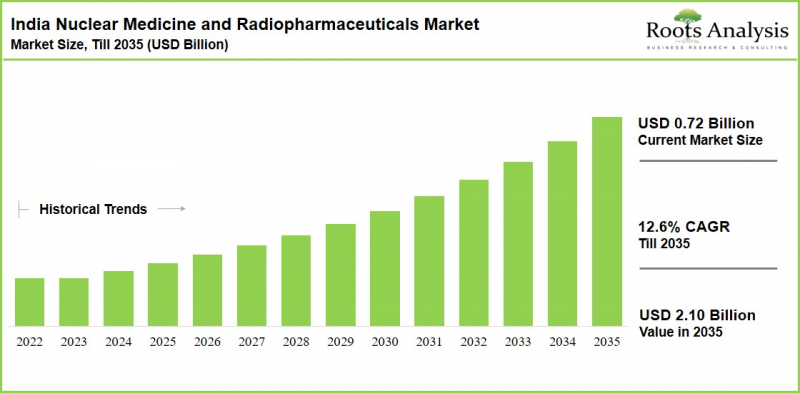
India Nuclear Medicine and Radiopharmaceuticals Market: Growth and Trends
Nuclear medicine uses trace amounts of radioactive material, known as radiopharmaceuticals or radiotracers, to diagnose and treat disease at the molecular level. Unlike conventional radiology, which primarily captures anatomical structure, nuclear medicine imaging modalities such as single photon emission computed tomography (SPECT) and positron emission tomography (PET) reveal how organs and tissues actually function, enabling earlier detection of cancer, cardiac ischemia, neurodegenerative disorders, and thyroid disease. Therapeutic radiopharmaceuticals extend this molecular targeting further, delivering cytotoxic radiation directly to diseased cells while sparing surrounding healthy tissue, a precision-medicine approach increasingly referred to as theranostics.
India's nuclear medicine ecosystem has historically been anchored by the Department of Atomic Energy (DAE) and its Board of Radiation and Isotope Technology (BRIT), which supply the majority of Tc-99m generators and related isotopes to hospitals nationwide. Over the past few years, this state-led backbone has been complemented by a fast-growing private radiopharmacy and cyclotron network, an expanding installed base of PET-CT and SPECT-CT systems across corporate hospital chains, and a wave of new FDG and gallium-68 production units being commissioned in metro and tier-1 cities. Rising cancer incidence, an aging population, growing awareness of early cancer and cardiac screening, and increasing insurance penetration for advanced diagnostic imaging are collectively pushing nuclear medicine and radiopharmaceuticals from a tertiary-care niche toward a core component of India's diagnostic and oncology care pathway.
Government policies are further reinforcing the market growth momentum. India's Department of Atomic Energy has been directing capital toward dedicated reactor and isotope production capacity to strengthen domestic radioisotope self-sufficiency and reduce reliance on imported medical isotopes, including public-private partnership models aimed at scaling up production of medically important radionuclides. Combined with the localization of PET tracer manufacturing and the entry of global radiopharmaceutical majors into Indian distribution and manufacturing partnerships, these developments are reshaping supply-chain economics for an industry that has traditionally been constrained by the short half-life of key isotopes.
Growth Drivers: Strategic Enablers of Market Expansion
The India nuclear medicine and radiopharmaceuticals market is being propelled by a convergence of epidemiological, infrastructural, and policy-driven forces. Rising cancer incidence and a growing burden of cardiovascular and neurological disease are driving demand for precise, function-based diagnostic imaging, positioning PET-CT and SPECT-CT as increasingly standard tools in oncology staging, cardiac perfusion assessment, and dementia workup. As hospital networks expand into tier-2 and tier-3 cities, the accompanying build-out of diagnostic imaging and nuclear medicine departments is widening patient access beyond India's traditional metro-centric hubs.
Government-backed investment in domestic radioisotope production is a second major enabler. Continued funding for dedicated reactor and cyclotron infrastructure under the Department of Atomic Energy, alongside public-private partnership models for isotope manufacturing, is reducing India's historical dependence on imported Tc-99m, Mo-99, and PET isotopes, while improving supply reliability for hospitals operating time-sensitive nuclear medicine procedures. This is complemented by growing private-sector investment in radiopharmacies and cyclotron facilities, which is shortening isotope transport times and expanding same-day radiotracer availability.
Additionally, the growing global clinical success of Lutetium-177-based and related therapies for prostate cancer and neuroendocrine tumors is increasing interest among Indian oncology centers and radiopharmaceutical developers in establishing domestic theranostic pathways. This trend is expected to support the emergence of a high-value therapeutic radiopharmaceuticals segment, complementing India's traditionally diagnostics-led radiopharmaceutical market. Finally, expanding health insurance coverage, rising per-capita healthcare spending, growing medical tourism for advanced cardiac and cancer diagnostics, and strategic collaborations between global radiopharmaceutical manufacturers and Indian hospital chains and distributors are together reinforcing sustained, long-term demand for radiopharmaceutical products and nuclear medicine services across the country.
Market Challenges: Critical Barriers Impeding Progress
Despite strong underlying demand, several structural challenges continue to constrain the pace of growth in the India nuclear medicine and radiopharmaceuticals market. The short half-life of key radioisotopes, including Tc-99m and 18F-FDG, requires production facilities to be located close to end-use hospitals, and India's cyclotron and reactor-based isotope production capacity remains concentrated in a limited number of metro cities, leaving large parts of the country dependent on constrained cold-chain logistics and time-sensitive distribution networks.
The high capital cost of PET-CT, SPECT-CT, and cyclotron infrastructure represents a further barrier, particularly for standalone diagnostic centers and hospitals outside major metros, where capital budgets and patient volumes may not yet justify the investment. Regulatory complexity is another consideration, as radiopharmaceutical manufacturing, storage, transport, and clinical use require close compliance with Atomic Energy Regulatory Board (AERB) licensing and radiation-safety protocols, adding cost and lead time to new facility rollouts.
A shortage of trained nuclear medicine physicians, radiopharmacists, and imaging technologists further limits the pace at which new capacity can be operationalized, while inconsistent reimbursement for advanced diagnostic and therapeutic radiopharmaceutical procedures under government and private insurance schemes continues to affect patient access and provider adoption economics.
India Nuclear Medicine and Radiopharmaceuticals Market: Key Insights
The report examines the current state of the India nuclear medicine and radiopharmaceuticals market and identifies the principal growth opportunities emerging across the value chain. Some of the key findings include:
- India currently contributes close to 2.2% of the global nuclear medicine market, positioning it well below its share of global disease burden and hinting at significant long-term upside as domestic infrastructure scales.
- The Department of Atomic Energy has channeled dedicated capital toward new reactors and isotope-production infrastructure, including public-private partnership models, to strengthen domestic radioisotope self-sufficiency.
- Asia-Pacific, inclusive of India, China, and Japan, is emerging as the fastest-growing regional radiopharmaceuticals market globally, supported by rising healthcare expenditure and expanding nuclear medicine infrastructure.
- Therapeutic radiopharmaceuticals and radioligand theranostics, particularly Lutetium-177-based agents for oncology indications, represent the fastest-growing product category as Indian oncology centers begin adopting targeted radionuclide therapy.
- Domestic and global manufacturers, including the DAE's Board of Radiation and Isotope Technology (BRIT) and private players such as Jubilant Radiopharma, remain central to India's radiopharmaceutical supply chain, alongside a growing base of independent radiopharmacies and cyclotron operators.
- Hospitals continue to be the leading end-user setting for nuclear medicine procedures in India, reflecting the specialized radiation-handling infrastructure, cold-chain logistics, and multidisciplinary care required for both diagnostic and therapeutic radiopharmaceutical use.
- Given the pace of cancer-care infrastructure expansion, indigenous isotope production, and rising theranostics adoption, the India nuclear medicine and radiopharmaceuticals market is well positioned for sustained double-digit growth through 2035.
India Nuclear Medicine and Radiopharmaceuticals Market Segmentation
The market sizing and opportunity analysis has been segmented across the following parameters:
By Type of Product Type
- Diagnostic Radiopharmaceuticals
- Therapeutic Radiopharmaceuticals
By Type of Radioisotope
- Technetium-99m (Tc-99m)
- Fluorine-18 (18F-FDG)
- Iodine-131
- Gallium-68
- Lutetium-177
- Yttrium-90
- Thallium-201
- Others
By Imaging Modality
- SPECT / SPECT-CT
- PET / PET-CT
- PET-MRI
- Targeted Radionuclide Therapy
By Application
- Oncology
- Cardiology
- Neurology
- Thyroid and Endocrine Disorders
- Others
By End User
- Hospitals
- Diagnostic Imaging Centers
- Academic and Research Institutes
- Radiopharmacies
India Nuclear Medicine and Radiopharmaceuticals Market: Key Segment Insights
Diagnostic Radiopharmaceuticals Continue to Lead the Market
Diagnostic agents, led by Technetium-99m based tracers and 18F-FDG for PET oncology imaging, currently represent the largest share of India's nuclear medicine market and are expected to retain this leadership through the forecast period. This is underpinned by the well-established clinical role of SPECT and PET imaging in cancer staging, cardiac perfusion assessment, and thyroid evaluation, together with the comparatively lower infrastructure and training barriers associated with diagnostic, as opposed to therapeutic, radiopharmaceuticals.
Oncology Leads Application Segment
Oncology remains the dominant application area for nuclear medicine procedures in India. This dominance is driven by rising cancer incidence, expanding access to PET-CT for cancer staging and treatment-response monitoring, and the emergence of Lutetium-177-based radioligand therapy for prostate cancer and neuroendocrine tumors. Cardiology and neurology follow as significant, fast-growing application areas, supported by increasing use of myocardial perfusion imaging and amyloid PET imaging respectively.
Hospitals Account for the Largest End-User Share
Hospitals continue to represent the leading end-user segment for India's nuclear medicine and radiopharmaceuticals market. This high share is owing to the specialized radiation-safety infrastructure, AERB-compliant handling protocols, and multidisciplinary oncology and cardiology teams required to deliver both diagnostic imaging and therapeutic radiopharmaceutical procedures. Standalone diagnostic imaging centers and dedicated radiopharmacies are, however, expanding at a faster relative pace as isotope-distribution networks mature.
Example Players in the India Nuclear Medicine and Radiopharmaceuticals Market
- Bracco Imaging
- Board of Radiation and Isotope Technology (BRIT), Department of Atomic Energy
- Curium
- Cardinal Health
- GE HealthCare
- Jubilant Radiopharma (Jubilant Pharma)
- Mallinckrodt Pharmaceuticals
- Novartis (Advanced Accelerator Applications)
- Photon Radiopharma and other domestic radiopharmacy operators
- Siemens Healthineers
INDIA NUCLEAR MEDICINE AND RADIOPHARMACEUTICALS MARKET: RESEARCH COVERAGE
- Market Sizing and Opportunity Analysis: An in-depth analysis of the India nuclear medicine and radiopharmaceuticals market, focusing on key segments including type of product, type of radioisotope, imaging modality, application, and end user.
- Competitive Landscape: A detailed assessment of radiopharmaceutical manufacturers, isotope producers, and radiopharmacy operators active in India, evaluated across parameters such as year of establishment, product portfolio, manufacturing capacity, and location of operations.
- Company Profiles: In-depth profiles of prominent players engaged in radiopharmaceutical manufacturing, distribution, and nuclear medicine imaging services in India, featuring information on business segments, portfolio, and key initiatives.
- Regulatory Landscape: An overview of the regulatory framework governing radiopharmaceutical manufacturing, transport, and clinical use in India, including Atomic Energy Regulatory Board (AERB) licensing requirements.
- Recent Developments: A detailed analysis of recent partnerships, collaborations, funding and investment activity, capacity expansions, and industry events relevant to India's nuclear medicine and radiopharmaceuticals sector.
- Porter's Five Forces Analysis: A qualitative assessment of the competitive forces shaping India's nuclear medicine and radiopharmaceuticals market.
- Market Impact Analysis: An evaluation of the drivers, restraints, opportunities, and challenges affecting market growth through 2035.
KEY QUESTIONS ANSWERED IN THIS REPORT
- What is the current and future size of the India nuclear medicine and radiopharmaceuticals market?
- What is the projected CAGR of the India nuclear medicine and radiopharmaceuticals market through 2035?
- Which product type, radioisotope, application, and end-user segment currently leads the India market?
- Which region within India offers the strongest near-term growth opportunity?
- Who are the leading companies operating in India's nuclear medicine and radiopharmaceuticals industry?
- What regulatory factors govern radiopharmaceutical manufacturing and use in India?
- What are the primary challenges faced by radiopharmaceutical manufacturers and nuclear medicine providers in India?
- What factors are likely to influence the evolution of this market through the forecast period?
REASONS TO BUY THIS REPORT
- The report provides a comprehensive market analysis, offering detailed revenue projections for the overall India nuclear medicine and radiopharmaceuticals market and its constituent sub-segments, valuable to established market leaders as well as new entrants.
- The report offers stakeholders a comprehensive overview of the market, including key drivers, barriers, opportunities, and challenges, empowering distributors, manufacturers, and healthcare providers to make data-driven decisions and capitalize on emerging growth prospects.
- The report supports businesses in identifying future opportunities across India's nuclear medicine value chain and assessing whether those opportunities are worth pursuing, based on segment-level and regional demand patterns.
- The report assists in understanding evolving customer and provider needs, preferences, and procurement behavior, enabling stakeholders to tailor radiopharmaceutical products and distribution strategies more effectively.
- The report equips new entrants with the market intelligence required to build successful go to market and distribution strategies for the India nuclear medicine and radiopharmaceuticals sector.
Additional Benefits
- Complementary Excel Data Packs for all Analytical Modules in the Report
- 15% Free Content Customization
- Detailed Report Walkthrough Session with Research Team
- Free Updated Report if the Report is 6-12 Months Old or Older
TABLE OF CONTENTS
1. PREFACE
- 1.1. Introduction
- 1.2. Market Share Insights
- 1.3. Key Market Insights
- 1.4. Report Coverage
- 1.5. Key Questions Answered
- 1.6. Chapter Outlines
2. RESEARCH METHODOLOGY
- 2.1. Chapter Overview
- 2.2. Research Assumptions
- 2.3. Database Building
- 2.3.1. Data Collection
- 2.3.2. Data Validation
- 2.3.3. Data Analysis
- 2.4. Project Methodology
- 2.4.1. Secondary Research
- 2.4.1.1. Annual Reports
- 2.4.1.2. Academic Research Papers
- 2.4.1.3. Company Websites
- 2.4.1.4. Investor Presentations
- 2.4.1.5. Regulatory Filings
- 2.4.1.6. White Papers
- 2.4.1.7. Industry Publications
- 2.4.1.8. Conferences and Seminars
- 2.4.1.9. Government Portals
- 2.4.1.10. Media and Press Releases
- 2.4.1.11. Newsletters
- 2.4.1.12. Industry Databases
- 2.4.1.13. Roots Proprietary Databases
- 2.4.1.14. Paid Databases and Sources
- 2.4.1.15. Social Media Portals
- 2.4.1.16. Other Secondary Sources
- 2.4.2. Primary Research
- 2.4.2.1. Introduction
- 2.4.2.2. Types
- 2.4.2.2.1. Qualitative
- 2.4.2.2.2. Quantitative
- 2.4.2.3. Advantages
- 2.4.2.4. Techniques
- 2.4.2.4.1. Interviews
- 2.4.2.4.2. Surveys
- 2.4.2.4.3. Focus Groups
- 2.4.2.4.4. Observational Research
- 2.4.2.4.5. Social Media Interactions
- 2.4.2.5. Stakeholders
- 2.4.2.5.1. Company Executives (CXOs)
- 2.4.2.5.2. Board of Directors
- 2.4.2.5.3. Company Presidents and Vice Presidents
- 2.4.2.5.4. Key Opinion Leaders
- 2.4.2.5.5. Research and Development Heads
- 2.4.2.5.6. Technical Experts
- 2.4.2.5.7. Subject Matter Experts
- 2.4.2.5.8. Scientists
- 2.4.2.5.9. Doctors and Other Healthcare Providers
- 2.4.2.6. Ethics and Integrity
- 2.4.2.6.1. Research Ethics
- 2.4.2.6.2. Data Integrity
- 2.4.3. Analytical Tools and Databases
- 2.4.1. Secondary Research
3. MARKET DYNAMICS
- 3.1. Forecast Methodology
- 3.1.1. Top-Down Approach
- 3.1.2. Bottom-Up Approach
- 3.1.3. Hybrid Approach
- 3.2. Market Assessment Framework
- 3.2.1. Total Addressable Market (TAM)
- 3.2.2. Serviceable Addressable Market (SAM)
- 3.2.3. Serviceable Obtainable Market (SOM)
- 3.2.4. Currently Acquired Market (CAM)
- 3.3. Forecasting Tools and Techniques
- 3.3.1. Qualitative Forecasting
- 3.3.2. Correlation
- 3.3.3. Regression
- 3.3.4. Time Series Analysis
- 3.3.5. Extrapolation
- 3.3.6. Convergence
- 3.3.7. Forecast Error Analysis
- 3.3.8. Data Visualization
- 3.3.9. Scenario Planning
- 3.3.10. Sensitivity Analysis
- 3.4. Key Considerations
- 3.4.1. Demographics
- 3.4.2. Market Access
- 3.4.3. Reimbursement Scenarios
- 3.4.4. Industry Consolidation
- 3.5. Robust Quality Control
- 3.6. Key Market Segmentations
- 3.7. Limitations
4. MACRO-ECONOMIC INDICATORS
- 4.1. Chapter Overview
- 4.2. Market Dynamics
- 4.2.1. Time Period
- 4.2.1.1. Historical Trends
- 4.2.1.2. Current and Forecasted Estimates
- 4.2.2. Currency Coverage
- 4.2.2.1. Overview of Major Currencies Affecting the Market
- 4.2.2.2. Impact of Currency Fluctuations on the Industry
- 4.2.3. Foreign Exchange Impact
- 4.2.3.1. Evaluation of Foreign Exchange Rates and Their Impact on Market
- 4.2.3.2. Strategies for Mitigating Foreign Exchange Risk
- 4.2.4. Recession
- 4.2.4.1. Historical Analysis of Past Recessions and Lessons Learnt
- 4.2.4.2. Assessment of Current Economic Conditions and Potential Impact on the Market
- 4.2.5. Inflation
- 4.2.5.1. Measurement and Analysis of Inflationary Pressures in the Economy
- 4.2.5.2. Potential Impact of Inflation on the Market Evolution
- 4.2.6. Interest Rates
- 4.2.6.1. Overview of Interest Rates and Their Impact on the Market
- 4.2.6.2. Strategies for Managing Interest Rate Risk
- 4.2.7. Commodity Flow Analysis
- 4.2.7.1. Type of Commodity
- 4.2.7.2. Origins and Destinations
- 4.2.7.3. Values and Weights
- 4.2.7.4. Modes of Transportation
- 4.2.8. Global Trade Dynamics
- 4.2.8.1. Import Scenario
- 4.2.8.2. Export Scenario
- 4.2.9. War Impact Analysis
- 4.2.9.1. Russian-Ukraine War
- 4.2.9.2. Israel-Hamas War
- 4.2.10. COVID Impact / Related Factors
- 4.2.10.1. Global Economic Impact
- 4.2.10.2. Industry-specific Impact
- 4.2.10.3. Government Response and Stimulus Measures
- 4.2.10.4. Future Outlook and Adaptation Strategies
- 4.2.11. Other Indicators
- 4.2.11.1. Fiscal Policy
- 4.2.11.2. Consumer Spending
- 4.2.11.3. Gross Domestic Product (GDP)
- 4.2.11.4. Employment
- 4.2.11.5. Taxes
- 4.2.11.6. R&D Innovation
- 4.2.11.7. Stock Market Performance
- 4.2.11.8. Supply Chain
- 4.2.11.9. Cross-Border Dynamics
- 4.2.1. Time Period
5. EXECUTIVE SUMMARY
6. INTRODUCTION
- 6.1. Chapter Overview
- 6.2. Overview of India Nuclear Medicine and Radiopharmaceuticals
- 6.2.1. Key Characteristics of India Nuclear Medicine and Radiopharmaceuticals
- 6.2.2. Key Applications of the India Nuclear Medicine and Radiopharmaceuticals
- 6.2.3. Challenges Associated with India Nuclear Medicine and Radiopharmaceuticals
- 6.3. Future Perspective
7. REGULATORY SCENARIO
8. COMPREHENSIVE DATABASE OF LEADING PLAYERS
9. COMPETITIVE LANDSCAPE
- 9.1. Chapter Overview
- 9.2. India Nuclear Medicine and Radiopharmaceuticals: Overall Market Landscape
- 9.2.1. Analysis by Year of Establishment
- 9.2.2. Analysis by Company Size
- 9.2.3. Analysis by Location of Headquarters
- 9.2.4. India Nuclear Medicine and Radiopharmaceuticals Market: Overall Market Landscape
- 9.2.4.1. Analysis by Type of Radioisotope
- 9.2.4.2. Analysis by Type of Product
- 9.2.4.3. Analysis by Imaging Modality
- 9.2.4.4. Analysis by End User
10. COMPANY COMPETITIVENESS ANALYSIS
- 10.1. Chapter Overview
- 10.2. Assumptions and Key Parameters
- 10.3. Methodology
- 10.4. Overview of Peer Groups Based in Singapore
11. COMPANY PROFILES
- 11.1. Chapter Overview
- 11.2. Bracco Imaging
- 11.2.1. Company Overview
- 11.2.2. Company Mission
- 11.2.3. Company Footprint
- 11.2.4. Management Team
- 11.2.5. Contact Details
- 11.2.6. Financial Performance
- 11.2.7. Operating Business Segments
- 11.2.8. Product Portfolio
- 11.2.9. MOAT Analysis
- 11.2.10. Recent Developments and Future Outlook
- similar detail is presented for other below mentioned companies based on information in the public domain
- 11.3. Board of Radiation and Isotope Technology (BRIT), Department of Atomic Energy
- 11.4. Curium
- 11.5. Cardinal Health
- 11.6. GE HealthCare
- 11.7. Jubilant Radiopharma (Jubilant Pharma)
- 11.8. Mallinckrodt Pharmaceuticals
- 11.9. Novartis (Advanced Accelerator Applications)
- 11.10. Photon Radiopharma and Other Domestic Radiopharmacy Operators
- 11.11. Siemens Healthineers
12. RECENT DEVELOPMENTS
- 12.1. Chapter Overview
- 12.2. Recent Funding
- 12.3. Recent Partnerships
- 12.4. Other Recent Initiatives
13. INDIA NUCLEAR MEDICINE AND RADIOPHARMACEUTICALS MARKET
- 13.1. Chapter Overview
- 13.2. Key Assumptions and Methodology
- 13.3. Trends Disruptions Impacting Market
- 13.4. Demand Side Trends
- 13.5. Supply Side Trends
- 13.6. India Nuclear Medicine and Radiopharmaceuticals Market, Historical Trends (Since 2022) and Forecasted Estimates (Till 2035)
- 13.7. Multivariate Scenario Analysis
- 13.7.1. Conservative Scenario
- 13.7.2. Optimistic Scenario
- 13.8. Investment Feasibility Index
- 13.9. Key Market Segmentations
14. MARKET OPPORTUNITIES BASED ON TYPE OF PRODUCT
- 14.1. Chapter Overview
- 14.2. Key Assumptions and Methodology
- 14.3. Revenue Shift Analysis
- 14.4. Market Movement Analysis
- 14.5. Penetration-Growth (P-G) Matrix
- 14.6. India Nuclear Medicine and Radiopharmaceuticals Market for Diagnostic Radiopharmaceuticals: Historical Trends (Since 2022) and Forecasted Estimates (Till 2035)
- 14.7. India Nuclear Medicine and Radiopharmaceuticals Market for Therapeutic Radiopharmaceuticals: Historical Trends (Since 2022) and Forecasted Estimates (Till 2035)
- 14.8. Data Triangulation and Validation
- 14.8.1. Secondary Sources
- 14.8.2. Primary Sources
- 14.8.3. Statistical Modeling
15. MARKET OPPORTUNITIES BASED ON TYPE OF RADIOISOTOPE
- 15.1. Chapter Overview
- 15.2. Key Assumptions and Methodology
- 15.3. Revenue Shift Analysis
- 15.4. Market Movement Analysis
- 15.5. Penetration-Growth (P-G) Matrix
- 15.6. India Nuclear Medicine and Radiopharmaceuticals Market for Technetium-99m (Tc-99m): Historical Trends (Since 2022) and Forecasted Estimates (Till 2035)
- 15.7. India Nuclear Medicine and Radiopharmaceuticals Market for Fluorine-18 (18F-FDG): Historical Trends (Since 2022) and Forecasted Estimates (Till 2035)
- 15.8. India Nuclear Medicine and Radiopharmaceuticals Market for Iodine-131: Historical Trends (Since 2022) and Forecasted Estimates (Till 2035)
- 15.9. India Nuclear Medicine and Radiopharmaceuticals Market for Gallium-68: Historical Trends (Since 2022) and Forecasted Estimates (Till 2035)
- 15.10. India Nuclear Medicine and Radiopharmaceuticals Market for Lutetium-177: Historical Trends (Since 2022) and Forecasted Estimates (Till 2035)
- 15.11. India Nuclear Medicine and Radiopharmaceuticals Market for Yttrium-90: Historical Trends (Since 2022) and Forecasted Estimates (Till 2035)
- 15.12. India Nuclear Medicine and Radiopharmaceuticals Market for Thallium-201: Historical Trends (Since 2022) and Forecasted Estimates (Till 2035)
- 15.13. India Nuclear Medicine and Radiopharmaceuticals Market for Others: Historical Trends (Since 2022) and Forecasted Estimates (Till 2035)
- 15.14. Data Triangulation and Validation
- 15.14.1. Secondary Sources
- 15.14.2. Primary Sources
- 15.14.3. Statistical Modeling
16. MARKET OPPORTUNITIES BASED ON TYPE OF IMAGING MODALITY
- 16.1. Chapter Overview
- 16.2. Key Assumptions and Methodology
- 16.3. Revenue Shift Analysis
- 16.4. Market Movement Analysis
- 16.5. Penetration-Growth (P-G) Matrix
- 16.6. India Nuclear Medicine and Radiopharmaceuticals Market for SPECT / SPECT-CT: Historical Trends (Since 2022) and Forecasted Estimates (Till 2035)
- 16.7. India Nuclear Medicine and Radiopharmaceuticals Market for PET / PET-CT: Historical Trends (Since 2022) and Forecasted Estimates (Till 2035)
- 16.8. India Nuclear Medicine and Radiopharmaceuticals Market for PET-MRI: Historical Trends (Since 2022) and Forecasted Estimates (Till 2035)
- 16.9. India Nuclear Medicine and Radiopharmaceuticals Market for Targeted Radionuclide Therapy: Historical Trends (Since 2022) and Forecasted Estimates (Till 2035)
- 16.10. Data Triangulation and Validation
- 16.10.1. Secondary Sources
- 16.10.2. Primary Sources
- 16.10.3. Statistical Modeling
17. MARKET OPPORTUNITIES BASED ON TYPE OF APPLICATION
- 17.1. Chapter Overview
- 17.2. Key Assumptions and Methodology
- 17.3. Revenue Shift Analysis
- 17.4. Market Movement Analysis
- 17.5. Penetration-Growth (P-G) Matrix
- 17.6. India Nuclear Medicine and Radiopharmaceuticals Market for Oncology: Historical Trends (Since 2022) and Forecasted Estimates (Till 2035)
- 17.7. India Nuclear Medicine and Radiopharmaceuticals Market for Cardiology: Historical Trends (Since 2022) and Forecasted Estimates (Till 2035)
- 17.8. India Nuclear Medicine and Radiopharmaceuticals Market for Neurology: Historical Trends (Since 2022) and Forecasted Estimates (Till 2035)
- 17.9. India Nuclear Medicine and Radiopharmaceuticals Market for Thyroid and Endocrine Disorders: Historical Trends (Since 2022) and Forecasted Estimates (Till 2035)
- 17.10. India Nuclear Medicine and Radiopharmaceuticals Market for Others: Historical Trends (Since 2022) and Forecasted Estimates (Till 2035)
- 17.11. Data Triangulation and Validation
- 17.11.1. Secondary Sources
- 17.11.2. Primary Sources
- 17.11.3. Statistical Modeling
18. MARKET OPPORTUNITIES BASED ON TYPE OF END USER
- 18.1. Chapter Overview
- 18.2. Key Assumptions and Methodology
- 18.3. Revenue Shift Analysis
- 18.4. Market Movement Analysis
- 18.5. Penetration-Growth (P-G) Matrix
- 18.6. India Nuclear Medicine and Radiopharmaceuticals Market in Hospitals: Historical Trends (Since 2022) and Forecasted Estimates (Till 2035)
- 18.7. India Nuclear Medicine and Radiopharmaceuticals Market in the Diagnostic Imaging Centers: Historical Trends (Since 2022) and Forecasted Estimates (Till 2035)
- 18.8. India Nuclear Medicine and Radiopharmaceuticals Market in the Academic and Research Institutes: Historical Trends (Since 2022) and Forecasted Estimates (Till 2035)
- 18.9. India Nuclear Medicine and Radiopharmaceuticals Market in the Radiopharmacies: Historical Trends (Since 2022) and Forecasted Estimates (Till 2035)
- 18.10. Data Triangulation and Validation
19. KEY WINNING STRATEGIES
20. ROOTS STRATEGIC RECOMMENDATIONS
21. INSIGHTS FROM PRIMARY RESEARCH
22. REPORT CONCLUSION
23. TABULATED DATA
24. LIST OF COMPANIES AND ORGANIZATIONS

