PUBLISHER: Roots Analysis | PRODUCT CODE: 2132679

PUBLISHER: Roots Analysis | PRODUCT CODE: 2132679
Japan Digital Pathology Market by Product, Pathology, Application, and End User - Trends and Forecast Till 2035
JAPAN DIGITAL PATHOLOGY MARKET: OVERVIEW
According to Roots Analysis, the Japan digital pathology market is valued at USD 0.05 billion in the current year and is projected to reach USD 0.14 billion by 2035, representing a CAGR of 12.1% during the forecast period.
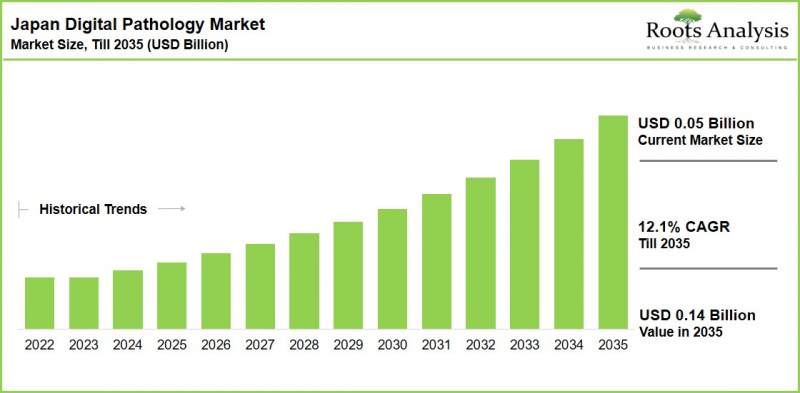
Japan Digital Pathology Market: Growth and Trends
Digital pathology converts glass tissue slides into high-resolution digital images that can be stored, shared, and analyzed electronically, enabling remote diagnosis, second-opinion consultation, and AI-assisted image interpretation. In Japan, adoption has been driven primarily by the diagnostic burden associated with an aging population and rising cancer incidence, both of which are increasing demand for faster, more consistent, and more collaborative pathology workflows. Whole slide imaging is increasingly used not only for routine disease diagnosis but also for education, quality assurance, and pharmaceutical biomarker research.
A defining feature of the Japanese market is the acute shortage of practicing pathologists relative to caseload, compounded by a projected national shortfall of roughly 960,000 healthcare professionals by 2040. Digital pathology, particularly when combined with AI-based triage and pre-screening tools, is emerging as a solution to workforce shortages. It enables a smaller pool of specialists to review larger caseloads remotely and collaborate across regional hospital networks.
Government policy is also reinforcing this shift. Japan's Society 5.0 digitalization agenda and growing public investment in digital health are accelerating the adoption of electronic medical records, AI-enabled diagnostics, and cloud-based imaging infrastructure. Recently, Japanese regulators further streamlined guidelines for cloud-based pathology image storage, easing a key adoption barrier for hospitals evaluating cloud-hosted whole slide imaging platforms over on-premise storage.
Growth Drivers: Strategic Enablers of Market Expansion
Regulatory clarity is one of the strongest enablers of growth in Japan. PMDA guidance on Software as a Medical Device (SaMD) is accelerating approval pathways for AI-powered diagnostic platforms, giving vendors a clearer route to market for computational pathology tools than in many other jurisdictions. This is complemented by Japan's early acceptance of whole slide imaging for primary diagnostic use, a regulatory milestone that has already been achieved in only a small number of countries globally, including the United States and the European Union.
Additional factors include Japan's strong domestic optics and imaging manufacturing base, supported by companies such as Hamamatsu Photonics and Olympus, which supply high-resolution scanners for medical institutions. Other growth drivers include stronger collaboration among hospitals, universities, and global AI vendors to develop biomarker discovery and cancer detection algorithms, rising pharmaceutical demand for digital pathology in drug development and biomarker quantification, and continued government investment in hospital digitization and electronic medical record integration.
Market Challenges: Critical Barriers Impeding Progress
Despite favorable regulatory and demographic tailwinds, several barriers continue to constrain faster adoption. The high upfront capital cost of whole slide imaging scanners, storage infrastructure, and validated AI software can be prohibitive for smaller hospitals and community laboratories, concentrating early adoption among large academic and tertiary care centers. Data storage and interoperability also remain a challenge because large whole slide image files require substantial storage capacity and bandwidth, and DICOM-WSI interoperability across hospital IT systems and vendor platforms is still maturing.
Reimbursement policy for telepathology and AI-assisted diagnostic workflows remains an evolving area, creating some uncertainty around return on investment for adopting institutions. Clinical validation and pathologist trust present a further hurdle, as widespread adoption depends on pathologists gaining confidence in digital-only diagnostic workflows relative to traditional microscopy, particularly for complex or borderline cases. Further, competition from established analog pathology infrastructure and a conservative clinical culture around new diagnostic technology can slow the pace of institutional transition even where the underlying economic and workforce case for digitization is strong.
Japan Digital Pathology Market: Key Insights
The report examines the current state of the Japan digital pathology market and identifies the key growth levers shaping its future. Selected findings include:
- Human pathology applications dominate global market revenue, reflecting widespread use in cancer and chronic-disease diagnostics; Japan mirrors this global pattern given its rising cancer incidence.
- Software is the fastest-growing and highest-revenue product segment globally, reflecting increasing demand for AI-enabled image analysis and workflow platforms over standalone scanning hardware.
- Japan's digital health budget rose to approximately JPY 61.7 billion (USD 400 million), with an emphasis on AI diagnostics and electronic medical record integration.
- A projected national shortfall of approximately 960,000 healthcare professionals by 2040 is a key structural driver accelerating digital pathology and AI-assisted diagnostic adoption.
- Japan's PMDA has approved whole slide imaging systems for primary diagnostic use, positioning the country among a small group of markets with cleared digital-only pathology diagnosis pathways.
- Recently, Japanese regulators streamlined guidelines for cloud-based pathology image storage, easing a key adoption barrier for hospital IT infrastructure decisions.
- Domestic imaging technology leaders, including Hamamatsu Photonics and Olympus, continue to play a central role in supplying scanners tailored to Japanese clinical and research institutions.
Japan Digital Pathology Market: Segments
The market sizing and opportunity analysis has been segmented across the following parameters:
By Product
- Scanners (Whole Slide Imaging Systems)
- Software
- Image Analysis Software
- Workflow & Storage Management Software
- Storage & Communication Systems
- Other Devices & Consumables
By Pathology
- Human Pathology
- Veterinary Pathology
By Application
- Disease Diagnosis
- Drug Discovery & Biomarker Research
- Academic Research & Education
- Digital Consultation / Telepathology
By End User
- Hospitals & Diagnostic Laboratories
- Academic & Research Institutes
- Pharmaceutical & Biotechnology Companies
- Contract Research Organizations (CROs)
Japan Digital Pathology Market: Key Segment Insights
Software Emerges as the Fastest-Growing Product Segment
According to Roots Analysis market report, the software segment is expected to register a higher CAGR during the forecast period. This growth is largely driven by Japanese hospitals completing their initial scanner deployment cycles. As a result, incremental spending is increasingly shifting toward software licensing, cloud storage subscriptions, and validated AI-based diagnostic-support algorithms, reflecting the broader global shift toward software-led value creation in digital pathology.
Disease Diagnosis Remains the Leading Clinical Application
Disease diagnosis, particularly oncology-related pathology, continues to account for the largest share of digital pathology use in Japan. This dominance is driven by the country's rising cancer incidence, and the diagnostic efficiency gains digital workflows provide over conventional microscopy. Academic research and pharmaceutical biomarker discovery represent smaller but faster-growing use cases, supported by university-industry collaboration on AI algorithm development.
Hospitals and Diagnostic Laboratories Account for the Largest End-User Share
Hospitals and diagnostic laboratories represent the leading end-user segment. This high share reflects the concentration of pathology caseload within large academic medical centers and tertiary hospital networks that have the capital base and clinical scale to justify early investment in whole slide imaging infrastructure.
Example Players in the Japan Digital Pathology Market
- 3DHISTECH
- Fujifilm Holdings
- Hamamatsu Photonics
- Koninklijke Philips N.V.
- Leica Biosystems
- Olympus Corporation
- PathAI
- Proscia
- Roche Diagnostics (Ventana Medical Systems)
- Sectra AB
- Sysmex Corporation
- Visiopharm
JAPAN DIGITAL PATHOLOGY MARKET: RESEARCH COVERAGE
- Market Sizing and Opportunity Analysis: An in-depth assessment of the Japan digital pathology market across product, pathology, application, and end user, with historical trends and forecasted estimates till 2035.
- Technology and Competitive Landscape: A detailed review of whole slide imaging scanners, AI-enabled analysis software, and cloud storage platforms in use, alongside profiling of leading domestic and international vendors active in Japan.
- Company Profiles: Profiles of prominent players engaged in digital pathology in Japan, covering company overview, portfolio, strategic initiatives, and market positioning.
- Regulatory and Reimbursement Analysis: An assessment of the PMDA regulatory pathway for Software as a Medical Device, whole slide imaging approval status, and evolving telepathology reimbursement policy.
- Recent Developments: Analysis of partnerships, product launches, regulatory milestones, and infrastructure investments shaping the competitive landscape.
- Market Impact Analysis: A structured review of the drivers, restraints, opportunities, and challenges shaping near- and long-term market evolution.
KEY QUESTIONS ANSWERED IN THIS REPORT
- What is the current size of the Japan digital pathology market, and what is its projected growth through 2035?
- Which product segment holds the largest and fastest-growing share of the market?
- Which clinical application is driving the most digital pathology adoption in Japan?
- Who are the leading domestic and international companies operating in the Japan digital pathology space?
- How is Japan's PMDA regulatory framework shaping AI-powered diagnostic platform approvals?
- What role does the pathologist workforce shortage play in accelerating digital pathology adoption?
- Which regions of Japan are leading in digital pathology infrastructure and deployment?
- What are the primary barriers to broader digital pathology adoption in Japanese hospitals?
Reasons to Buy this Report
- The report provides a comprehensive, data-backed view of the Japan digital pathology market, offering revenue estimates and growth projections across key product, application, and end-user segments, valuable for both established diagnostics vendors and new market entrants.
- It offers stakeholders a structured overview of demand drivers, adoption barriers, and emerging opportunities, empowering distributors, investors, and manufacturers to align strategy with Japan's evolving regulatory and reimbursement environment.
- The report supports identification of white-space opportunities across underserved regions, application areas, and end-user channels, helping businesses evaluate which opportunities are commercially worth pursuing.
- It enables more informed engagement with hospital networks, pathology departments, and research institutions by clarifying current demand patterns and unmet clinical needs within digital pathology.
- The report equips new entrants with the market intelligence required to build effective go-to-market and distribution strategies for the Japanese healthcare and life sciences sector.
ADDITIONAL BENEFITS
- Complementary data packs covering key market segments
- Content customization available on request
- Detailed report walkthrough session with the research team
- Free report update if the report is 6-12 months old or older
TABLE OF CONTENTS
1. BACKGROUND
- 1.1. Context
- 1.2. Project Objectives
2. RESEARCH METHODOLOGY
- 2.1. Chapter Overview
- 2.2. Research Assumptions
- 2.2.1. Market Landscape and Market Trends
- 2.2.2. Market Forecast and Opportunity Analysis
- 2.2.3. Comparative Analysis
- 2.3. Database Building
- 2.3.1. Data Collection
- 2.3.2. Data Validation
- 2.3.3. Data Analysis
- 2.4. Project Methodology
- 2.4.1. Secondary Research
- 2.4.1.1. Annual Reports
- 2.4.1.2. Academic Research Papers
- 2.4.1.3. Company Websites
- 2.4.1.4. Investor Presentations
- 2.4.1.5. Regulatory Filings
- 2.4.1.6. White Papers
- 2.4.1.7. Industry Publications
- 2.4.1.8. Conferences and Seminars
- 2.4.1.9. Government Portals
- 2.4.1.10. Media and Press Releases
- 2.4.1.11. Newsletters
- 2.4.1.12. Industry Databases
- 2.4.1.13. Roots Proprietary Databases
- 2.4.1.14. Paid Databases and Sources
- 2.4.1.15. Social Media Portals
- 2.4.1.16. Other Secondary Sources
- 2.4.2. Primary Research
- 2.4.2.1. Types of Primary Research
- 2.4.2.1.1. Qualitative Research
- 2.4.2.1.2. Quantitative Research
- 2.4.2.1.3. Hybrid Approach
- 2.4.2.2. Advantages of Primary Research
- 2.4.2.3. Techniques for Primary Research
- 2.4.2.3.1. Interviews
- 2.4.2.3.2. Surveys
- 2.4.2.3.3. Focus Groups
- 2.4.2.3.4. Observational Research
- 2.4.2.3.5. Social Media Interactions
- 2.4.2.4. Key Opinion Leaders Considered in Primary Research
- 2.4.2.4.1. Company Executives (CXOs)
- 2.4.2.4.2. Board of Directors
- 2.4.2.4.3. Company Presidents and Vice Presidents
- 2.4.2.4.4. Research and Development Heads
- 2.4.2.4.5. Technical Experts
- 2.4.2.4.6. Subject Matter Experts
- 2.4.2.4.7. Scientists
- 2.4.2.4.8. Doctors and Other Healthcare Providers
- 2.4.2.5. Ethics and Integrity
- 2.4.2.5.1. Research Ethics
- 2.4.2.5.2. Data Integrity
- 2.4.2.1. Types of Primary Research
- 2.4.3. Analytical Tools and Databases
- 2.4.1. Secondary Research
- 2.5. Robust Quality Control
3. ECONOMIC AND OTHER PROJECT-SPECIFIC CONSIDERATIONS
- 3.1. Chapter Overview
- 3.2. Forecast Methodology
- 3.2.1. Top-down Approach
- 3.2.2. Bottom-up Approach
- 3.2.3. Hybrid Approach
- 3.3. Market Assessment Framework
- 3.3.1. Total Addressable Market (TAM)
- 3.3.2. Serviceable Addressable Market (SAM)
- 3.3.3. Serviceable Obtainable Market (SOM)
- 3.3.4. Currently Acquired Market (CAM)
- 3.4. Forecasting Tools and Techniques
- 3.4.1. Qualitative Forecasting
- 3.4.2. Correlation
- 3.4.3. Regression
- 3.4.4. Extrapolation
- 3.4.5. Convergence
- 3.4.6. Sensitivity Analysis
- 3.4.7. Scenario Planning
- 3.4.8. Data Visualization
- 3.4.9. Time Series Analysis
- 3.4.10. Forecast Error Analysis
- 3.5. Key Considerations
- 3.5.1. Demographics
- 3.5.2. Government Regulations
- 3.5.3. Reimbursement Scenarios
- 3.5.4. Market Access
- 3.5.5. Supply Chain
- 3.5.6. Industry Consolidation
- 3.5.7. Pandemic / Unforeseen Disruptions Impact
- 3.6. Limitations
4. MACRO-ECONOMIC INDICATORS
- 4.1. Chapter Overview
- 4.2. Market Dynamics
- 4.2.1. Time Period
- 4.2.1.1. Historical Trends
- 4.2.1.2. Current and Forecasted Estimates
- 4.2.2. Currency Coverage
- 4.2.2.1. Major Currencies Affecting the Market
- 4.2.2.2. Factors Affecting Currency Fluctuations
- 4.2.2.3. Impact of Currency Fluctuations on the Industry
- 4.2.3. Foreign Currency Exchange Rate
- 4.2.3.1. Impact of Foreign Exchange Rate Volatility on the Market
- 4.2.3.2. Strategies for Mitigating Foreign Exchange Risk
- 4.2.4. Recession
- 4.2.4.1. Assessment of Current Economic Conditions and Potential Impact on the Market
- 4.2.4.2. Historical Analysis of Past Recessions and Lessons Learnt
- 4.2.5. Inflation
- 4.2.5.1. Measurement and Analysis of Inflationary Pressures in the Economy
- 4.2.5.2. Potential Impact of Inflation on the Market Evolution
- 4.2.6. Interest Rates
- 4.2.6.1. Interest Rates and Their Impact on the Market
- 4.2.6.2. Strategies for Managing Interest Rate Risk
- 4.2.7. Commodity Flow Analysis
- 4.2.7.1. Type of Commodity
- 4.2.7.2. Origins and Destinations
- 4.2.7.3. Values and Weights
- 4.2.7.4. Modes of Transportation
- 4.2.8. Global Trade Dynamics
- 4.2.8.1. Import Scenario
- 4.2.8.2. Export Scenario
- 4.2.8.3. Trade Policies
- 4.2.8.4. Strategies for Mitigating the Risks Associated with Trade Barriers
- 4.2.8.5. Impact of Trade Barriers on the Market
- 4.2.9. War Impact Analysis
- 4.2.9.1. Russian-Ukraine War
- 4.2.9.2. Israel-Hamas War
- 4.2.10. COVID Impact / Related Factors
- 4.2.10.1. Global Economic Impact
- 4.2.10.2. Industry-specific Impact
- 4.2.10.3. Government Response and Stimulus Measures
- 4.2.10.4. Future Outlook and Adaptation Strategies
- 4.2.11. Other Indicators
- 4.2.11.1. Fiscal Policy
- 4.2.11.2. Consumer Spending
- 4.2.11.3. Gross Domestic Product (GDP)
- 4.2.11.4. Employment
- 4.2.11.5. Taxes
- 4.2.11.6. Stock Market Performance
- 4.2.11.7. Cross-Border Dynamics
- 4.2.1. Time Period
- 4.3. Conclusion
5. EXECUTIVE SUMMARY
6. INTRODUCTION
- 6.1. Chapter Overview
- 6.2. Overview of Digital Pathology
- 6.2.1. Key Characteristics of Digital Pathology
- 6.2.2. Key Applications of the Digital Pathology
- 6.2.3. Challenges Associated with Digital Pathology
- 6.3. Future Perspective
7. REGULATORY SCENARIO
8. COMPREHENSIVE DATABASE OF LEADING PLAYERS
9. COMPETITIVE LANDSCAPE
- 9.1. Chapter Overview
- 9.2. Digital Pathology: Overall Market Landscape
- 9.2.1. Analysis by Year of Establishment
- 9.2.2. Analysis by Company Size
- 9.2.3. Analysis by Location of Headquarters
- 9.2.4. Digital Pathology Market: Overall Market Landscape
- 9.2.4.1. Analysis by Type of Product
- 9.2.4.2. Analysis by Type of Pathology
- 9.2.4.3. Analysis by Application
- 9.2.4.4. Analysis by End User
10. COMPANY COMPETITIVENESS ANALYSIS
- 10.1. Chapter Overview
- 10.2. Assumptions and Key Parameters
- 10.3. Methodology
- 10.4. Overview of Peer Groups Based in Japan
11. COMPANY PROFILES
- 11.1. Chapter Overview
- 11.2. 3DHISTECH
- 11.2.1. Company Overview
- 11.2.2. Company Mission
- 11.2.3. Company Footprint
- 11.2.4. Management Team
- 11.2.5. Contact Details
- 11.2.6. Financial Performance
- 11.2.7. Operating Business Segments
- 11.2.8. Product Portfolio
- 11.2.9. MOAT Analysis
- 11.2.10. Recent Developments and Future Outlook
- detail is presented for other below mentioned companies based on information in the public domain
- 11.3. Fujifilm Holdings
- 11.4. Hamamatsu Photonics
- 11.5. Koninklijke Philips N.V.
- 11.6. Leica Biosystems
- 11.7. Olympus Corporation
- 11.8. PathAI
- 11.9. Proscia
- 11.10. Roche Diagnostics (Ventana Medical Systems)
- 11.11. Sectra AB
- 11.12. Sysmex Corporation
- 11.13. Visiopharm
12. RECENT DEVELOPMENTS
- 12.1. Chapter Overview
- 12.2. Recent Funding
- 12.3. Recent Partnerships
- 12.4. Other Recent Initiatives
13. DIGITAL PATHOLOGY MARKET
- 13.1. Chapter Overview
- 13.2. Key Assumptions and Methodology
- 13.3. Trends Disruption Impacting Market
- 13.4. Demand Side Trends
- 13.5. Supply Side Trends
- 13.6. Global Digital Pathology Market, Historical Trends (Since 2020) and Forecasted Estimates (Till 2035)
- 13.7. Multivariate Scenario Analysis
- 13.7.1. Conservative Scenario
- 13.7.2. Optimistic Scenario
- 13.8. Investment Feasibility Index
- 13.9. Key Market Segmentations
14. MARKET OPPORTUNITIES BASED ON PRODUCT
- 14.1. Chapter Overview
- 14.2. Key Assumptions and Methodology
- 14.3. Revenue Shift Analysis
- 14.4. Market Movement Analysis
- 14.5. Penetration-Growth (P-G) Matrix
- 14.6. Japan Digital Pathology Market for Scanners: Historical Trends (Since 2020) and Forecasted Estimates (Till 2035)
- 14.7. Japan Digital Pathology Market for Software: Historical Trends (Since 2020) and Forecasted Estimates (Till 2035)
- 14.7.1. Japan Digital Pathology Market for Image Analysis Software: Historical Trends (Since 2020) and Forecasted Estimates (Till 2035)
- 14.7.2. Japan Digital Pathology Market for Workflow & Storage Management Software: Historical Trends (Since 2020) and Forecasted Estimates (Till 2035)
- 14.8. Japan Digital Pathology Market for Storage & Communication Systems: Historical Trends (Since 2020) and Forecasted Estimates (Till 2035)
- 14.9. Japan Digital Pathology Market for Other Devices & Consumables: Historical Trends (Since 2020) and Forecasted Estimates (Till 2035)
- 14.10. Data Triangulation and Validation
- 14.10.1. Secondary Sources
- 14.10.2. Primary Sources
- 14.10.3. Statistical Modeling
15. MARKET OPPORTUNITIES BASED ON PATHOLOGY
- 15.1. Chapter Overview
- 15.2. Key Assumptions and Methodology
- 15.3. Revenue Shift Analysis
- 15.4. Market Movement Analysis
- 15.5. Penetration-Growth (P-G) Matrix
- 15.6. Japan Digital Pathology Market for Human Pathology: Historical Trends (Since 2020) and Forecasted Estimates (Till 2035)
- 15.7. Japan Digital Pathology Market for Veterinary Pathology: Historical Trends (Since 2020) and Forecasted Estimates (Till 2035)
- 15.8. Data Triangulation and Validation
- 15.8.1. Secondary Sources
- 15.8.2. Primary Sources
- 15.8.3. Statistical Modeling
16. MARKET OPPORTUNITIES BASED ON APPLICATION
- 16.1. Chapter Overview
- 16.2. Key Assumptions and Methodology
- 16.3. Revenue Shift Analysis
- 16.4. Market Movement Analysis
- 16.5. Penetration-Growth (P-G) Matrix
- 16.6. Japan Digital Pathology Market for Disease Diagnosis: Historical Trends (Since 2020) and Forecasted Estimates (Till 2035)
- 16.7. Japan Digital Pathology Market for Drug Discovery & Biomarker Research: Historical Trends (Since 2020) and Forecasted Estimates (Till 2035)
- 16.8. Japan Digital Pathology Market for Academic Research and Education: Historical Trends (Since 2020) and Forecasted Estimates (Till 2035)
- 16.9. Japan Digital Pathology Market for Digital Consultation / Telepathology: Historical Trends (Since 2020) and Forecasted Estimates (Till 2035)
- 16.10. Data Triangulation and Validation
- 16.10.1. Secondary Sources
- 16.10.2. Primary Sources
- 16.10.3. Statistical Modeling
17. MARKET OPPORTUNITIES BASED ON END USER
- 17.1. Chapter Overview
- 17.2. Key Assumptions and Methodology
- 17.3. Revenue Shift Analysis
- 17.4. Market Movement Analysis
- 17.5. Penetration-Growth (P-G) Matrix
- 17.6. Japan Digital Pathology Market for Hospitals & Diagnostic Laboratories: Historical Trends (Since 2020) and Forecasted Estimates (Till 2035)
- 17.7. Japan Digital Pathology Market for Academic & Research Institutes: Historical Trends (Since 2020) and Forecasted Estimates (Till 2035)
- 17.8. Japan Digital Pathology Market for Pharmaceutical & Biotechnology Companies: Historical Trends (Since 2020) and Forecasted Estimates (Till 2035)
- 17.8. Japan Digital Pathology Market for Contract Research Organizations (CROs): Historical Trends (Since 2020) and Forecasted Estimates (Till 2035)
- 17.9. Data Triangulation and Validation
- 17.9.1. Secondary Sources
- 17.9.2. Primary Sources
- 17.9.3. Statistical Modeling
18. KEY WINNING STRATEGIES
19. ROOTS STRATEGIC RECOMMENDATIONS
20. INSIGHTS FROM PRIMARY RESEARCH
21. REPORT CONCLUSION
22. TABULATED DATA
23. LIST OF COMPANIES AND ORGANIZATIONS

