PUBLISHER: Roots Analysis | PRODUCT CODE: 2132681

PUBLISHER: Roots Analysis | PRODUCT CODE: 2132681
Singapore Advanced Therapy Manufacturing Market by Therapy Type, Scale of Operation, Type of Manufacturer, Application and End User - Trends and Growth Forecast, Till 2035
SINGAPORE ADVANCED THERAPY MANUFACTURING MARKET: OVERVIEW
Singapore advanced therapy manufacturing market size is estimated to be USD 177 million in the current year and is projected to exceed USD 1,562 million by 2035, at a compound annual growth rate of 27.37% during the forecast period, till 2035.
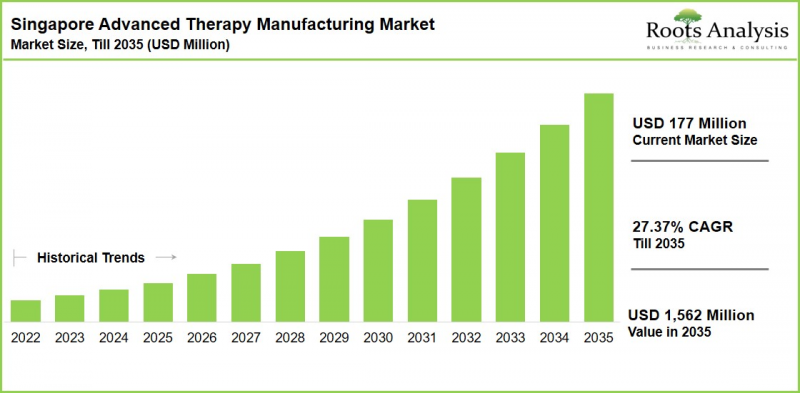
Singapore Advanced Therapy Manufacturing Market: Growth and Trends
Advanced therapy manufacturing covers the GMP-grade production of cell therapies, gene therapies, tissue-engineered products and next-generation biologics such as antibody-drug conjugates. These advanced therapies require specialized bioprocessing, viral vector production, fill-finish and cold-chain handling that differ materially from conventional small-molecule or biologics manufacturing. Over the past decade, Singapore has moved from a base for generic and API production toward a hub for complex biologics and ATMPs, supported by national platforms, regulatory alignment and sustained capital deployment into next-generation manufacturing infrastructure.
Agencies such as the Singapore Economic Development Board (EDB), the Agency for Science, Technology and Research, and the Health Sciences Authority (HSA) have accelerated this shift by co-funding facilities and aligning regulatory pathways with the US FDA and EU EMA. Recent investments highlight Singapore's rapid expansion as a leading advanced therapy manufacturing hub. These include AstraZeneca's USD 1.5 billion antibody-drug conjugate (ADC) facility, the company's first end-to-end ADC manufacturing site globally, and WuXi Biologics' USD 2 billion biomanufacturing facility in Tuas, which significantly strengthens large-scale biologics production capacity.
In addition, SCG Cell Therapy has established an EDB-backed cGMP cell therapy manufacturing and R&D center to support clinical and commercial cell therapy development. Singapore has also launched the Nucleic Acid Therapeutics Initiative (NATi) mRNA Biofoundry, the first facility in Asia capable of producing gram-scale mRNA therapeutics, reinforcing the country's capabilities in next-generation therapeutic manufacturing and innovation. Collectively, these developments signal that Singapore is positioning advanced therapy manufacturing as a structural, long-term national capability rather than an experimental niche.
Growth Drivers: Factors Fueling Market Expansion
Growth in Singapore's advanced therapy manufacturing market is supported by sustained government co-funding and attractive tax incentives. These include tax holidays for new viral vector manufacturing facilities, helping reduce upfront capital investment for both innovator companies and contract development and manufacturing organizations (CDMOs) expanding their production capacity. A rapidly expanding global clinical pipeline is compounding this effect more than 2,700 regenerative medicine and advanced therapy clinical trials were active worldwide in 2025, concentrated in oncology, rare genetic disorders and autoimmune disease.
Singapore's position as a gateway to the broader ASEAN market is further strengthening its appeal. With a regional population of nearly 740 million and healthcare spending approaching USD 740 billion, the country provides manufacturers with a well-regulated base to efficiently serve the wider Southeast Asian market. GDP-certified cold-chain logistics through Changi Airport, combined with HSA's alignment with FDA and EMA standards, further support the export-oriented manufacturing model that underpins the market.
Market Challenges: Critical Barriers Hindering Progress
Despite strong momentum, the market faces several challenges that may impede the market growth. High operating costs and limited land area push manufacturers toward vertically integrated, highly automated facility designs, raising the capital intensity of new entry. A specialized bioprocessing workforce remains a persistent bottleneck, even as A*STAR's Bioprocessing Technology Institute expands training programmer to close the skills gap. Singapore's small domestic patient population limits local commercial volumes for autologous, patient-specific therapies, making export-oriented and CDMO-driven models the primary path to scale. Meanwhile, competition from lower-cost Asian manufacturers and differing regulations across ASEAN markets make last-mile distribution more challenging.
Singapore Advanced Therapy Manufacturing Market: Key Insights
The analysis identifies growth opportunities for distribution partners, channel intermediaries and specialized logistics providers serving the advanced therapy manufacturing value chain. Key findings include:
- Outsourcing is gaining share as smaller and mid-sized biotech companies increasingly rely on Singapore-based CDMO capacity rather than building in-house facilities, opening a distinct channel opportunity for partners supplying raw materials, consumables and validated logistics services without requiring heavy upfront capital.
- Cold-chain and specialized handling remain a differentiation lever despite GDP-certified logistics through Changi Airport, unmet demand persists for specialized cryopreservation, real-time tracking and advanced packaging for temperature- and time-sensitive cell and gene therapy shipments.
- Singapore's positioning as an ASEAN springboard allows manufacturers to serve Indonesia, Thailand, Vietnam and the Philippines from a single regulatory base, creating durable regional distribution partnership opportunities that bypass fragmented country-by-country registration.
- Modality mix is diversifying beyond traditional cell therapy, the build-out of mRNA biofoundry capacity, and large-scale ADC manufacturing is widening the addressable distribution and cold-chain base to nucleic-acid and next-generation antibody-based products.
- Government co-funding of manufacturing facilities is de-risking early-stage capacity investment, favoring channel partners that align early with EDB and A*STAR-backed programmes over price-only competitors.
- Vertical integration by global majors is raising barriers to entry for smaller regional players while simultaneously creating openings for niche distributors specializing in vector-specific reagents, single-use consumables or modality-specific cold-chain logistics that generalist players cannot easily replicate.
- Talent development initiatives, such as A*STAR Bioprocessing Technology Institute's training programmes, indicate sustained multi-year capacity growth rather than a short-term investment cycle, supporting long-horizon distribution and supply agreements.
Recent Deal Activity Signaling Investor Momentum
- Capacity Expansion: WuXi Biologics' USD 2 billion Tuas biomanufacturing project reflects sustained confidence in Singapore as a large-scale outsourcing base for complex biologics and advanced therapies.
- Facility Launch: SCG Cell Therapy's EDB-supported cGMP cell therapy manufacturing and R&D centre extends iPSC-based, off-the-shelf cell therapy production capacity serving Asia-Pacific, North America and Europe.
- Partnership: Teijin Limited and Hilleman Laboratories' memorandum of understanding to expand cell and gene therapy contract development and manufacturing signals continued cross-border collaboration.
- Platform Launch: The Nucleic Acid Therapeutics Initiative (NATi) mRNA Biofoundry establishes Asia's first facility capable of gram-scale mRNA therapeutic and vaccine production.
Singapore Advanced Therapy Manufacturing Market Segments
The market sizing and opportunity analysis has been segmented across the following parameters:
By Therapy Type
- Cell Therapies
- Gene Therapies
- Tissue-Engineered Products
- Antibody-Drug Conjugates (ADCs) and Other Advanced Biologics
By Scale of Operation
- Preclinical / Clinical
- Commercial
By Type of Manufacturer
- In-House Manufacturers
- Contract Development and Manufacturing Organizations (CDMOs)
By Application
- Oncological Disorders
- Rare and Genetic Disorders
- Infectious Diseases
- Other Indications
By End User
- Biopharmaceutical Companies
- Hospitals and Academic Medical Centers
- Research Institutes
Singapore Advanced Therapy Manufacturing Market: Key Segments
Cell Therapies Lead the Market and Gene Therapies Register the Fastest CAGR
Cell therapies currently account for the largest share of Singapore's advanced therapy manufacturing revenue, reflecting an established base of iPSC and CAR-T-adjacent manufacturing capacity and earlier commercial traction. However, the gene therapies segment is likely to register the fastest CAGR during the forecast period. This highest growth is aided by the build-out of capacity and rising global approvals for genetic-disorder indications, which are pulling incremental viral-vector and nucleic-acid manufacturing demand into Singapore.
CDMOs are Gaining Share Over In-House Manufacturing
Contract development and manufacturing organizations are expanding their share of total capacity as smaller biotech companies increasingly favor outsourced, GMP-compliant production over the capital intensity of building proprietary facilities. Large-scale commitments from WuXi Biologics and AstraZeneca illustrate that Singapore is trusted to host both dedicated in-house facilities and shared outsourcing infrastructure within the same jurisdiction, allowing sponsors to calibrate their manufacturing footprint to commercial maturity.
Oncology Dominates the Application Segment
Oncology-focused advanced therapies, spanning CAR-T adjacent cell therapies and antibody-drug conjugates, represent the largest application segment, consistent with the concentration of global clinical pipeline activity in cancer indications. Rare and genetic disorders form the fastest-growing application segment, driven by an expanding base of approved and late-stage gene therapies and government-backed interest in precision medicine.
Example Players in the Singapore Advanced Therapy Manufacturing Market
- A*STAR Bioprocessing Technology Institute (research and technology-transfer partner)
- Amgen
- AstraZeneca
- Esco Aster
- GSK
- Hilleman Laboratories
- Lonza
- SCG Cell Therapy
- Thermo Fisher Scientific
- WuXi Biologics
SINGAPORE ADVANCED THERAPY MANUFACTURING MARKET: RESEARCH COVERAGE
- Market Sizing and Opportunity Analysis: An in-depth analysis of the Singapore advanced therapy manufacturing market, segmented by therapy type, type of manufacturer, scale of operation, application and end user.
- Manufacturer Landscape: An assessment of companies operating advanced therapy manufacturing capacity in Singapore, based on parameters such as year of facility establishment, scale, ownership model (in-house vs. CDMO) and modality portfolio.
- Company Profiles: In-depth profiles of prominent players engaged in advanced therapy manufacturing in Singapore, featuring facility investment, technology platform and recent capacity developments.
- Partnerships and Collaborations Analysis: A comprehensive review of partnership activity among manufacturers, technology providers and government platforms, evaluated by year, partnership type, focus area and counterparties.
- Regulatory and Policy Landscape: An assessment of HSA's regulatory framework, EDB incentive structures and national platforms such as NATi, and their impact on manufacturing timelines and market entry.
- Competitive Benchmarking: A structured comparison of manufacturers by scale, modality breadth and export orientation.
- Market Impact Analysis: The report analyzes drivers, restraints, opportunities and challenges affecting market growth, including the impact of workforce and cold-chain constraints on commercialization timelines.
KEY QUESTIONS ANSWERED IN THIS REPORT
- How large is the Singapore advanced therapy manufacturing market today, and how large will it be by 2035?
- Which therapy types and manufacturer models in-house versus CDMO are gaining or losing share?
- Which companies are best positioned across each segment, and how deep is their manufacturing pipeline?
- How will the shift toward CDMO outsourcing and nucleic-acid modalities reshape distribution and channel economics?
- Which application segments and end-user categories offer the strongest near-term revenue and long-term growth combination?
- What is the realistic impact of workforce and cold-chain infrastructure constraints on commercialization timelines?
Reasons to Buy this Report
- Top-Down and Bottom-Up Triangulated Forecasting: Revenue projections for each segment are cross-validated using macro-level clinical pipeline data and company-level capacity disclosures, reducing forecast risk for investors and channel partners.
- Primary Research with Senior Commercial and Technical Leadership: Insights are grounded in interviews with manufacturing and commercial leaders across large, mid-sized and specialty organizations operating in Singapore, not desk research alone.
- Regulatory-Readiness Analysis: A dedicated view of HSA's alignment with FDA and EMA standards, alongside EDB incentive structures, helps distributors time market-entry and portfolio decisions around regulatory clarity.
- Investor-Grade Financial Context: Company profiles include facility investment figures, recent capital deployment (such as AstraZeneca's ADC facility and WuXi Biologics' Tuas project), and partnership activity, positioned for use in diligence and business case development.
ADDITIONAL BENEFITS
- Complementary PPT Insights Pack
- Complementary Excel Data Packs for all Analytical Modules in the Report
- 15% Free Content Customization
- Detailed Report Walkthrough Session with Research Team
- Free Updated Report if the Report is 6-12 Months Old or Older
TABLE OF CONTENTS
1. PREFACE
- 1.1. Introduction
- 1.2. Market Share Insights
- 1.3. Key Market Insights
- 1.4. Report Coverage
- 1.5. Key Questions Answered
- 1.6. Chapter Outlines
2. RESEARCH METHODOLOGY
- 2.1. Chapter Overview
- 2.2. Research Assumptions
- 2.3. Database Building
- 2.3.1. Data Collection
- 2.3.2. Data Validation
- 2.3.3. Data Analysis
- 2.4. Project Methodology
- 2.4.1. Secondary Research
- 2.4.1.1. Annual Reports
- 2.4.1.2. Academic Research Papers
- 2.4.1.3. Company Websites
- 2.4.1.4. Investor Presentations
- 2.4.1.5. Regulatory Filings
- 2.4.1.6. White Papers
- 2.4.1.7. Industry Publications
- 2.4.1.8. Conferences and Seminars
- 2.4.1.9. Government Portals
- 2.4.1.10. Media and Press Releases
- 2.4.1.11. Newsletters
- 2.4.1.12. Industry Databases
- 2.4.1.13. Roots Proprietary Databases
- 2.4.1.14. Paid Databases and Sources
- 2.4.1.15. Social Media Portals
- 2.4.1.16. Other Secondary Sources
- 2.4.2. Primary Research
- 2.4.2.1. Introduction
- 2.4.2.2. Types
- 2.4.2.2.1. Qualitative
- 2.4.2.2.2. Quantitative
- 2.4.2.3. Advantages
- 2.4.2.4. Techniques
- 2.4.2.4.1. Interviews
- 2.4.2.4.2. Surveys
- 2.4.2.4.3. Focus Groups
- 2.4.2.4.4. Observational Research
- 2.4.2.4.5. Social Media Interactions
- 2.4.2.5. Stakeholders
- 2.4.2.5.1. Company Executives (CXOs)
- 2.4.2.5.2. Board of Directors
- 2.4.2.5.3. Company Presidents and Vice Presidents
- 2.4.2.5.4. Key Opinion Leaders
- 2.4.2.5.5. Research and Development Heads
- 2.4.2.5.6. Technical Experts
- 2.4.2.5.7. Subject Matter Experts
- 2.4.2.5.8. Scientists
- 2.4.2.5.9. Doctors and Other Healthcare Providers
- 2.4.2.6. Ethics and Integrity
- 2.4.2.6.1. Research Ethics
- 2.4.2.6.2. Data Integrity
- 2.4.3. Analytical Tools and Databases
- 2.4.1. Secondary Research
3. MARKET DYNAMICS
- 3.1. Forecast Methodology
- 3.1.1. Top-Down Approach
- 3.1.2. Bottom-Up Approach
- 3.1.3. Hybrid Approach
- 3.2. Market Assessment Framework
- 3.2.1. Total Addressable Market (TAM)
- 3.2.2. Serviceable Addressable Market (SAM)
- 3.2.3. Serviceable Obtainable Market (SOM)
- 3.2.4. Currently Acquired Market (CAM)
- 3.3. Forecasting Tools and Techniques
- 3.3.1. Qualitative Forecasting
- 3.3.2. Correlation
- 3.3.3. Regression
- 3.3.4. Time Series Analysis
- 3.3.5. Extrapolation
- 3.3.6. Convergence
- 3.3.7. Forecast Error Analysis
- 3.3.8. Data Visualization
- 3.3.9. Scenario Planning
- 3.3.10. Sensitivity Analysis
- 3.4. Key Considerations
- 3.4.1. Demographics
- 3.4.2. Market Access
- 3.4.3. Reimbursement Scenarios
- 3.4.4. Industry Consolidation
- 3.5. Robust Quality Control
- 3.6. Key Market Segmentations
- 3.7. Limitations
4. MACRO-ECONOMIC INDICATORS
- 4.1. Chapter Overview
- 4.2. Market Dynamics
- 4.2.1. Time Period
- 4.2.1.1. Historical Trends
- 4.2.1.2. Current and Forecasted Estimates
- 4.2.2. Currency Coverage
- 4.2.2.1. Overview of Major Currencies Affecting the Market
- 4.2.2.2. Impact of Currency Fluctuations on the Industry
- 4.2.3. Foreign Exchange Impact
- 4.2.3.1. Evaluation of Foreign Exchange Rates and Their Impact on Market
- 4.2.3.2. Strategies for Mitigating Foreign Exchange Risk
- 4.2.4. Recession
- 4.2.4.1. Historical Analysis of Past Recessions and Lessons Learnt
- 4.2.4.2. Assessment of Current Economic Conditions and Potential Impact on the Market
- 4.2.5. Inflation
- 4.2.5.1. Measurement and Analysis of Inflationary Pressures in the Economy
- 4.2.5.2. Potential Impact of Inflation on the Market Evolution
- 4.2.6. Interest Rates
- 4.2.6.1. Overview of Interest Rates and Their Impact on the Market
- 4.2.6.2. Strategies for Managing Interest Rate Risk
- 4.2.7. Commodity Flow Analysis
- 4.2.7.1. Type of Commodity
- 4.2.7.2. Origins and Destinations
- 4.2.7.3. Values and Weights
- 4.2.7.4. Modes of Transportation
- 4.2.8. Global Trade Dynamics
- 4.2.8.1. Import Scenario
- 4.2.8.2. Export Scenario
- 4.2.9. War Impact Analysis
- 4.2.9.1. Russian-Ukraine War
- 4.2.9.2. Israel-Hamas War
- 4.2.10. COVID Impact / Related Factors
- 4.2.10.1. Global Economic Impact
- 4.2.10.2. Industry-specific Impact
- 4.2.10.3. Government Response and Stimulus Measures
- 4.2.10.4. Future Outlook and Adaptation Strategies
- 4.2.11. Other Indicators
- 4.2.11.1. Fiscal Policy
- 4.2.11.2. Consumer Spending
- 4.2.11.3. Gross Domestic Product (GDP)
- 4.2.11.4. Employment
- 4.2.11.5. Taxes
- 4.2.11.6. R&D Innovation
- 4.2.11.7. Stock Market Performance
- 4.2.11.8. Supply Chain
- 4.2.11.9. Cross-Border Dynamics
- 4.2.1. Time Period
5. EXECUTIVE SUMMARY
6. INTRODUCTION
- 6.1. Chapter Overview
- 6.2. Overview of Singapore Advanced Therapy Manufacturing
- 6.2.1. Key Characteristics of Singapore Advanced Therapy Manufacturing
- 6.2.2. Key Applications of the Singapore Advanced Therapy Manufacturing
- 6.2.3. Challenges Associated with Singapore Advanced Therapy Manufacturing
- 6.3. Future Perspective
7. REGULATORY SCENARIO
8. COMPREHENSIVE DATABASE OF LEADING PLAYERS
9. COMPETITIVE LANDSCAPE
- 9.1. Chapter Overview
- 9.2. Singapore Advanced Therapy Manufacturing: Overall Market Landscape
- 9.2.1. Analysis by Year of Establishment
- 9.2.2. Analysis by Company Size
- 9.2.3. Analysis by Location of Headquarters
- 9.2.4. Singapore Advanced Therapy Manufacturing Market: Overall Market Landscape
- 9.2.4.1. Analysis by Therapy Type
- 9.2.4.2. Analysis by Scale of Operation Type
- 9.2.4.3. Analysis by Manufacturer Type
- 9.2.4.4. Analysis by Application
- 9.2.4.5. Analysis by End User
10. COMPANY COMPETITIVENESS ANALYSIS
- 10.1. Chapter Overview
- 10.2. Assumptions and Key Parameters
- 10.3. Methodology
- 10.4. Overview of Peer Groups Based in Singapore
12. COMPANY PROFILES
- 12.1. Chapter Overview
- 12.2. A*STAR Bioprocessing Technology Institute (Research and Technology-Transfer Partner)
- 12.2.1. Company Overview
- 12.2.2. Company Mission
- 12.2.3. Company Footprint
- 12.2.4. Management Team
- 12.2.5. Contact Details
- 12.2.6. Financial Performance
- 12.2.7. Operating Business Segments
- 12.2.8. Product Portfolio
- 12.2.9. MOAT Analysis
- 12.2.10. Recent Developments and Future Outlook
- similar details are presented for other below mentioned companies based on information in the public domain
- 12.3. Amgen
- 12.4. AstraZeneca
- 12.5. Esco Aster
- 12.6. GSK
- 12.7. Hilleman Laboratories
- 12.8. Lonza
- 12.9. SCG Cell Therapy
- 12.10. Thermo Fisher Scientific
- 12.11. WuXi Biologics
13. RECENT DEVELOPMENTS
- 13.1. Chapter Overview
- 13.2. Recent Funding
- 13.3. Recent Partnerships
- 13.4. Other Recent Initiatives
14. SINGAPORE ADVANCED THERAPY MANUFACTURING MARKET
- 14.1. Chapter Overview
- 14.2. Key Assumptions and Methodology
- 14.3. Trends Disruption Impacting Market
- 14.4. Demand Side Trends
- 14.5. Supply Side Trends
- 14.6. Global Singapore Advanced Therapy Manufacturing Market, Historical Trends (Since 2020) and Forecasted Estimates (Till 2035)
- 14.7. Multivariate Scenario Analysis
- 14.7.1. Conservative Scenario
- 14.7.2. Optimistic Scenario
- 14.8. Investment Feasibility Index
- 14.9. Key Market Segmentations
15. MARKET OPPORTUNITIES BASED ON TYPE OF THERAPY
- 15.1. Chapter Overview
- 15.2. Key Assumptions and Methodology
- 15.3. Revenue Shift Analysis
- 15.4. Market Movement Analysis
- 15.5. Penetration-Growth (P-G) Matrix
- 15.6. Singapore Advanced Therapy Manufacturing Market for Cell Therapy: Historical Trends (Since 2020) and Forecasted Estimates (Till 2035)
- 15.7. Singapore Advanced Therapy Manufacturing Market for Gene Therapy: Historical Trends (Since 2020) and Forecasted Estimates (Till 2035)
- 15.8. Singapore Advanced Therapy Manufacturing Market for Tissue-Engineered Products: Historical Trends (Since 2020) and Forecasted Estimates (Till 2035)
- 15.9. Antibody-Drug Conjugates (ADCs) and Other Advanced Biologics
- 15.10. Data Triangulation and Validation
- 15.10.1. Secondary Sources
- 15.10.2. Primary Sources
- 15.10.3. Statistical Modeling
16. MARKET OPPORTUNITIES BASED ON TYPE OF SCALE OF OPERATION
- 16.1. Chapter Overview
- 16.2. Key Assumptions and Methodology
- 16.3. Revenue Shift Analysis
- 16.4. Market Movement Analysis
- 16.5. Penetration-Growth (P-G) Matrix
- 16.6. Singapore Advanced Therapy Manufacturing Market for Preclinical / Clinical: Historical Trends (Since 2020) and Forecasted Estimates (Till 2035)
- 16.7. Singapore Advanced Therapy Manufacturing Market for Commercial: Historical Trends (Since 2020) and Forecasted Estimates (Till 2035)
- 16.8. Data Triangulation and Validation
- 16.8.1. Secondary Sources
- 16.8.2. Primary Sources
- 16.8.3. Statistical Modeling
17. MARKET OPPORTUNITIES BASED ON TYPE OF MANUFACTURER
- 17.1. Chapter Overview
- 17.2. Key Assumptions and Methodology
- 17.3. Revenue Shift Analysis
- 17.4. Market Movement Analysis
- 17.5. Penetration-Growth (P-G) Matrix
- 17.6. Singapore Advanced Therapy Manufacturing Market for In-House Manufacturers: Historical Trends (Since 2020) and Forecasted Estimates (Till 2035)
- 17.7. Singapore Advanced Therapy Manufacturing Market for Contract Development and Manufacturing Organizations (CDMOs): Historical Trends (Since 2020) and Forecasted Estimates (Till 2035)
- 17.8. Data Triangulation and Validation
- 17.8.1. Secondary Sources
- 17.8.2. Primary Sources
- 17.8.3. Statistical Modeling
18. MARKET OPPORTUNITIES BASED ON TYPE OF APPLICATION
- 18.1. Chapter Overview
- 18.2. Key Assumptions and Methodology
- 18.3. Revenue Shift Analysis
- 18.4. Market Movement Analysis
- 18.5. Penetration-Growth (P-G) Matrix
- 18.6. Singapore Advanced Therapy Manufacturing Market for Oncology: Historical Trends (Since 2020) and Forecasted Estimates (Till 2035)
- 18.7. Singapore Advanced Therapy Manufacturing Market for Rare and Genetic Disorders: Historical Trends (Since 2020) and Forecasted Estimates (Till 2035)
- 18.8. Singapore Advanced Therapy Manufacturing Market for Infectious Diseases: Historical Trends (Since 2020) and Forecasted Estimates (Till 2035)
- 18.9. Singapore Advanced Therapy Manufacturing Market for Other Indications: Historical Trends (Since 2020) and Forecasted Estimates (Till 2035)
- 18.10. Data Triangulation and Validation
- 18.10.1. Secondary Sources
- 18.10.2. Primary Sources
- 18.10.3. Statistical Modeling
19. MARKET OPPORTUNITIES BASED ON TYPE OF END USER
- 19.1. Chapter Overview
- 19.2. Key Assumptions and Methodology
- 19.3. Revenue Shift Analysis
- 19.4. Market Movement Analysis
- 19.5. Penetration-Growth (P-G) Matrix
- 19.6. Singapore Advanced Therapy Manufacturing Market in Biopharmaceutical Companies: Historical Trends (Since 2020) and Forecasted Estimates (Till 2035)
- 19.7. Singapore Advanced Therapy Manufacturing Market in the Hospitals and Academic Medical Centers: Historical Trends (Since 2020) and Forecasted Estimates (Till 2035)
- 19.8. Data Triangulation and Validation
20. KEY WINNING STRATEGIES
21. ROOTS STRATEGIC RECOMMENDATIONS
22. INSIGHTS FROM PRIMARY RESEARCH
23. REPORT CONCLUSION
24. TABULATED DATA
25. LIST OF COMPANIES AND ORGANIZATIONS
26. ROOTS SUBSCRIPTION SERVICES
27. AUTHOR DETAILS

