PUBLISHER: Roots Analysis | PRODUCT CODE: 2161675

PUBLISHER: Roots Analysis | PRODUCT CODE: 2161675
Primary Cells Market - Trends and Forecast Till 2035
PRIMARY CELLS MARKET: OVERVIEW
The global primary cells market is valued at an estimated USD 1.26 billion in 2026 and is projected to expand to USD 2.04 billion by 2035, representing a CAGR of 5.5% during the forecast period. This upward trajectory is anchored in a broader shift within biomedical research and drug development, where physiologically accurate, donor-derived cell models are steadily displacing immortalized cell lines and animal-based systems as the preferred substrate for preclinical testing, disease modeling, and cell-based therapeutic manufacturing.
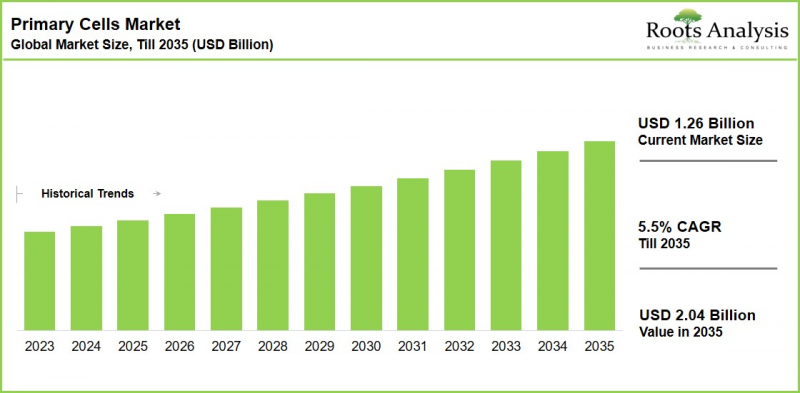
Primary Cells Market: Growth and Trends
Conventional in vitro models have long struggled to replicate native human tissue physiology with sufficient accuracy, a gap that has historically undermined the predictive value of preclinical studies and contributed to elevated attrition rates in clinical development. Immortalized cell lines are prone to genetic drift and oncogenic transformation. Animal models can also introduce interspecies variability in metabolism, immune responses, and disease progression. These limitations have encouraged pharmaceutical and biotechnology companies to adopt primary human and animal cells as more translationally relevant alternatives.
This shift is reinforced by the parallel expansion of cell and gene therapy pipelines, many of which depend on large, consistent volumes of high-quality primary immune cells as raw material inputs. As sponsors scale from early-stage research through GMP-grade clinical and commercial manufacturing, reliable, quality-assured sourcing of primary cells has become a critical bottleneck and, correspondingly, a growing commercial opportunity for distribution partners capable of guaranteeing traceability, viability, and regulatory-grade documentation across the supply chain.
Growth Drivers: Factors Fueling Market Expansion
The global increase in cancer, metabolic, and immunological disease incidence is intensifying demand for physiologically relevant preclinical platforms. Primary human cells allow researchers to study disease biology at the cellular level, evaluate candidate therapeutics under near-native conditions, and support regulatory-grade toxicology and efficacy testing.
Further, a growing number of cell and gene therapy developers rely on primary immune cells as core manufacturing inputs. As clinical and commercial pipelines mature, biopharmaceutical companies are increasingly securing dependable, scalable sources of human-derived primary cells, a trend that is expected to push GMP-grade primary cell demand ahead of the broader market's average growth rate.
Market Challenges: Critical Barriers Hindering Progress
Despite robust demand, the market is constrained by donor-to-donor variability and batch-to-batch inconsistency in cell quality, yield, and functional performance, a persistent sourcing and quality-control challenge for manufacturers and their distribution partners alike.
In addition, primary cells are highly susceptible to microbial contamination, serum-batch variability, and suboptimal culture or transport conditions. These all elevate the complexity, cost, and risk profile of maintaining reproducible, ready-to-use inventories, reinforcing the value of specialized cold-chain and quality-assurance infrastructure across the distribution network.
Recent Developments Signaling Market Momentum
- The integration of Discovery Life Sciences and AllCells provides access to tens of thousands of recallable donors across the US and Europe, with fresh and cryopreserved RUO and GMP-grade cellular materials available for cell and gene therapy programs.
- The combined Discovery-AllCells platform can deliver human cellular starting materials within 24-48 hours, highlighting the growing importance of rapid fulfillment for research and cell therapy workflows.
- Trailhead Biosystems raised an additional $20 million, bringing its total financing to $40 million, to accelerate commercialization of iPSC-derived human cell products designed to replicate properties of primary human cells.
- Akadeum Life Sciences secured more than $20 million to expand its cell-separation technology after launching a GMP-compliant product suite for clinical trials, supporting the broader infrastructure required for cell-based therapies.
- Atelerix signed an exclusive distribution agreement with MineBio for China, offering cell-preservation technology that can maintain biological materials at ambient temperatures for up to two weeks, potentially reducing dependence on ultra-cold transportation.
- Made Scientific and Pluristyx established an integrated partnership covering GMP iPSC lines and derivative cell types, creating a single-source pathway from cell-line development through commercial supply.
- PHC Group and CCRM are collaborating to develop an optimized expansion culture process for primary T cells, including evaluation of multiple culture conditions and automated cell-expansion technologies
- Applied Biological Materials participated in the American Association for Cancer Research (AACR) annual conference in San Diego, US, engaging with a research community spanning more than 100 scientific sessions and close to 7,400 abstract presentations.
- Lonza launched a dedicated Media Development Lab at its Singapore site to optimize cell culture media formulations for bioprocessing customers, supporting a smoother transition from research-grade to GMP-grade manufacturing.
Primary Cells Market Segments
The market sizing and opportunity analysis has been segmented across the following parameters:
By Source of Origin
- Humans
- Animals
By Type of Organ System
- Nervous System
- Immune System
- Cardiovascular / Circulatory System
- Hepatic System
- Musculoskeletal System
- Respiratory System
- Endocrine System
- Integumentary System
- Reproductive System
- Digestive System
- Ocular System
- Urinary System
By Type of Primary Cell
- Fibroblasts
- Epithelial Cells
- Endothelial Cells
- Hematopoietic Cells
- Stem Cells
- Keratinocytes
- Muscle Cells
- Adipose Cells
- Melanocytes
By Application Area
- Therapeutics
- Diagnostics
By Therapeutic Area
- Oncological Disorders
- Infectious Disorders
- Central Nervous System Disorders
- Metabolic Disorders
- Immunological Disorders
- Cardiovascular Disorders
- Other Disorders
By Scale of Operation
- Preclinical Research
- GMP Products
By End-User
- Industry Players
- Academic Players
By Type of Industry Player
- In-house Manufacturers
- Contract Research Organizations
By Geographical Regions
- North America (US, Canada)
- Europe (UK, Germany, France, Italy, Spain, Rest of Europe)
- Asia Pacific (China, Japan, South Korea, Australia, India)
- Middle East and North Africa (Saudi Arabia, United Arab Emirates, Egypt)
- Latin America (Brazil, Mexico, Argentina)
Primary Cells Market: Key Segment Insights
Fibroblasts Lead the Type of Primary Cell Segment
According to our market report, fibroblasts account for the highest share of the market and are likely to remain dominant in the future. Their ability to synthesize their own extracellular matrix and establish biophysical and biochemical signaling niches makes them especially valuable in contemporary 3D organoid and tissue-engineering research, sustaining their leadership position among primary cell types.
North America Dominates the Regional Landscape
Based on our market analysis, North America occupies the highest share of the global primary cells market. This dominance is driven by well-established life sciences infrastructure, a dense concentration of primary cell suppliers and biobanks, advanced healthcare and research systems, and a regulatory environment that supports extensive preclinical outsourcing. This regional concentration reinforces the case for distribution partners with strong North American cold-chain and logistics networks.
On the other hand, Asia-Pacific is expected to register a higher CAGR during the forecast period. China, Japan, and South Korea are strengthening their biopharmaceutical R&D infrastructure, while the rising number of academic research institutes, CROs, and biotechnology companies is expanding demand for primary cells. In addition, increasing outsourcing of preclinical research and improving healthcare and research funding are expected to further accelerate regional market growth.
Oncological Disorders Lead the Therapeutic Area Segment
Oncological disorders account for the highest market share by therapeutic area and are expected to continue expanding at a higher CAGR during the forecast period. Primary cells play a central role in screening novel chemotherapeutics, targeted therapies, and chimeric antigen receptor (CAR)-T constructs, offering a level of physiological fidelity that traditional non-human cell lines cannot match in oncology-focused drug development.
Preclinical Research Dominates by Scale of Operation, GMP Products Segment Grows Faster
Preclinical research currently accounts for the largest overall market share. This high share reflects the widespread use of human and animal primary cells in efficacy screening, toxicity testing, and target validation. The GMP products segment, while smaller today, is forecast to expand at a higher CAGR during the forecast period. This lucrative growth is driven by rising demand for clinical-grade primary cells in cell and gene therapy manufacturing and personalized treatment programs.
Contract Research Organizations Represent a Rising Opportunity
Contract research organizations are expected to account for the highest market share. Moreover, this segment is expected to grow at a higher CAGR during the forecast period. Their specialized expertise in primary cell isolation, scalable global networks, and ability to offer rapid turnaround for custom cell panels and integrated assay services position CROs, and the distribution partners that support them, to capture a growing share of outsourced preclinical work.
Example Players in the Primary Cells Market
- AcceGen
- Applied Biological Materials
- Cell Applications
- Cyagen
- iCell Bioscience
- Innoprot
- Kosheeka
- Lab4Paws
- Lonza
- ScienCell Research Laboratories
PRIMARY CELLS MARKET: RESEARCH COVERAGE
- Market Sizing and Opportunity Analysis: An in-depth assessment of the market across source of origin, type of organ system, type of primary cell, application area, therapeutic area, scale of operation, end-user, type of industry players, and geography.
- Market Landscape: A detailed assessment of active primary cell manufacturers and channel partners, covering year of establishment, company size, headquarters location, and range of cell types and services offered.
- Company Profiles: In-depth profiles of prominent players engaged in primary cell isolation, culture, and distribution, covering service portfolios, recent initiatives, and areas of specialization.
- Cold-Chain and Logistics Assessment: A focused review of cryopreservation, cold-chain transport, and quality-assurance requirements relevant to distributors and logistics partners entering the primary cell supply chain.
- Partnerships and Collaborations: An analysis of partnerships inked by primary cell suppliers, biobanks, and research institutions, based on year, type, cell type, and most active players.
- Recent Developments and Capacity Expansions: A review of recent facility expansions, platform launches, and conference-linked initiatives shaping near-term supply availability.
- SWOT Analysis: A strategic assessment of the primary cells market's strengths, weaknesses, opportunities, and threats, with actionable implications for distributors, investors, and R&D decision-makers.
KEY QUESTIONS ANSWERED IN THIS REPORT
- Which are the leading companies in the primary cells market?
- Which region dominates the market, and which region is growing the fastest?
- What are the key trends observed in the primary cells market?
- What factors are likely to influence the evolution of this market?
- What are the primary challenges faced by primary cell suppliers and distributors?
- What is the current and future market size?
- What is the CAGR of this market through 2035?
- How is current and future market opportunity distributed across key segments?
- What opportunities exist for distributors, logistics partners, and CROs entering this space?
REASONS TO BUY THIS REPORT
This report is designed to give distributors, channel partners, and investors a decisive analytical edge in a fast-evolving, quality-sensitive market. Its core differentiators include:
- Market Opportunity Analysis: Market estimates are built using a hybrid methodology that cross-validates top-down macro assessments against bottom-up, minimizing forecast bias.
- Actionable Segmentation: Nine-parameter segmentation (source of origin, organ system, cell type, application, therapeutic area, scale of operation, end-user, industry player type, geography) enables precise opportunity sizing for any go-to-market or investment thesis.
- Primary Research-Backed Insights: Findings are informed by direct engagement with business development leaders, scientific directors, and commercial executives across small, mid-sized, and large primary cell suppliers, ensuring insights reflect real operating conditions rather than desk research alone.
- High-Growth Segment Identification: The analysis highlights segments expected to outperform the broader market, enabling distributors, suppliers, and investors to prioritize resources toward cell types, applications, therapeutic areas, operating scales, and end-user categories with stronger commercial potential.
- Geographic Opportunity Assessment: Regional analysis identifies high-potential markets, supplier concentration, demand centers, and geographic expansion opportunities, supporting decisions related to market entry, distribution network development, and international growth.
ADDITIONAL BENEFITS
- Complimentary PPT Insights Pack
- Complimentary Excel Data Packs for All Analytical Modules in the Report
- 15% Free Content Customization
- Detailed Report Walkthrough Session with the Research Team
- Free Updated Report if the Report Is 6-12 Months Old or Older
TABLE OF CONTENTS
1. BACKGROUND
- 1.1. Context
- 1.2. Project Objectives
2. RESEARCH METHODOLOGY
- 2.1. Chapter Overview
- 2.2. Research Assumptions
- 2.2.1. Market Landscape and Market Trends
- 2.2.2. Market Forecast and Opportunity Analysis
- 2.2.3. Comparative Analysis
- 2.3. Database Building
- 2.3.1. Data Collection
- 2.3.2. Data Validation
- 2.3.3. Data Analysis
- 2.4. Project Methodology
- 2.4.1. Secondary Research
- 2.4.1.1. Annual Reports
- 2.4.1.2. Academic Research Papers
- 2.4.1.3. Company Websites
- 2.4.1.4. Investor Presentations
- 2.4.1.5. Regulatory Filings
- 2.4.1.6. White Papers
- 2.4.1.7. Industry Publications
- 2.4.1.8. Conferences and Seminars
- 2.4.1.9. Government Portals
- 2.4.1.10. Media and Press Releases
- 2.4.1.11. Newsletters
- 2.4.1.12. Industry Databases
- 2.4.1.13. Roots Proprietary Databases
- 2.4.1.14. Paid Databases and Sources
- 2.4.1.15. Social Media Portals
- 2.4.1.16. Other Secondary Sources
- 2.4.2. Primary Research
- 2.4.2.1. Types of Primary Research
- 2.4.2.1.1. Qualitative Research
- 2.4.2.1.2. Quantitative Research
- 2.4.2.1.3. Hybrid Approach
- 2.4.2.2. Advantages of Primary Research
- 2.4.2.3. Techniques for Primary Research
- 2.4.2.3.1. Interviews
- 2.4.2.3.2. Surveys
- 2.4.2.3.3. Focus Groups
- 2.4.2.3.4. Observational Research
- 2.4.2.3.5. Social Media Interactions
- 2.4.2.4. Key Opinion Leaders Considered in Primary Research
- 2.4.2.4.1. Company Executives (CXOs)
- 2.4.2.4.2. Board of Directors
- 2.4.2.4.3. Company Presidents and Vice Presidents
- 2.4.2.4.4. Research and Development Heads
- 2.4.2.4.5. Technical Experts
- 2.4.2.4.6. Subject Matter Experts
- 2.4.2.4.7. Scientists
- 2.4.2.4.8. Doctors and Other Healthcare Providers
- 2.4.2.5. Ethics and Integrity
- 2.4.2.5.1. Research Ethics
- 2.4.2.5.2. Data Integrity
- 2.4.2.1. Types of Primary Research
- 2.4.3. Analytical Tools and Databases
- 2.4.1. Secondary Research
- 2.5. Robust Quality Control
3. MARKET DYNAMICS
- 3.1. Chapter Overview
- 3.2. Forecast Methodology
- 3.2.1. Top-down Approach
- 3.2.2. Bottom-up Approach
- 3.2.3. Hybrid Approach
- 3.3. Market Assessment Framework
- 3.3.1. Total Addressable Market (TAM)
- 3.3.2. Serviceable Addressable Market (SAM)
- 3.3.3. Serviceable Obtainable Market (SOM)
- 3.3.4. Currently Acquired Market (CAM)
- 3.4. Forecasting Tools and Techniques
- 3.4.1. Qualitative Forecasting
- 3.4.2. Correlation
- 3.4.3. Regression
- 3.4.4. Extrapolation
- 3.4.5. Convergence
- 3.4.6. Sensitivity Analysis
- 3.4.7. Scenario Planning
- 3.4.8. Data Visualization
- 3.4.9. Time Series Analysis
- 3.4.10. Forecast Error Analysis
- 3.5. Key Considerations
- 3.5.1. Demographics
- 3.5.2. Government Regulations
- 3.5.3. Reimbursement Scenarios
- 3.5.4. Market Access
- 3.5.5. Supply Chain
- 3.5.6. Industry Consolidation
- 3.5.7. Pandemic / Unforeseen Disruptions Impact
- 3.6. Limitations
4. MACRO-ECONOMIC INDICATORS
- 4.1. Chapter Overview
- 4.2. Market Dynamics
- 4.2.1. Time Period
- 4.2.1.1. Historical Trends
- 4.2.1.2. Current and Forecasted Estimates
- 4.2.2. Currency Coverage
- 4.2.2.1. Major Currencies Affecting the Market
- 4.2.2.2. Factors Affecting Currency Fluctuations on the Industry
- 4.2.2.3. Impact of Currency Fluctuations on the Industry
- 4.2.3. Foreign Currency Exchange Rate
- 4.2.3.1. Impact of Foreign Exchange Rate Volatility on the Market
- 4.2.3.2. Strategies for Mitigating Foreign Exchange Risk
- 4.2.4. Recession
- 4.2.4.1. Assessment of Current Economic Conditions and Potential Impact on the Market
- 4.2.4.2. Historical Analysis of Past Recessions and Lessons Learnt
- 4.2.5. Inflation
- 4.2.5.1. Measurement and Analysis of Inflationary Pressures in the Economy
- 4.2.5.2. Potential Impact of Inflation on the Market Evolution
- 4.2.6. Interest Rates
- 4.2.6.1. Interest Rates and Their Impact on the Market
- 4.2.6.2. Strategies for Managing Interest Rate Risk
- 4.2.7. Commodity Flow Analysis
- 4.2.7.1. Type of Commodity
- 4.2.7.2. Origins and Destinations
- 4.2.7.3. Values and Weights
- 4.2.7.4. Modes of Transportation
- 4.2.8. Global Trade Dynamics
- 4.2.8.1. Import Scenario
- 4.2.8.2. Export Scenario
- 4.2.8.3. Trade Policies
- 4.2.8.4. Strategies for Mitigating the Risks Associated with Trade Barriers
- 4.2.8.5. Impact of Trade Barriers on the Market
- 4.2.9. War Impact Analysis
- 4.2.9.1. Russian-Ukraine War
- 4.2.9.2. Israel-Hamas War
- 4.2.10. COVID Impact / Related Factors
- 4.2.10.1. Global Economic Impact
- 4.2.10.2. Industry-specific Impact
- 4.2.10.3. Government Response and Stimulus Measures
- 4.2.10.4. Future Outlook and Adaptation Strategies
- 4.2.11. Other Indicators
- 4.2.11.1. Fiscal Policy
- 4.2.11.2. Consumer Spending
- 4.2.11.3. Gross Domestic Product
- 4.2.11.4. Employment
- 4.2.11.5. Taxes
- 4.2.11.6. Stock Market Performance
- 4.2.11.7. Cross Border Dynamics
- 4.2.1. Time Period
- 4.3. Conclusion
5. EXECUTIVE SUMMARY
6. PRIMARY CELL MANUFACTURERS: MARKET LANDSCAPE
- 6.1. Methodology and Key Parameters
- 6.2. Primary Cell Manufacturers: Market Landscape
- 6.2.1. Analysis by Year of Establishment
- 6.2.2. Analysis by Business Model
- 6.2.3. Analysis by Company Size
- 6.2.4. Analysis by Location of Headquarters
- 6.2.5. Analysis by Source of Origin
- 6.2.6. Analysis by Animal Source of Origin
- 6.2.7. Analysis by Type of Organ System
- 6.2.8. Analysis by Type of Primary Cell
- 6.2.9. Analysis by Scale of Operation
- 6.2.10. Analysis by Phenotype of Primary Cell
- 6.2.11. Analysis by Additional Offerings
7. COMPANY COMPETITIVENESS ANALYSIS
- 7.1. Methodology and Key Parameters
- 7.2. Scoring
- 7.3. Peer Groups
- 7.4. Overview of Primary Cell Manufacturers based in North America
- 7.5. Primary Cell Manufacturers based in North America (Peer Group I)
- 7.6. Leading Primary Cell Manufacturers based in North America (Peer Group I)
- 7.7. Overview of Primary Cell Manufacturers based in Europe
- 7.8. Primary Cell Manufacturers based in Europe (Peer Group II)
- 7.9. Leading Primary Cell Manufacturers based in Europe (Peer Group II)
- 7.10. Overview of Primary Cell Manufacturers based in Asia-Pacific (Peer Group II)
- 7.11. Primary Cell Manufacturers based in Asia-Pacific (Peer Group III)
- 7.12. Leading Primary Cell Manufacturers based in Asia-Pacific (Peer Group III)
8. COMPANY PROFILES
- 8.1. Chapter Overview
- 8.2. AcceGen
- 8.2.1. Primary Cells Portfolio
- 8.2.2. Key Initiatives
- 8.3. Applied Biological Materials
- 8.4. Cell Applications
- 8.5. Cyagen
- 8.6. iCell Bioscience
- 8.7. Innoprot
- 8.8. Kosheeka
- 8.9. Lab4Paws
- 8.10. Lonza
- 8.11. ScienCell Research Laboratories
9. GLOBAL PRIMARY CELLS MARKET
- 9.1. Key Assumptions and Methodology
- 9.2. Global Primary Cells Market: Historical Trends (Since 2023) and Forecasted Estimates (Till 2035)
- 9.2.1. Scenario Analysis
- 9.2.1.1. Conservative Scenario
- 9.2.1.2. Optimistic Scenario
- 9.2.1. Scenario Analysis
- 9.3. Key Market Segmentations
10. PRIMARY CELLS MARKET, BY SOURCE OF ORIGIN
- 10.1. Key Assumptions and Methodology
- 10.2. Primary Cells Market: Distribution by Source of Origin
- 10.2.1. Primary Cells Market for Humans: Historical Trends (Since 2023) and Forecasted Estimates (Till 2035)
- 10.2.2. Primary Cells Market for Animals: Historical Trends (Since 2023) and Forecasted Estimates (Till 2035)
- 10.3. Data Triangulation and Validation
11. PRIMARY CELLS MARKET, BY TYPE OF ORGAN SYSTEM
- 11.1. Key Assumptions and Methodology
- 11.2. Primary Cells Market: Distribution by Type of Organ System
- 11.2.1. Primary Cells Market for Nervous System: Historical Trends (Since 2023) and Forecasted Estimates (Till 2035)
- 11.2.2. Primary Cells Market for Immune System: Historical Trends (Since 2023) and Forecasted Estimates (Till 2035)
- 11.2.3. Primary Cells Market for Cardiovascular / Circulatory System: Historical Trends (Since 2023) and Forecasted Estimates (Till 2035)
- 11.2.4. Primary Cells Market for Hepatic System: Historical Trends (Since 2023) and Forecasted Estimates (Till 2035)
- 11.2.5. Primary Cells Market for Musculoskeletal System: Historical Trends (Since 2023) and Forecasted Estimates (Till 2035)
- 11.2.6. Primary Cells Market for Respiratory System: Historical Trends (Since 2023) and Forecasted Estimates (Till 2035)
- 11.2.7. Primary Cells Market for Endocrine System: Historical Trends (Since 2023) and Forecasted Estimates (Till 2035)
- 11.2.8. Primary Cells Market for Integumentary System: Historical Trends (Since 2023) and Forecasted Estimates (Till 2035)
- 11.2.9. Primary Cells Market for Reproductive System: Historical Trends (Since 2023) and Forecasted Estimates (Till 2035)
- 11.2.10. Primary Cells Market for Digestive System: Historical Trends (Since 2023) and Forecasted Estimates (Till 2035)
- 11.2.11. Primary Cells Market for Ocular System: Historical Trends (Since 2023) and Forecasted Estimates (Till 2035)
- 11.2.12. Primary Cells Market for Urinary System: Historical Trends (Since 2023) and Forecasted Estimates (Till 2035)
- 11.3. Data Triangulation and Validation
12. PRIMARY CELLS MARKET, BY TYPE OF PRIMARY CELL
- 12.1. Key Assumptions and Methodology
- 12.2. Primary Cells Market: Distribution by Type of Primary Cell
- 12.2.1. Primary Cells Market for Fibroblasts: Historical Trends (Since 2023) and Forecasted Estimates (Till 2035)
- 12.2.2. Primary Cells Market for Epithelial Cells: Historical Trends (Since 2023) and Forecasted Estimates (Till 2035)
- 12.2.3. Primary Cells Market for Endothelial Cells: Historical Trends (Since 2023) and Forecasted Estimates (Till 2035)
- 12.2.4. Primary Cells Market for Hematopoietic Cells: Historical Trends (Since 2023) and Forecasted Estimates (Till 2035)
- 12.2.5. Primary Cells Market for Stem Cells: Historical Trends (Since 2023) and Forecasted Estimates (Till 2035)
- 12.2.6. Primary Cells Market for Keratinocytes: Historical Trends (Since 2023) and Forecasted Estimates (Till 2035)
- 12.2.7. Primary Cells Market for Muscle Cells: Historical Trends (Since 2023) and Forecasted Estimates (Till 2035)
- 12.2.8. Primary Cells Market for Adipose Cells: Historical Trends (Since 2023) and Forecasted Estimates (Till 2035)
- 12.2.9. Primary Cells Market for Melanocytes: Historical Trends (Since 2023) and Forecasted Estimates (Till 2035)
- 12.3. Data Triangulation and Validation
13. PRIMARY CELLS MARKET, BY APPLICATION AREA
- 13.1. Key Assumptions and Methodology
- 13.2. Primary Cells Market: Distribution by Application Area
- 13.2.1. Primary Cells Market for Therapeutics: Historical Trends (Since 2023) and Forecasted Estimates (Till 2035)
- 13.2.2. Primary Cells Market for Diagnostics: Historical Trends (Since 2023) and Forecasted Estimates (Till 2035)
- 13.3. Data Triangulation and Validation
14. PRIMARY CELLS MARKET, BY THERAPEUTIC AREA
- 14.1. Key Assumptions and Methodology
- 14.2. Primary Cells Market: Distribution by Therapeutic Area
- 14.2.1. Primary Cells Market for Oncological Disorders: Historical Trends (Since 2023) and Forecasted Estimates (Till 2035)
- 14.2.2. Primary Cells Market for Infectious Disorders: Historical Trends (Since 2023) and Forecasted Estimates (Till 2035)
- 14.2.3. Primary Cells Market for Central Nervous System Disorders: Historical Trends (Since 2023) and Forecasted Estimates (Till 2035)
- 14.2.4. Primary Cells Market for Metabolic Disorders: Historical Trends (Since 2023) and Forecasted Estimates (Till 2035)
- 14.2.5. Primary Cells Market for Immunological Disorders: Historical Trends (Since 2023) and Forecasted Estimates (Till 2035)
- 14.2.6. Primary Cells Market for Cardiovascular Disorders: Historical Trends (Since 2023) and Forecasted Estimates (Till 2035)
- 14.2.7. Primary Cells Market for Other Disorders: Historical Trends (Since 2023) and Forecasted Estimates (Till 2035)
- 14.3. Data Triangulation and Validation
15. PRIMARY CELLS MARKET, BY SCALE OF OPERATION
- 15.1. Key Assumptions and Methodology
- 15.2. Primary Cells Market: Distribution by Scale of Operation
- 15.2.1. Primary Cells Market for Preclinical Research: Historical Trends (Since 2023) and Forecasted Estimates (Till 2035)
- 15.2.2. Primary Cells Market for GMP Products: Historical Trends (Since 2023) and Forecasted Estimates (Till 2035)
- 15.3. Data Triangulation and Validation
16. PRIMARY CELLS MARKET, BY END-USER
- 16.1. Key Assumptions and Methodology
- 16.2. Primary Cells Market: Distribution by End-user
- 16.2.1. Primary Cells Market for Industry Players: Historical Trends (Since 2023) and Forecasted Estimates (Till 2035)
- 16.2.2. Primary Cells Market for Academic Players: Historical Trends (Since 2023) and Forecasted Estimates (Till 2035)
- 16.3. Data Triangulation and Validation
17. PRIMARY CELLS MARKET, BY TYPE OF INDUSTRY PLAYER
- 17.1. Key Assumptions and Methodology
- 17.2. Primary Cells Market: Distribution by Type of Industry Player
- 17.2.1. Primary Cells Market for In-house Manufacturers: Historical Trends (Since 2023) and Forecasted Estimates (Till 2035)
- 17.2.2. Primary Cells Market for Contract Research Organizations: Historical Trends (Since 2023) and Forecasted Estimates (Till 2035)
- 17.3. Data Triangulation and Validation
18. PRIMARY CELLS MARKET, BY GEOGRAPHICAL REGIONS
- 18.1. Key Assumptions and Methodology
- 18.2. Primary Cells Market: Distribution by Geographical Regions
- 18.2.1. Primary Cells Market in North America: Historical Trends (Since 2023) and Forecasted Estimates (Till 2035)
- 18.2.1.1. Primary Cells Market in the US: Historical Trends (Since 2023) and Forecasted Estimates (Till 2035)
- 18.2.1.2. Primary Cells Market in Canada: Historical Trends (Since 2023) and Forecasted Estimates (Till 2035)
- 18.2.2. Primary Cells Market in Europe: Historical Trends (Since 2023) and Forecasted Estimates (Till 2035)
- 18.2.2.1. Primary Cells Market in the UK: Historical Trends (Since 2023) and Forecasted Estimates (Till 2035)
- 18.2.2.2. Primary Cells Market in Germany: Historical Trends (Since 2023) and Forecasted Estimates (Till 2035)
- 18.2.2.3. Primary Cells Market in France: Historical Trends (Since 2023) and Forecasted Estimates (Till 2035)
- 18.2.2.4. Primary Cells Market in Spain: Historical Trends (Since 2023) and Forecasted Estimates (Till 2035)
- 18.2.2.5. Primary Cells Market in Italy: Historical Trends (Since 2023) and Forecasted Estimates (Till 2035)
- 18.2.2.6. Primary Cells Market in Rest of Europe: Historical Trends (Since 2023) and Forecasted Estimates (Till 2035)
- 18.2.3. Primary Cells Market in Asia-Pacific: Historical Trends (Since 2023) and Forecasted Estimates (Till 2035)
- 18.2.3.1. Primary Cells Market in China: Historical Trends (Since 2023) and Forecasted Estimates (Till 2035)
- 18.2.3.2. Primary Cells Market in Japan: Historical Trends (Since 2023) and Forecasted Estimates (Till 2035)
- 18.2.3.3. Primary Cells Market in South Korea: Historical Trends (Since 2023) and Forecasted Estimates (Till 2035)
- 18.2.3.4. Primary Cells Market in Australia: Historical Trends (Since 2023) and Forecasted Estimates (Till 2035)
- 18.2.3.5. Primary Cells Market in India: Historical Trends (Since 2023) and Forecasted Estimates (Till 2035)
- 18.2.4. Primary Cells Market in Middle East and North Africa: Historical Trends (Since 2023) and Forecasted Estimates (Till 2035)
- 18.2.4.1. Primary Cells Market in Saudi Arabia: Historical Trends (Since 2023) and Forecasted Estimates (Till 2035)
- 18.2.4.2. Primary Cells Market in United Arab Emirates: Historical Trends (Since 2023) and Forecasted Estimates (Till 2035)
- 18.2.4.3. Primary Cells Market in Egypt: Historical Trends (Since 2023) and Forecasted Estimates (Till 2035)
- 18.2.5. Primary Cells Market in Latin America: Historical Trends (Since 2023) and Forecasted Estimates (Till 2035)
- 18.2.5.1. Primary Cells Market in Brazil: Historical Trends (Since 2023) and Forecasted Estimates (Till 2035)
- 18.2.5.2. Primary Cells Market in Mexico: Historical Trends (Since 2023) and Forecasted Estimates (Till 2035)
- 18.2.5.3. Primary Cells Market in Argentina: Historical Trends (Since 2023) and Forecasted Estimates (Till 2035)
- 18.2.1. Primary Cells Market in North America: Historical Trends (Since 2023) and Forecasted Estimates (Till 2035)
- 18.3. Revenue Shift Analysis: Geographical Regions
- 18.4. Penetration-Growth (P-G) Matrix: Geographical Regions
- 18.5. Data Triangulation and Validation
19. EXECUTIVE INSIGHTS
20. CONCLUSION
21. APPENDIX I: TABULATED DATA
22. APPENDIX II: LIST OF COMPANIES AND ORGANIZATIONS
List of Tables
- Table 6.1 Primary Cell Manufacturers: List of Primary Cell Manufacturers
- Table 6.2 Primary Cell Manufacturers: Information on Source of Origin, Animal Source of Origin, Type of Organ System and Type of Primary Cell
- Table 6.3 Primary Cell Manufacturers: Information on Scale of Operation, Phenotype of Primary Cell, and Additional Offerings
- Table 21.1 Primary Cell Manufacturers: Distribution by Year of Establishment
- Table 21.2 Primary Cell Manufacturers: Distribution by Company Size
- Table 21.3 Primary Cell Manufacturers: Distribution by Business Model
- Table 21.4 Primary Cell Manufacturers: Distribution by Location of Headquarters
- Table 21.5 Primary Cell Manufacturers: Distribution by Source of Origin
- Table 21.6 Primary Cell Manufacturers: Distribution by Animal Source of Origin
- Table 21.7 Primary Cell Manufacturers: Distribution by Type of Organ System
- Table 21.8 Primary Cell Manufacturers: Distribution by Type of Primary Cell
- Table 21.9 Primary Cell Manufacturers: Distribution by Scale of Operation
- Table 21.10 Primary Cell Manufacturers: Distribution by Phenotype of Primary Cell
- Table 21.11 Primary Cell Manufacturers: Distribution by Additional Offerings
- Table 21.12 Global Primary Cells Market, Historical Trends (2023-2025) and Forecasted Estimates (2026-2035): Conservative, Base and Optimistic Scenario (USD Billion)
- Table 21.13 Primary Cells Market: Distribution by Source of Origin
- Table 21.14 Primary Cells Market for Humans, Historical Trends (2023-2025) and Forecasted Estimates (2026-2035): Conservative, Base and Optimistic Scenario (USD Billion)
- Table 21.15 Primary Cells Market for Animals, Historical Trends (2023-2025) and Forecasted Estimates (2026-2035): Conservative, Base and Optimistic Scenario (USD Billion)
- Table 21.16 Primary Cells Market: Distribution by Type of Organ System
- Table 21.17 Primary Cells Market for Nervous System, Historical Trends (2023-2025) and Forecasted Estimates (2026-2035): Conservative, Base and Optimistic Scenario (USD Billion)
- Table 21.18 Primary Cells Market for Immune System, Historical Trends (2023-2025) and Forecasted Estimates (2026-2035): Conservative, Base and Optimistic Scenario (USD Billion)
- Table 21.19 Primary Cells Market for Cardiovascular / Circulatory System, Historical Trends (2023-2025) and Forecasted Estimates (2026-2035): Conservative, Base and Optimistic Scenario (USD Billion)
- Table 21.20 Primary Cells Market for Hepatic System, Historical Trends (2023-2025) and Forecasted Estimates (2026-2035): Conservative, Base and Optimistic Scenario (USD Billion)
- Table 21.21 Primary Cells Market for Musculoskeletal System, Historical Trends (2023-2025) and Forecasted Estimates (2026-2035): Conservative, Base and Optimistic Scenario (USD Billion)
- Table 21.22 Primary Cells Market for Respiratory System, Historical Trends (2023-2025) and Forecasted Estimates (2026-2035): Conservative, Base and Optimistic Scenario (USD Billion)
- Table 21.23 Primary Cells Market for Endocrine System, Historical Trends (2023-2025) and Forecasted Estimates (2026-2035): Conservative, Base and Optimistic Scenario (USD Billion)
- Table 21.24 Primary Cells Market for Integumentary System, Historical Trends (2023-2025) and Forecasted Estimates (2026-2035): Conservative, Base and Optimistic Scenario (USD Billion)
- Table 21.25 Primary Cells Market for Digestive System, Historical Trends (2023-2025) and Forecasted Estimates (2026-2035): Conservative, Base and Optimistic Scenario (USD Billion)
- Table 21.26 Primary Cells Market for Reproductive System, Historical Trends (2023-2025) and Forecasted Estimates (2026-2035): Conservative, Base and Optimistic Scenario (USD Billion)
- Table 21.27 Primary Cells Market for Ocular System, Historical Trends (2023-2025) and Forecasted Estimates (2026-2035): Conservative, Base and Optimistic Scenario (USD Billion)
- Table 21.28 Primary Cells Market for Urinary System, Historical Trends (2023-2025) and Forecasted Estimates (2026-2035): Conservative, Base and Optimistic Scenario (USD Billion)
- Table 21.29 Primary Cells Market: Distribution by Type of Primary Cell
- Table 21.30 Primary Cells Market for Fibroblasts, Historical Trends (2023-2025) and Forecasted Estimates (2026-2035): Conservative, Base and Optimistic Scenario (USD Billion)
- Table 21.31 Primary Cells Market for Epithelial Cells, Historical Trends (2023-2025) and Forecasted Estimates (2026-2035): Conservative, Base and Optimistic Scenario (USD Billion)
- Table 21.32 Primary Cells Market for Endothelial Cells, Historical Trends (2023-2025) and Forecasted Estimates (2026-2035): Conservative, Base and Optimistic Scenario (USD Billion)
- Table 21.33 Primary Cells Market for Hematopoietic Cells, Historical Trends (2023-2025) and Forecasted Estimates (2026-2035): Conservative, Base and Optimistic Scenario (USD Billion)
- Table 21.34 Primary Cells Market for Stem Cells, Historical Trends (2023-2025) and Forecasted Estimates (2026-2035): Conservative, Base and Optimistic Scenario (USD Billion)
- Table 21.35 Primary Cells Market for Keratinocytes, Historical Trends (2023-2025) and Forecasted Estimates (2026-2035): Conservative, Base and Optimistic Scenario (USD Billion)
- Table 21.36 Primary Cells Market for Muscle Cells, Historical Trends (2023-2025) and Forecasted Estimates (2026-2035): Conservative, Base and Optimistic Scenario (USD Billion)
- Table 21.37 Primary Cells Market for Adipose Cells, Historical Trends (2023-2025) and Forecasted Estimates (2026-2035): Conservative, Base and Optimistic Scenario (USD Billion)
- Table 21.38 Primary Cells Market for Melanocytes, Historical Trends (2023-2025) and Forecasted Estimates (2026-2035): Conservative, Base and Optimistic Scenario (USD Billion)
- Table 21.39 Primary Cells Market: Distribution by Application Area
- Table 21.40 Primary Cells Market for Therapeutics, Historical Trends (2023-2025) and Forecasted Estimates (2026-2035): Conservative, Base and Optimistic Scenario (USD Billion)
- Table 21.41 Primary Cells Market for Diagnostics, Historical Trends (2023-2025) and Forecasted Estimates (2026-2035): Conservative, Base and Optimistic Scenario (USD Billion)
- Table 21.42 Primary Cells Market: Distribution by Therapeutic Area
- Table 21.43 Primary Cells Market for Oncological Disorders, Historical Trends (2023-2025) and Forecasted Estimates (2026-2035): Conservative, Base and Optimistic Scenario (USD Billion)
- Table 21.44 Primary Cells Market for Infectious Disorders, Historical Trends (2023-2025) and Forecasted Estimates (2026-2035): Conservative, Base and Optimistic Scenario (USD Billion)
- Table 21.45 Primary Cells Market for Central Nervous System Disorders, Historical Trends (2023-2025) and Forecasted Estimates (2026-2035): Conservative, Base and Optimistic Scenario (USD Billion)
- Table 21.46 Primary Cells Market for Metabolic Disorders, Historical Trends (2023-2025) and Forecasted Estimates (2026-2035): Conservative, Base and Optimistic Scenario (USD Billion)
- Table 21.47 Primary Cells Market for Immunological Disorders, Historical Trends (2023-2025) and Forecasted Estimates (2026-2035): Conservative, Base and Optimistic Scenario (USD Billion)
- Table 21.48 Primary Cells Market for Cardiovascular Disorders, Historical Trends (2023-2025) and Forecasted Estimates (2026-2035): Conservative, Base and Optimistic Scenario (USD Billion)
- Table 21.49 Primary Cells Market for Other Disorders, Historical Trends (2023-2025) and Forecasted Estimates (2026-2035): Conservative, Base and Optimistic Scenario (USD Billion)
- Table 21.50 Primary Cells Market: Distribution by Scale of Operation
- Table 21.51 Primary Cells Market for Preclinical Research, Historical Trends (2023-2025) and Forecasted Estimates (2026-2035): Conservative, Base and Optimistic Scenario (USD Billion)
- Table 21.52 Primary Cells Market for GMP Products, Historical Trends (2023-2025) and Forecasted Estimates (2026-2035): Conservative, Base and Optimistic Scenario (USD Billion)
- Table 21.53 Primary Cells Market: Distribution by End-user
- Table 21.54 Primary Cells Market for Industry Players, Historical Trends (2023-2025) and Forecasted Estimates (2026-2035): Conservative, Base and Optimistic Scenario (USD Billion)
- Table 21.55 Primary Cells Market for Academic Players, Historical Trends (2023-2025) and Forecasted Estimates (2026-2035): Conservative, Base and Optimistic Scenario (USD Billion)
- Table 21.56 Primary Cells Market: Distribution by Type of Industry Player
- Table 21.57 Primary Cells Market for In-House Manufacturers, Historical Trends (2023-2025) and Forecasted Estimates (2026-2035): Conservative, Base and Optimistic Scenario (USD Billion)
- Table 21.58 Primary Cells Market for Contract Research Organizations, Historical Trends (2023-2025) and Forecasted Estimates (2026-2035): Conservative, Base and Optimistic Scenario (USD Billion)
- Table 21.59 Primary Cells Market: Distribution by Geographical Regions, 2023, 2026 and 2035
- Table 21.60 Primary Cells Market in North America, Historical Trends (2023-2025) and Forecasted Estimates (2026-2035): Conservative, Base and Optimistic Scenario (USD Billion)
- Table 21.61 Primary Cells Market in the US, Historical Trends (2023-2025) and Forecasted Estimates (2026-2035): Conservative, Base and Optimistic Scenario (USD Billion)
- Table 21.62 Primary Cells Market in Canada, Historical Trends (2023-2025) and Forecasted Estimates (2026-2035): Conservative, Base and Optimistic Scenario (USD Billion)
- Table 21.63 Primary Cells Market in Europe, Historical Trends (2023-2025) and Forecasted Estimates (2026-2035): Conservative, Base and Optimistic Scenario (USD Billion)
- Table 21.64 Primary Cells Market in the UK, Historical Trends (2023-2025) and Forecasted Estimates (2026-2035): Conservative, Base and Optimistic Scenario (USD Billion)
- Table 21.65 Primary Cells Market in Germany, Historical Trends (2023-2025) and Forecasted Estimates (2026-2035): Conservative, Base and Optimistic Scenario (USD Billion)
- Table 21.66 Primary Cells Market in France, Historical Trends (2023-2025) and Forecasted Estimates (2026-2035): Conservative, Base and Optimistic Scenario (USD Billion)
- Table 21.67 Primary Cells Market in Spain, Historical Trends (2023-2025) and Forecasted Estimates (2026-2035): Conservative, Base and Optimistic Scenario (USD Billion)
- Table 21.68 Primary Cells Market in Italy, Historical Trends (2023-2025) and Forecasted Estimates (2026-2035): Conservative, Base and Optimistic Scenario (USD Billion)
- Table 21.69 Primary Cells Market in Rest of Europe, Historical Trends (2023-2025) and Forecasted Estimates (2026-2035): Conservative, Base and Optimistic Scenario (USD Billion)
- Table 21.70 Primary Cells Market in Asia-Pacific, Historical Trends (2023-2025) and Forecasted Estimates (2026-2035): Conservative, Base and Optimistic Scenario (USD Billion)
- Table 21.71 Primary Cells Market in China, Historical Trends (2023-2025) and Forecasted Estimates (2026-2035): Conservative, Base and Optimistic Scenario (USD Billion)
- Table 21.72 Primary Cells Market in Japan, Historical Trends (2023-2025) and Forecasted Estimates (2026-2035): Conservative, Base and Optimistic Scenario (USD Billion)
- Table 21.73 Primary Cells Market in South Korea, Historical Trends (2023-2025) and Forecasted Estimates (2026-2035): Conservative, Base and Optimistic Scenario (USD Billion)
- Table 21.74 Primary Cells Market in Australia, Historical Trends (2023-2025) and Forecasted Estimates (2026-2035): Conservative, Base and Optimistic Scenario (USD Billion)
- Table 21.75 Primary Cells Market in India, Historical Trends (2023-2025) and Forecasted Estimates (2026-2035): Conservative, Base and Optimistic Scenario (USD Billion)
- Table 21.76 Primary Cells Market in Middle East and North Africa, Historical Trends (2023-2025) and Forecasted Estimates (2026-2035): Conservative, Base and Optimistic Scenario (USD Billion)
- Table 21.77 Primary Cells Market in Saudi Arabia, Historical Trends (2023-2025) and Forecasted Estimates (2026-2035): Conservative, Base and Optimistic Scenario (USD Billion)
- Table 21.78 Primary Cells Market in United Arab Emirates, Historical Trends (2023-2025) and Forecasted Estimates (2026-2035): Conservative, Base and Optimistic Scenario (USD Billion)
- Table 21.79 Primary Cells Market in Egypt, Historical Trends (2023-2025) and Forecasted Estimates (2026-2035): Conservative, Base and Optimistic Scenario (USD Billion)
- Table 21.80 Primary Cells Market in Latin America, Historical Trends (2023-2025) and Forecasted Estimates (2026-2035): Conservative, Base and Optimistic Scenario (USD Billion)
- Table 21.81 Primary Cells Market in Brazil, Historical Trends (2023-2025) and Forecasted Estimates (2026-2035): Conservative, Base and Optimistic Scenario (USD Billion)
- Table 21.82 Primary Cells Market in Mexico, Historical Trends (2023-2025) and Forecasted Estimates (2026-2035): Conservative, Base and Optimistic Scenario (USD Billion)
- Table 21.83 Primary Cells Market in Argentina, Historical Trends (2023-2025) and Forecasted Estimates (2026-2035): Conservative, Base and Optimistic Scenario (USD Billion)
List of Figures
- Figure 2.1 Research Methodology: Project Methodology
- Figure 2.2 Research Methodology: Data Sources for Secondary Research
- Figure 2.3 Research Methodology: Robust Quality Control
- Figure 3.1 Market Dynamics: Forecast Methodology
- Figure 3.2 Market Dynamics: Market Assessment Framework
- Figure 3.3 Market Dynamics: Example List of Parameters
- Figure 5.1 Executive Summary: Market Landscape
- Figure 5.2 Executive Summary: Market Forecast and Opportunity Analysis
- Figure 6.1 Primary Cell Manufacturers: Distribution by Year of Establishment
- Figure 6.2 Primary Cell Manufacturers: Distribution by Business Model
- Figure 6.3 Primary Cell Manufacturers: Distribution by Company Size
- Figure 6.4 Primary Cell Manufacturers: Distribution by Location of Headquarters
- Figure 6.5 Primary Cell Manufacturers: Distribution by Source of Origin
- Figure 6.6 Primary Cell Manufacturers: Distribution by Animal Source of Origin
- Figure 6.7 Primary Cell Manufacturers: Distribution by Type of Organ System
- Figure 6.8 Primary Cell Manufacturers: Distribution by Type of Primary Cell
- Figure 6.9 Primary Cell Manufacturers: Distribution by Scale of Operation
- Figure 6.10 Primary Cell Manufacturers: Distribution by Phenotype of Primary Cell
- Figure 6.11 Primary Cell Manufacturers: Distribution by Additional Offerings
- Figure 7.1 Overview of Primary Cell Manufacturers based in North America: Distribution by Company Size
- Figure 7.2 Overview of Primary Cell Manufacturers based in North America: Distribution by Scale of Operation
- Figure 7.3 Overview of Primary Cell Manufacturers based in North America: Distribution by Phenotype of Primary Cell
- Figure 7.4 Primary Cell Manufacturers based in North America (Peer Group I)
- Figure 7.5 Overview of Primary Cell Manufacturers based in Europe: Distribution by Company Size
- Figure 7.6 Overview of Primary Cell Manufacturers based in Europe: Distribution by Scale of Operation
- Figure 7.7 Overview of Primary Cell Manufacturers based in Europe: Distribution by Phenotype of Primary Cell
- Figure 7.8 Primary Cell Manufacturers based in Europe (Peer Group II)
- Figure 7.9 Overview of Primary Cell Manufacturers based in Asia-Pacific: Distribution by Company Size
- Figure 7.10 Overview of Primary Cell Manufacturers based in Asia-Pacific: Distribution by Scale of Operation
- Figure 7.11 Overview of Primary Cell Manufacturers based in Asia-Pacific: Distribution by Phenotype of Primary Cell
- Figure 7.12 Primary Cell Primary Cell Manufacturers based in Asia-Pacific (Peer Group III)
- Figure 9.1 Global Primary Cells Market: Historical Trends (Since 2023) and Forecasted Estimates (Till 2035)
- Figure 9.2 Global Primary Cells Market, till 2035: Conservative Scenario (USD Billion)
- Figure 9.3 Global Primary Cells Market, till 2035: Optimistic Scenario (USD Billion)
- Figure 10.1 Primary Cells Market for Humans: Historical Trends (Since 2023) and Forecasted Estimates (Till 2035)
- Figure 10.2 Primary Cells Market for Animals: Historical Trends (Since 2023) and Forecasted Estimates (Till 2035)
- Figure 11.1 Primary Cells Market for Nervous System: Historical Trends (Since 2023) and Forecasted Estimates (Till 2035)
- Figure 11.2 Primary Cells Market for Immune System: Historical Trends (Since 2023) and Forecasted Estimates (Till 2035)
- Figure 11.3 Primary Cells Market for Cardiovascular / Circulatory System: Historical Trends (Since 2023) and Forecasted Estimates (Till 2035)
- Figure 11.4 Primary Cells Market for Hepatic System: Historical Trends (Since 2023) and Forecasted Estimates (Till 2035)
- Figure 11.5 Primary Cells Market for Musculoskeletal System: Historical Trends (Since 2023) and Forecasted Estimates (Till 2035)
- Figure 11.6 Primary Cells Market for Respiratory System: Historical Trends (Since 2023) and Forecasted Estimates (Till 2035)
- Figure 11.7 Primary Cells Market for Endocrine System: Historical Trends (Since 2023) and Forecasted Estimates (Till 2035)
- Figure 11.8 Primary Cells Market for Integumentary System: Historical Trends (Since 2023) and Forecasted Estimates (Till 2035)
- Figure 11.9 Primary Cells Market for Digestive System: Historical Trends (Since 2023) and Forecasted Estimates (Till 2035)
- Figure 11.10 Primary Cells Market for Reproductive System: Historical Trends (Since 2023) and Forecasted Estimates (Till 2035)
- Figure 11.11 Primary Cells Market for Ocular System: Historical Trends (Since 2023) and Forecasted Estimates (Till 2035)
- Figure 11.12 Primary Cells Market for Urinary System: Historical Trends (Since 2023) and Forecasted Estimates (Till 2035)
- Figure 12.1 Primary Cells Market for Fibroblasts: Historical Trends (Since 2023) and Forecasted Estimates (Till 2035)
- Figure 12.2 Primary Cells Market for Epithelial Cells: Historical Trends (Since 2023) and Forecasted Estimates (Till 2035)
- Figure 12.3 Primary Cells Market for Endothelial Cells: Historical Trends (Since 2023) and Forecasted Estimates (Till 2035)
- Figure 12.4 Primary Cells Market for Hematopoietic Cells: Historical Trends (Since 2023) and Forecasted Estimates (Till 2035)
- Figure 12.5 Primary Cells Market for Stem Cells: Historical Trends (Since 2023) and Forecasted Estimates (Till 2035)
- Figure 12.6 Primary Cells Market for Keratinocytes: Historical Trends (Since 2023) and Forecasted Estimates (Till 2035)
- Figure 12.7 Primary Cells Market for Muscle Cells: Historical Trends (Since 2023) and Forecasted Estimates (Till 2035)
- Figure 12.8 Primary Cells Market for Adipose Cells: Historical Trends (Since 2023) and Forecasted Estimates (Till 2035)
- Figure 12.9 Primary Cells Market for Melanocytes: Historical Trends (Since 2023) and Forecasted Estimates (Till 2035)
- Figure 13.1 Primary Cells Market for Therapeutics: Historical Trends (Since 2023) and Forecasted Estimates (Till 2035)
- Figure 13.2 Primary Cells Market for Diagnostics: Historical Trends (Since 2023) and Forecasted Estimates (Till 2035)
- Figure 14.1 Primary Cells Market for Oncological Disorders: Historical Trends (Since 2023) and Forecasted Estimates (Till 2035)
- Figure 14.2 Primary Cells Market for Infectious Disorders: Historical Trends (Since 2023) and Forecasted Estimates (Till 2035)
- Figure 14.3 Primary Cells Market for Central Nervous System Disorders: Historical Trends (Since 2023) and Forecasted Estimates (Till 2035)
- Figure 14.4 Primary Cells Market for Metabolic Disorders: Historical Trends (Since 2023) and Forecasted Estimates (Till 2035)
- Figure 14.5 Primary Cells Market for Immunological Disorders: Historical Trends (Since 2023) and Forecasted Estimates (Till 2035)
- Figure 14.6 Primary Cells Market for Cardiovascular Disorders: Historical Trends (Since 2023) and Forecasted Estimates (Till 2035)
- Figure 14.7 Primary Cells Market for Other Disorders: Historical Trends (Since 2023) and Forecasted Estimates (Till 2035)
- Figure 15.1 Primary Cells Market for Preclinical Research: Historical Trends (Since 2023) and Forecasted Estimates (Till 2035)
- Figure 15.2 Primary Cells Market for GMP Products: Historical Trends (Since 2023) and Forecasted Estimates (Till 2035)
- Figure 16.1 Primary Cells Market for Industry Players: Historical Trends (Since 2023) and Forecasted Estimates (Till 2035)
- Figure 16.2 Primary Cells Market for Academic Players: Historical Trends (Since 2023) and Forecasted Estimates (Till 2035)
- Figure 17.1 Primary Cells Market for In-house Manufacturers: Historical Trends (Since 2023) and Forecasted Estimates (Till 2035)
- Figure 17.2 Primary Cells Market for Contract Research Organizations: Historical Trends (Since 2023) and Forecasted Estimates (Till 2035)
- Figure 18.1 Primary Cells Market in North America: Historical Trends (Since 2023) and Forecasted Estimates (Till 2035)
- Figure 18.2 Primary Cells Market in the US: Historical Trends (Since 2023) and Forecasted Estimates (Till 2035)
- Figure 18.3 Primary Cells Market in Canada: Historical Trends (Since 2023) and Forecasted Estimates (Till 2035)
- Figure 18.4 Primary Cells Market in Europe: Historical Trends (Since 2023) and Forecasted Estimates (Till 2035)
- Figure 18.5 Primary Cells Market in the UK: Historical Trends (Since 2023) and Forecasted Estimates (Till 2035)
- Figure 18.6 Primary Cells Market in Germany: Historical Trends (Since 2023) and Forecasted Estimates (Till 2035)
- Figure 18.7 Primary Cells Market in France: Historical Trends (Since 2023) and Forecasted Estimates (Till 2035)
- Figure 18.8 Primary Cells Market in Spain: Historical Trends (Since 2023) and Forecasted Estimates (Till 2035)
- Figure 18.9 Primary Cells Market in Italy: Historical Trends (Since 2023) and Forecasted Estimates (Till 2035)
- Figure 18.10 Primary Cells Market in Rest of Europe: Historical Trends (Since 2023) and Forecasted Estimates (Till 2035)
- Figure 18.11 Primary Cells Market in Asia-Pacific: Historical Trends (Since 2023) and Forecasted Estimates (Till 2035)
- Figure 18.12 Primary Cells Market in China: Historical Trends (Since 2023) and Forecasted Estimates (Till 2035)
- Figure 18.13 Primary Cells Market in Japan: Historical Trends (Since 2023) and Forecasted Estimates (Till 2035)
- Figure 18.14 Primary Cells Market in South Korea: Historical Trends (Since 2023) and Forecasted Estimates (Till 2035)
- Figure 18.15 Primary Cells Market in Australia: Historical Trends (Since 2023) and Forecasted Estimates (Till 2035)
- Figure 18.16 Primary Cells Market in India: Historical Trends (Since 2023) and Forecasted Estimates (Till 2035)
- Figure 18.17 Primary Cells Market in Middle East and North Africa: Historical Trends (Since 2023) and Forecasted Estimates (Till 2035)
- Figure 18.18 Primary Cells Market in Saudi Arabia: Historical Trends (Since 2023) and Forecasted Estimates (Till 2035)
- Figure 18.19 Primary Cells Market in United Arab Emirates: Historical Trends (Since 2023) and Forecasted Estimates (Till 2035)
- Figure 18.20 Primary Cells Market in Egypt: Historical Trends (Since 2023) and Forecasted Estimates (Till 2035)
- Figure 18.21 Primary Cells Market in Latin America: Historical Trends (Since 2023) and Forecasted Estimates (Till 2035)
- Figure 18.22 Primary Cells Market in Brazil: Historical Trends (Since 2023) and Forecasted Estimates (Till 2035)
- Figure 18.23 Primary Cells Market in Mexico: Historical Trends (Since 2023) and Forecasted Estimates (Till 2035)
- Figure 18.24 Primary Cells Market in Argentina: Historical Trends (Since 2023) and Forecasted Estimates (Till 2035)
- Figure 18.25 Revenue Shift Analysis: Geographical Regions
- Figure 18.26 Penetration-Growth (P-G) Matrix: Geographical Regions

