PUBLISHER: Roots Analysis | PRODUCT CODE: 2161679

PUBLISHER: Roots Analysis | PRODUCT CODE: 2161679
Crohn's Disease Market - Trends and Forecast Till 2035
CROHN'S DISEASE MARKET: OVERVIEW
As per Roots Analysis, the global Crohn's disease market is estimated to grow from USD 10.3 billion in the current year to USD 18.1 billion by 2035, registering a CAGR of 6.5% across the forecast period.
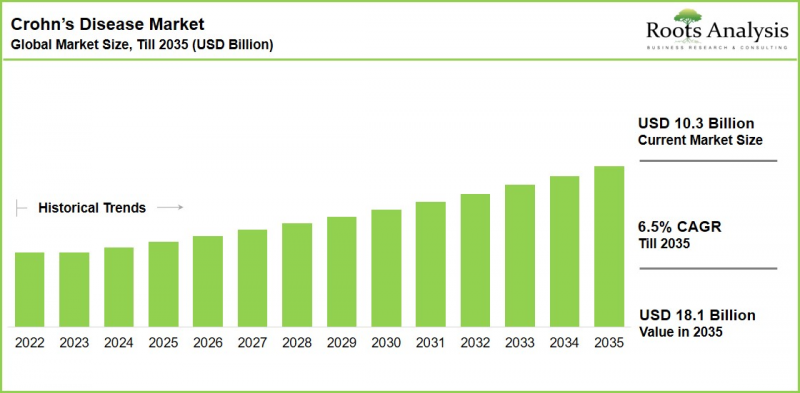
Crohn's Disease Market: Growth and Trends
Crohn's disease is a chronic inflammatory disorder of the gastrointestinal tract. It can affect any segment of the digestive system, though the small intestine and colon are most commonly involved. The disease follows a relapsing and remitting course, and its clinical presentation ranges from mild discomfort to severe, unbearable illness marked by strictures, fistulas, and malnutrition. This variability continues to complicate diagnosis and long-term disease management.
The treatment landscape is shifting toward targeted and individualized therapy. Biologic agents are now a cornerstone of treatment for moderate to severe disease, supported by strong physician confidence, broad reimbursement, and a growing range of approved therapies. Recent approvals of IL-23 inhibitors, including Omvoh and TREMFYA, alongside AbbVie's Rinvoq, the first once-daily oral therapy for the indication, are broadening options for patients who no longer respond to older anti-TNF drugs.
The growing wave of biosimilar launches, including Wezlana, Amjevita, and Avsola, is reshaping the competitive and pricing landscape and improving patient access to biologic therapy. At the same time, developers are exploring cell therapy and novel integrin- and IL-23-targeted pathways for patients with treatment-refractory disease, signaling continued innovation ahead.
For pharmaceutical companies, the growing mix of infused, subcutaneous, and emerging oral therapies is reshaping demand across hospital, retail, and online pharmacy channels, creating new opportunities across the specialty pharmaceutical supply chain.
Growth Drivers: Factors Fueling Market Expansion
The Crohn's disease market is primarily driven by the rising global prevalence of the condition. An estimated 1 million patients were living with Crohn's disease in the US alone in 2023, and the CDC estimates that 2.4 to 3.1 million people in the country are living with inflammatory bowel disease overall. As diagnosis rates improve, demand for effective, long-term therapeutic solutions continues to build across care settings.
Continued advancements in targeted biologic therapies are reinforcing this trajectory. These agents provide better disease control and fewer limitations than older treatment options, encouraging innovation and strengthening physician adoption in moderate to severe patients. The rising use of JAK inhibitors and immunomodulators is further expanding the toolkit available to patients who do not respond adequately to conventional therapy, supporting sustained value growth across the market.
Market Challenges: Critical Barriers Hindering Progress
Despite favorable growth prospects, the market faces several challenges that may impede the market growth during the forecast period. Some of the significant challenges include high treatment costs and disease complexity. Notably, biologic therapies such as infliximab and ustekinumab carry annual treatment costs ranging from USD 45,000 to USD 90,000, limiting affordability for many patients and healthcare systems. Further, highly variable disease presentation also delays timely diagnosis, with one study finding that roughly half of Crohn's disease patients waited more than two years to receive a diagnosis.
Adverse effects and safety concerns associated with immunosuppressive and biologic therapies, including elevated infection risk, add further hesitancy among physicians and patients. Addressing these cost, diagnostic, and safety challenges will be critical for stakeholders seeking to capture the full commercial opportunity within this space.
Recent Developments Signaling Investor Momentum
- Johnson & Johnson announced USFDA approval of Stelara for the treatment of patients aged two years and older with moderately to severely active Crohn's disease.
- Teva Pharmaceuticals secured USD 400 million from Blackstone Life Sciences to advance clinical development of duvakitug for inflammatory bowel diseases, including Crohn's disease.
- Agomab initiated an initial public offering to finance a Phase 2b trial of Ontunisertib, a candidate therapy for Crohn's disease.
- Bio-Thera Solutions, in partnership with Hikma Pharmaceuticals, announced USFDA approval of STARJEMZA, a biosimilar of Stelara, for chronic inflammatory and autoimmune conditions including Crohn's disease.
Collectively, these transactions underscore sustained investor and strategic-acquirer confidence in the Crohn's disease pipeline, with biosimilar competition and novel-mechanism development as themes directly relevant to distributors and investors evaluating exposure to this market.
Currently Approved Drugs for Crohn's Disease
A number of biologics and small molecules are approved for the treatment of Crohn's disease. The most recent approval is Eli Lilly's Omvoh, an IL-23 inhibitor for moderate to severe disease, cleared by the FDA in January 2025. In May 2023, AbbVie's Rinvoq became the first once-daily pill approved for moderate to severe Crohn's disease.
Crohn's Disease Market Segments
The market sizing and opportunity analysis has been segmented across the following parameters:
By Drug Class
- Biologics
- Amino Salicylates
- Antibiotics
- Corticosteroids
- Immunomodulators
- Others
By Route of Administration
- Subcutaneous
- Intravenous
- Oral
By Distribution Channel
- Hospital Pharmacy
- Retail Pharmacy
- Online Pharmacy
By Geographical Regions
- North America
- Europe
- Asia-Pacific
- Middle East and Africa
- Latin America
Crohn's Disease Market: Key Segments
Biologics Lead the Drug Class Segment
Based on Roots Analysis market assessment, the biologics segment captures the majority of overall Crohn's disease market revenue share. This dominance is largely because biologics have become the standard of care for moderate to severe disease, where conventional corticosteroids and immunomodulators are often insufficient for long-term control. AbbVie's expanding portfolio, spanning HUMIRA, and Skyrizi illustrates how continued innovation in targeted mechanisms is reinforcing this segment's dominance. Biologics are also expected to register the highest CAGR through the forecast period, driven by continued IL-23 inhibitor innovation.
Subcutaneous Route Dominates Administration
According to the Roots Analysis market report, the subcutaneous route captures highest share of the overall market by 2035. This largest share is supported by widely used maintenance products such as HUMIRA that allow standardized, fixed-dose, self-administered treatment at home. On the other hand, the oral segment, while smaller today, is projected to grow at a comparatively higher CAGR during the forecast period. This lucrative growth is largely because developers such as AbbVie advance next-generation oral small molecules that reduce dependence on facility-based administration.
Hospital Pharmacies Lead the Distribution Channel Segment
Hospital pharmacies currently hold the largest share of the Crohn's disease distribution channel segment. This high share reflects the professional administration and monitoring required for infused biologics such as Takeda's ENTYVIO. Meanwhile, the online pharmacy segment is expected to grow at a comparatively higher CAGR during the forecast period. This unprecedented growth is largely because home delivery and telehealth-enabled platforms reduce the burden of repeated in-person visits for patients managing unpredictable flare-ups.
North America Dominates the Geographical Segment
Based on the regional analysis, North America is projected to capture the highest share of Crohn's disease market revenue by 2035. This dominance is supported by extensive specialist care networks and favorable reimbursement policies. The region's scale is reinforced by developers such as AbbVie, headquartered in Illinois, alongside the substantial US disease burden tracked by the CDC. Asia-Pacific, meanwhile, is likely to register the fastest regional CAGR through the forecast period, aided by expanding healthcare infrastructure and rising biologic therapy availability.
Example Players in the Crohn's Disease Market
- AbbVie
- Athos Therapeutics
- Eli Lilly and Company
- Janssen Biotech
- Pfizer
- Roche
- Sanofi
- Takeda
Expert Interview and Industry Insights
The opinions and insights presented in this study were shaped by discussions with multiple stakeholders across the value chain. Validating the market's growth trajectory, Professor Jean-Frederic Colombel noted that a study conducted with the Crohn's & Colitis Foundation found that roughly half of Crohn's disease patients waited more than two years to receive a diagnosis, underscoring the scale of the unmet clinical need. The research report features detailed transcripts of interviews held with the following industry participants:
- Founder, Public Hospital, US
- Gastroenterology and Assistant Professor of Medicine, Public University, US
- Gastroenterologist, Mid-Sized Company, Germany
- Clinical Pharmacy Coordinator, Non-Profit Organization, US
- Gastroenterologist and Head of the Clinical Pharmacology, Public University, Portugal
- Gastroenterologist, Public Hospital, Spain
- Gastroenterologist, Public Hospital, Germany
- Gastroenterologist, Public Hospital, US
- Gastroenterologist, Public University, US
- Assistant Professor, Public University, US
CROHN'S DISEASE MARKET: RESEARCH COVERAGE
- Market Sizing and Opportunity Analysis: An in-depth analysis of the global market focusing on key segments, including drug class, route of administration, distribution channel, and geographical regions.
- Market Landscape of Drugs and Therapy Programs: A detailed assessment of Crohn's disease drug candidates by stage of development, type of molecule, type of biologic, drug frequency, route of administration, target pathway, target patient population, and developer size and headquarters.
- Clinical Commercial Attractiveness: An evaluation of Phase III drugs targeting Crohn's disease, scored across key commercial and clinical parameters.
- Company Profiles: In-depth profiles of prominent players engaged in Crohn's disease drug development, covering drug portfolios and key recent initiatives.
- Clinical Trial Analysis: A comprehensive analysis of registered clinical trials by registration year, status, phase, study design, target patient population, sponsor activity, and geography.
- Drug Failure Analysis: An assessment of discontinued Crohn's disease drug candidates by trial phase, reason for discontinuation, and sponsor type.
- Market Impact Analysis: A structured review of the key drivers, restraints, opportunities, and challenges shaping the Crohn's disease market.
- Revenue Shift and Penetration-Growth Analysis: An assessment of movement across geographical regions using a Penetration-Growth (P-G) Matrix to identify emerging opportunity areas.
KEY QUESTIONS ANSWERED IN THIS REPORT
- Which are the leading companies in the Crohn's disease market?
- Which region dominates the market, and which is growing the fastest?
- What are the key trends observed in this market?
- What factors are likely to influence the evolution of this market?
- What are the primary challenges faced by drug developers and distributors in this space?
- What is the current and future market size?
- What is the CAGR of this market through 2035?
- How is current and future market opportunity distributed across key segments?
- What opportunities exist for distributors and channel partners entering this space?
REASONS TO BUY THIS REPORT
This report is designed to give distributors, channel partners, and investors a decisive analytical edge in a fast-evolving market. Its core differentiators include:
- Top-Down and Bottom-Up Triangulated Forecasting: Market estimates are built using a hybrid methodology that cross-validates top-down macro assessments against bottom-up, drug-level demand data, minimizing forecast bias.
- Distribution and Channel-Partner Lens: Unlike conventional drug pipeline reports, this study explicitly maps the hospital, retail, and online pharmacy opportunities available to distribution partners across the Crohn's disease value chain.
- Primary Research-Backed Insights: Findings are validated through direct interviews with gastroenterologists, hospital leaders, and clinical pharmacy coordinators, ensuring insights reflect real clinical practice rather than desk research alone.
- Actionable Segmentation: Four-parameter segmentation (drug class, route of administration, distribution channel, geography) enables precise opportunity sizing for any go-to-market or investment thesis.
- Clinical Trial and Drug Failure Intelligence: Dedicated chapters on clinical trial activity and drug discontinuation trends provide an early read on which pipeline candidates are most likely to reach commercialization.
ADDITIONAL BENEFITS
- Complementary PPT Insights Pack
- Complementary Excel Data Packs for all Analytical Modules in the Report
- 15% Free Content Customization
- Detailed Report Walkthrough Session with Research Team
- Free Updated Report if the Report is 6-12 Months Old or Older
TABLE OF CONTENTS
1. BACKGROUND
- 1.1. Context
- 1.2. Project Objectives
2. RESEARCH METHODOLOGY
- 2.1. Chapter Overview
- 2.2. Research Assumptions
- 2.2.1. Market Landscape and Market Trends
- 2.2.2. Market Forecast and Opportunity Analysis
- 2.2.3. Comparative Analysis
- 2.3. Database Building
- 2.3.1. Data Collection
- 2.3.2. Data Validation
- 2.3.3. Data Analysis
- 2.4. Project Methodology
- 2.4.1. Secondary Research
- 2.4.1.1. Annual Reports
- 2.4.1.2. Academic Research Papers
- 2.4.1.3. Company Websites
- 2.4.1.4. Investor Presentations
- 2.4.1.5. Regulatory Filings
- 2.4.1.6. White Papers
- 2.4.1.7. Industry Publications
- 2.4.1.8. Conferences and Seminars
- 2.4.1.9. Government Portals
- 2.4.1.10. Media and Press Releases
- 2.4.1.11. Newsletters
- 2.4.1.12. Industry Databases
- 2.4.1.13. Roots Proprietary Databases
- 2.4.1.14. Paid Databases and Sources
- 2.4.1.15. Social Media Portals
- 2.4.1.16. Other Secondary Sources
- 2.4.2. Primary Research
- 2.4.2.1. Types of Primary Research
- 2.4.2.1.1. Qualitative Research
- 2.4.2.1.2. Quantitative Research
- 2.4.2.1.3. Hybrid Approach
- 2.4.2.2. Advantages of Primary Research
- 2.4.2.3. Techniques for Primary Research
- 2.4.2.3.1. Interviews
- 2.4.2.3.2. Surveys
- 2.4.2.3.3. Focus Groups
- 2.4.2.3.4. Observational Research
- 2.4.2.3.5. Social Media Interactions
- 2.4.2.4. Key Opinion Leaders Considered in Primary Research
- 2.4.2.4.1. Company Executives (CXOs)
- 2.4.2.4.2. Board of Directors
- 2.4.2.4.3. Company Presidents and Vice Presidents
- 2.4.2.4.4. Research and Development Heads
- 2.4.2.4.5. Technical Experts
- 2.4.2.4.6. Subject Matter Experts
- 2.4.2.4.7. Scientists
- 2.4.2.4.8. Doctors and Other Healthcare Providers
- 2.4.2.5. Ethics and Integrity
- 2.4.2.5.1. Research Ethics
- 2.4.2.5.2. Data Integrity
- 2.4.2.1. Types of Primary Research
- 2.4.3. Analytical Tools and Databases
- 2.4.1. Secondary Research
- 2.5. Robust Quality Control
3. MARKET DYNAMICS
- 3.1. Chapter Overview
- 3.2. Forecast Methodology
- 3.2.1. Top-down Approach
- 3.2.2. Bottom-up Approach
- 3.2.3. Hybrid Approach
- 3.3. Market Assessment Framework
- 3.3.1. Total Addressable Market (TAM)
- 3.3.2. Serviceable Addressable Market (SAM)
- 3.3.3. Serviceable Obtainable Market (SOM)
- 3.3.4. Currently Acquired Market (CAM)
- 3.4. Forecasting Tools and Techniques
- 3.4.1. Qualitative Forecasting
- 3.4.2. Correlation
- 3.4.3. Regression
- 3.4.4. Extrapolation
- 3.4.5. Convergence
- 3.4.6. Sensitivity Analysis
- 3.4.7. Scenario Planning
- 3.4.8. Data Visualization
- 3.4.9. Time Series Analysis
- 3.4.10. Forecast Error Analysis
- 3.5. Key Considerations
- 3.5.1. Demographics
- 3.5.2. Government Regulations
- 3.5.3. Reimbursement Scenarios
- 3.5.4. Market Access
- 3.5.5. Supply Chain
- 3.5.6. Industry Consolidation
- 3.5.7. Pandemic / Unforeseen Disruptions Impact
- 3.6. Limitations
4. MACRO-ECONOMIC INDICATORS
- 4.1. Chapter Overview
- 4.2. Market Dynamics
- 4.2.1. Time Period
- 4.2.1.1. Historical Trends
- 4.2.1.2. Current and Forecasted Estimates
- 4.2.2. Currency Coverage
- 4.2.2.1. Major Currencies Affecting the Market
- 4.2.2.2. Factors Affecting Currency Fluctuations on the Industry
- 4.2.2.3. Impact of Currency Fluctuations on the Industry
- 4.2.3. Foreign Currency Exchange Rate
- 4.2.3.1. Impact of Foreign Exchange Rate Volatility on the Market
- 4.2.3.2. Strategies for Mitigating Foreign Exchange Risk
- 4.2.4. Recession
- 4.2.4.1. Assessment of Current Economic Conditions and Potential Impact on the Market
- 4.2.4.2. Historical Analysis of Past Recessions and Lessons Learnt
- 4.2.5. Inflation
- 4.2.5.1. Measurement and Analysis of Inflationary Pressures in the Economy
- 4.2.5.2. Potential Impact of Inflation on the Market Evolution
- 4.2.6. Interest Rates
- 4.2.6.1. Interest Rates and Their Impact on the Market
- 4.2.6.2. Strategies for Managing Interest Rate Risk
- 4.2.7. Commodity Flow Analysis
- 4.2.7.1. Type of Commodity
- 4.2.7.2. Origins and Destinations
- 4.2.7.3. Values and Weights
- 4.2.7.4. Modes of Transportation
- 4.2.8. Global Trade Dynamics
- 4.2.8.1. Import Scenario
- 4.2.8.2. Export Scenario
- 4.2.8.3. Trade Policies
- 4.2.8.4. Strategies for Mitigating the Risks Associated with Trade Barriers
- 4.2.8.5. Impact of Trade Barriers on the Market
- 4.2.9. War Impact Analysis
- 4.2.9.1. Russian-Ukraine War
- 4.2.9.2. Israel-Hamas War
- 4.2.10. COVID Impact / Related Factors
- 4.2.10.1. Global Economic Impact
- 4.2.10.2. Industry-specific Impact
- 4.2.10.3. Government Response and Stimulus Measures
- 4.2.10.4. Future Outlook and Adaptation Strategies
- 4.2.11. Other Indicators
- 4.2.11.1. Fiscal Policy
- 4.2.11.2. Consumer Spending
- 4.2.11.3. Gross Domestic Product
- 4.2.11.4. Employment
- 4.2.11.5. Taxes
- 4.2.11.6. Stock Market Performance
- 4.2.11.7. Cross Border Dynamics
- 4.2.1. Time Period
- 4.3. Conclusion
5. EXECUTIVE SUMMARY
6. INTRODUCTION
- 6.1. Overview of Crohn's Disease
- 6.2. Factors Contributing to Crohn's Disease
- 6.3. Crohn's Disease Treatment and Management
- 6.4. Future Perspectives
7. MARKET LANDSCAPE OF CROHN'S DISEASE DRUGS / THERAPY PROGRAMS
- 7.1. Methodology and Key Parameters
- 7.2. Crohn's Disease Drugs / Therapy Programs: Market Landscape
- 7.2.1. Analysis by Stage of Development
- 7.2.2. Analysis by Clinical Stage of Development
- 7.2.3. Analysis by Type of Molecule
- 7.2.4. Analysis by Type of Biologic
- 7.2.5. Analysis by Type of Therapy
- 7.2.6. Analysis by Drug Frequency
- 7.2.7. Analysis by Route of Administration
- 7.2.8. Analysis by Target Pathway
- 7.2.9. Analysis by Target Patient Population
- 7.2.10. Analysis by Year of Establishment
- 7.2.11. Analysis by Company Size
- 7.2.12. Analysis by Location of Headquarters
- 7.2.13. Most Active Players: Number of Drugs / Therapy Programs
8. CLINICAL COMMERCIAL ATTRACTIVENESS
- 8.1. Methodology and Key Parameters
- 8.2. Key Parameters and Scoring
- 8.3. Phase III Drugs Targeting Crohn's Disease
9. COMPANY PROFILES
- 9.1. Chapter Overview
- 9.2. AbbVie*
- 9.2.1. Drug Portfolio
- 9.2.2. Key Initiatives
- Similar details are presented for other companies mentioned below (based on information in the public domain)
- 9.3. Athos Therapeutics
- 9.4. Eli Lilly and Company
- 9.5. Janssen Biotech
- 9.6. Pfizer
- 9.7. Roche
- 9.8. Sanofi
- 9.9. Takeda
10. CLINICAL TRIAL ANALYSIS
- 10.1. Methodology and Key Parameters
- 10.2. Crohn's Disease Market: Clinical Trial Analysis
- 10.2.1. Analysis by Trial Registration Year
- 10.2.2. Analysis by Trial Status
- 10.2.3. Analysis by Trial Registration Year and Trial Status
- 10.2.4. Analysis by Trial Registration Year and Patients Enrolled
- 10.2.5. Analysis by Trial Phase
- 10.2.6. Analysis by Trial Registration Year and Trial Phase
- 10.2.7. Analysis of Patients Enrolled by Trial Phase
- 10.2.8. Analysis by Study Design
- 10.2.8.1. Analysis by Design Masking
- 10.2.8.2. Analysis by Intervention Model
- 10.2.8.3. Analysis by Trial Purpose
- 10.2.8.4. Analysis by Allocation
- 10.2.9. Analysis by Target Patient Population
- 10.2.10. Most Active Sponsor / Collaborator: Analysis by Number of Registered Trials
- 10.2.10.1. Analysis by Leading Industry Players
- 10.2.10.2. Analysis by Leading Non-Industry Players
- 10.2.11. Analysis by Geography
- 10.2.11.1. Analysis of Clinical Trials by Trial Status and Geography
- 10.2.11.2. Analysis of Patients Enrolled by Trial Status and Geography
11. DRUG FAILURE ANALYSIS
- 11.1. Methodology and Key Parameters
- 11.2. Crohn's Disease Market: Drug Failure Analysis
- 11.2.1. Analysis by Trial Phase
- 11.2.2. Analysis by Trial Status and Discontinuation
- 11.2.3. Analysis by Reason for Drug Discontinuation
- 11.2.4. Analysis by Study Start Year and Year of Termination
- 11.2.5. Analysis by Type of Sponsor / Collaborator
12. MARKET IMPACT ANALYSIS
- 12.1. Market Drivers
- 12.2. Market Restraints
- 12.3. Market Opportunities
- 12.4. Market Challenges
13. GLOBAL CROHN'S DISEASE MARKET
- 13.1. Key Assumptions and Methodology
- 13.2. Global Crohn's Disease Market, Historical Trends (Since 2023) and Forecasted Estimates (Till 2035)
- 13.2.1. Multivariate Scenario Analysis
- 13.2.1.1. Conservative Scenario
- 13.2.1.2. Optimistic Scenario
- 13.2.1. Multivariate Scenario Analysis
- 13.3. Key Market Segments
14. CROHN'S DISEASE MARKET, BY DRUG CLASS
- 14.1. Key Assumptions and Methodology
- 14.2. Crohn's Disease Market: Distribution by Drug Class
- 14.2.1. Crohn's Disease Market for Biologics, Historical Trends (Since 2023) and Forecasted Estimates (Till 2035)
- 14.2.2. Crohn's Disease Market for Amino salicylates, Historical Trends (Since 2023) and Forecasted Estimates (Till 2035)
- 14.2.3. Crohn's Disease Market for Antibiotics, Historical Trends (Since 2023) and Forecasted Estimates (Till 2035)
- 14.2.4. Crohn's Disease Market for Corticosteroids, Historical Trends (Since 2023) and Forecasted Estimates (Till 2035)
- 14.2.5. Crohn's Disease Market for Immunomodulators, Historical Trends (Since 2023) and Forecasted Estimates (Till 2035)
- 14.2.6. Crohn's Disease Market for Others, Historical Trends (Since 2023) and Forecasted Estimates (Till 2035)
- 14.3. Data Triangulation and Validation
15. CROHN'S DISEASE MARKET, BY ROUTE OF ADMINISTRATION
- 15.1. Key Assumptions and Methodology
- 15.2. Crohn's Disease Treatment Market: Distribution by Route of Administration
- 15.2.1. Crohn's Disease Market for Subcutaneous Route, Historical Trends (Since 2023) and Forecasted Estimates (Till 2035)
- 15.2.2. Crohn's Disease Market for Intravenous Route, Historical Trends (Since 2023) and Forecasted Estimates (Till 2035)
- 15.2.3. Crohn's Disease Market for Oral Route, Historical Trends (Since 2023) and Forecasted Estimates (Till 2035)
- 15.3. Data Triangulation and Validation
16. CROHN'S DISEASE MARKET, BY DISTRIBUTION CHANNEL
- 16.1. Key Assumptions and Methodology
- 16.2. Crohn's Disease Market: Distribution by Distribution Channel
- 16.2.1. Crohn's Disease Market for Hospital Pharmacies, Historical Trends (Since 2023) and Forecasted Estimates (Till 2035)
- 16.2.2. Crohn's Disease Market for Retail Pharmacies, Historical Trends (Since 2023) and Forecasted Estimates (Till 2035)
- 16.2.3. Crohn's Disease Market for Online Pharmacies, Historical Trends (Since 2023) and Forecasted Estimates (Till 2035)
- 16.3. Data Triangulation and Validation
17. CROHN'S DISEASE MARKET, BY GEOGRAPHICAL REGIONS
- 17.1. Key Assumptions and Methodology
- 17.2. Crohn's Disease Market: Distribution by Geographical Regions
- 17.2.1. Crohn's Disease Market in North America: Historical Trends (Since 2023) and Forecasted Estimates (Till 2035)
- 17.2.1.1. Crohn's Disease Market in the US: Historical Trends (Since 2023) and Forecasted Estimates (Till 2035)
- 17.2.1.2. Crohn's Disease Market in Canada: Historical Trends (Since 2023) and Forecasted Estimates (Till 2035)
- 17.2.2. Crohn's Disease Market in Europe: Historical Trends (Since 2023) and Forecasted Estimates (Till 2035)
- 17.2.2.1. Crohn's Disease Market in Germany: Historical Trends (Since 2023) and Forecasted Estimates (Till 2035)
- 17.2.2.2. Crohn's Disease Market in the UK: Historical Trends (Since 2023) and Forecasted Estimates (Till 2035)
- 17.2.2.3. Crohn's Disease Market in France: Historical Trends (Since 2023) and Forecasted Estimates (Till 2035)
- 17.2.2.4. Crohn's Disease Market in Spain: Historical Trends (Since 2023) and Forecasted Estimates (Till 2035)
- 17.2.2.5. Crohn's Disease Market in Italy: Historical Trends (Since 2023) and Forecasted Estimates (Till 2035)
- 17.2.2.6. Crohn's Disease Market in Rest of Europe: Historical Trends (Since 2023) and Forecasted Estimates (Till 2035)
- 17.2.3. Crohn's Disease Market in Asia-Pacific: Historical Trends (Since 2023) and Forecasted Estimates (Till 2035)
- 17.2.3.1. Crohn's Disease Market in China: Historical Trends (Since 2023) and Forecasted Estimates (Till 2035)
- 17.2.3.2. Crohn's Disease Market in Japan: Historical Trends (Since 2023) and Forecasted Estimates (Till 2035)
- 17.2.3.3. Crohn's Disease Market in Australia: Historical Trends (Since 2023) and Forecasted Estimates (Till 2035)
- 17.2.3.4. Crohn's Disease Market in India: Historical Trends (Since 2023) and Forecasted Estimates (Till 2035)
- 17.2.3.5. Crohn's Disease Market in South Korea: Historical Trends (Since 2023) and Forecasted Estimates (Till 2035)
- 17.2.3.6. Crohn's Disease Market in Rest of Asia-Pacific: Historical Trends (Since 2023) and Forecasted Estimates (Till 2035)
- 17.2.4. Crohn's Disease Market in Middle East and Africa: Historical Trends (Since 2023) and Forecasted Estimates (Till 2035)
- 17.2.4.1. Crohn's Disease Market in Israel: Historical Trends (Since 2023) and Forecasted Estimates (Till 2035)
- 17.2.4.2. Crohn's Disease Market in Saudi Arabia: Historical Trends (Since 2023) and Forecasted Estimates (Till 2035)
- 17.2.4.3. Crohn's Disease Market in United Arab Emirates: Historical Trends (Since 2023) and Forecasted Estimates (Till 2035)
- 17.2.4.4. Crohn's Disease Market in Egypt: Historical Trends (Since 2023) and Forecasted Estimates (Till 2035)
- 17.2.5. Crohn's Disease Market in Latin America: Historical Trends (Since 2023) and Forecasted Estimates (Till 2035)
- 17.2.5.1. Crohn's Disease Market in Brazil: Historical Trends (Since 2023) and Forecasted Estimates (Till 2035)
- 17.2.5.2. Crohn's Disease Market in Mexico: Historical Trends (Since 2023) and Forecasted Estimates (Till 2035)
- 17.2.5.3. Crohn's Disease Market in Argentina: Historical Trends (Since 2023) and Forecasted Estimates (Till 2035)
- 17.2.1. Crohn's Disease Market in North America: Historical Trends (Since 2023) and Forecasted Estimates (Till 2035)
- 17.3. Revenue Shift Analysis: Geographical Regions
- 17.4. Penetration-Growth (P-G) Matrix: Geographical Regions
- 17.5. Data Triangulation and Validation
18. CONCLUSION
19. INSIGHTS FROM PRIMARY RESEARCH
20. APPENDIX I: TABULATED DATA
21. APPENDIX II: LIST OF COMPANIES AND ORGANIZATION

