PUBLISHER: Roots Analysis | PRODUCT CODE: 2161885

PUBLISHER: Roots Analysis | PRODUCT CODE: 2161885
Biologics API Market - Trends and Forecast Till 2035
BIOLOGICS API MARKET: OVERVIEW
According to Roots Analysis, the global biologics API market is estimated to grow from USD 78.4 billion in the current year to USD 153.8 billion by 2035, registering a CAGR of 8% during the forecast period.
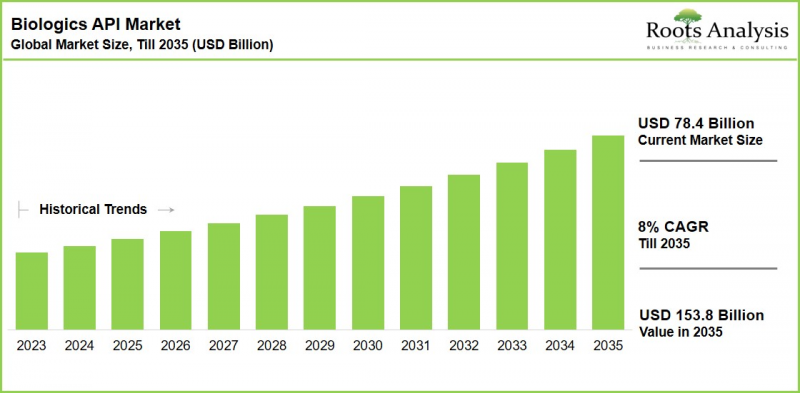
Biologics API Market: Growth and Trends
Biologics APIs form the foundation of modern biological medicines, serving as the active components in therapies such as proteins, peptides, nucleic acids and other complex molecules produced using recombinant DNA technology, cell culture and microbial fermentation. Unlike conventional small-molecule APIs, biologics APIs require highly controlled manufacturing processes, as even minor variations in cell lines, culture conditions or purification methods can influence product quality and performance.
This complexity has increased the need for advanced upstream and downstream processing capabilities, robust quality systems and scalable manufacturing infrastructure. As a result, pharmaceutical companies are strengthening internal production capacities to ensure supply security and maintain greater process control. At the same time, these requirements are creating significant opportunities for specialized biologics API manufacturers and contract development and manufacturing organizations (CDMOs) that offer technical expertise and flexible production capabilities.
The rising adoption of biologics across oncology, autoimmune disorders, diabetes, rare diseases and other chronic conditions is further driving demand for biologics API manufacturing. Moreover, the emergence of advanced modalities, including cell and gene therapies, bispecific antibodies and mRNA therapeutics, is increasing the need for specialized manufacturing platforms that can support both clinical and commercial production.
The market is also witnessing a gradual shift toward hybrid manufacturing models. While large pharmaceutical companies continue to invest in in-house facilities to secure long-term manufacturing capacity, emerging biotechnology firms increasingly rely on outsourcing partners to accelerate development timelines, access specialized technologies and reduce capital investment. This evolving balance between internal manufacturing and strategic outsourcing is expected to remain a key factor shaping the future of the biologics API market.
Key Growth Drivers: Factors Expanding Market
- Increasing Demand for Biologic Medicines: The growing prevalence of cancer, autoimmune disorders, diabetes, rare diseases and other chronic conditions is increasing demand for biologic therapies. The expanding biologics pipeline is consequently creating sustained requirements for API manufacturing capacity.
- Expansion of Biologics Approvals and Clinical Pipelines: The increasing number of biologics progressing through clinical development and receiving regulatory approval is expanding the addressable API manufacturing opportunity. The market includes established modalities as well as emerging therapies such as bispecific antibodies, ADCs, cell therapies, gene therapies and mRNA therapeutics.
- Growing Adoption of Personalized and Targeted Therapies: The shift toward more targeted and personalized treatment approaches is supporting the development of complex biologic medicines. These therapies often require specialized manufacturing technologies, creating demand for experienced API manufacturers with advanced process capabilities.
- Investment in Advanced Manufacturing Infrastructure: Pharmaceutical companies and manufacturing organizations continue to invest in new and expanded biologics facilities. These investments are increasing production capacity while supporting the adoption of advanced bioreactors, automation, process analytical technologies and digital manufacturing systems.
Market Restraints and Challenges: Factors Impeding Market Growth
- Complexity of Biologic Manufacturing: Biologics are significantly more sensitive to manufacturing conditions than conventional small-molecule APIs. Changes in cell lines, raw materials, process parameters or purification steps can affect product characteristics and quality, increasing process-development and validation requirements.
- High Manufacturing Costs: Biologics API production requires specialized facilities, advanced equipment, highly skilled personnel and extensive quality-control infrastructure. These requirements can increase capital and operational expenditure, particularly for emerging manufacturers.
- Stringent Regulatory Requirements: Biologics manufacturers must comply with rigorous regulatory requirements covering process validation, quality control, contamination control, characterization, stability and manufacturing consistency. Meeting these requirements can increase development timelines and manufacturing costs.
Biologics API Market Segmentation
The biologics API market is segmented across various segments mentioned below:
By Type of Modality
- Monoclonal antibodies
- Protein-peptide therapeutics
- Biosimilars
- Vaccines
- Bispecific antibodies
- Gene therapy APIs
- Cell therapy APIs
- Antibody-drug conjugate APIs
- mRNA therapeutics APIs
- Other biologic modalities
By Type of Expression System
- Mammalian expression systems
- CHO
- Vero
- HEK
- Others
- Microbial expression systems
- E. coli
- Yeast
- Others
- Other expression systems
By Type of Bioreactor
- Single-Use Bioreactors
- Stainless-Steel Bioreactors
By Scale of Operation
- Preclinical / Clinical Scale
- Commercial Scale
By Type of Manufacturer
- In-House Manufacturers
- Contract Manufacturers
- Hybrid Manufacturers
By Geographical Regions
- North America
- Europe
- Asia-Pacific
- Middle East and North Africa
- Latin America
Biologics API Market: Key Segment Insights
Monoclonal Antibodies Dominate the Market
Monoclonal antibodies represent a major component of the biologics API market due to their extensive use across oncology, autoimmune disorders, infectious diseases and other therapeutic areas. The established commercial base of antibody-based medicines, combined with continued development of next-generation antibodies and biosimilars, is sustaining demand for antibody API manufacturing capacity.
Beyond monoclonal antibodies, the expanding pipeline of bispecific antibodies, ADCs, cell therapies, gene therapies and mRNA-based medicines is broadening the demand profile for biologics API manufacturing. Each modality introduces distinct requirements related to expression systems, process development, purification, quality control and manufacturing scale.
Mammalian Systems Lead Biologics API Production
Mammalian expression systems represent the dominant expression platform in the biologics API market. Their ability to produce complex proteins with appropriate folding and post-translational modifications makes them particularly suitable for manufacturing monoclonal antibodies and other sophisticated biologics.
Microbial expression systems remain important for selected proteins, peptides and other relatively less complex biologic molecules. Meanwhile, alternative expression technologies involving plant, insect and other systems are gaining attention as manufacturers explore approaches that can improve production efficiency, scalability and cost competitiveness.
Single-Use Systems Create New Manufacturing Opportunities
Stainless-steel bioreactors currently account for a substantial portion of biologics API manufacturing capacity due to their established use in large-scale commercial production.
However, single-use bioreactors are gaining adoption because they can provide manufacturing flexibility, reduce cleaning and sterilization requirements and support multiproduct production. Their use is particularly relevant for clinical-scale manufacturing, emerging biologic modalities and facilities seeking faster production changeovers.
The continued development of larger single-use systems, improved process monitoring and advanced bioprocess controls is expected to support their adoption across a broader range of biologics API applications.
Commercial Manufacturing Drives Capacity Expansion
Commercial-scale production represents a major component of the biologics API market as increasing numbers of biologic medicines transition from clinical development to commercial manufacturing. At the same time, preclinical and clinical-scale production remains strategically important for biotechnology companies developing new modalities.
Flexible manufacturing platforms allow developers to produce clinical material while refining processes before commercial-scale technology transfer and manufacturing. The growing number of biologic candidates entering clinical development is therefore creating opportunities across both development-scale and commercial API manufacturing.
In-House Manufacturing Dominate the Market
In-house manufacturers currently account for a substantial portion of biologics API production. Large pharmaceutical companies continue to invest in dedicated manufacturing facilities to strengthen supply security, maintain process control and support long-term production requirements.
At the same time, contract and hybrid manufacturing models are expanding. Biotechnology companies, emerging drug developers and companies entering new biologic modalities can use external manufacturing partners to access specialized infrastructure without making equivalent levels of capital investment in internal facilities. The hybrid manufacturer model is expected to gain importance as companies balance internal strategic capabilities with outsourced manufacturing requirements.
North America Dominates the Market
North America represents a leading regional market for biologics APIs, supported by the presence of major pharmaceutical and biotechnology companies, advanced healthcare infrastructure, extensive R&D capabilities and continued investment in biopharmaceutical manufacturing.
The region benefits from a strong commercial biologics base and a large pipeline of innovative therapies. Investments in domestic API manufacturing capacity are also supporting the development of advanced manufacturing infrastructure.
Asia-Pacific: Emerging Hub for Biologics API Manufacturing
Asia-Pacific is expected to experience strong growth as pharmaceutical manufacturers expand biologics production capacity across countries including China, India and South Korea. The region benefits from expanding biopharmaceutical infrastructure, skilled workforce availability and competitive manufacturing economics. Increasing investment in biosimilars, biologics and advanced therapies is also strengthening the regional API manufacturing ecosystem. For international pharmaceutical companies, Asia-Pacific is becoming increasingly relevant as a source of manufacturing capacity and as a strategic market for biologics development and commercialization.
Example Players in Biologics API Market
- AbbVie
- Amgen
- Bristol Myers Squibb
- Eli Lilly
- Novartis
- Pfizer
- Roche
- Sanofi
BIOLOGICS API MARKET: REPORT COVERAGE
- Market Sizing and Opportunity Analysis: An in-depth analysis of the biologics API market, including market size and forecast across key segments such as type of modality, expression system, bioreactor type, scale of operation, manufacturer type, and geographical regions. The analysis also evaluates emerging opportunities across monoclonal antibodies, biosimilars, vaccines, bispecific antibodies, antibody-drug conjugates, gene therapies, cell therapies, mRNA therapeutics, and protein-peptide therapeutics.
- Market Landscape: A comprehensive assessment of companies involved in biologics API manufacturing, including in-house manufacturers, contract manufacturers, and hybrid manufacturing organizations. The analysis covers parameters such as year of establishment, company size, headquarters location, manufacturing capabilities, biologic modalities supported, production scale, expression systems, and geographical footprint.
- Company Profiles: Detailed profiles of prominent biologics API manufacturers, covering year of establishment, headquarters, company size, manufacturing capabilities, product and service portfolio, biologic modalities supported, production infrastructure, and recent strategic initiatives. The profiles also highlight capacity expansions and investments in biologics manufacturing capabilities.
- Regulatory Landscape Analysis: An overview of the regulatory requirements governing biologics API development and manufacturing, including manufacturing controls, process validation, quality standards, contamination control, analytical characterization, technology transfer, and regulatory expectations for biologic drug substances across major markets.
- Partnerships and Collaborations: An analysis of partnerships and collaborations established across the biologics API ecosystem, segmented by year of partnership, type of collaboration, biologic modality, manufacturing activity, and participating companies. The analysis identifies strategic relationships focused on process development, technology transfer, clinical manufacturing, commercial production, and capacity expansion.
- Investment and Funding Analysis: An assessment of funding rounds, acquisitions, strategic investments, manufacturing facility investments, capacity expansions, and new biologics production facilities shaping the market. The analysis highlights major investments aimed at increasing manufacturing capacity and strengthening capabilities across emerging biologic modalities.
- Market Impact Analysis: A detailed assessment of the factors influencing the biologics API market, including market drivers, restraints, emerging opportunities, and challenges related to biologics adoption, manufacturing complexity, high production costs, regulatory requirements, supply-chain resilience, outsourcing trends, technological advancements, and the emergence of advanced biologic modalities.
FREQUENTLY ASKED QUESTIONS
- What is a biologics API?
- What is the current size of the biologics API market?
- What will be the size of the biologics API market by 2035?
- What is the expected CAGR of the biologics API market?
- Which expression system dominates biologics API manufacturing?
- Which region currently leads the biologics API market?
- Which region is expected to experience significant growth?
- What are the major opportunities in the biologics API market?
- Who should purchase the biologics API market report?
REASONS TO BUY THIS REPORT?
This report provides stakeholders with a structured assessment of the biologics API market to support business planning, investment analysis and market-entry strategies. The study can help:
- Top-Down and Bottom-Up Triangulated Forecasting: Market estimates are developed using a hybrid approach that combines macro-level market assessment with bottom-up analysis of biologic modalities, manufacturing activity, company capabilities, and production trends to improve forecast reliability.
- Comprehensive Market and Competitive Coverage: The study covers market sizing, segmentation, manufacturer benchmarking, biologics API manufacturing capabilities, regulatory landscape, partnerships and collaborations, investments, capacity expansions, and competitive developments across key geographic markets.
- Strategic Partnership and Investment Intelligence: Analysis of partnerships, collaborations, acquisitions, funding, strategic investments, and manufacturing facility expansions helps stakeholders identify emerging business relationships and areas attracting capital.
- Emerging Modality Opportunity Analysis: Dedicated assessment of ADCs, bispecific antibodies, cell therapies, gene therapies, mRNA therapeutics, biosimilars, vaccines, monoclonal antibodies, and protein-peptide therapeutics helps stakeholders identify manufacturing opportunities emerging from the evolution of biologic drug pipelines.
ADDITIONAL BENEFITS
- Complementary Excel Data Packs for all Analytical Modules in the Report
- 15% Free Content Customization
- Detailed Report Walkthrough Session with Research Team
- Free Updated Report if the Report is 6-12 Months Old or Older
TABLE OF CONTENTS
1. BACKGROUND
- 1.1. Context
- 1.2. Project Objectives
2. RESEARCH METHODOLOGY
- 2.1. Research Assumptions
- 2.1.1. Market Landscape and Market Trends
- 2.1.2. Market Forecast and Opportunity Analysis
- 2.1.3. Comparative Analysis
- 2.2. Database Building
- 2.2.1. Data Collection
- 2.2.2. Data Validation
- 2.2.3. Data Analysis
- 2.3. Project Methodology
- 2.3.1. Project Commencement
- 2.3.2. Secondary Research
- 2.3.2.1. Annual Reports
- 2.3.2.2. Academic Research Papers
- 2.3.2.3. Company Websites
- 2.3.2.4. Investor Presentations and Regulatory Filings
- 2.3.2.5. White Papers
- 2.3.2.6. Industry Publications
- 2.3.2.7. Conferences and Seminars
- 2.3.2.8. Government Portals
- 2.3.2.9. Media and Press Releases
- 2.3.2.10. Newsletters
- 2.3.2.11. Industry and Paid Databases
- 2.3.2.12. Roots Proprietary Databases
- 2.3.3. Primary Research
- 2.3.4. Data Analysis and Interpretation
- 2.3.5. Market Forecast and Validation
- 2.3.6. Report Compilation
- 2.4. Research Ethics and Integrity
- 2.5. Analytical Tools and Databases
- 2.7. Robust Quality Control Framework
3. MARKET DYNAMICS
- 3.1. Forecast Methodology
- 3.1.1. Top-Down Approach
- 3.1.2. Bottom-Up Approach
- 3.1.3. Hybrid Approach
- 3.2. Market Assessment Framework
- 3.2.1. Total Addressable Market (TAM)
- 3.2.2. Serviceable Addressable Market (SAM)
- 3.2.3. Serviceable Obtainable Market (SOM)
- 3.2.4. Currently Acquired Market (CAM)
- 3.3. Forecasting Tools and Techniques
- 3.3.1. Qualitative Forecasting
- 3.3.2. Correlation
- 3.3.3. Regression
- 3.3.4. Extrapolation
- 3.3.5. Convergence
- 3.3.6. Sensitivity Analysis
- 3.3.7. Scenario Planning
- 3.3.8. Data Visualization
- 3.3.9. Time Series Analysis
- 3.3.10. Forecast Error Analysis
- 3.4. Key Considerations
- 3.4.1. Demographics
- 3.4.2. Economic Factors
- 3.4.3. Competitive Landscape
- 3.4.4. Government Regulations and Policies
- 3.4.5. R&D Investment
- 3.4.6. Technological Factors
- 3.4.7. Industry Consolidation
- 3.4.8. Supply Chain
- 3.4.9. Market Access
- 3.4.10. Pandemics / Unforeseen Disruptions Impact
4. MACRO-ECONOMIC INDICATORS
- 4.1. Market Dynamics
- 4.1.1. Time Period
- 4.1.1.1. Historical Trends
- 4.1.1.2. Current and Forecasted Estimates
- 4.1.2. Currency Coverage
- 4.1.2.1. Overview of Major Currencies Affecting the Market
- 4.1.2.2. Impact of Currency Fluctuations on the Industry
- 4.1.3. Foreign Exchange Impact
- 4.1.3.1. Evaluation of Foreign Exchange Rates and Their Impact on Market
- 4.1.3.2. Strategies for Mitigating Foreign Exchange Risk
- 4.1.4. Recession
- 4.1.4.1. Historical Analysis of Past Recessions and Lessons Learnt
- 4.1.4.2. Assessment of Current Economic Conditions and Potential Impact on the Market
- 4.1.5. Inflation
- 4.1.5.1. Measurement and Analysis of Inflationary Pressures in the Economy
- 4.1.5.2. Potential Impact of Inflation on the Market Evolution
- 4.1.6. Other Indicators
- 4.1.6.1. War Impact Analysis
- 4.1.6.2. Cross-border Dynamics
- 4.1.6.3. Consumer Spendings and Gross Domestic Product
- 4.1.6.4. Stock Market Performance
- 4.1.1. Time Period
5. EXECUTIVE SUMMARY
6. MARKET LANDSCAPE
- 6.1. Chapter Overview
- 6.2. Peptide API Contract Manufacturing: Overall Market Landscape
- 6.3. Analysis by Year of Establishment
- 6.4. Analysis by Company Size
- 6.5. Analysis by Location of Headquarters
- 6.6. Analysis by Type of Biologic Manufactured
- 6.7. Analysis by Type of API Manufactured
- 6.8. Analysis by Scale of Operation
- 6.9. Analysis by Type of Service Offered
- 6.10. Analysis by Geographical Presence
7. COMPANY COMPETITIVENESS ANALYSIS
- 7.1. Chapter Overview
- 7.2. Key Parameters
- 7.3. Methodology
- 7.4. Company Competitiveness Analysis
- 7.5. Biologics API Contract Manufacturers Headquartered in North America
- 7.6. Biologics API Contract Manufacturers Headquartered in Europe
- 7.7. Biologics API Contract Manufacturers Headquartered in Asia-Pacific and Rest of the World
8. COMPANY PROFILES: BIOLOGICS API CONTRACT MANUFACTURERS
- 8.1. Chapter Overview
- 8.2. Biologics API Manufacturers: List of Companies
9. GLOBAL BIOLOGICS API MARKET (BY VALUE)
- 9.1. Key Assumptions and Methodology
- 9.2. Biologics API Market: Distribution by Type of Biologic
- 9.3. Biologics API Market: Distribution by Expression System
- 9.4. Biologics API Market: Distribution by Bioreactor
- 9.5. Biologics API Market: Distribution by Scale of Operation
- 9.6. Biologics API Market: Distribution by Manufacturer
- 9.7. Biologics API Market: Distribution by Geographical Regions
10. ADC API MARKET (BY VALUE)
- 10.1. Key Assumptions and Methodology
- 10.2. ADC API Market, Till 2035
- 10.3. ADC API Market: Distribution by Expression System
- 10.4. ADC API Market: Distribution by Bioreactor
- 10.5. ADC API Market: Distribution by Scale of Operation
- 10.6. ADC API Market: Distribution by Manufacturer
- 10.7. ADC API Market: Distribution by Geographical Regions
11. GENE THERAPY API MARKET (BY VALUE)
- 11.1. Key Assumptions and Methodology
- 11.2. Gene Therapy API Market, Till 2035
- 11.3. Gene Therapy API Market: Distribution by Expression System
- 11.4. Gene Therapy API Market: Distribution by Bioreactor
- 11.5. Gene Therapy API Market: Distribution by Scale of Operation
- 11.6. Gene Therapy API Market: Distribution by Manufacturer
- 11.7. Gene Therapy API Market: Distribution by Geographical Regions
12. MONOCLONAL ANTIBODY API MARKET (BY VALUE)
- 12.1. Key Assumptions and Methodology
- 12.2. Monoclonal Antibody API Market, Till 2035
- 12.3. Monoclonal Antibody API Market: Distribution by Expression System
- 12.4. Monoclonal Antibody API Market: Distribution by Bioreactor
- 12.5. Monoclonal Antibody API Market: Distribution by Scale of Operation
- 12.6. Monoclonal Antibody API Market: Distribution by Manufacturer
- 12.7. Monoclonal Antibody API Market: Distribution by Geographical Regions
13. BIOSIMILAR API MARKET (BY VALUE)
- 13.1. Key Assumptions and Methodology
- 13.2. Biosimilar API Market, Till 2035
- 13.3. Biosimilar API Market: Distribution by Expression System
- 13.4. Biosimilar API Market: Distribution by Bioreactor
- 13.5. Biosimilar API Market: Distribution by Scale of Operation
- 13.6. Biosimilar API Market: Distribution by Manufacturer
- 13.7. Biosimilar API Market: Distribution by Modality
- 13.8. Biosimilar API Market: Distribution by Geographical Regions
14. VACCINE API MARKET (BY VALUE)
- 14.1. Key Assumptions and Methodology
- 14.2. Vaccine API Market, Till 2035
- 14.3. Vaccine API Market: Distribution by Expression System
- 14.4. Vaccine API Market: Distribution by Bioreactor
- 14.5. Vaccine API Market: Distribution by Scale of Operation
- 14.6. Vaccine API Market: Distribution by Manufacturer
- 14.7. Vaccine API Market: Distribution by Geographical Regions
15. BISPECIFIC ANTIBODY API MARKET (BY VALUE)
- 15.1. Key Assumptions and Methodology
- 15.2. Bispecific Antibody API Market, Till 2035
- 15.3. Bispecific Antibody API Market: Distribution by Expression System
- 15.4. Bispecific Antibody API Market: Distribution by Bioreactor
- 15.5. Bispecific Antibody API Market: Distribution by Scale of Operation
- 15.6. Bispecific Antibody API Market: Distribution by Manufacturer
- 15.7. Bispecific Antibody API Market: Distribution by Geographical Regions
16. mRNA THERAPEUTICS API MARKET (BY VALUE)
- 16.1. Key Assumptions and Methodology
- 16.2. mRNA Therapeutics API Market, Till 2035
- 16.3. mRNA Therapeutics API Market: Distribution by Bioreactor
- 16.4. mRNA Therapeutics API Market: Distribution by Scale of Operation
- 16.5. mRNA Therapeutics API Market: Distribution by Manufacturer
- 16.6. mRNA Therapeutics API Market: Distribution by Geographical Regions
17. PROTEIN / PEPTIDE THERAPEUTICS API MARKET (BY VALUE)
- 17.1. Key Assumptions and Methodology
- 17.2. Protein / Peptide Therapeutics API Market, Till 2035
- 17.3. Protein / Peptide Therapeutics API Market: Distribution by Expression System
- 17.4. Protein / Peptide Therapeutics API Market: Distribution by Bioreactor
- 17.5. Protein / Peptide Therapeutics API Market: Distribution by Scale of Operation
- 17.6. Protein / Peptide Therapeutics API Market: Distribution by Manufacturer
- 17.7. Protein / Peptide Therapeutics API Market: Distribution by Geographical Region
18. CELL THERAPY API MARKET (BY VALUE)
- 18.1. Key Assumptions and Methodology
- 18.2. Cell Therapy API Market, Till 2035
- 18.3. Cell Therapy API Market: Distribution by Expression System
- 18.4. Cell Therapy API Market: Distribution by Bioreactor
- 18.5. Cell Therapy API Market: Distribution by Scale of Operation
- 18.6. Cell Therapy API Market: Distribution by Manufacturer
- 18.7. Cell Therapy API Market: Distribution by Type of Cell Therapy
- 18.8. Cell Therapy API Market: Distribution by Geographical Regions
19. GLOBAL BIOLOGICS API MARKET (BY VOLUME)
- 19.1. Key Assumptions and Methodology
- 19.2. Biologics API Market: Distribution by Type of Biologic
- 19.3. Biologics API Market for Monoclonal Antibodies
- 19.4. Biologics API Market for Protein / Peptide Therapeutics
- 19.5. Biologics API Market for Biosimilars
- 19.6. Biologics API Market for ADCs
- 19.7. Biologics API Market for Bispecific Antibodies
- 19.8. Biologics API Market for mRNA Therapeutics
- 19.9. Biologics API Market for Cell Therapies
- 19.10.Biologics API Market for Gene Therapies
20. GENE THERAPY API MARKET (BY VOLUME)
- 20.1. Key Assumptions and Methodology
- 20.2. Gene Therapy API Market, Forecasted Estimates (till 2035)
- 20.3. Gene Therapy API Market: Distribution by Expression System
- 20.4. Gene Therapy API Market: Distribution by Bioreactor
- 20.5. Gene Therapy API Market: Distribution by Scale of Operation
- 20.6. Gene Therapy API Market: Distribution by Manufacturer
- 20.7. Gene Therapy API Market: Distribution by Geographical Regions
21. CELL THERAPY API MARKET (BY VOLUME)
- 21.1. Key Assumptions and Methodology
- 21.2. Cell Therapy API Market, Forecasted Estimates (till 2035)
- 21.3. Cell Therapy API Market: Distribution by Expression System
- 21.4. Cell Therapy API Market: Distribution by Bioreactor
- 21.5. Cell Therapy API Market: Distribution by Scale of Operation
- 21.6. Cell Therapy API Market: Distribution by Manufacturer
- 21.7. Cell Therapy API Market: Distribution by Geographical Regions
22. DATA TRIANGULATION AND VALIDATION (BY VALUE AND VOLUME)
23. CONCLUDING REMARKS
List of Figures
- Figure 2.1 Research Methodology: Project Methodology
- Figure 2.2 Research Methodology: Data Sources for Secondary Research
- Figure 2.3 Research Methodology: Robust Quality Control
- Figure 3.1 Market Dynamics: Forecast Methodology
- Figure 3.2 Market Dynamics: Market Assessment Framework
- Figure 3.3 Market Dynamics: Example List of Parameters
- Figure 4.1 Historical Analysis of Past Recessions and Lessons Learnt
- Figure 5.2 Executive Summary: Market Forecast and Opportunity Analysis
- Figure 6.1 Biologics API Market: Distribution by Type of Modality
- Figure 6.2 Biologics API Market: Distribution by Expression System
- Figure 6.3 Biologics API Market: Distribution by Bioreactor
- Figure 6.4 Biologics API Market: Distribution by Scale of Operation
- Figure 6.5 Biologics API Market: Distribution by Manufacturer
- Figure 6.6 Biologics API Market: Distribution by Geographical Regions
- Figure 7.1 ADC API Market, Forecasted Estimates (till 2035) (USD Billion)
- Figure 7.2 ADC API Market: Distribution by Expression System
- Figure 7.3 ADC API Market: Distribution by Bioreactor
- Figure 7.4 ADC API Market: Distribution by Scale of Operation
- Figure 7.5 ADC API Market: Distribution by Manufacturer
- Figure 7.6 ADC API Market: Distribution by Geographical Regions
- Figure 8.1 Gene Therapy API Market, Forecasted Estimates (till 2035) (USD Billion)
- Figure 8.2 Gene Therapy API Market: Distribution by Expression System
- Figure 8.3 Gene Therapy API Market: Distribution by Bioreactor
- Figure 8.4 Gene Therapy API Market: Distribution by Scale of Operation
- Figure 8.5 Gene Therapy API Market: Distribution by Manufacturer
- Figure 8.6 Gene Therapy API Market: Distribution by Geographical Regions
- Figure 9.1 Monoclonal Antibody API Market, Forecasted Estimates (till 2035) (USD Billion)
- Figure 9.2 Monoclonal Antibody API Market: Distribution by Expression System
- Figure 9.3 Monoclonal Antibody API Market: Distribution by Bioreactor
- Figure 9.4 Monoclonal Antibody API Market: Distribution by Scale of Operation
- Figure 9.5 Monoclonal Antibody API Market: Distribution by Manufacturer
- Figure 9.6 Monoclonal Antibody API Market: Distribution by Geographical Regions
- Figure 10.1 Biosimilar API Market, Forecasted Estimates (till 2035) (USD Billion)
- Figure 10.2 Biosimilar API Market: Distribution by Expression System
- Figure 10.3 Biosimilar API Market: Distribution by Bioreactor
- Figure 10.4 Biosimilar API Market: Distribution by Scale of Operation
- Figure 10.5 Biosimilar API Market: Distribution by Manufacturer
- Figure 10.6 Biosimilar API Market: Distribution by Modality
- Figure 10.7 Biosimilar API Market: Distribution by Geographical Regions
- Figure 11.1 Vaccine API Market, Forecasted Estimates (till 2035) (USD Billion)
- Figure 11.2 Vaccine API Market: Distribution by Expression System
- Figure 11.3 Vaccine API Market: Distribution by Bioreactor
- Figure 11.4 Vaccine API Market: Distribution by Scale of Operation
- Figure 11.5 Vaccine API Market: Distribution by Manufacturer
- Figure 11.6 Vaccine API Market: Distribution by Geographical Regions
- Figure 12.1 Bispecific Antibody API Market, Forecasted Estimates (till 2035) (USD Billion)
- Figure 12.2 Bispecific Antibody API Market: Distribution by Expression System
- Figure 12.3 Bispecific Antibody API Market: Distribution by Bioreactor
- Figure 12.4 Bispecific Antibody API Market: Distribution by Scale of Operation
- Figure 12.5 Bispecific Antibody API Market: Distribution by Manufacturer
- Figure 12.6 Bispecific Antibody API Market: Distribution by Geographical Regions
- Figure 13.1 mRNA Therapeutics API Market, Forecasted Estimates (till 2035) (USD Billion)
- Figure 13.2 mRNA Therapeutics API Market: Distribution by Bioreactor
- Figure 13.3 mRNA Therapeutics API Market: Distribution by Scale of Operation
- Figure 13.4 mRNA Therapeutics API Market: Distribution by Manufacturer
- Figure 13.5 mRNA Therapeutics API Market: Distribution by Geographical Regions
- Figure 14.1 Protein / Peptide Therapeutics API Market, Forecasted Estimates (till 2035) (USD Billion)
- Figure 14.2 Protein / Peptide Therapeutics API Market: Distribution by Expression System
- Figure 14.3 Protein / Peptide Therapeutics API Market: Distribution by Bioreactor
- Figure 14.4 Protein / Peptide Therapeutics API Market: Distribution by Scale of Operation
- Figure 14.5 Protein / Peptide Therapeutics API Market: Distribution by Manufacturer
- Figure 14.6 Protein / Peptide Therapeutics API Market: Distribution by Geographical Regions
- Figure 15.1 Cell Therapy API Market, Forecasted Estimates (till 2035) (USD Billion)
- Figure 15.2 Cell Therapy API Market: Distribution by Expression System
- Figure 15.3 Cell Therapy API Market: Distribution by Bioreactor
- Figure 15.4 Cell Therapy API Market: Distribution by Scale of Operation
- Figure 15.5 Cell Therapy API Market: Distribution by Manufacturer
- Figure 15.6 Cell Therapy API Market: Distribution by Cell Therapy
- Figure 15.7 Cell Therapy API Market: Distribution by Geographical Regions
- Figure 16.1 Biologics API Market (by Volume): Distribution by Type of Biologic
- Figure 16.2 Biologics API Market for Monoclonal Antibodies (Million Liters)
- Figure 16.3 Biologics API Market for Protein / Peptide Therapeutics (Million Liters)
- Figure 16.4 Biologics API Market for Biosimilars (Million Liters)
- Figure 16.5 Biologics API Market for ADCs (Million Liters)
- Figure 16.6 Biologics API Market for Bispecific Antibodies (Million Liters)
- Figure 16.7 Biologics API Market for mRNA Therapeutics (Million Liters)
- Figure 16.8 Biologics API Market for Cell Therapies (10^6 Cells)
- Figure 16.9 Biologics API Market for Gene Therapies (Liters)
- Figure 17.1 Gene Therapy API Market (by Volume), Forecasted Estimates (till 2035) (Liters)
- Figure 17.2 Gene Therapy API Market (by Volume): Distribution by Expression System
- Figure 17.3 Gene Therapy API Market (by Volume): Distribution by Bioreactor
- Figure 17.4 Gene Therapy API Market (by Volume): Distribution by Scale of Operation
- Figure 17.5 Gene Therapy API Market (by Volume): Distribution by Manufacturer
- Figure 17.6 Gene Therapy API Market (by Volume): Distribution by Geographical Regions
- Figure 18.1 Cell Therapy API Market (by Volume), Forecasted Estimates (till 2035) (10^6 Cells)
- Figure 18.2 Cell Therapy API Market (by Volume): Distribution by Expression System
- Figure 18.3 Cell Therapy API Market (by Volume): Distribution by Bioreactor
- Figure 18.4 Cell Therapy API Market (by Volume): Distribution by Scale of Operation
- Figure 18.5 Cell Therapy API Market (by Volume): Distribution by Manufacturer
- Figure 18.6 Cell Therapy API Market (by Volume): Distribution by Geographical Regions

