PUBLISHER: SNS Research | PRODUCT CODE: 2022831

PUBLISHER: SNS Research | PRODUCT CODE: 2022831
Skin Cancer Drugs Market, 2025 - 2034: Opportunities, Challenges, Strategies & Forecasts
The "Skin Cancer Drugs Market: 2025 - 2034 - Opportunities, Challenges, Strategies & Forecasts" report presents an in-depth assessment of the skin cancer drugs ecosystem including therapeutic areas, treatment options, key trends, market drivers, challenges, investment potential, leading therapies, drug development pipeline, opportunities, future roadmap, value chain, ecosystem player profiles and strategies. The report also presents market size forecasts for skin cancer drugs from 2025 through to 2034. The forecasts are segmented for 3 drug classes, 4 therapeutic categories, 5 regions and 26 leading countries.
The report comes with an associated Excel datasheet suite covering quantitative data from all numeric forecasts presented in the report and 2025 clinical pipeline dataset.
Synopsis:
Skin cancer remains one of the most prevalent malignancies worldwide, marked by the unchecked proliferation of abnormal skin cells. While most skin cancers, excluding melanoma, are generally non life-threatening, early detection and treatment remain crucial. Failing to treat skin cancer in its early stages can result in permanent functional and cosmetic damage as tumors spread, invading essential tissues and organs.
Surgical intervention has traditionally been the cornerstone of skin cancer treatment. However, the landscape is rapidly evolving, as drug therapies, including chemotherapy, immunotherapy, and targeted treatments, are becoming increasingly vital in managing advanced cases. The focus of pharmaceutical innovation is particularly strong in the areas of melanoma, basal cell carcinoma (BCC), and squamous cell carcinoma (SCC). Significant investments are being poured into the pipeline, with an emphasis on developing novel agents that offer better efficacy and decrease side effects.
As breakthrough therapies continue to reshape the treatment paradigm, the skin cancer drug market is set for significant growth. The market is expected to reach nearly $6 billion by the end of 2025 with a projected CAGR of 5.6% from 2025 to 2028, driven by a surge in both innovation and demand for more effective treatment options.
The "Skin Cancer Drugs Market: 2025 - 2034 - Opportunities, Challenges, Strategies & Forecasts" report presents an in-depth assessment of the skin cancer drugs ecosystem including therapeutic areas, treatment options, key trends, market drivers, challenges, investment potential, leading therapies, drug development pipeline, opportunities, future roadmap, value chain, ecosystem player profiles and strategies. The report also presents market size forecasts for skin cancer drugs from 2025 through to 2034. The forecasts are segmented for 3 drug classes, 4 therapeutic categories, 5 regions and 26 leading countries.
*The report comes with an associated Excel datasheet suite covering quantitative data from all numeric forecasts presented in the report and 2025 clinical pipeline dataset.
Topics Covered:
The report covers the following topics:
- Skin cancer drugs ecosystem
- Market drivers and barriers
- Review of melanoma and non-melanoma skin cancers
- Role of drugs in skin cancer and key trends
- Analysis of key drug classes and 40 plus leading skin cancer drugs
- Future drug development pipeline with almost 100 candidates
- Industry roadmap and value chain
- Profiles and strategies of 79 leading ecosystem players, including skin cancer drug developers
- Strategic recommendations for ecosystem players
- Market analysis and forecasts from 2025 till 2034
Sample Figure:
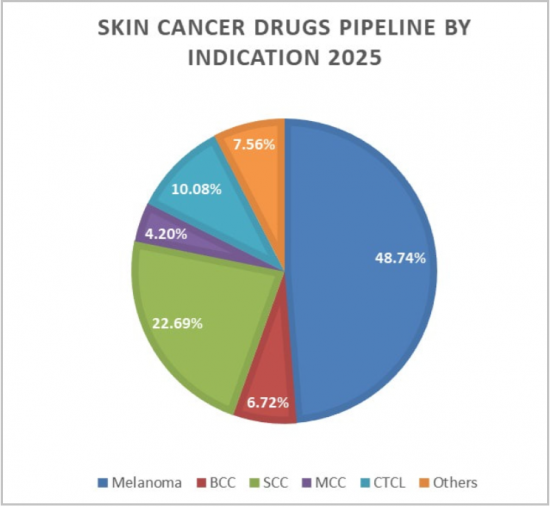
Skin Cancer Drugs Development Pipeline Breakdown by Indication (%)
Key Findings:
The report has the following key findings
- Drug developers continue to invest heavily in novel drug development programs for skin cancer, particularly in the areas of melanoma, basal cell carcinoma (BCC), and squamous cell carcinoma (SCC). Collectively, these three indications now constitute over 80% of all drug development programs for skin cancers, indicating a strong focus on addressing the most prevalent forms of skin cancer.
- The skin cancer drugs market has shown resilience and is expected to reach the size of nearly $6 billion by the end of 2025 growing at a CAGR of approximately 5.6% from 2025 to 2028. This growth trajectory reflects the increasing incidence of skin cancer, ongoing advancements in treatment modalities, and a surge in drug approvals.
- Immunotherapies, particularly monoclonal antibodies, continue to solidify their role in the skin cancer drug market. Recent approvals include Cosibelimab (Unloxcyt) in December 2024 for metastatic or locally advanced cutaneous squamous cell carcinoma (CSCC), a PD-L1 blocking antibody that enhances immune response against cancer cells. Additionally, the FDA approved Opdivo Qvantig, a subcutaneous formulation of nivolumab, for melanoma and other solid tumors, offering a more convenient alternative to intravenous infusions. These developments highlight the growing impact of monoclonal antibodies in improving treatment outcomes and patient convenience.
- The focus on late-stage drug development programs remains robust, with a significant emphasis on monoclonal antibodies, IDO1 inhibitors, BRAF and MEK inhibitors, tyrosine kinase inhibitors (TKIs), and novel oncolytic viruses and vaccines. These therapies are designed to enhance efficacy and address resistance mechanisms observed in current treatments.
- An increasing number of companies are competing for a larger share of the skin cancer market by investing in pipeline candidates and combination therapies. Strategic mergers and acquisitions play a key role, such as Regeneron Pharmaceuticals' $250 million acquisition of Checkmate Pharmaceuticals in April 2022. This deal brought vidutolimod, an investigational immunotherapy designed to activate the immune system against skin cancers, into Regeneron's portfolio.
Key Questions Answered:
The report provides answers to the following key questions:
- How big is the skin cancer drugs opportunity?
- What trends, challenges and barriers are influencing its growth?
- How is the ecosystem evolving by segment and region?
- What will the market size be in 2034 and at what rate will it grow?
- Which countries and submarkets will see the highest percentage of growth?
- What does the drug development pipeline look like in 2025 for skin cancer?
- What are the prospects of immunotherapy drugs in skin cancer treatment?
- How big is the market for melanoma drugs?
- Who are the key market players and what are their strategies?
- How will patent expirations of innovator drugs impact the market?
- What strategies should skin cancer drug developers adopt to remain competitive?
Sample Figure:
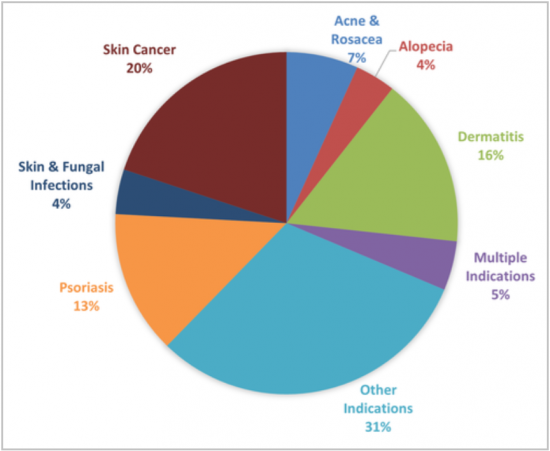
Distribution of Dermatological Pipeline Candidates by Indication (%)
Forecast Segmentation:
Market forecasts are provided for each of the following submarkets and their subcategories:
Drug Class
- Chemotherapy
- Immunotherapy
- Targeted Agents & Other Drugs
Therapeutic Category
- Melanoma
- BCC/SCC (Basal and Squamous Cell Carcinoma)
- MCC (Merkel Cell Carcinoma)
- Other Skin Cancers
Regional Markets
- Asia Pacific
- Europe
- Middle East & Africa
- North America
- Latin & Central America
Country Markets
- Australia
- Brazil
- Canada
- China
- Egypt
- France
- Germany
- Greece
- India
- Israel
- Italy
- Japan
- Mexico
- Netherlands
- Poland
- Portugal
- Russia
- Saudi Arabia
- South Africa
- South Korea
- Spain
- Switzerland
- Taiwan
- Turkey
- UK
- USA
List of Companies Mentioned:
The following companies and organizations have been reviewed, discussed or mentioned in the report:
- AB Science
- AbbVie
- Adaptimmune Therapeutics
- Adgero Biopharmaceuticals
- Agenus
- Allergen
- Almirall
- Altor BioScience
- Amgen
- Angimmune
- Antigen Express
- APCure
- Apexigen
- Array Biopharma
- Ascend Biopharmaceuticals
- Astellas Pharma
- AstraZeneca
- Athenex
- Autotelic
- Basilea Pharmaceutica
- Bausch Health
- Bayer
- Berg Pharma
- Biodesix
- Biogen
- BioLineRx
- Bioniz
- BioNTech
- Biosceptre
- Biothera Pharmaceuticals
- Boehringer Ingelheim
- Boston Biomedical
- Brickell Biotech
- BrightPath Biotherapeutics
- Bristol-Myers Squibb (BMS)
- Celgene
- Celldex Therapeutics
- Celltrion
- CEL-SCI Corporation
- Centre for Genomic Regulation
- Checkmate Pharmaceuticals
- Chugai Pharmaceutical Company
- Cipla
- Circio
- Cutanea Life Sciences
- Cytori Therapeutics
- CytRx Corporation
- Daiichi Sankyo
- DermBiont
- DFB Soria
- Dr. Reddy's Laboratories
- Dynavax Technologies
- Eisai
- Elevar Therapeutics
- Elios Therapeutics
- Equillium
- Eterna Therapeutics
- Exelixis
- FDA
- Fresenius Kabi
- G&E Herbal Biotechnology
- Galderma
- Galectin Therapeutics
- Genentech
- Generex Biotechnology Corporation
- Genzyme Corporation
- Glycotope
- GSK (GlaxoSmithKline)
- HedgePath Pharmaceuticals
- HiberCell
- Hikma Pharmaceuticals
- Huya Bioscience
- Idera Pharmaceuticals
- Ignyta
- Immune Design
- ImmunityBio Inc.
- Immunocore
- Incyte Corporation
- Infinity Pharmaceuticals
- Inhibitor Therapeutics
- Innate Pharma
- Innovent Biologics
- Inovio
- Inovio Pharmaceutical
- Iovance Biotherapeutics
- Ipsen
- IRX Therapeutics
- Jiangsu Hengrui Medicine Co
- Johnson & Johnson
- Karyopharm Therapeutics
- Kintara Therapeutics
- Kowa
- Krystal Biotech
- LadRx Corporation
- Leap Therapeutics
- LEO Pharma
- Lilly
- LSK BioPharma
- Lumos Pharma
- Lupin
- MacroGenics
- Mayne Pharma Group
- MD Anderson Cancer Center
- MedImmune
- Medivir
- Merck & Co
- Merck KGaA
- Millennium Pharmaceuticals
- miRagen Therapeutics
- Mirati Therapeutics
- Moderna
- Molecular Templates
- Morphotek
- Mylan
- NanoCarrier
- Nanology
- NantCell
- NantKwest
- Nektar Therapeutics
- Neon Therapeutics
- Nestle
- Neumedicines
- NewLink Genetics
- Novartis
- Oncolys Biopharma
- Oncolytics Biotech
- OncoSec Medical
- Oncotelic
- Ono Pharmaceutical
- Otsuka Holdings Company
- Parker Institute for Cancer Immunotherapy
- PellePharm
- Pfizer
- Philogen
- Phio Pharmaceuticals
- Photogen Technologies Inc
- Pierre Fabre
- Plexxikon
- Polaris Pharmaceuticals
- Poli Group
- Polynoma
- Privo Technologies
- Prometheus Laboratories
- Provectus Biopharmaceuticals
- Pyxis Oncology
- Reata Pharmaceuticals
- Regeneron Pharmaceutical
- Rhizen Pharmaceuticals
- Roche
- Sanofi
- Sesen Bio
- Sol-Gel Technologies
- Soligenix
- Sumitomo Dainippon Pharma
- Summit Therapeutics
- Sun Pharma
- Syndax Pharmaceuticals
- Taiho Pharmaceutical Company
- Takara Bio
- Takeda
- Targovax
- Teva Pharmaceutical Industries
- Transgene
- Trillium Therapeutics
- TriSalus Life Sciences
- Ultimovacs
- Vidac Pharma
- Viralytics
- X4 Pharmaceuticals

